


Seasonal Evolution and Influencing Factors of Groundwater Chemistry in the Baiquan Spring Area of Jinan
-
摘要: 为探究季节变化对济南白泉泉域地下水文地球化学过程的影响,深化对泉域地下水形成与演化机制的认识,本文以济南白泉泉域枯水期和丰水期的地下水为研究对象,采用 Gibbs 图解法、饱和指数法、离子比值法、离子相关性分析法、因子分析法及自组织映射(SOM)等方法对地下水水化学特征、形成机制及季节分异规律进行了系统分析。结果显示:济南白泉泉域地下水水化学类型以 HCO3-Ca 为主,枯水期地下水TDS值略高,碱性略强。两期地下水化学组成主要受水-岩相互作用控制,其中碳酸盐岩溶解和硅酸盐水解是主要的水文地球化学过程。从枯水期到丰水期,部分方解石和白云石由饱和状态转为不饱和,表明降水补给促进了碳酸盐矿物的持续溶解。离子比值与主成分分析表明,地下水中${\rm{SO}}_4^{2-} $和${\rm{NO}}_3^{-} $主要来源于农业化肥与城市生活污水的混合输入。SOM 聚类结果进一步表明,研究区地下水化学组成具有明显的空间异质性和季节分异特征,枯水期分区更清晰稳定,丰水期则更易反映降水补给增强条件下污染物向浅层地下水迁移的影响。白泉泉域作为济南市重要水源地,其地下水水质已受到一定程度的人类活动干扰,建议加强地下水动态监测与分区保护,以保障区域供水安全。Abstract:
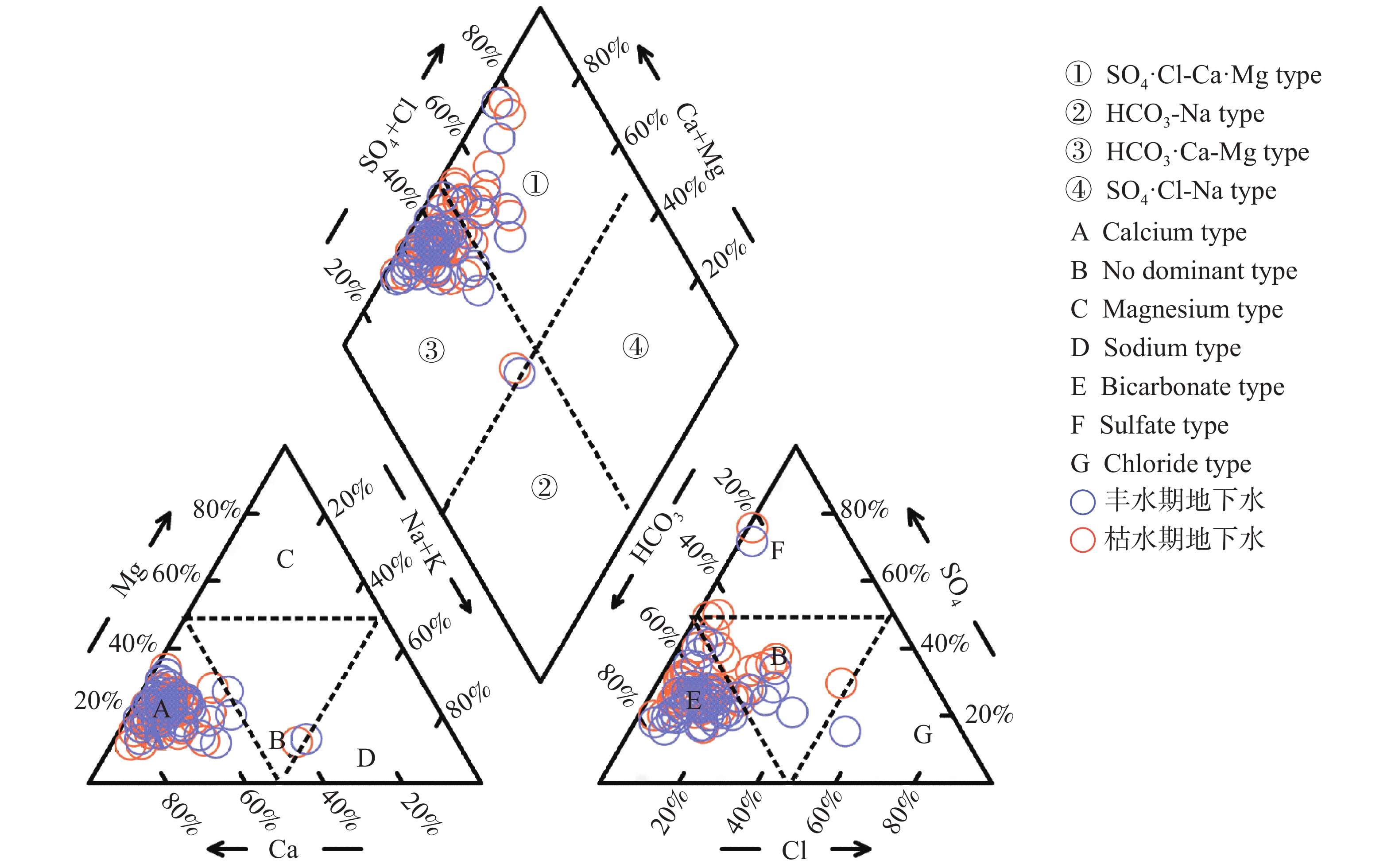
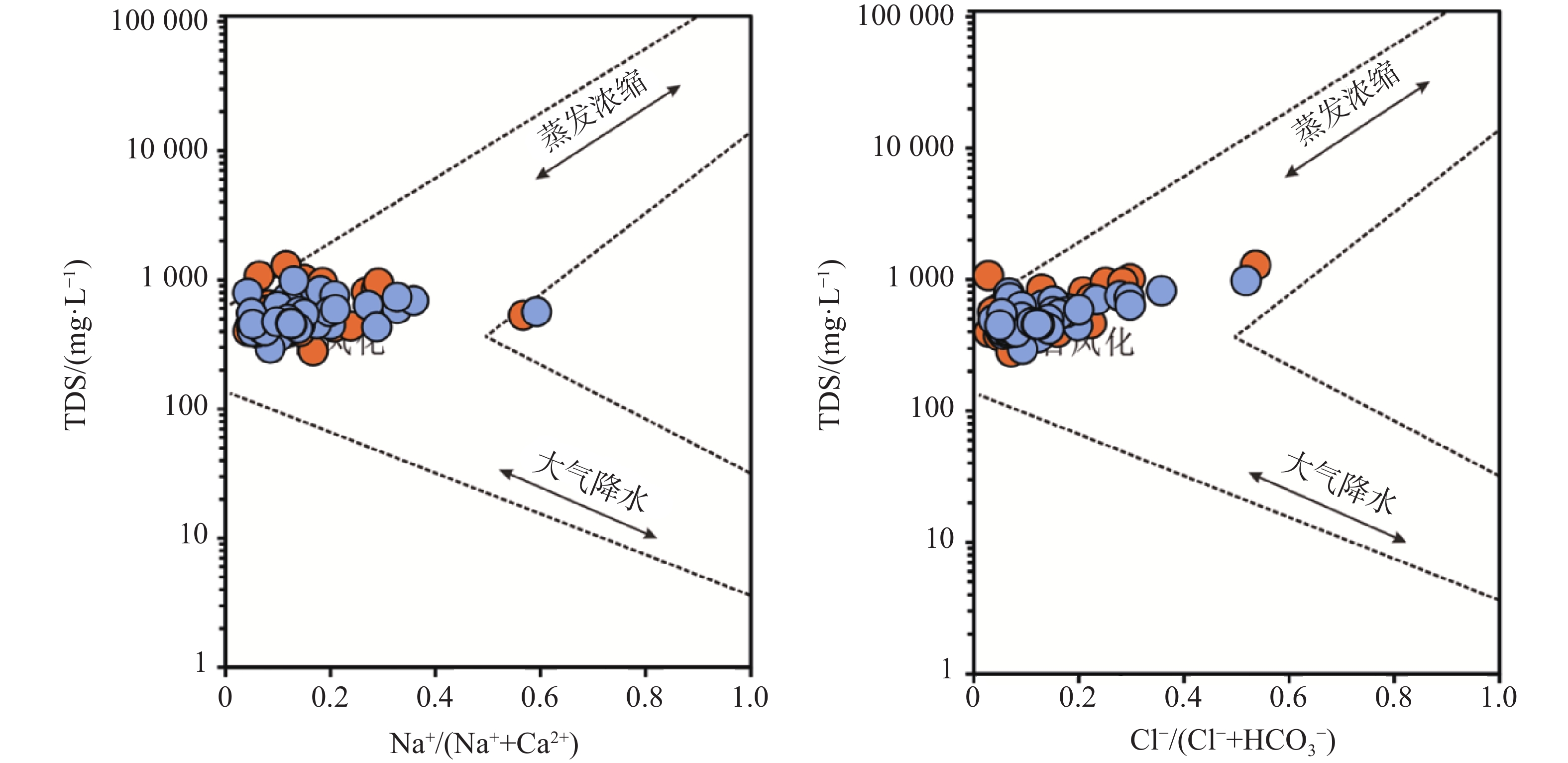
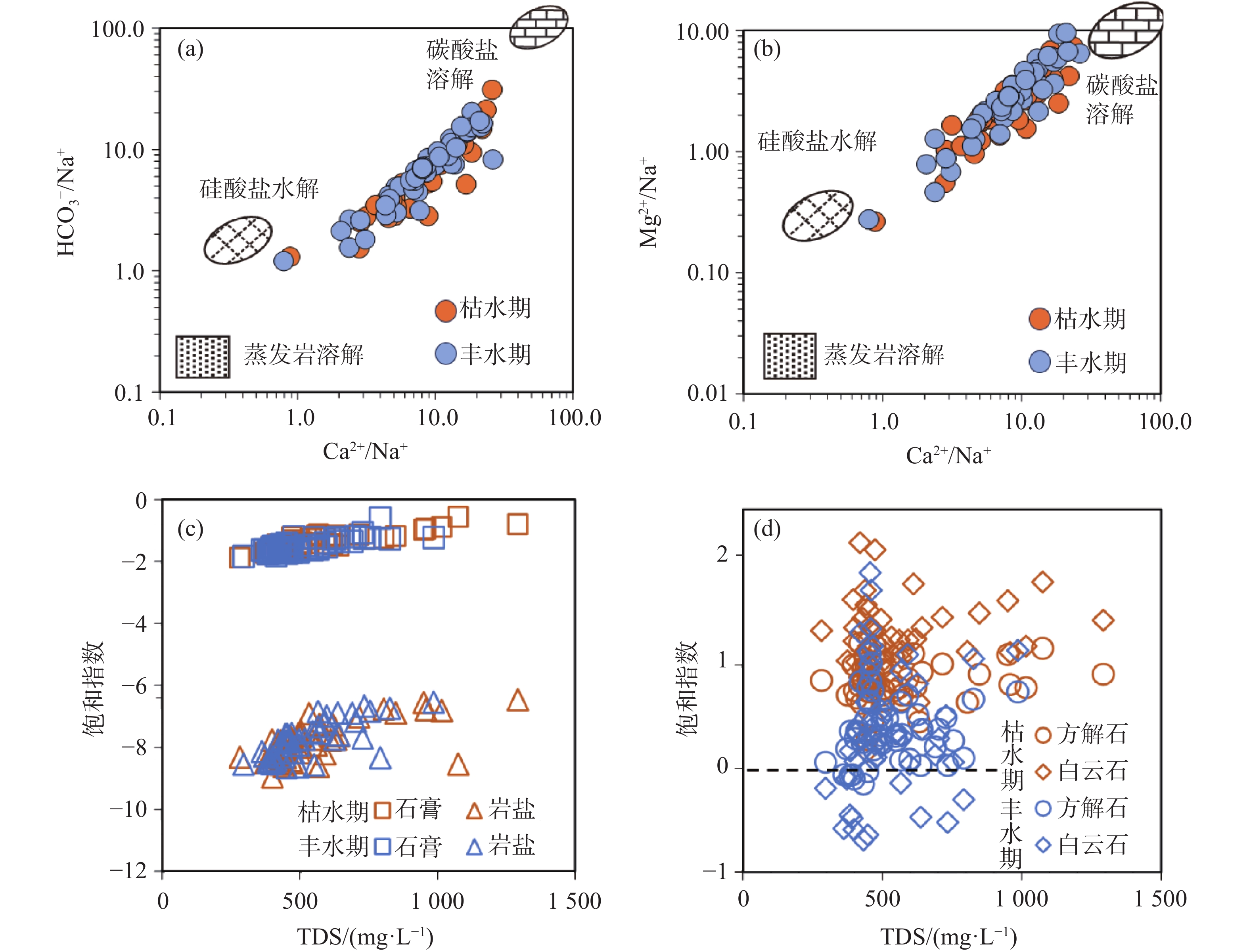
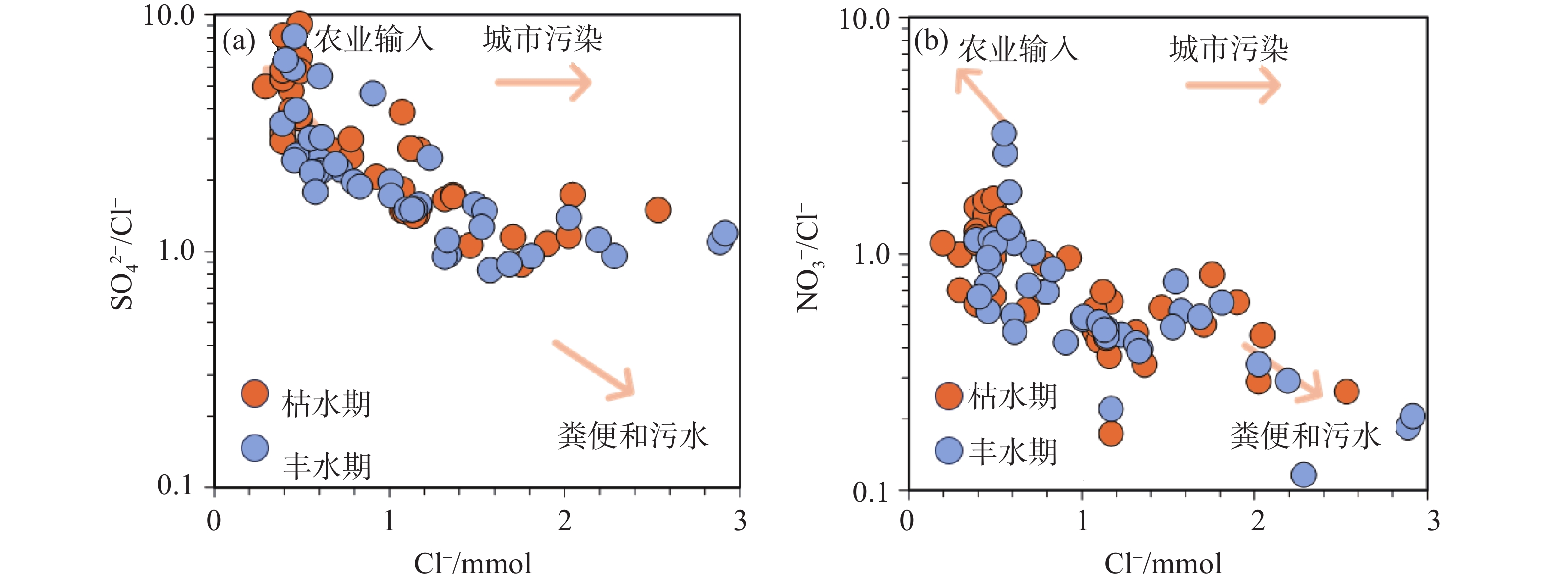
The Baiquan spring area in eastern Jinan, China, is an important karst groundwater system and regional water-supply source. However, compared with the well-studied Baotu Spring catchment, seasonal hydrochemical evolution and its controlling mechanisms in the Baiquan spring area remain insufficiently characterized. To clarify the seasonal response of groundwater chemistry and distinguish the effects of natural processes and human activities, 48 groundwater samples were collected in both the dry and wet seasons, yielding 96 samples in total. The samples were mainly obtained from production and domestic wells with depths of approximately 30−450 m. Major hydrochemical parameters, including pH, K+, Na+, Ca2+, Mg2+, Cl−, ${\rm{SO}}_4^{2-}$, ${\rm{HCO}}_3^{-}$, ${\rm{NO}}_3^{-}$, and total dissolved solids (TDS), were analyzed. Descriptive statistics, Piper and Gibbs diagrams, ionic ratios, correlation analysis, mineral saturation indices calculated using PHREEQC, factor analysis, and a self-organizing map (SOM) combined with K-means clustering were integrated to identify hydrochemical characteristics, dominant geochemical reactions, seasonal differences, and spatial heterogeneity. Groundwater was generally weakly alkaline and dominated by ${\rm{HCO}}_3^{-}$ and Ca2+, with the HCO3-Ca hydrochemical facies prevailing in both seasons. The mean pH and TDS were 7.74 and 558.5 mg/L in the dry season and 7.28 and 524.4 mg/L in the wet season, respectively, indicating slightly stronger alkalinity and mineralization during the dry season and an overall dilution effect during the wet season. Chloride showed particularly strong spatial variability, with coefficients of variation greater than 1 in both seasons, while ${\rm{SO}}_4^{2-}$ and Na+ also displayed marked spatial dispersion. Together with locally elevated ${\rm{SO}}_4^{2-}$ and Cl− concentrations, these patterns indicate spatially heterogeneous groundwater chemistry and external inputs at some locations. The Gibbs diagrams showed that most samples fell within the rock-weathering dominance field, demonstrating that water−rock interaction is the primary control on groundwater chemistry. Ionic relationships further suggested that carbonate dissolution and silicate hydrolysis jointly contribute to the major-ion composition. Mineral saturation calculations revealed clear seasonal changes in carbonate equilibrium. Gypsum and halite remained undersaturated in both seasons. In the dry season, calcite and dolomite were supersaturated, with mean saturation indices of 0.82 and 1.26, respectively. In the wet season, calcite became undersaturated in approximately 12.5% of the samples and dolomite in approximately 25%. This shift suggests that precipitation recharge, likely accompanied by relatively CO2-rich infiltrating water, enhances carbonate dissolution and changes mineral−water equilibrium. Significant positive correlations of TDS with Ca2+, Mg2+, Na+, Cl−, ${\rm{SO}}_4^{2-}$, and ${\rm{HCO}}_3^{-}$, together with the strong Ca2+−Mg2+ relationship, further support the dominant role of mineral dissolution and carbonate weathering in groundwater mineralization. Anthropogenic inputs were also evident. Variations in ${\rm{SO}}_4^{2-}$/Cl− and ${\rm{NO}}_3^{-}$/Cl− molar ratios, together with ion correlations, indicate that ${\rm{SO}}_4^{2-}$ and ${\rm{NO}}_3^{-}$ are influenced by mixed inputs from agricultural fertilizers and urban sources such as domestic sewage and manure. ${\rm{SO}}_4^{2-}$ appears more closely associated with agricultural inputs, whereas increasing Cl− concentrations correspond to a stronger urban pollution signal. Factor analysis further differentiated the controlling processes. In the dry season, three factors explained 79.3% of the total variance: water−rock interaction, a mixed influence of silicate weathering and nitrogen-related anthropogenic input, and cation exchange. In the wet season, three factors explained 71.73% of the variance. Rock weathering remained dominant, while combined natural−anthropogenic effects and a more complex process involving cation exchange and possible sulfate reduction also contributed to groundwater chemistry. The SOM analysis revealed pronounced spatial heterogeneity and seasonal differentiation. Groundwater in both seasons was classified into four hydrochemical clusters. During the dry season, high-mineralization clusters were concentrated mainly in the northern discharge area and adjacent runoff−discharge transition zone, whereas low-mineralization groundwater occurred mainly in the central and southern recharge and runoff zones. This pattern was relatively clear and stable, indicating stronger control by internal groundwater evolution along the regional flow path. During the wet season, high-mineralization groundwater remained concentrated mainly in the northern discharge area, but its spatial distribution became more dispersed, likely because enhanced recharge and mixing weakened the continuity of hydrochemical zones. Overall, groundwater hydrochemistry in the Baiquan spring area is jointly controlled by hydrogeological setting, water−rock interaction, seasonal recharge, and human activities. Natural mineral dissolution determines the basic hydrochemical composition, whereas seasonal precipitation regulates mineral equilibrium, groundwater mixing, and contaminant transport. The northern discharge area is the principal zone of mineralization and hardness accumulation, while the central and southern recharge areas have lower mineralization and greater sensitivity to external disturbance. -
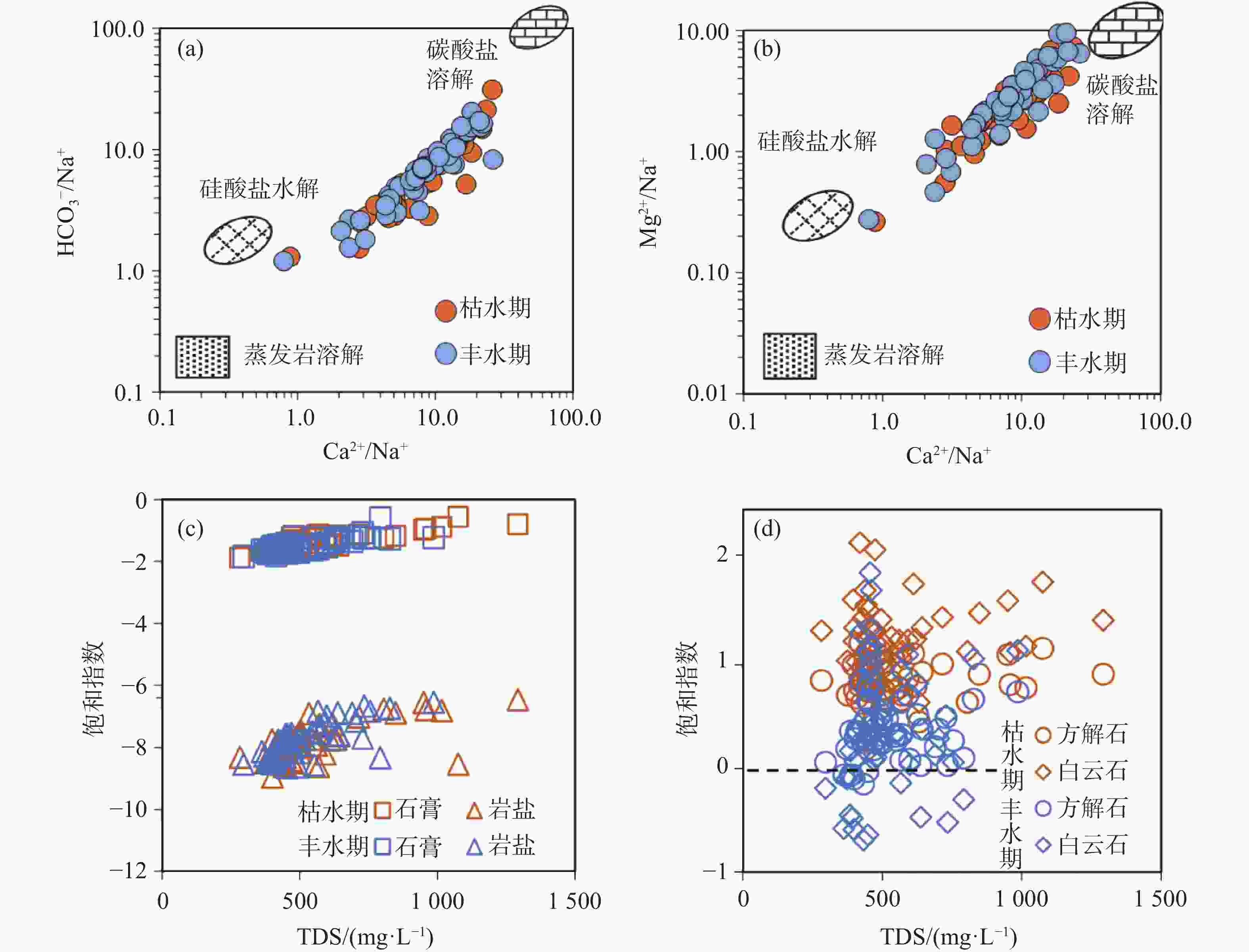
图 5 地下水${\rm{HCO}}_3^{-}$/ Na+与Ca2+/ Na+、Mg2+/ Na+与Ca2+/ Na+关系及矿物饱和指数与TDS关系图
Figure 5. Relationship between ${\rm{HCO}}_3^{-}$/ Na+and Ca2+/ Na+, Mg2+/ Na+and Ca2+/ Na+ in groundwater, and relationship between mineral saturation index and TDS
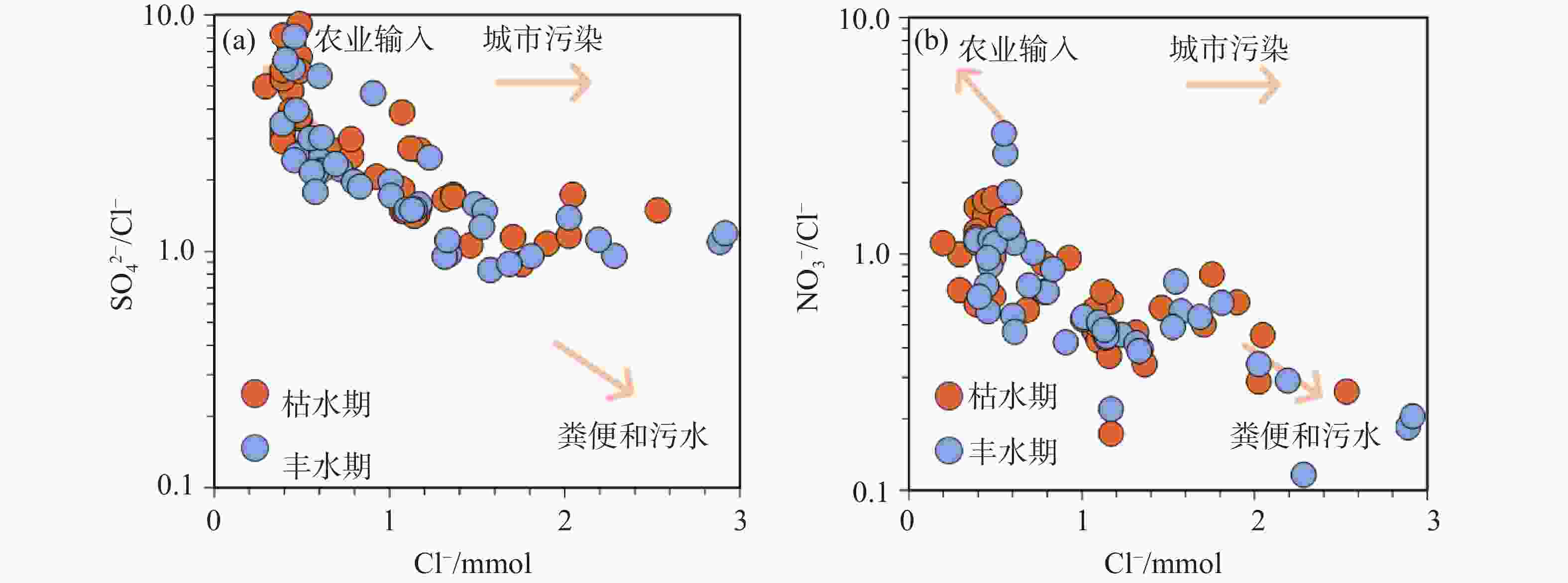
图 6 地下水${\rm{SO}}_4^{2-}$/ Cl−、${\rm{NO}}_3^{-}$/ Cl−与Cl−关系图
Figure 6. Relationship between groundwater ${\rm{SO}}_4^{2-}$/ Cl−,${\rm{NO}}_3^{-}$/ Cl− and Cl−
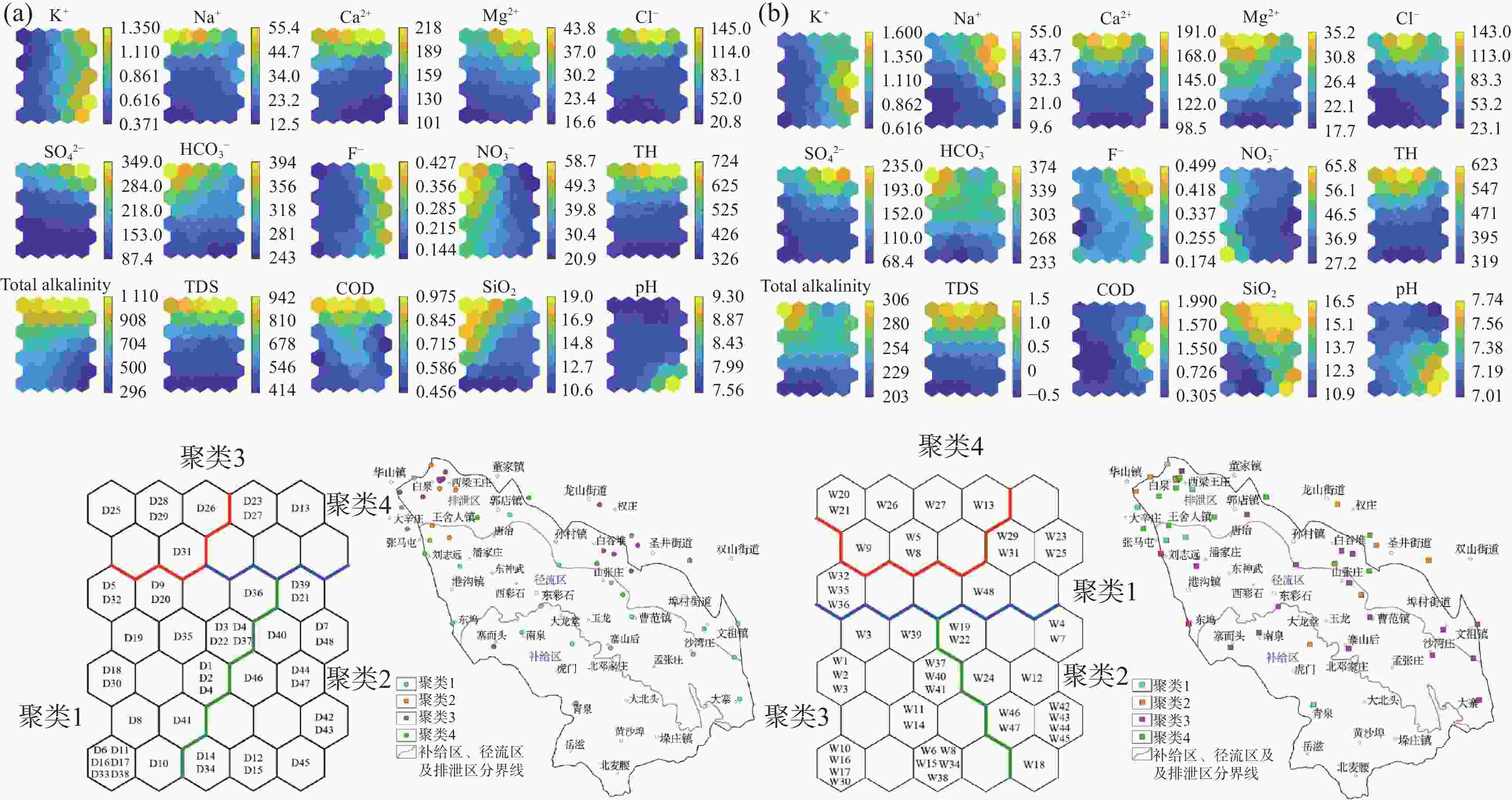
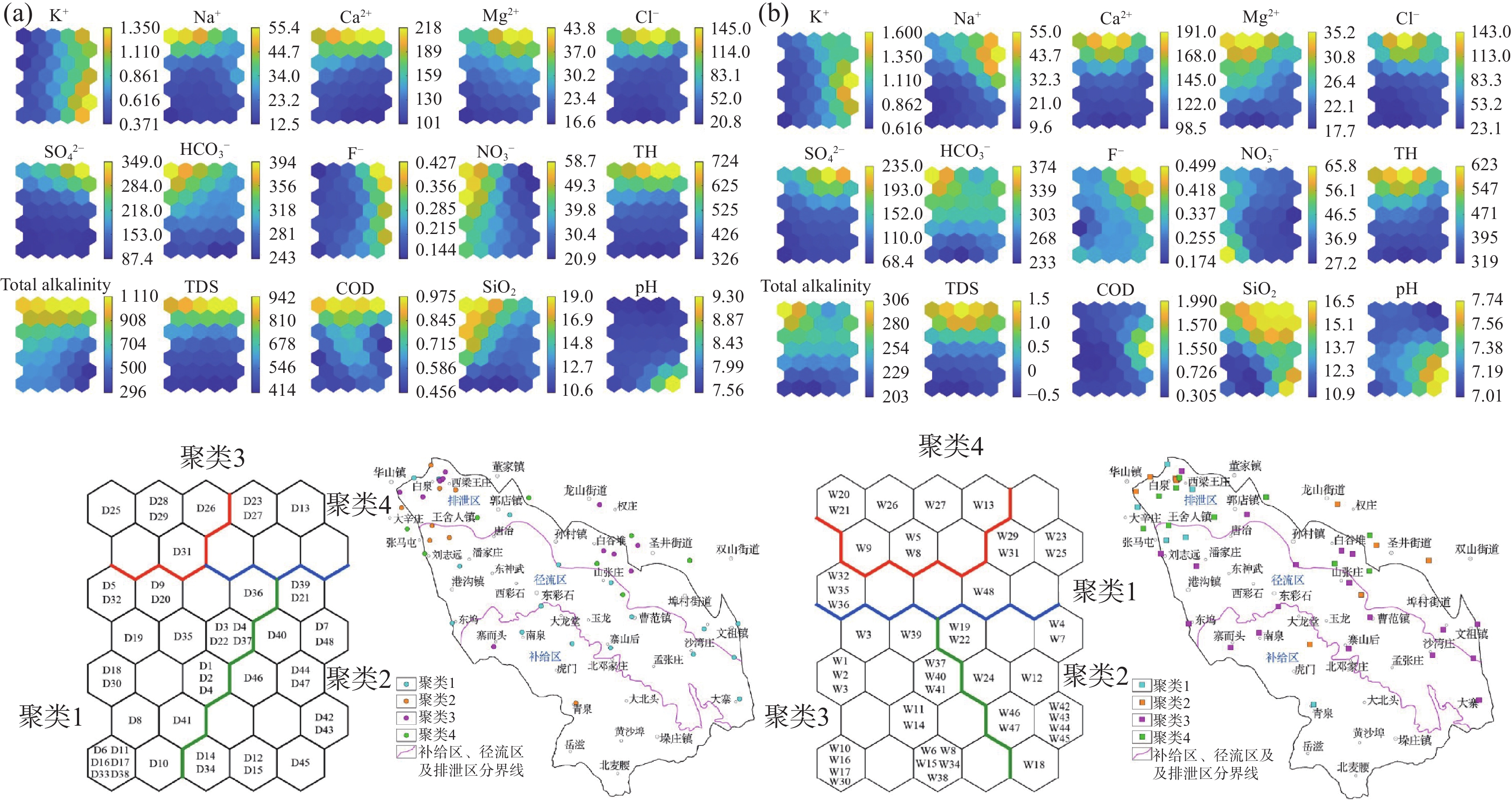
图 7 地下水化学指标SOM聚类结果及空间分布:(a)枯水期,(b)丰水期
Figure 7. SOM clustering results and spatial distribution of groundwater hydrochemical indicators: (a) dry season, (b) wet season
表 1 研究区地下水水化学组分统计
Table 1. Statistics of chemical components of groundwater in the study area
枯水期 丰水期 最大值 最小值 平均值 标准差 变异系数 最大值 最小值 平均值 标准差 变异系数 K+ 1.86 0.05 0.74 0.45 0.60 3 0.4 0.97 0.47 0.49 Na+ 97.54 4.09 23.32 20.04 0.86 107 5.9 22.32 19.93 0.89 Ca2+ 317.6 63.53 132.6 47.93 0.36 250 71 122.6 36.86 0.30 Mg2+ 59.55 9.6 24.61 9.86 0.40 51.1 13.1 24.45 8.05 0.33 Cl− 359.6 6.82 48.15 57.26 1.19 327.7 13.6 50.97 53.31 1.05 ${\rm{SO}}_4^{2-}$ 617.0 54.69 134.2 93.83 0.70 542 49.5 107.5 73.93 0.69 ${\rm{HCO}}_3^{-}$ 483.3 178.2 293.5 57.54 0.20 434 156 291.6 55.62 0.19 F− 0.85 0.1 0.23 0.16 0.70 0.83 0.06 0.35 0.13 0.36 ${\rm{NO}}_3^{-}$ 89 6.18 36.98 16.24 0.44 110 8.9 38.60 19.17 0.50 TDS 1292 282 558.5 205.3 0.37 822 296 524.4 140.8 0.27 pH 8.3 7.3 7.74 0.23 0.03 8.07 6.9 7.28 0.30 0.04  下载: 导出CSV
表 2 地下水成分相关性分析
Table 2. Correlation analysis of groundwater components
枯水期 K+ Na+ Ca2+ Mg2+ Cl− ${\mathrm{SO}}_4^{2-} $ $ {\mathrm{HCO}}_3^-$ F− NO3− TDS K+ − Na+ 0.160 − Ca2+ −0.058 0.383** − Mg2+ 0.070 0.328* 0.726** − Cl− 0.073 0.510** 0.769** 0.686** − SO42− 0.177 0.296* 0.781** 0.558** 0.364* − HCO3− −0.251 0.591** 0.444** 0.573** 0.387** 0.135 − F− 0.523** 0.163 0.030 0.027 −0.099 0.400** −0.146 − NO3− −0.562** 0.015 0.255 −0.067 0.183 −0.158 0.278 −0.542** − TDS 0.031 0.571** 0.966** 0.778** 0.783** 0.806** 0.528** 0.120 0.157 − 丰水期 K+ Na+ Ca2+ Mg2+ Cl− ${\mathrm{SO}}_4^{2-} $ ${\mathrm{HCO}}_3^- $ F− ${\mathrm{NO}}_3^- $ TDS K+ − Na+ 0.437** − Ca2+ 0.005 0.115 − Mg2+ −0.032 0.041 0.667** − Cl− 0.124 0.469** 0.610** 0.549** − SO42− 0.218 0.148 0.708** 0.358* 0.095 − HCO3− −0.029 0.366* 0.340* 0.536** 0.222 0.097 − F− 0.304* 0.276 0.291* 0.199 0.100 0.576** −0.028 − NO3− −0.391** −0.174 0.022 −0.019 −0.001 −0.174 −0.065 −0.114 − TDS 0.113 0.533** 0.862** 0.700** 0.780** 0.570** 0.540** 0.311* −0.055 − **. 在 0.01 级别(双尾),相关性显著。*. 在 0.05 级别(双尾),相关性显著。
下载: 导出CSV
表 3 地下水成分因子分析
枯水期 F1 F2 F3 丰水期 F1 F2 F3 K+ 0.04 0.80 0.19 K+ 0.24 0.78 0.19 Na+ 0.63 0.07 0.66 Na+ 0.51 0.43 0.57 Ca2+ 0.93 −0.07 −0.31 Ca2+ 0.86 −0.24 −0.31 Mg2+ 0.84 0.04 −0.04 Mg2+ 0.75 −0.38 −0.06 Cl− 0.82 −0.11 0.03 Cl− 0.72 −0.17 0.35 ${\rm{SO}}_4^{2-}$ 0.73 0.39 −0.42 ${\rm{SO}}_4^{2-}$ 0.65 0.26 −0.61 ${\rm{HCO}}_3^{-}$ 0.62 −0.37 0.52 ${\rm{HCO}}_3^{-}$ 0.54 −0.26 0.42 F− 0.10 0.83 0.05 F− 0.45 0.49 −0.46 ${\rm{NO}}_3^{-}$ 0.14 −0.83 −0.12 ${\rm{NO}}_3^{-}$ −0.14 −0.59 −0.14 TDS 0.99 0.02 −0.13 TDS 0.97 −0.13 0.09
下载: 导出CSV
-
[1] Wu X, Li C, Sun B, Geng F, Gao S, Lv M, Ma X, Li H, Xing L. Groundwater hydrogeochemical formation and evolution in a karst aquifer system affected by anthropogenic impacts[J]. Environmental Geochemistry and Health, 2020, 42(9): 2609-2626. doi: 10.1007/s10653-019-00450-z [2] Ledesma-Ruiz R, Pastén-Zapata E, Parra R, Harter T, Mahlknecht J. Investigation of the geochemical evolution of groundwater under agricultural land: a case study in northeastern Mexico[J]. Journal of Hydrology, 2015, 521: 410-423. doi: 10.1016/j.jhydrol.2014.12.026 [3] Jeannin P-Y, Hessenauer M, Malard A, Chapuis V. Impact of global change on karst groundwater mineralization in the Jura Mountains[J]. Science of the Total Environment, 2016, 541: 1208-1221. doi: 10.1016/j.scitotenv.2015.10.008 [4] 王楠, 胥芹, 孙小艳, 武显仓, 李常锁, 高帅. 趵突泉泉域岩溶水化学特征及成因研究[J]. 中国岩溶, 2024, 43(2): 279-290. doi: 10.11932/karst20240203Wang Nan, Xu Qin, Sun Xiaoyan, Wu Xiancang, Li Changsuo, Gao Shuai. Hydrochemical characteristics and formation mechanism of karst water in Baotu Spring watershed[J]. Carsologica Sinica, 2024, 43(2): 279-290. doi: 10.11932/karst20240203 [5] Sullivan P L, Macpherson G L, Martin J B, Price R M. Evolution of carbonate and karst critical zones[J]. Chemical Geology, 2019, 527: 119223. doi: 10.1016/j.chemgeo.2019.06.023 [6] 韦跃龙, 陈伟海, 李成展, 罗劬侃. 岩溶景观区可持续发展能力与自然-人类影响要素间的关系[J]. 中国岩溶, 2025, 44(4): 854-875. doi: 10.11932/karst20250413Wei Yuelong, Chen Weihai, Li Chengzhan, Luo Qukan. Relationship between sustainable development capacity of karst landscape areas and natural-human influencing factors[J]. Carsologica Sinica, 2025, 44(4): 854-875. doi: 10.11932/karst20250413 [7] 柳浩然, 张文强, 刘文, 马雪莹, 关琴, 张海林. 基于长期监测的济南趵突泉水文地球化学演化规律研究[J]. 中国岩溶, 2023, 42(5): 1061-1073. doi: 10.11932/karst20230516Liu Haoran, Zhang Wenqiang, Liu Wen, Ma Xueying, Guan Qin, Zhang Hailin. Hydrogeochemical evolution characteristics of Baotu Spring in Jinan City, based on long-term monitoring[J]. Carsologica Sinica, 2023, 42(5): 1061-1073. doi: 10.11932/karst20230516 [8] 李常锁, 高帅, 殷延伟, 逄伟, 孙斌, 柳浩然, 陈奂良, 刚什婷, 邢立亭, 耿付强. 济南四大泉群附近补给路径及补给比例研究[J]. 中国岩溶, 2023, 42(5): 875-886. doi: 10.11932/karst20230501Li Changsuo, Gao Shuai, Yin Yanwei, Pang Wei, Sun Bin, Liu Haoran, Chen Huanliang, Gang Shenting, Xing Liting, Geng Fuqiang. Research on recharge paths and recharge ratios near the four major spring groups in Jinan[J]. Carsologica Sinica, 2023, 42(5): 875-886. doi: 10.11932/karst20230501 [9] 黄靖宇, 李春宇, 许模, 魏啟杨. 自然与工程扰动叠加影响下的滇东南岩溶大泉水文过程[J]. 中国岩溶, 2025, 44(6): 1134-1143. doi: 10.11932/karst20250601Huang Jingyu, Li Chunyu, Xu Mo, Wei Qiyang. Hydrogeological processes of large karst spring in southeastern Yunnan affected by the combined influence of natural and engineering disturbances[J]. Carsologica Sinica, 2025, 44(6): 1134-1143. doi: 10.11932/karst20250601 [10] Kaufmann G, Romanov D. The initial phase of cave formation: aquifer-scale three-dimensional models with strong exchange flow[J]. Journal of Hydrology, 2019, 572: 528-542. doi: 10.1016/j.jhydrol.2019.03.053 [11] Gao S, Li C, Liu Y, Sun B, Zhao Z, Lv M, Gang S. Hydrogeochemical characteristics and evolution processes of karst groundwater affected by multiple influencing factors in a karst spring basin, Eastern China[J]. Water, 2023, 15(22): 3899. doi: 10.3390/w15223899 [12] Zheng T, Deng Y, Wang Y, Jiang H, O’Loughlin E J, Flynn T M, Gan Y, Ma T. Seasonal microbial variation accounts for arsenic dynamics in shallow alluvial aquifer systems[J]. Journal of Hazardous Materials, 2019, 367: 109-119. doi: 10.1016/j.jhazmat.2018.12.087 [13] Liu J, Wang H, Jin D, Xu F, Zhao C. Hydrochemical characteristics and evolution processes of karst groundwater in Carboniferous Taiyuan formation in the Pingdingshan coalfield[J]. Environmental Earth Sciences, 2020, 79(6): 151. doi: 10.1007/s12665-020-8898-4 [14] 徐慧珍, 段秀铭, 高赞东, 王庆兵, 李文鹏, 殷秀兰. 济南泉域排泄区岩溶地下水水化学特征[J]. 水文地质工程地质, 2007, 34(3): 15-19. doi: 10.3969/j.issn.1000-3665.2007.03.005Xu Huizhen, Duan Xiuming, Gao Zandong, Wang Qingbing, Li Wenpeng, Yin Xiulan. Hydrochemical study of karst groundwater in the Jinan spring catchment[J]. Hydrogeology & Engineering Geology, 2007, 34(3): 15-19. doi: 10.3969/j.issn.1000-3665.2007.03.005 [15] 束龙仓, 王小博, 李虎, 倪寒茜, 李罡, 余亚飞, 王鑫, 张曼琦. 地铁施工对济南白泉泉群流量的影响[J]. 吉林大学学报(地球科学版), 2021, 51(1): 192-200. doi: 10.13278/j.cnki.jjuese.20200065Shu Longcang, Wang Xiaobo, Li Hu, Ni Hanxi, Li Gang, Yu Yafei, Wang Xin, Zhang Manqi. Impact of subway construction on flow of Baiquan Spring Group in Jinan[J]. Journal of Jilin University (Earth Science Edition), 2021, 51(1): 192-200. doi: 10.13278/j.cnki.jjuese.20200065 [16] 张兰新, 徐扬, 张慧. 济南白泉泉群形成机理研究[J]. 山东国土资源, 2017, 33(8): 58-62.Zhang Lanxin, Xu Yang, Zhang Hui. Study on formation mechanism of Baiquan Spring Groups in Jinan City[J]. Shandong Land and Resources, 2017, 33(8): 58-62. [17] 孙斌, 邢立亭, 彭玉明, 李常锁. 济南十大泉群特征、形成模式及水循环差异性浅析[J]. 中国岩溶, 2021, 40(3): 409-419. doi: 10.11932/karst20210301Sun Bin, Xing Liting, Peng Yuming, Li Changsuo. Characteristics, formation models and water cycle differences of ten major spring groups in Jinan City[J]. Carsologica Sinica, 2021, 40(3): 409-419. doi: 10.11932/karst20210301 [18] 李常锁. 趵突泉泉域岩溶水流路径识别与水化学形成机制研究[D]. 武汉: 中国地质大学(武汉), 2023.Li Changsuo. Identification of karst water flow paths and hydrochemical formation mechanisms in the Baotu Spring watershed[D]. Wuhan: China University of Geosciences (Wuhan), 2023. [19] 张保祥, 张超. 水文地球化学方法在地下水研究中的应用综述[J]. 人民黄河, 2019, 41(10): 135-142. doi: 10.3969/j.issn.1000-1379.2019.10.023Zhang Baoxiang, Zhang Chao. Progress on hydrogeochemical method applied in groundwater study[J]. Yellow River, 2019, 41(10): 135-142. doi: 10.3969/j.issn.1000-1379.2019.10.023 [20] 栾风娇, 周金龙, 贾瑞亮, 陆成新, 白铭, 梁红涛. 新疆巴里坤-伊吾盆地地下水水化学特征及成因[J]. 环境化学, 2017, 36(2): 380-389. doi: 10.7524/j.issn.0254-6108.2017.02.2016062001Luan Fengjiao, Zhou Jinlong, Jia Ruiliang, Lu Chengxin, Bai Ming, Liang Hongtao. Hydrochemical characteristics and formation mechanism of groundwater in plain areas of Barkol-Yiwu Basin, Xinjiang[J]. Environmental Chemistry, 2017, 36(2): 380-389. doi: 10.7524/j.issn.0254-6108.2017.02.2016062001 [21] Yang F, Jia C, Yang X, Yang H, Chang W. Probabilistic potential health risk quantification, hydrochemistry, driving forces of groundwater nitrate and fluoride in a typical irrigation district, Northern China[J]. Journal of Environmental Management, 2022, 323: 116171. doi: 10.1016/j.jenvman.2022.116171 [22] Wu X, Liu H, Liu C, Li C, Liu J, Geng F, Hu X, Kang F. Mechanisms of water quantity and quality evolution in karst groundwater: new insights from long-term monitoring data[J]. Journal of Hydrology, 2025, 661: 133634. doi: 10.1016/j.jhydrol.2025.133634 [23] 贾超, 王丛, 刘森, 杨霄, 刘文, 高帅, 朱恒华. 济南西部冲积平原地下水水文地球化学特征研究[J]. 水利水电技术(中英文), 2022, 53(3): 49-60. doi: 10.13928/j.cnki.wrahe.2022.03.005Jia Chao, Wang Cong, Liu Sen, Yang Xiao, Liu Wen, Gao Shuai, Zhu Henghua. Study on hydrogeochemical characteristics of groundwater in the alluvial plain of western Jinan[J]. Water Resources and Hydropower Engineering, 2022, 53(3): 49-60. doi: 10.13928/j.cnki.wrahe.2022.03.005 [24] Nguyen T T, Kawamura A, Tong T N, Nakagawa N, Amaguchi H, Gilbuena R Jr. Clustering spatio-seasonal hydrogeochemical data using self-organizing maps for groundwater quality assessment in the Red River Delta, Vietnam[J]. Journal of Hydrology, 2015, 522: 661-673. doi: 10.1016/j.jhydrol.2015.01.023 [25] Shang Y, Fu C, Zhang W, Li X, Li X. Groundwater hydrochemistry, source identification and health assessment based on self-organizing map in an intensive mining area in Shanxi, China[J]. Environmental Research, 2024, 252: 118934. doi: 10.1016/j.envres.2024.118934 [26] Wu C, Wu X, Lu C, Sun Q, He X, Yan L, Qin T. Hydrogeochemical characterization and its seasonal changes of groundwater based on self-organizing maps[J]. Water, 2021, 13(21): 3065. doi: 10.3390/w13213065 [27] 曾妍妍, 周金龙, 贾瑞亮, 王松涛, 杜江岩. 新疆祁漫塔格地区地表水水化学特征及成因分析[J]. 干旱区资源与环境, 2017, 31(6): 64-70. doi: 10.13448/j.cnki.jalre.2017.180Zeng Yanyan, Zhou Jinlong, Jia Ruiliang, Wang Songtao, Du Jiangyan. Hydrochemical characteristics and causes of surface water in Qimantage area, Xinjiang[J]. Journal of Arid Land Resources and Environment, 2017, 31(6): 64-70. doi: 10.13448/j.cnki.jalre.2017.180 [28] 安乐生, 赵全升, 叶思源, 刘贯群, 丁喜桂. 黄河三角洲浅层地下水化学特征及形成作用[J]. 环境科学, 2012, 33(2): 370-378. doi: 10.13227/j.hjkx.2012.02.005An Lesheng, Zhao Quansheng, Ye Siyuan, Liu Guanqun, Ding Xigui. Hydrochemical characteristics and formation mechanism of shallow groundwater in the Yellow River Delta[J]. Environmental Science, 2012, 33(2): 370-378. doi: 10.13227/j.hjkx.2012.02.005 [29] Li C, Zhang X, Gao X, Li C, Jiang C, Liu W, Lin G, Zhang X, Fang J, Ma L, Zhang X. Spatial and temporal evolution of groundwater chemistry of Baotu karst water system at Northern China[J]. Minerals, 2022, 12(3): 348. doi: 10.3390/min12030348 [30] Zhang C, Li X, Wang Z, Hou X, Ma J, Gao M, Bai Z, Fu C, Gui C, Zuo X. Combining stable isotope (2H, 18O, and 87Sr/86Sr) and hydrochemistry to understand hydrogeochemical processes in karst groundwater system, Xin’an, northern China[J]. Environmental Earth Sciences, 2023, 82(9): 224. doi: 10.1007/s12665-023-10906-2 [31] Torres-Martínez J A, Mora A, Knappett P S K, Ornelas-Soto N, Mahlknecht J. Tracking nitrate and sulfate sources in groundwater of an urbanized valley using a multi-tracer approach combined with a Bayesian isotope mixing model[J]. Water Research, 2020, 182: 115962. doi: 10.1016/j.watres.2020.115962 [32] 张结. 济南泉域岩溶水硝酸盐和硫酸盐来源识别及升高机理研究[D]. 武汉: 中国地质大学(武汉), 2022.Zhang Jie. Identification of nitrate and sulfate sources and their increasing mechanism in karst water system of Jinan Spring Catchment based on hydrochemistry and multi-isotopes[D]. Wuhan: China University of Geosciences (Wuhan), 2022. [33] 吴春勇, 苏小四, 郭金淼, 董维红. 鄂尔多斯沙漠高原白垩系地下水水化学演化的多元统计分析[J]. 世界地质, 2011, 30(2): 244-253. doi: 10.3969/j.issn.1004-5589.2011.02.013Wu Chunyong, Su Xiaosi, Guo Jinmiao, Dong Weihong. Multivariate statistical analysis of hydrogeochemical evolution of groundwater in Cretaceous aquifer Ordos desert plateau[J]. Global Geology, 2011, 30(2): 244-253. doi: 10.3969/j.issn.1004-5589.2011.02.013 [34] Yao R, Yan Y, Wei C, Luo M, Xiao Y, Zhang Y. Hydrochemical characteristics and groundwater quality assessment using an integrated approach of the PCA, SOM, and fuzzy c-means clustering: a case study in the Northern Sichuan Basin[J]. Frontiers in Environmental Science, 2022, 10: 907872. doi: 10.3389/fenvs.2022.907872 [35] Pei L, Wang C, Zuo Y, Liu X, Chi Y. Impacts of land use on surface water quality using self-organizing map in middle region of the Yellow River Basin, China[J]. International Journal of Environmental Research and Public Health, 2022, 19(17): 10946. doi: 10.3390/ijerph191710946 -

 点击查看大图
计量
- 文章访问数: 7
- HTML浏览量: 2
- PDF下载量: 0
- 被引次数: 0
