


Hydrochemical characteristics and pollution source apportionment of a karst underground river system in northern Guizhou
-
摘要: 岩溶生态系统脆弱且复杂,有效提高岩溶区多种相似污染源并存的污染溯源的准确性,对保护岩溶地下水具有重要意义。通过分析现状条件下地下水化学特征,采用主要离子溯源、氮氧同位素及PMF模型方法识别污染主控因子,实现多源地下水污染精准解析和量化。结果表明,研究区地下水中K+、Na+、${\rm{HCO}}_3^{-}$、Cl−、TFe、Mn、TP、NH$_4^{+}$、${\rm{NO}}_3^{-}$-N含量超过背景值1.17~
4940 倍,部分地下水化学类型改变为SO4·HCO3—NH4·Ca·Mg型,表明区内地下水受到污染。通过主要离子溯源、氮氧同位素分析方法确定了地下水污染来源的种类,基于新污染物筛查的PMF模型对污染贡献进行了量化,上游酒企废水、农业面源污染贡献率分别为85.06%~96.07%、3.04%~13.74%;中下游酒企废水、农业面源、养殖废水污染贡献率分别为0.22%~0.68%、15.56%~48.13%、51.24%~84.22%。通过整合水化学分析、氮氧同位素分析、PMF模型、新污染物筛查技术,准确地识别了地下水污染来源,提高岩溶区多种相似污染源并存的污染溯源的准确性。Abstract:The karst ecosystem is fragile and complex. How to effectively improve the accuracy of pollution source identification when multiple similar pollution sources coexist in karst areas is of great significance for the protection of karst groundwater.Taking the groundwater pollution of a certain underground river in northern Guizhou, where multiple similar pollution sources such as agricultural non-point sources, domestic sewage, brewery sewage, and aquaculture wastewater coexist, as the research object, this study analyzes the hydrochemical characteristics of groundwater under current conditions, identifies the main pollution-controlling factors using methods including major ion source tracing, nitrogen and oxygen isotope analysis, and the PMF (Positive Matrix Factorization) model based on emerging pollutant screening, determines the contribution rates of pollution sources, and ultimately achieves accurate analysis and quantification of groundwater pollution under the condition of coexisting multiple similar pollution sources. Results show that: the contents of K+,Na+,${\rm{HCO}}_3^{-}$,Cl−,TFe (Total Iron), Mn (Manganese), TP (Total Phosphorus), NH$_4^{+}$ (Ammonium), and ${\rm{NO}}_3^{-}$-N (Nitrate Nitrogen) in the groundwater of the study area exceed the background values by 1.17 to 4940 times, and show a pattern where their contents in the wet season are higher than those in the dry season.Some of the groundwater chemical types have changed from the HCO3—Ca·Mg type to the SO4·HCO3—NH4·Ca·Mg type.In the wet season, the ions with a coefficient of variation (CV) greater than 100% include K+,Na+,${\rm{HCO}}_3^{-}$,Cl−, TFe, Mn, TP, NH$_4^{+}$ , and ${\rm{NO}}_3^{-}$-N. In the dry season, the ions with a CV greater than 100% are Mn, TP, NH$_4^{+}$, and ${\rm{NO}}_3^{-}$-N. The groundwater in the study area is contaminated by external source inputs, and the external input in the wet season is higher than that in the dry season, which is related to the leakage of potential pollution sources in the study area during the wet season of the sampling period.The main ion tracing based on changes in the molar concentration ratio of Cl− to ${\rm{NO}}_3^{-}$/Cl− in groundwater identified that the pollution at CK18 originated from the distiller's grains yard upstream. The nitrates in the groundwater outcrops at K57, K39, K61, S02, K001, K29, and S01 mainly came from agricultural planting areas.The nitrogen and oxygen isotope analysis method confirmed that the S01 spring point, DB01 surface water, and SL08 leakage point share the same source, with the pollution originating from the leakage of brewery wastewater from the sewage treatment plant.The pollution at leakage points SL01 and SL02, domestic sewage sampling point SH01, and spring points K29, K61, S02, K39, K57, and K001 originates from the leakage of stock solution from the chemical fertilizer production workshops YY05 and YY06.The PMF model based on emerging pollutant screening was used to quantify pollution contributions. In the upper reaches of the karst underground river system, the contribution rates of brewery wastewater and agricultural non-point sources were 85.06% to 96.07% and 3.04% to 13.74%, respectively; in the middle and lower reaches, the contribution rates of brewery wastewater, agricultural non-point sources, and aquaculture wastewater were 0.22% to 0.68%, 15.56% to 48.13%, and 51.24% to 84.22%, respectively.By integrating hydrochemical analysis, nitrogen and oxygen isotope analysis, the PMF model, and emerging pollutant screening technology, the sources of groundwater pollution were accurately identified. This has improved the accuracy of pollution source tracing when multiple similar pollution sources coexist in karst areas, providing a scientific basis for regional groundwater pollution control and management. -
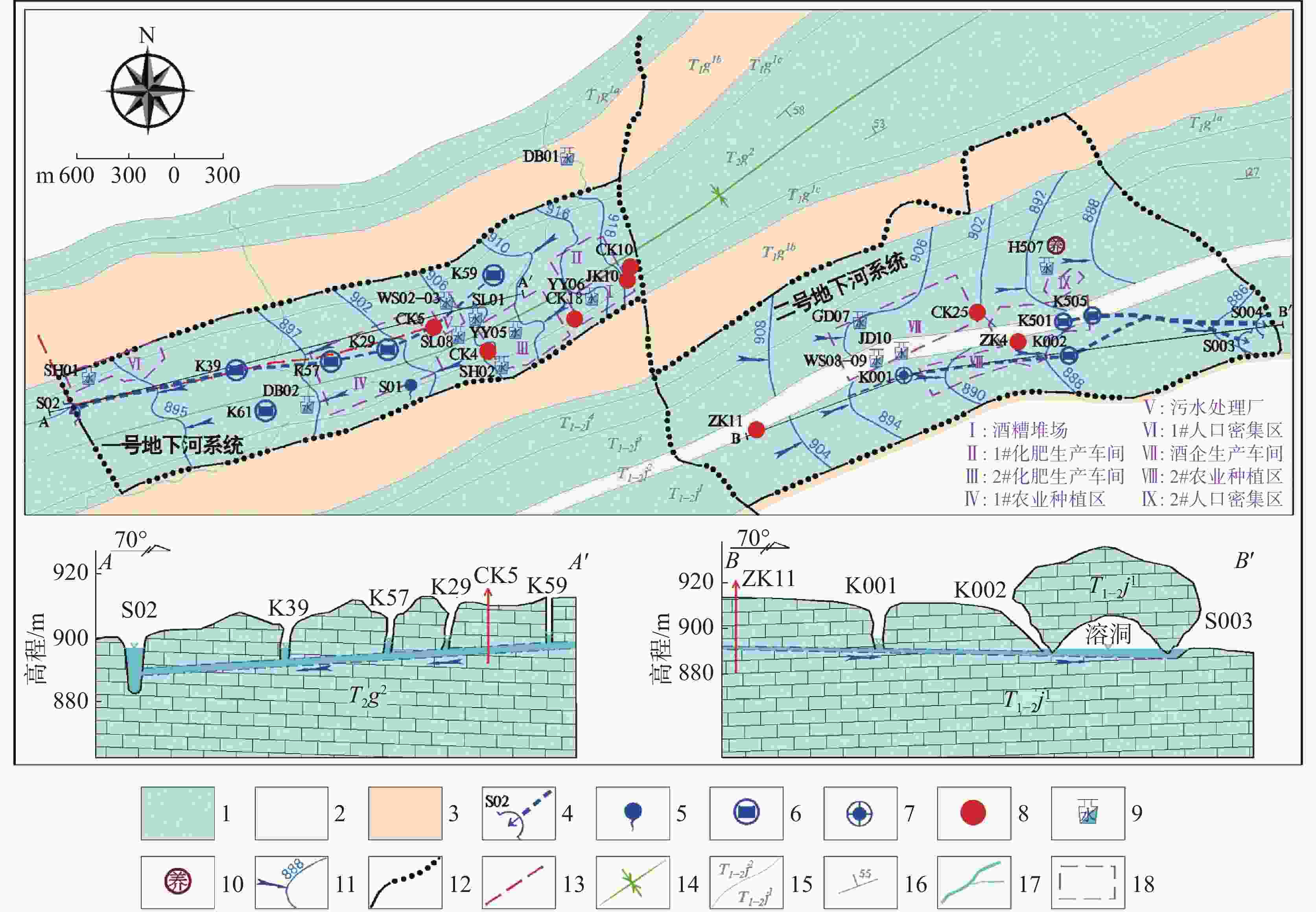
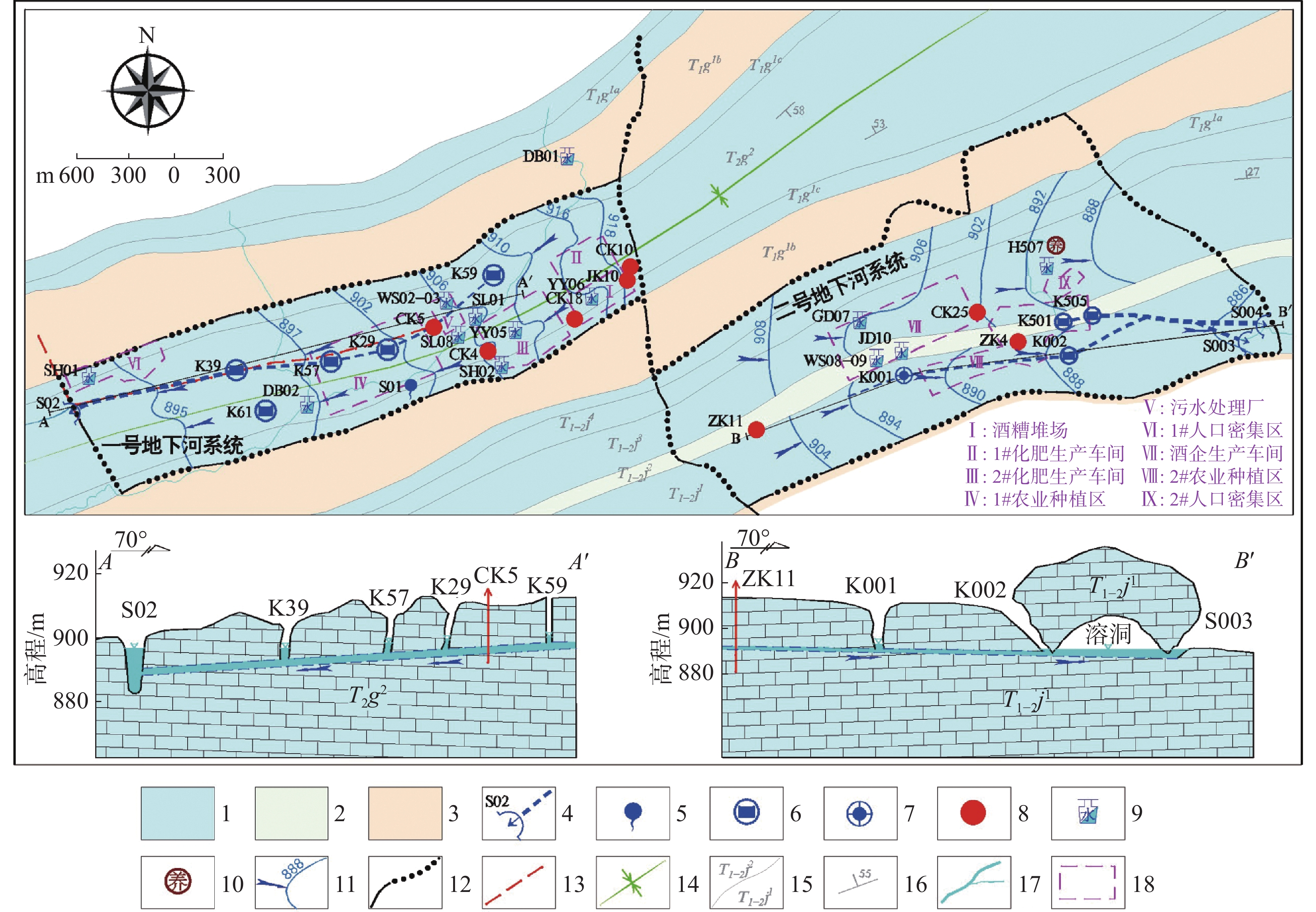
图 1 研究区水文地质略图
1-纯碳酸盐岩含水岩组 2-碳酸盐岩与碎屑岩互层含水岩组 3-隔水层 4-地下河出口及编号 5-岩溶下降泉 6-岩溶竖井 7-地下河天窗 8-监测井 9-采样点 10-养殖场 11-等水位线及地下水流向 12-地下水系统界线 13-推测断层 14-向斜轴 15-地质界线及地层代号 16-岩层产状 17-河流及溪沟 18-潜在污染源边界
Figure 1. Simplified hydrogeological map of the study area
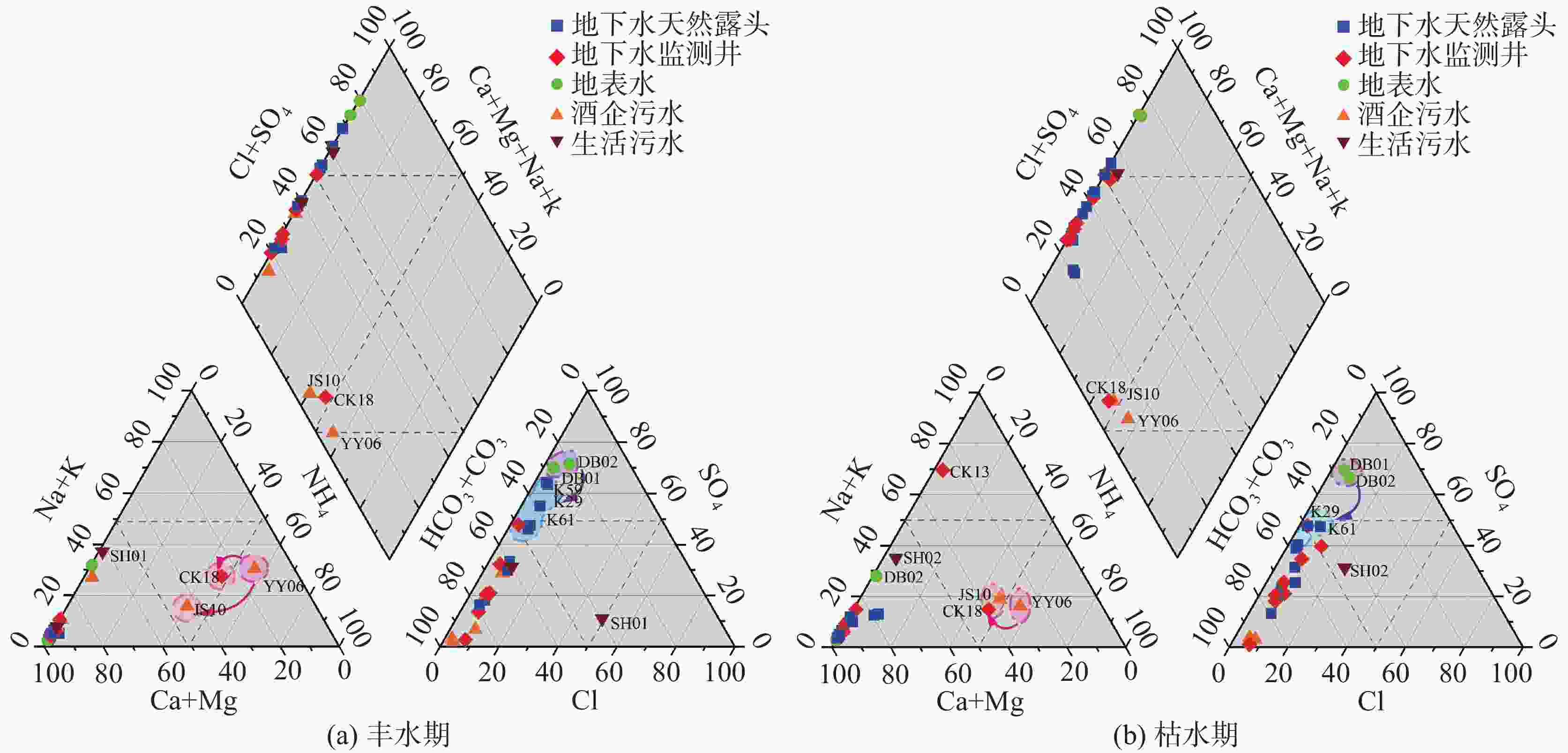
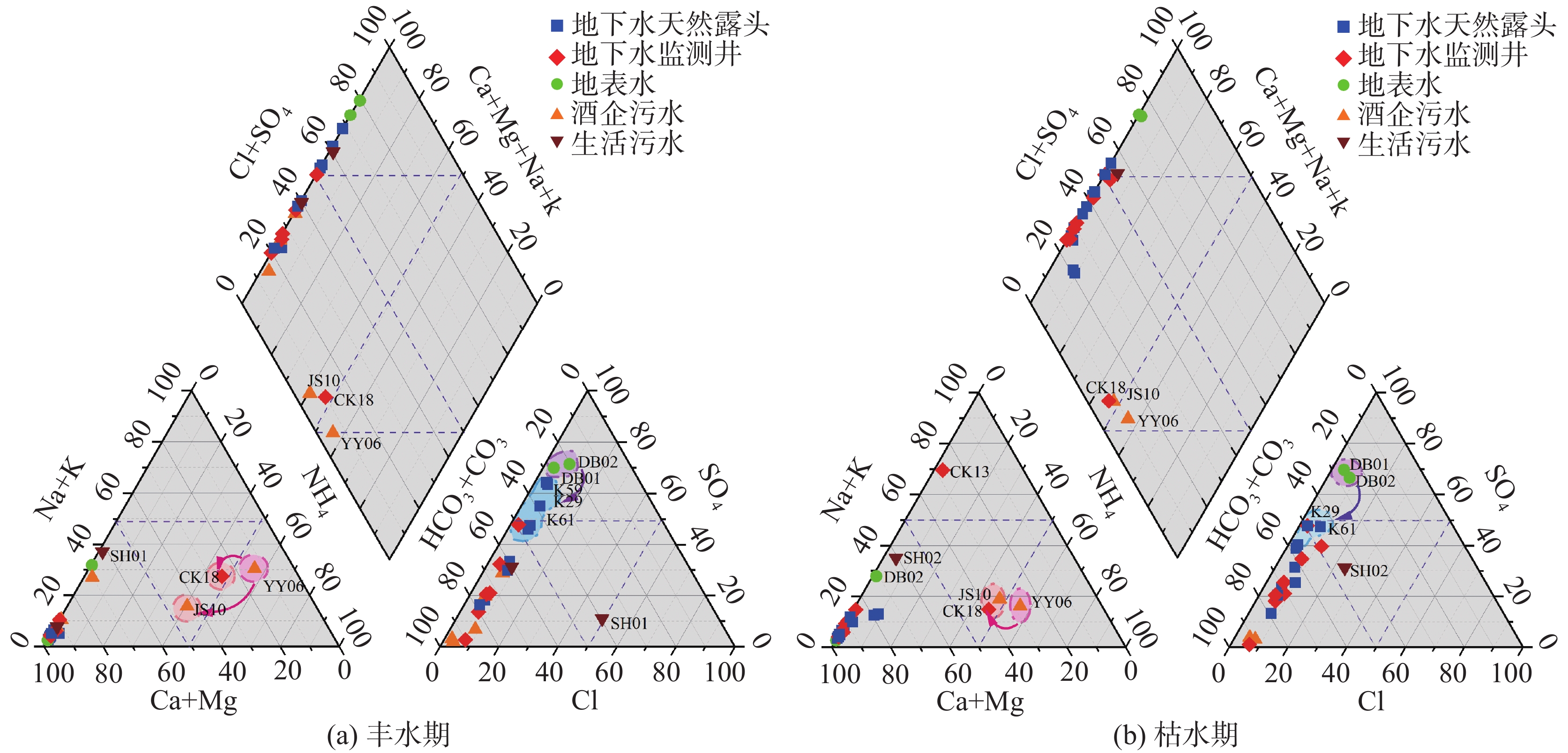
图 2 研究区水体改进型Piper三线图
Figure 2. Modified piper trilinear diagram of water bodies in the study area
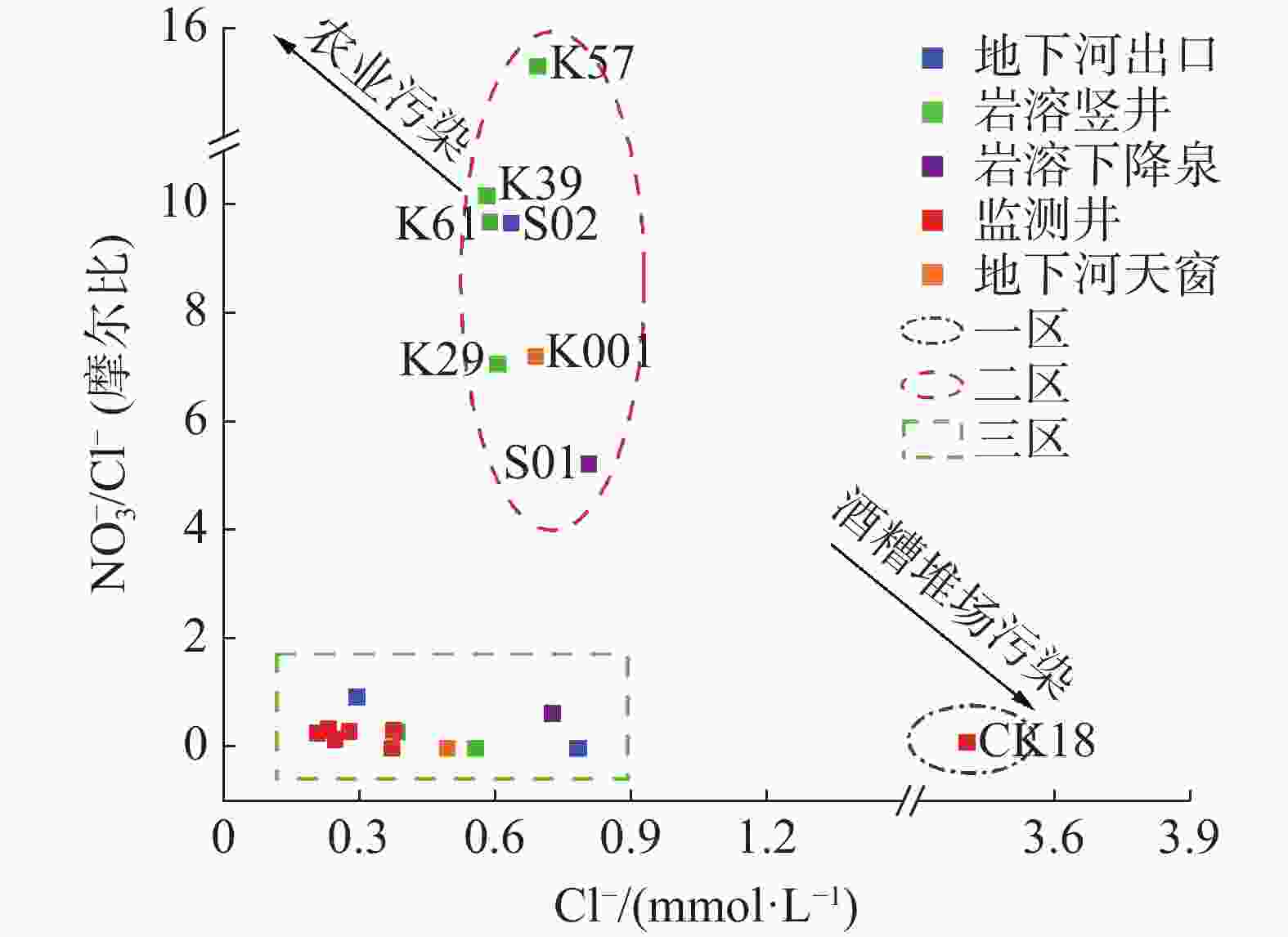
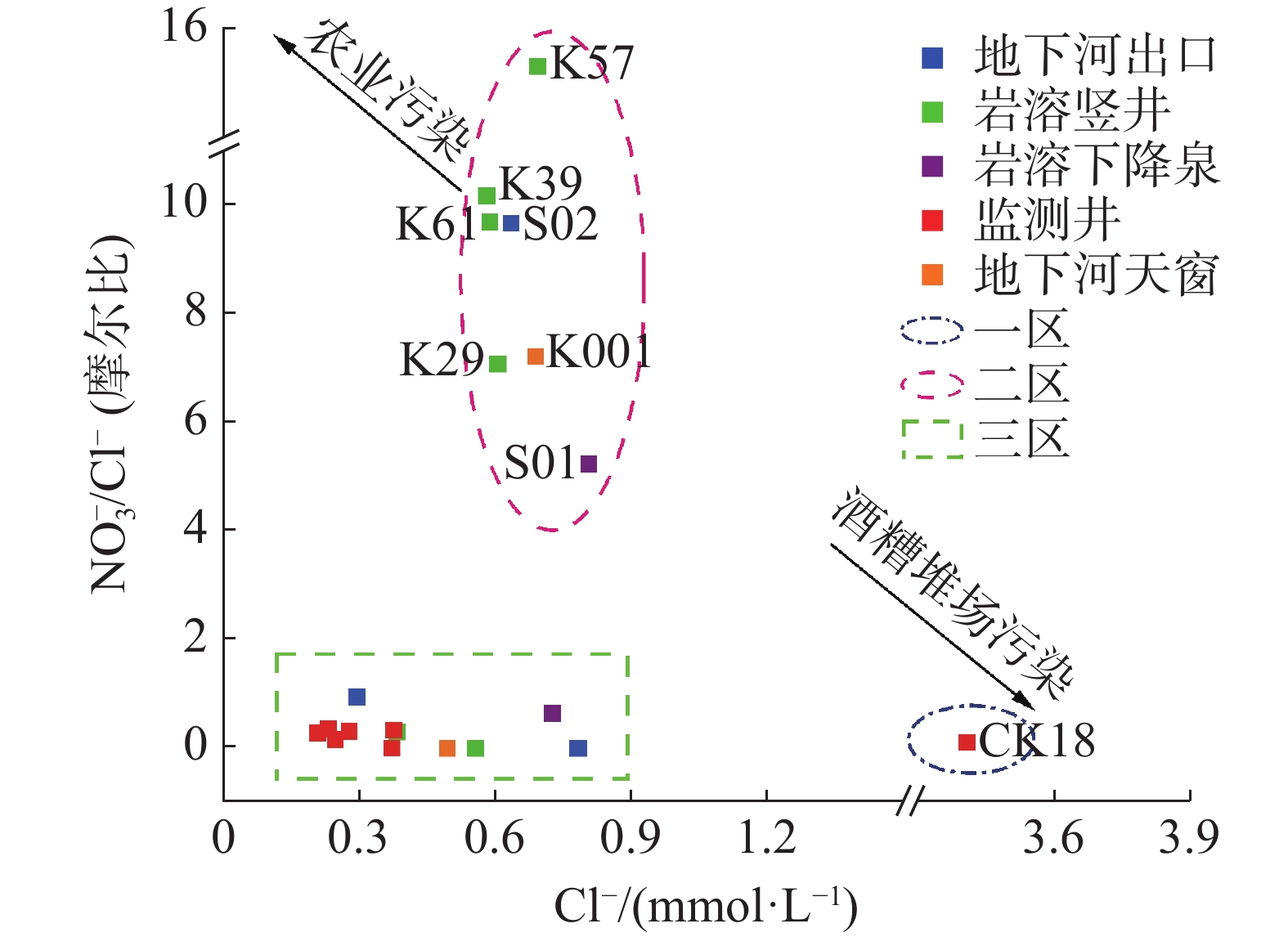
图 3 研究区地下水Cl−与${\rm{NO}}_3^{-}$/Cl−摩尔浓度比值变化
Figure 3. Variation of the molar concentration ratio of Cl− and ${\rm{NO}}_3^{-}$/Cl− in groundwater of the study area
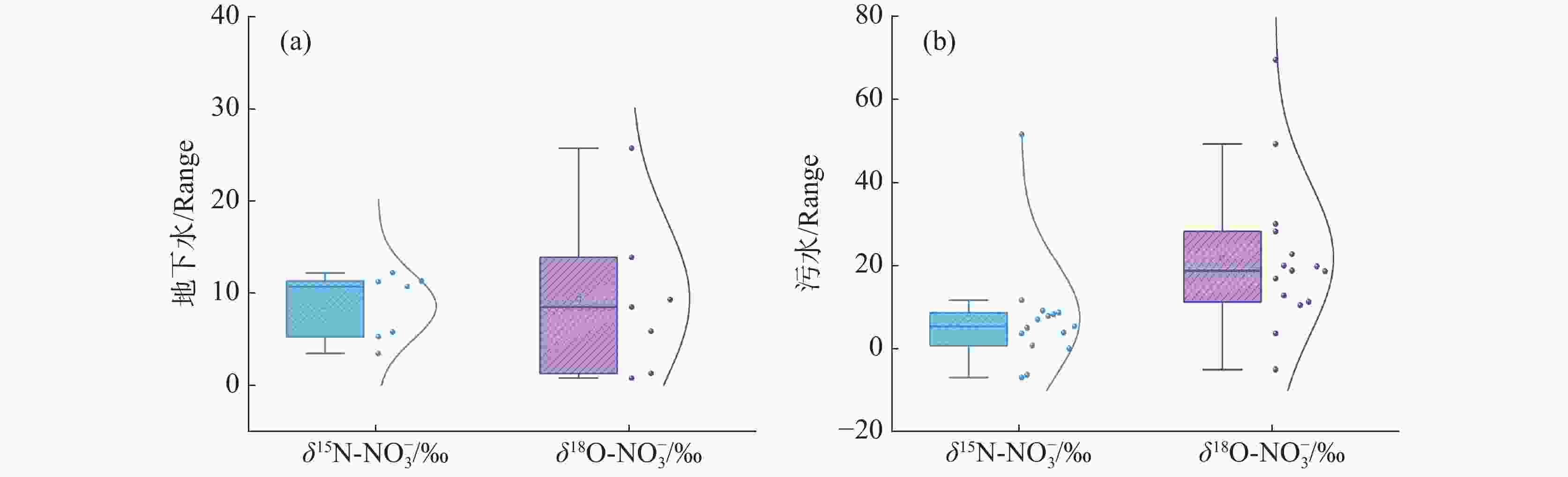
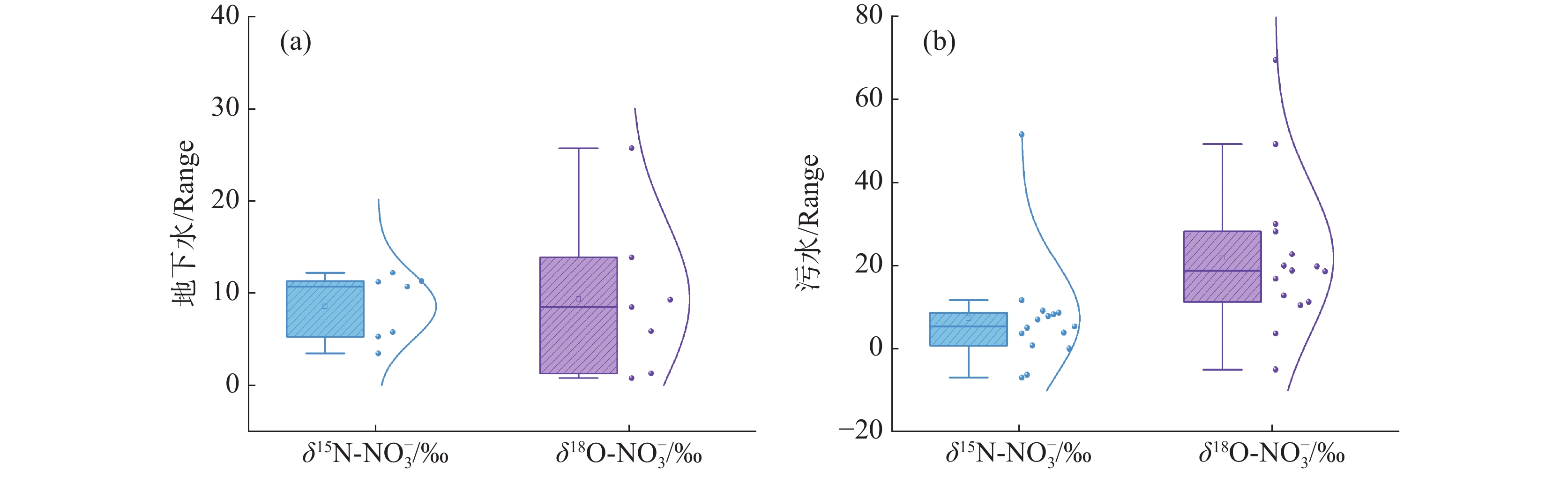
图 4 地下水与污水δ15 N-${\rm{NO}}_3^{-}$、δ18O-${\rm{NO}}_3^{-}$浓度箱线图
Figure 4. Boxplot of concentrations of δ15N-${\rm{NO}}_3^{-}$ and δ18O-${\rm{NO}}_3^{-}$ in groundwater and sewage
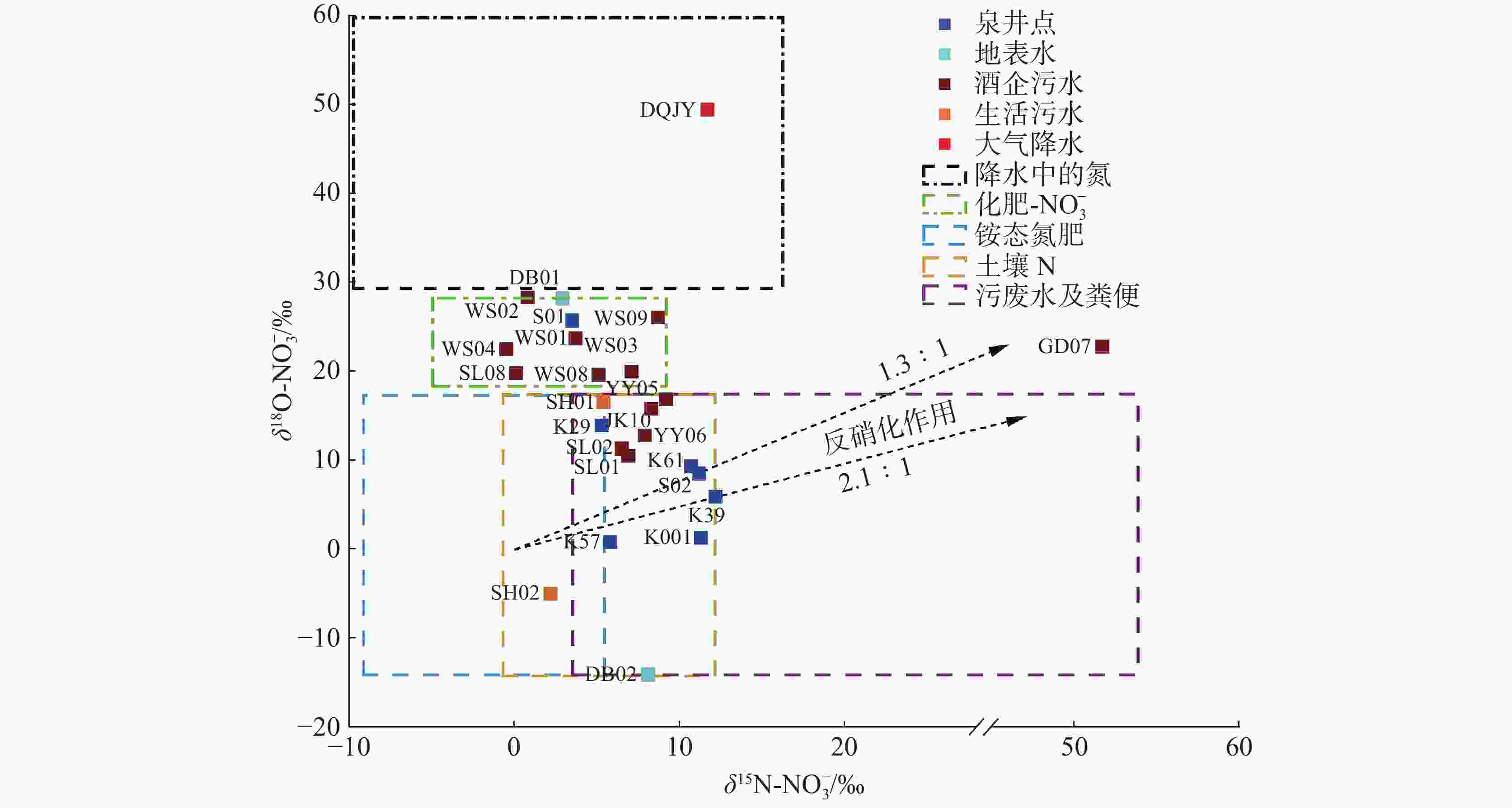
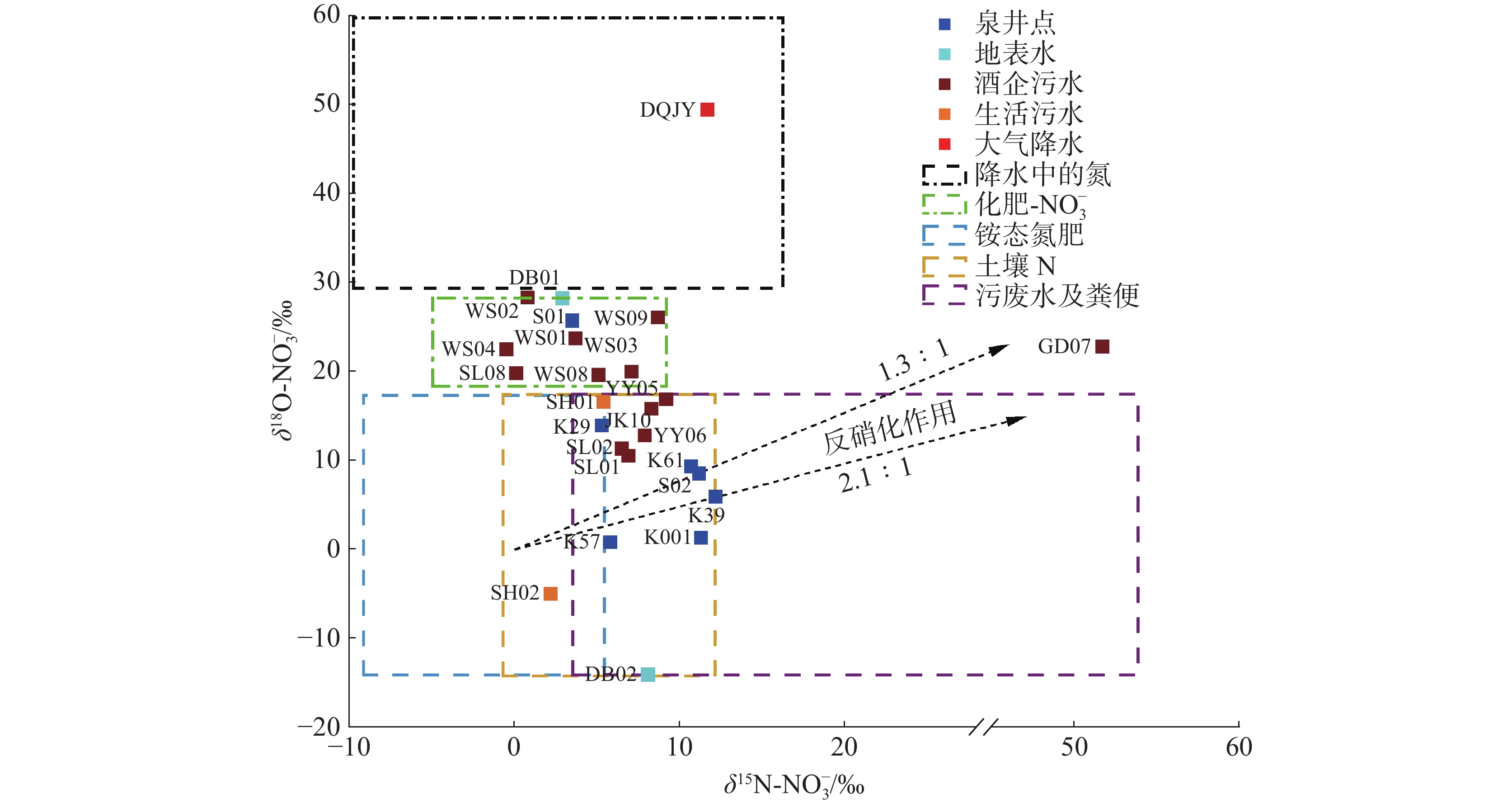
图 5 研究区水体δ15 N-${\rm{NO}}_3^{-}$与δ18O-${\rm{NO}}_3^{-}$分布
Figure 5. Distribution of δ15 N-${\rm{NO}}_3^{-}$andδ18O-${\rm{NO}}_3^{-}$in water bodies of the study area
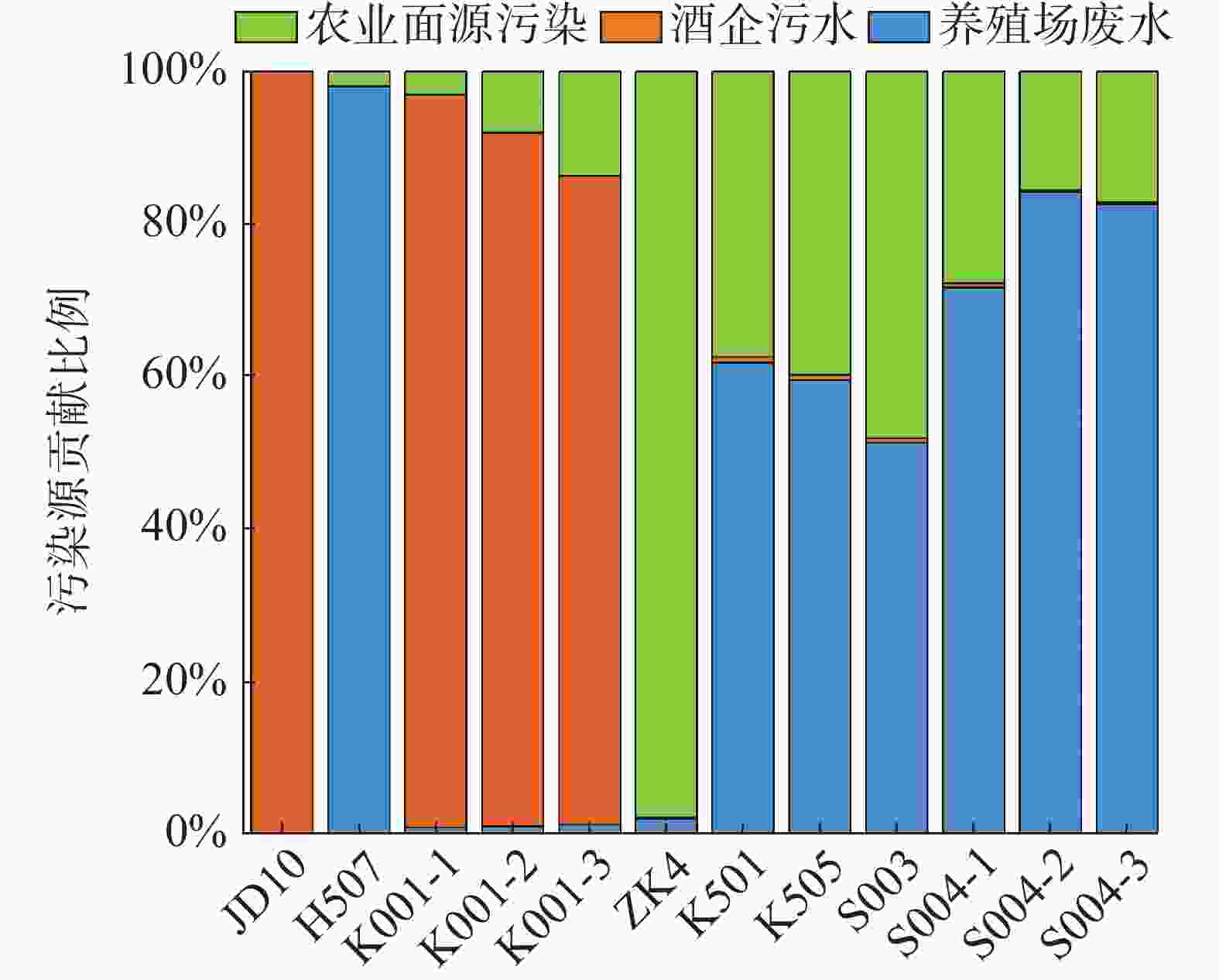
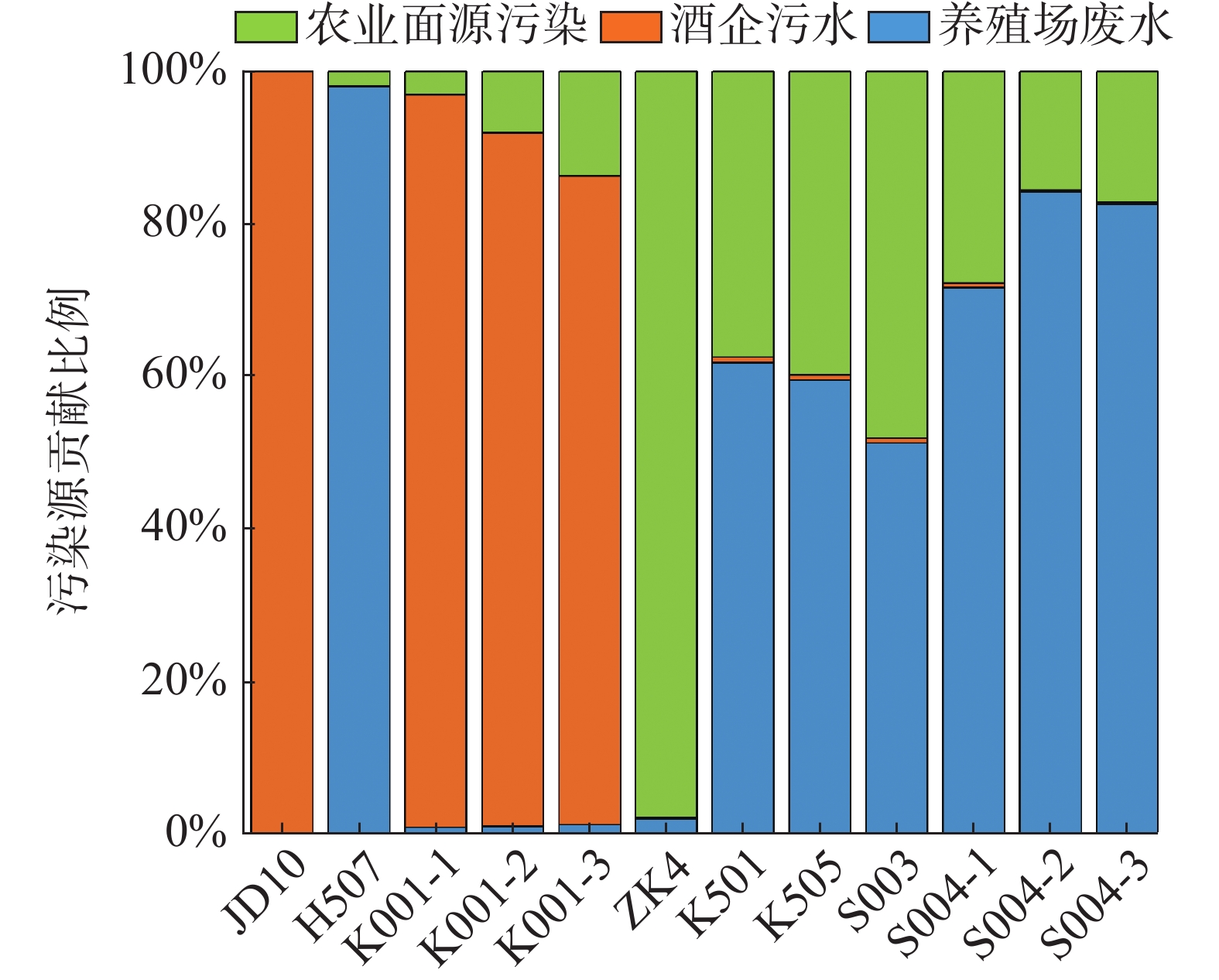
图 6 研究区地下水各污染源贡献比例(PMF模型)
Figure 6. Contribution ratios of various pollution sources to groundwater in the study area (PMF model)
表 1 研究区地下水理化参数统计表
Table 1. Statistics of physicochemical parameters of groundwater in the study area
离子类别 季节 最大值/mg·L−1 最小值/mg·L−1 平均值/mg·L−1 标准差 变异系数/% 背景值/mg·L−1 地下水Ⅲ类限值 K+ 丰季 142.80 0.40 15.61 40.13 257.10 0.76-4.80 — 枯季 20.22 3.00 8.86 6.17 69.66 Na+ 丰季 56.30 3.50 10.56 14.56 137.90 2.76-7.20 200 枯季 19.41 5.22 10.34 5.19 50.13 Ca2+ 丰季 220.66 52.16 135.67 42.96 31.67 117.6-132.0 — 枯季 154.06 31.01 114.58 31.67 27.64 Mg2+ 丰季 48.33 7.30 24.97 15.81 63.33 6.48-21.30 — 枯季 32.60 19.14 24.30 3.99 16.43 ${\rm{HCO}}_3^{-}$ 丰季 2561.91 127.10 470.08 669.88 142.50 133.00-264.00 — 枯季 494.07 192.30 356.82 94.50 26.48 ${\rm{SO}}_4^{2-}$ 丰季 389.94 41.33 174.17 110.50 63.44 45.20-98.6 250 枯季 160.71 45.15 92.81 38.21 41.17 Cl− 丰季 120.77 7.28 26.89 30.37 112.94 8.10-13.20 — 枯季 27.74 8.10 18.20 7.10 39.07 TFe 丰季 8.89 0.05 0.88 2.53 287.46 0.05-0.08 0.3 枯季 1.05 0.05 0.35 0.34 98.77 Mn 丰季 3.56 0.01 0.82 1.02 262.99 0.005-0.02 0.1 枯季 2.83 0.01 0.76 0.87 114.22 TP 丰季 6.78 0.01 0.67 1.94 290.74 0.01 — 枯季 2.25 0.01 0.55 0.88 159.94 NH$_4^{+}$ 丰季 247.00 0.02 21.27 71.10 334.16 0.02-0.05 0.5 枯季 17.10 0.02 3.82 6.55 171.52 ${\rm{NO}}_3^{-}$−N 丰季 148.37 0.59 49.55 47.70 96.29 0.10-1.80 20 枯季 6.61 0.04 1.55 2.18 140.94 pH 丰季 8.09 7.29 7.81 0.27 3.49 7.6-8.1 6.5-8.5 枯季 7.88 7.10 7.39 0.24 3.21 注:pH值为无量纲.  下载: 导出CSV
表 2 研究区地下水样品新污染物的定量靶向筛查分析测试结果(ng·L−1)
Table 2. Analytical test results of quantitative targeted screening for emerging contaminants in groundwater samples of the study area (ng·L−1)
新污染物 化合物名称
(中文)采样点位 JD10 H507 K001-1 K001-2 K001-3 K501 K505 S003 S004-1 S004-2 S004-3 ZK4 抗生
素及
药物
类磺胺对甲氧嘧啶 N.D. 6587.2 5.1 8.1 35.8 755.8 477.0 263.6 397.2 591.7 514.9 N.D. 盐酸金霉素 N.D. 9984.2 N.D. N.D. N.D. 708.4 226.3 200.6 124.6 27.5 27.4 N.D. 氟尼辛 N.D. 158.9 N.D. N.D. N.D. 166.1 41.6 24.5 46.6 43.6 41.3 N.D. 磺胺氯哒嗪 N.D. 5355.6 N.D. N.D. 23.9 977.2 417.7 197.5 299.5 470.0 412.1 N.D. 腺苷 N.D. N.D. 332.6 136.4 105.3 309.0 110.5 111.0 254.9 19.8 44.8 N.D. 埃莫福汀B N.D. N.D. N.D. N.D. N.D. N.D. N.D. N.D. N.D. N.D. N.D. N.D. 盐酸差向金霉素 N.D. N.D. N.D. N.D. N.D. N.D. N.D. N.D. N.D. N.D. N.D. N.D. 阿苯达唑亚砜 N.D. N.D. N.D. N.D. N.D. N.D. N.D. N.D. N.D. N.D. N.D. N.D. 农药
类及
内分
泌干
扰物类啶虫脒 N.D. N.D. N.D. N.D. N.D. N.D. N.D. N.D. N.D. N.D. N.D. N.D. 扑灭津- 2 -羟基 N.D. N.D. N.D. N.D. N.D. N.D. N.D. N.D. N.D. N.D. N.D. N.D. 阿特拉通莠去通除草剂 N.D. N.D. N.D. N.D. N.D. N.D. N.D. N.D. N.D. N.D. N.D. N.D. N,N-二乙基-3-甲基苯甲酰胺 N.D. 0.6 0.9 4.0 1.5 2.0 1.2 N.D. 1.3 1.5 1.0 1.8 扑灭通 N.D. N.D. N.D. N.D. N.D. 0.5 0.4 0.6 0.7 N.D. N.D. 0.6 阿特拉津 N.D. N.D. 1.8 2.9 3.0 21.5 11.6 4.6 9.4 8.7 8.4 6.2 酒
企
发
酵
污
水阿魏酸 25932.4 N.D. 1037.3 797.9 531.9 N.D. N.D. N.D. N.D. N.D. N.D. N.D. 水杨酸 1143.8 N.D. 95.3 79.4 61.1 N.D. N.D. N.D. N.D. N.D. N.D. N.D. 4-羟基-3-甲基苯甲酸 519.8 N.D. 52.0 47.3 39.4 N.D. N.D. N.D. N.D. N.D. N.D. N.D. 对羟基苯甲醛 1970.7 N.D. 115.9 82.8 63.7 N.D. N.D. N.D. N.D. N.D. N.D. N.D. 苜蓿素 N.D. N.D. N.D. N.D. N.D. N.D. N.D. N.D. N.D. N.D. N.D. N.D. 咖啡酸乙酯 N.D. N.D. N.D. N.D. N.D. N.D. N.D. N.D. N.D. N.D. N.D. N.D.
下载: 导出CSV
-
[1] 罗维, 杨秀丽, 犹俊, 杨丽君. 浅谈岩溶地区区域地下水质量评价——以贵州鸭池河—构皮滩流域为例[J]. 贵州地质, 2014, 31(2): 150-153,135. doi: 10.3969/j.issn.1000-5943.2014.02.015Luo Wei, Yang Xiuli, You Jun, Yang Lijun. Assessment of regional groundwater quality in karst area—A case study of Yachihe-Goupitan area in Guizhou[J]. Guizhou Geology, 2014, 31(2): 150-153,135. doi: 10.3969/j.issn.1000-5943.2014.02.015 [2] 王若帆, 赵良杰, 李 强, 吉勤克补子, 焦恒, 江峰, 陈刚. 黔中洋水背斜分散排泄系统地下水化学特征[J]. 中国岩溶, 2023, 42(4): 733-741. doi: 10.11932/karst20230409Wang Ruofan, Zhao Liangjie, Li Qiang, Jiqin Kebuzi, Jiao Heng, Jiang Feng, Chen Gang. Chemical characteristics of groundwater in the dispersed drainage system of Yangshui anticline in central Guizhou[J]. Carsologica Sinica, 2023, 42(4): 733-741. doi: 10.11932/karst20230409 [3] 高旭波, 向绚丽, 侯保俊, 高列波, 张建友, 张松涛, 李成城, 姜春芳. 水化学—稳定同位素技术在岩溶水文地质研究中的应用[J]. 中国岩溶, 2020, 39(5): 629-636. doi: 10.11932/karst2020y26Gao Xubo, Xiang Xuanli, Hou Baojun, Gao Liebo, Zhang Jianyou, Zhang Songtao, Li Chengcheng, Jiang Chunfang. Application of hydrochemistry coupled with stable isotopes in the study of karst water hydrogeology[J]. Carosologica Sinica, 2020, 39(5): 629-636. doi: 10.11932/karst2020y26 [4] 靳孟贵, 张结, 张志鑫, 曹明达, 黄鑫. 地下水硫酸盐溯源的进展、问题和发展趋势[J]. 地质科技通报, 2022, 41(5): 160-171. doi: 10.19509/j.cnki.dzkq.2022.0161Jin Menggui, Zhang Jie, Zhang Zhixin, Cao Mingda, Huang Xin. A review on source identification of dissolved sulfate in groundwater: Advances, problems and development trends[J]. Bulletin of Geological Science and Technology, 2022, 41(5): 160-171. doi: 10.19509/j.cnki.dzkq.2022.0161 [5] 易世友, 焦 恒, 周长松, 高峰, 陈涛. 基于“三源模式”的岩溶地下河区污染场地修复治理−以遵义坪桥地下河系统为例[J]. 中国岩溶, 2023, 42(4): 648-661 .Yi Shiyou, Jiao Heng, Zhou Changsong, Gao Feng, Chen Tao. Remediation of polluted sites in the typical area of karst underground river based on 'Three-Source Model': A case study in the Pingqiao underground river system, Zunyi, China[J]. Carsologica Sinica, 2023, 42(4): 648-661. [6] Haeran Moon, Seong Taek Yun, Jeong Eun Oh. Assessment of environmental forensic indicator for anthropogenic groundwater contamination via target/suspect/nontarget analysis using HRMS techniques[J]. Journal of Hazardous Materials, 2024. [7] 孟志龙, 杨永刚, 秦作栋, 焦文涛. 汾河下游流域水体硝酸盐污染过程同位素示踪[J]. 中国环境科学, 2017, 37(3): 1066-1072. doi: 10.3969/j.issn.1000-6923.2017.03.033Meng Zhilong, Yang Yonggang, Qin Zuodong, Jiao Wentao. Isotopic tracing for nitrate pollution process of water body in the lower reaches of Fenhe River[J]. China Environmental Science, 2017, 37(3): 1066-1072. doi: 10.3969/j.issn.1000-6923.2017.03.033 [8] Meghdadi A, Javar N. Quantification of spatial and seasonal variation in the proportional contribution of nitrate sources using a multi-isotope approach and Bayesian isotope mixing model[J]. Environmental Pollution, 2018, 235: 207-222. doi: 10.1016/j.envpol.2017.12.078 [9] Asunción Romanelli, David X. Soto, Ioannis Matiatos, Daniel E. Martínez, Soledad Esquius. A biological and nitrate isotopic assessment framework to understand eutrophication in aquatic ecosystems[J]. Science of the Total Environment, 2020, 715. [10] Shang Xu, Huang Hong, Nei Kun, Xia Fang, Chen Zheng, Yang Yue, Randy A. Dahlgren, Zhang Minghua, Ji Xiaoliang. Riverine nitrate source apportionment using dual stable isotopes in a drinking water source watershed of southeast China[J]. Science of the Total Environment, 2020, 724. [11] Zhang Han, Xu Yi, Cheng Siqian, Li Qiling, Yu Haoran. Application of the dual-isotope approach and Bayesian isotope mixing model to identify nitrate in groundwater of a multiple land-use area in Chengdu Plain, China[J]. Science of the Total Environment, 2020, 717. [12] 金赞芳, 张文辽, 郑奇, 朱晨阳, 李非里. 氮氧同位素联合稳定同位素模型解析水源地氮源[J]. 环境科学, 2018, 39(5): 2039-2047.Jin Zanfang, Zhang Wenliao, Zheng Qi, Zhu Chenyang, Li Feili. Contribution of nitrogen sources in water sources by combining nitrogen and oxygen Isotopes and SIAR[j]. Environmental Science, 2018, 39(5): 2039-2047. [13] 寇馨月, 丁军军, 李玉中, 毛丽丽, 李巧珍, 徐春英, 郑欠, 庄姗. 青岛市农区地下水硝态氮污染来源解析[J]. 环境科学, 2021, 42(7): 3232-3241. doi: 10.13227/j.hjkx.202010263Kou Xinyue, Ding Junjun, Li Yuzhong, Mao Lili, Li Qiaozhen, Xu Chunying, Zheng Qian Zhuang Shan. Identifying the sources of groundwater ${\rm{NO}}_3^{-}$-N in Agricultural Region of Qingdao[J]. Environmental Science, 2021, 42(7): 3232-3241. doi: 10.13227/j.hjkx.202010263 [14] 张涵, 杜昕宇, 高菲, 曾卓, 程思茜, 许懿. 联合PMF模型与稳定同位素的地下水污染溯源[J]. 环境科学, 2022, 43(8): 4054-4063. doi: 10.13227/j.hjkx.202110174Zhang Han, Du Xinyu, Gao Fei, Zeng Zhuo, Cheng Siqian, Xu Yi. Groundwater pollution source identification by combination of PMF model and stable isotope technology[J]. Environmental Science, 2022, 43(8): 4054-4063. doi: 10.13227/j.hjkx.202110174 [15] 苏春利, 张雅, 马燕华, 刘文波. 贵阳市岩溶地下水水化学演化机制: 水化学和锶同位素证据[J]. 地球科学, 2019, 44(9): 2829-2838.Su Chunli, Zhang Ya, Ma Yanhua, Liu Wenbo. Hydrochem-ical evolution processes of karst groundwater in Guiyang City: Evidences from hydrochemistry and 87Sr/86Sr ratios[J]. Earth Science, 2019, 44(9): 2829-2838. [16] 陈锋, 孟凡生, 王业耀, 张铃松, 杨琦. 多元统计模型在水环境污染物源解析中的应用[J]. 人民黄河, 2016, 38(1): 79-84. doi: 10.3969/j.issn.1000-1379.2016.01.021Chen Feng, Meng Fansheng, Wang Yeyao, Zhang Lingsong, Yang Qi. Application of multivariate statistical analysis in the source apportionment of surface water[J]. Yellow River, 2016, 38(1): 79-84. doi: 10.3969/j.issn.1000-1379.2016.01.021 [17] Zhang Han, Li Hongfei, Yu Haoran, Cheng Siqian. Water quality assessment and pollution source apportionment using multi-statistic and APCS-MLR modeling techniques in Min river basin, China[J]. Environmental Science and Pollution Research, 2020, 27(33): 41987-42000. doi: 10.1007/s11356-020-10219-y [18] 彭倩, 刘凡, 周美春, 凌晶, 黄蕾. 基于PCA—AHP的综合地下水脆弱性模型及应用[J]. 环境科学与技术, 2024, 47(S2): 67-74. doi: 10.19672/j.cnki.1003-6504.2260.23.338Peng Qian, Liu Fan, Zhou Meichun, Ling Jing, Huang Lei. A Comprehensive Groundwater Vulnerability Model Based on PCA—AHP and Its Application[J]. Environmental Science & Technology, 2024, 47(S2): 67-74. doi: 10.19672/j.cnki.1003-6504.2260.23.338 [19] 邢洁, 宋男哲, 陈祥伟, 倪红伟, 韩旭. 基于主成分分析的松花江流域黑龙江段水质评价[J]. 中国给水排水, 2021, 37(1): 89-94. doi: 10.19853/j.zgjsps.1000-4602.2021.01.015Xing Jie, Song Nanzhe, Chen Xiangwei, Ni Hongwei, Han Xu. Water quality assessment of Heilongjiang control section in Songhua Riv- er Basin based on principal component analysis[J]. China Water & Wastewater, 2021, 37(1): 89-94. doi: 10.19853/j.zgjsps.1000-4602.2021.01.015 [20] 曹建文, 杨海洋, 王 喆, 赵良杰, 林玉山, 栾崧, 李录娟. 湖北某抽水蓄能电站建设中地下河系统多元信息综合分析评价[J]. 中国岩溶, 2023, 42(4): 699-710. doi: 10.11932/karst20230406Cao Jianwen, Yang Haiyang, Wang Zhe, Zhao Liangjie, Lin Yushan, Luan Song, Li Lujuan. Comprehensive analysis and evaluation of the multi-information on the underground river system in construction of a pumped-storage hydropower station in Hubei[J]. CARSOLOGICA SINICA, 2023, 42(4): 699-710. doi: 10.11932/karst20230406 [21] 曾莘茹, 姜光辉, 郭 芳, 汤庆佳, 刘 凡. 桂林甑皮岩洞穴遗址地下水示踪及污染来源分析[J]. 中国岩溶, 2016, 35(3): 245-253. doi: 10.11932/karst20160301Zeng Xinru, Jiang Guanghui, Guo Fang, Tang Qingjia, Liu Fan. Tracer tests for pollutant sources of the Zengpiyan remainder cave in Guilin, China[J]. Carsologica Sinica, 2016, 35(3): 245-253. doi: 10.11932/karst20160301 [22] Gao Shilin, Wu Qixin, Zhang Borui, Peng Meixue, Zeng Jie, Zhu Liang. Significant effects of rural wastewater treatment plants in reducing microplastic pollution: A perspective from China's southwest area[J/OL]. Journal of Hazardous Materials, 2024, 480. [23] Jiang Feng, Wu Qixin, Li Qiang, Jiqin Kebuzi, Zeng Jie, Gao Shilin, Yi Shiyou, Liu Shuang, Liang Feng. Integrated quantitative tracing for Karst groundwater contamination: A case study of landfill in Zunyi, Guizhou Province, China[J/OL]. Environmental Pollution, 2025, 368. [24] Zeng Jie, Han Guilin, Wu Qixin, Qu Rui, Ma Qiang, Chen Jingwen, Mao Shijun, Ge Xin, Wang Zhongjun, Ma Zhiheng. Significant influence of urban human activities and marine input on rainwater chemistry in a coastal large city, China[J/OL]. Water Research, 2024, 257. [25] Zhang Chi, Rao Wenbo, Wu Zhihua, Zheng Fangwen, Li Tianning, Li Chao, Lei Xiang, Xie Hengwang, Chu Xiaodong. Anthropogenic impacts and quantitative sources of nitrate in a rural-urban canal using a combined PMF, δ15N/δ18O− ${\rm{NO}}_3^{-}$, and MixSIAR approach[J/OL]. Environmental Research, 2024, 251. [26] W. McCance, O. A. H. Jones, M. Edwards, A. Surapaneni, S. Chadalavada, M. Currell. Contaminants of Emerging Concern as novel groundwater tracers for delineating wastewater impacts in urban and peri-urban areas[J], Water Research, 2018, 146: 118-133. [27] W. McCance, O. A. H. Jones, M. Edwards, A. Surapaneni, S. Chadalavada, M. Currell. Contaminants of Emerging Concern as novel groundwater tracers for delineating wastewater impacts in urban and peri-urban areas[J/OL]. Water Research, 2018, 146: 118-133. [28] Yu Yang, Wang Siyu, Yu Pingfeng, Wang Dongsheng, Hu Baolan, Zheng Ping, Zhang Meng. A bibliometric analysis of emerging contaminants (ECs) (2001-2021): Evolution of hotspots and research trends[J]. The Science of the total environment. 2023, 907. [29] 刘菲. 地下水系统中的新污染物[J]. 水文地质工程地质, 2024, 51(2): 1-2. [30] 崔坤磊, 尹希杰, 李艳利, 杨海丽, 裴盛祥, 苏静. 细菌反硝化法测试硝酸盐氮、氧同位素的研究与应用[J]. 应用海洋学学报, 2021, 40(4): 629-635.Cui Kunlei, Yin Xijie, Li Yanli, Yang Haili, Pei Shengxiang, Su Jing. Study and application of the isotopes N and O in nitrate determination by bacterial denitrification[J]. Journal of Applied Oceanography, 2021, 40(4): 629-635. [31] Paatero P, Tapper U. Positive matrix factorization: a non-negative factor model with optimal utilization of error estimates of data values[J]. Environmentrics, 1994, 5(2): 111-126. doi: 10.1002/env.3170050203 [32] Haghnazar Hamed; Johannesson Karen H. ; González-Pinzón Ricardo; Pourakbar Mojtaba; Aghayani Ehsan; Rajabi Akbar; Hashemi Ahmad Asl. Groundwater geochemistry, quality, and pollution of the largest lake basin in the Middle East: Comparison of PMF and PCA-MLR receptor models and application of the source-oriented HHRA approach[J]. Chemosphere, 2022. [33] 孟瑞芳, 孟舒然. 基于正定矩阵因子分析模型的滹沱河冲洪积扇地下水污染源解析[J]. 环境污染与防治, 2021, 43(5): 586-591. doi: 10.15985/j.cnki.1001-3865.2021.05.010Meng Ruifang, Meng Shuran. Source analysis of groundwater pollution in Hutuo River alluvial-pluvial fan based on positive matrix factorization model[J]. Environmental Pollution and Control, 2021, 43(5): 586-591. doi: 10.15985/j.cnki.1001-3865.2021.05.010 [34] Chen Ruihui, Teng Yanguo, Chen Haiyang, Hu Bin, Yue Weifeng. Groundwater Pollution and risk assessment based on source apportionment in a typical cold agricultural region in Northeastern China[J]. Science of the Total Environment, 2019, 696. [35] 马小雪, 龚畅, 郭加汛, 王腊春, 徐蕴韵, 赵春发. 长江下游快速城市化地区水污染特征及源解析: 以秦淮河流域为例[J]. 环境科学, 2021, 42(7): 3291-3303. doi: 10.13227/j.hjkx.202011184Ma Xiaoxue, Gong Chang, Guo Jiaxun, Wang Lachun, Xu Yunyun, Zhao Chunfa. Water pollution characteristics and source apportionment in rapid urbanization region of the lower Yangze River: considering the Qinhuai River catchment[J]. Environmental Science, 2021, 42(7): 3291-3303. doi: 10.13227/j.hjkx.202011184 [36] Zhang Han, Cheng Siqian, Li Hongfei, Fu Kang, Xu Yi. Groundwater pollution source identification and apportionment using PMF and PCA-APCA-MLR receptor models in a typical mixed land-use area in Southwestern China[J]. Science of the Total Environment, 2020, 741. [37] Wu Jin, Yang Gang, Chen Haiyang, Zhai Yuanzheng, Teng Yanguo, Li Jiao, Chen Ruihui. Source apportionment and source specific health risk assessment of HMs and PAHs in soils with an integrated framework in a typical cold agricultural region in China[J]. The Science of the total environment, 2023, 904. [38] Hu Bin, Li Panwen, Chen Ruihui, Zheng Yinan, Li Jiao, Li Yi. The new region demarcation framework for implementing the joint prevention and control of groundwater pollution: A case study in western of Bohai Bay, China[J]. Journal of Hazardous Materials, 2024, 478. [39] Linhoff Benjamin. Deciphering natural and anthropogenic nitrate and recharge sources in arid region groundwater[J]. The Science of The Total Environmentt, 2022, 848. [40] CAROL Kendall、EMILY M. Elliott、SCOTT D. Wankel. Tracing anthropogenic inputs of nitrogen to ecosystems[M]. Oxford, UK: Blackwell Publishing Ltd, 2007: 375-449. [41] IAN D. Clark, Peter Fritz. Environmental isotopes in hydrogeology[M]. New York: CRC Press, 1997. [42] KAOWN Dugin, KOH Dongchan, MAYER Bernhard, LEE Kangkun. Identification of nitrate and sulfate sources in groundwater using dual stable isotope approaches for an agricultural area with different land use ( Chuncheon, mid-eastern Korea)[J]. Agriculture, Ecosystems&Environment, 2009, 132(34): 223-231. doi: 10.1016/j.agee.2009.04.004 [43] SPALDING R F, HIRSH A J, EXNERM E, et al. Applicability of the dual isotopes δ15N and δ18O to identify nitrate in groundwater beneath irrigated cropland[J]. Journal of Contaminant Hydrology, 2019, 220: 128-135. doi: 10.1016/j.jconhyd.2018.12.004 [44] KEARA B. Moore, BRENDA Ekwurzel, BRADLEY K. Esser, G. Bryant Hudson, JEAN E. Moran. Sources of groundwater nitrate revealed using residence time and isotope methods[J]. Applied Geochemistry, 2006, 21(6): 1016-1029. [45] 尹玉龙, 王周锋, 王文科, 陈立, 邢萌, 刘卫国. 利用氮氧同位素定量识别地下水中硝酸盐来源[J]. 水资源与水工程学报, 2015, 26(5): 104-108. doi: 10.11705/j.issn.1672-643X.2015.05.20Yin Yulong, Wang Zhoufeng, Wang Wenke, Chen Li, Xing Meng Liu Weiguo. Quantitative identification of nitrate source in groundwater by using nitrogen and oxygen isotope[J]. Journal of Water Resources& Water engineering, 2015, 26(5): 104-108. doi: 10.11705/j.issn.1672-643X.2015.05.20 [46] 魏守才, 刘京涛, 夏江宝, 马良. 基于氮氧同位素示踪的滨州市水体硝酸盐污染来源解析[J]. 北京师范大学学报(自然科学版), 2021, 57(1): 29-35.Wei Shoucai, Liu Jingtao, Xia Jiangbao, Ma Liang. Analysis of surface water and groundwater nitrate sources in Binzhou City in the Yellow River Delta using isotopes of nitrogen and oxygen[J]. Journal of Beijing Normal University(Natural Science), 2021, 57(1): 29-35. -

 点击查看大图
计量
- 文章访问数: 176
- HTML浏览量: 44
- PDF下载量: 76
- 被引次数: 0
