


Analysis of the development characteristics of karst underground rivers and groundwater pollution causes in the vicinity of Dacongli Tailing Sand Reservior
-
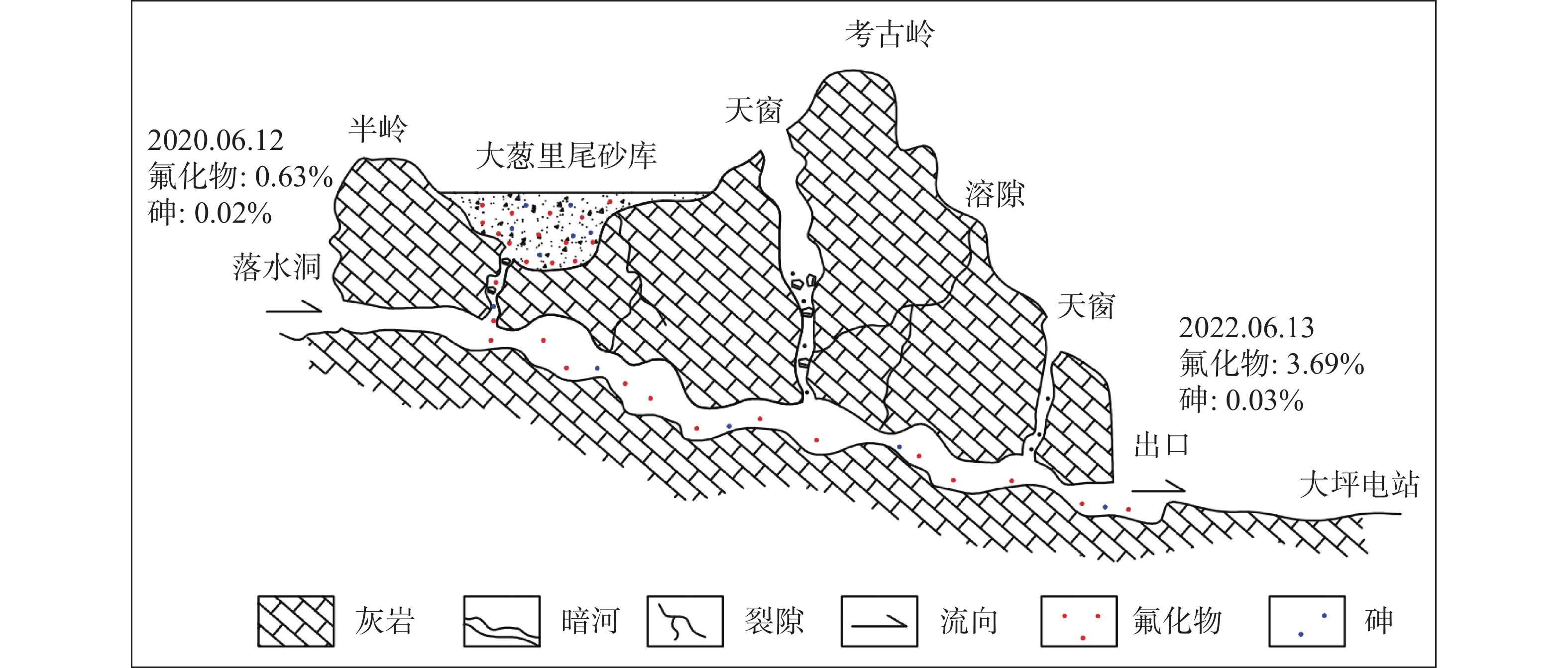
摘要: 香花岭地处湖南省湘南地区,具有矿产资源丰富,开采历史悠久的特点。但在各类矿床开采冶炼中,产生了大量的工业废渣和废水。由于未经有效处理而长期随意排放,给当地的水土环境造成严重的污染。本文通过水工环综合调查、地球物理深部探测和地下水污染分析等综合方法,旨在查明香花岭中~下游碳酸盐岩区地下暗河发育情况和地下水污染特征,以及暗河发育与地下水污染的因果关系。经综合调查和深部探测发现,在大葱里尾砂库下方、半岭和考古岭一带,存在I和II号2条地下暗河。其中,I号暗河长1150 km,II号暗河长712 m,总体埋深在65 m~93 m。对大葱里尾砂库上游和下游的地下水进行对比检测表明,上游地下水中的氟化物和砷含量较低,其中氟化物含量仅为0.63%,砷含量为0.02%,均未出现V类超标情况;而下游暗河出口水中的氟化物则出现V类超标异常,表明暗河出口的污染源主要来自大葱里尾砂库中的污水和污泥。此外,尾砂库岩溶塌陷,致使库中污水污泥渗漏,进一步验证了库中污染物通过浅部的岩溶构造作为运移通道,向下运移至深部的暗河中,造成地下水污染的结论。针对上述结论,提出从上游入口中投入药剂改良水质,并对尾砂库加强监管的建议措施。Abstract: Xianghualing is located in the southern part of Hunan Province, with abundant mineral resources and a long history of mining.However, in the mining and smelting of various mineral deposits, a large amount of industrial waste and wastewater are generated.Due to long-term indiscriminate discharge without effective treatment, it has caused serious pollution to the local water and soil environment.For example, through long-term monitoring of the water quality at the underground river outlet of the Daping Power Station downstream, it was found that the fluoride concentration was above 3.695ml·L−1, which is classified as a V-grade type; The arsenic concentration fluctuates around 0.031ml·L−1 and is classified as Class I-III.This article aims to investigate the development of underground rivers and the characteristics of groundwater pollution in the middle to lower reaches of carbonate rock areas, as well as the causal relationship between underground river development and groundwater pollution,through comprehensive methods such as hydraulic engineering and environmental investigation, geophysical deep exploration, and groundwater pollution analysis. It provides targeted governance suggestions for local environmental protection departments.After comprehensive investigation and deep exploration, it was found that there are two underground rivers,named I and II, distributed under the tail sand reservoir of Dacongli,and the section form Banling hill to Kaoguling mountain.With an overall burial depth of 65m to 93m,The length of underground river I is 1150km, and the length of underground river II is 712m.By comparative testing of the groundwater between upstream and downstream of the tail sand reservoir of Dacongli, it showed that the fluoride and arsenic content in the upstream groundwater was relatively low, with fluoride content only 0.63% and arsenic content 0.02%, and no V-class exceedance was observed; In contrast,the fluoride in the water at the outlet of the downstream underground river exceeded the V-class standard abnormally,which Indicated that the pollution source at the outlet of the dark river mainly comes from the sewage and sludge in the tail sand storage of Dacongli. Moreover, karst collapse occurred in the tailings storage facility, leading to leakage of sewage and sludge in the reservoir. alse further confirmed the conclusion that pollutants in the reservoir are transported downwards through shallow karst structures to deep underground rivers, resulting in groundwater pollution. Based on the above conclusion, it is suggested to invest chemicals from the upstream inlet to improve water quality and strengthen supervision of tailings storage facilities.
-
Key words:
- tailing sand reservior of Dacongli /
- arsenic /
- fluoride /
- underground river
-
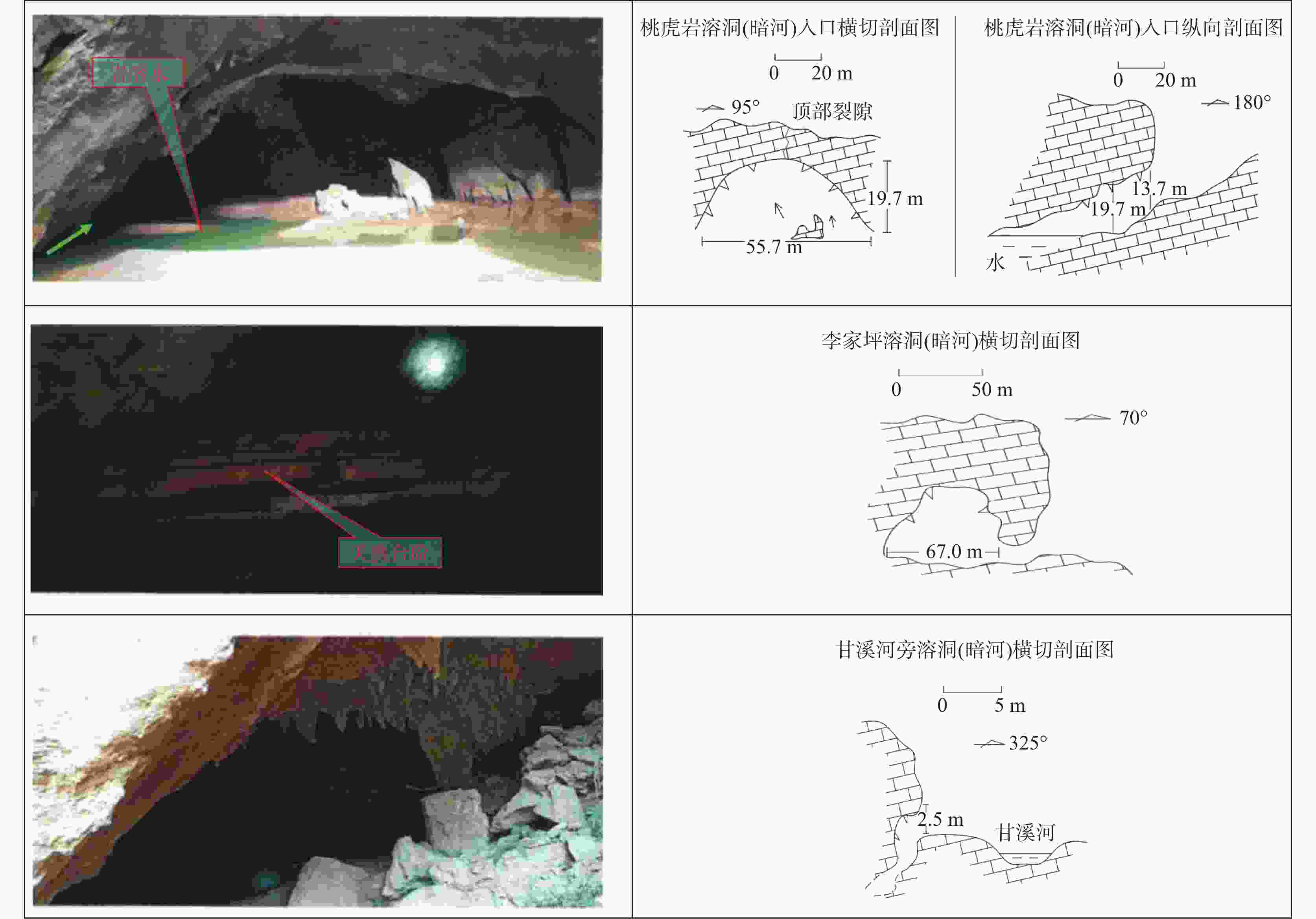
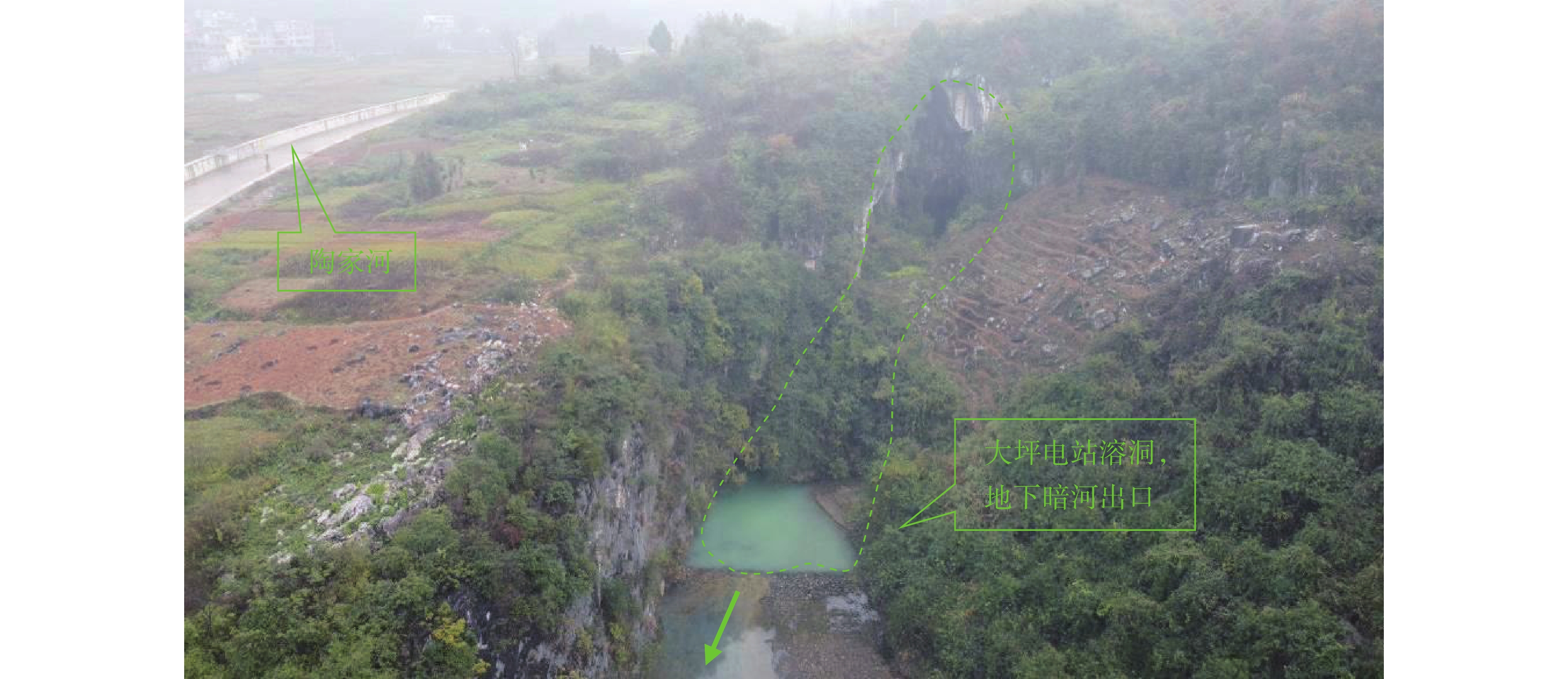
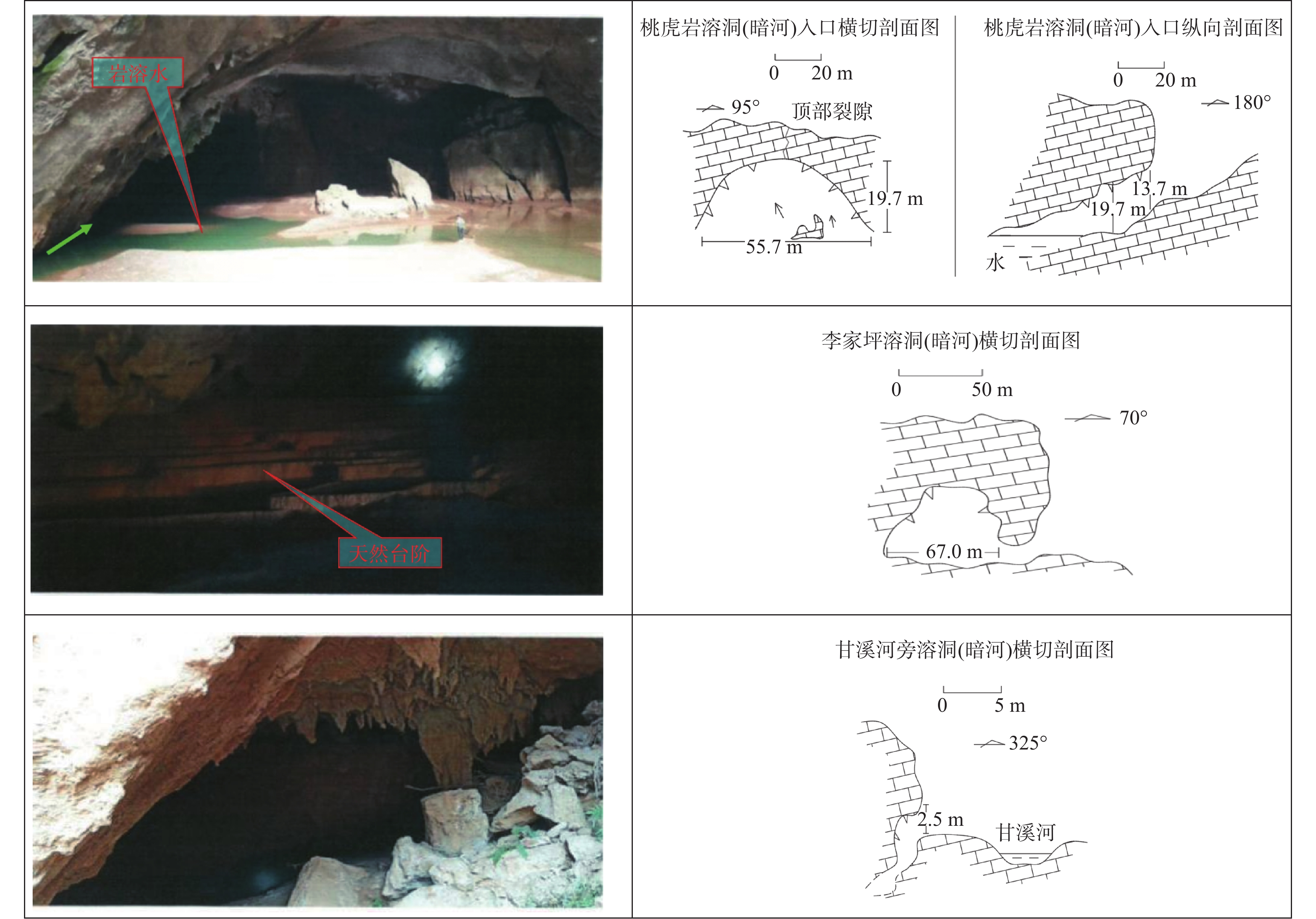
图 1 浅部岩溶发育特征及素描图
Figure 1. Characteristics of shallow karst structure and its sketch map
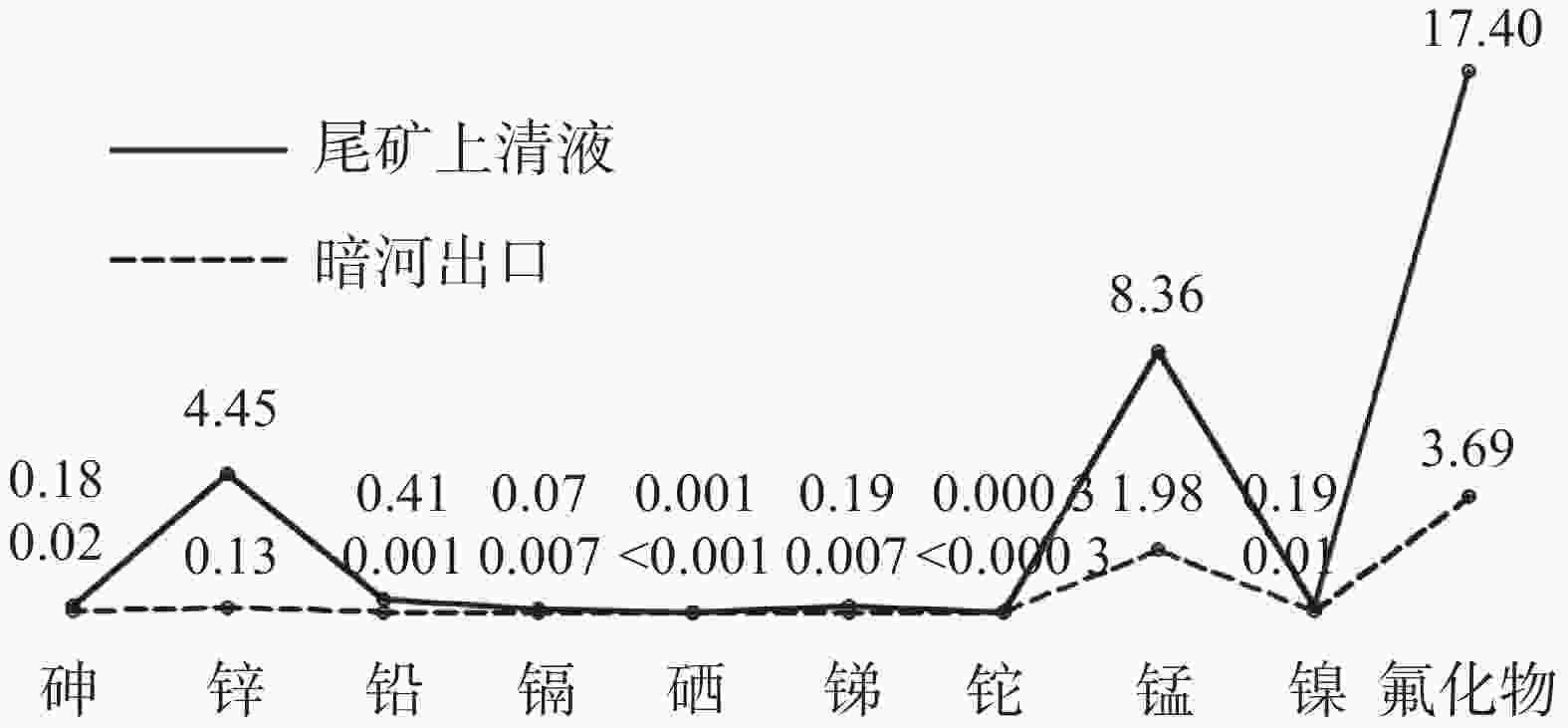
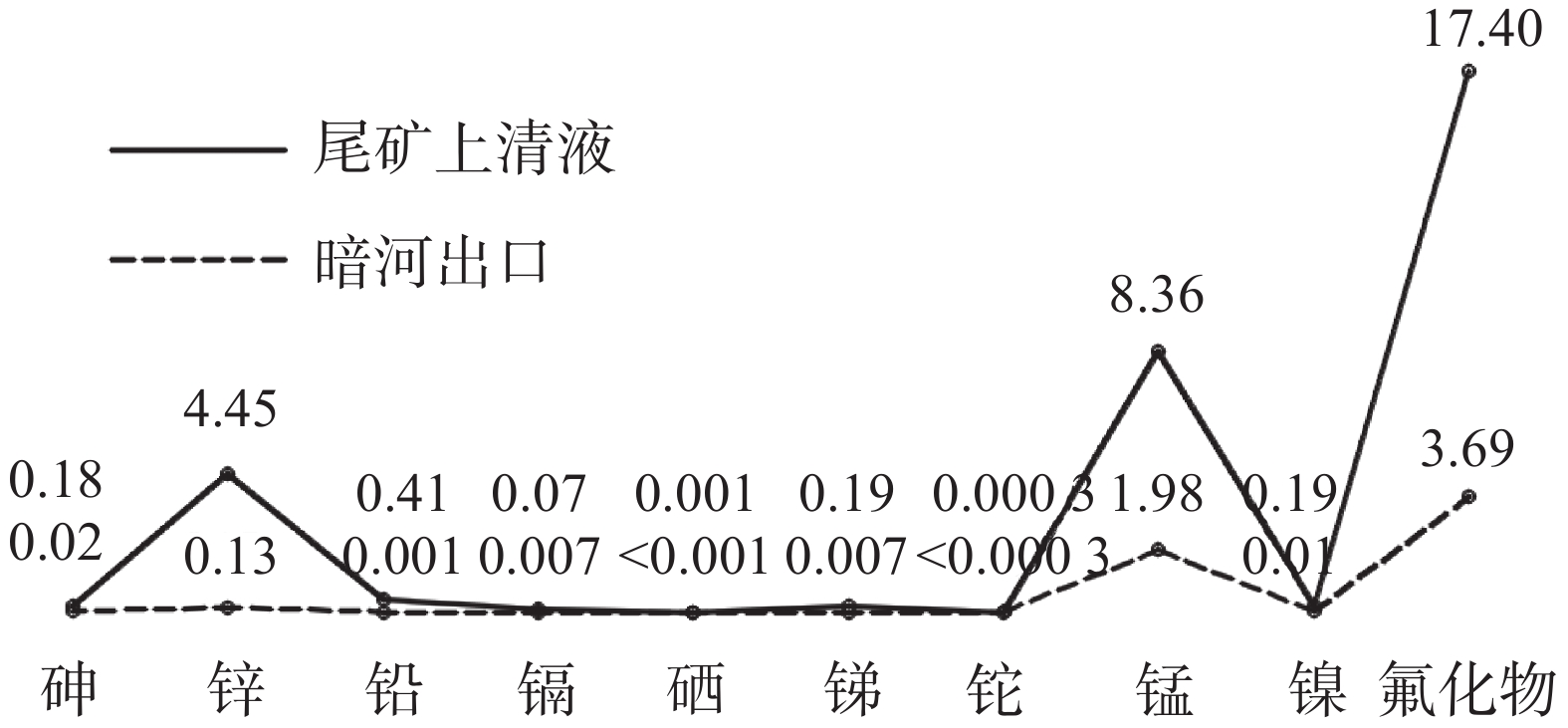
图 3 尾矿上清液与暗河水不同物质浓度曲线特征图
Figure 3. Curve characters of various elements from supernatant of Da Congli tailing reservior and hiding river
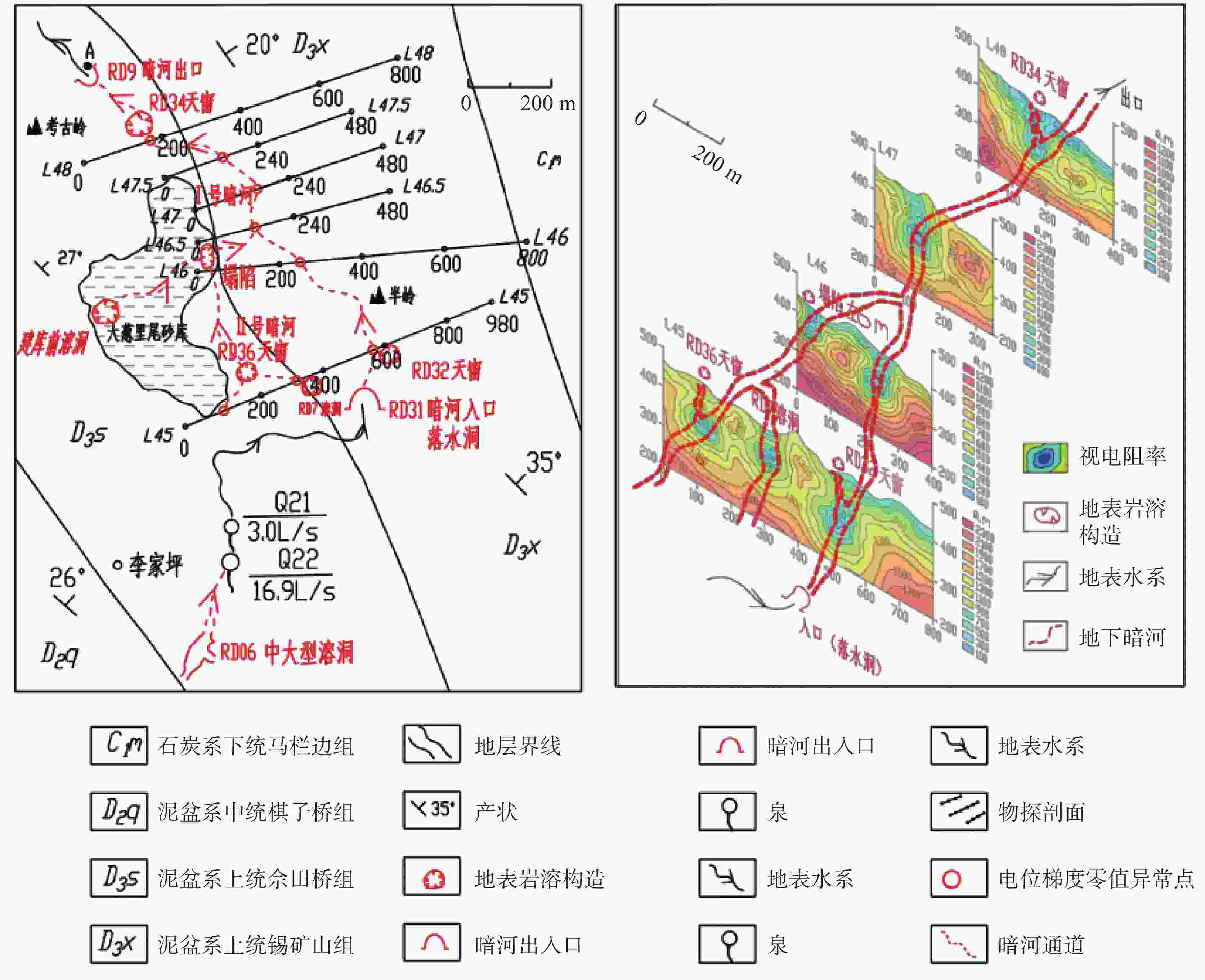
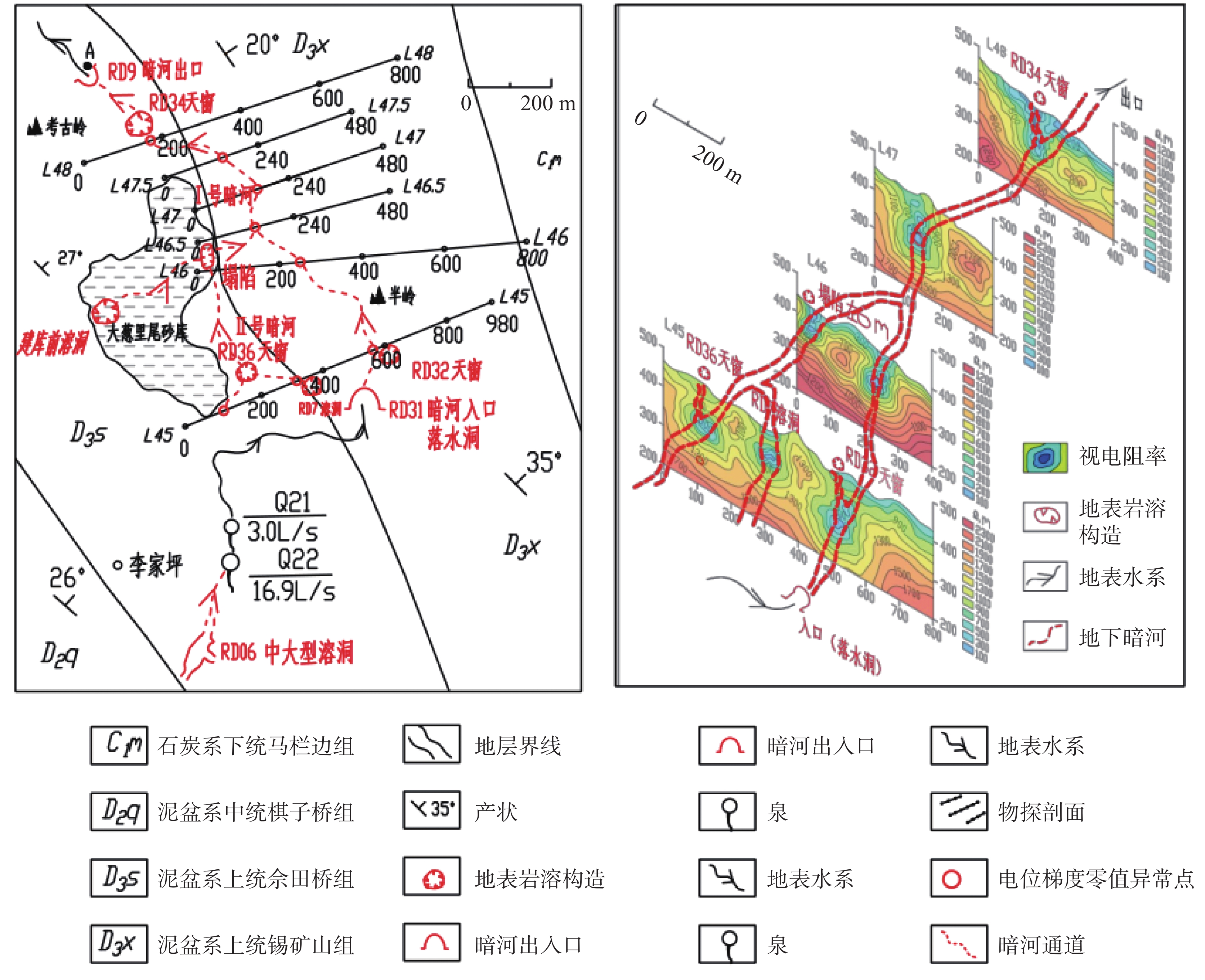
图 4 大葱里尾砂库周边岩溶暗河平面、断面特征图
Figure 4. Planar distribution and transverse sections of karst hiding rivers nearby the Da Ccongli tailing reservior
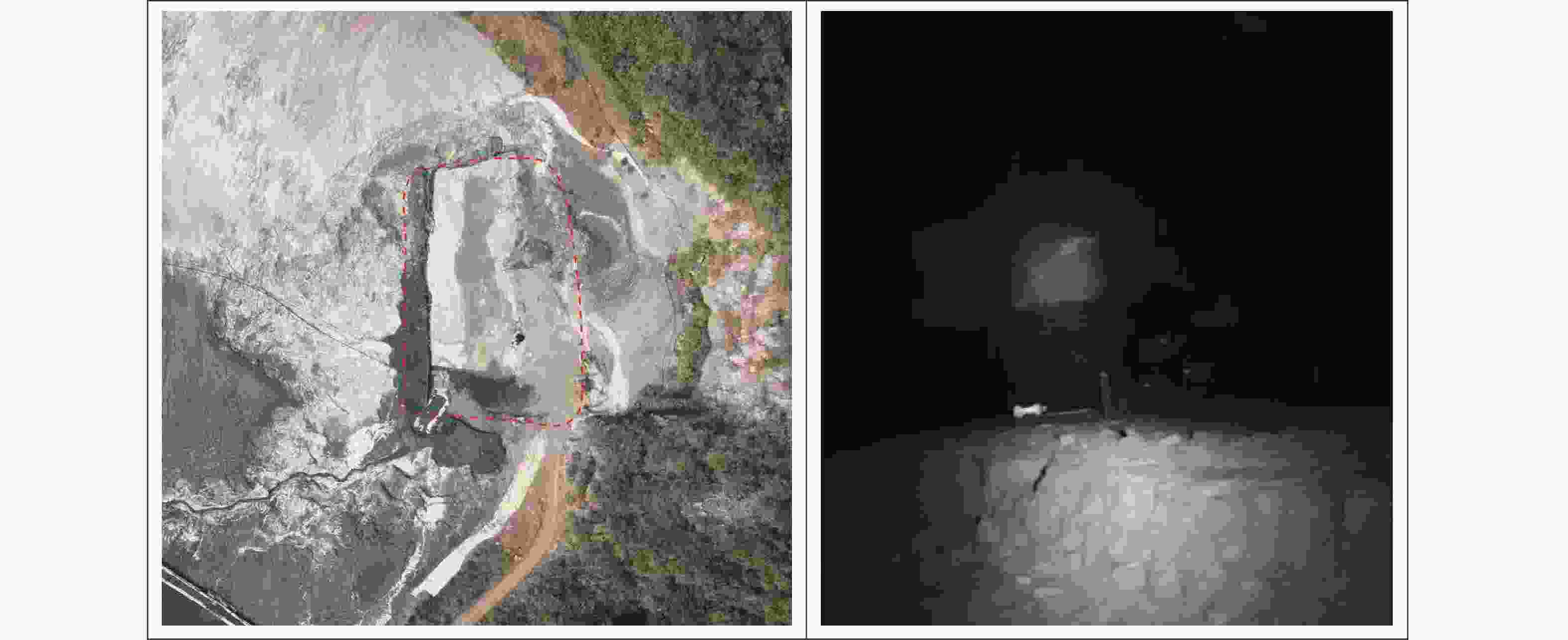
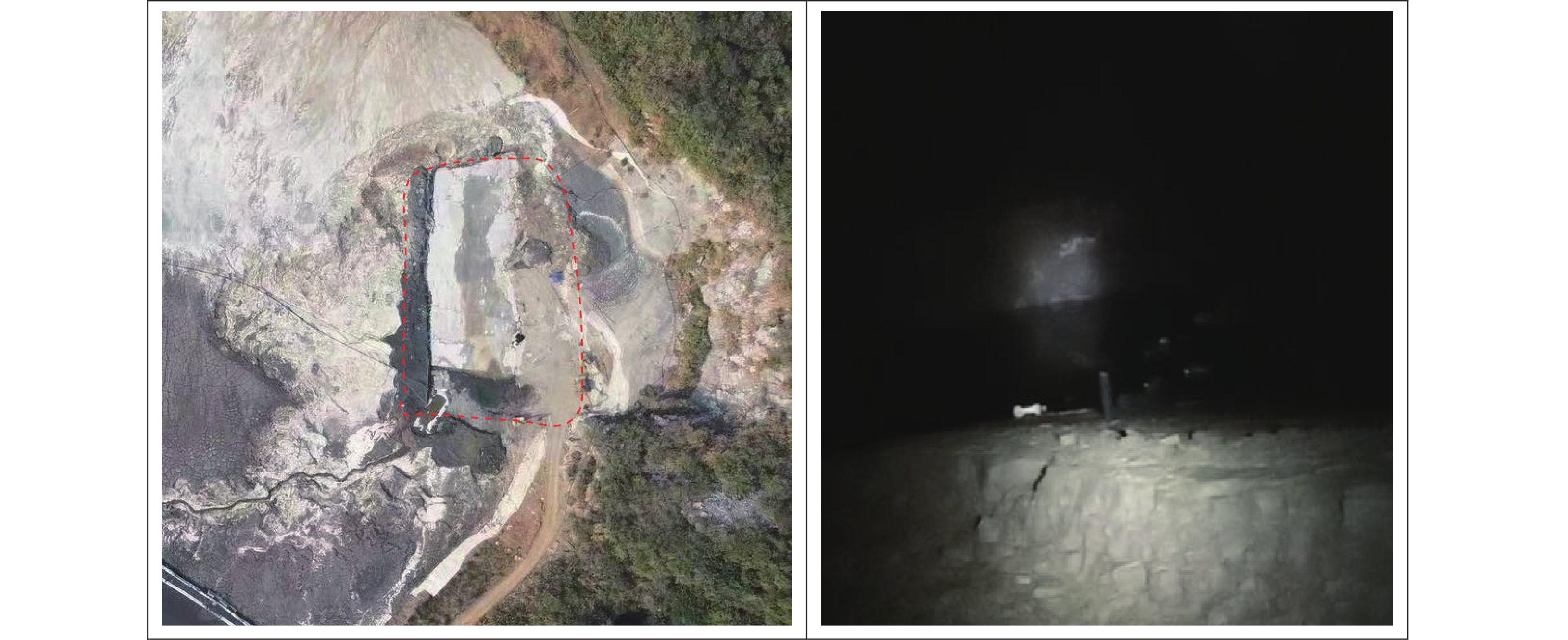
图 5 尾矿砂塌陷及暗河出口污染物堆积体
Figure 5. Collapse in tailing sand reservior and the pollutant pile in export of dark rivers
表 1 暗河下游岩溶水水质检测结果表
Table 1. Test results of karst water quality from lower reaches of dark river
检测项 PH 砷(ml·L−1) 锌(ml·L−1) 铅(ml·L−1) 镉(ml·L−1) 硒(ml·L−1) 检测结果 7.48 0.03125 0.132 0.000125 0.00078 0.00041 质量级别 \ I~III类 I~II类 I类 I~II类 检测项 锑(ml·L−1) 铊(ml·L−1) 锰(ml·L−1) 镍(ml·L−1) 氟化物(ml·L−1) 检测结果 0.0067 0.00006 1.98 0.0117 3.695 质量级别 \ 超V类 标准依据:地表水环境质量标准GB 3838 -2002中表1(地表水环境质量标准基本项目标准限值ml·L−1) 下载: 导出CSV
表 2 陶家河上游~下游2020年流量监测结果统计表(万t/日)
Table 2. Flow monitoring results of TAO Jia river ranging from upstream to downstream in 2020(w.t/d)
断面号\日期 2月25日 4月20日 6月15日 8月20日 10月25日 12月19日 上游108断面 23.6 30.7 150.9 101.4 60.5 35.8 下游109断面 22.3 28.3 145.1 95.8 57.7 33.1 垂向渗透率 5.5% 7.8% 3.8% 5.5% 4.6% 7.5%
下载: 导出CSV
表 3 尾矿上清液不同物质分析结果表
Table 3. Test results of various elements from supernatant of Da Congli tailing reservior
PH 锌(ml·L−1) 锑(ml·L−1) 锰(ml·L−1) 铊(ml·L−1) 砷(ml·L−1) 铅(ml·L−1) 镉(ml·L−1) 硒(ml·L−1) 镍(ml·L−1) 氟化物(ml·L−1) 6.3 4.45 0.186 8.36 0.00031 0.1845 0.4145 0.075555 0.001135 0.1875 17.4
下载: 导出CSV
-
[1] 南亚林, 杨惠, 甄平福. 陕北神府矿区地下水污染评价[J]. 地下水, 2018, 40(5): 5-8,25. doi: 10.3969/j.issn.1004-1184.2018.05.002Nan Yalin, Yang Hui, Zhen Pingfu. Groundwater contamination assessment of Shenfu mining area in northern Shaanxi province[J]. Ground Water, 2018, 40(5): 5-8,25. doi: 10.3969/j.issn.1004-1184.2018.05.002 [2] 丁坚平, 鄢贵权, 王伍军. 工业废渣库岩溶渗漏水动力弥散污染及其防治研究[J]. 中国岩溶, 1998(02): 2-7.Ding Jianping, Yan Guiquan, Wang Wujun. A study on leakage pollution and groundwater protection around an industrial waste residue site in karst region[J]. Carsologica Sinica, 1998(02): 2-7. [3] 时坚, 王晶, 刘德深, 韩行瑞. 山西岩溶泉域水污染现状、趋势与防治对策研究[J]. 中国岩溶, 2004(3): 53-58. doi: 10.3969/j.issn.1001-4810.2004.03.007Shi Jian, Wang Jin, Liu Deshen, Han Xingrui. Study on the pollution status, trend and protection measure of Shangxi karst springs[J]. Carsologica Sinica, 2004(3): 53-58. doi: 10.3969/j.issn.1001-4810.2004.03.007 [4] 高旭波, 王万洲, 侯保俊, 高列波, 张建友, 张松涛, 李成城, 姜春芳. 中国北方岩溶地下水污染分析[J]. 中国岩溶, 2020, 39(03): 287-298. doi: 10.11932/karst2020y25Gao Xubo, Wang Wanzhou, Hou Baojun, Gao Liebo, Zhang Jianyou, Zhang Songtao, Li Chengcheng, Jiang Chunfang. Analysis of karst groundwater pollution in northern China[J]. Carsologica Sinica, 2020, 39(03): 287-298. doi: 10.11932/karst2020y25 [5] 赵子千, 沙浩群, 黄赳, 何小松, 潘琦, 柳榭阳. 煤矸石堆场地下水污染特征及成因研究[J]. 环境工程技术学报, 2023, 13(04): 1604-1613.Zhao Ziqian, Sha Haoqun, Huang Jiu, He Xiaosong, Pan Qi, Liu Xieyang. Study on the characteristics and causes of groundwater pollution incoal gangue dumps[J]. Journal of Environmental Engineering, 2023, 13(04): 1604-1613. [6] 文士茵. 矿山开采对地下水污染风险评价研究[J]. 环境与发展, 2019, 31(01): 54-55. doi: 10.16647/j.cnki.cn15-1369/X.2019.01.030Wen Shiyin. Research on risk assessment of groundwater pollution caused by mining[J]. Environment and Development, 2019, 31(01): 54-55. doi: 10.16647/j.cnki.cn15-1369/X.2019.01.030 [7] 易世友, 李强, 高峰, 陈涛, 江瑞萍. 典型岩溶地下河系统污染成因及修复治理效果分析[J]. 四川地质学报, 2024, 44(04): 657-663. doi: 10.3969/j.issn.1006-0995.2024.04.014Yi Shiyou, Li Qiang, Gao Feng, Chen Tao, Jiang Ruiping. Analysis of pollution causes and remediation effects of typical karst underground river system[J]. Acta Geologica Sichuan, 2024, 44(04): 657-663. doi: 10.3969/j.issn.1006-0995.2024.04.014 [8] 罗林, 郑明英, 王万金. 典型非均质岩溶地下水污染治理新思路及关键技术[J]. 地下水, 2024, 46(03): 77-79.Luo Lin, Zheng Mingying, Wang Wanjin. New ideas and key technologies for pollution control of typical non-homogeneous karst groundwater[J]. Ground Water, 2024, 46(03): 77-79. [9] 罗晛. 矿区地下水污染的原因、特征及治理措施[J]. 世界有色金属, 2021(21): 229-230. doi: 10.3969/j.issn.1002-5065.2021.21.113Luo Xian. Causes, characteristics and treatment measures of groundwater pollution in mining area[J]. World Nonferrous Metals, 2021(21): 229-230. doi: 10.3969/j.issn.1002-5065.2021.21.113 [10] 李星宇, 南天, 王新娟, 李鹏, 谢振华, 邵景力. 数值模拟方法在隐伏岩溶水源地保护区划分及污染治理中的应用[J]. 中国岩溶, 2014, 33(03): 280-287.Li Xingyu, Nan Tian, Wang Xinjuan, Li Peng, Xie Zhenghua, Shao Jingli. Application of the numerical simulation method in concealed karst wellhead for protection area delimitation and contamination prevention[J]. Carsologica Sinica, 2014, 33(03): 280-287. [11] 张军以, 王腊春, 马小雪, 张丽. 西南岩溶地区地下水污染及防治途径[J]. 水土保持通报, 2014, 34(02): 245-249.Zhang Junyi, Wang Lachun, Ma Xiaoxue, Zhang Li. Groundwater pollution and controlling measures in karst mountainous areas of southwestern China[J]. Bulletin of Soil and Water Conservation, 2014, 34(02): 245-249. [12] 李元仲. 山东陶枣煤田矿业开发对裂隙岩溶水的污染机理及防治对策[J]. 中国地质灾害与防治学报, 2014, 25(03): 62-66.Li Yuanzhong. The mechanism and prevention measures of fracture-karst water pollution induced by mining at Taozao coalfield in Shandong province[J]. The Chinese Journal of Geological Hazard and Control, 2014, 25(03): 62-66. [13] 刘伟威, 贾龙, 刘昶, 周富彪. 河池市金城江区城西岩溶水源地砷污染来源及途径[J]. 中国岩溶, 2024, 43(4): 854-862,875. doi: 10.11932/karst20240405Liu Weiwei, Jia Long, Liu Chang, Zhou Fubiao. Sources and pathways of arsenic pollution in the karst water source area in the west of Jinchengjiang district, Hechi City[J]. Carsologica Sinica, 2024, 43(4): 854-862,875. doi: 10.11932/karst20240405 [14] 孙晓杰, 赵立, 邢益毓, 郝晓丹, 刘红, 陈一宁. 山西省地下水2016—2020年水质变化趋势及污染因子分析[J]. 环境科学导刊, 2022, 41(6): 73-79 doi: 10.13623/j.cnki.hkdk.2022.06.009Sun Xiaojie, Zhao Li, Xing Yiyu, Hao Xiaodan, Liu Hong, Chen Yining. Analysis of Groundwater Quality Change Trend and Pollution Factors in Shanxi Province from 2016 to 2020[J]. Environmental Science Survey, 2022, 41(6): 73-79 doi: 10.13623/j.cnki.hkdk.2022.06.009 [15] 杜文堂, 王占辉, 冯更辰, 李树文, 张景森. 邢台市岩溶水污染现状与演化趋势预测[J]. 中国岩溶, 2011, 30(03): 285-290. doi: 10.3969/j.issn.1001-4810.2011.03.008Du Wentang, Wang Zhanhui, Feng Gengchen, Li Shuwen, Zhang Jingseng. Study on the situation and evolution trend of karst water pollution in Xingtai City[J]. Carsologica Sinica, 2011, 30(03): 285-290. doi: 10.3969/j.issn.1001-4810.2011.03.008 [16] 刘长礼, 王秀艳, 吕敦玉, 赵悦文. 中国南方岩溶地下水面源污染风险评价及防控对策[J]. 地球学报, 2017, 38(06): 910-918. doi: 10.3975/cagsb.2017.06.06Liu Changli, Wang Xiuyan, Lyu Dunyu, Zhao Yuewen. Risk assessment and control countermeasures of southern China's karst groundwater areal source pollution[J]. Acta Geoscientica Sinica, 2017, 38(06): 910-918. doi: 10.3975/cagsb.2017.06.06 [17] 管清花, 李福林, 王爱芹, 冯平, 田婵娟, 陈学群, 刘丹. 济南市岩溶泉域地下水化学特征与水环境演化[J]. 中国岩溶, 2019, 38(05): 653-662. doi: 10.11932/karst20190501Guan Qinghua, Li FUlin, Wang Aiqin, Feng Ping, Tian Chanjuan, Chen Xuequn, Liu Dan. Hydrochemistry characteristics and evolution of karst spring groundwater system in Jinan[J]. Carsologica Sinica, 2019, 38(05): 653-662. doi: 10.11932/karst20190501 [18] 宁航, 王宗星, 柳富田, 蒋万军, 常威, 张竞, 万军伟. 基于系统空间特征识别的岩溶地下水污染成因分析[J]. 地质科技通报, 2022, 41(05): 367-376Ning hang, Wang Zongqing, Liu Futian, Jiang Wanjun, Chang Wei, ZHANG Jing, WAN Junwei. Genesis of karst groundwater contamination based on system spatial feature recognition[J]. Bulletin of Geological Science and Technology, 2022, 41(05): 367-376 [19] 张恒. 黔西南煤区岩溶地下河污染调查方法探析[J]. 地下水, 2016, 38(04): 93-95. doi: 10.3969/j.issn.1004-1184.2016.04.035Zhang Heng. Pollution sources survey in karst underground river in coal- producing regions southwest of Guizhou[J]. Ground Water, 2016, 38(04): 93-95. doi: 10.3969/j.issn.1004-1184.2016.04.035 [20] 李曦滨. 综合勘查技术方法在喀斯特地区煤矿酸性矿井水污染勘查的应用——以贵州省凯里市鱼洞河流域龙洞泉水污染勘查为例[J]. 中国煤炭地质, 2021, 33(12): 76-82. doi: 10.3969/j.issn.1674-1803.2021.12.16Li Xibin. Application of integrated exploration technology in karst area coalmine acid mine water pollution wxploration—a case study of Yudonghe watershed Longdong spring water pollution exploration in Kaili city, Guizhou province[J]. Coal Geology of China, 2021, 33(12): 76-82 doi: 10.3969/j.issn.1674-1803.2021.12.16 [21] 王战军. 电法在追索水库坝区地下暗河中的应用[J]. 物探与化探, 2019, 43(5): 1157-1162.Wang Zhanjun. The application of electrical method to tracking underground river of reservoir dam area[J]. Geophysical and Geochemical Exploration, 2019, 43(5): 1157-1162. [22] 陈开银, 熊英举. 充电法在贵阳市站街太平村岩溶管道地下河路径勘探中的应用[J]. 科技风, 2021(32): 193-195.Chen Kai'in, Xiong Yingju. Application of charging method in underground river path exploration of karst pipeline in Taiping village, Zhanjie, Guiyang city[J]. Technology Wind, 2021(32): 193-195. [23] 羊文, 张西君, 冯娟, 陈丞, 杨磊. 充电法和高密度电法在贵州贞丰者相二金矿岩溶勘查中的应用[J]. 贵州地质, 2021, 38(2): 192-200. doi: 10.3969/j.issn.1000-5943.2021.02.011Yang Wen, Zhang Xijun, Feng Juan, Chen Cheng, Yang Lei. Application of mise-a-la-masse method and high-density electrical method in karst exploration of zhexiang No. 2 gold deposit in Zhenfeng, Guizhou[J]. Guizhou Geology, 2021, 38(2): 192-200. doi: 10.3969/j.issn.1000-5943.2021.02.011 [24] 黄小军, 王鹏, 董亮. 高密度电法在地下暗河勘探中的应用[J]. 资源环境与工程, 2012, 26(1): 66-68. doi: 10.3969/j.issn.1671-1211.2012.01.016Huang Xiaojun, Wang Peng, Dong Liang. Application of high density resistivity method on the underground river exploration[J]. Resources Environment & Engineering, 2012, 26(1): 66-68. doi: 10.3969/j.issn.1671-1211.2012.01.016 [25] 刘道涵, 徐俊杰, 齐信, 邬健强. 基于高密度电法的城市岩溶地下水通道三维电性成像[J]. 中国岩溶, 2023, 42(6): 1331-1338.Liu Daohan, Xu Junjie, Qi Xin, Wu Jianjiang. Three-dimensional electrical imaging of urban karst groundwater channels based on electrical resistivity tomography[J]. Carsologica Sinica, 2023, 42(6): 1331-1338. [26] 韩凯, 郑智杰, 甘伏平, 陈贻祥, 陈玉玲. 利用多源大功率充电法定位复杂岩溶含水通道的方法[J]. 吉林大学学报, 2016, 46(5): 1501-1510.Han Kai, Zheng Zhijie, Gan Fuping, Chen Yixiang, Chen Yuling. Determination of complex karst water channel using multi-source high power Mise-A-La-Masse method[J]. Journal of Jilin University, 2016, 46(5): 1501-1510. [27] 陈贻祥, 黄奇波, 覃小群, 韩凯, 肖琼, 苗迎, 杜成亮, 贺德煌. 自然电场法与高密度电法联作在西江中下游岩溶区找水中的应用[J]. 中国岩溶, 2022, 41(5): 684-697. doi: 10.11932/karst20220502Chen Yixiang, Huang Qibo, Qin Xiaoqun, Han Kai, Xiao Qiong, Miao Ying, Du Chengliang, He Dehuang. Application of self-potential and high-density resistivity method to the water exploration in karst terrain of middle-lower reaches of Xijiang River[J]. Carsologica Sinica, 2022, 41(5): 684-697. doi: 10.11932/karst20220502 [28] 武毅, 孙银行, 李凤哲. 西南岩溶地区不同含水介质地球物理勘查技术[J]. 中国岩溶, 2011, 30(3): 278-284. doi: 10.3969/j.issn.1001-4810.2011.03.007Wu Yi, Sun Yinhang, Li Fengzhe. The geophysical prospecting technique in different aquifer media in karst area, Southwest China[J]. Carsologica Sinica, 2011, 30(3): 278-284. doi: 10.3969/j.issn.1001-4810.2011.03.007 [29] 宋晨, 潘晓东, 刘天云, 罗飞, 曾洁, 彭聪, 程瑞瑞, 张文平. 云南省一把伞水库主封堵区岩溶渗漏条件与管道特征分析[J]. 中国岩溶, 2024, 43(5): 1088-1098. doi: 10.11932/karst2024y033Song Chen, Pan Xiaodong, Liu Tianyun, Luo Fei, Zeng Jie, Peng Cong, Cheng Ruirui, Zhang Wenping. Analysis of karst leakage conditions and pipeline characteristics in the main blocked area of Yibasan reservoir, Yunnan[J]. Carsologica Sinica, 2024, 43(5): 1088-1098. doi: 10.11932/karst2024y033 [30] 韩凯, 梁东辉, 甘伏平, 黄芬. 用高精度示踪技术和大功率充电法确定地下河系统的管道分布特征: 以毛村地下河系统为例[J]. 中国岩溶, 2021, 40(5): 884-893. doi: 10.11932/karst20210513Han Kai, Liang Donghui, Gan Fuping, Huang Fen. Utilizing high-precision tracer technology and high-powered mise-a-la-masse method to determine the pipeline distribution characteristics of underground river system: a case study in Maocun underground river system[J]. Carsologica Sinica, 2021, 40(5): 884-893. doi: 10.11932/karst20210513 [31] 梁东辉, 甘伏平, 张伟, 韩凯. 微动HVSR法在岩溶区探测地下河管道和溶洞的有效性研究[J]. 中国岩溶, 2020, 39(1): 95-100.Liang Donghui, Gan Fuping, Zhang Wei, Han Kai. Study on the effectiveness of the microtremor HVSR method in detecting underground river pipelines and caves in karst areas[J]. Carsologica Sinica, 2020.39(1): 95-100. [32] 贾海鹏. 弹性波CT法在岩溶勘察中的应用研究[J]. 岩土工程技术, 2024, 38(4): 489-493. doi: 10.3969/j.issn.1007-2993.2024.04.020Jia Haipeng. Application research of elastic wave CT method in karst exploration[J]. Geotechnical Engineering Technique, 2024, 38(4): 489-493. doi: 10.3969/j.issn.1007-2993.2024.04.020 [33] 喻波. 拟三维跨孔地震波CT技术在桥梁桩基础岩溶勘察中的应用[J]. 工程地球物理学报, 2023, 20(4): 491-499.Yu Bo. Application of quasi-three-dimensional cross-hole seismic-wave tomography in karst investigation of bridge pile foundation[J]. Chinese Journal of Engineering Geophysics, 2023, 20(4): 491-499. [34] 李耐宾, 裴世建. 微动技术在大连地铁岩溶勘察中的应用[J]. 工程地球物理学报, 2019, 16(5): 580-585. doi: 10.3969/j.issn.1672-7940.2019.05.004Li Naibin, Pei Shijian. The application of microtremor technology to karst survey of the Dalian subway[J]. Chinese Journal of Engineering Geophysics, 2019, 16(5): 580-585. doi: 10.3969/j.issn.1672-7940.2019.05.004 [35] 苏会锋, 赵玉成, 温进芳. 探地雷达在武隆隧道岩溶、暗河探测中的应用[J]. 石家庄铁道学院学报, 2005(1): 54-57. doi: 10.3969/j.issn.2095-0373.2005.01.015Su Huifeng, Zhao Yucheng, Wen Jinfang. Application of ground-penetrating radarin Wulong tunnel's karst and underground river detection[J]. Journal of Shijiazhuang Tiedao University, 2005(1): 54-57. doi: 10.3969/j.issn.2095-0373.2005.01.015 [36] 李俊杰, 朱红雷, 赵国军, 夏志强, 郭佳豪. 地质雷达电磁干扰分析及在隧洞岩溶探测中的应用[J]. 中国岩溶, 2018, 37(2): 286-293. doi: 10.11932/karst20180216Li Junjie, Zhu Honglei, Zhao Guojun, Xia Zhiqiang, Guo Jiahao. Electromagnetic interference analysis of ground penetrating radar and its application in karst detection in tunnel[J]. Carsologica Sinica, 2018, 37(2): 286-293. doi: 10.11932/karst20180216 [37] 曾洁, 潘晓东, 任坤, 刘伟, 彭聪, 郑智杰. 贵州省碧云湖岩溶渗漏水文地质条件与渗漏管道位置识别[J]. 中国岩溶, 2024, 43(1): 201-208. doi: 10.11932/karst20240101Zeng Jie, Pan Xiaodong, Ren Kun, Liu Wei, Peng Cong, Zheng Zhijie. Hydrogeological conditions of karst leakage and locating of leakage channels in Biyun lake, Guizhou[J]. Carsologica Sinica, 2024, 43(1): 201-208. doi: 10.11932/karst20240101 [38] 龙绍都, 何斌. 湖南省岩溶水基本特征及其资源初步评价[J]. 湖南地质, 1985(2): 37-49.Long Shaodu, He Bin. Basic characteristics and preliminary evaluation of karst water resources in Hunan Province[J]. Hunan Geology, 1985(2): 37-49. [39] 陈任良, 巫金裕, 李芳贤. 香花岭岩溶暗河特征及利用问题[J]. 中国岩溶, 1985, 4(3): 51-58.Chen Renliang, Wu Jinyu, Li Fangxian. Features of subterran streams in karstified Xianghualing mt. and their utilization problems.[J]. Carsologica Sinica, 1985,4(3): 51-58. -

 点击查看大图
计量
- 文章访问数: 291
- HTML浏览量: 156
- PDF下载量: 114
- 被引次数: 0
