


Characteristics and Genesis of an Exceptionally Large Sinter Group in the Duolong Metallogenic Belt, Northern Xizang
-
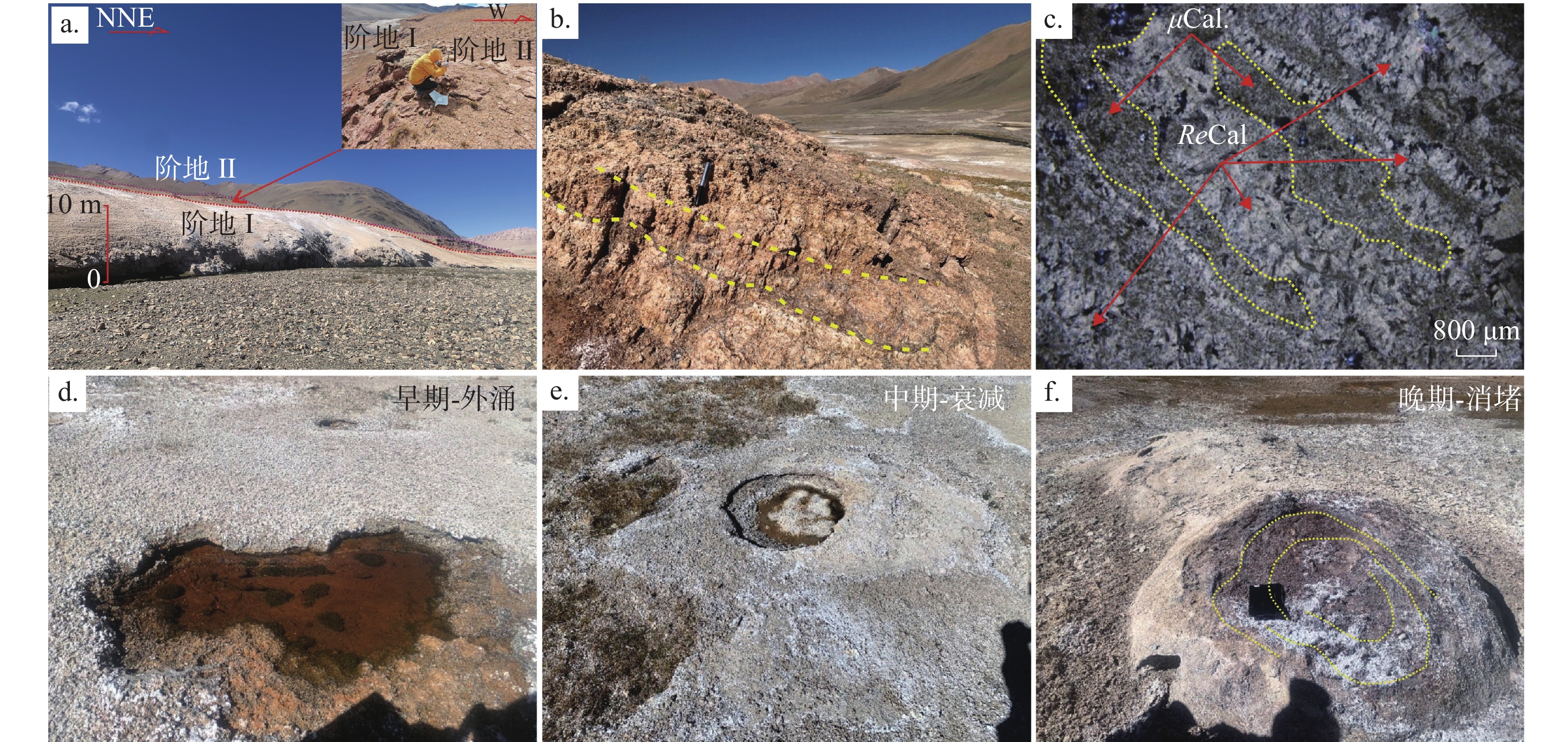
摘要: 藏北多龙矿集区新发现25×104 m2超大规模泉华群,开展新发现泉华群热泉水水化学特征和钙华成因机制研究,可为多龙矿集区地热资源可持续开发和地质遗迹保护提供参考依据。文章在野外地质调查基础上,对泉华群及周边热泉、河水、泉水等水体进行水化学分析,并对钙华开展δ13C和δ18O同位素取样测试。结果显示:垂向分为上、下两级阶地,热泉水温19.2~37.9 ℃,属低温热水类型。泉华群热泉TDS值为
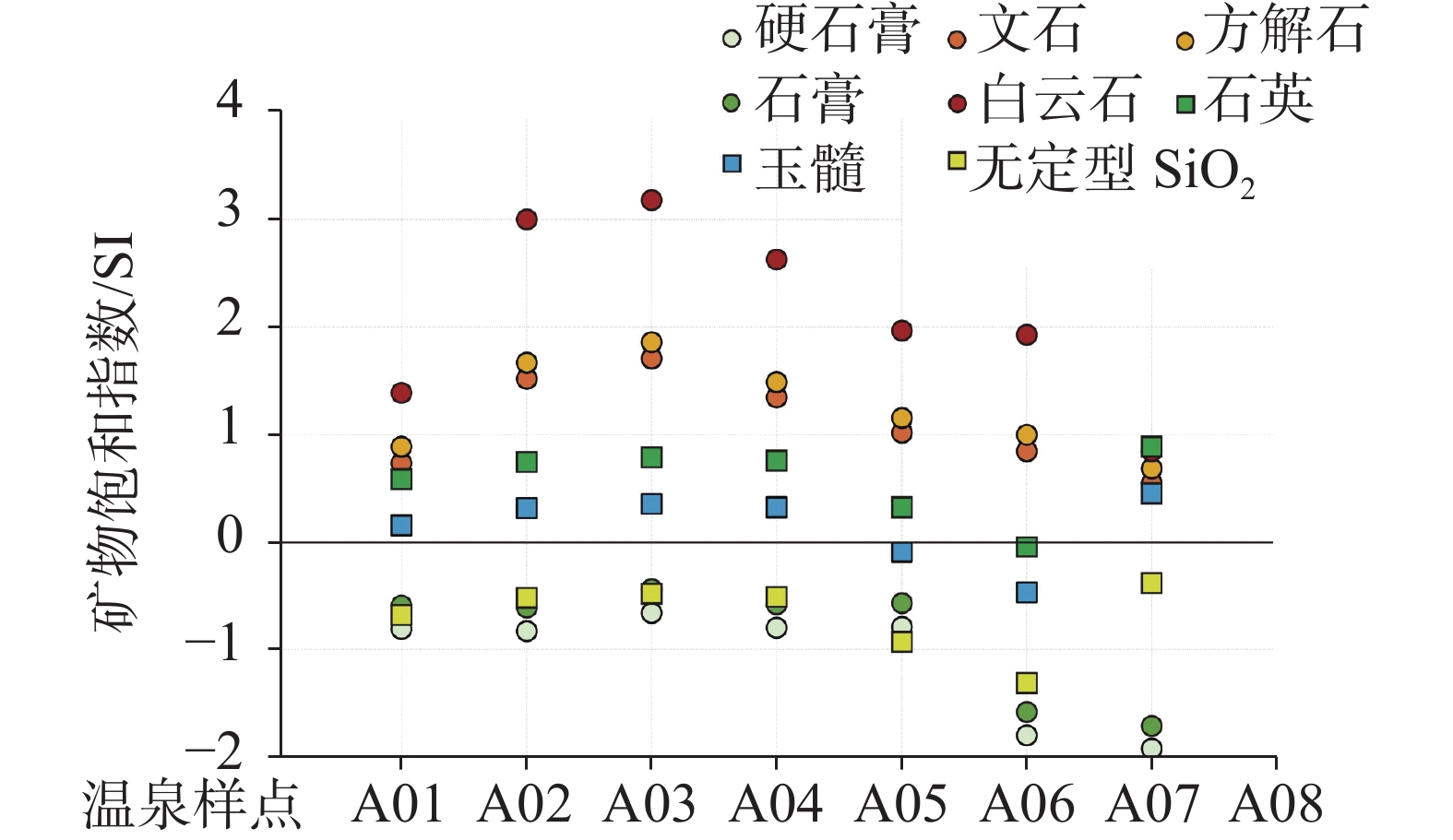
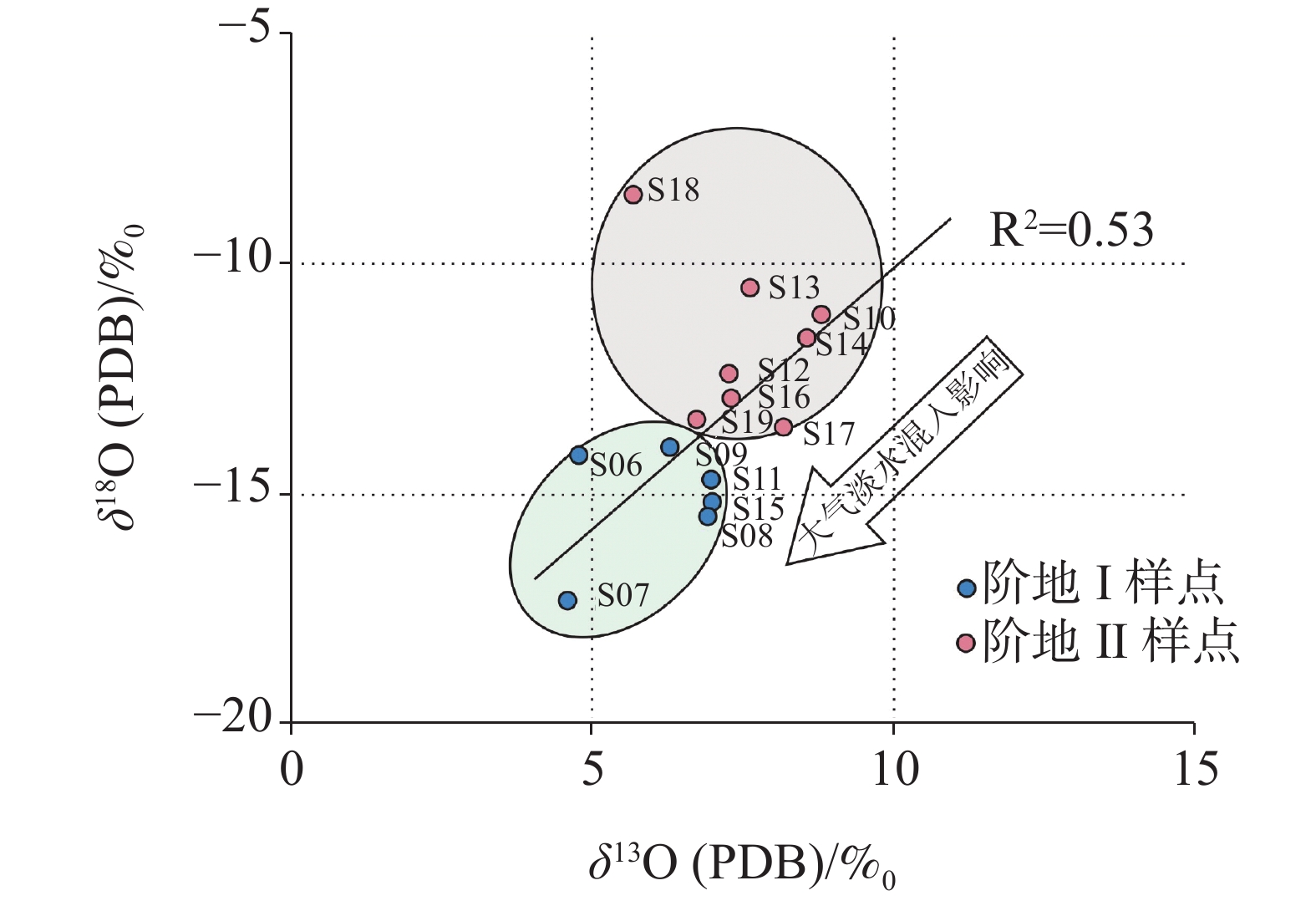
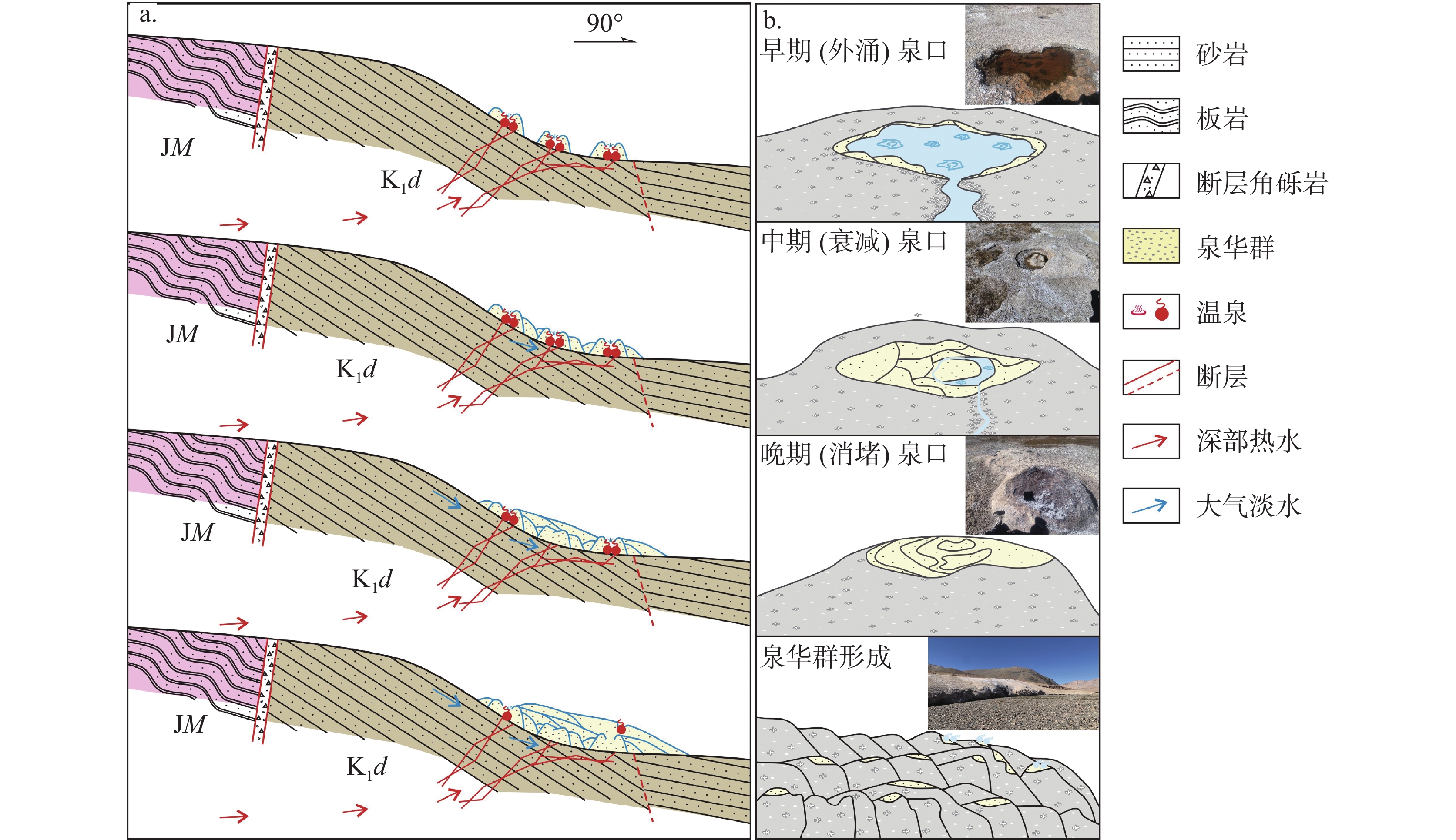
1625 ~1870 mg/L,水化学类型为HCO3·SO4-Na·Ca型,水中富含 Li、B、As,具深部热水属性,且与流域内其他水体水化学特征差异显著。Na-K-Mg三角图解表明热泉水水–岩相互作用尚未达到平衡状态,石英与玉髓呈饱和或近饱和状态,经3种SiO2地温计计算,热储温度为91.85~121.58 ℃。δ13C和δ18O同位素表明阶地Ⅰ(下级年代较新)的钙华受浅表冷水影响更强。整体上沿容日阿藏布发育的NE和NW向断裂成为连接姐尼拉索-拉嘎拉断裂的沟通导热断裂,为地热流体上涌并与大气淡水混入提供通道。在CO2脱气与蒸发浓缩作用下,经多期泉华沉积、封堵与突破,最终形成现今大规模连片泉华群地貌。Abstract:A giant hot spring sinter covering an area of 25×104 m2 was newly discovered in the Duolong ore concentration area, northern Xizang Research on the hydrochemical characteristics of thermal springs and the genetic mechanism of travertine in this newly identified sinter can provide a reference for the sustainable development of geothermal resources and the protection of geological relics in the Duolong area, and also supply data support for studies on hydrothermal systems and tectonic evolution at different stages on the Qinghai-Xizang Plateau. Based on field geological surveys, this study performed hydrochemical analysis on water bodies including thermal springs, rivers, and springs within and around the sinter group, with a total of 10 hydrochemical sampling sites. δ13C and δ18O isotopic analyses were carried out on travertine samples, collecting 16 sets of isotopic data. The results showed as follows. (1) The newly discovered sinter group in the Duolong ore concentration area covers 25×104 m2 and is vertically divided into upper and lower terraces. The water temperature ranges from 19.2 to 37.9 ℃, belonging to low-temperature thermal water. Various spring vents developed on Terrace Ⅰ and Terrace Ⅱ directly record the morphological features of springs at different evolutionary stages, representing three types corresponding to the early (continuous upwelling), middle (declining), and late (blocked and extinct) stages of hot spring activity. (2) Thermal springs of the sinter group have moderate cation and anion contents, with total dissolved solids (TDS) ranging from 1625 to 1870 mg/L. The hydrochemical type is HCO3·SO4-Na·Ca, with relatively high concentrations of Li, B, and As, indicating a deep high-temperature thermal water origin. The hydrochemical characteristics are distinctly different from those of other thermal springs, rivers, springs, and lakes in the Rongriazangbo Basin. (3) The Na-K-Mg triangular diagram shows that all thermal waters, including those from the sinter group, fall in the unbalanced domain, indicating that water-rock interactions have not reached equilibrium. Quartz and chalcedony in the thermal waters are saturated or near-saturated, suggesting that they are the dominant silica phases in the geothermal reservoir. The reservoir temperatures estimated by the quartz geothermometer with steam loss, quartz geothermometer without steam loss, and revised SiO2 geothermometer are 99.06−119.50 ℃, 97.76−121.58 ℃, and 91.85−117.71 ℃, respectively. (4) For travertine from TerraceⅡ, δ13C ranges from 5.69‰ to 8.83‰ with a mean of 7.54‰, and δ18O ranges from -13.58‰ to -8.50‰ with a mean of -11.76‰. For travertine from TerraceⅠ, δ13C ranges from 4.80‰ to 7.01‰ with a mean of 6.10‰, and δ18O ranges from -17.34‰ to -14.00‰ with a mean of -15.15‰. This indicates that travertine in TerraceⅠ was more strongly affected by shallow cold water during its formation. (5) NE- and NW-trending faults along the Rongriazangbo act as conductive geothermal faults connecting the Jienilasuo-Lagala deep fault, providing pathways for the upwelling of thermal water and the mixing of meteoric freshwater. During geological history, deep thermal water continuously ascended along these faults. Driven by CO2 degassing and evaporative concentration, calcium carbonate precipitated continuously and blocked spring vents, forming drumlin-like spring mounds. The accumulated pressure forced thermal water to break through weak zones and form new springs. Multi-stage superimposition and lateral connection eventually formed the large-scale sinter group observed today.-
Key words:
- Northern Xizang Plateau /
- sinter group /
- travertine /
- hydrogeology /
- silica geothermometer
-
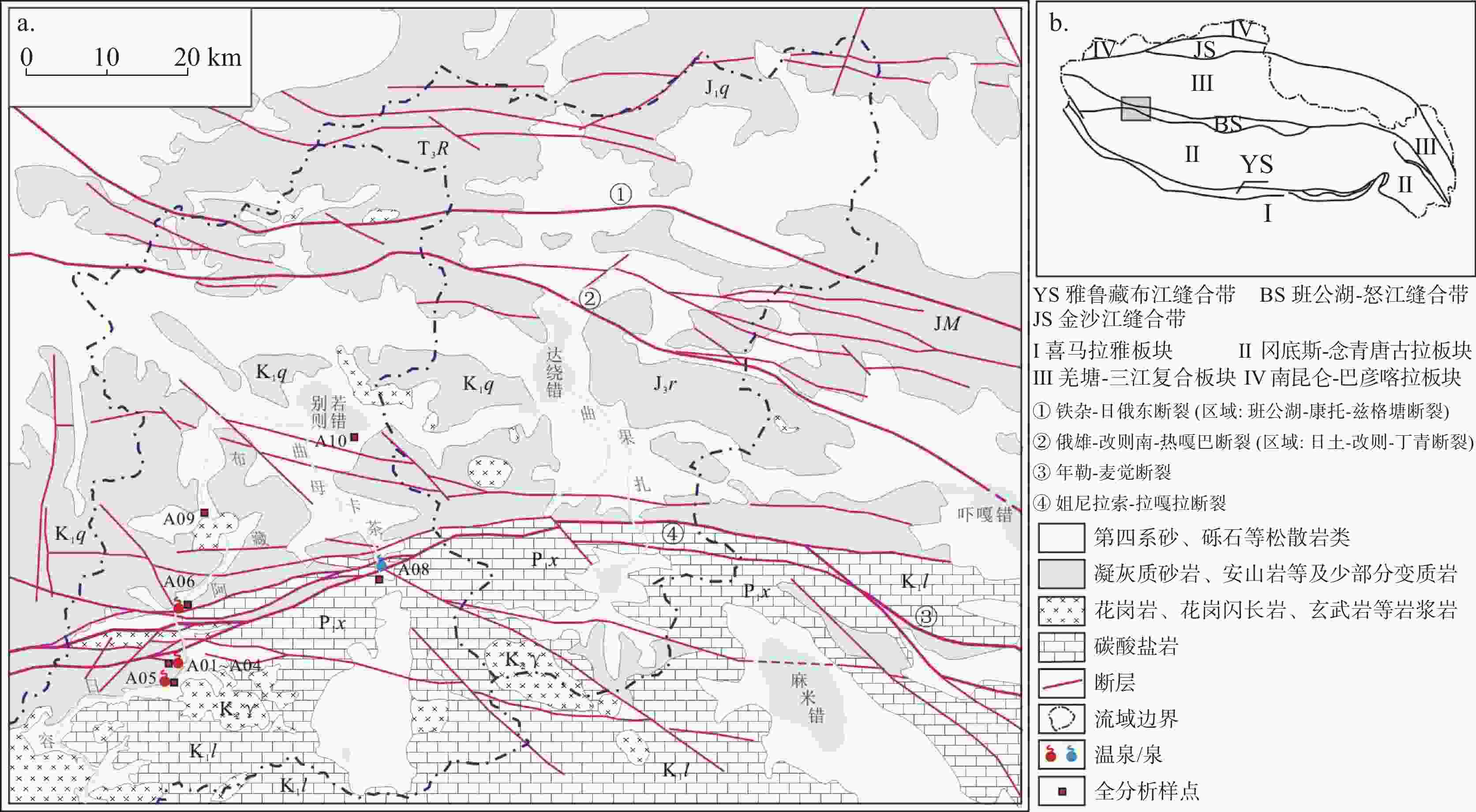
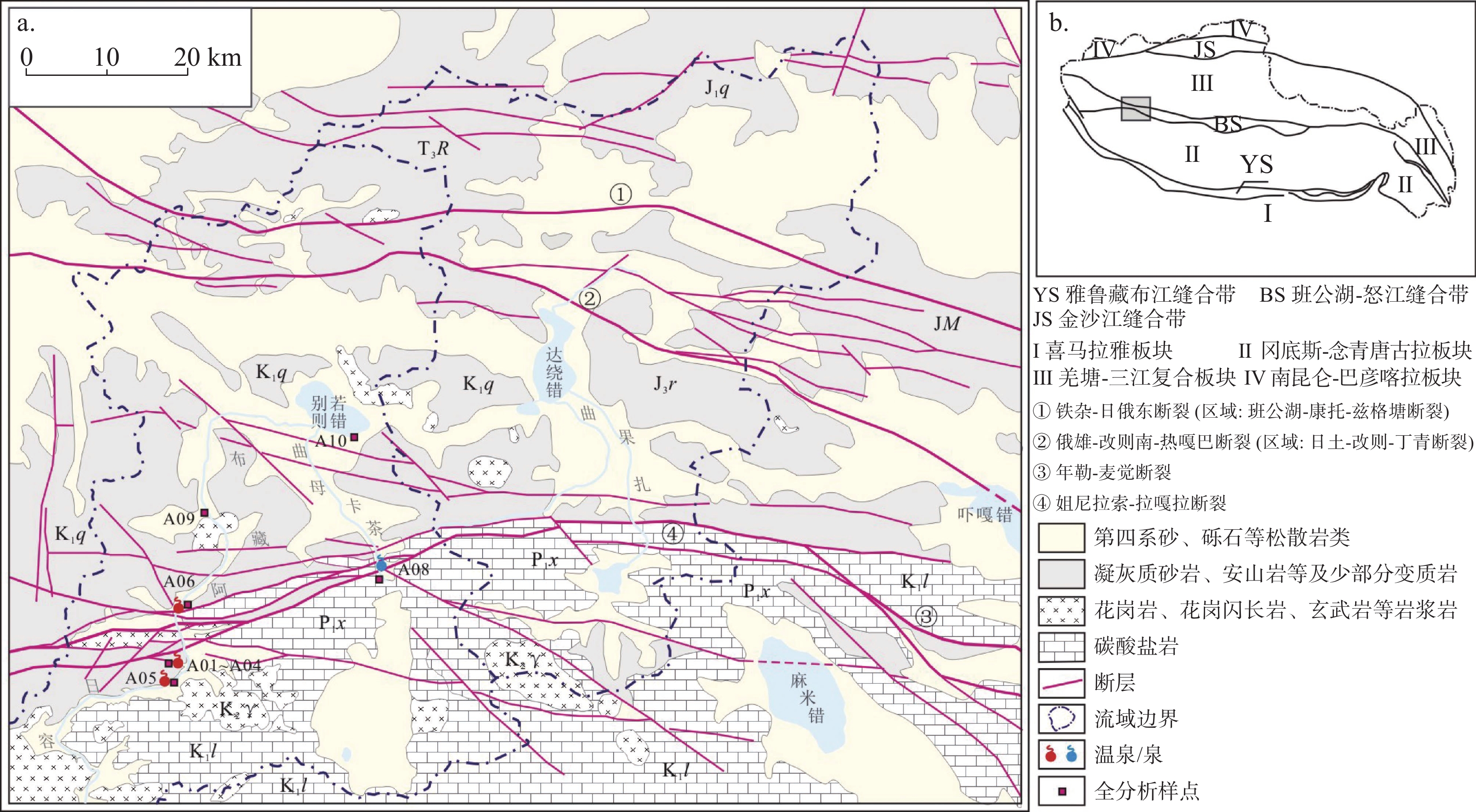
图 1 研究区区域地质背景简图(a)/大地构造位置图(b)图
K1l—早白垩世郎山组;K1q—早白垩世去申拉组;JM—侏罗纪木嘎岗日群;J3r—晚侏罗世日松组; T3R—晚三叠世日干配错群;P1x—早二叠世下拉组
Figure 1. Simplified map of the regional geological background of the study area (a) / tectonic location map (b)
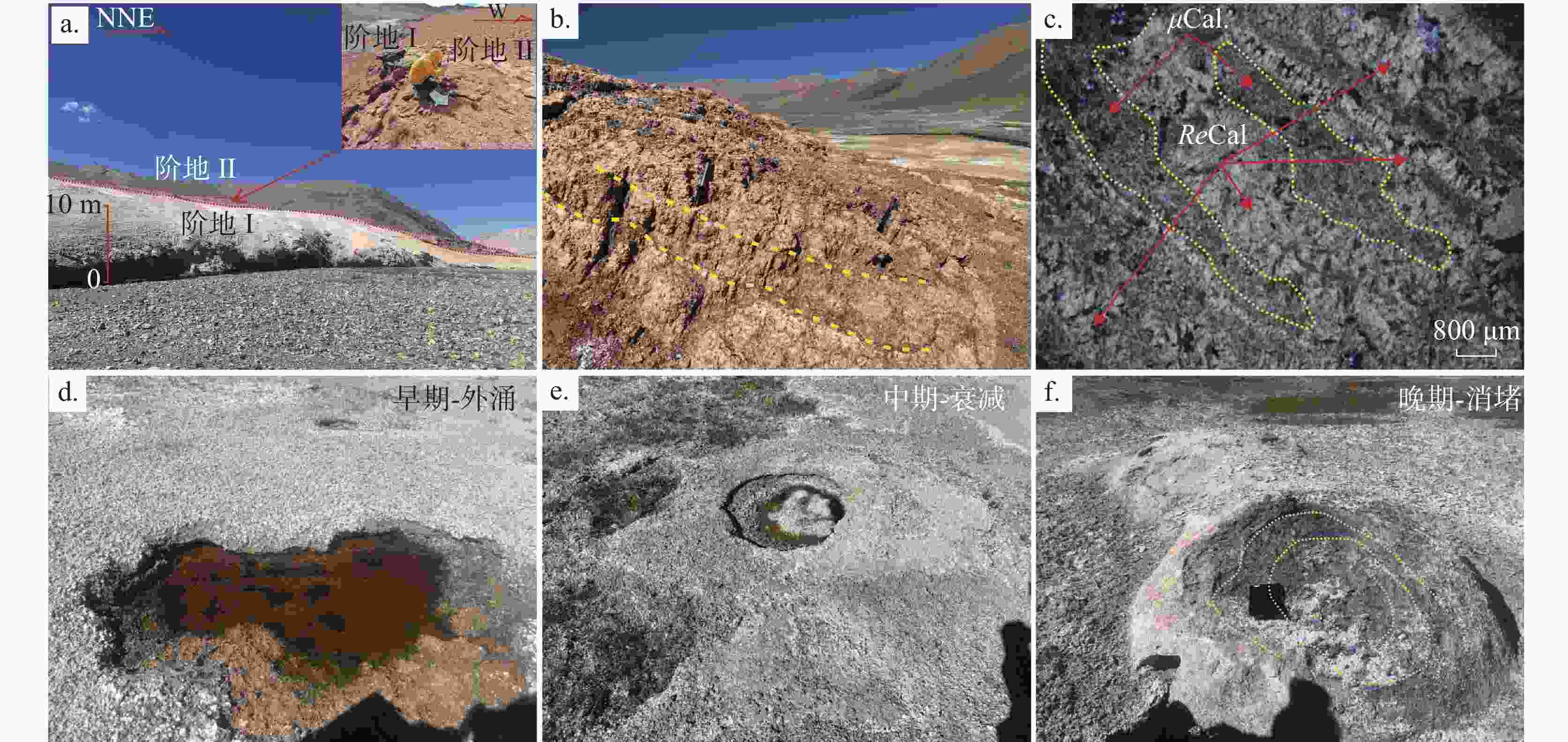
图 2 泉华群野外露头特征(a-b、d-f)和正交镜照片(c)
Figure 2. Field outcrop characteristics of the sinter group (a−b, d−f) and photomicrograph under cross-polarized light (c)
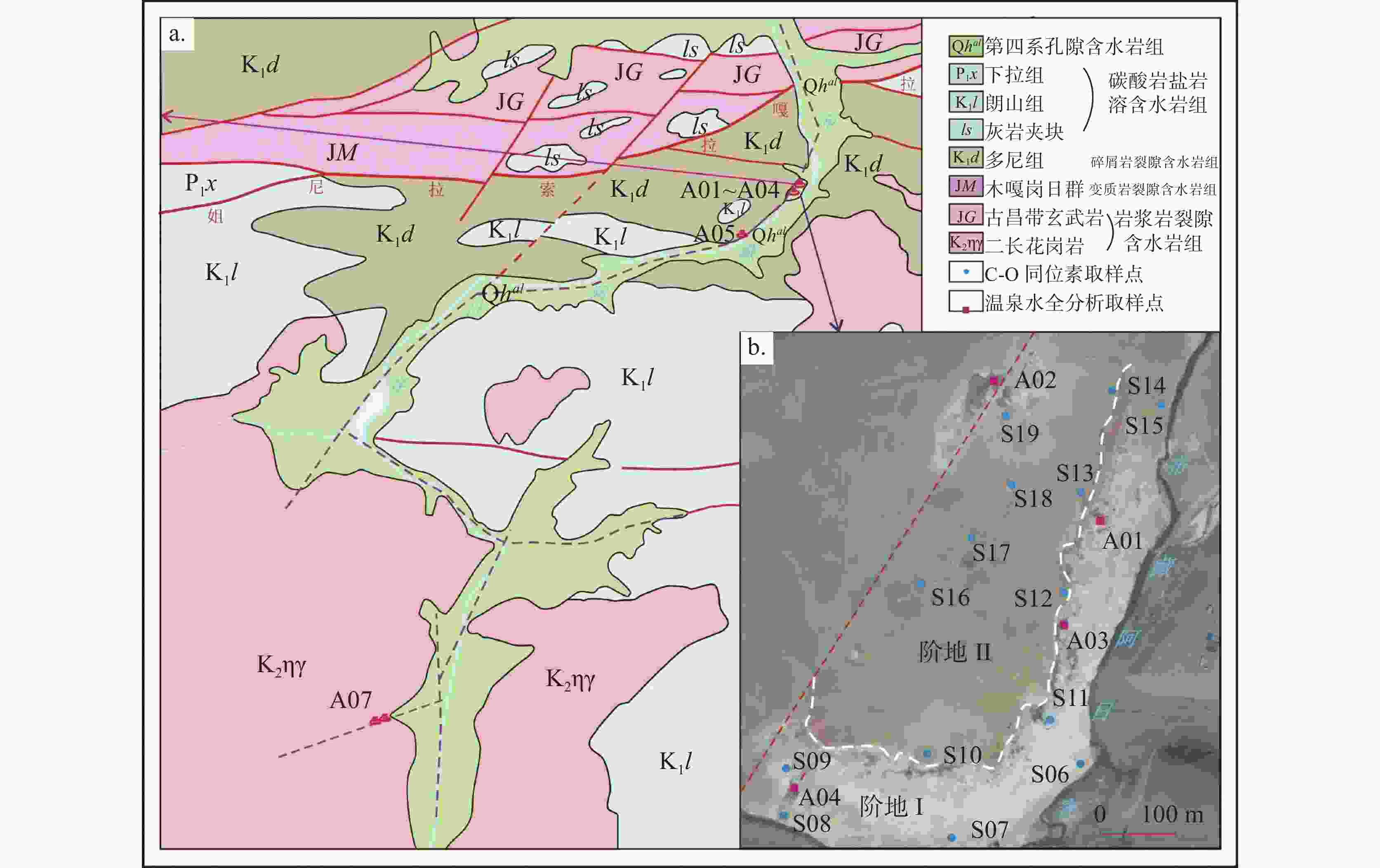
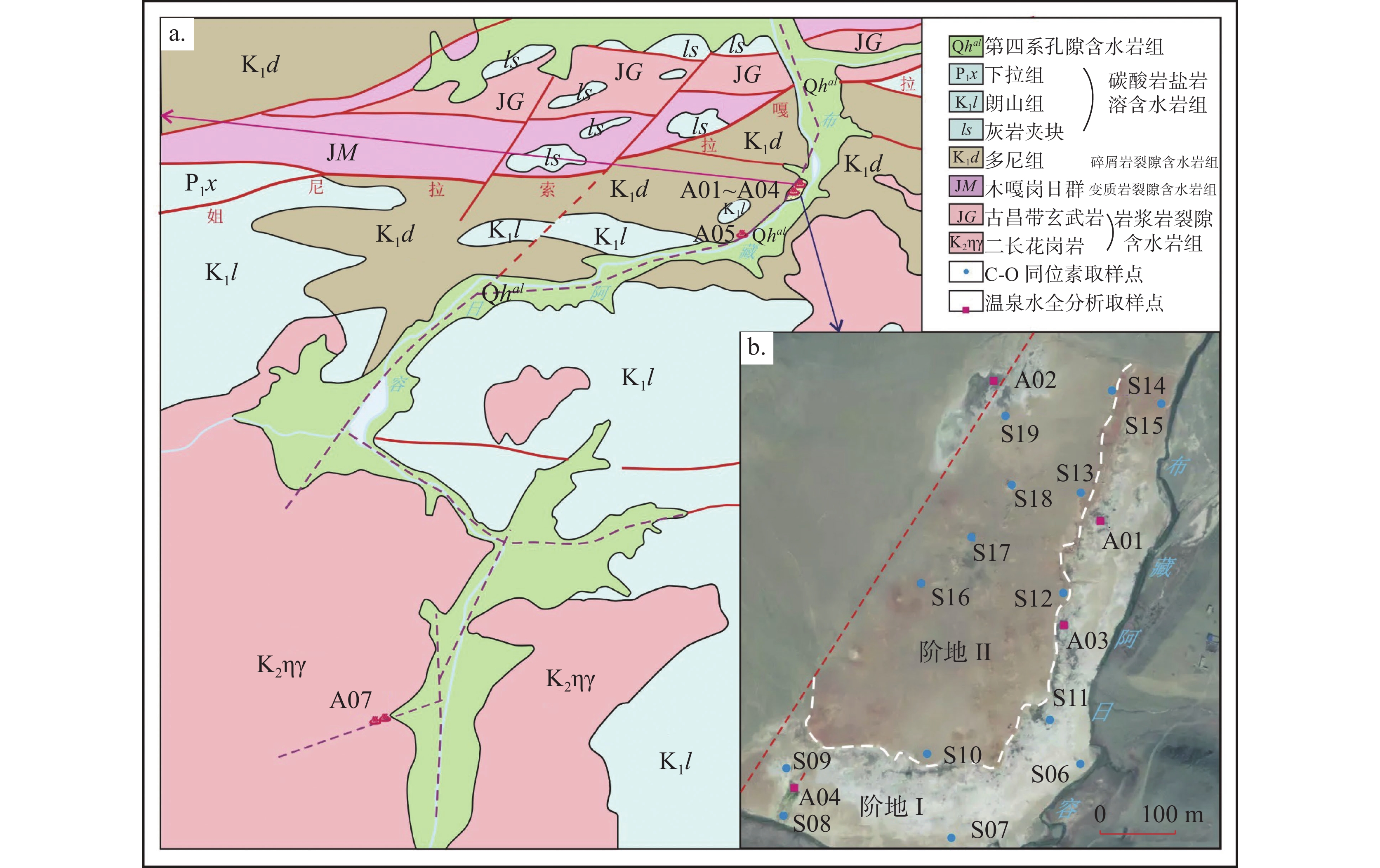
图 3 容日阿藏布流域温泉发育地质简图(a)和泉华群C-O同位素、泉水全分析样点分布图(b)
Figure 3. Simplified geological map of hot spring development in the Rongri Zangbo river basin (a) and distribution map of C-O isotope and complete water analysis sampling sites of sinter group and spring water (b)
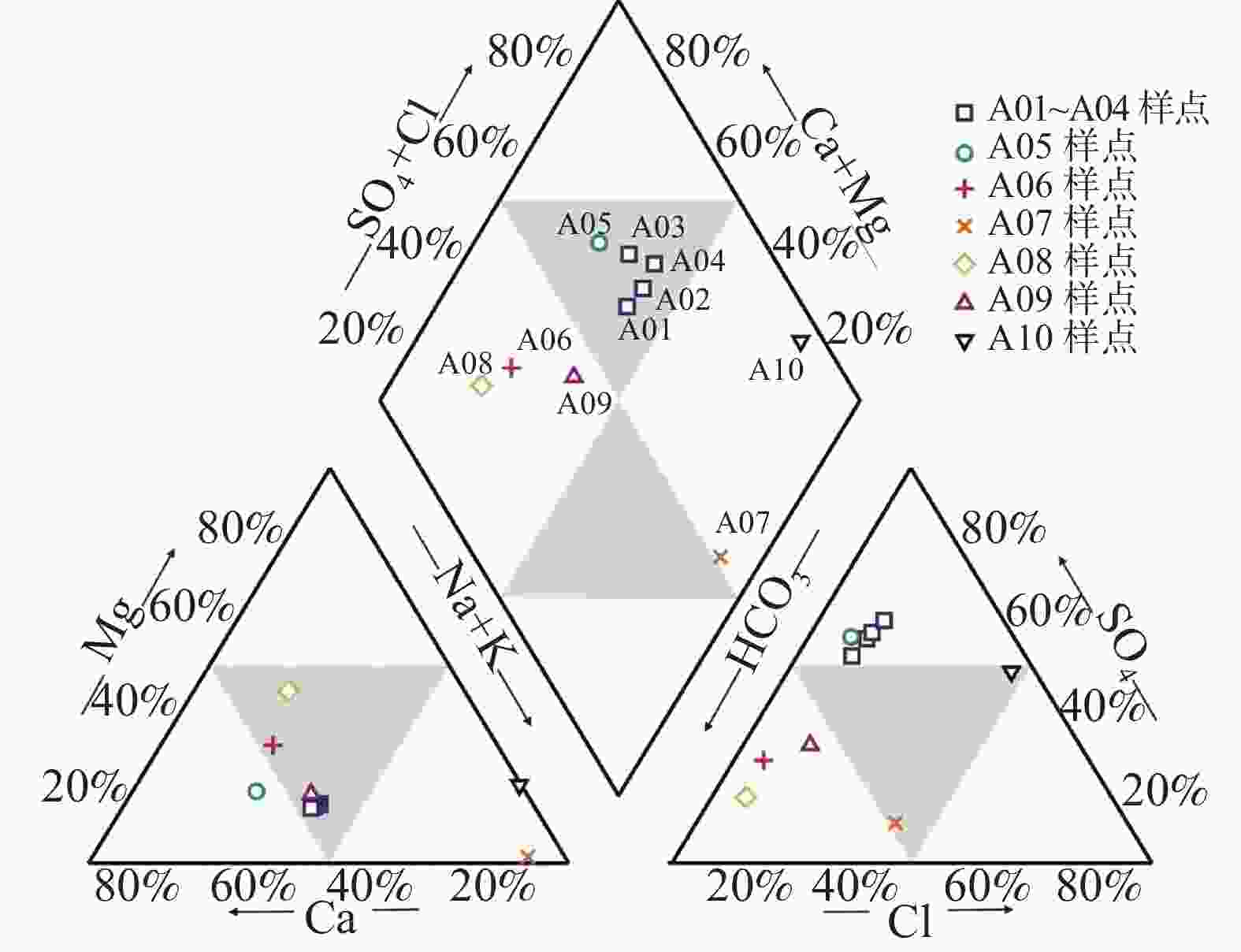
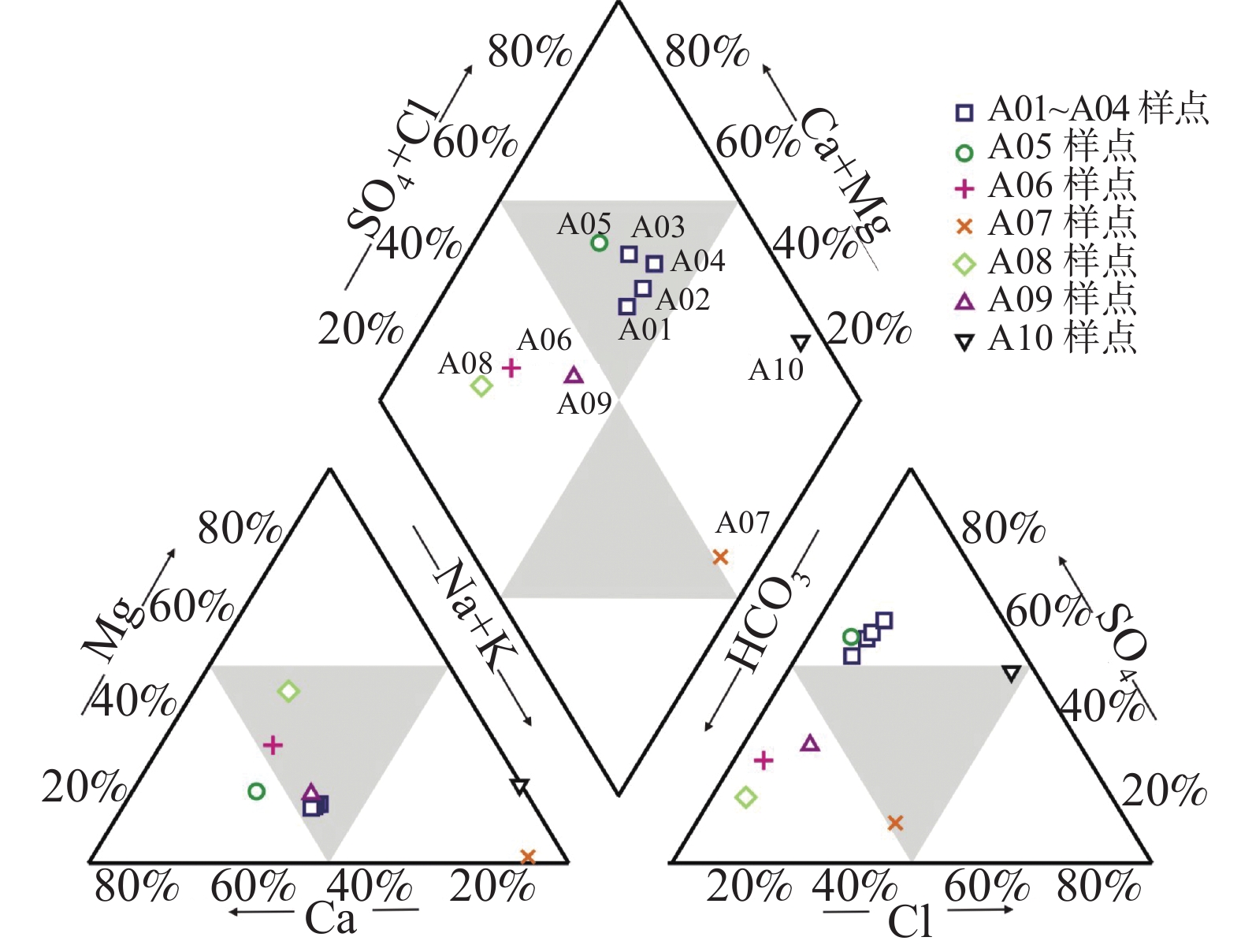
图 4 研究区各类型地下水Piper图
Figure 4. Piper diagram of various types of groundwater in the study area
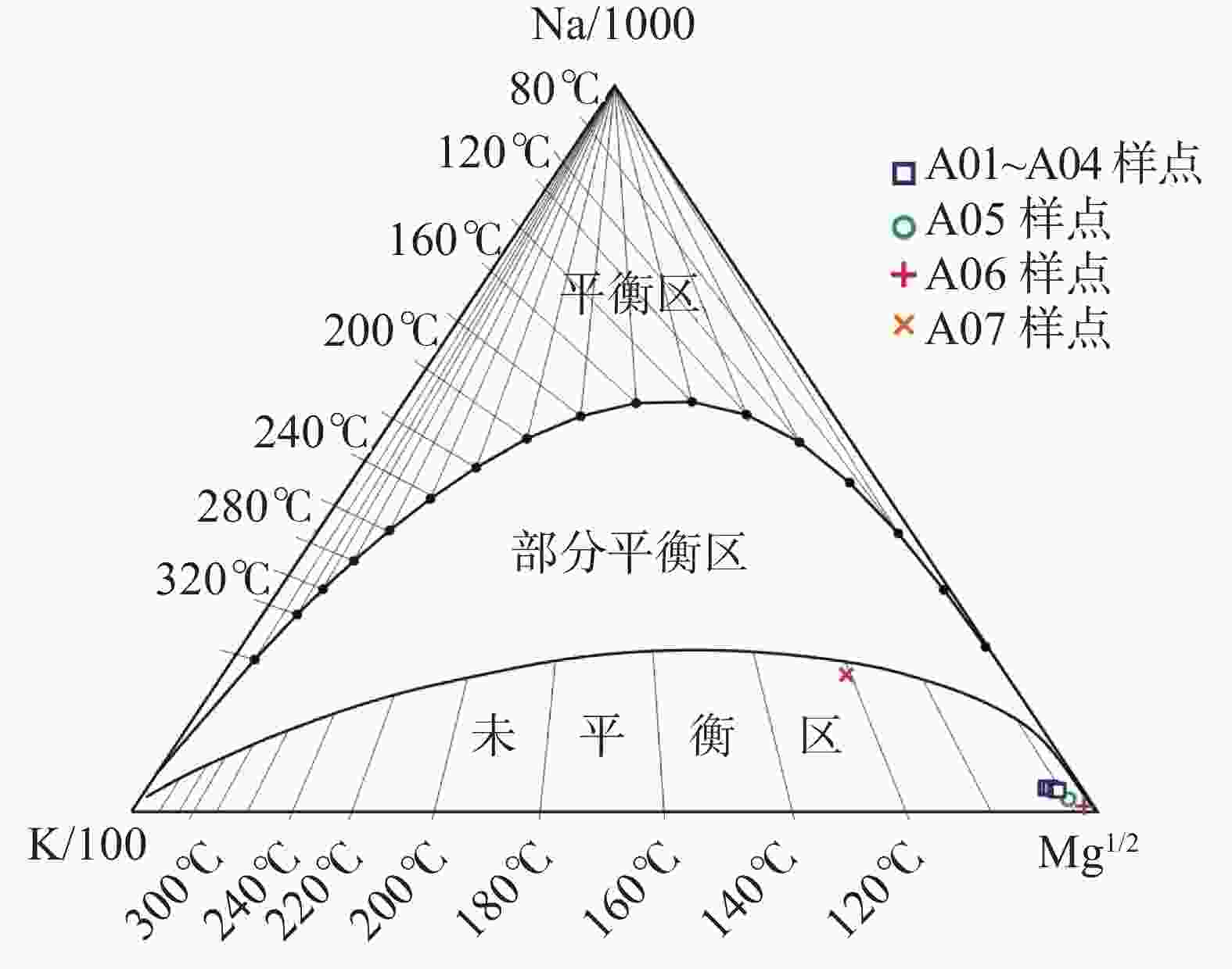
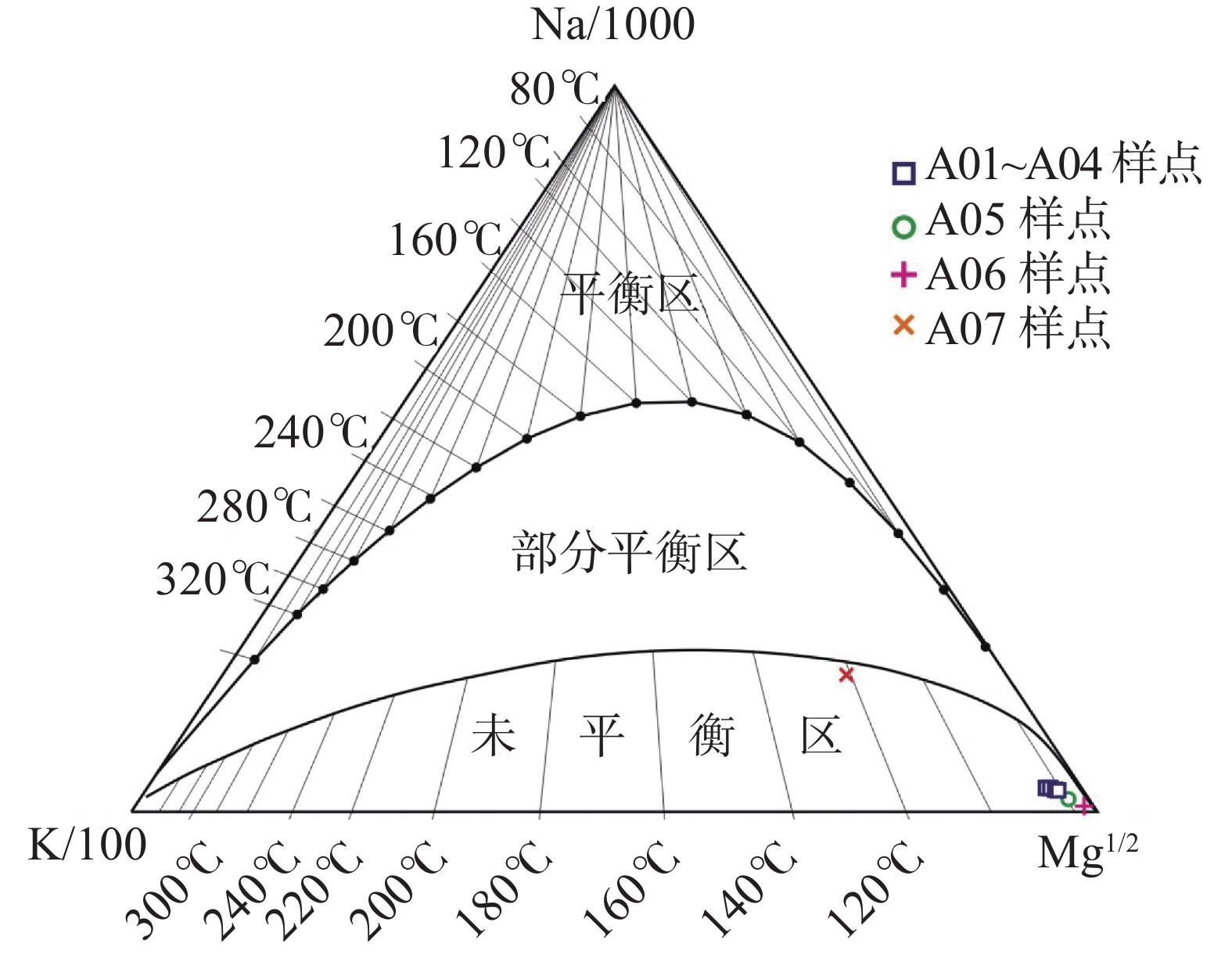
图 5 研究区热泉水Na-K-Mg三角图
Figure 5. Na-K-Mg ternary diagram of thermal spring water in the study area
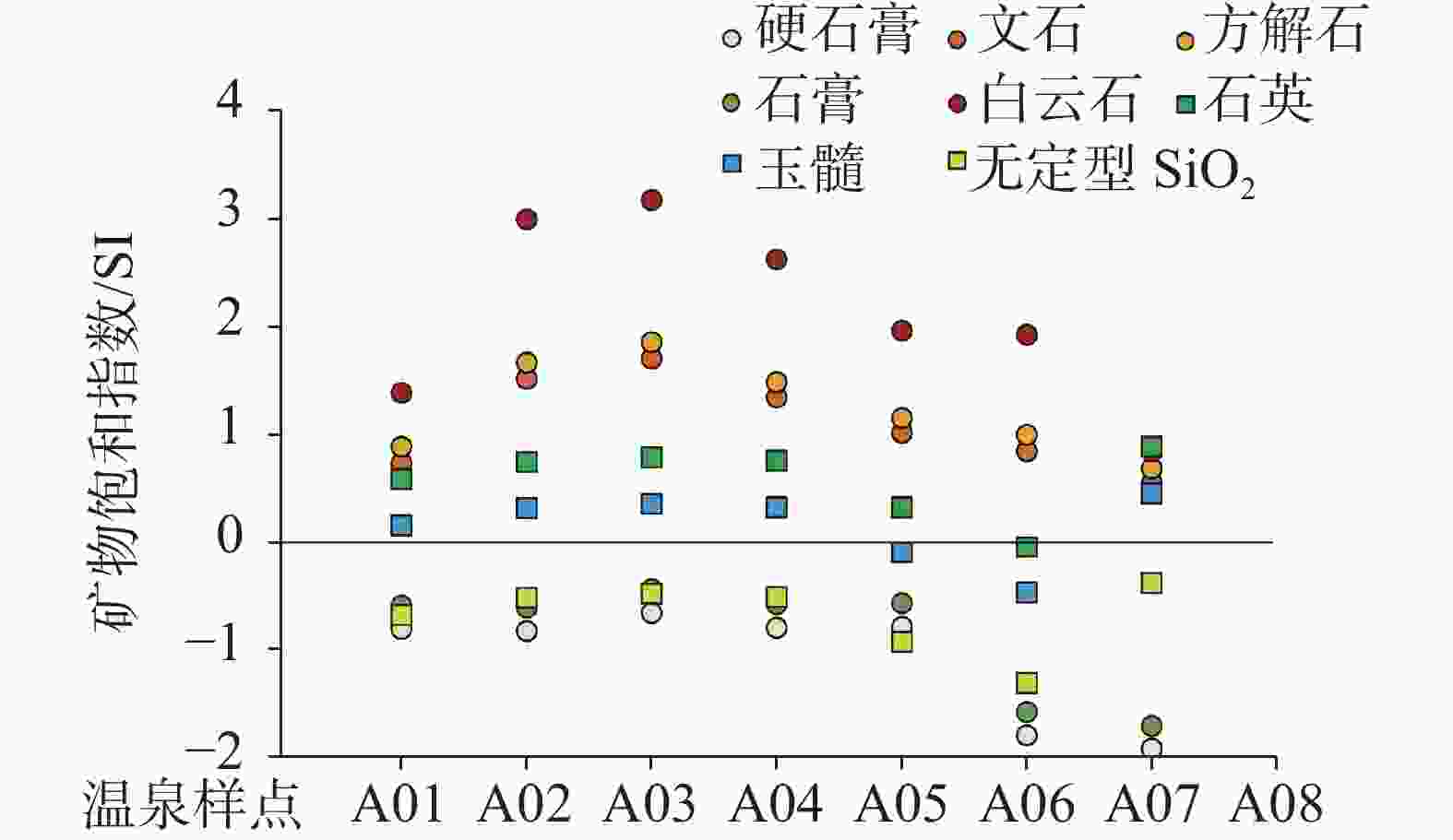
图 6 研究区热泉水中主要矿物的饱和指数图
Figure 6. Saturation index diagram of major minerals in thermal spring water in the study area
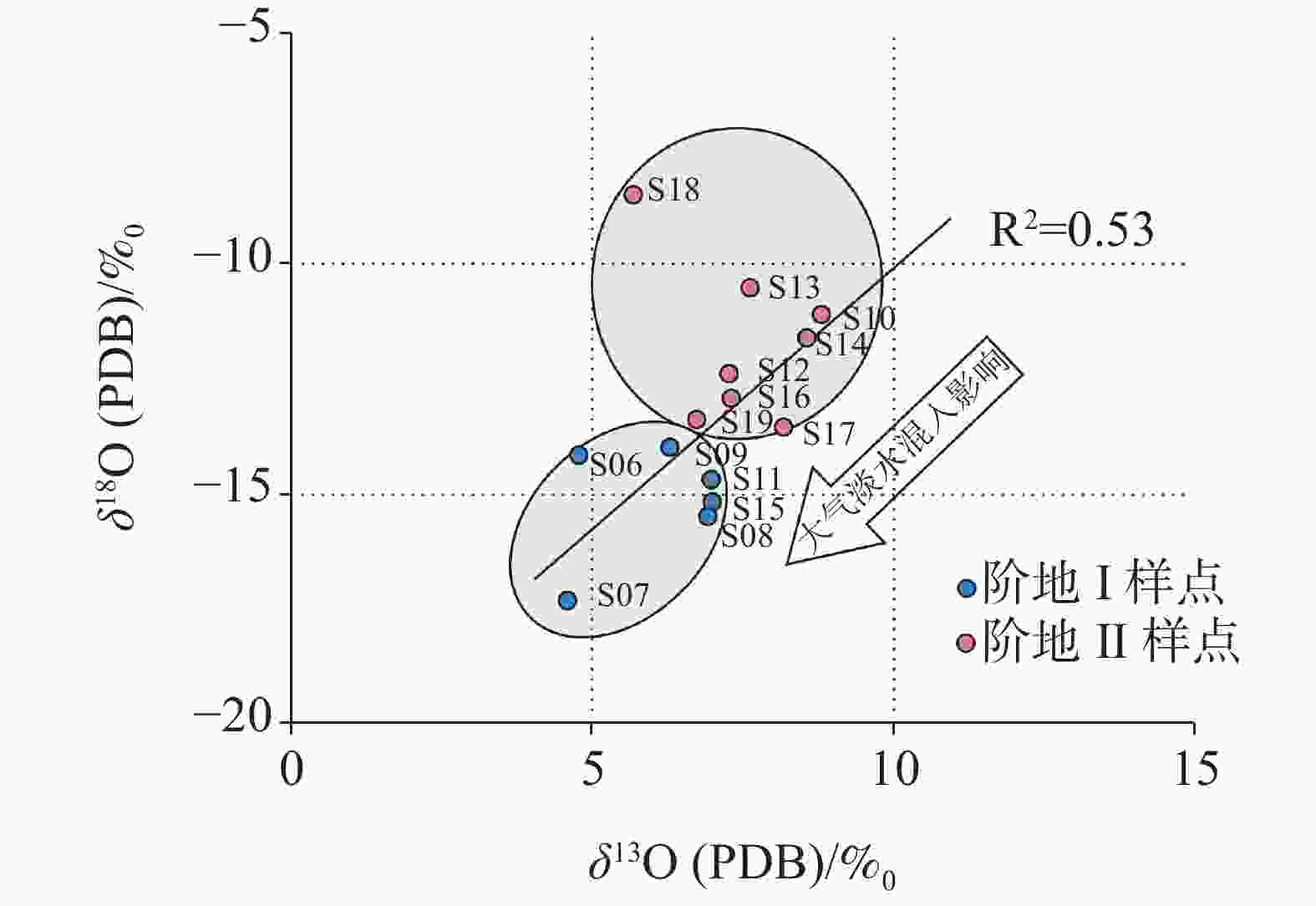
图 7 泉华群阶地Ⅰ、阶地Ⅱ钙华的δ18O和δ13C关系图
Figure 7. δ18O vs. δ13C plot for the tufa samples of terrace I and II, sinter group
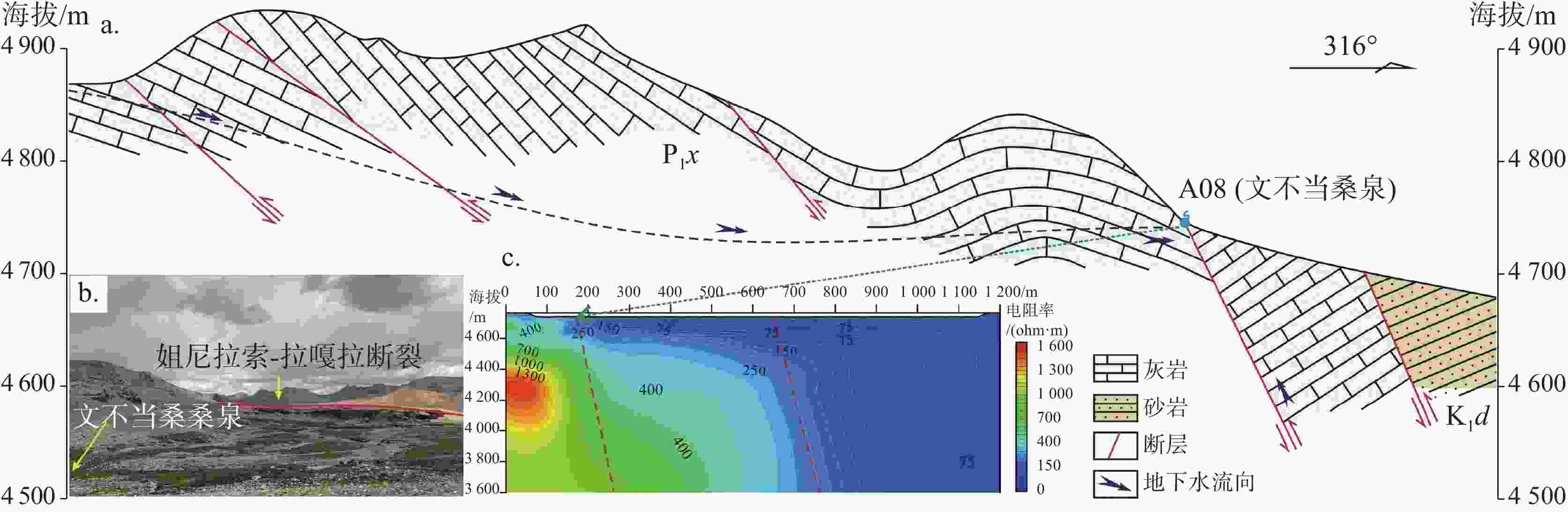
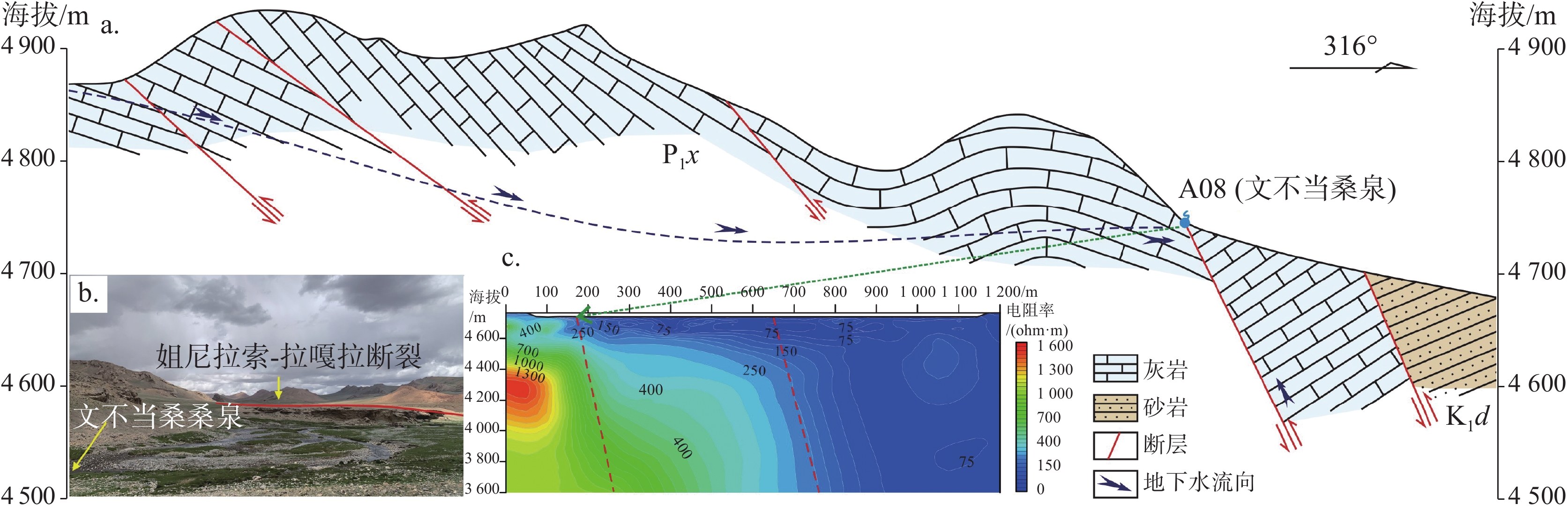
图 8 姐尼拉索-拉嘎拉断裂带水文地质剖面(a)、露头(b)及AMT图(c)
Figure 8. Hydrogeological section (a), outcrop (b) and AMT profile (c) of the Jienilasuo-Lagala fault zone
表 1 容日阿藏布流域及周边代表性温泉水、地表水水化学取样统计表
Table 1. Hydrochemical sampling statistics of representative hot spring water and surface water in the Rongri Zangbo river basin and its surrounding areas
样点 类型 位置 构造位置 出露地
层岩性测试项目(mg/L) pH 温度
℃水化学类型 Na+ K+ Ca2+ Mg2+ Cl− ${\rm{SO}}_4^{2-}$ ${\rm{HCO}}_3^{-}$ SiO2 Li B As TDS A01 温泉 泉华群处温泉 断裂带附近,
NNE断裂K1d 多尼组
石英砂岩244.6 28.1 266.0 50.1 108.7 711.7 626.1 45.8 2.0 7.7 1.6 1768 7.34 37.89 HCO3·SO4-Na·Ca A02 温泉 泉华群处温泉 229.5 22.0 232.5 47.9 119.4 780.9 540.0 67.5 2.0 10.1 1.9 1712 8.30 24.56 HCO3·SO4-Na·Ca A03 温泉 泉华群处温泉 243.3 27.1 369.5 49.3 118.0 793.6 503.4 74.78 2.0 9.0 1.78 1870 8.34 19.22 HCO3·SO4-Na·Ca A04 温泉 泉华群处温泉 239.5 23.1 251.9 50.5 115.6 741.6 387.5 68.3 2.0 10.1 1.7 1625 8.21 27.60 HCO3·SO4-Na·Ca A05 温泉 泉华群南2 km温泉 断裂带附近,
NNE断裂K1d 多尼组
石英砂岩136.9 17.5 279.3 55.9 70.5 676.1 512.0 25.4 1.4 4.7 1.0 1501 7.67 28.17 HCO3·SO4-Na·Ca A06 温泉 泉华群北5 km泉 断裂带内 P1x 下拉组灰岩 46.8 6.3 87.0 33.8 19.5 110.9 370.4 10.8 0.4 1.56 0.8 496 7.97 18.45 HCO3·SO4-Na·Mg A07 温泉 容日阿藏布上游 断裂带附近,
NEE断裂K2ηγ 黑云二
长花岗岩832.0 73.5 63.4 8.2 612.1 203.6 1241.2 90.1 20.0 202.3 26.1 2509 7.46 55.01 Cl·HCO3-Na A08 泉水 文不当桑大泉 断裂带内 P1x 下拉组灰岩 41.3 3.0 69.0 50.3 17.1 56.1 327.1 11.7 0.1 0.05 0.1 358 8.56 13.50 HCO3-Na·Ca A09 河水 容日阿藏布 / 第四系 64.9 7.5 71.6 17.2 38.0 113.9 271.5 13.8 0.8 2.23 0.7 472 8.05 10.22 SO4·HCO3-Na·Ca A10 湖水 别若则错 / 第四系 5291.9 424.0 13.3 715.4 4620.0 6513.0 845.1 7.2 29.9 22.9 9.9 18653 9.02 10.55 Cl·SO4- Mg·Na  下载: 导出CSV
表 2 研究区热泉水估算热储温度表
Table 2. Estimated reservoir temperatures of thermal springs in the study area
热泉编号 泉口实测温度/ ℃ 估算热储温度/ ℃ 玉髓法a 玉髓法b 有蒸汽损失石英 无蒸汽损失石英 修正SiO2 A01 37.89 67.54 69.09 99.06 97.76 91.85 A02 24.56 87.60 87.81 115.05 116.35 112.01 A03 19.22 93.30 93.10 119.50 121.58 117.71 A04 27.60 88.25 88.41 115.55 116.95 112.66 A05 28.17 40.99 44.10 77.12 72.67 64.96 A06 18.45 9.08 13.70 49.54 41.77 32.32 A07 55.01 104.14 103.13 127.87 131.45 128.52
下载: 导出CSV
-
[1] 伍光和, 王乃昂, 胡双熙, 田连恕, 张建明. 自然地理学(第四版) [M]. 北京: 高等教育出版社, 2008: 1-502.Wu Guanghe, Wang Naiang, Hu Shuangxi, Tian Lianshu, Zhang Jianming. Physical Geography (4th Edition) [M]. Beijing: Higher Education Press, 2008: 1-502. [2] 何靓雯, 代群威, 徐荣林, 崔杰, 安德军, 杜伟旗, 张婷, 蒋瑞阳, 冉玥. 四川牟尼沟钙华剖面特征及其环境指示意义[J]. 中国岩溶, 2024, 43(3): 575-584. doi: 10.11932/karst2024y021He Liangwen, Dai Qunwei, Xu Ronglin, Cui Jie, An Dejun, Du Weiqi, Zhang Ting, Jiang Ruiyang, Ran Yue. Characteristics of travertine profiles and their environmental indications in Munigou, Sichuan, China[J]. Carsologica Sinica, 2024, 43(3): 575-584. doi: 10.11932/karst2024y021 [3] 朱梅湘. 地热系统的成岩成矿作用[J]. 矿物岩石地球化学通报, 1993(4): 227-230.Zhu Meixiang. Hydrothermal Diagenesis and Mineralization[J]. Bulletin of Mineralogy, Petrology and Geochemistry, 1993(4): 227-230. [4] Wang Z, Yin J J, Cheng H, Ning Y, Meyer M C. Climatic controls on travertine deposition in southern Tibet during the late Quaternary[J]. Palaeogeography, Palaeoclimatology, Palaeoecology, 2022, 589: 110852. doi: 10.1016/j.palaeo.2022.110852 [5] Harrison L N, Hurwitz S, Paces J B, Whitlock C, Peek S, Licciardi J. Travertine records climate-induced transformations of the Yellowstone hydrothermal system from the late Pleistocene to the present[J]. Geological Society of America Bulletin, 2024, 136(9-10): 3605-3618. doi: 10.1130/B37317.1 [6] 汪智军, 殷建军, 袁道先. 钙华在第四纪研究中的应用: 以青藏高原为例[J]. 科学通报, 2018, 63(11): 1012-1023. doi: 10.1360/N972017-01210Wang Zhijun, Yin Jianjun, Yuan Daoxian. Possibilities and problems associated with travertines and tufas in Quaternary studies: A case of the Tibetan Plateau[J]. Science China Press, 2018, 63(11): 1012-1023. doi: 10.1360/N972017-01210 [7] Anna G, Capezzuoli E. Travertine: distinctive depositional fabrics of carbonates from thermal spring systems[J]. Sedimentology, 2014, 61(1): 264-290. doi: 10.1111/sed.12087 [8] Pentecost A. The quaternary travertine deposits of Europe and Asia Minor[J]. Quaternary Science Reviews, 1995, 14: 1005-1028. doi: 10.1016/0277-3791(95)00101-8 [9] Ford T D, Pedley H M. A review of tufa and travertine deposits of the world[J]. Earth Science Review, 1996, 41: 117-175. doi: 10.1016/S0012-8252(96)00030-X [10] 刘再华. 表生和内生钙华的气候环境指代意义研究进展[J]. 科学通报, 2014, 59(23): 2229-2239. doi: 10.1360/N972013-00037Liu Zaihua. Research progress in paleoclimatic interpretations of tufa and travertine[J]. Chinese Science Bulletin, 2014, 59(23): 2229-2239. doi: 10.1360/N972013-00037 [11] Pentecost A, Zhang Z. A review of Chinese travertines[J]. Cave Karst Science, 2001, 28: 15-28. [12] Tan H B, Zhang Y F, Zhang W J, Kong N, Zhang Q, Huang J. Understanding the circulation of geothermal waters in the Tibetan Plateau using oxygen and hydrogen stable isotopes[J]. Applied Geochemistry, 2014, 51(1): 23-32. doi: 10.1016/j.apgeochem.2014.09.006 [13] Tan H B, Su J B, Xu P, Dong T, Elenga H. Enrichment mechanism of Li, B and K in the geothermal water and associated deposits from the Kawu area of the Tibetan plateau: Constraints from geochemical experimental data[J]. Applied Geochemistry, 2018, 93: 60-68. doi: 10.1016/j.apgeochem.2018.04.001 [14] 黄豪擎, 袁兴成, 彭清华, 郭游, 薛仲凯, 旦增, 李健, 刘振峰, 巴桑次仁, 孙飞, 袁胜. 喜马拉雅山南地区地热水和钙华地球化学特征与成因机制[J]. 沉积与特提斯地质, 2023, 43(2): 340-356. doi: 10.19826/j.cnki.1009-3850.2023.05004Huang Haoqing, Yuan Xingcheng, Peng Qinghua, Guo You, Xue Zhongkai, Dan Zeng, Li Jian, Liu Zhenfeng, Basangciren, Sun Fei, Yuan Sheng. Geochemical characteristics and genetic mechanism of geothermal water and travertine in the southern Himalayas[J]. Sedimentary Geology and Tethyan Geology, 2023, 43(2): 340-356. doi: 10.19826/j.cnki.1009-3850.2023.05004 [15] 覃建勋, 韩鹏, 车晓超, 袁国礼, 方斌, 王根厚. 利用荣玛地区温泉钙华δ18O及微量元素重建西藏全新世以来古气候[J]. 地学前缘, 2014, 21(2): 312-322.Qi Jianxun, Han Peng, Che Xiaochao, Yuan Guoli, Fang Bin, Wang Genhou. Resuming the holocene paleoclimate using δ18O and trace elements of travertine in Rongma area, Tibet[J]. Earth Science Frontiers, 2014, 21(2): 312-322. [16] 陆艺, 苏金宝, 谭红兵, 许鹏, 陈振坤. 西藏东南缘地热泉华的地球化学特征和成因[J]. 矿物岩石地球化学通报, 2019, 38(6): 1207-1223.Lu Yi, Su Jinbao, Tan Hongbing, Xu Peng, Chen Zhenkun. Geochemical characteristics and origin of sinters in the southeastern margin of Tibet[J]. Bulletin of Mineralogy, Petrology and Geochemistry, 2019, 38(6): 1207-1223. [17] 雷国良, 张虎才, 李志忠, Adam M H, 朱芸, 姜修洋, 陈秀玲, 常凤琴, 李华勇. 青藏高原西部昂拉仁错古湖岸钙华沉积的地球化学特征及环境意义[J]. 第四纪研究, 2013, 33(5): 839-847.Lei Guoliang, Zhang Hucai, Li Zhizhong, Adam M H, Zhu Yun, Jiang Xiuyang, Chen Xiuling, Chang Fengqin, Li Huayong. Geochemical features and significance of shoreline tufa from a closed-basin lake Ngangla Ring Tso in the western Tibetan Plateau[J]. Quaternary Sciences, 2013, 33(5): 839-847. [18] 滕吉文, 杨顶辉, 田小波, 徐涛, 陈赟, 白志明, 梁晓峰, 张晰, 吴晶, 刘有山. 青藏高原深部地球物理探测70年[J]. 中国科学: 地球科学, 2019, 49(10): 1546-1564.Teng Jiwen, Yang Dinghui, Tian Xiaobo, Xu Tao, Chen Yun, Bai Zhiming, Liang Xiaofeng, Zhang Xi, Wu Jing, Liu Youshan. Geophysical investigation progresses of the Qinghai-Tibetan Plateau in the past 70 years[J]. Scientia Sinica (Terrae), 2019, 49(10): 1546-1564. [19] 潘桂棠, 李兴振, 王立全, 丁俊, 陈智粱. 青藏高原及邻区大地构造单元初步划分[J]. 地质通报, 2002, 21(11): 701-707. doi: 10.3969/j.issn.1671-2552.2002.11.002Pan Guitang, Li Xingzhen, Wang Liquan, Ding Jun, Chen Zhiliang. Preliminary division of tectonic units of the Qinghai-Tibet Plateau and its adjacent regions[J]. Geological Bulletin of China, 2002, 21(11): 701-707. doi: 10.3969/j.issn.1671-2552.2002.11.002 [20] 四川省地质调查院. 中华人民共和国区域地质调查报告(1: 25万物玛幅)[R]. 成都: 四川省地质调查院, 2005.Sichuan Institute of Geological Survey. Regional geological survey report of the People's Republic of China (1: 250 000 Oma Sheet) [R]. Chengdu: Sichuan Institute of Geological Survey, 2005. [21] Ding L, Kapp P, Cai F, Garzione C N, Xiong Z, Wang H, Wang C. Timing and mechanisms of Tibetan Plateau uplift[J]. Nature Reviews earth & environment, 2022, 3(10): 652-667. doi: 10.1038/s43017-022-00318-4 [22] 汪东波, 江少卿, 董方浏. 藏北多龙矿集区荣那斑岩铜矿找矿突破的实践[J]. 中国地质, 2016, 43(5): 1599-1612.Wang Dongbo, Jiang Shaoqing, Dong Fangliu. Geological exploration of the Rongna porphyry copper deposit in the Duolong ore concentration area, northern Tibet[J]. Geology in China, 2016, 43(5): 1599-1612. [23] Lin B, Tang J X, Chen YC, et al. Geochronology and genesis of the Tiegelongnan porphyry Cu (Au) deposit in Tibet: Evidence from U-Pb, Re-Os dating and Hf, S, and H-O isotopes. Resource Geology, 2017, 67(1): 1-21. [24] 唐菊兴, 杨欢欢, 李宏伟, 王勤, 李彦波, 李社, 林彬, 李发桥, 翟建军, 唐晓倩, 杨超, 董玉杰, 李建力, 付雪莲, 陈守关, 袁盛朝, 王梦蝶, 张琪, 张荣坤. 西藏多龙斑岩-浅成低温热液型铜(金)矿集区地质特征及找矿潜力分析[J]. 中国矿业, 2024, 33(6): 1-13. doi: 10.12075/j.issn.1004-4051.20241146Tang Juxing, Yang Huanhuan, Li Hongwei, Wang Qin, Li Yanbo, Li She, Lin Bin, Li Faqiao, Zhai Jianjun, Tang Xiaoqian, Yang Chao, Dong Yujie, Li Jianli, Fu Xuelian, Chen Shouguan, Yuan Shengchao, Wang Mengdie, Zhang Qi, Zhang Rongkun. Geological characteristics and prospecting potential analysis of Duolong porphyry-epithermal copper (gold) ore district in Tibet[J]. China Mining Magazine, 2024, 33(6): 1-13. doi: 10.12075/j.issn.1004-4051.20241146 [25] 刘元晴, 周乐, 吕琳, 李伟, 王新峰, 邓启军, 宋绵, 郑一迪, 马雪梅. 山东鲁中山区地热地质特征及热水成因[J]. 地质通报, 2020, 39(12): 1908-1918.Liu Yuanqing, Zhou Le, Lv Lin, Li Wei, Wang Xinfeng, Deng Qijun, Song Mian, Zheng Yidi, Ma Xuemei. Geothermal geological characteristics and genesis of hot water in the central mountain area of Shandong Province[J]. Geological Bulletin of China, 2020, 39(12): 1908-1918. [26] 杜磊, 文华国, 罗连超, 董俊玲, 温龙斌, 游雅贤, 王启宇. 陆地热泉钙华: 重建古气候历史信息重要载体[J]. 中国地质, 2022, 49(3): 802-821.Du Lei, Wen Huaguo, Luo Lianchao, Dong Junling, Wen Longbin, You Yaxian, Wang Qilu. Terrestrial hot-spring travertine: an important window into paleoclimate reconstruction[J]. Geology in China, 49(3): 802-821. [27] 刘操, 徐高海, 李德龙, 罗富恒, 徐海峰, 陈诚, 邹剑舒. 渝东北长滩地区温泉水化学特征及成因分析[J]. 中国岩溶, 2025, 44(6): 1144-1157.Liu Cao, Xu Gaohai, Li Delong, Luo Fuheng, Xu Haifeng, Chen Cheng, Zou Jianshu. Hydrochemical characteristics and genesis analysis of hot springs in the Changtan area, Chongqing[J]. Carsologica Sinica, 2025, 44(6): 1144-1157. [28] Piper A M. A graphical procedure in the geochemical interpretation of water analyses[J]. Neuro-chemistry international, 1944, 25(6): 27-39. doi: 10.3133/b479 [29] Peralta A Y, Cabassi J, Tassi F, Caffe P J, Vaselli O. Fluid geochemistry of a deep-seated geothermal resource in the Puna plateau (Jujuy Province, Argentina)[J]. Journal of Volcanology and Geothermal Research, 2017, 338: 121-134. doi: 10.1016/j.jvolgeores.2017.03.030 [30] Fan Y F, Pang Z H, Liao D W, Tian J, Hao Y, Huang T, Li Y. Hydrogeochemical characteristics and genesis of geothermal water from the Ganzi geothermal field, Eastern Tibetan Plateau[J]. Water, 2019, 11(8): 1631. doi: 10.3390/w11081631 [31] Giggenbach W F. Geothermal solute equilibriaDerivation of Na-K-Mg-Ca geoondicators[J]. Geochimica et Cosmochimica Acta, 1988, 52(12): 2749-2765. [32] 李泓泉, 张树胜, 谢明忠, 周江, 周建飞, 贾立新, 郝星波, 任建帅, 刘永平, 于丹丹. 冀西北蔚县盆地地热资源赋存特征及勘查开发方向[J]. 地质论评, 2020, 66(4): 919-932. doi: 10.16509/j.georeview.2020.04.010Li Hongquan, Zhang Shusheng, Xie Zhongming, Zhou Jiang, Zhou Jianfei, Jia Lixin, Hao Xingbo, Ren Jianshuai, Liu Yongping, Yu Dandan. The occurrence characteristics and exploration and development direction of geothermal resources in Yuxian Basin, northwest Hebei Province[J]. Geological Review, 2020, 66(4): 919-932. doi: 10.16509/j.georeview.2020.04.010 [33] Yi L, Qi J, Li X, et al. Geochemical characteristics and genesis of the high-temperature geothermal systems in the north section of the Sanjiang Orogenic belt in southeast Tibetan Plateau[J]. Journal of Volcanology and Geothermal Research, 2021, 414: 107244. doi: 10.1016/j.jvolgeores.2021.107244 [34] 蒲俊兵, 袁道先, 蒋勇军, 苟鹏飞, 殷建军. 重庆岩溶地下河水文地球化学特征及环境意义[J]. 水科学进展, 2010, 21(5): 628-636. doi: 10.14042/j.cnki.32.1309.2010.05.008Pu J B, Yuan D X, Jiang Y J, Gou Pengfei, Yin Jianjun. Hydrogeochemistry and environmental meaning of Chongqing subterranean karst streams in China[J]. Advances in water science, 2010, 21(5): 628-636. doi: 10.14042/j.cnki.32.1309.2010.05.008 [35] 袁丽娟, 杨峰田. 北京迭断陷内蓟县系热储层温度分布特征[J]. 吉林大学学报(地球科学版), 2017, 47(1): 179-188. doi: 10.13278/j.cnki.jjuese.201701204Yuan Lijuan, Yang Fengtian. Temperature distribution characteristic of Jixian reservoir in Beijing depression[J]. Journal of Jilin University (Earth Science Edition), 2017, 47(1): 179-188. doi: 10.13278/j.cnki.jjuese.201701204 [36] Fournier R O. Chemical geothermometers and mixing models for geothermal systems[J]. Geothermics, 1977, 5: 31-40. doi: 10.1016/0375-6505(77)90007-4 [37] 罗伟, 杨仕江, 彭静, 袁余洋, 李生红, 曾祥建, 张信. 黔北遵义地区地热水化学特征及成因[J]. 中国岩溶, 2024, 43(1): 72-83. doi: 10.11932/karst20240106Luo Wei, Yang Shijiang, Peng Jing, Yuan Yuyang, Li Shenghong, Zeng Xiangjian, Zhang Xin. Hydrochemical characteristics and genesis of geothermal water in the Zunyi area, north Guizhou[J]. Carsologica Sinica, 2024, 43(1): 72-83. doi: 10.11932/karst20240106 [38] 王大锐. 塔里木盆地中、上奥陶统烃源岩的碳同位素宏观证据[J]. 地质论评, 2000, 46(3): 328-334.Wang Darui. Marco-evidence of carbon isotopes for the Middle-Upper Ordovician source rocks in the Tarim Basin[J]. Geological Review, 2000, 46(3): 328-334. -

 点击查看大图
计量
- 文章访问数: 349
- HTML浏览量: 116
- PDF下载量: 194
- 被引次数: 0
