


Hydrochemical characteristics and controlling factors of surface water and groundwater in a typical coal mining area, southwestern Hunan
-
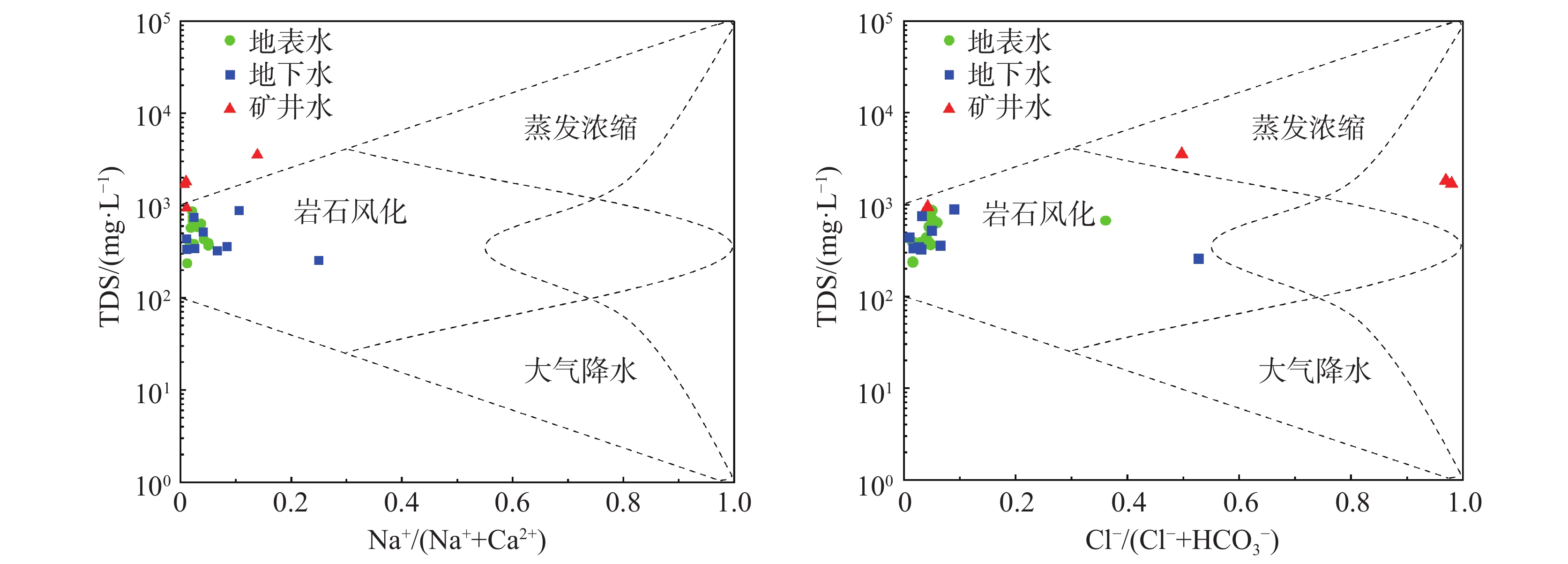
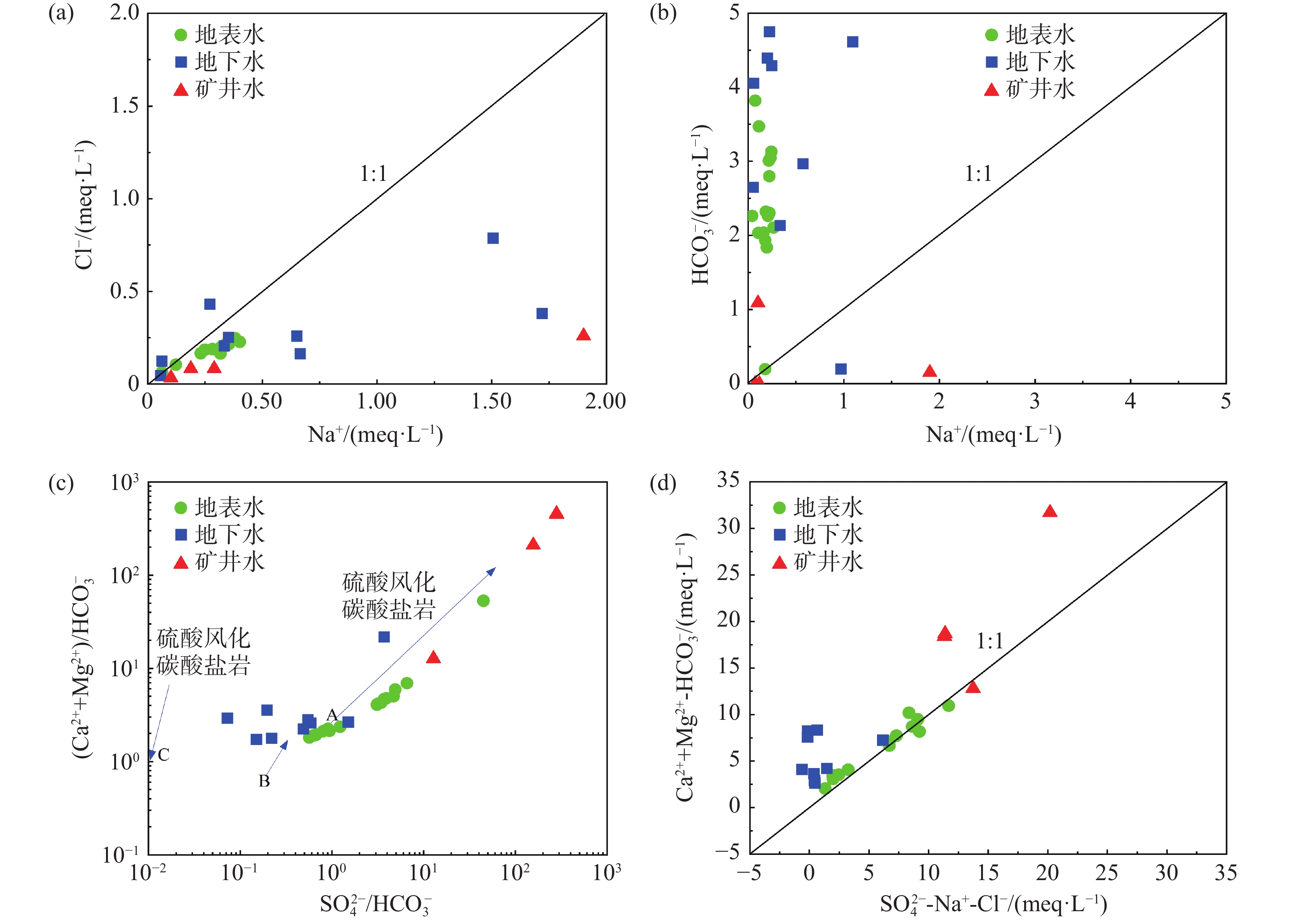
摘要: 为探究湘西南典型煤矿区地表水和地下水水化学特征和控制因素,采集13组地下水(含4组矿井水)和16组地表水样品,采用数理统计方法、Piper三线图、Gibbs图以及离子比例系数等多元分析手段,对湘西南典型煤矿区地表水和地下水的水文地球化学特征进行了系统分析,并探讨了其水化学特征的空间演变特征。结果表明:湘西南典型煤矿区地表水和地下水呈弱碱性,水化学主导类型为HCO3·SO4-Ca型水。研究区地表水系主要水化学指标呈现石桥溪(北支)>石燕溪(下游)>石井溪(南支)的空间分布格局,而pH和${\rm{HCO}}_3^{-}$浓度则呈相反趋势。南支石井溪未受到矿井水明显影响,水化学类型为HCO3·SO4-Ca型。北支石桥溪受矿井水影响明显,水化学类型为SO4-Ca型。岩石风化溶解作用和人类活动两大因素控制着研究区水化学演化。水岩作用以碳酸盐矿物的溶解为主,碳酸盐岩的溶解制约Ca2+、Mg2+和${\rm{HCO}}_3^{-}$等离子的变化,${\rm{SO}}_4^{2-}$主要来源于石炭系梓门桥组灰岩层石膏夹层溶解和煤系地层中硫铁矿氧化。地表水和地下水中Cl−、${\rm{NO}}_3^{-}$主要是来源于生活污水和农业活动。该研究阐明了湘西南典型煤矿区地表水和地下水水化学演化特征及其驱动机制;多指标综合分析矿井水为区域地表水和地下水水化学演变规律分析提供了较为系统的方法,可为类似区域研究提供借鉴。Abstract:
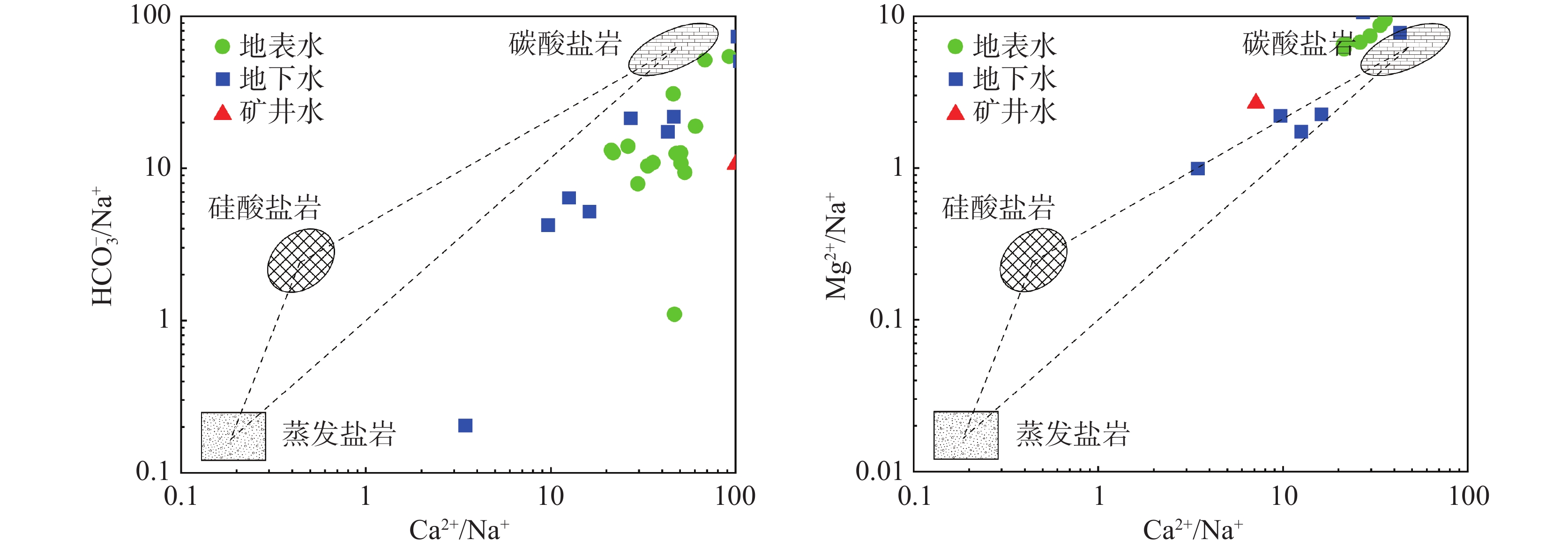
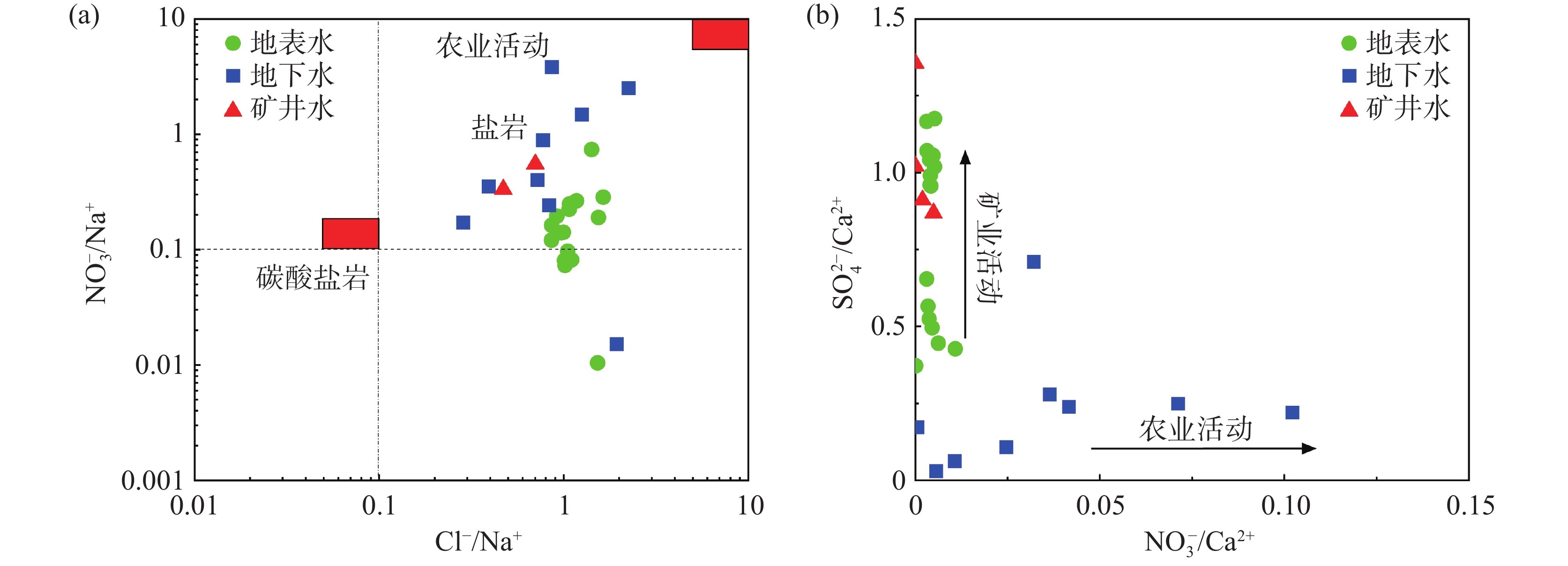
The southwestern Hunan region is a significant coal resource accumulation zone in China. Within its coal mining areas, carbonate rocks and coal-bearing clastic rock strata are distributed in an interbedded manner, resulting in complex geological structures. Hydrogeochemical processes are jointly influenced by mining activities and karstification. This study focuses on a typical small watershed in southwestern Hunan, with a total area of approximately 20.51 km2. The landform is predominantly characterized by dissolution-tectonic features of low mountains and wide valleys, and denudation-tectonic features of clastic rock hills and valleys. The regional strata are primarily composed of the Quaternary System of the Cenozoic Erathem and the Carboniferous System of the Upper Paleozoic Erathem. Groundwater types mainly include pore water in loose rocks, fissure-karst water in carbonate rocks, and pore-fissure water in clastic rocks. To systematically elucidate the hydrochemical properties and identify the major controlling factors of surface water and groundwater in this typical coal mining area of southwestern Hunan, 16 surface water and 13 groundwater samples (including 4 mine water samples) were collected. A multi-indicator comprehensive analysis was conducted using mathematical statistical analysis, Piper trilinear diagrams, Gibbs diagrams, and ion ratio methods to systematically investigate the hydrochemical composition, spatial distribution patterns, and formation mechanisms of various water bodies in the region. The results indicate that both surface water and groundwater in the study area are generally weakly alkaline, with pH values ranging from 7.06 to 8.33 and TDS concentrations varying between 236 and 884 mg·L−1. Groundwater exhibits limited influence from mine water, with hydrochemical types predominantly being HCO3·SO4-Ca, followed by HCO3-Ca. For surface water, the major hydrochemical indicators (${\rm{SO}}_4^{2-}$, Ca2+, Mn, TDS, and toxic metals) exhibited the spatial distribution pattern: Shiqiao Creek (north Branch) > Shiyan Creek (downstream) > Shijing Creek (south Branch). In contrast, the trends for pH and ${\rm{HCO}}_3^{-}$ concentration were the opposite. The North Branch (Shiqiao Creek), influenced by mine water input, has a SO4-Ca hydrochemical type. The south Branch (Shijing Creek), less affected by mining activities, is primarily of the HCO3·SO4-Ca type. After their confluence, the main stream of Shiyan Creek generally exhibits a SO4-Ca hydrochemical type. Gibbs diagrams show that most samples from the study area plot within the rock weathering dominance field, indicating that the chemical composition of the water bodies is primarily controlled by mineral dissolution within the aquifers, with relatively weaker influences from evaporation concentration and atmospheric precipitation. However, most mine water samples deviate from the model's distribution range, and their spatial heterogeneity may originate from geochemical disturbances caused by historical coal mining activities. The end-member diagram illustrating the relative contributions of rock weathering and dissolution shows that regional water samples are concentrated towards the carbonate rock end-member, with some samples trending towards the silicate rock end-member. Ion ratio analysis indicates that Ca2+, Mg2+, and ${\rm{HCO}}_3^{-}$ are mainly derived from the dissolution of carbonate minerals. ${\rm{SO}}_4^{2-}$ primarily originates from the dissolution of gypsum interbeds within the Zimenqiao Formation limestone and the oxidation of pyrite in the coal-bearing strata. Cl− and ${\rm{NO}}_3^{-}$ are mainly attributed to inputs from human activities such as domestic sewage and agricultural fertilization. Mine water samples exhibit significantly higher concentrations of Fe and Mn and are locally acidic, indicating that historical mining disturbances have enhanced sulfide oxidation, creating an acidic environment that promotes the dissolution and migration of metallic elements. In surface water, the concentrations of ions like ${\rm{SO}}_4^{2-}$, Ca2+, and TDS show a positive correlation with the intensity of mine water input, reflecting the pronounced impact of mining activities on surface water chemistry. Principal Component Analysis results indicate that the groundwater hydrochemistry is primarily controlled by three factors: PC1 accounts for 39.65% of the total variance and reflects the dominance of carbonate rock dissolution in controlling the regional groundwater chemistry; PC2 explains 36.08% of the variance, characterizing the influence of anthropogenic inputs of Cl− and Na+; PC3,representing gypsum dissolution,contribute 11.35% to the total variance. The surface water chemistry is predominantly governed by three factors: PC1, accounting for 54.28% of the total variance, characterizes the dual influence of gypsum dissolution and sulfide oxidation from coal seams on the surface water hydrochemistry; PC2, with a variance contribution of 24.69%, reflects the coupled effects of silicate weathering from the Carboniferous Ceshui Formation and anthropogenic NaCl input; PC3, with a variance contribution of 11.80%, represents ${\rm{NO}}_3^{-}$ input from agricultural fertilization. Integrated multi-indicator analysis reveals that rock weathering/dissolution and anthropogenic activities are identified as the two main factors controlling the hydrochemical evolution in the study area. Specifically, carbonate rock dissolution governs the variations of Ca2+, Mg2+, and ${\rm{HCO}}_3^{-}$, while sulfide oxidation and gypsum dissolution drive ${\rm{SO}}_4^{2-}$ enrichment. In contrast, anthropogenic activities primarily regulate the distribution of Cl− and ${\rm{NO}}_3^{-}$. This study systematically reveals the hydrochemical characteristics and formation mechanisms of surface water and groundwater in a typical coal mining area of southwestern Hunan, clarifying the hydrochemical relationships and spatial distribution patterns within the "surface water-groundwater-mine water" ternary system. The results demonstrate that the coupled effects of carbonate rock weathering/dissolution and sulfide oxidation from coal-bearing strata jointly determine the chemical evolution of regional water bodies, while human activities have intensified ion migration in localized areas. The comprehensive multi-indicator analytical methodology proposed in this study is able to provide a scientific basis and methodological reference for identifying hydrochemical characteristics, preventing and controlling pollution, and protecting regional water resources in karst coal mining areas. -
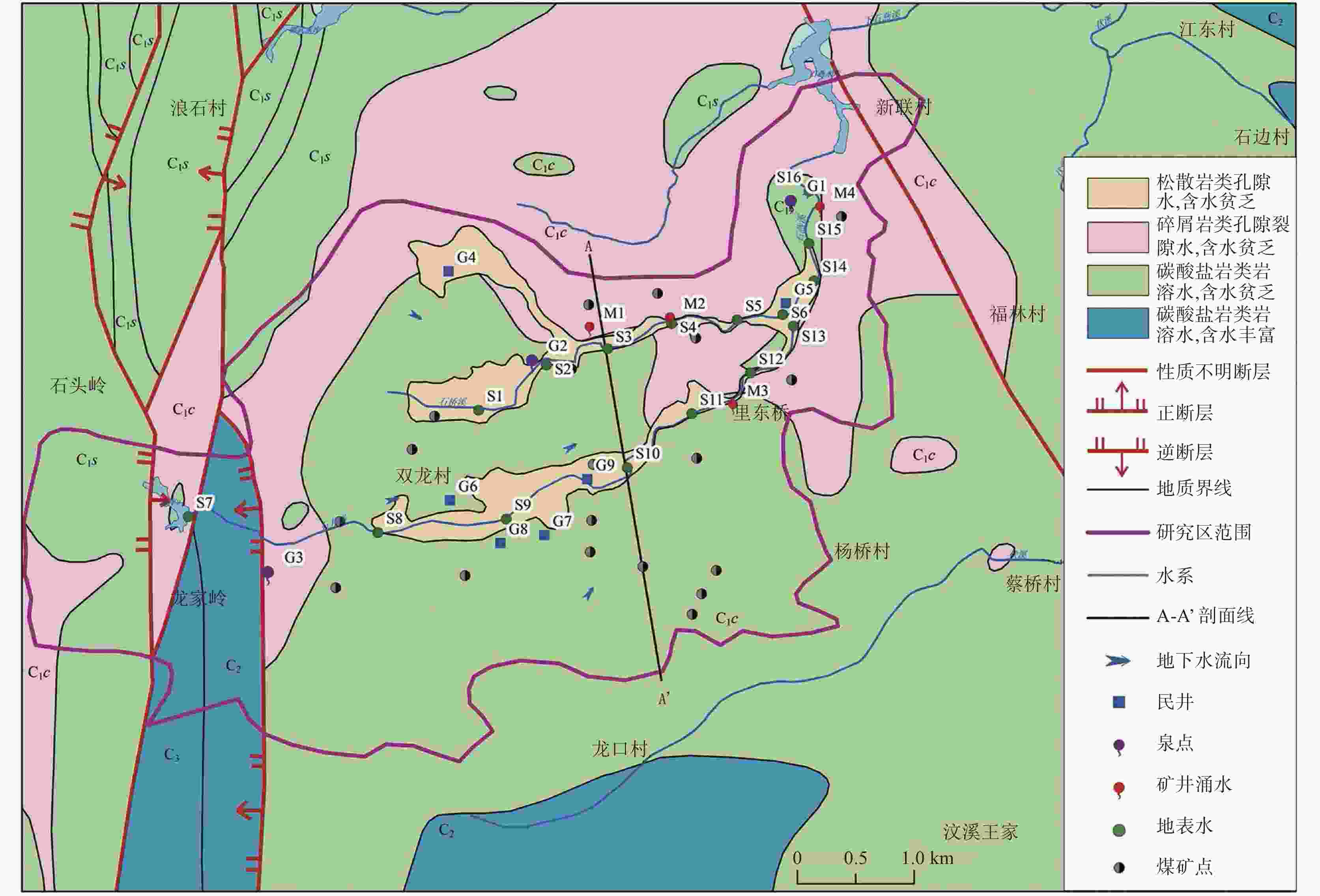
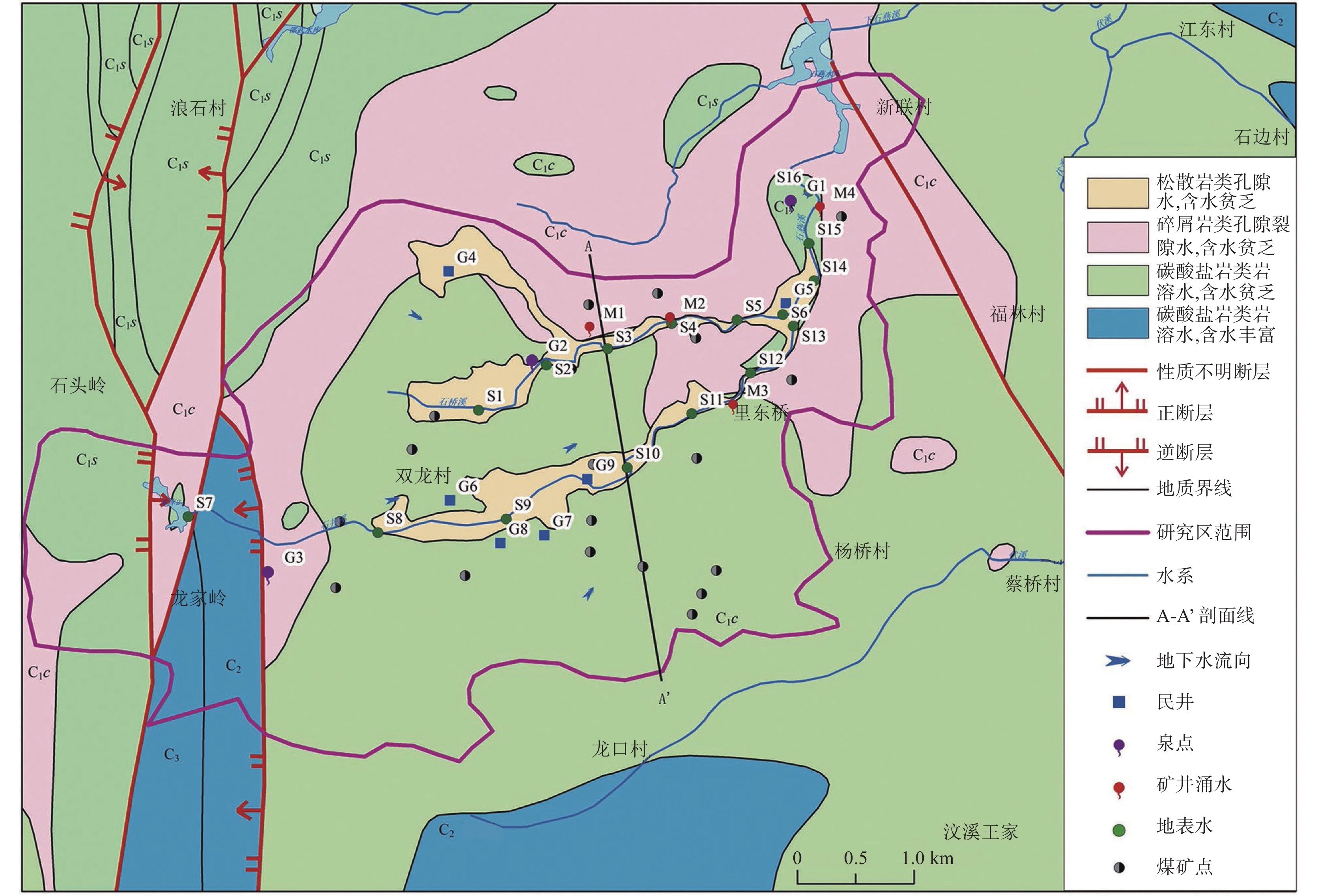
图 1 区域地表水和地下水采样点分布图
Figure 1. Distribution map of regional surface water and groundwater sampling points
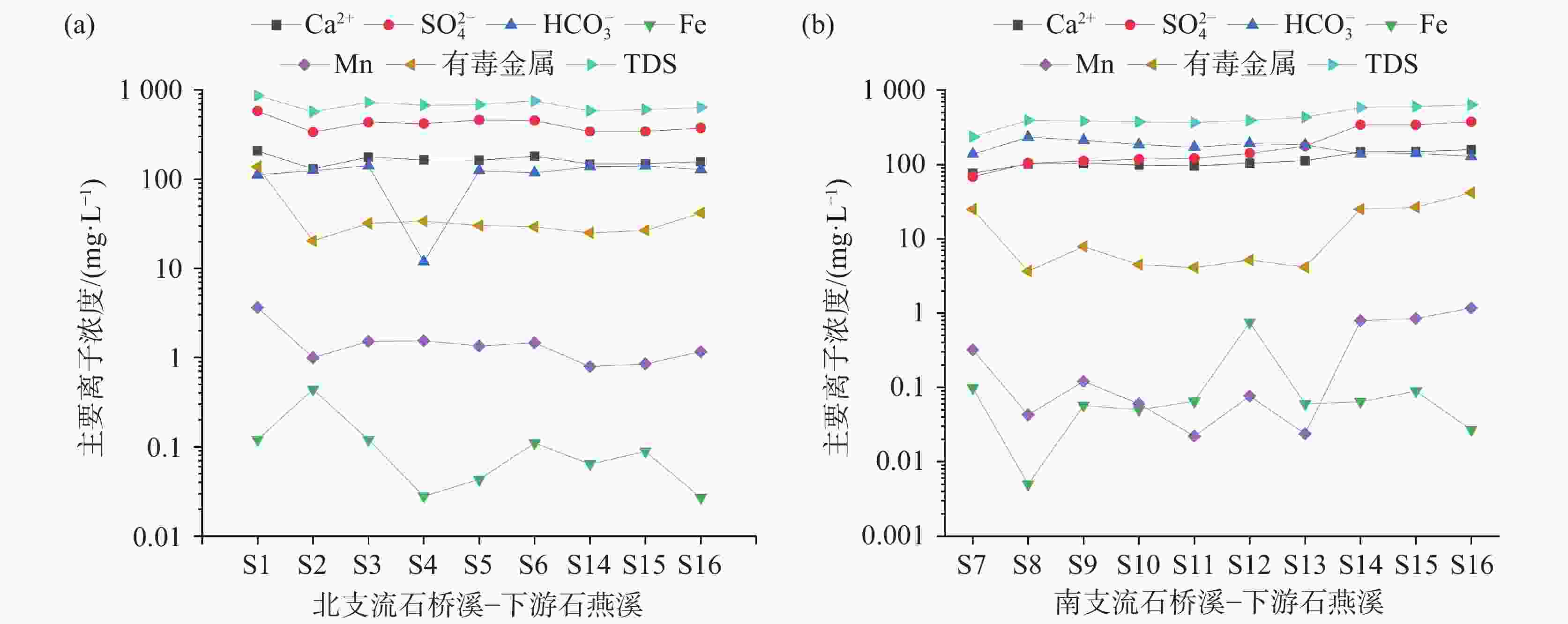
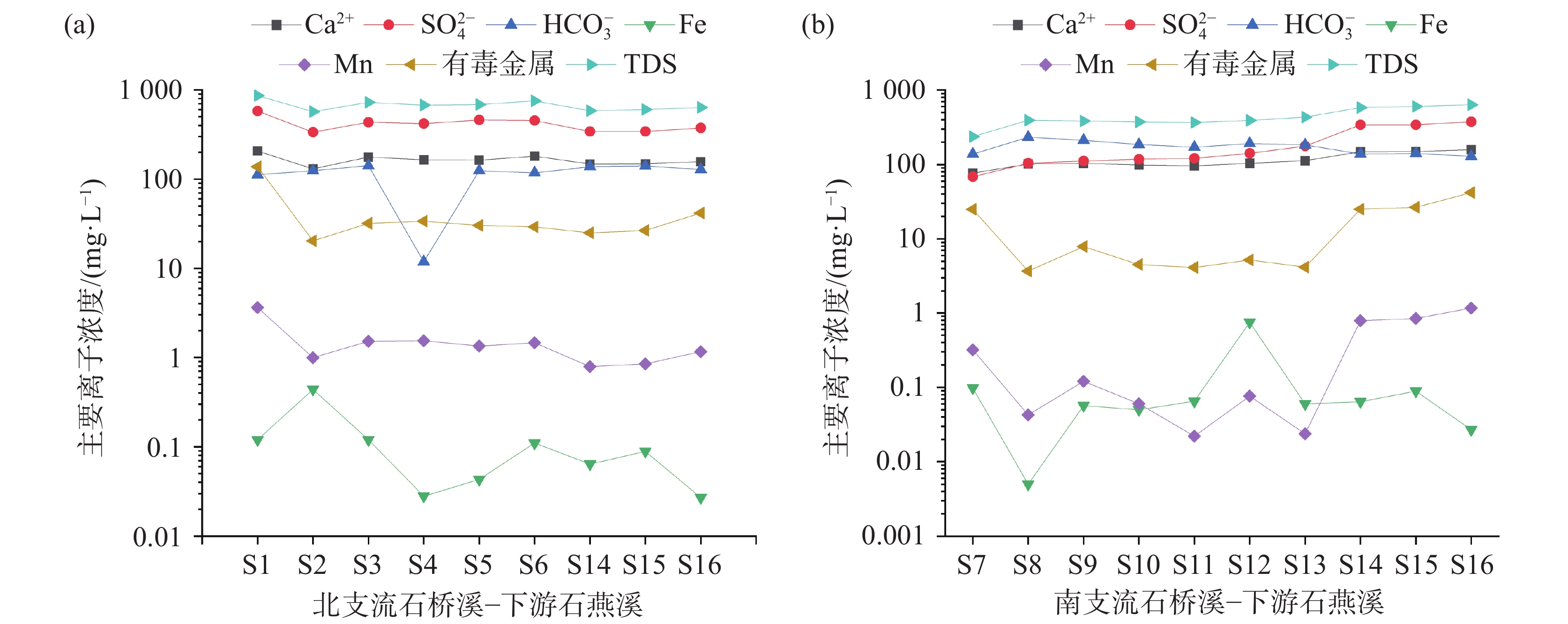
图 4 地表水水化学参数空间变化图
Figure 4. Spatial distribution map of hydrochemical parameters of surface water
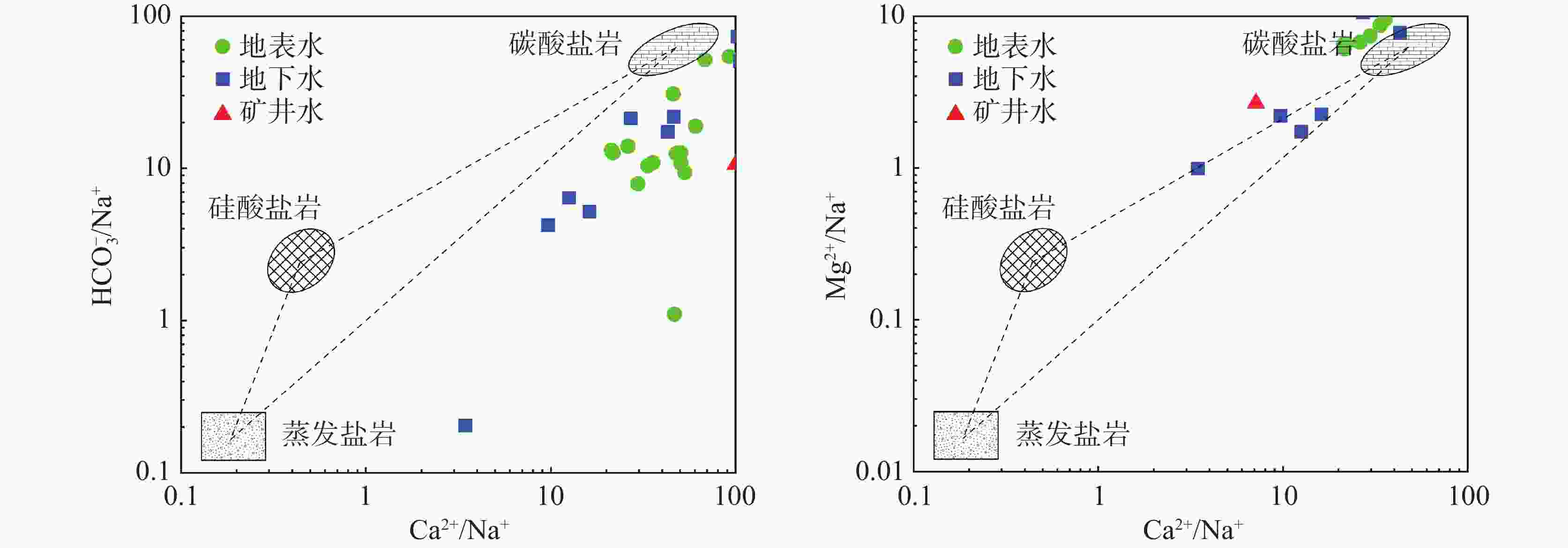
图 7 研究区岩石风化溶解相对贡献端元图
Figure 7. End-member diagram of relative contributions from rock weathering and dissolution in the study area
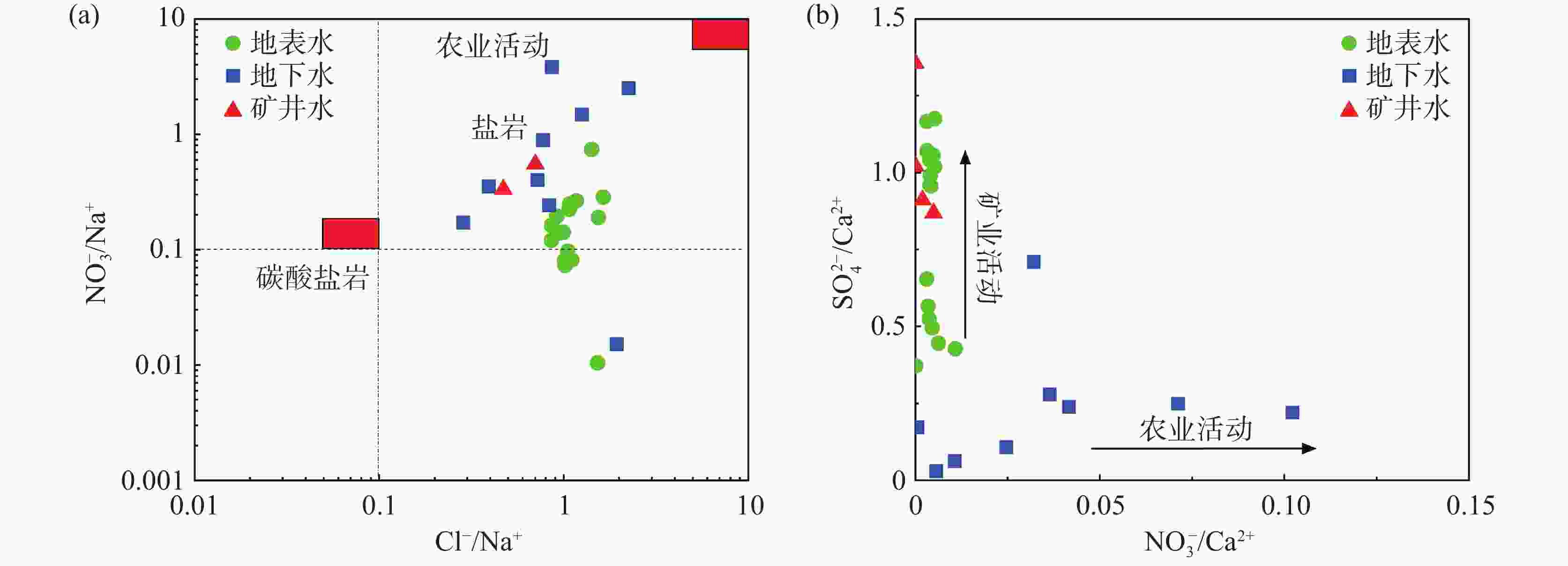
图 9 人类活动对水体水化学组分影响
Figure 9. Impacts of anthropogenic activities on hydrochemical components of water bodies
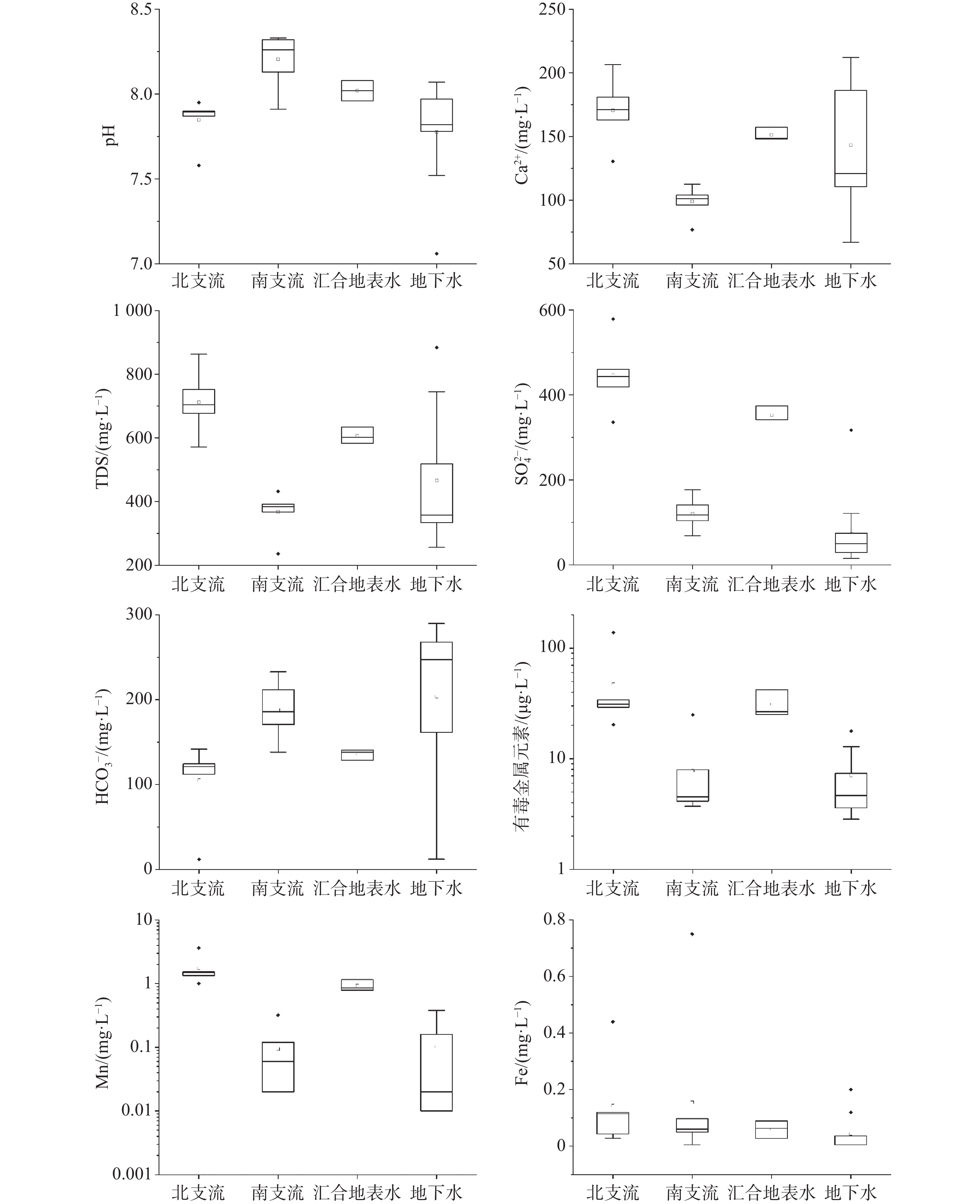
表 1 区域不同水体水化学特征统计
Table 1. Statistics of hydrochemical characteristics of different water bodies in the region
类型 项目 pH TDS K+ Na+ Ca2+ Mg2+ Cl− ${\rm{SO}}_4^{2-}$ ${\rm{HCO}}_3^{-}$ ${\rm{NO}}_3^{-}$ Fe Mn 有害金属 地下水 地下水
(n=9)最小值 7.06 256.00 0.17 1.21 66.90 7.07 1.61 14.90 12.10 0.21 0.01 0.01 2.85 最大值 8.07 884.00 29.30 25.10 212.20 29.20 27.90 317.40 289.80 27.20 0.20 0.38 17.71 平均值 7.78 466.33 8.10 9.58 143.32 19.66 10.44 80.03 203.68 12.95 0.04 0.10 7.09 标准偏差 0.31 213.62 9.64 8.79 55.68 8.11 7.81 94.48 91.68 8.98 0.07 0.13 5.07 变异系数 4.05 45.81 119.02 91.72 38.85 41.23 74.79 118.06 45.01 69.36 159.49 124.63 71.57 矿井水
(n=4)最小值 2.42 938.00 1.13 1.67 205.30 44.40 1.21 551.50 2.50 0.00 0.12 2.41 22.32 最大值 7.14 3536.00 15.90 74.80 463.80 105.30 9.14 1138.00 66.50 4.05 267.50 40.32 1894.60 平均值 4.85 1994.50 6.78 20.39 296.65 71.70 4.06 727.85 20.19 1.39 75.87 12.53 559.89 标准偏差 2.09 1098.21 6.50 36.28 114.38 25.61 3.48 278.83 31.04 1.91 128.83 18.55 897.73 变异系数 43.09 55.06 95.98 177.94 38.56 35.72 85.81 38.31 153.78 137.71 169.81 147.97 160.34 地表水 北支石桥
溪(n=6)最小值 7.58 571.00 4.71 2.48 130.50 25.30 5.83 335.70 11.90 1.27 0.03 1.00 20.38 最大值 7.95 863.00 5.40 4.49 206.60 29.90 7.08 578.70 141.60 2.87 0.44 3.62 137.89 平均值 7.85 712.00 5.01 3.86 170.55 27.22 6.37 446.67 105.33 2.23 0.14 1.75 47.30 标准偏差 0.13 96.40 0.30 0.72 25.06 1.79 0.54 78.64 46.83 0.57 0.15 0.94 44.62 变异系数 1.71 13.54 6.03 18.70 14.69 6.56 8.47 17.61 44.46 25.60 105.03 53.87 94.34 南支石井
溪(n=7)最小值 8.13 236.00 0.80 0.96 76.80 5.91 2.26 68.70 138.10 0.02 0.01 0.02 3.71 最大值 8.33 392.00 5.34 5.34 103.90 22.50 8.64 121.20 233.00 3.40 0.10 0.32 24.98 平均值 8.27 350.40 3.73 3.14 95.34 16.60 5.97 104.52 187.90 1.59 0.06 0.11 9.05 标准偏差 0.08 64.68 2.21 1.98 10.76 6.27 2.89 21.07 36.68 1.24 0.03 0.12 9.06 变异系数 0.99 18.46 59.16 63.16 11.28 37.74 48.43 20.16 19.52 78.10 60.83 107.15 100.11 汇合石燕
溪(n=3)最小值 7.96 602.00 5.17 5.10 148.60 23.50 7.64 341.50 128.50 1.93 0.03 0.85 26.65 最大值 8.02 634.50 5.28 6.12 157.30 24.00 8.09 374.40 140.50 1.99 0.09 1.16 41.94 平均值 7.99 618.25 5.23 5.61 152.95 23.75 7.87 357.95 134.50 1.96 0.06 1.00 34.29 标准偏差 0.04 22.98 0.08 0.72 6.15 0.35 0.32 23.26 8.49 0.04 0.04 0.22 10.81 变异系数 0.53 3.72 1.49 12.86 4.02 1.49 4.05 6.50 6.31 2.16 75.59 22.27 31.53 注:变异系数和pH无量纲;最小值、最大值、平均值、标准偏差单位为mg∙L−1;有害金属为Cd、Co、Ni,单位为μg∙L−1。  下载: 导出CSV
表 2 矿井水水化学特征
Table 2. Hydrochemical characteristics of mine water
矿井水 pH TDS K+ Na+ Ca2+ Mg2+ Cl− ${\rm{SO}}_4^{2-}$ ${\rm{HCO}}_3^{-}$ ${\rm{NO}}_3^{-}$ Fe Mn 有害金属 M1 7.14 938.00 3.35 2.36 205.30 44.40 2.95 668.30 66.50 0.00 0.35 2.40 22.31 M2 2.42 1816.00 6.72 2.72 265.50 62.50 2.94 553.60 2.50 4.05 35.50 2.83 282.52 M3 5.89 3536.00 15.90 74.80 463.80 105.30 9.14 1138.00 9.24 0.00 267.50 4.58 40.04 M4 3.93 1688.00 1.13 1.67 252.00 74.60 1.21 551.50 2.50 1.50 0.12 40.32 1894.66 注:pH无量纲;有害金属为Cd、Co、Ni,单位为μg∙L−1;其余单位mg∙L−1。
下载: 导出CSV
表 3 研究区不同水体主成分分析
Table 3. PCA of different water bodies in the study area
指标 主成分 地表水n=16 地下水n=9 PC1 PC2 PC3 PC1 PC2 PC3 ${\rm{HCO}}_3^{-}$ −0.881 −0.027 0.033 0.932 −0.306 0.091 Cl− −0.091 0.984 0.000 0.464 0.833 0.081 ${\rm{SO}}_4^{2-}$ 0.832 0.168 0.495 0.258 −0.037 0.939 ${\rm{NO}}_3^{-}$ 0.019 −0.043 0.962 −0.212 0.678 0.586 K+ 0.208 0.902 0.197 −0.43 0.869 0.104 Na+ 0.093 0.942 0.032 0.005 0.973 −0.05 Ca2+ 0.754 0.207 0.581 0.808 0.046 0.109 Mg2+ 0.542 0.271 0.751 0.862 0.061 0.302 TDS 0.761 0.212 0.594 0.675 0.302 0.632 pH −0.878 0.061 −0.073 0.614 −0.49 −0.242 特征值 5.428 2.469 1.180 3.965 3.609 1.135 贡献率 54.279 24.691 11.802 39.652 36.087 11.351 累计贡献率 54.279 78.970 90.773 39.652 75.739 87.090
下载: 导出CSV
-
[1] 陶兰初, 寸得欣, 涂春霖, 马一奇, 刘振南, 尹林虎, 和成忠, 庞龙, 张七道. 珠江源块泽河流域地表水水化学特征及控制因素[J]. 环境科学, 2023, 44(11): 6025-6037. doi: 10.13227/j.hjkx.202212204Tao Lanchu, Cun Dexin, Tu Chunlin, Ma Yiqi, Liu Zhennan, Yin Linhu, He Chengzhong, Pang Long, Zhang Qidao. Hydrochemical characteristics and controlling factors of surface water in the Pearl River source block lake basin[J]. Environmental Science, 2023, 44(11): 6025-6037. doi: 10.13227/j.hjkx.202212204 [2] 常浩, 魏晓超, 魏征. 煤矿开采影响下岩溶地下水化学特征及演化机制研究[J]. 干旱区资源与环境, 2024, 38(6): 120-129. doi: 10.13448/j.cnki.jalre.2024.125Chang Hao, Wei Xiaochao, Wei Zheng. Chemical characteristics and evolutionary mechanism of karst groundwater under the influence of coal mining[J]. Journal of Arid Land Resources and Environment, 2024, 38(6): 120-129. doi: 10.13448/j.cnki.jalre.2024.125 [3] 刘海, 康博, 管政亭, 宋阳, 柴义伦. 淮南煤矿区地表水和地下水水化学特征及控制因素[J]. 环境科学, 2023, 44(11): 6038-6049. doi: 10.13227/j.hjkx.202210277Liu Hai, Kang Bo, Guan Zhengting, Song Yang, Chai Yilun. Hydrochemical characteristics and control factors of surface water and groundwater in huainan coal mine area[J]. Environmental Science, 2023, 44(11): 6038-6049. doi: 10.13227/j.hjkx.202210277 [4] 刘凯旋, 刘启蒙, 柴辉婵, 张妹, 李竞赢. 孙疃矿区地下水化学特征及其控制因素研究[J]. 煤炭工程, 2019, 51(4): 74-79.Liu Kaixuan, Liu Qimeng, Chai Huichan, Zhang Mei, Li Jingying. Chemical characteristics and control factors of groundwater in suntuan coal mine[J]. Coal Engineering, 2019, 51(4): 74-79. [5] 王忠忠, 胡飞跃, 贾龙, 支兵发. 广州北部隐伏岩溶区地下水水化学特征及成因分析[J]. 中国岩溶, 2025, 44(2): 228-237. doi: 10.11932/karst20250202Wang Zhongzhong, Hu Feiyue, Jia Long, Zhi Bingfa. Analysis of hydrochemical characteristics and controlling factors of groundwater in the covered karst area of northern Guangzhou[J]. Carsologica Sinica, 2025, 44(2): 228-237. doi: 10.11932/karst20250202 [6] DZ/T 0064.2-2021 地下水质分析方法 第 2 部分: 水样的采集和保存[S]. 北京: 中国标准出版社, 2021.DZ/T 0064.2-2021 Methods for analysis of groundwater quality. Part 2: Collection and preservation of water samples[S]. Beijing: Standards Press of China, 2021. [7] DZ/T 0064.9-2021 地下水质分析方法 第 9 部分: 溶解性固体总量的测定重量法[S]. 北京: 中国标准出版社, 2021.DZ/T 0064.9-2021 Methods for analysis of groundwater quality. Part 9: Determination of total dissolved solids. Gravimetric method[S]. Beijing: Standards Press of China, 2021. [8] 於昊天, 马腾, 邓娅敏, 杜尧, 沈帅, 鲁宗杰. 江汉平原东部地区浅层地下水水化学特征[J]. 地球科学, 2017, 42(5): 685-692.Yu Haotian, Ma Teng, Deng Yamin, Du Yao, Shen Shuai, Lu Zongjie. Hydrochemical characteristics of shallow groundwater in eastern Jianghan plain[J]. Earth Science, 2017, 42(5): 685-692. [9] 林德洪, 刘汉武, 史绪山. 贵州鬃岭煤矿区水环境污染特征及成因分析[J]. 安全与环境工程, 2021, 28(5): 186-195. doi: 10.13578/j.cnki.issn.1671-1556.20210152Lin Dehong, Liu Hanwu, Shi Xushan. Characteristics and cause analysis of water pollution in zongling coal mining area, Guizhou[J]. Safety and Environmental Engineering, 2021, 28(5): 186-195. doi: 10.13578/j.cnki.issn.1671-1556.20210152 [10] Piper A M. A graphic procedure in the geochemical interpretation of water-analyses[J]. Eos, Transactions American Geophysical Union, 1944, 25(6): 914-928. doi: 10.1029/TR025i006p00914 [11] Gibbs R J. Mechanisms controlling world water chemistry[J]. Science, 1970, 170(3962): 1088-1090. doi: 10.1126/science.170.3962.1088 [12] Marandi A, Shand P. Groundwater chemistry and the Gibbs diagram[J]. Applied Geochemistry, 2018, 97: 209-212. doi: 10.1016/j.apgeochem.2018.07.009 [13] Gaillardet J, Dupre B, Louvat P, Allegre C J. Global silicate weathering and CO2 consumption rates deduced from the chemistry of large rivers[J]. Chemical Geology, 1999, 159(1-4): 3-30. doi: 10.1016/S0009-2541(99)00031-5 [14] 杨雅晴, 张兵, 崔旭, 田蕾, 代孟均, 王义东. 白洋淀流域地下水水化学特征及主要离子来源[J]. 环境科学与技术, 2024, 47(9): 91-100. doi: 10.19672/j.cnki.1003-6504.0180.24.338Yang Yaqing, Zhang Bing, Cui Xu, Tian Lei, Dai Mengjun, Wang Yidong. Groundwater hydrochemical characteristics and main ion sources in Baiyangdian basin[J]. Environmental Science & Technology, 2024, 47(9): 91-100. doi: 10.19672/j.cnki.1003-6504.0180.24.338 [15] 马雪梅, 李伟, 邓启军, 郑一迪, 马学军, 龚磊, 何锦. 安固里淖流域地下水水化学特征及控制因素[J]. 环境科学, 2025, 46(6): 3415-3428. doi: 10.13227/j.hjkx.202405185Ma Xuemei, Li Wei, Deng Qijun, Zheng Yidi, Ma Xuejun, Gong Lei, He Jin. Hydrochemical characteristics and controlling factors of groundwater in the Angulinao basin[J]. Environmental Science, 2025, 46(6): 3415-3428. doi: 10.13227/j.hjkx.202405185 [16] 张成文, 郑灏帆, 何剑波, 刘子龙, 毛绪美. 水化学和同位素揭示的甘肃平凉岩溶水成因机制研究[J]. 中国岩溶, 2025, 44(4): 701-710. doi: 10.11932/karst2025y015Zhang Chengwen, Zheng Haofan, He Jianbo, Liu Zilong, Mao Xumei. Genesis mechanism of karst water revealed by hydrochemistry and isotopes in Pingliang, Gansu[J]. Carsologica Sinica, 2025, 44(4): 701-710. doi: 10.11932/karst2025y015 [17] 周智强, 黄奇波, 汪玉松, 罗飞, 梁建宏, 熊江俣. 典型岩溶矿区地表水和地下水补给来源及水化学演化机制[J]. 环境科学, 2024, 45(9): 5264-5276. doi: 10.13227/j.hjkx.202310156Zhou Zhiqiang, Huang Qibo, Wang Yusong, Luo Fei, Liang Jianhong, Xiong Jiangyu. Recharge sources and hydrochemical evolution mechanism of surface water and groundwater in typical karst mining area[J]. Environmental Science, 2024, 45(9): 5264-5276. doi: 10.13227/j.hjkx.202310156 [18] 王攀, 靳孟贵, 路东臣. 河南省永城市浅层地下水化学特征及形成机制[J]. 地球科学, 2020, 45(6): 2232-2244.Wang Pan, Jin Menggui, Lu Dongchen. Hydrogeochemistry characteristics and formation mechanism of shallow groundwater in Yongcheng City, Henan Province[J]. Earth Science, 2020, 45(6): 2232-2244. [19] 魏兴, 周金龙, 乃尉华, 曾妍妍, 范薇, 李斌. 新疆喀什三角洲地下水化学特征及演化规律[J]. 环境科学, 2019, 40(9): 4042-4051. doi: 10.13227/j.hjkx.201901211Wei Xing, Zhou Jinlong, Nai Weihua, Zeng Yanyan, Fan Wei, Li Bin. Hydrochemical characteristics and evolution of groundwater in the kashgar delta area in Xinjiang[J]. Environmental Science, 2019, 40(9): 4042-4051. doi: 10.13227/j.hjkx.201901211 [20] 陈清飞, 陈安强, 崔荣阳, 叶远行, 闵金恒, 付斌, 闫辉, 张丹. 滇池周边浅层地下水硝酸盐来源及转化过程识别[J]. 环境科学, 2023, 44(11): 6062-6070. doi: 10.13227/j.hjkx.202211320Chen Qingfei, Chen Anqiang, Cui Rongyang, Ye Yuanxing, Min Jinheng, Fu Bin, Yan Hui, Zhang Dan. Identification of nitrate source and transformation process in shallow groundwater around Dianchi Lake[J]. Environmental Science, 2023, 44(11): 6062-6070. doi: 10.13227/j.hjkx.202211320 [21] 刘元晴, 周乐, 吕琳, 李伟, 王新峰, 邓启军, 郑一迪, 李常锁. 牟汶河中上游孔隙水化学特征及控制因素[J]. 环境科学, 2023, 44(3): 1429-1439. doi: 10.13227/j.hjkx.202204161Liu Yuanqing, Zhou Le, Lyu Lin, Li Wei, Wang Xinfeng, Deng Qijun, Zheng Yidi, Li Changsuo. Hydrochemical characteristics and control factors of pore-water in the middle and upper reaches of Muwen River[J]. Environmental Science, 2023, 44(3): 1429-1439. doi: 10.13227/j.hjkx.202204161 [22] Liu J, Peng Y, Li C, Gao Z, Chen S. An investigation into the hydrochemistry, quality and risk to human health of groundwater in the central region of Shandong Province, North China[J]. Journal of Cleaner Production, 2021, 282(4): 125416. [23] 刘海, 宋阳, 李迎春, 魏伟, 赵国红, 王旭东, 黄健敏. 长江流域安庆段浅层地下水水化学特征及控制因素[J]. 环境科学, 2024, 45(3): 1525-1538. doi: 10.13227/j.hjkx.202304087Liu Hai, Song Yang, Li Yingchun, Wei Wei, Zhao Guohong, Wang Xudong, Huang Jianmin. Hydrochemical characteristics and control factors of shallow groundwater in Anqing section of the Yangtze River basin[J]. Environmental Science, 2024, 45(3): 1525-1538. doi: 10.13227/j.hjkx.202304087 [24] 陈浩, 王家鼎, 王琳琳, 杨传伟, 姜福红. 山东省邹城市东部地下水水化学特征及形成机制[J]. 中国岩溶, 2023, 42(1): 139-148. doi: 10.11932/karst20230110Chen Hao, Wang Jiading, Wang Linlin, Yang Chuanwei, Jiang Fuhong. Hydrochemical characteristics and formation mechanism of groundwater in east Zoucheng City, Shandong Province[J]. Carsologica Sinica, 2023, 42(1): 139-148. doi: 10.11932/karst20230110 [25] 周施阳, 董好刚, 李立湘, 袁东方, 卢丽, 姚飞延, 向翻, 陈林, 王震威, 吴鑫. 浙南仙居盆地水化学特征及成因分析[J]. 中国岩溶, 2024, 43(3): 527-537. doi: 10.11932/karst20240303Zhou Shiyang, Dong Haogang, Li Lixiang, Yuan Dongfang, Lu Li, Yao Feiyan, Xiang Fan, Chen Lin, Wang Zhenwei, Wu Xin. Hydrochemical characteristics and genetic analysis of the Xianju basin in southern Zhejiang Province[J]. Carsologica Sinica, 2024, 43(3): 527-537. doi: 10.11932/karst20240303 [26] 吕晓立, 刘景涛, 韩占涛, 朱亮, 李海军. 城镇化进程中珠江三角洲高锰地下水赋存特征及成因[J]. 环境科学, 2022, 43(10): 4449-4458. doi: 10.13227/j.hjkx.202111136Lyu Xiaoli, Liu Jingtao, Han Zhantao, Zhu Liang, Li Haijun. Characteristics and causes of high-manganese groundwater in Pearl river delta during urbanization[J]. Environmental Science, 2022, 43(10): 4449-4458. doi: 10.13227/j.hjkx.202111136 -

 点击查看大图
计量
- 文章访问数: 588
- HTML浏览量: 256
- PDF下载量: 325
- 被引次数: 0
