


Transformation Characteristics and Monitoring-Evaluation Methods of Atmospheric Water, Surface Water, and Groundwater in Southern Karst Regions
-
摘要: 我国大气水、地表水、地下水单项监测系统跻身国际领先行列,但“三水”转化环节的监测评价较薄弱,成为水资源一体化调查评价的短板。本文通过资料收集整理与综合研究,分析论述了南方岩溶区深切峡谷流域、浅切宽谷流域、山间盆地流域的“三水”转化特征,以及转化过程和关键界面。系统阐述了监测站点布局、监测评价原则与方法。研究指出,“三水”转化监测布局需兼顾共性与差异性,深切峡谷流域应重点加强沟谷控制下的快速转化过程监测;浅切宽谷流域应强化地表与地下交织的反复转化过程监测;山间盆地流域应重点关注边缘输入、内部交替、盆底输出的转化过程监测。“三水”转化监测评价应融合传统与现代方法,推广应用新技术,因各类方法均有优劣,实践中需组合使用、相互校验,以弥补单一方法的局限。Abstract:
New demands in natural resource management, ecological environment protection, and integrated water resource investigation and assessment have driven research on the transformation characteristics and monitoring-evaluation methods of the "three waters" (atmospheric water, surface water, and groundwater) in the karst areas of southern China. The research trends are mainly manifested in four aspects: (1) Focus on the conditions of complex underlying surfaces and heterogeneous media, and combine regional geographical and climatic factors to deepen the exploration of regional-scale "three waters" transformation conditions; (2) Strengthen hydrogeological surveys, experiments, and monitoring of the spatial structure, hydrodynamic properties, and transformation processes of transformation boundaries, so as to clarify the mechanisms and laws of "three waters" transformation at the boundaries; 3) Conduct comprehensive multi-scale and multi-factor studies to reveal transformation patterns and their interrelationships, take into account regional and ecosystem differences, and construct more targeted and universal models; (4) Develop automated and intelligent monitoring equipment, enhance data analysis, and improve cross-departmental data sharing mechanisms. Guided by the theory of systems science, and based on the principles of hydrology, hydraulics, hydrogeology, groundwater dynamics, as well as the technologies and methods for water resource investigation and assessment, this paper sorts out the research trends of "three waters" transformation monitoring, analyzes the "three waters" transformation characteristics of different watershed types, and summarizes the monitoring contents, station layout, and evaluation principles and methods through the collection, collation, and comprehensive study of literature. It forms a systematic review to provide references for the practice of integrated water resource investigation and assessment and related research. Watershed geomorphology, as the dominant factor controlling the direction, path, and speed of water flow, directly affects the "three waters" transformation process and determines its basic characteristics. Therefore, the classification of watershed geomorphic forms is a prerequisite for the analysis of "three waters" transformation characteristics. Combined with the results of regional hydrogeological surveys, the main types of watershed geomorphic forms in the karst areas of southern China can be summarized into three categories: deeply incised canyon watersheds, shallowly incised wide-valley watersheds, and intermontane basin watersheds. The key interfaces for "three waters" transformation in the karst areas of southern China are complex and diverse, mainly including: the surface underlying surface and vadose zone, which are the initial interfaces for precipitation transformation; springs, spring groups, or diffuse discharge zones where aquifers (zones) are exposed; The groundwater-surface water interaction zone beneath and on both sides of surface water bodies such as gullies, riverbeds, lakes, and wetlands; and sinking stream inlets and underground river outlets unique to karst areas. Different from the planar geometric interfaces in the distribution areas of layered porous aquifers in alluvial plains, these interfaces have more complex forms. The monitoring layout for "three waters" transformation shall follow the principles of full-process monitoring, key point enhancement, and systematic correlation. Specifically, it is necessary to arrange monitoring stations throughout the process from the runoff generation area, recharge area, runoff area to the discharge and confluence area; densify monitoring points at the key interfaces of "three waters" transformation and areas affected by human activities; and construct a complete spatio-temporal dynamic monitoring system for "three waters" transformation through synchronous multi-factor monitoring at stations. Meanwhile, the monitoring layout shall take into account the differences in "three waters" transformation characteristics of different watershed types: for deeply incised canyon watersheds, monitoring of the rapid transformation process under gully control shall be strengthened based on the characteristics of vertical gradients and linear confluence; for shallowly incised wide-valley watersheds, monitoring of the double-layer runoff process with interwoven surface and groundwater shall be enhanced in combination with the characteristics of the karst diversion network system; for intermontane basin watersheds, aiming at the characteristics of layered structure and clear zoning, monitoring shall focus on the transformation processes of edge input, internal alternation, and basin bottom output. The monitoring and evaluation methods for "three waters" transformation are characterized by the combination of traditional and modern methods, and the promotion and application of modern new technologies and methods show a strong momentum. Since all types of methods have limitations as well as advantages and disadvantages, different methods need to be used in combination in practice to make up for the defects of a single method through mutual inspection and verification. -
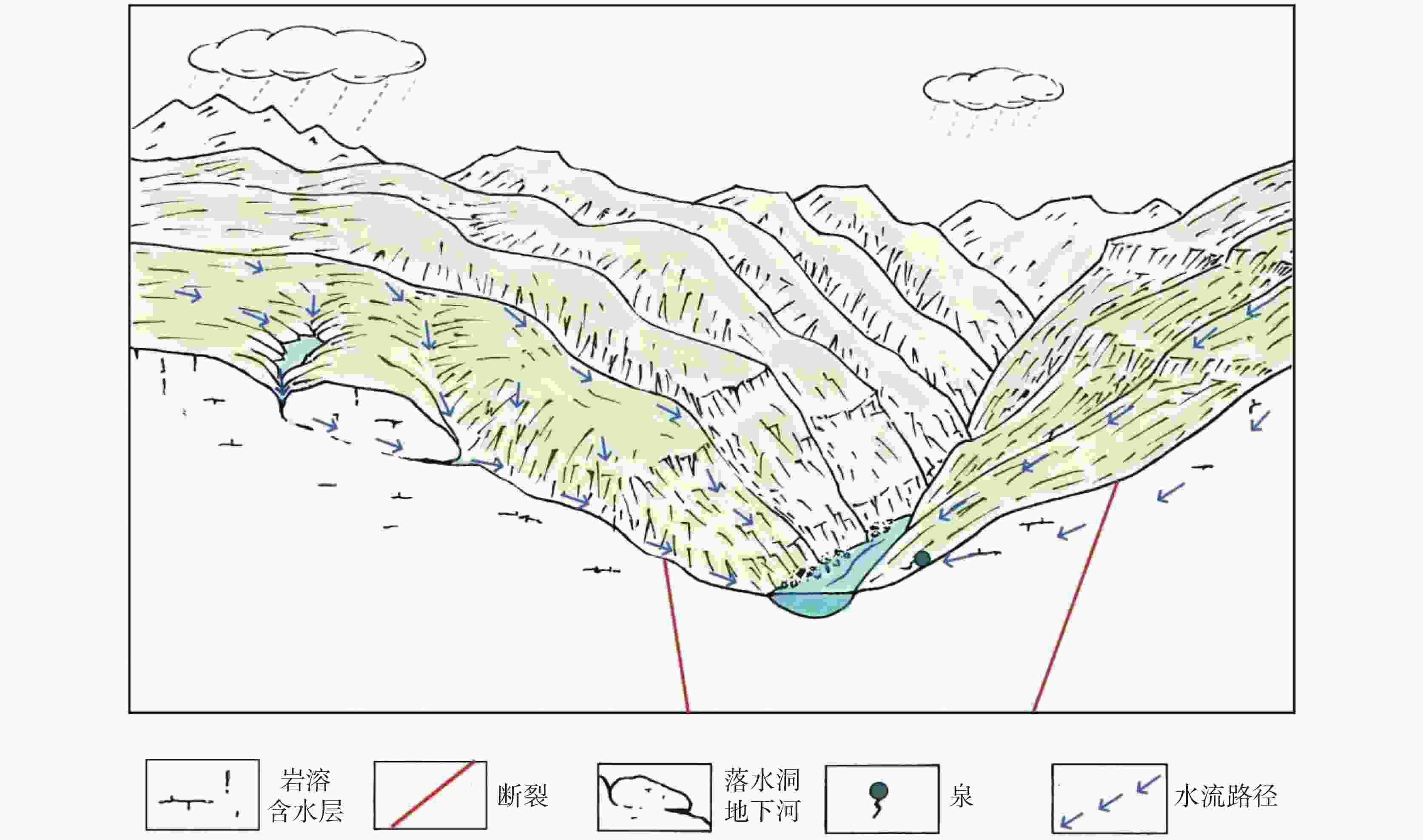
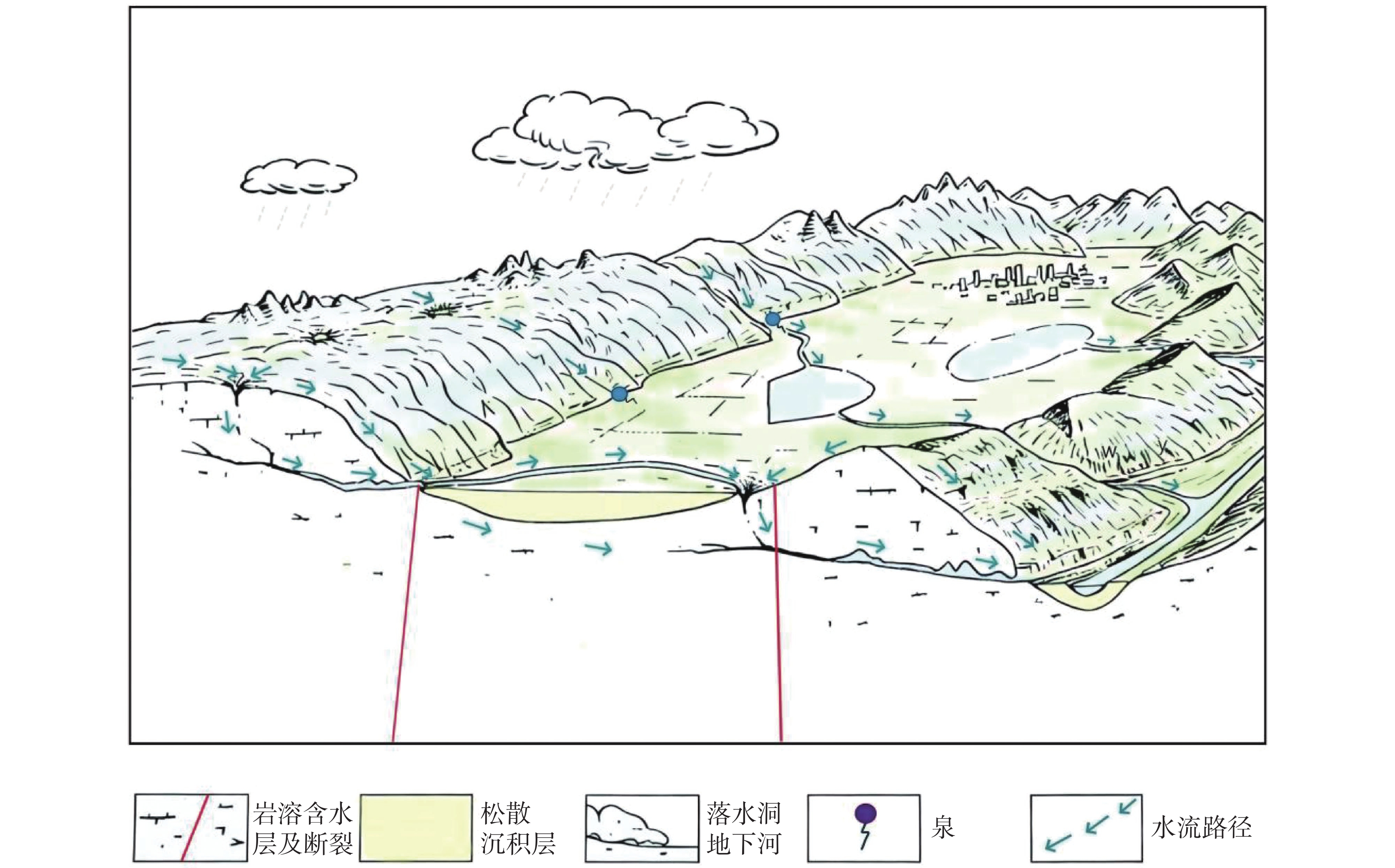
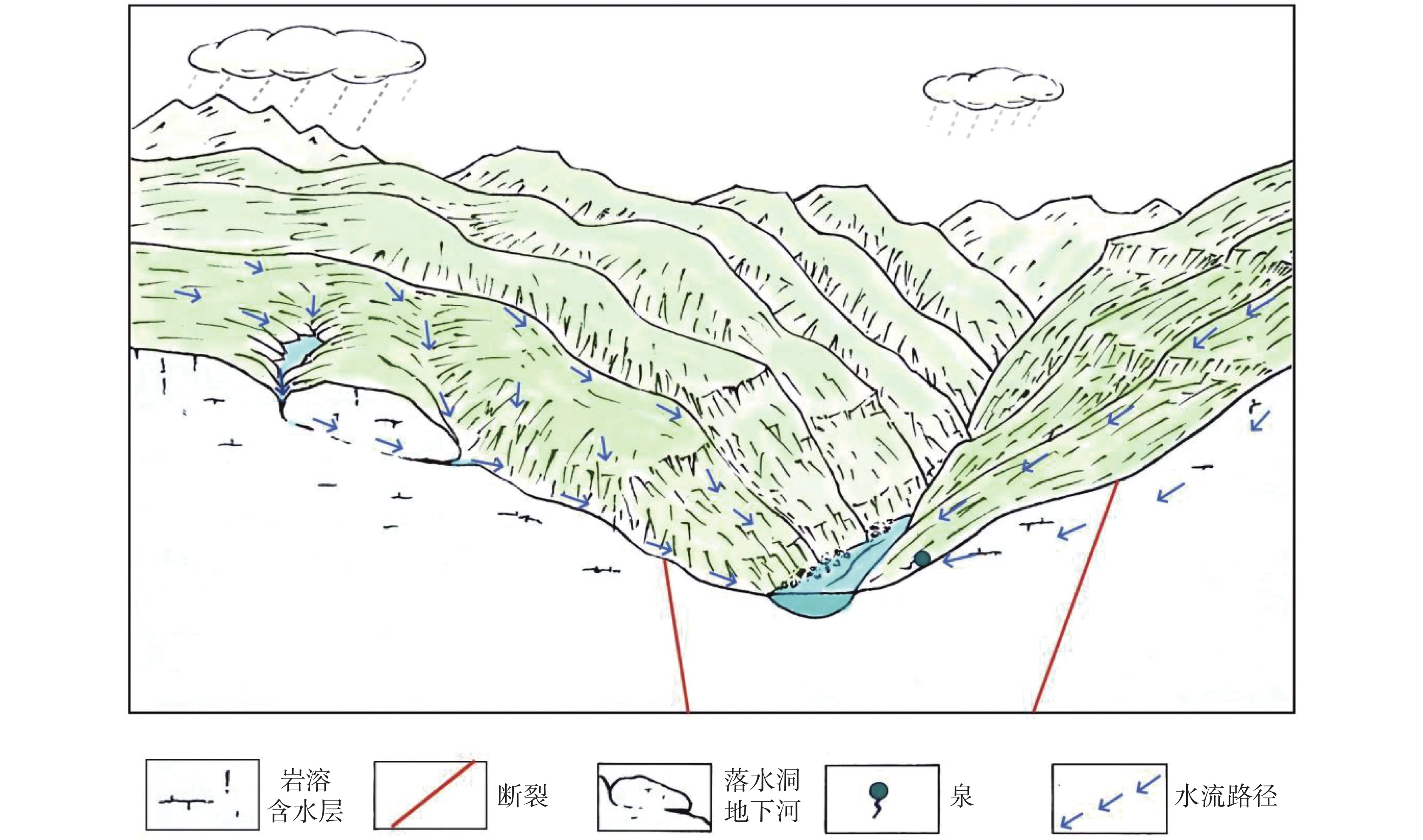
图 1 深切峡谷流域景观及水流路径示意图
Figure 1. Schematic diagram of the landscape and water flow path of the deep canyon watershed
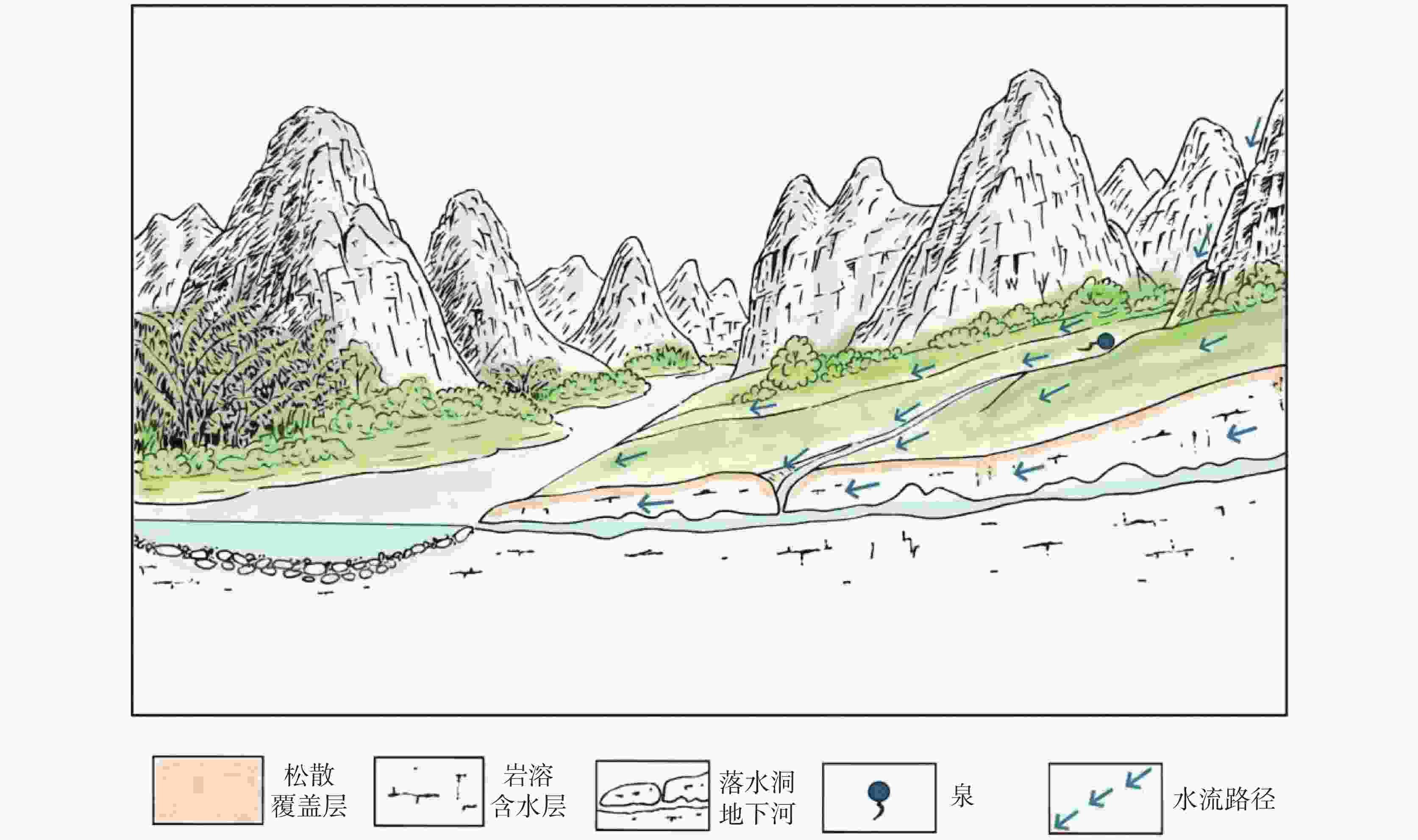
图 2 浅切宽谷流域景观及水流路径示意图
Figure 2. Schematic diagram of the landscape and water flow path of the shallow-cut wide valley watershed
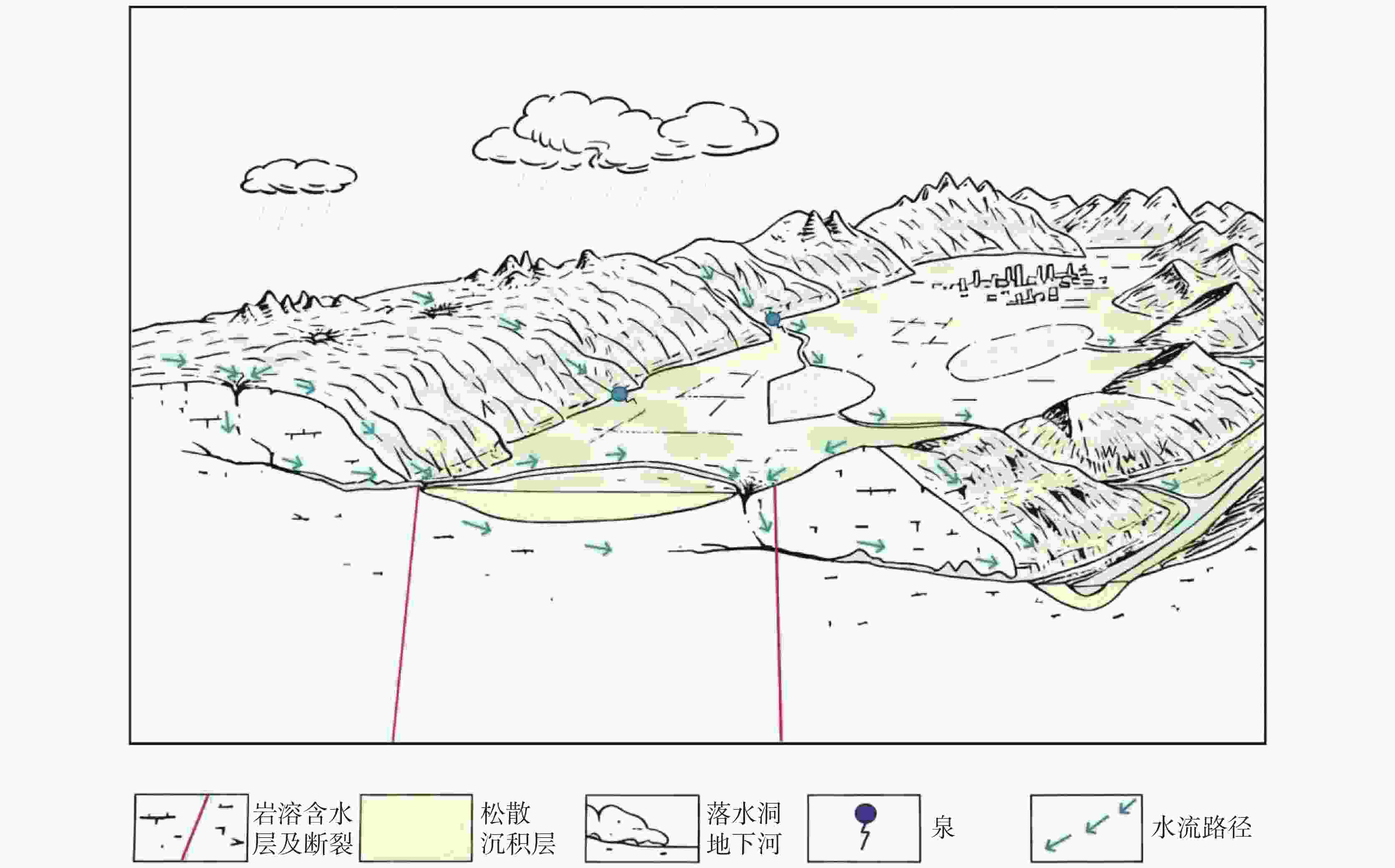
图 3 山间盆地流域景观及水流路径示意图
Figure 3. Schematic diagram of the landscape and water flow path of the intermountain basin watershed
表 1 岩溶流域“三水”转化监测基本工作量表
Table 1. Basic work scale for monitoring the transformation of "three waters" in karst watershed
(单位:个/100 km2) 流域类型 调查精度 气象站 水文站 地下水监测点 深切峡谷流域 1∶ 250000 0.03-0.05 0.05-0.1 0.05-0.1 1∶ 50000 0.3-0.5 0.5-1.0 0.5-1.0 浅切宽谷流域 1∶ 250000 0.01-0.03 0.1-0.2 0.1-0.3 1∶ 50000 0.1-0.3 1.0-3.0 2.0-4.0 山间盆地流域 1∶ 250000 0.02-0.04 0.03-0.1 0.1-0.2 1∶ 50000 0.2-0.4 0.5-2.0 1.0-3.0  下载: 导出CSV
-
[1] 黄昌硕, 耿雷华, 杨军飞. 水资源领域若干相关术语研究[J]. 水利发展研究, 2025, 25(7): 47-52.HUANG Changshuo, GENG Leihua, YANG Junfei. Research on several related terms in the field of water resources[J]. Research on Water Conservancy Development, 2020, 25 (7) : 47-52. [2] 杜中. 水文站网规划理论发展过程及趋势分析[J]. 水利发展研究, 2015, 15(6): 43-46. doi: 10.13928/j.cnki.wrdr.2015.06.012DU Zhong. Analysis of the development process and trend of hydrological station network planning theory[J]. Research on Water Resources Development, 2015, 15(6): 43-46. doi: 10.13928/j.cnki.wrdr.2015.06.012 [3] 中华人民共和国政府水利部. 中国水资源公报[M]. 中国水利水电出版社, 1998-2023.Ministry of Water Resources of the People's Republic of China. China Water Resources Bulletin[M]. China Water & Power Press, 1998-2023. [4] 陈添裴, 黄欢, 林艳竹, 等. 国家地下水监测报告[R]. 中国地质环境监测院, 2022-2023.CHEN Tianpei, HUANG Huan, LIN Yanzhu, et al. National Groundwater Monitoring Report[R]. China Institute of Geological Environment Monitoring, 2022-2023. [5] 李文鹏, 郑跃军, 刘文波, 等. 国家地下水资源调查评价报告[R]. 中国地质环境监测院, 2023.LI Wenpeng, ZHENG Yuejun, LIU Wenbo, et al. National groundwater resources investigation and evaluation report[R]. China Institute of Geological Environment Monitoring, 2023. [6] 王宇. 岩溶区地表水与地下水资源及环境统一评价的流域边界划分研究[J]. 中国岩溶, 2019, 38(6): 823-830.WANG Yu. Study on watershed boundary division for unified evaluation of surface water and groundwater resources and environment in karst areas[J]. Carsologica Sinica, 2019, 38(6): 823-830. [7] 李文鹏. “水文地质与水资源调查计划”进展[J]. 水文地质工程地质, 2022, 49(2): 1-6. doi: 10.16030/j.cnki.issn.1000-3665.202202057LI Wenpeng. Achievements of investigation program on hydrogeology and water resources of CGS[J]. Hydrogeology & Engineering Geology, 2022, 49(2): 1-6. doi: 10.16030/j.cnki.issn.1000-3665.202202057 [8] 赵良杰, 杨杨, 曹建文, 夏日元, 王喆, 栾崧, 林玉山. 珠江流域地下水资源评价及问题分析[J]. 中国地质, 2021, 48(4): 1020-1031.ZHAO Liangjie, YANG Yang, CAO Jianwen, XIA Riyuan, WANG Zhe, LUAN Song, LIN Yushan. Groundwater resources evaluation and problem analysis in Pearl River Basin[J]. Geology in China, 2021, 48(4): 1020-1031. [9] 裴建国, 梁茂珍, 陈阵. 西南岩溶石山地区岩溶地下水系统划分及其主要特征值统计[J]. 中国岩溶, 2008, 27(1): 6-10.PEI Jianguo, LIANG Maozhen, CHEN Zhen. Classification of karst groundwater system and statistics of the main characteristic values in Southwest China karst mountain[J]. Carsologica Sinica, 2008, 27(1): 6-10. [10] 杨杨, 赵良杰, 潘晓东, 夏日元, 曹建文. 西南岩溶山区地下水资源评价方法对比研究: 以寨底地下河流域为例[J]. 中国岩溶, 2022, 41(1): 111-123.YANG Yang, ZHAO Liangjie, PAN Xiaodong, XIA Riyuan, CAO Jianwen. Comparative study on evaluation methods of groundwater resources in karst area of Southwest China: Taking Zhaidi underground river basin as an example[J]. Carsologica Sinica, 2022, 41(1): 111-123. [11] 蒋忠诚, 裴建国, 夏日元, 张美良, 雷明堂. 我国“十一五”期间的岩溶研究进展与重要活动[J]. 中国岩溶, 2010, 29(4): 349-354. doi: 10.3969/j.issn.1001-4810.2010.04.001JIANG Zhongcheng, PEI Jianguo, XIA Riyuan, ZHANG Meiliang, LEI Mingtang. Progresses and important activities of karst research during the 11th Five-Year Plan in China[J]. Carsologica Sinica, 2010, 29(4): 349-354. doi: 10.3969/j.issn.1001-4810.2010.04.001 [12] 夏日元, 邹胜章, 唐建生, 梁彬, 曹建文. 南方岩溶地区1∶5万水文地质环境地质调查技术要点分析[J]. 中国岩溶, 2017, 36(5): 599-608.XIA Riyuan, ZOU Shengzhang, TANG Jiansheng, Liang Bin, CAO Jianwen. Technical key points of 1∶50, 000 hydrogeological and environmental geology surveys in karst areas of South China[J]. Carsologica Sinica, 2017, 36(5): 599-608. [13] 王宇. 南方岩溶地区水文地质调查的问题与改进措施[J]. 中国岩溶, 2023, 42(4): 627-635. doi: 10.11932/karst20230401WANG Yu. Problems and their countermeasures in a hydrogeological survey of karst areas in South China[J]. Carsologica Sinica, 2023, 42(4): 627-635. doi: 10.11932/karst20230401 [14] 王宇. 云南省地下水资源潜力评价现状与问题分析[J]. 中国岩溶, 2020, 39(2): 137-146. doi: 10.11932/karst20200201WANG Yu. Evaluation status and problems of groundwater resource potential in Yunnan Province[J]. Carsologica Sinica, 2020, 39(2): 137-146. doi: 10.11932/karst20200201 [15] 张寿越, 何宇彬, 金玉章, 王在中. 中国岩溶研究[M]. 科学出版社, 1979.ZHANG Shouyue, HE Yubin, JIN Yuzhang, WANG Zaizhong. Karst research in china[M]. Science Press, 1979. [16] 袁道先, 蔡桂鸿. 岩溶环境学[M]. 重庆出版社, 1988.YUAN Daoxian, CAI Guihong. Karst environmental science[M]. Chongqing Publishing House, 1988. [17] 王宇, 张贵, 张华, 康晓波, 彭淑惠, 王波, 等. 云南省岩溶水文地质环境地质调查与研究[M]. 地质出版社, 2018.WANG Yu, ZHANG Gui, ZHANG Hua, KANG Xiaobo, PENG Shuhui, WANG Bo, et al. Investigation and research on karst hydrogeology and environmental geology in Yunnan Province[M]. Geological Publishing House, 2018. [18] 夏日元, 张二勇, 谭建生, 王明章, 王宇, 曹建文, 等. 西南岩溶石山区地下水资源调查评价与开发利用模式[M]. 科学出版社, 2018.XIA Riyuan, ZHANG Eryong, TAN Jiansheng, WANG Mingzhang, WANG Yu, CAO Jianwen, et al. Investigation, evaluation and development and utilization model of groundwater resources in karst mountainous areas of Southwest China[M]. Science Press, 2018. [19] 王宇. 西南岩溶地区岩溶水系统分类、特征及勘查评价要点[J]. 中国岩溶, 2002, 21(2): 114-119. doi: 10.3969/j.issn.1001-4810.2002.02.008WANG Yu. Classification, characteristics of karst water system and key points for the exploration and evaluation to Karst water in karst area of Southwest China[J]. Carsologica Sinica, 2002, 21(2): 114-119. doi: 10.3969/j.issn.1001-4810.2002.02.008 [20] 杨杨, 赵良杰, 夏日元, 王莹. 珠江流域岩溶地下河分布特征与影响因素研究[J]. 中国岩溶, 2022, 41(4): 562-576. doi: 10.11932/karst20220515YANG Yang, ZHAO Liangjie, XIA Riyuan, WANG Ying. Distribution and influencing factors of karst underground rivers in the Pearl River Basin[J]. Carsologica Sinica, 2022, 41(4): 562-576. doi: 10.11932/karst20220515 [21] 薛显武, 陈喜, 秦年秀, 赵旭升, 石朋. 喀斯特流域枯季径流衰减系数与地表形态特征相关分析研究[J]. 中国岩溶, 2011, 30(1): 41-46. doi: 10.3969/j.issn.1001-4810.2011.01.007XUE Xianwu, CHEN Xi, QIN Nianxiu, ZHAO Xusheng, SHI Peng. Correlation analysis between low-flow recession coefficient and surface landform characteristics in karst basin[J]. Carsologica Sinica, 2011, 30(1): 41-46. doi: 10.3969/j.issn.1001-4810.2011.01.007 [22] 范威, 陈植华, 牛俊强, 李伟, 王亮, 黄荷. 香溪河岩溶流域水系结构与洪峰特征关系[J]. 中国岩溶, 2021, 40(3): 430-438. doi: 10.11932/karst2021y21FAN Wei, CHEN Zhihua, NIU Junqiang, LI Wei, WANG Liang, HUANG He. Relationship between the surface water system structure and the flood peak in the Xiangxi river karst basin[J]. Carsologica Sinica, 2021, 40(3): 430-438. doi: 10.11932/karst2021y21 [23] 龚效宇, 曾成, 何春, 陈旺光. 贵州乌江南源上游流域不同岩溶地貌单元的流量衰减分析[J]. 中国岩溶, 2020, 39(2): 154-163. doi: 10.11932/karst2020y22GONG Xiaoyu, ZENG Cheng, HE Chun, CHEN Wangguang. Flow recession analysis of karst underground river basins in different karst geomorphic units in the upper reaches of the south source of the Wujiang river, Guizhou Province[J]. Carsologica Sinica, 2020, 39(2): 154-163. doi: 10.11932/karst2020y22 [24] 劳文科, 蓝芙宁, 蒋忠诚, 覃小群, 谢运球, 邓艳. 石期河流域岩溶水系统及其水资源构成分析[J]. 中国岩溶, 2009, 28(3): 255-262. doi: 10.3969/j.issn.1001-4810.2009.03.005LAO Wenke, LAN Funing, JIANG Zhongcheng, QIN Xiaoqun, XIE Yuanqiu, DENG Yan. Analysis on karst groundwater system and its water resources composition in Shiqihe basin[J]. Carsologica Sinica, 2009, 28(3): 255-262. doi: 10.3969/j.issn.1001-4810.2009.03.005 [25] 梁虹. 喀斯特流域空间尺度对洪、枯水水文特征值影响初探: 以贵州河流为例[J]. 中国岩溶, 1997, 16(2): 121-129.LIANG Hong. A preliminary study on the impact of spatial scale of karst basin on hydrological characteristics of flood and drought periods— exampled by the river s in Guizhou Province[J]. Carsologica Sinica, 1997, 16(2): 121-129. [26] 蒋忠诚, 王瑞江, 裴建国, 何师意. 我国南方表层岩溶带及其对岩溶水的调蓄功能[J]. 中国岩溶, 2001, 20(2): 106-110. doi: 10.3969/j.issn.1001-4810.2001.02.005JIANG Zhongcheng, WANG Ruijiang, PEI Jianguo, HE Shiyi. The surface karst zone in southern China and its regulating and storing function for karst water[J]. Carsologica Sinica, 2001, 20(2): 106-110. doi: 10.3969/j.issn.1001-4810.2001.02.005 [27] 王宇. 岩溶高原地下水径流系统垂向分带[J]. 中国岩溶, 2018, 37(1): 1-8. doi: 10.11932/karst20180101WANG Yu. Vertical zoning of groundwater runoff system in karst plateau[J]. Carsologica Sinica, 2018, 37(1): 1-8. doi: 10.11932/karst20180101 [28] 王宇, 张华, 张贵, 王波, 彭淑惠, 何绕生, 周翠琼. 喀斯特断陷盆地环境地质分区及功能[J]. 中国岩溶, 2017, 36(3): 283-295. doi: 10.11932/karst20170316WANG Yu, ZHANG Hua, ZHANG Gui, WANG Bo, PENG Shuhui, HE Raosheng, ZHOU Chuiqiong. Zoning of environmental geology and functions in karst fault-depression basins[J]. Carsologica Sinica, 2017, 36(3): 283-295. doi: 10.11932/karst20170316 [29] 王宇, 彭淑惠. 云南省岩溶水赋存特征[J]. 中国岩溶, 2011, 30(3): 253-259. doi: 10.3969/j.issn.1001-4810.2011.03.003WANG Yu, PENG Shuhui. Distribution features of karst water in Yunnan[J]. Carsologica Sinica, 2011, 30(3): 253-259. doi: 10.3969/j.issn.1001-4810.2011.03.003 [30] 中华人民共和国水利部. SL/T 365-2015 水资源水量监测技术导则[S]. 北京: 中国水利水电出版社, 2015.Ministry of Water Resources of the People‘s Republic of China. SL/T SL365-2015 Technical Guidelines for Water Resources and Quantity Monitoring[S]. Beijing: China Water & Power Press, 2015. [31] 中华人民共和国水利部. SL/T238-1999 水资源评价导则[S]. 北京: 中国水利水电出版社, 1999.Ministry of Water Resources of the People‘s Republic of China. SL/T238-1999 Guidelines for Water Resources Assessment[S]. Beijing: China Water & Power Press, 1999. [32] 中华人民共和国水利部, 中华人民共和国自然资源部. GB/T51040-2023 地下水监测工程技术规范[S]. 北京: 中国计划出版社, 2023.Ministry of Water Resources of the People‘s Republic of China, Ministry of Natural Resources of the People's Republic of China. GB/T51040-2023 Technical Code for Groundwater Monitoring Engineering[S]. Beijing: China Planning Press. [33] 国家市场监督管理总局, 国家标准化管理委员会. GB/T43216-2023 岩溶关键带监测技术要求[S]. 北京: 中国标准出版社, 2023.State Administration for Market Regulation, Standardization Administration of China. GB/T43216-2023 Technical Requirements for Monitoring of Karst Critical Zones[S]. Beijing: Standards Press of China, 2023. [34] 中华人民共和国自然资源部. DZ/T0469-2024 地下水资源调查评价规范[S]. 北京: 地质出版社, 2024.Ministry of Natural Resources of the People's Republic of China. DZ/T0469-2024 Code for Investigation and Evaluation of Groundwater Resources[S]. Beijing: Geological Publishing House, 2024. [35] 刘琼, 李瑞敏, 王轶, 高萌萌, 李小磊, 孙超. 区域地下水资源承载能力评价理论与方法研究[J]. 水文地质工程地质, 2020, 47(6): 173-183. doi: 10.16030/j.cnki.issn.1000-3665.202007071LIU Qiong, LI Ruimin, WANG Yi, GAO Mengmeng, LI Xiaolei, SUN Chao. Theory and methodology for evaluation of carrying capacity of regional groundwater resources in China[J]. Hydrogeology & Engineering Geology, 2020, 47(6): 173-183. doi: 10.16030/j.cnki.issn.1000-3665.202007071 [36] 王宇. 滇池湖底塌陷漏水隐患研究的问题与建议[J]. 中国岩溶, 2024, 43(1): 1-11. doi: 10.11932/karst20240103WANG Yu. Problems and suggestions on the study of collapse and water leakage at the bottom of Dianchi lake[J]. Carsologica Sinica, 2024, 43(1): 1-11. doi: 10.11932/karst20240103 [37] 刘芮彤, 王锦国, 周云, 黄华, 陈长生. 云南鹤庆西山岩溶地下水均衡模拟[J]. 中国岩溶, 2019, 38(4): 532-538. doi: 10.11932/karst20190409LIU Ruitong, WANG Jinguo, ZHOU Yun, HUANG Hua, CHEN Changsheng. Simulation of karst groundwater balance in the Westshan mountains, Heqing county, Yunnan Province[J]. Carsologica Sinica, 2019, 38(4): 532-538. doi: 10.11932/karst20190409 [38] 李晓英, 顾文钰. 水均衡法在区域地下水资源量评价中的应用研究[J]. 水资源与水工程学报, 2014, 25(1): 87-90.LI Xiaoying, GU Wenyu. Application of water balance method in evaluation of groundwater resources[J]. Journal of Water Resources and Water Engineering, 2014, 25(1): 87-90. [39] 杨杨, 唐建生, 苏春田, 潘晓东, 赵良杰. 岩溶区多重介质水流模型研究进展[J]. 中国岩溶, 2014, 33(4): 419-424. doi: 10.11932/karst20140405YANG Yang, TANG Jiansheng, SU Chuntian, PAN Xiaodong, ZHAO Liangjie. Research advances on multi-medium flow model for karst aquifers[J]. Carsologica Sinica, 2014, 33(4): 419-424. doi: 10.11932/karst20140405 [40] 胡立堂, 王忠静, 赵建世, 马义华. 地表水和地下水相互作用及集成模型研究[J]. 水利学报, 2007, 38(1): 54-59. doi: 10.3321/j.issn:0559-9350.2007.01.008HU Litang, WANG Zhongjing, ZHAO Jianshi, MA Yihua. Research on the interaction and integration model between surface water and groundwater[J]. Journal of Hydraulic Engineering, 2007, 38(1): 54-59. doi: 10.3321/j.issn:0559-9350.2007.01.008 [41] 王蕊, 王中根, 夏军. 地表水和地下水耦合模型研究进展[J]. 地理科学进展, 2008, 27(1): 37-41.WANG Rui, WANG Zhonggen, XIA Jun. Research progress of coupling model of surface water and groundwater[J]. Progress in Geography, 2008, 27(1): 37-41. [42] 周妍, 白国营, 赵洪岩, 王素芬, 邵景力. 分布式地表水—地下水耦合数值模型研究进展[J]. 南水北调与水利科技(中英文), 2023, 21(3): 435-446. doi: 10.13476/j.cnki.nsbdqk.2023.0044ZHOU Yan, BAI Guoying, ZHAO Hongyan, WANG Sufen, SHAO Jingli. Research progress on distributed surface water-groundwater coupled numerical model[J]. South-to-north Water Diversion and Water Conservancy Science and Technology (Chinese and English), 2023, 21(3): 435-446. doi: 10.13476/j.cnki.nsbdqk.2023.0044 [43] 陈税琳, 刘明柱. 地表水—地下水相互作用模型研究现状与进展[J]. 北京城市学院学报, 2011(2): 87-93. doi: 10.16132/j.cnki.cn11-5388/z.2011.02.001CHEN Shuilin, LIU Mingzhu. Research status and progress of surface water-groundwater interaction model[J]. Journal of Beijing City University, 2011(2): 87-93. doi: 10.16132/j.cnki.cn11-5388/z.2011.02.001 [44] 党志文, 邵景力, 崔亚莉, 李军, 宫志强, 赵良杰, 梁永升. 基于MODFLOW-CFP的贵州大井流域岩溶地下水数值模拟[J]. 中国岩溶, 2023, 42(2): 266-276. doi: 10.11932/karst2023y002DANG Zhiwen, SHAO Jingli, CUI Yali, LI Jun, GONG Zhiqiang, ZHAO Liangjie, LIANG Yongsheng. Numerical simulation of karst groundwater in Dajing basin of Guizhou Province based on MODFLOW-CFP[J]. Carsologica Sinica, 2023, 42(2): 266-276. doi: 10.11932/karst2023y002 [45] 陈立华, 杨开鹏, 黄都熠. 平治河岩溶流域退水规律分析与降雨径流模拟[J]. 中国岩溶, 2018, 37(2): 238-244. doi: 10.11932/karst20180210CHEN Lihua, YANG Kaipeng, HUANG Duyi. Study of rainfall-runoff simulation and recession flow in Pingzhihe river karst basin[J]. Carsologica Sinica, 2018, 37(2): 238-244. doi: 10.11932/karst20180210 [46] 刘文冲, 赵良杰, 崔亚莉, 曹建文, 王莹, 李美玲. 基于SWAT-MODFLOW地表−地下水耦合模型的结构与应用研究[J]. 中国岩溶, 2023, 42(6): 1131-1139.LIU Wenchong, ZHAO Liangjie, CUI Yali, CAO Jianwen, WANG Ying, LI Meiling. Structure and application of SWAT-MODFLOW coupling model for surface-groundwater[J]. Carsologica Sinica, 2023, 42(6): 1131-1139. -

 点击查看大图
计量
- 文章访问数: 446
- HTML浏览量: 206
- PDF下载量: 94
- 被引次数: 0
