


Preliminary study of hydrochemical and isotopic characteristics of the Yepuqu basin, southern Xizang
-
摘要: 研究典型流域水化学和同位素组成对青藏高原水资源保护具有重要意义。文章以青藏高原南部叶普曲为例,系统采集了泉水、河流、雨水和冰雪融水,分析其水化学和同位素组成,剖析流域水循环和岩石风化机制。结果表明:(1)泉水和河流水化学类型以Ca-HCO3·SO4型为主(占82%),其次为Ca-HCO3(占12%)。(2)利用氢氧同位素分割径流,得到冰雪融水和雨水对泉水的贡献分别为84%和16%;河流水补给来源中冰雪融水和地下水占68%,雨水占32%。(3)大气降水、碳酸盐岩和硅酸盐岩风化是流域水体溶质主要来源;硫酸和碳酸共同参与流域岩石风化,其中硫酸分别贡献泉水和河流阳离子总量的53%和52%。(4)泉水氘过量参数d值分布分散,揭示流域多数泉水属于独立的水文地质单元;河流分布集中,表明河流补给来源较泉水稳定。文章明确了叶普曲地下水和地表水水化学特征及成因机制,指出了硫化物氧化产酸对岩石风化的贡献,丰富了青藏高原流域水和物质循环理论研究,有利于地表水和地下水资源的保护和合理开发。Abstract: Known as the "Asian Water Tower", the study of water cycle in typical basins of the Qinghai-Xizang Plateau plays a critical role for water resources conservation. This study takes the Yepuqu basin in southern Xizang as the research object, through systematic sampling of spring water, river water, snowmelt, and rainwater (a total of 21 samples collected in June 2023),we comprehensively employed hydrochemical analysis, hydrogen-oxygen isotope tracers (δD, δ18O), and deuterium excess (d-excess) techniques to investigate water circulation pathways,solute sources and rock weathering mechanism. Key findings include: (1) The dominant water chemical type is Ca-HCO3·SO4 (82%), followed by Ca-HCO3 (12%). Isotopic hydrograph separation reveals distinct recharge patterns: spring water recharge derives 84% from snowmelt and 16% from rainfall, while river water recharge comprises 68% from snowmelt and groundwater and 32% from rainfall. Furthermore, the contribution ratio of snowmelt and groundwater decrease progressively along the river flow direction. (2) The solutes are primarily derived from atmospheric precipitation and the weathering of carbonate and silicate rocks. Rainwater contributes 7.6% and 4.2% to the total cation concentration and ${\rm{SO}}_4^{2-}$ in spring water, respectively, and 6.7% and 2.5% in river water, respectively. Notably, sulfate plays a significant role in the rock weathering, accounting for 53% in springs and 52% of the total cation content in spring and river water, respectively, which exceeds the contribution from carbonate weathering. This is mainly attributed to acid production via sulfide oxidation in coal-bearing strata. (3) Springs exhibit highly variable and scattered d-excess values (7.5‰ to 22.4‰), indicating that most springs belong to independent hydrogeological units. In contrast, the d-excess values of river water are concentrated (11.2‰ to 12.7‰), suggesting more stable recharge sources. The downstream decline in river d-excess values reflect an increasing proportion of groundwater recharge. This study quantitatively identifies the dominant contribution of sulfide oxidation-induced acidification to rocking weathering in typical Qinghai-Xizang Plateau basins for the first time. It elucidates the hydrogeological significance of the d-excess parameter in identifying hydrated structural units and water-rock interactions. These findings advance the theoretical framework of water-rock interaction in alpine regions and provide a scientific basis for sustainable water resource management and development on the plateau.
-
Key words:
- hydrochemistry /
- hydrogen and oxygen isotope /
- d-excess /
- water cycle /
- rock weathering /
- karst water /
- Yepuqu
-
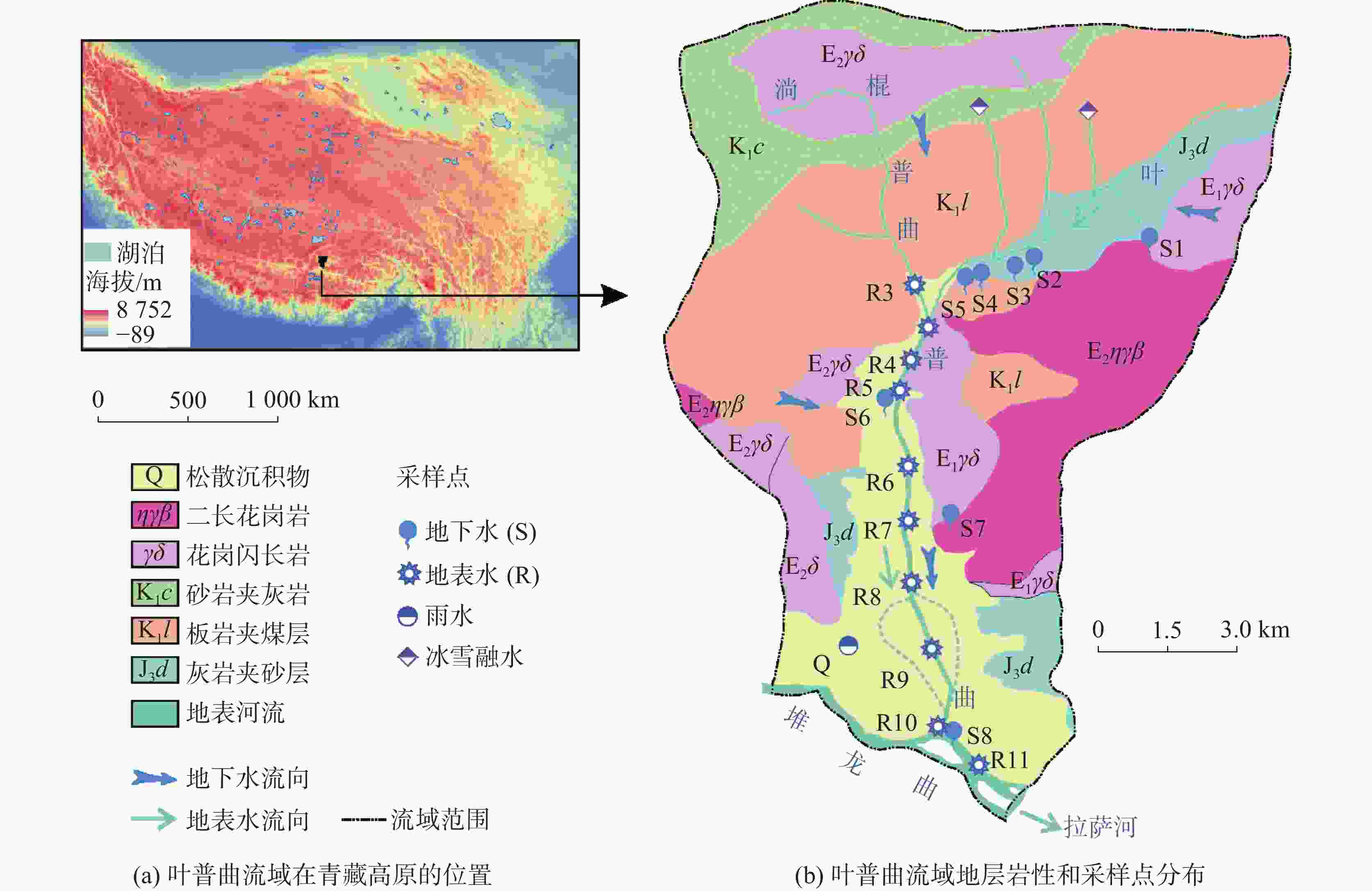
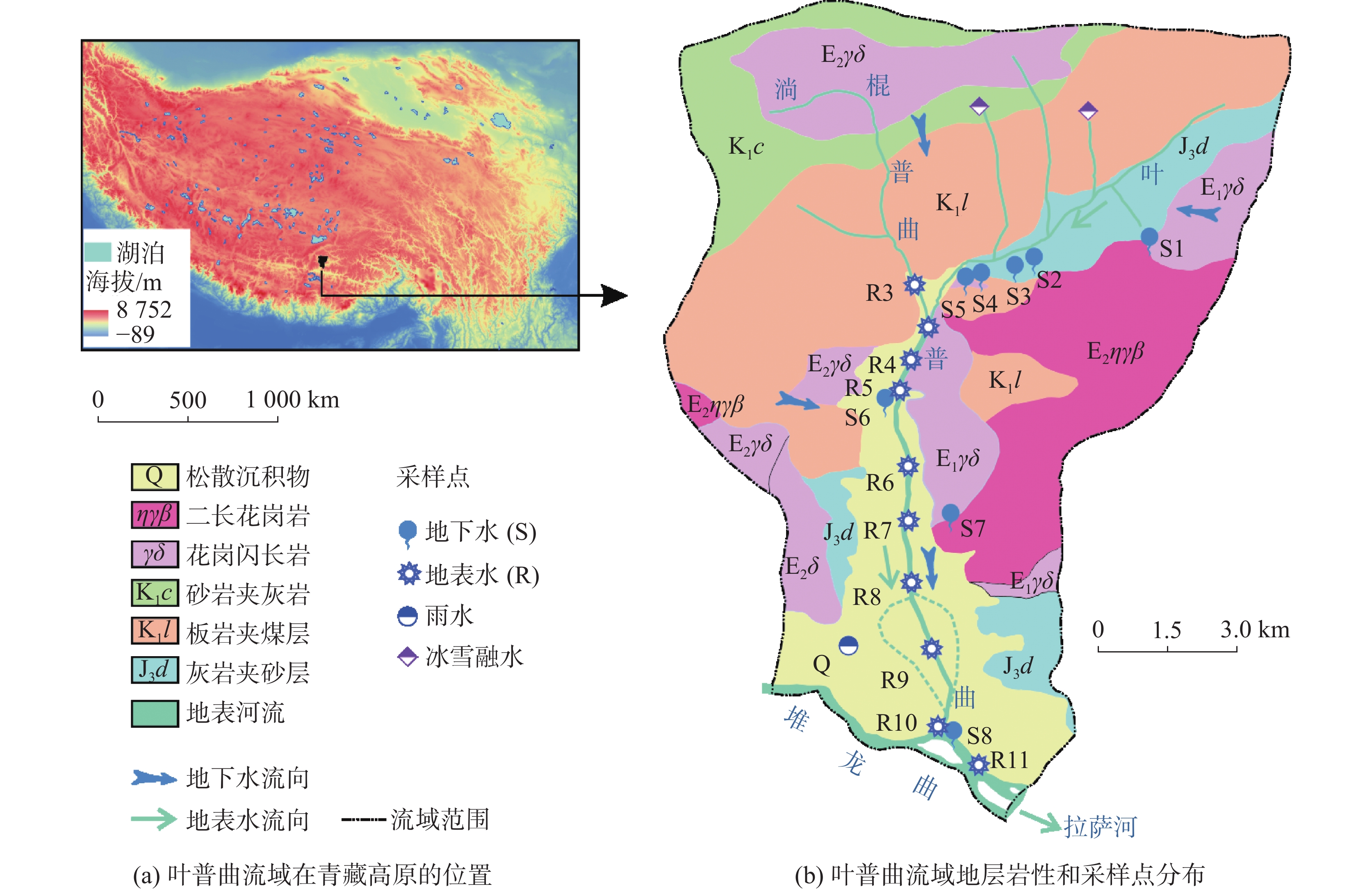
图 1 叶普曲流域位置和采样点分布
Figure 1. Location of the Yepuqu basin and distribution of sampling sites
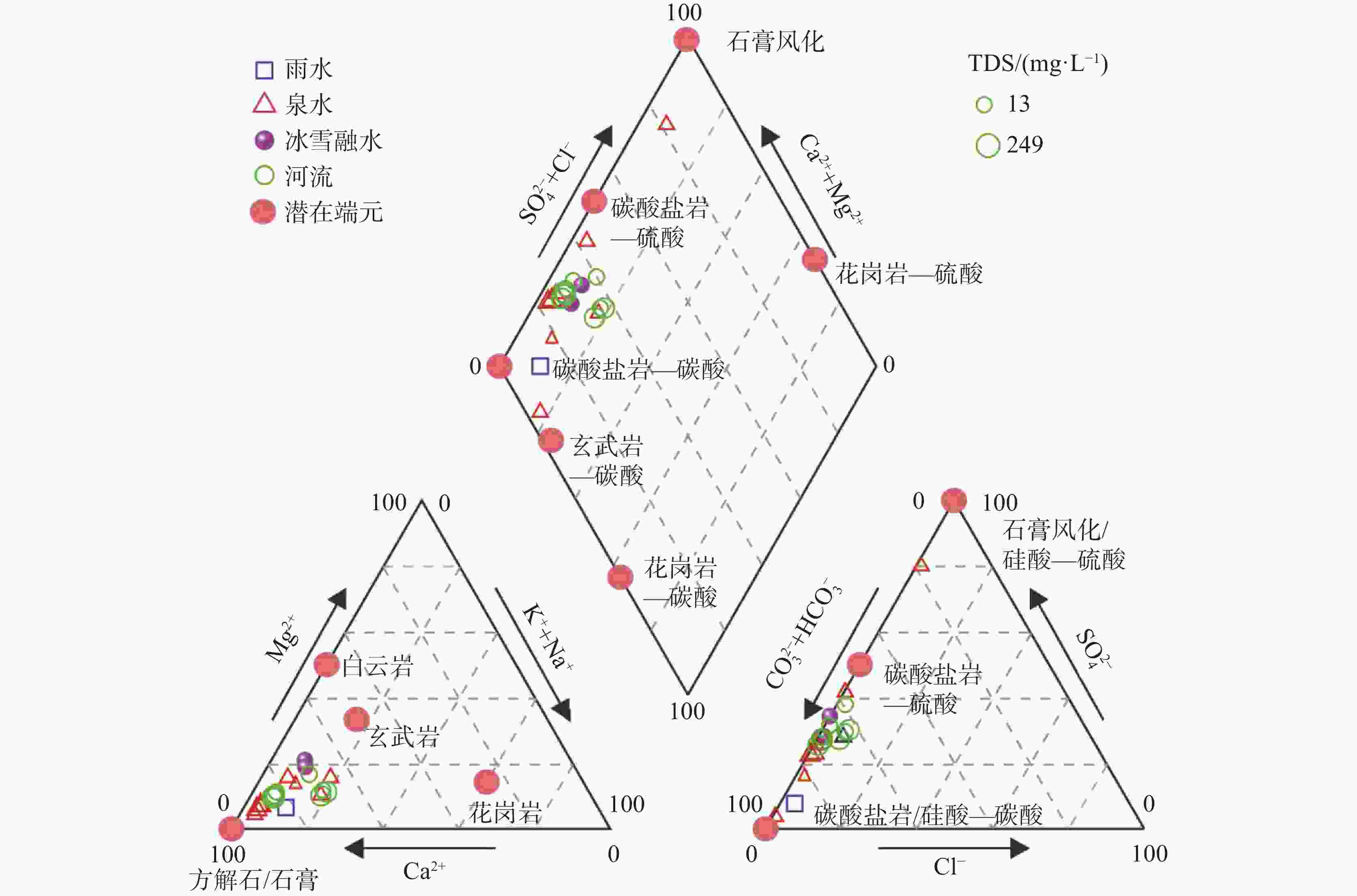
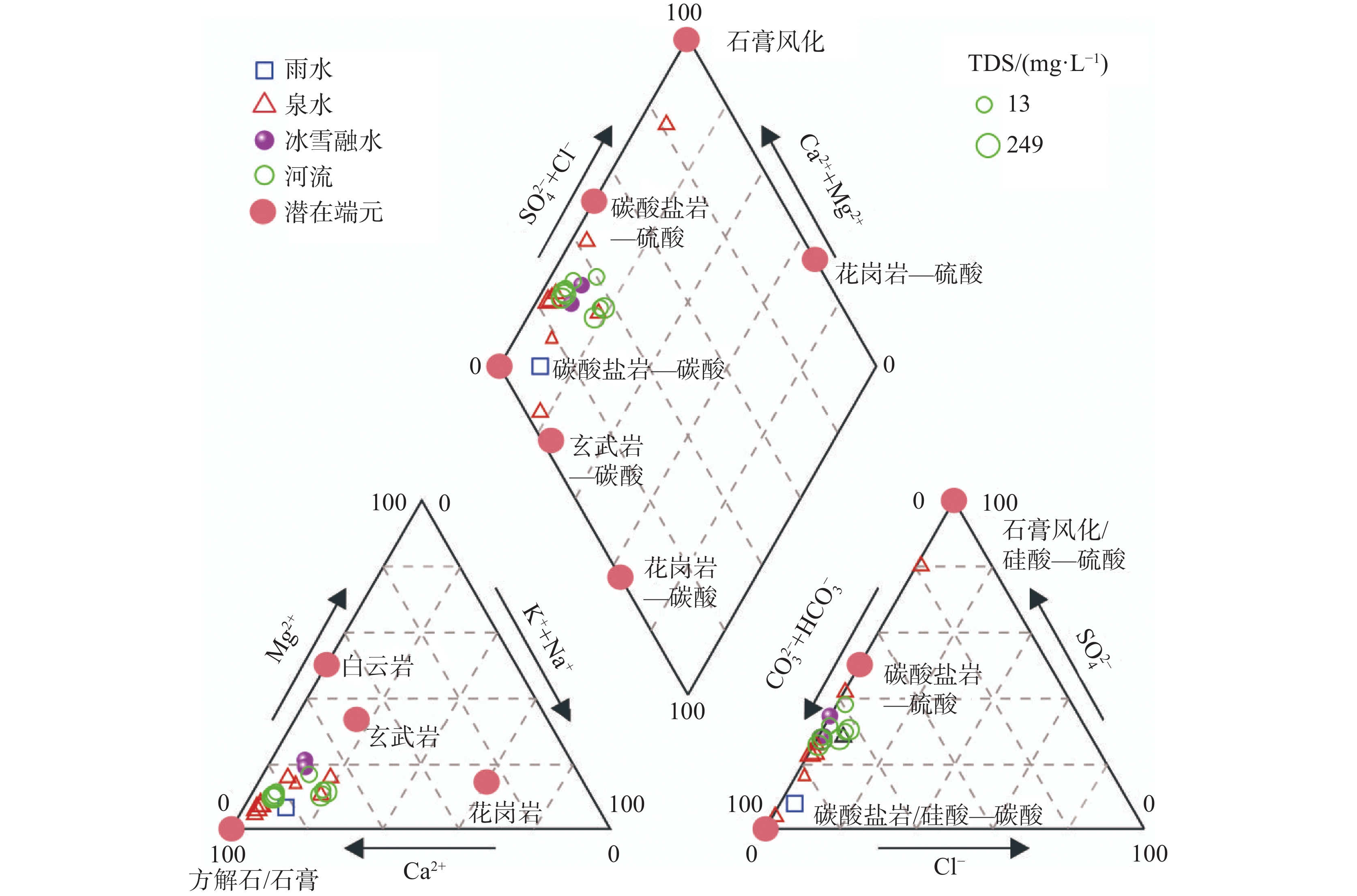
图 2 叶普曲流域水体Piper图
Figure 2. Piper diagram for sampled water bodies in the Yepuqu basin
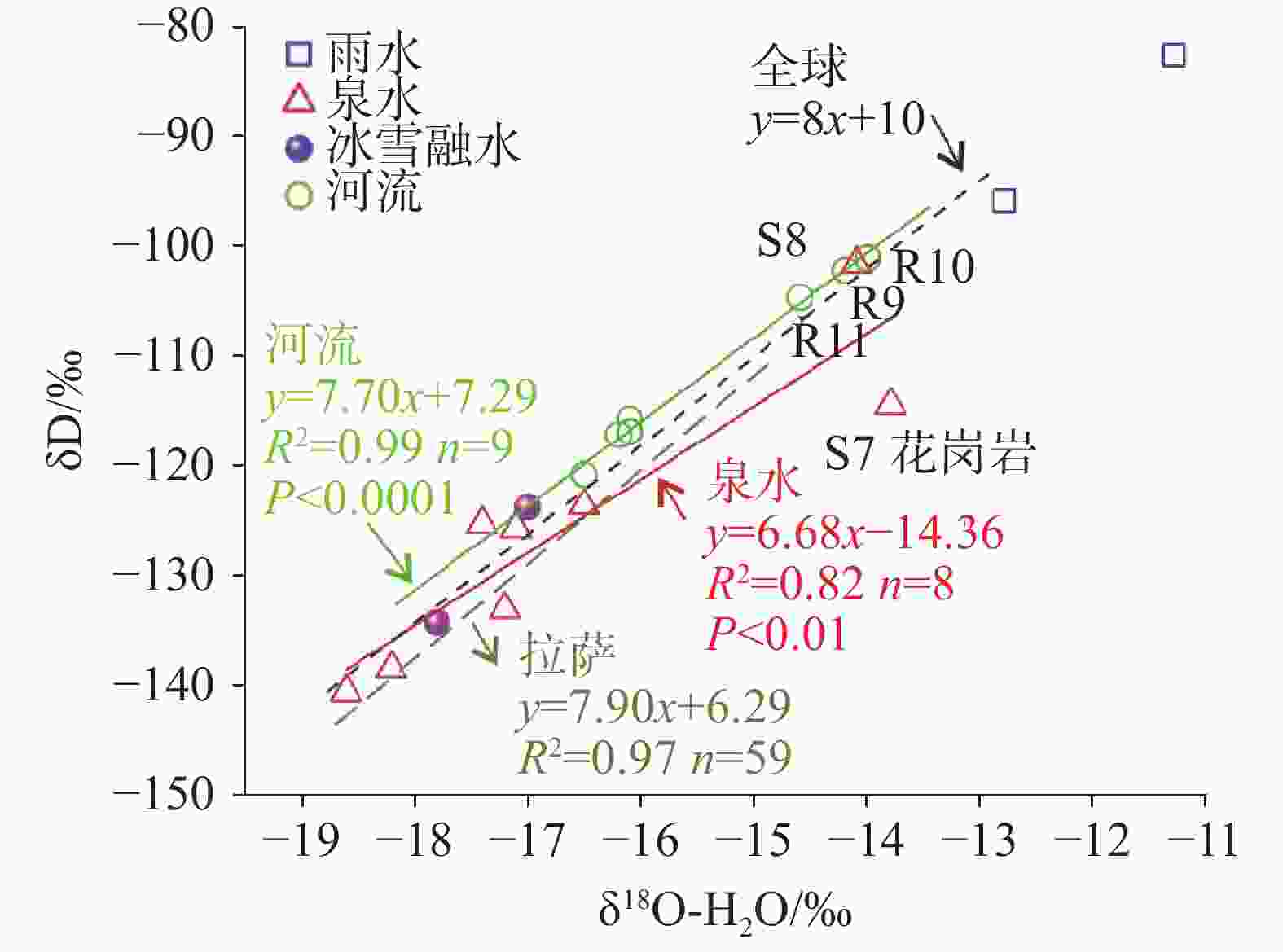
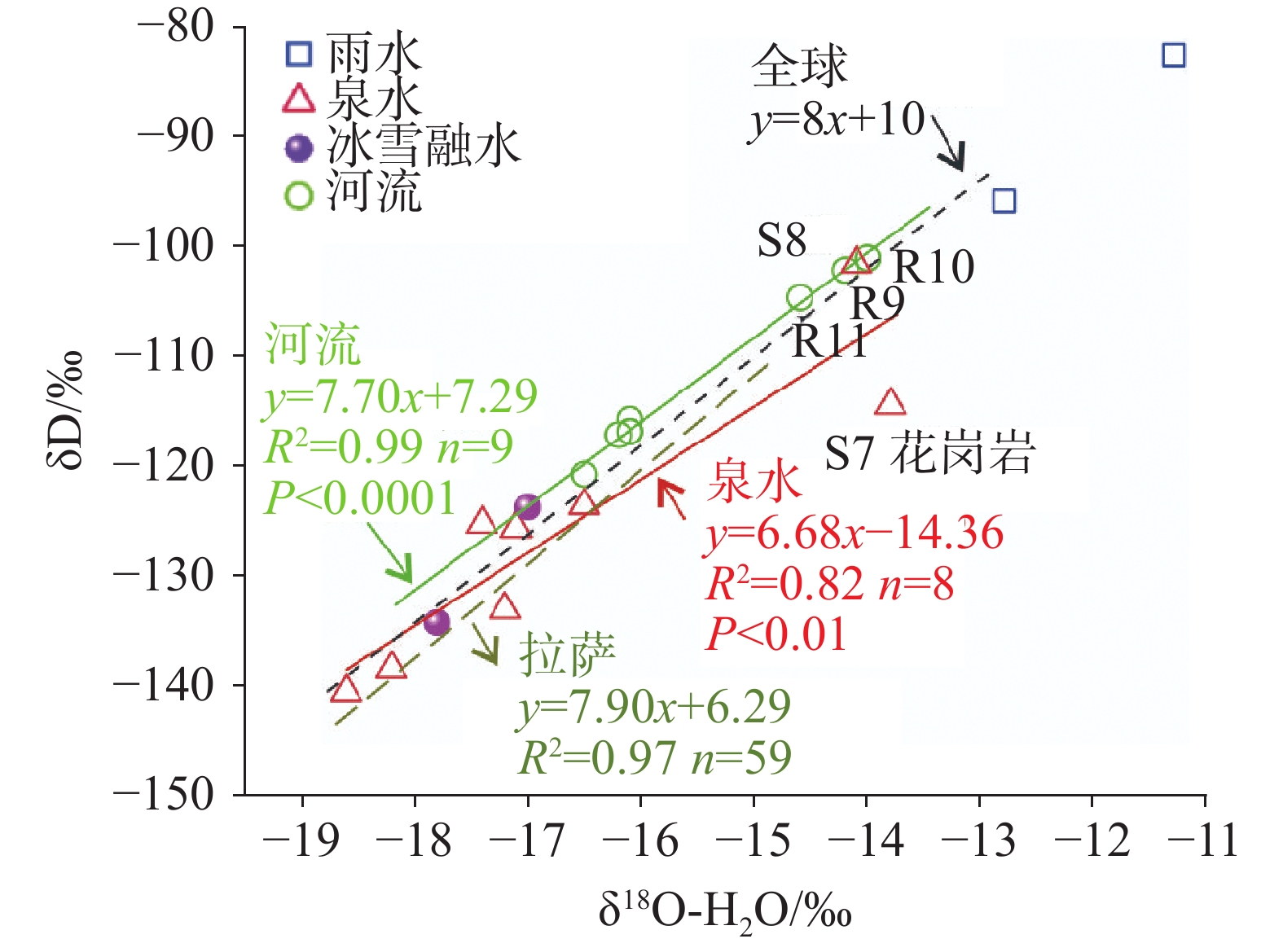
图 3 叶普曲流域水体δD与δ18O-H2O的关系
Figure 3. Dual isotopic plot of δD and δ18O-H2O of sampled waters in the Yepuqu basin
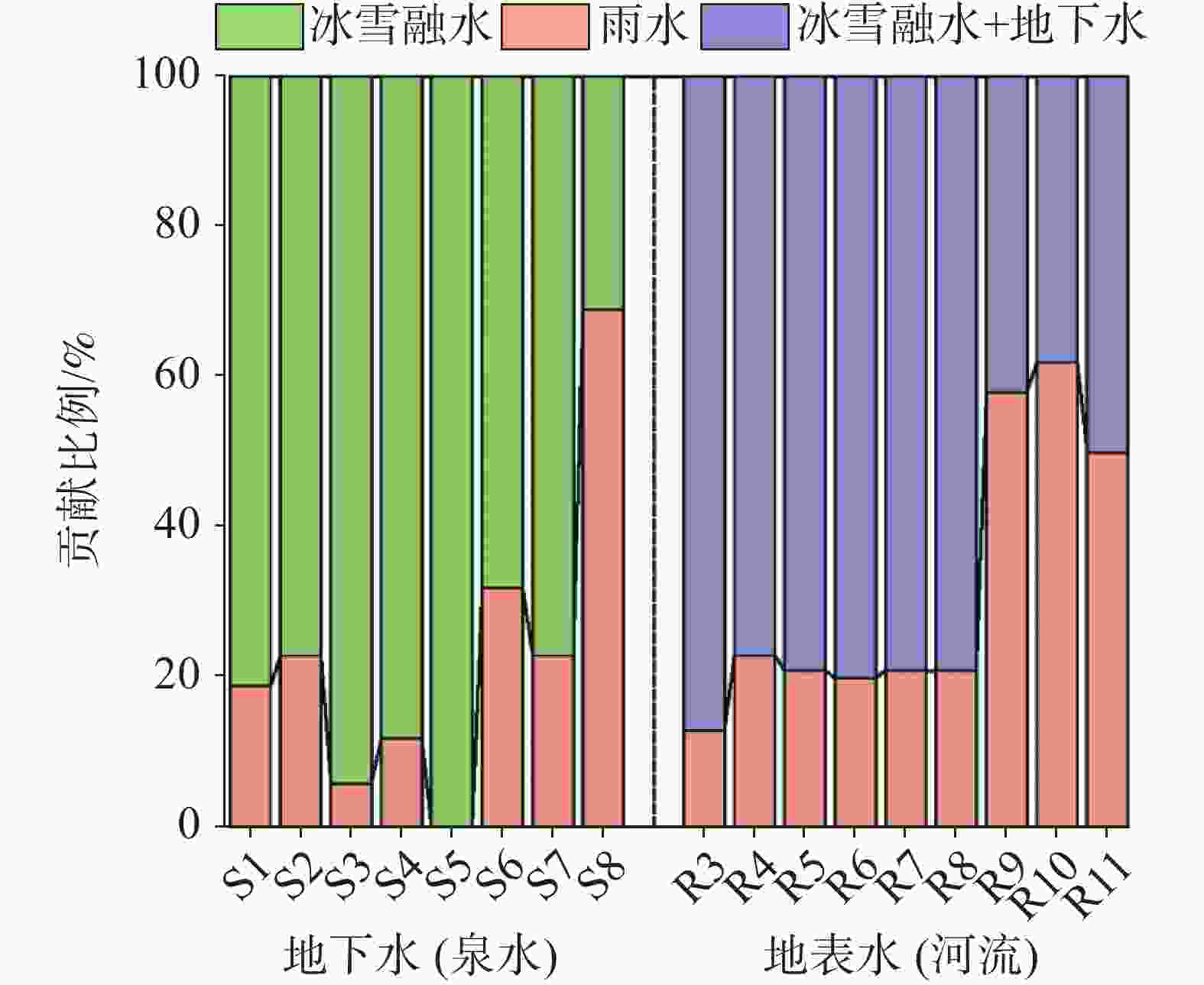
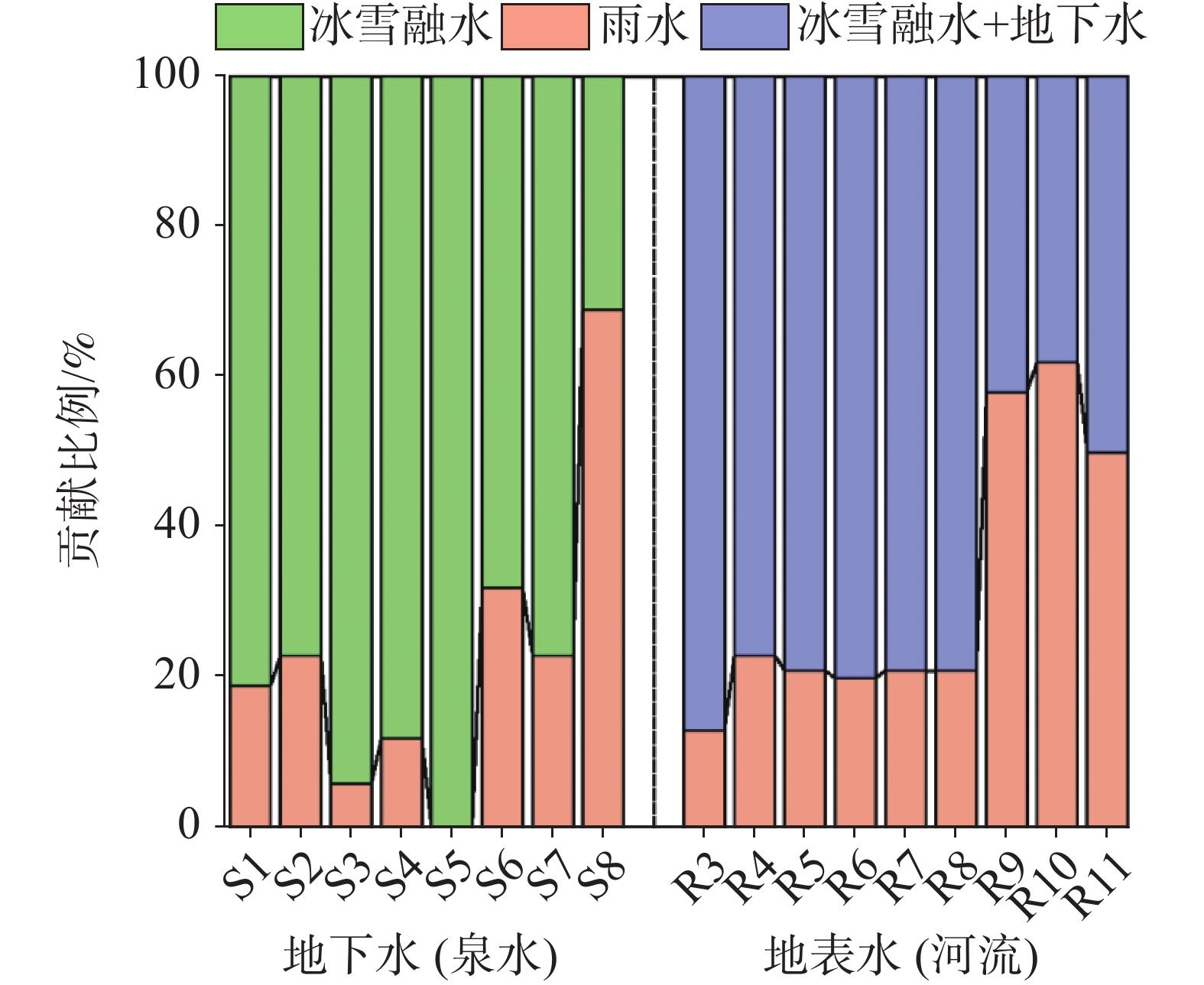
图 4 叶普曲流域地下水和地表水同位素径流分割结果
Figure 4. Results of isotopic hydrograph separation for groundwater and surface water in the Yepuqu basin
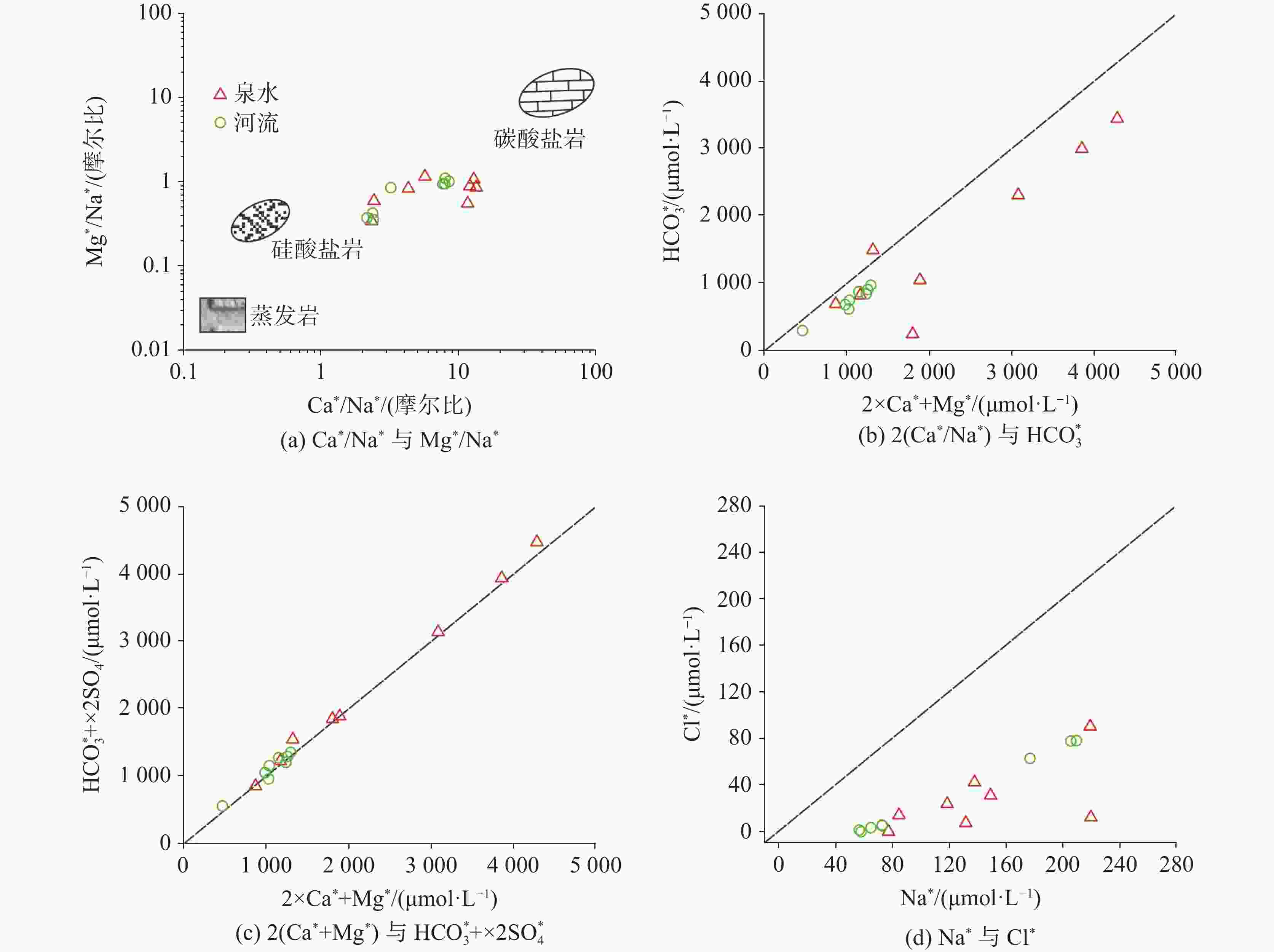
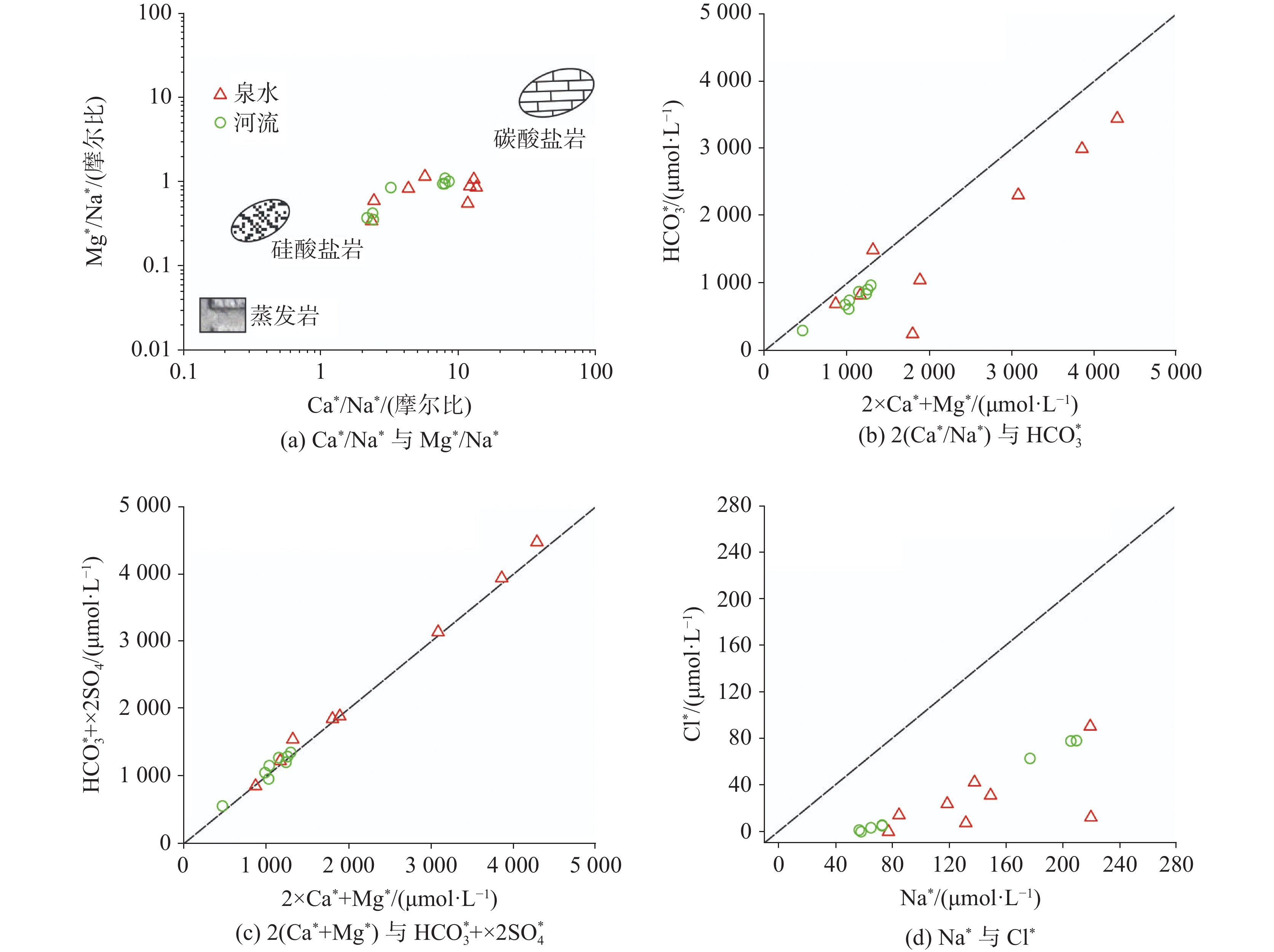
图 5 叶普曲流域地下水和地表水不同离子浓度关系
Figure 5. Plots of relationships between different ion concentrations in groundwater and surface water in the Yepuqu basin
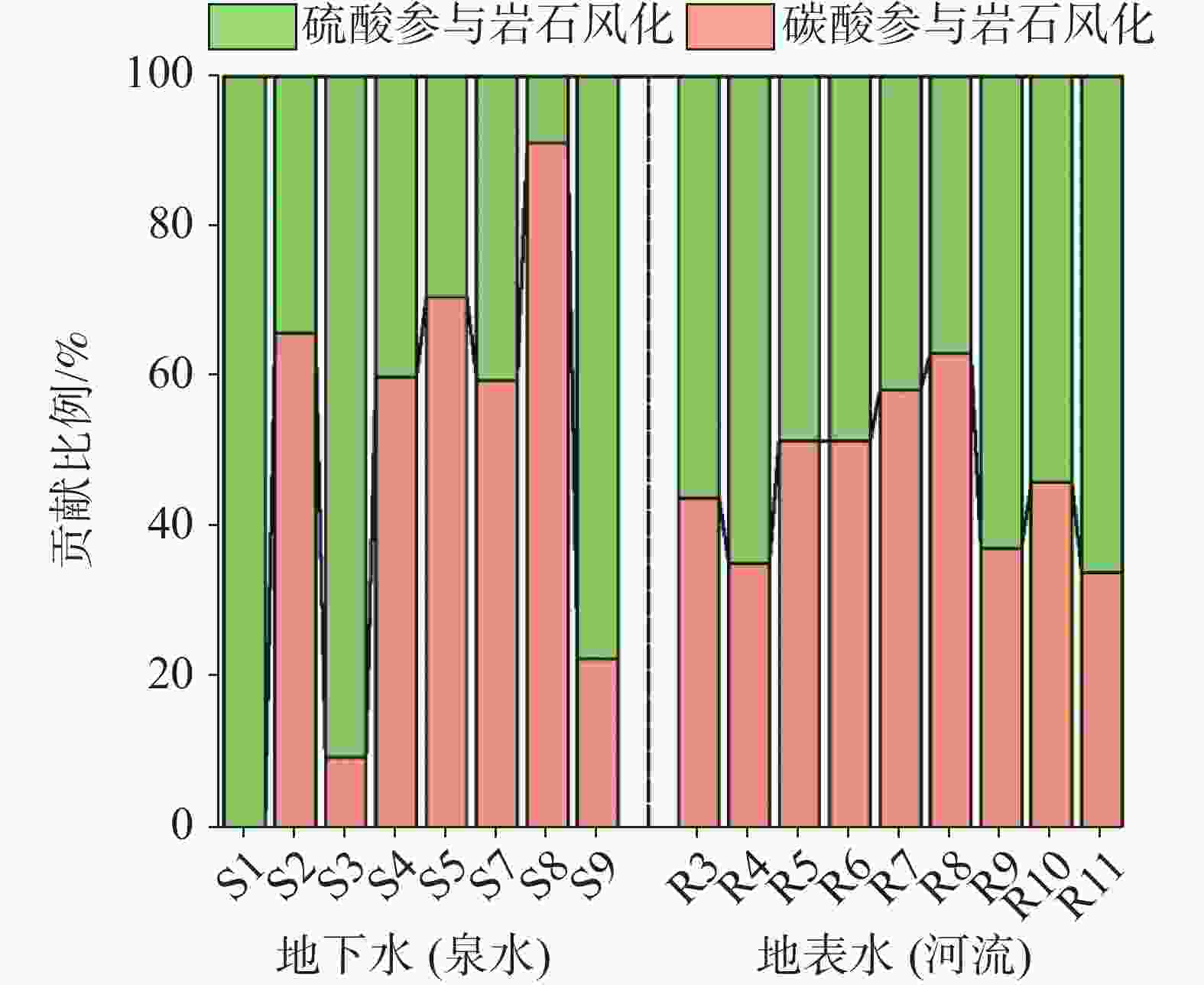
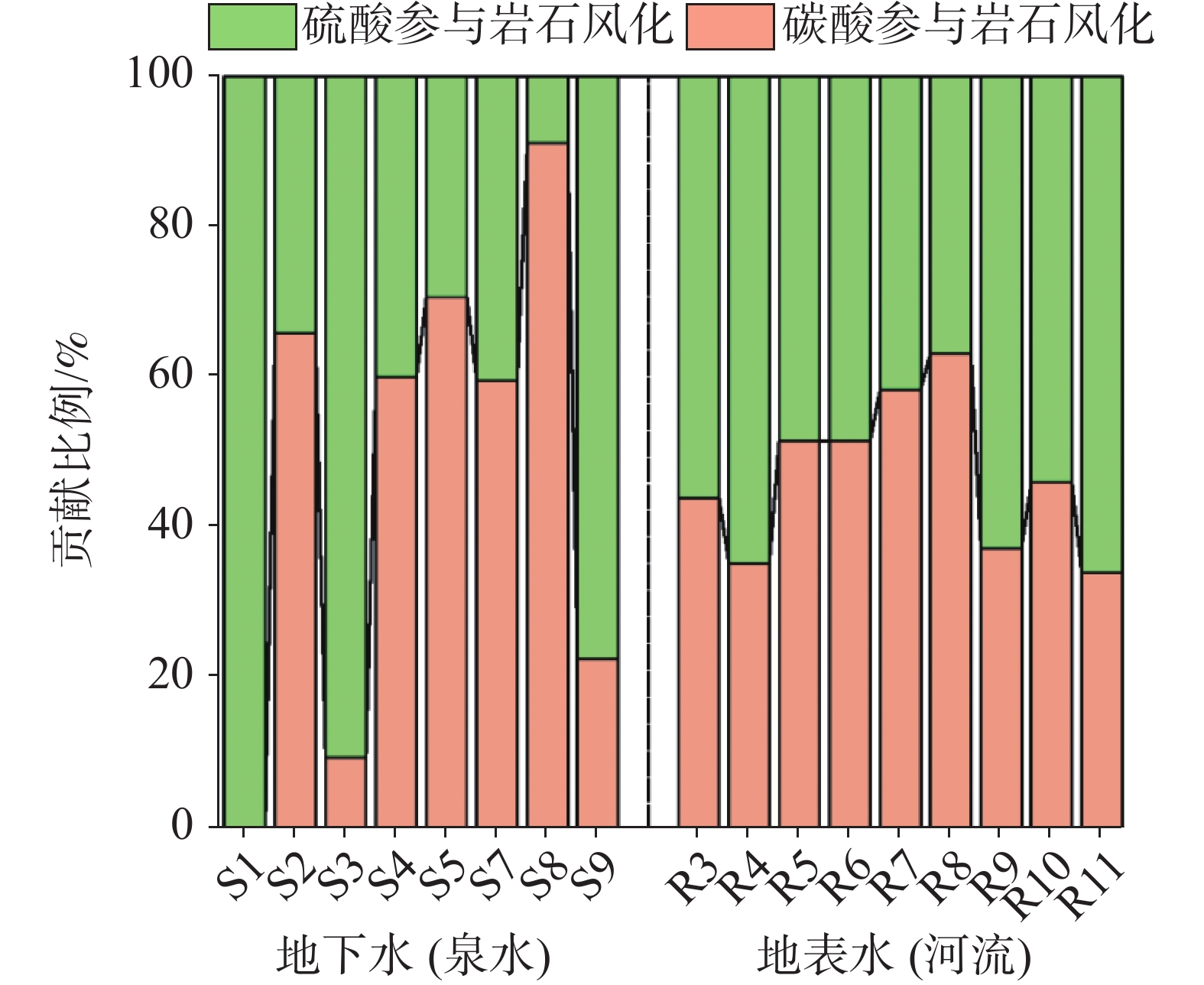
图 6 叶普曲流域硫酸和碳酸参与岩石风化贡献
Figure 6. Contributions of sulfuric and carbonic acids to rock weathering in the Yepuqu basin
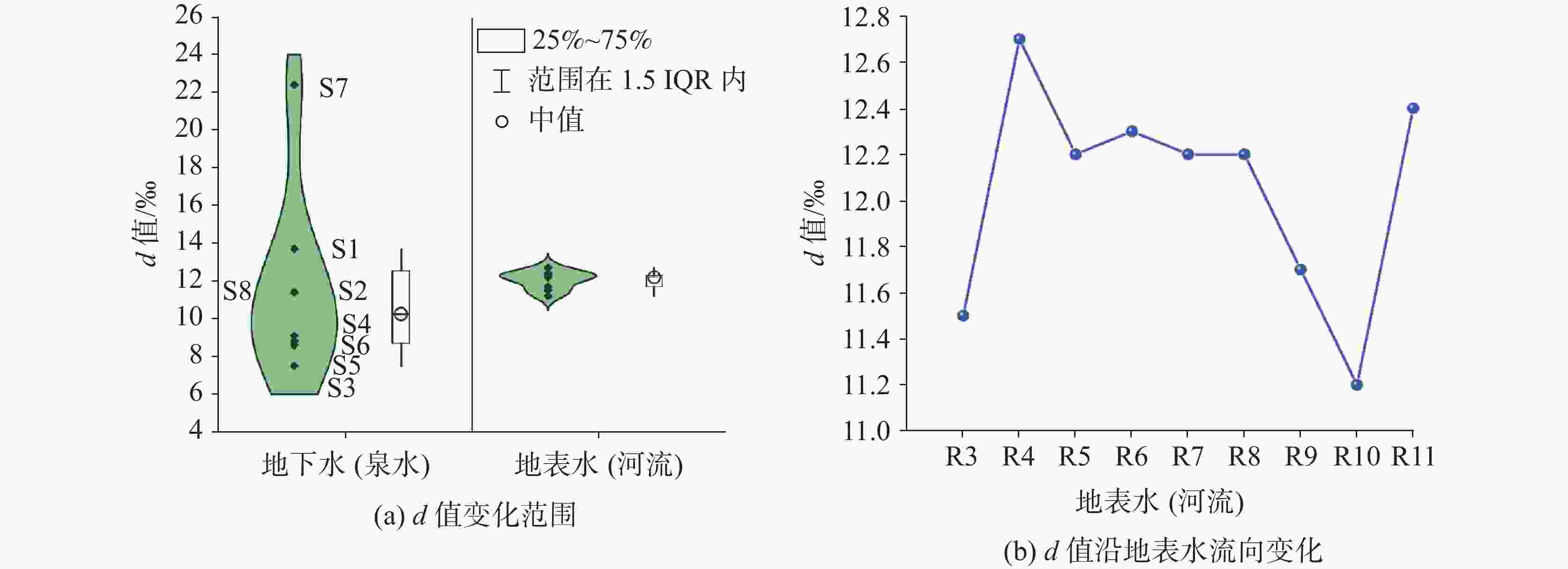
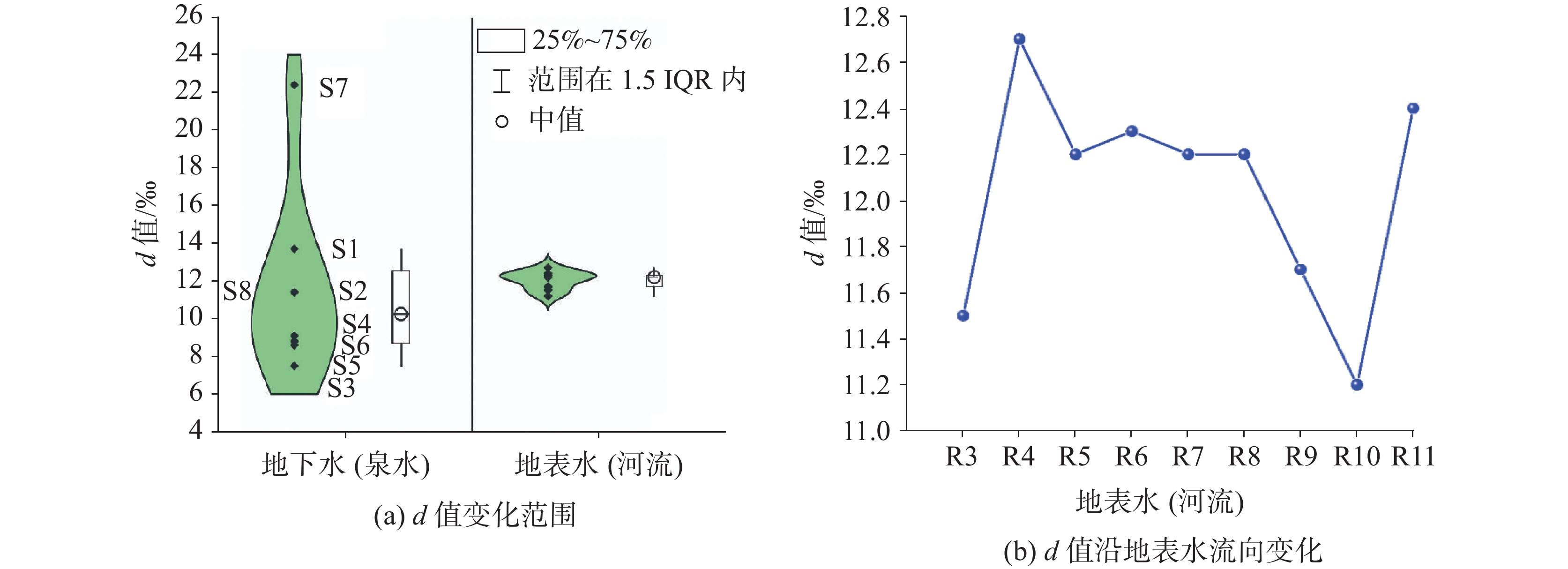
图 7 叶普曲流域d值变化范围及沿河流流程变化
Figure 7. Variation range of d-excess value and its changes along the river flow in the Yepuqu basin
表 1 叶普曲流域地下水和地表水同位素径流分割结果
Table 1. Results of isotopic hydrograph separation for groundwater and surface water in the Yepuqu basin
采样点类型 ID pH T K+ Na+ Ca2+ Mg2+ ${\rm{HCO}}_3^{-}$ Cl− ${\rm{SO}}_4^{2-}$ ${\rm{NO}}_3^{-}$ TDS δD δ18O-H2O d-excess 离子平衡 ℃ mg·L−1 ‰ % 泉水 S1 8.2 3.9 0.44 3.20 31.5 3.73 23 0.50 76.97 3.59 128 −125.2 −17.4 13.7 −0.71 S2 7.8 6.2 0.53 3.34 72.7 3.61 191 1.74 45.31 2.52 223 −125.6 −17.1 11.4 −0.86 S3 8.3 16.4 0.13 1.95 37.6 1.10 72 0.18 40.58 0.37 118 −138.4 −18.2 7.5 0.49 S4 8.5 11.5 0.66 2.90 59.0 2.60 149 1.08 39.86 2.11 180 −133.4 −17.8 9.1 −0.50 S5 8.2 8.1 0.44 3.60 82.1 3.14 218 1.34 49.47 1.12 249 −140.5 −18.6 8.6 −1.47 S6 8.5 10.8 0.45 2.12 16.1 1.77 51 0.74 7.82 2.78 54 −123.5 −16.5 8.8 −0.28 S7 8.3 22.0 3.12 5.22 22.7 3.21 99 0.67 2.67 <0.05a 87 −114.4 −17.1 22.4 0.16 S8 7.9 17.8 2.07 5.21 21.9 1.88 58 3.44 19.51 2.09 83 −101.5 −14.1 11.4 1.09 冰雪融水 R1 8.0 13.2 0.39 1.78 13.0 2.31 37 <0.1 15.10 0.12 51 −134.2 −17.8 8.0 0.09 R2 8.0 12.6 0.32 0.99 7.3 1.18 25 0.25 7.84 2.36 31 −123.7 −17.0 12.6 −9.65 河流 R3 8.2 20.6 0.41 1.48 8.7 1.25 25 0.52 12.46 1.88 37 −120.7 −16.5 11.5 −8.12 R4 8.1 13.4 0.37 1.45 19.4 1.56 45 0.57 16.42 2.49 62 −115.7 −16.1 12.7 1.59 R5 8.4 15.1 0.41 1.59 22.1 1.61 54 0.62 17.25 2.21 71 −116.8 −16.1 12.2 0.43 R6 8.4 14.9 0.42 1.64 23.4 1.64 58 0.64 17.50 2.23 74 −117.1 −16.2 12.3 0.43 R7 8.4 22.9 0.51 1.82 23.7 1.72 62 0.70 18.51 <0.05 78 −116.8 −16.1 12.2 −0.38 R8 8.2 19.7 0.58 1.82 24.5 1.72 66 0.72 18.35 <0.05 81 −116.8 −16.1 12.2 −1.06 R9 8.7 16.6 1.87 4.87 19.0 1.90 52 3.28 19.70 <0.05 77 −102.1 −14.2 11.7 −0.08 R10 8.1 17.9 2.05 4.96 21.4 1.85 60 3.29 19.22 0.06 83 −101.0 −14.0 11.2 0.13 R11 8.1 15.7 1.88 4.21 18.0 1.86 49 2.75 17.76 1.17 71 −104.6 −14.6 12.4 0.76 雨水 P1 −82.5 −11.3 7.8 P2 0.16 0.35 2.9 0.14 16 0.38 1.07 0.43 13 −95.8 −12.8 6.8 −25.23 注:a 表示离子浓度低于检测限  下载: 导出CSV
-
[1] 朱立平, 鞠建廷, 乔宝晋, 杨瑞敏, 刘翀, 韩博平. “亚洲水塔”的近期湖泊变化及气候响应: 进展、问题与展望[J]. 科学通报, 2019, 64(27): 2796-2806. doi: 10.1360/TB-2019-0185Zhu Liping, Ju Jianting, Qiao Baojin, Yang Ruimin, Liu Chong, Han Boping. Recent lake changes of the Asia Water Tower and their climate response: Progress, problems and prospects[J]. Chinese Science Bull, 2019, 64(27): 2796-2806. doi: 10.1360/TB-2019-0185 [2] Cheng M Y, Luo S, Zhang P, Xiong G Z, Chen K, Jiang C Q, Yang F D, Huang H H, Yang P S, Liu G X, Zhang Y H, Ba S, Yin P, Xiong J, Miao W, Ning K. A genome and gene catalog of the aquatic microbiomes of the Tibetan Plateau[J]. Nature Communications, 2024, 15: 1438. doi: 10.1038/s41467-024-45895-8 [3] 田原, 余成群, 查欣洁, 高星, 于明寨. 青藏高原西部、南部和东北部边界地区天然水的水化学性质及其成因[J]. 地理学报, 2019, 74(5): 975-991. doi: 10.11821/dlxb201905011Tian Yuan, Yu Chengqun, Zha Xinjie, Gao Xing, Yu Mingzhai. Hydrochemical characteristics and factors controlling of natural water in the western, southern, and northeastern border areas of the Qinghai-Tibet Plateau[J]. Acta Geographica Sinica, 2019, 74(5): 975-991. doi: 10.11821/dlxb201905011 [4] 王欣, 连文皓, 魏俊锋, 张勇, 殷永胜, 王琼, 张法刚. 青藏高原水资源现状与问题[J]. 水科学进展, 2023, 34(5): 812-826.Wang Xin, Lian Wenhao, Wei Junfeng, Zhang Yong, Yin Yongsheng, Wang Qiong, Zhang Fagang. Status and problems of water resources on the Qinghai-Tibet Plateau[J]. Advances in Water Science, 2023, 34(5): 812-826. [5] 高泽永, 牛富俊, 王一博, 王玮, 林战举, 罗京, 吕明侠. 青藏高原多年冻土区热喀斯特湖水文特征及环境效应[J]. 水科学进展, 2022, 33(2): 174-184.Gao Zeyong, Niu Fujun, Wang Yibo, Wang Wei, Lin Zhanju, Luo Jing, Lyu Mingxia. Hydrological characteristics of thermokarst lake and its environmental effects on Qinghai-Tibet Plateau[J]. Advances in Water Science, 2022, 33(2): 174-184. [6] 宋献方, 刘相超, 夏军, 于静洁, 唐常源. 基于环境同位素技术的怀沙河流域地表水和地下水转化关系研究[J]. 中国科学(D辑: 地球科学), 2007, 37(1): 102-110. doi: 10.1360/zd2007-37-1-102 [7] Pu T, Qin D, Kang S C, Niu H W, He Y Q, Wang S J. Water isotopes and hydrograph separation in different glacial catchments in the southeast margin of the Tibetan Plateau[J]. Hydrological Processes, 2017, 31(22): 3810-3826. doi: 10.1002/hyp.11293 [8] Scanlon B R, Fakhreddine S, Rateb A, de Graaf I, Famiglietti J, Gleeson T, Grafton R Q, Jobbagy E, Kebede S, Kolusu S R, Konikow L F, Long D, Mekonnen M, Schmied H M, Mukherjee A, MacDonald A, Reedy C, Shamsudduha M, Simmons C T, Sun A, Taylor R G, Villholth K G, Vörösmarty C J, Zheng C M. Global water resources and the role of groundwater in a resilient water future[J]. Nature Reviews Earth & Environment, 2023, 4: 87-101. [9] 孙龙, 刘廷玺, 段利民, 张文瑞, 郑国峰. 矿区流域不同水体同位素时空特征及水循环指示意义[J]. 水科学进展, 2022, 33(5): 805-815.Sun Long, Liu Tingxi, Duan Limin, Zhang Wenrui, Zheng Guofeng. Spatial and temporal characteristics of isotopes of different water sources and implications for water circulation in mining areas[J]. Advances in Water Science, 2022, 33(5): 805-815. [10] Li C C, Gao X B, Wang W Z, Zhang X, Zhang X B, Jiang C F, Wang Y X. Hydro-biogeochemical processes of surface water leakage into groundwater in large scale karst water system: A case study at Jinci, Northern China[J]. Journal of Hydrology, 2021, 596: 125691. doi: 10.1016/j.jhydrol.2020.125691 [11] Zhang J, Genty D, Sirieix C, Michel S, Minster B, Régnierc E. Quantitative assessments of moisture sources and temperature governing rainfall δ18O from 20 years' monitoring records in SW-France: importance for isotopic-based climate reconstructions[J]. Journal of Hydrology, 2021, 591: 125327. [12] 尹观, 倪师军, 张其春. 氘过量参数及其水文地质学意义: 以四川九寨沟和冶勒水文地质研究为例[J]. 成都理工学院学报, 2001, 28(3): 251-254.Yin Guan, Ni Shijun, Zhang Qichun. Deuterium excess parameter and geohydrology significance: Taking the geohydrology researches in Jiuzaigou and Yele, Sichuan for example[J]. Journal of Chengdu University of Technology, 2001, 28(3): 251-254. [13] Ren K, Pan X D, Yuan D X, Zeng J, Liang J P, Peng C. Nitrate sources and nitrogen dynamics in a karst aquifer with mixed nitrogen inputs (Southwest China): Revealed by multiple stable isotopic and hydro-chemical proxies[J]. Water Research, 2022, 210: 118000. doi: 10.1016/j.watres.2021.118000 [14] 高晶. 青藏高原降水稳定氧18同位素数据集(1991-2008)[DS/OL]. 国家青藏高原科学数据中心 (2021) [2025-02-26]. DOI:10.11888/Geogra. tpdc. 270940.Gao Jing. Data set of δ18O stable isotopes in precipitation from Tibetan network for isotopes (1991-2008)[DS/OL]. National Tibetan Plateau/Third Pole Environment Data Center (2021) [2025-02-26]. DOI:10.11888/Geogra. tpdc. 270940. [15] Yang X X, Xu B Q, Yang W, Qu D M, Lin P N. Study of altitudinal lapse rates of δ18O in precipitation/river water with seasons on the southeast Tibetan Plateau[J]. Chinese Science Bull, 2009, 54: 2742-2750. doi: 10.1007/s11434-009-0496-5 [16] 田立德, 姚檀栋, 孙维贞, Stievenard M, Jouzel J. 青藏高原南北降水中δD和δ18O关系及水汽循环[J]. 中国科学(D辑: 地球科学), 2001(3): 214-220. doi: 10.1360/zd2001-31-3-214 [17] Craig H. Isotopic variation in meteoric waters[J]. Science, 1961, 133: 1702-1703. doi: 10.1126/science.133.3465.1702 [18] 任坤, 曾洁, 彭聪, 潘晓东, 于正良, 吴华英. 玉龙雪山—丽江水体水化学与同位素特征、变化规律及成因[J]. 地理学报, 2024, 79(11): 2864-2879. doi: 10.11821/dlxb202411011Ren Kun, Zeng Jie, Peng Cong, Pan Xiaodong, Yu Zhengliang, Wu Huaying. Hydrochemical and isotopic characteristics, changes and controlling factors of waters in the Yulong Snow Mountain-Lijiang area, China[J]. Acta Geographica Sinica, 2024, 79(11): 2864-2879. doi: 10.11821/dlxb202411011 [19] Li J, Pang Z H. The elevation gradient of stable isotopes in precipitation in the eastern margin of Tibetan Plateau[J]. Science China Earth Sciences, 2022, 65(10): 1972-1984. doi: 10.1007/s11430-021-9942-0 [20] Liu W J, Sun H G, Li Y C, Xu Z F. Hydrochemistry and carbon isotope characteristics of Nujiang River water: Implications for CO2 budgets of rock weathering in the Tibetan Plateau[J]. Science China Earth Sciences, 2023, 66(12): 2953-2970. doi: 10.1007/s11430-023-1221-3 [21] Yu Z L, Yan N, Wu G J, Xu T L, Li F. Chemical weathering in the upstream and midstream reaches of the Yarlung Tsangpo basin, southern Tibetan Plateau[J]. Chemical Geology, 2021, 559: 119906. doi: 10.1016/j.chemgeo.2020.119906 [22] Gaillardet J D B, Louvat P, Allegre J. Global silicate weathering and CO2 consumption rates deduced from the chemistry of large rivers[J]. Chemical Geology, 1999, 159: 3-30. doi: 10.1016/S0009-2541(99)00031-5 [23] Spenec J, Telmer K. The role of sulfur in chemical weathering and atmospheric CO2 fluxes: Evidence from major ions, δ13CDIC, and δ34SSO4 in rivers of the Canadian Cordillera[J]. Geochimica et Cosmochimica Acta, 2005, 69(23): 5441-5458. doi: 10.1016/j.gca.2005.07.011 [24] Hindshaw R S, Heaton T H E, Boyd E S, Lindsay M, Tipper E. Influence of glaciation on mechanisms of mineral weathering in two high Arctic catchments[J]. Chemical Geology, 2016, 420: 37-50. doi: 10.1016/j.chemgeo.2015.11.004 [25] Xu S, Li S L, Bufe A, Klaus M, Zhong J, Wen H, Chen S, Li L. Escalating carbon export from high-elevation rivers in a warming climate[J]. Environmental Science & Technology, 2024, 58: 7032-7044. [26] 李铮, 钟君, 李思亮, 秦翔, 徐森, 陈率. 青藏高原北部典型冰川流域化学风化研究[J]. 地理学报, 2023, 78(7): 1792-1808. doi: 10.11821/dlxb202307017Li Zheng, Zhong Jun, Li Siliang, Qin Xiang, Xu Sen, Chen Shuai. Chemical weathering in a typical glacier catchment in the northern Qinghai-Tibet Plateau[J]. Acta Geographica Sinica, 2023, 78(7): 1792-1808. doi: 10.11821/dlxb202307017 [27] 李芹, 王宇, 李笠, 张华, 王波. 喀斯特高原湖泊流域基于自然解决的生态修复方案: 以云南九大高原湖泊为例[J]. 中国岩溶, 2023, 42(3): 391-401. doi: 10.11932/karst2023y012Li Qin, Wang Yu, Li Li, Zhang Hua, Wang Bo. Ecological restoration scheme of lake basins on the karst plateau based on natural solution: Take nine lakes on the Yunnan Plateau as example[J]. Carsologica Sinica, 2023, 42(3): 391-401. doi: 10.11932/karst2023y012 [28] 廖驾, 朱振华, 彭毅, 韦珊瑚, 罗朝晖, 刘状, 徐强强, 谢亘. 湘西北地区岩溶地下水水化学与氘氧同位素特征分析[J]. 中国岩溶, 2023, 42(3): 425-435,481. doi: 10.11932/karst2023y003Liao Jia, Zhu Zhenhua, Peng Yi, Wei Shanhu, Luo Zhaohui, Liu Zhuang, Xu Qiangqiang, Xie Gen. Analysis on D/18O and hydrochemical characteristics of karst groundwater in northwestern Hunan Province[J]. Carsologica Sinica, 2023, 42(3): 425-435,481. doi: 10.11932/karst2023y003 [29] 秦欢欢, 高柏, 陈益平, 孙占学. 拉萨河夏季氢氧同位素空间分布特征及分析[J]. 地球与环境, 2021, 49(3): 277-284.Qin Huanhuan, Gao Bo, Chen Yiping, Sun Zhanxue. Spatial Distribution of hydrogen and oxygen isotopes in Lhasa River in summer and the implications[J]. Earth and Environment, 2021, 49(3): 277-284. -

 点击查看大图
计量
- 文章访问数: 2037
- HTML浏览量: 194
- PDF下载量: 447
- 被引次数: 0
