


Study on the nonlinear response characteristics of conduit-fracture flow to rainfall in a karst small watershed
-
摘要: 全球气候变化背景下,西南喀斯特区洪涝灾害频繁。由于二元结构发育,管道-裂隙在降雨过程中发挥快速导水作用,是径流对降雨响应的重要驱动因子,尤其是洪水过程。但受限于地下结构不可见和复杂性,管道-裂隙流对径流的贡献及其作用机制仍缺乏定量解析。本研究以典型白云岩峰丛洼地小流域为对象,通过流域出口溪流水高频电导率监测,结合电导率频率分布法识别管道流与裂隙流组分,采用增强回归树与分段回归模型揭示其日尺度贡献特征及阈值响应机制。结果表明:(1)管道流与裂隙流年均贡献率分别为4.1%和6.6%,但日最大贡献可达39.2%和61.8%,其中日降雨量为主导控制因子;(2)管道-裂隙流对降雨呈现"S型"非线性响应,具有双重阈值特征:初始响应阈值相近(12mm和11mm),饱和阈值分别为49mm和32.5mm;(3)超过饱和阈值后,受管道-裂隙空间结构限制,贡献率趋于稳定,表明含水层进入相对饱和状态。该研究量化了喀斯特含水层管道-裂隙流对降雨响应的双阈值特征,为喀斯特地区水文过程的认识及径流预测提供了科学依据。Abstract:
The intensification of global climate change has led to a widespread increase in both the frequency and magnitude of extreme precipitation events. This trend poses a serious threat to the karst regions of southwestern China, which are characterized by ecological fragility and hydrological complexity. Karst aquifers are highly developed with conduit and fracture networks that act as preferential flow paths during rainfall events. These pathways allow groundwater and surface water to rapidly converge into streams, substantially shortening runoff response times and amplifying flood peaks. As a result, the increasing occurrence of flood hazards has greatly complicated local water resources management and disaster mitigation efforts. However, the quantitative contributions of conduit flow and fracture flow to total runoff, as well as their activation mechanisms, remain poorly understood. This knowledge gap primarily arises from the concealed and highly heterogeneous nature of subsurface karst structures, which are difficult to characterize using conventional hydrological monitoring techniques. Consequently, existing hydrological models often underestimate peak discharges during extreme events in karst catchments. To address these challenges, we deployed a high-frequency electrical conductivity (EC) monitoring system with a 5-minute sampling interval at the outlet of a typical dolomite peak-cluster depression catchment in Huanjiang County, Guangxi Zhuang Autonomous Region, China. Such high temporal resolution is essential for tracking rapid hydrochemical dynamics during intense rainfall events. We applied a conductivity frequency distributions (CFDs) approach to decompose streamflow into different runoff components. This method is based on the principle that water flowing along different pathways-conduits, fractures, and matrix pores-exhibits distinct EC signatures due to differences in transport pathways and residence times. CFDs histograms were fitted using a mixture of multivariate normal distributions and decomposed into conduit flow (low EC, rapid transport), fracture flow (intermediate EC), and matrix flow (high EC, slow percolation). The proportional contributions of each component were then quantified. In addition, a boosted regression tree (BRT) model was used to assess the relative importance of 56 potential controlling factors and to identify the dominant rainfall characteristics regulating conduit and fracture flow contributions. Piecewise regression analysis (PRA) was further employed to construct nonlinear relationships between key rainfall variables and the contributions of conduit and fracture flow, allowing the identification of critical thresholds for flow activation and maximum runoff capacity. The results show that although conduit flow and fracture flow contribute only 4.1% and 6.6% to annual runoff, respectively, their importance increases dramatically during individual storm events. During extreme rainfall, the daily peak contribution of conduit flow reached up to 39.2%, while fracture flow peaked at 61.8%. The BRT model identified daily rainfall amount as the primary controlling factor, with relative importance exceeding 76% for both flow components. In contrast, antecedent soil moisture and other variables played a minor role, each contributing less than 10%. These findings confirm the strongly event-driven nature of rapid runoff generation in this karst system, characterized by short response times and weak hydrological memory. Single rainfall events act as the dominant trigger, with limited dependence on antecedent wetness. The PRA results revealed a clear sigmoidal (“S-shaped”) response of conduit and fracture flow contributions to increasing daily rainfall. Two distinct rainfall thresholds were identified for each flow component. The initial activation thresholds were 11 mm for fracture flow and 12 mm for conduit flow. The saturation thresholds were 32.5 mm and 49 mm, respectively. Below the activation threshold, the contributions of conduit and fracture flow to streamflow were negligible. Beyond the saturation threshold, their contributions stabilized and no longer increased with rainfall. This plateau indicates that the transport capacities of the subsurface networks had reached their maximum, constrained by physical structure and hydraulic conductivity. The higher saturation threshold of conduit flow suggests a greater storage and transmission capacity compared to fracture networks. Once saturation is reached, additional runoff must be generated through alternative mechanisms, such as matrix flow or surface runoff, reflecting a combined infiltration-excess and saturation-excess runoff generation process in karst systems. By integrating high-resolution EC monitoring with statistical modeling, this study quantitatively elucidates the threshold behavior of rapid flow in karst aquifers. It overcomes the limitations of traditional tracer experiments and recession curve analyses, which often fail to capture transient hydrological responses in highly heterogeneous environments. The identification of dual rainfall thresholds provides a robust scientific basis for improving the parameterization of rapid flow components in both conceptual and numerical hydrological models. Incorporating such threshold mechanisms and structural constraints is essential for enhancing flood forecasting and peak discharge prediction in karst regions. In summary, studies of karst hydrological processes must move beyond linear and continuous representations of rainfall−runoff relationships. This study quantitatively demonstrates the nonlinear dynamics and dual-threshold responses of conduit and fracture flow to rainfall, thereby advancing the mechanistic understanding of preferential flow in the karst critical zone. Future research should focus on testing the applicability of these thresholds across different lithologies, spatial scales, and climatic conditions. Such efforts will provide crucial support for sustainable water resources planning and flood risk management in karst regions. -
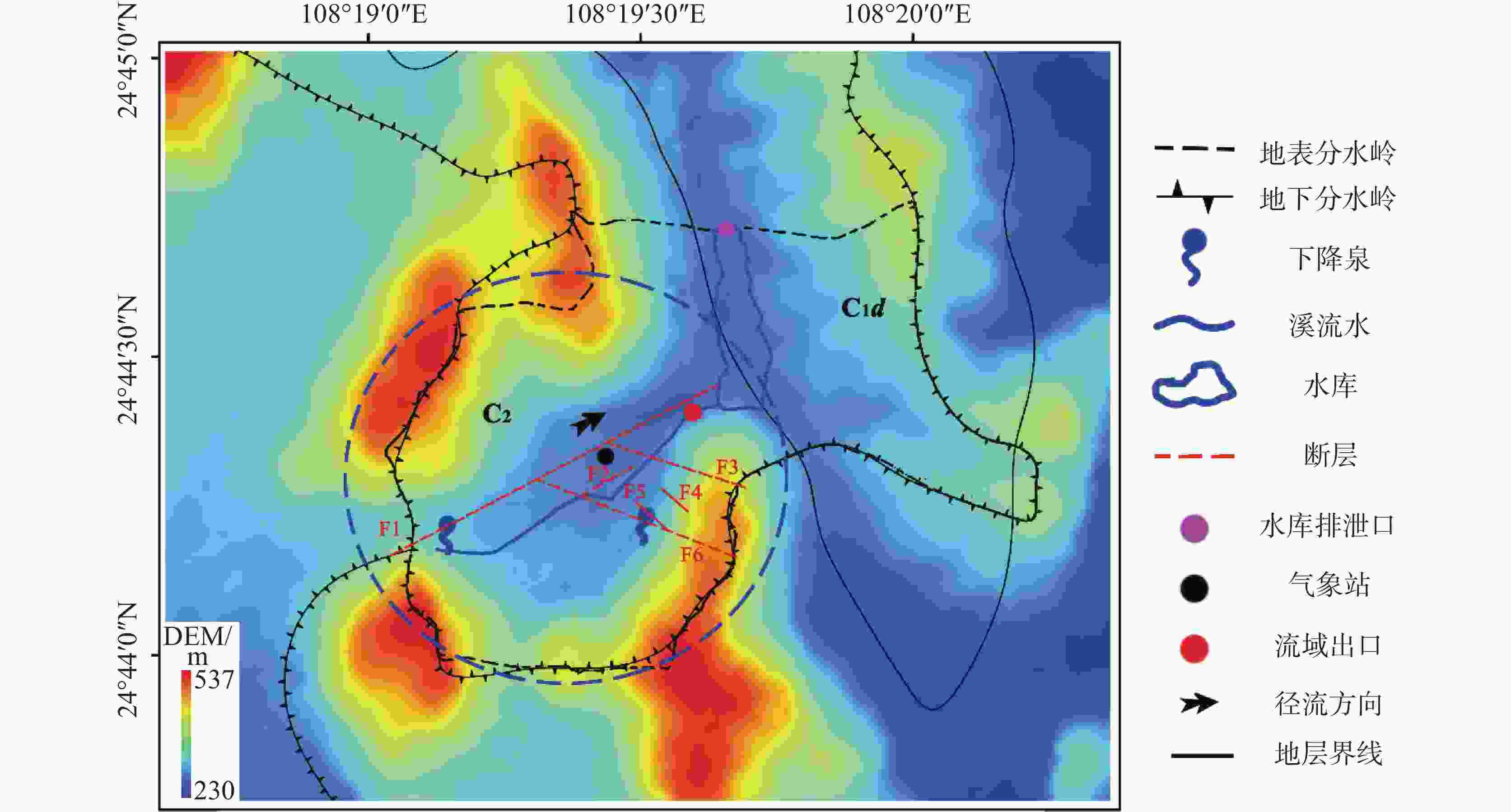
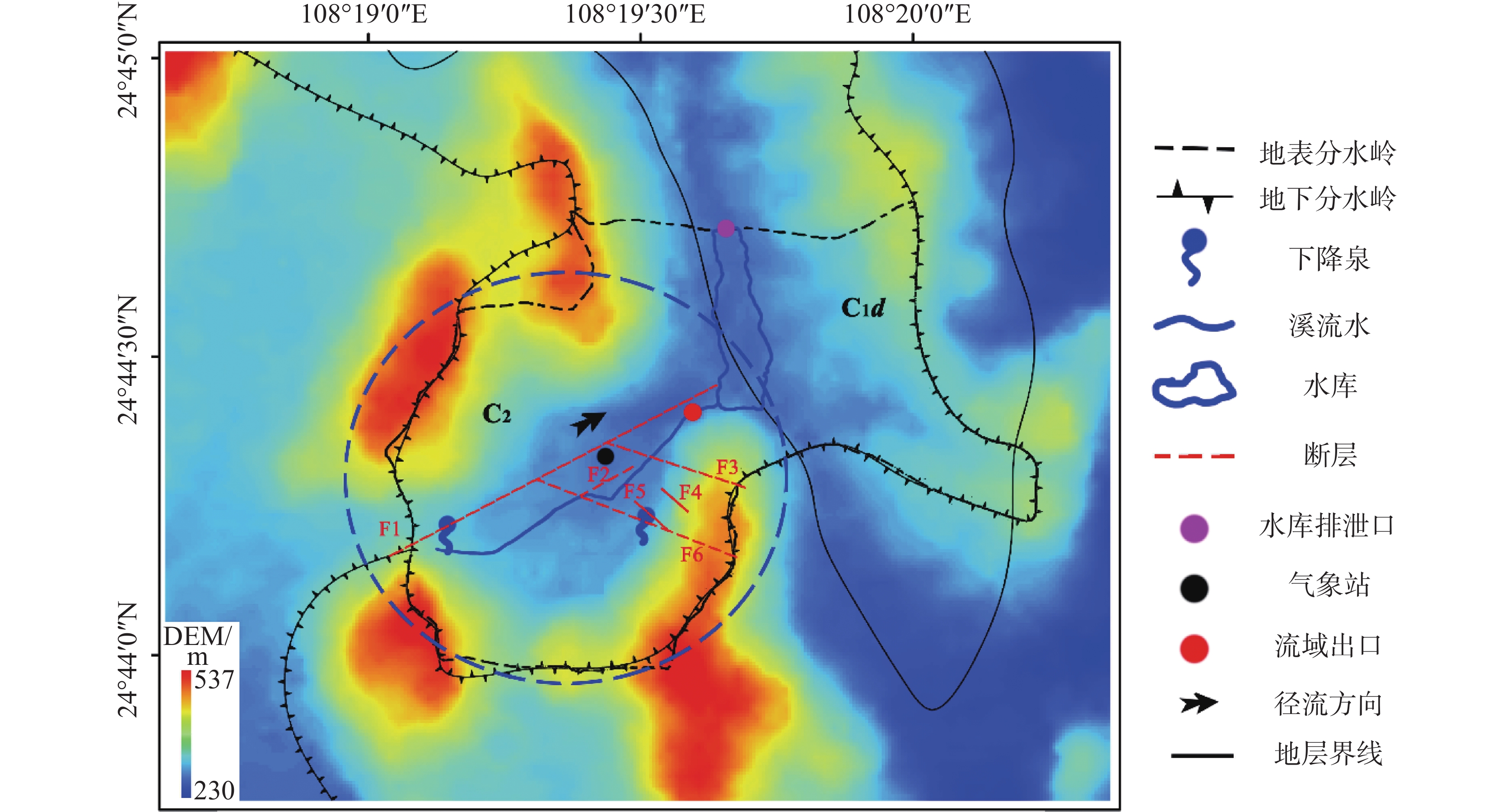
图 1 研究区及周边水文地质条件(蓝色虚线圈内为试验区)
Figure 1. Hydrogeological conditions of the study area (outlined by the blue dashed line)
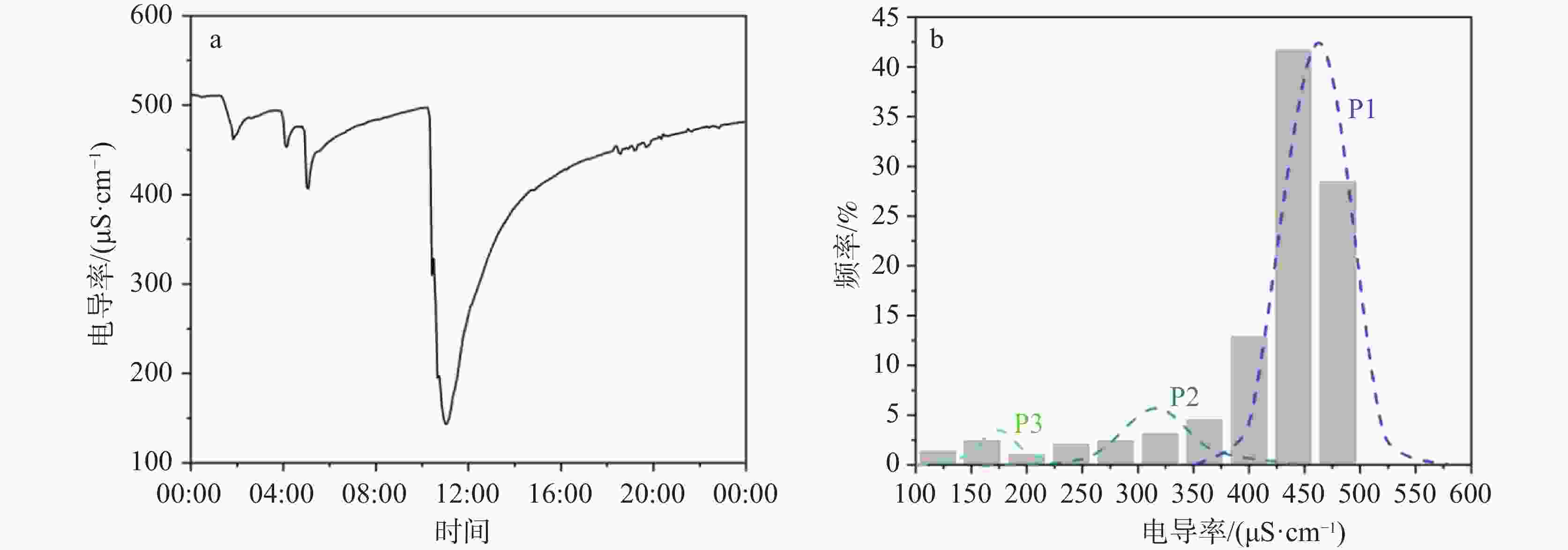
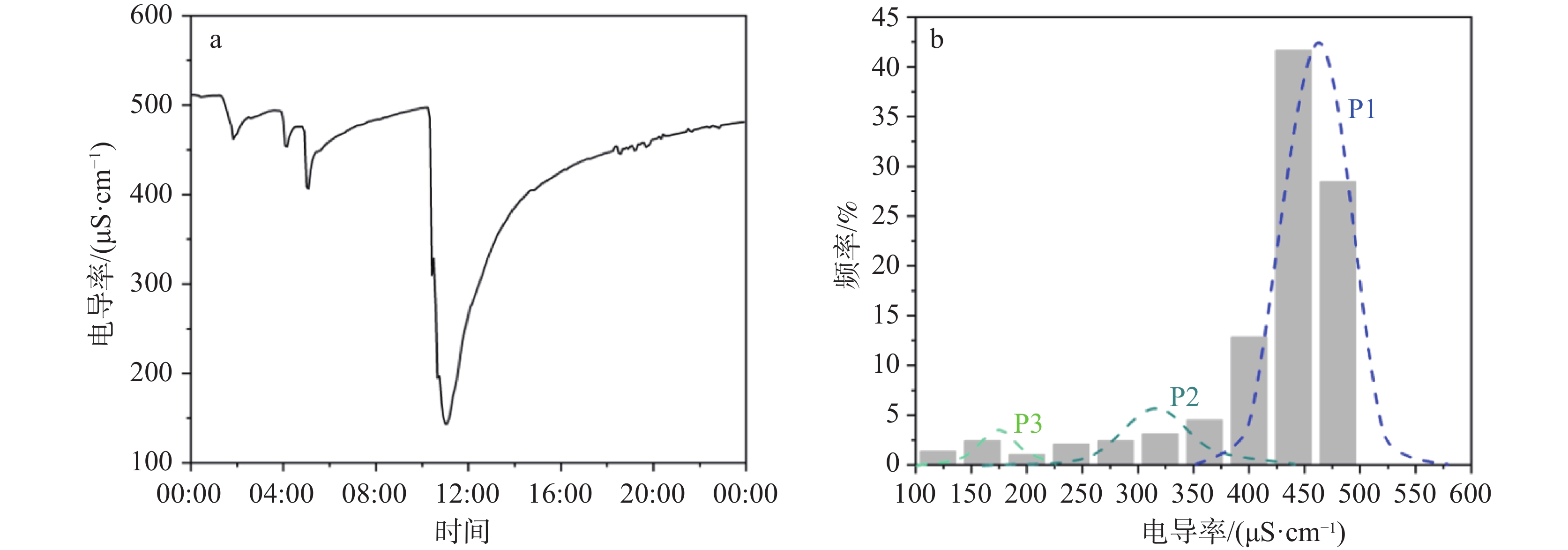
图 2 电导率频率分布(CFDs)分析方法的概念原理图 a:日尺度径流电导率动态变化特征;b:电导率频率直方图及成分划分
Figure 2. Conceptual schematic diagram of the Conductivity Frequency Distribution (CFDs) analysis method a: daily-scale dynamic variation characteristics of runoff conductivity ; b: conductivity frequency histogram and component classificaition
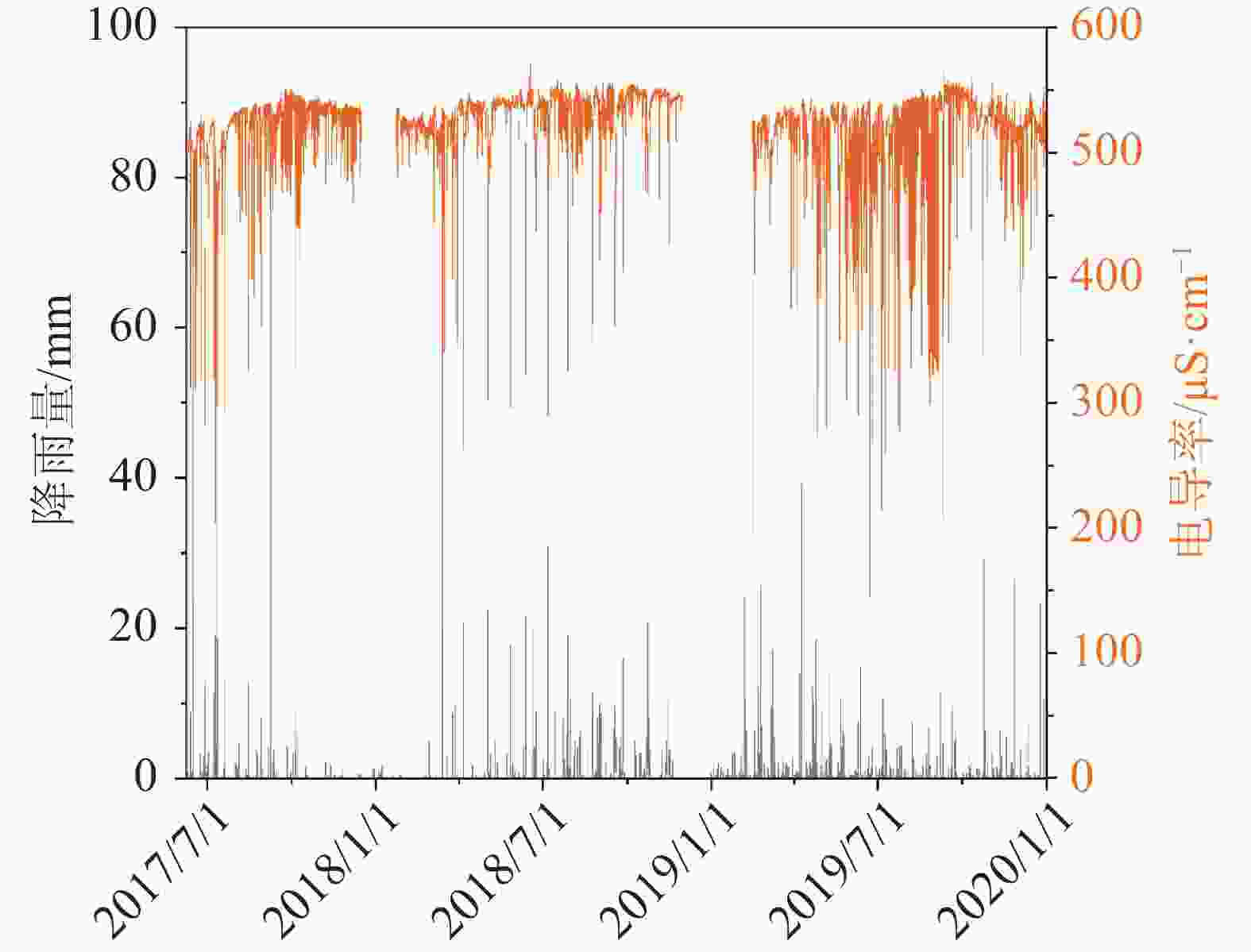
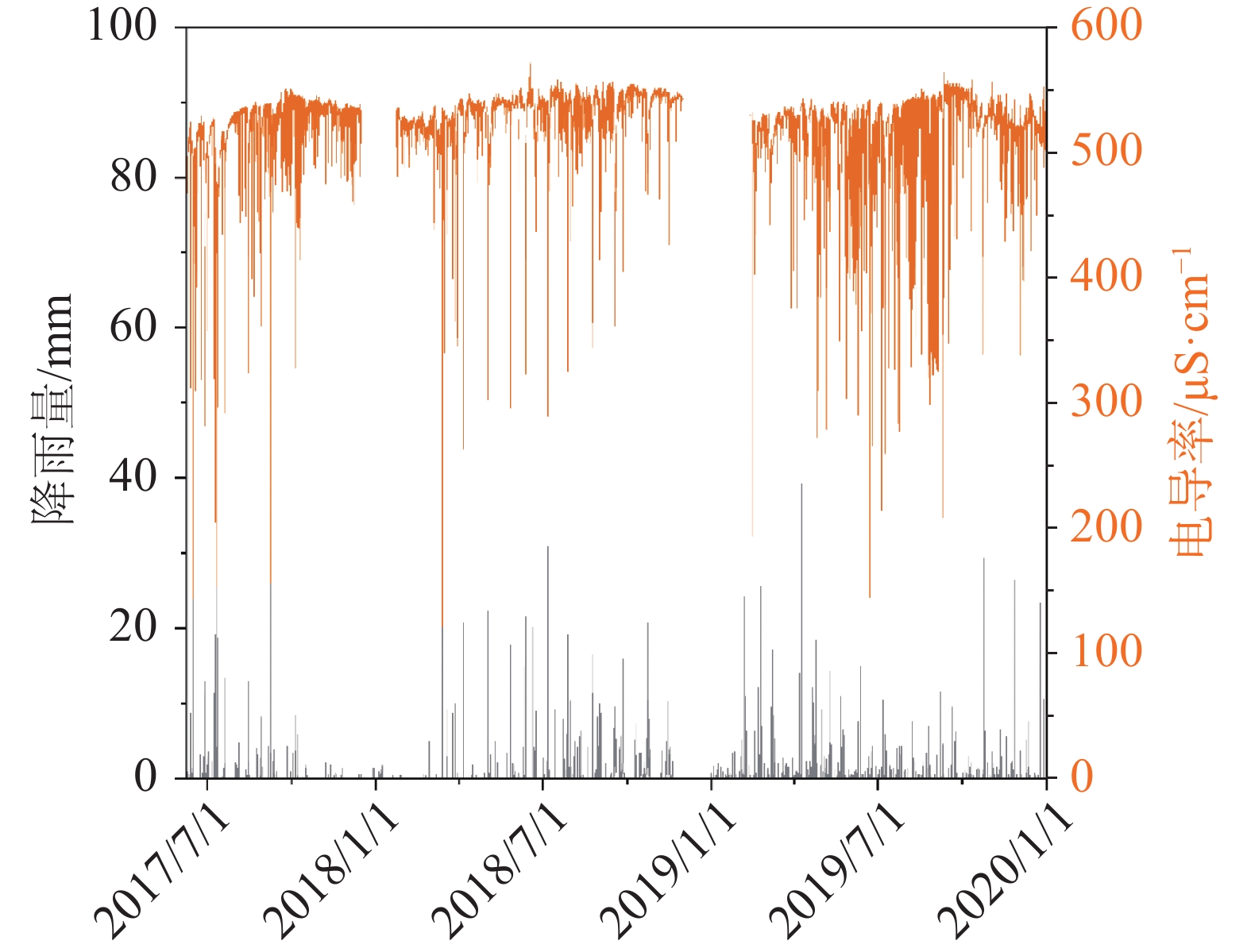
图 3 监测期内溪流水电导率动态变化特征
Figure 3. Dynamic variation characteristics of stream flow conductivity during the monitoring period
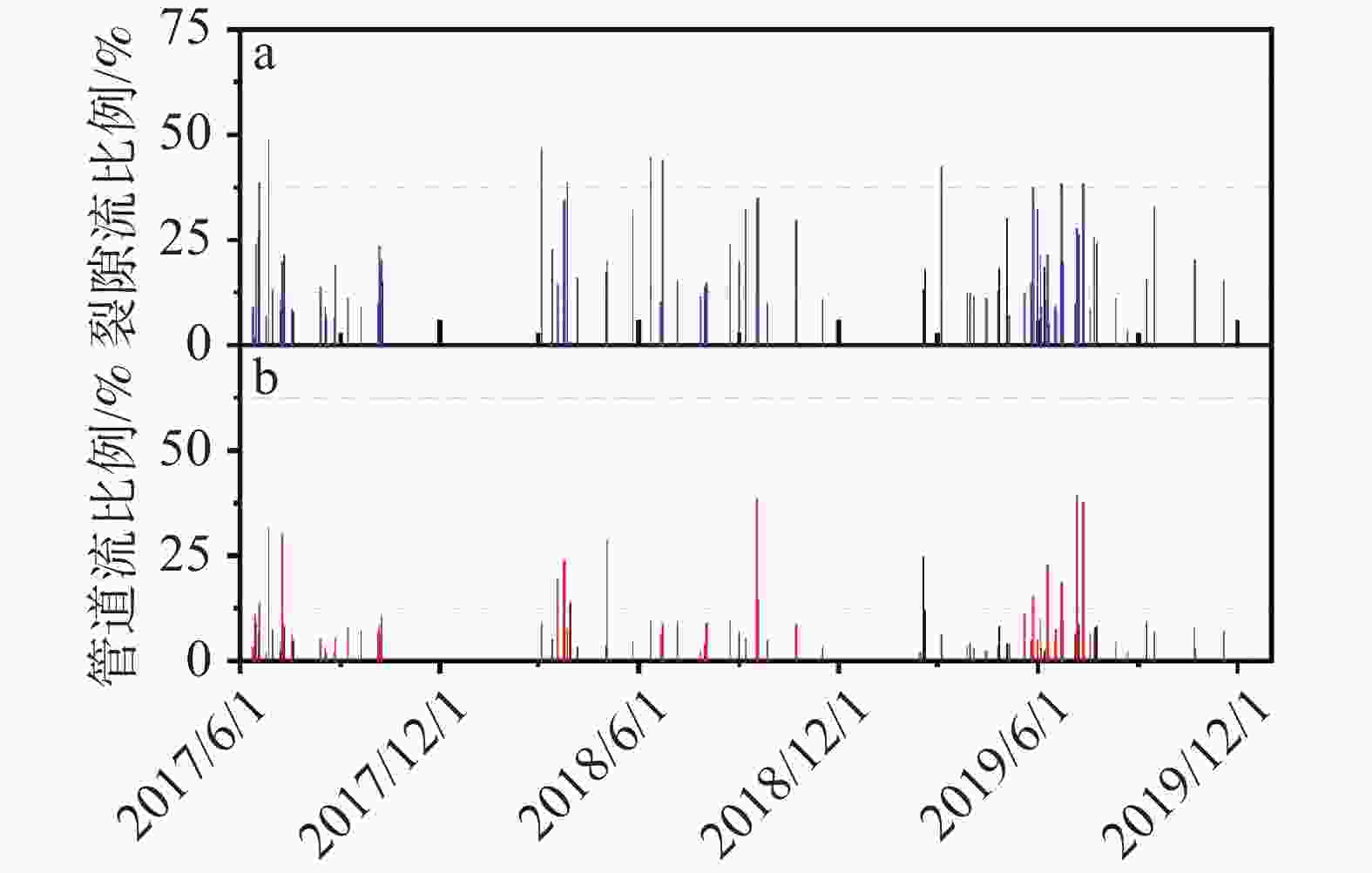
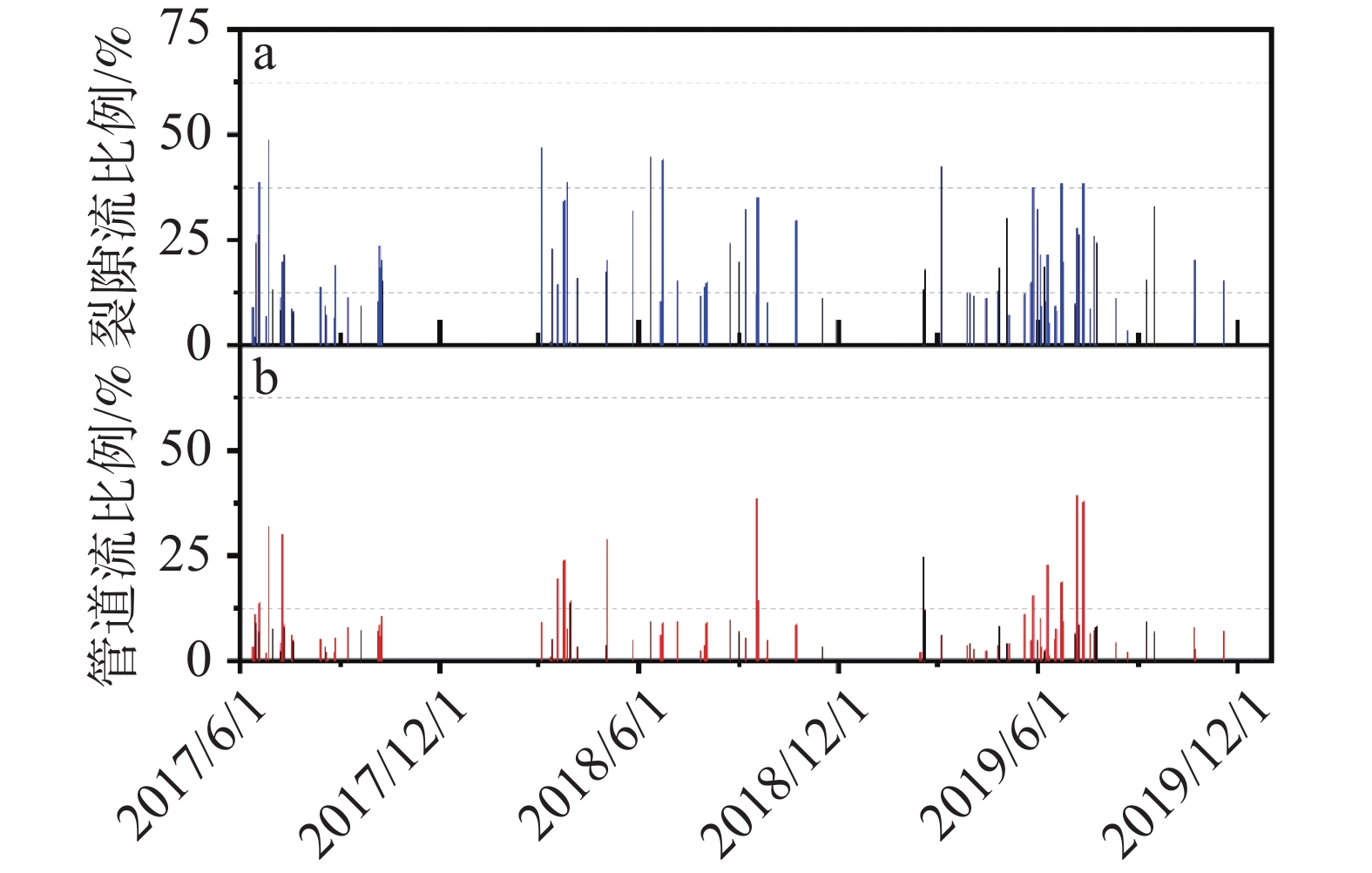
图 4 管道流和裂隙流对小流域径流的贡献比例
Figure 4. Contribution ratio of conduit flow and fracture flow to stream flow in small watershed
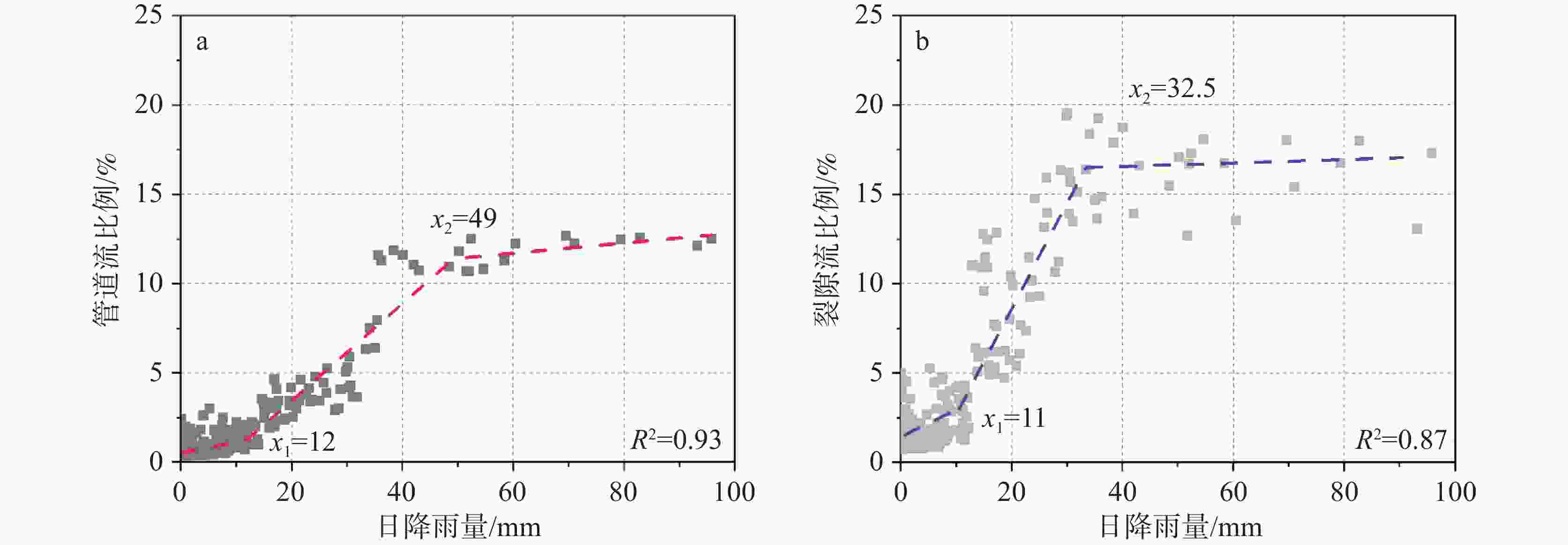
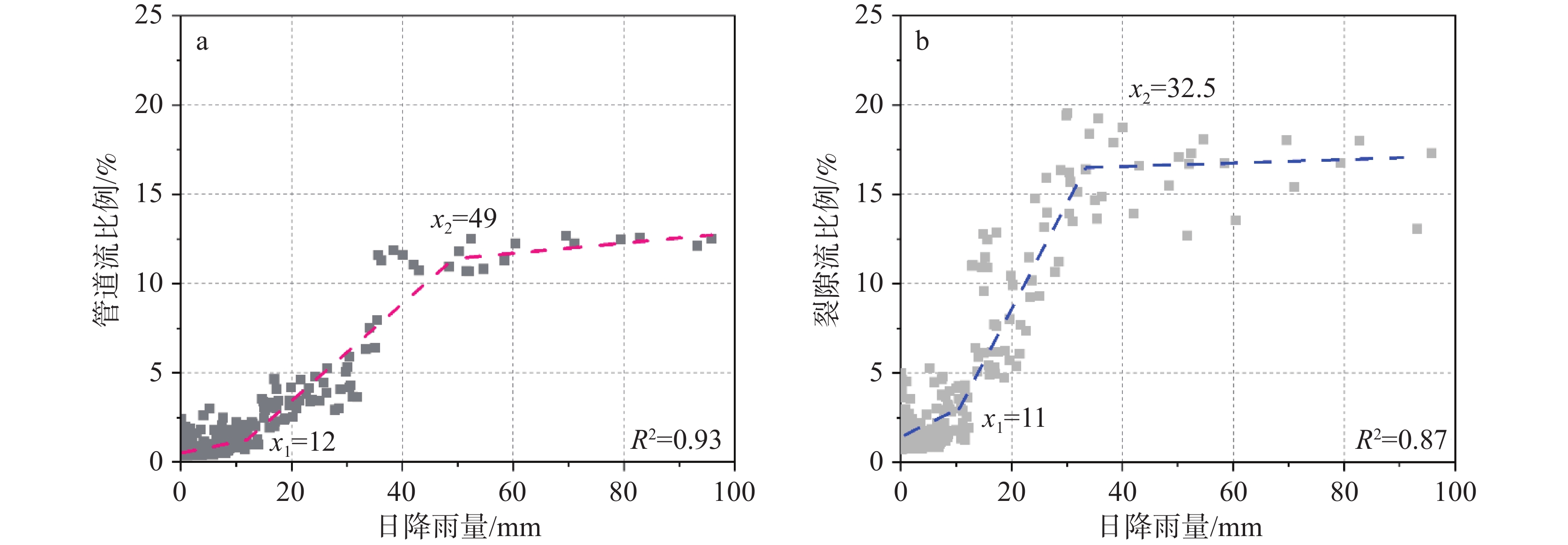
图 6 管道流和裂隙流降雨阈值效应
Figure 6. Rainfall threshold behaviors of conduit flow and fracture flow
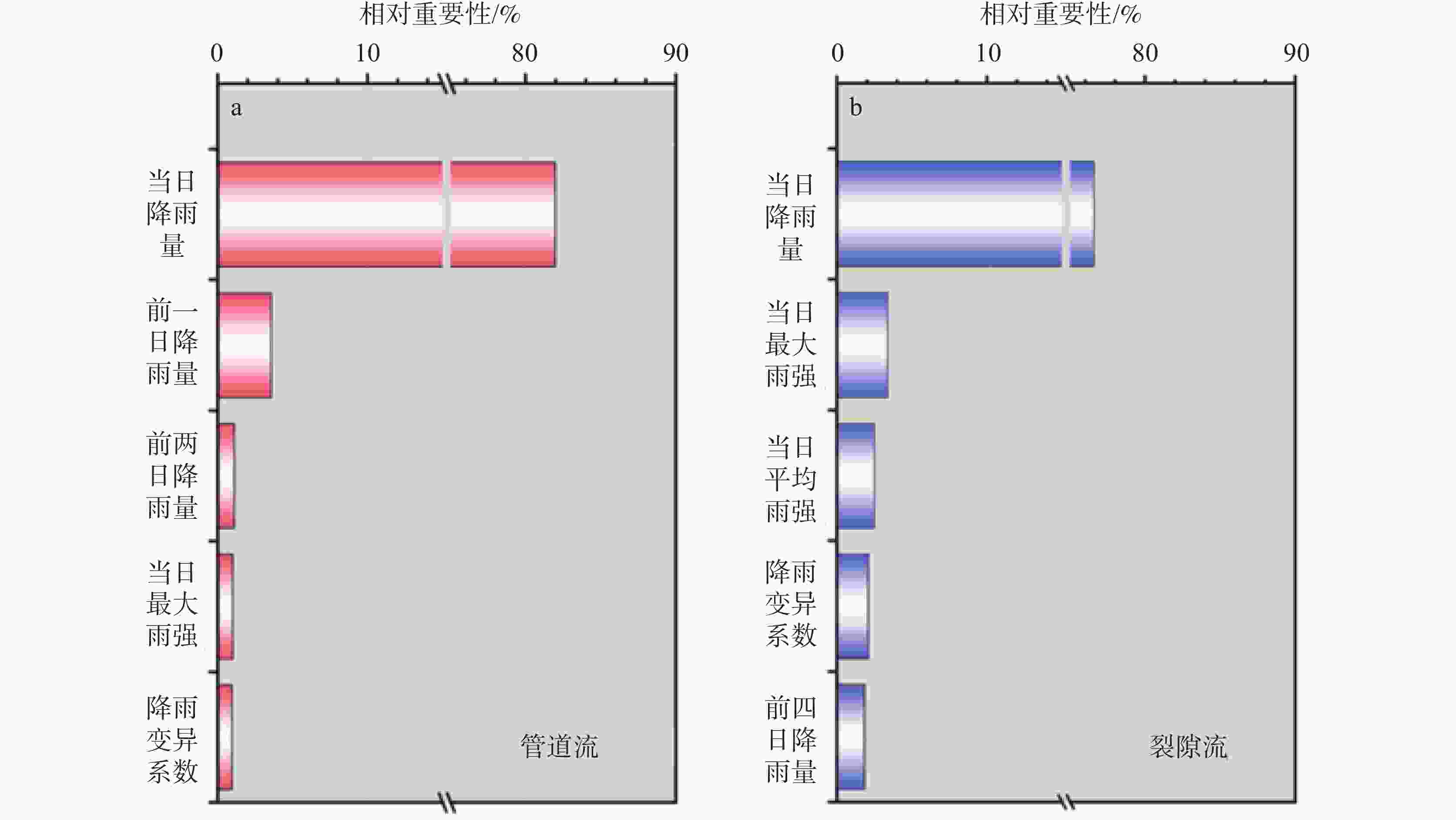
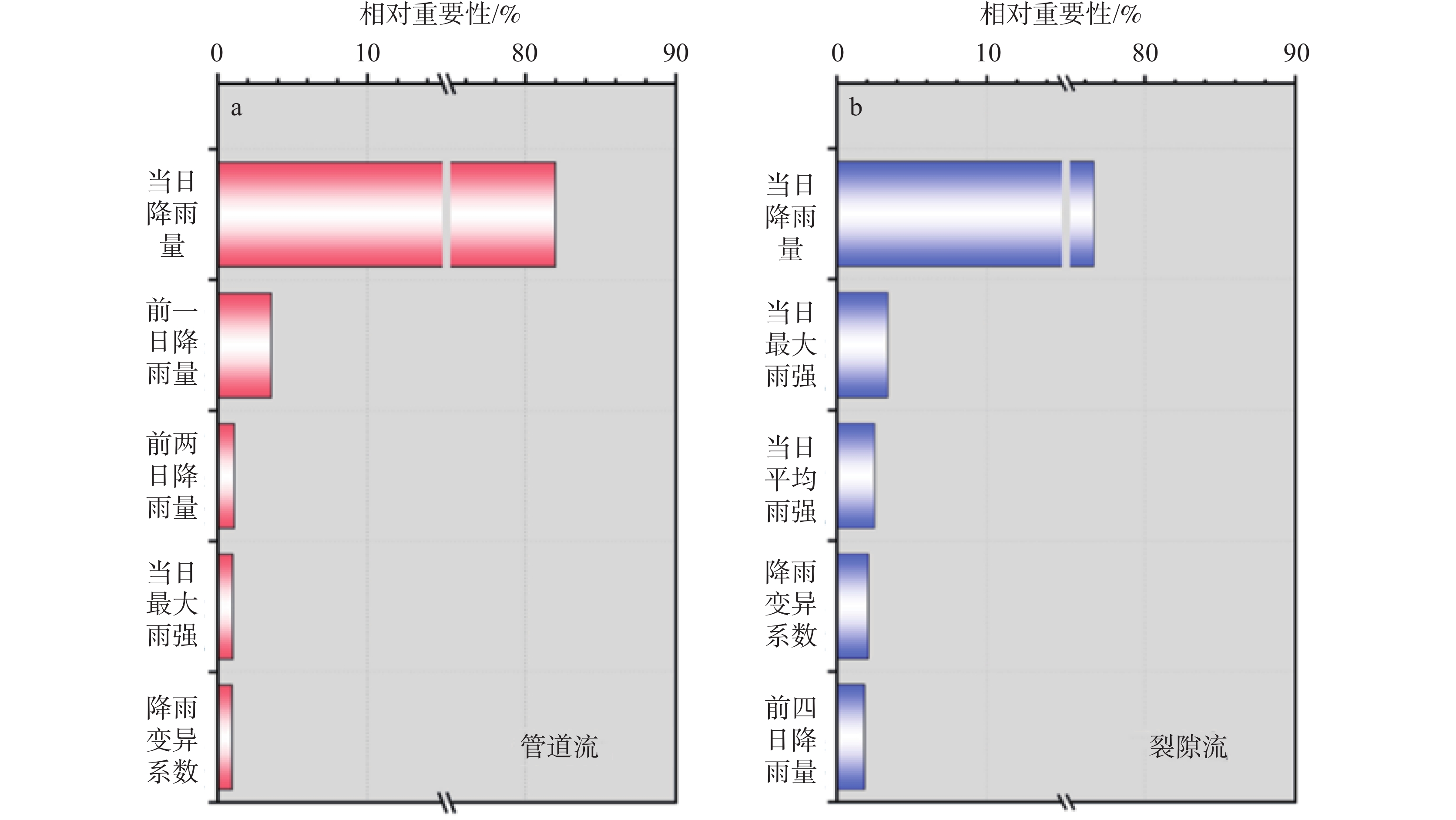
图 5 管道流和裂隙流影响因素重要性
Figure 5. Relative importance of influencing factors on conduit flow and fracture flow
表 1 建模所选变量
Table 1. Variables selected for modelling
变量 单位 描述 前n天降雨量 mm 第1天至第27天的前期总降雨量 偏度 − 27天内日降雨量的空间分布 连续干燥日 天 年最大连续降雨<1 mm的天数 连续湿润日 天 年最大连续降雨≥1 mm的天数 强降雨天数和强降雨量 天/mm 降雨≥50 mm的天数和总降雨量 暴雨天数和暴雨量 天/mm 降雨≥25 mm的天数和总降雨量 坡面地表径流的降雨阈值 天/mm 发生坡面地表径流的降雨(>44.7 mm)天数和降雨量 坡面地下径流的降雨阈值 天/mm 发生坡面地下径流的降雨(>39.5 mm)天数和降雨量 流域尺度的降雨阈值 天/mm 发生流域地表径流的降雨(>13 mm)天数和降雨量 1-5天内的最大降雨量 mm 最大连续1 - 5天降雨量 降雨变异系数 − n天降雨的变异系数 平均降雨量 mm 27天内湿润日(降雨>1 mm)的平均降雨量 降雨频率 − 27天内降雨日(降雨>1 mm)与27天的比值 潜在蒸散发 mm − 平均气温 ℃ 日平均气温 最高气温 ℃ 日最高气温 增强型植被指数 − 表征植被生长状况,越大表明越茂盛  下载: 导出CSV
-
[1] Fowler H J, Blenkinsop S, Green A, Davies P A. Precipitation extremes in 2023[J]. Nature Reviews Earth and Environment, 2024, 5(4): 250-252. doi: 10.1038/s43017-024-00547-9 [2] Li S, Chen Y, Wei W, Fang G, Duan W. The increase in extreme precipitation and its proportion over global land[J]. Journal of Hydrology, 2024, 628: 130456. doi: 10.1016/j.jhydrol.2023.130456 [3] Xanke J, Stevanović Z, Liesch T, Kaltenbrunn A, Ravbar N, Jourde H, Andreo B, Barberá J A, Goldscheider N. Flooding and flood water storage in karst systems of the mediterranean region[J]. Hydrogeology Journal, 2024, 32(6): 1587-1605. doi: 10.1007/s10040-024-02811-0 [4] Zhong F, Xu X, Li Z, Luo W, Zeng X, Li X, Gao H. Responses of crops to flood and implications for agriculture planning in subtropical humid karst peak-cluster depressions[J]. Journal of Hydrology, 2024, 641: 131728. doi: 10.1016/j.jhydrol.2024.131728 [5] Yan Y, Dai Q, Yuan Y, Peng X, Zhao L, Yang J. Effects of rainfall intensity on runoff and sediment yields on bare slopes in a karst area, SW China[J]. Geoderma, 2018, 330: 30-40. doi: 10.1016/j.geoderma.2018.05.026 [6] 张君, 陈洪松, 聂云鹏, 付智勇, 连晋姣, 王发, 罗紫东, 王克林. 西南喀斯特关键带结构及其水文过程研究进展[J]. 应用生态学报, 2024, 35(4): 985-996. doi: 10.13287/j.1001-9332.202404.020ZHANG Jun, CHEN Hongsong, NIE Yunpeng, FU Zhiyong, LIAN Jinjiao, WANG Fa, LUO Zidong, WANG Kelin. Research progress on structure and hydrological processes in the karst critical zone of southwest China[J]. Chinese Journal of Applied Ecology, 2024, 35(4): 985-996. doi: 10.13287/j.1001-9332.202404.020 [7] 黄荣, 王发, 陈洪松, 付智勇. 不同类型表层岩溶泉水源划分及对降雨的响应[J]. 水文, 2022, 42(3): 20-26. doi: 10.19797/j.cnki.1000-0852.20200514HUANG Rong, WANG Fa, CHEN Hongsong, FU Zhiyong. The water source division of different types of epikarst springs and their response to rainfall[J]. Hydrology, 2022, 42(3): 20-26. doi: 10.19797/j.cnki.1000-0852.20200514 [8] Guo L, Lin H, Fan B, Nyquist J, Toran L, Mount G J. Preferential flow through shallow fractured bedrock and a 3D fill-and-spill model of hillslope subsurface hydrology[J]. Journal of Hydrology, 2019, 576: 430-442. doi: 10.1016/j.jhydrol.2019.06.070 [9] 杨海明, 王家乐, 顾再柯, 刘伟, 王志刚, 刘纪根. 基于洪水退水过程的喀斯特小流域径流组分与含水层储水结构[J]. 地球科学与环境学报, 2025, 47(1): 82-94. doi: 10.19814/j.jese.2024.07026YANG Haiming, WANG Jiale, GU Zaike, LIU Wei, WANG Zhigang, LIU Jigen. Runoff components and aquifer storage structure in karst small watershed based on the flood recession process[J]. Chinese Journal of Earth Sciences and Environment, 2025, 47(1): 82-94. doi: 10.19814/j.jese.2024.07026 [10] 龚轶芳, 陈喜, 张志才, 张润润, 程勤波. 喀斯特峰丛-洼地小流域洪水滞时及相似性分析[J]. 水利水电科技进展, 2019, 39(4): 7-12. doi: 10.3880/j.issn.1006-7647.2019.04.002GONG Yifang, CHEN Xi, ZHANG Zhicai, ZHANG Runrun, CHENG Qinbo. Analysis of flood lag time and similarity in small karst peak cluster-depression watersheds[J]. Advances in Science and Technology of Water Resources, 2019, 39(4): 7-12. doi: 10.3880/j.issn.1006-7647.2019.04.002 [11] 潘钊, 孙自永, 马瑞, 常启昕, 胡雅璐, 刘源, 王旭. 黑河上游高寒山区降雨-径流形成过程的同位素示踪[J]. 地球科学, 2018, 43(11): 4226-4236.PAN Zhao, SUN Ziyong, MA Rui, CHANG Qixin, HU Yalu, LIU Yuan, WANG Xu. Isotopic investigation of rainfall-runoff generation in an alpine catchment in headwater regions of heihe river, northeast qinghai-tibet plateau[J]. Earth Science, 2018, 43(11): 4226-4236. [12] 鲁程鹏, 束龙仓, 苑利波, 张蓉蓉, 黄币娟, 王彬彬. 基于示踪试验求解岩溶含水层水文地质参数[J]. 吉林大学学报(地球科学版), 2009, 39(4): 717-721. doi: 10.3969/j.issn.1671-5888.2009.04.016LU Chengpeng, SHU Longcang, YUAN Libo, ZHANG Rongrong, HUANG Bijuan, WANG Binbin. Determination of hydrogeologic parameters of karst aquifer based on tracer test[J]. Journal of Jilin University (Earth Science Edition), 2009, 39(4): 717-721. doi: 10.3969/j.issn.1671-5888.2009.04.016 [13] De La Torre B, Gil-Márquez J M, Mudarra M, Andreo B. Towards a better understanding of flow-related processes in the vertically distributed compartments of karst aquifers by combining natural tracers and stable isotopes[J]. Journal of Hydrology, 2023, 620: 129392. doi: 10.1016/j.jhydrol.2023.129392 [14] 吕全标, 胡晓农, 曹建华, 黄芬, 朱昊. 基于钻孔抽水试验和示踪试验的岩溶地区含水层结构研究[J]. 中国岩溶, 2017(5): 727-735.LYU Quanbiao, HU Xiaonong, CAO Jianhua, HUANG Fen, ZHU Hao. Aquifer structure of karst areas derived from borehole pumping and tracer tests[J]. Carsologica Sinica, 2017(5): 727-735. [15] Lorenzi V, Banzato F, Barberio M D, Goeppert N, Goldscheider N, Gori F, Lacchini A, Manetta M, Medici G, Rusi S, Petitta M. Tracking flowpaths in a complex karst system through tracer test and hydrogeochemical monitoring: implications for groundwater protection (gran sasso, italy)[J]. Heliyon, 2024, 10(2): e24663. doi: 10.1016/j.heliyon.2024.e24663 [16] 杨平恒, 华茂松, 罗为群, 郭文静. 基于CiteSpace的岩溶地下水硝酸盐示踪研究进展[J]. 中国岩溶, 2024, 43(3): 563-574. doi: 10.11932/karst2024y005YANG Pingheng, HUA Maosong, LUO Weiqun, GUO Wenjing. Research progress of nitrate tracing in karst groundwater based on CiteSpace[J]. Carsologica Sinica, 2024, 43(3): 563-574. doi: 10.11932/karst2024y005 [17] Wang S, Yan Y, Fu Z, Chen H. Rainfall-runoff characteristics and their threshold behaviors on a karst hillslope in a peak-cluster depression region[J]. Journal of Hydrology, 2022, 605: 127370. doi: 10.1016/j.jhydrol.2021.127370 [18] 周星, 沈忱, 倪广恒, 胡宏昌. 结合退水曲线的数字滤波基流分割方法[J]. 清华大学学报(自然科学版), 2017, 57(3): 318-323,330. doi: 10.16511/j.cnki.qhdxxb.2017.26.016ZHOU Xing, SHEN Chen, NI Guangheng, HU Hongchang. Digital filter base flow separation method based on a master recession curve[J]. Journal of Tsinghua University (Science and Technology), 2017, 57(3): 318-323,330. doi: 10.16511/j.cnki.qhdxxb.2017.26.016 [19] 郭芳, 姜光辉, 刘凡, 李志杰. 岩溶山区坡面一孔多层地下水监测试验及科学意义[J]. 中国岩溶, 2024, 43(3): 491-499.GUO Fang, JIANG Guanghui, LIU Fan, LI Zhijie. Experiment of monitoring multi-layer groundwater at a karst hill slope and its scientific significance[J]. Carsologica Sinica, 2024, 43(3): 491-499. [20] 孟令华. 基于水化学和氢氧同位素的泰安城区岩溶地下水补给来源及演化过程[J]. 环境科学, 2024, 45(4): 2096-2106. doi: 10.13227/j.hjkx.202305012MENG Linghua. Recharge Source and Evolution Process of Karst Groundwater in Tai’ an Urban Area Based on Hydrochemistry and Hydrogen and Oxygen Isotopes[J]. Environmental Science, 2024, 45(4): 2096-2106. doi: 10.13227/j.hjkx.202305012 [21] 郭芳, 姜光辉, 刘绍华, 汤庆佳. 利用泉水电导率频率分布辨别岩溶含水系统的水源组分[J]. 水科学进展, 2018, 29(2): 245-251.GUO Fang, JIANG Guanghui, LIU Shaohua, TANG Qingjia. Identifying source water compositions of karst water systems by quantifying the conductance frequency distribution of springs[J]. Advances In Water Science, 2024, 43(3): 491-499. [22] Bingjun L I U, Lili W U, Wenxiu L U. Researches on DFA-based extreme precipitation threshold in the pearl river basin[J]. Acta Scientiarum Naturalium Universitatis Sunyatseni, 2023, 52(1): 136-141. [23] 宋宇飞, 范文, 左琛, 于宁宇, 陶虹. 基于敏感性分析的最优降雨阈值选择[J]. 工程地质学报, 2024, 32(2): 529-544. doi: 10.13544/j.cnki.jeg.2022-0054SONG Yufei, FAN Wen, ZUO Chen, YU Ningyu, TAO Hong. The optimal rainfall thresholds selection based on sensitivity analysis[J]. Journal of Engineering Geology, 2024, 32(2): 529-544. doi: 10.13544/j.cnki.jeg.2022-0054 [24] Zhang J, Wang S, Fu Z, Chen H, Wang K. Soil thickness controls the rainfall-runoff relationship at the karst hillslope critical zone in southwest China[J]. Journal of Hydrology, 2022, 609: 127779. doi: 10.1016/j.jhydrol.2022.127779 [25] 周壮壮, 任宗萍, 李鹏, 谢梦瑶, 李占斌, 徐国策. 不同植被覆盖下土壤含水量对降水的分级响应[J]. 中国水土保持科学(中英文), 2020, 18(6): 62-71.ZHOU Zhuangzhuang, REN Zongping, LI Peng, XIE Mengyao, LI Zhanbin, XU Guoce. Response of soil moisture content to precipitation under different vegetation coverages[J]. Science of Soil and Water Conservation, 2020, 18(6): 62-71. [26] 王瀛, 杨扬, 刘宝元, 刘瑛娜. 中国水蚀区5种典型土壤的侵蚀性降雨阈值比较[J]. 水土保持通报, 2022, 42(4): 227-233.WANG Ying, YANG Yang, LIU Baoyuan, LIU Yingna. Erosive Rainfall Thresholds for five typical soils in water erosion region of china[J]. Bulletin of Soil and Water Conservation, 2022, 42(4): 227-233. [27] 李静, 焦树林, 梁虹, 向征, 向尚. 基于mike she分布式水文模型的降水时间尺度对喀斯特流域径流模拟的影响研究——以红水河系六硐河流域为例[J]. 中国岩溶, 2012, 31(4): 388-394.LI Jing, JIAO Shulin, LIANG Hong, XIANG Zheng, XIANG Shang. Research on the impact on runoff by time-scale of the precipitation in karst basin in view of MIKESHE model: A case in Liudong river of the Hongshuihe system[J]. Carsologica Sinica, 2012, 31(4): 388-394. [28] 杨丽, 杨广斌, 李亦秋, 李蔓. 修正swat模型在喀斯特小流域的径流模拟研究——以羊鸡冲小流域为例[J]. 中国岩溶, 2024, 43(2): 291-301. doi: 10.11932/karst2024y011YANG Li, YANG Guangbin, LI Yiqiu, LI Man. Runoff simulation of modified SWAT model in karst watershed: A case study of Yangjichong sub-watershed[J]. Carsologica Sinica, 2024, 43(2): 291-301. doi: 10.11932/karst2024y011 [29] 胡可. 典型喀斯特小流域水文过程变化特征及其影响因素[D]. 北京: 中国科学院大学, 2014.HU Ke. Variation of hydrological processes and its impact factors in small typical karst catchment[D]. Beijing: University of Chinese Academy of Sciences, 2014. [30] 杨静. 喀斯特坡地降雨入渗产流特征及其影响因素[D]. 北京: 中国科学院大学, 2016.YANG Jing. Rainfall-infiltration-runoff characteristics and their influencing factors in karst hillslopes[D]. Beijing: University of Chinese Academy of Sciences, 2016. [31] 王发. 白云岩峰丛洼地小流域径流的多源补给特征及其模拟[D]. 北京: 中国科学院大学, 2022.WANG Fa. Runoff recharge characteristics of multi-medium flow and its modelling in a dolomite catchment[D]. Beijing: University of Chinese Academy of Sciences, 2022. [32] 付同刚, 陈洪松, 王克林. 喀斯特小流域土壤饱和导水率垂直分布特征[J]. 土壤学报, 2015, 52(03): 538-546.FU Tonggang, CHEN Hongsong, WANG Kelin. Vertical distribution of soil saturated hydraulic conductivity in a small karst catchment[J]. Acta Pedologica Sinica, 2015, 52(03): 538-546. [33] Massei N, Mahler B J, Bakalowicz M, Fournier M, Dupont J P. Quantitative interpretation of specific conductance frequency distributions in karst[J]. Ground Water, 2007, 45(3): 288-293. doi: 10.1111/j.1745-6584.2006.00291.x [34] 徐子凡, 陈喜, 刘维翰, 刘皓, 张志才. 表层岩溶带土岩结构对降雨−径流响应特征的影响[J]. 中国岩溶, 2024, 43(4): 863-875.XU Zifan, CHEN Xi, LIU Weihan, LIU Hao, ZHANG Zhicai. Effect of soil-rock structures on the characteristics of rainfall-runoff responses in epikarst zones[J]. Carsologica Sinica, 2024, 43(4): 863-875. [35] De’Ath G. Boosted trees for ecological modeling and prediction[J]. Ecology, 2007, 88(1): 243-251. doi: 10.1890/0012-9658(2007)88[243:BTFEMA]2.0.CO;2 [36] 李红琴, 张亚茹, 张法伟, 马文婧, 罗方林, 王春雨, 杨永胜, 张雷明, 李英年. 增强回归树模型在青藏高原高寒灌丛通量数据插补中的应用[J]. 植物生态学报, 2022, 46(12): 1437-1447.LI Hongqin, ZHANG Yaru, ZHANG Fawei, MA Wenjing, LUO Fanglin, WANG Chunyu, YANG Yongsheng, Application of boosted regression trees for the gap-filling to flux dataset in an alpine scrubland of Qingzang Plateau[J]. Chinese Journal of Plant Ecology, 2022, 46(12): 1437-1447. [37] Guo Y, Huang F, Chi F, Zhang N, Ma J, Miao Y, Chen F. Hydrogeological structures of karst features using hydrographs in an underground river basin formed in a peak cluster depression, southwest China[J]. Journal of Hydrology, 2024, 634: 131085. doi: 10.1016/j.jhydrol.2024.131085 [38] 毛小英, 王欢, 刘忠富. 传感器在水质检测中的应用综述[J]. 山西电子技术, 2023(4): 108-110. doi: 10.3969/j.issn.1674-4578.2023.04.036MAO Xiaoying, WANG Huan, LIU Zhongfu. Application review of sensors in water quality detection[J]. Shanxi Electronic Technology, 2023(4): 108-110. doi: 10.3969/j.issn.1674-4578.2023.04.036 [39] 丁虎, 郎赟超, 刘文景, 刘丛强. 桂西北峰丛洼地泉水和溪流在降雨过程中的水化学动态变化特征[J]. 地球与环境, 2011, 39(1): 48-55.DING Hu, LANG Yunchao, LIU Wenjing, LIU Congqiang. Variations in chemical composition of spring and stream water during rain events in a karst peak cluster-depression catchment, northwest Guangxi, China[J]. Earth and Environment, 2011, 39(1): 48-55. [40] Wang F, Chen H, Lian J, Fu Z, Nie Y. Seasonal recharge of spring and stream waters in a karst catchment revealed by isotopic and hydrochemical analyses[J]. Journal of Hydrology, 2020, 591: 125595. doi: 10.1016/j.jhydrol.2020.125595 [41] Dong W, Li Z, Shen L, Liu W, Guo Y, Xu H, Yong R. Study on the process of mass transfer and deterioration of limestone under dynamic dissolution of CO2 solution[J]. Scientific Reports, 2024, 14(1): 5278. doi: 10.1038/s41598-024-56038-w [42] 刘春. 基于稳定同位素和水化学的喀斯特小流域降雨径流响应规律研究[D]. 湖南师范大学, 2016.LIU Chun. Responses of stormflow to rainfall in a typical karst catchment based on stable isotopes and hydrogeochemistry[D]. Hunan Normal University, 2016. [43] 赵良杰. 岩溶裂隙-管道双重含水介质水流交换机理研究[D]. 中国地质大学(北京), 2020ZHAO Liangjie. Study of water exchange mechanism of karst matrix and conduit medium[D]. China University of Geosciences (Beijing), 2020. [44] 任惠敏, 付智勇, 王发, 陈洪松. 喀斯特坡地不同土地利用方式碳氮流失的水文驱动特征[J]. 中国岩溶, 2023, 42(1): 84-93. doi: 10.11932/karst20230107REN Huimin, FU Zhiyong, WANG Fa, Chen Hongsong. Hydrological driving characteristics of soil carbon and nitrogen losses under different land use modes on karst slopes[J]. Carsologica Sinica, 2023, 42(1): 84-93. doi: 10.11932/karst20230107 [45] Wang F, Zhang J, Lian J, Fu Z, Luo Z, Nie Y, Chen H. Spatial variability of epikarst thickness and its controlling factors in a dolomite catchment[J]. Geoderma, 2022, 428: 116213. doi: 10.1016/j.geoderma.2022.116213 [46] Blaurock K, Beudert B, Gilfedder B S, Fleckenstein J H, Peiffer S, Hopp L. Low hydrological connectivity after summer drought inhibits DOC export in a forested headwater catchment[J]. Hydrology and Earth System Sciences., 2021, 25(9): 5133-5151. doi: 10.5194/hess-25-5133-2021 [47] 肖熙, 王发, 陈洪松, 付智勇. 喀斯特坡地植被恢复对径流衰退过程的影响研究[J]. 农业现代化研究, 2025, 46(4): 767-776. doi: 10.13872/j.1000-0275.2025.0545XIAO Xi, WANG Fa, CHEN Hongsong, FU Zhiyong. Effects of vegetation restoration on runoff recession processes in karst hillslopes[J]. Research of Agricultural Modernization, 2025, 46(4): 767-776. doi: 10.13872/j.1000-0275.2025.0545 [48] Uchida T, Kosugi K, Mizuyama T. Runoff characteristics of pipeflow and effects of pipeflow on rainfall-runoff phenomena in a mountainous watershed[J]. Journal of Hydrology, 1999, 222(1): 18-36. doi: 10.1016/s0022-1694(99)00090-6 [49] Fu Z Y, Chen H S, Zhang W, Xu Q X, Wang S, Wang K L. Subsurface flow in a soil-mantled subtropical dolomite karst slope: a field rainfall simulation study[J]. Geomorphology, 2015, 250: 1-14. [50] Feng W, Mariotte P, Xu L, Buttler A, Bragazza L, Jiang J, Santonja M. Seasonal variability of groundwater level effects on the growth of carex cinerascens in lake wetlands[J]. Ecology and Evolution, 2020, 10(1): 517-526. doi: 10.1002/ece3.5926 [51] 周志浩, 罗明明, 陈静, 彭翔宇, 赵泽浩, 赵文慧. 集中补给条件对岩溶地下河水文过程及污染响应的影响[J]. 地质科技通报, 2025, 44(3): 324-333. doi: 10.19509/j.cnki.dzkq.tb20230566ZHOU Zhihao, LUO Mingming, CHEN Jing, PENG Xiangyu, ZHAO Zehao, ZHAO Wenhui. Effects of concentrated recharge conditions on hydrological processes and pollution responses of karst underground rivers[J]. Bulletin of Geological Science and Technology, 2025, 44(3): 324-333. doi: 10.19509/j.cnki.dzkq.tb20230566 [52] Baudement C, Arfib B, Mazzilli N, Jouves J, Lamarque T, Guglielmi Y. Groundwater management of a highly dynamic karst by assessing baseflow and quickflow with a rainfall-discharge model (dardennes springs, SE france)[J]. Bulletin de la Société Géologique de France, 2017, 188(6): 40. doi: 10.1051/bsgf/2017203 [53] 牛子豪, 束龙仓, 林欢, 李昶, 冯佳琪, 谭易成, 王熹, 齐天松. 不同补给条件下裂隙-管道介质间水流交换的示踪试验研究[J]. 水文地质工程地质, 2017, 44(3): 6-11.NIU Zihao, SHU Longcang, LIN Huan, LI Chang, FENG Jiaqi, TAN Yicheng, WANG Xi, QI Tiansong. Experimental study of water quantity exchange between fissures and sinkholes under different recharge modes in the fissure-conduit media[J]. Hydrogeology & Engineering Geology, 2017, 44(3): 6-11. [54] Gu Y, Yan B, Wang S, Cai Z, Liu H. Coupling a physically based hydrological model with a modified transformer for long-sequence runoff and peak-flow prediction[J]. Sustainability, 2025, 17(19): 8618. doi: 10.3390/su17198618 [55] Jeannin P Y, Artigue G, Butscher C, Chang Y, Charlier J B, Duran L, Gill L, Hartmann A, Johannet A, Jourde H, Kavousi A, Liesch T, Liu Y, Lüthi M, Malard A, Mazzilli N, Pardo-Igúzquiza E, Thiéry D, Reimann T, Schuler P, Wöhling T, Wunsch A. Karst modelling challenge 1: results of hydrological modelling[J]. Journal of Hydrology, 2021, 600: 126508. doi: 10.1016/j.jhydrol.2021.126508 [56] Li J, Yuan D, Ma M, Liu J. Simulation of karst floods with a hydrological model improved by meteorological model coupling[J]. Journal of Hydrometeorology., 2022, 23(2): 185-207. doi: 10.1175/JHM-D-21-0088.1 -

 点击查看大图
计量
- 文章访问数: 273
- HTML浏览量: 127
- PDF下载量: 145
- 被引次数: 0
