


Study on the mechanism and treatment of water inrush in the inclined shaft of the Siding tunnel on the new Guilin-Liucheng expressway in Guangxi
-
摘要: 突水涌泥问题是岩溶隧道施工中遭遇的主要灾害之一。文章通过对泗顶隧道隧址区的岩溶水文地质调查、高密度电法勘探及连通实验,查明斜井涌突水通道及水源,揭示斜井涌突水成因机制,预测斜井涌水量并结合涌水机制进行了检验,提出并综合比较了3种处置措施。结果显示:泗顶隧道斜井施工揭露了岩溶管道,隧址区冲沟水、暗河管道水及洼地汇集的雨水通过被揭露的岩溶管道涌入斜井施工区;斜井涌突水类型为岩溶管道型涌突水,涌突水灾害形成机制为高位岩溶洼地管道排泄和低位岩溶洼地管道倒灌;采用大气降雨入渗法预测斜井涌水量,结果较准确;基于斜井涌突水机制及隧址区地质环境条件,提出了截流外导的处置方案。Abstract:
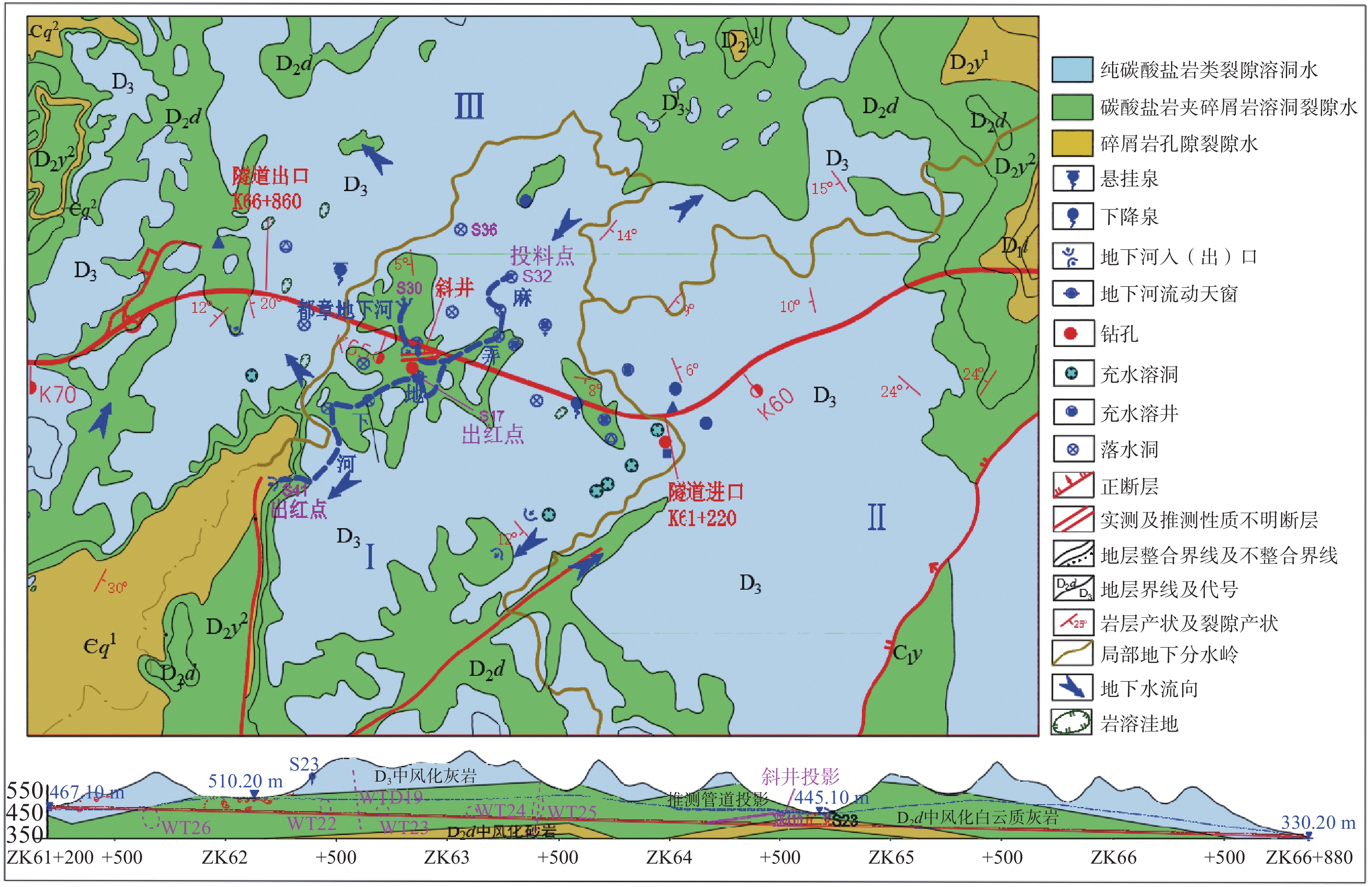
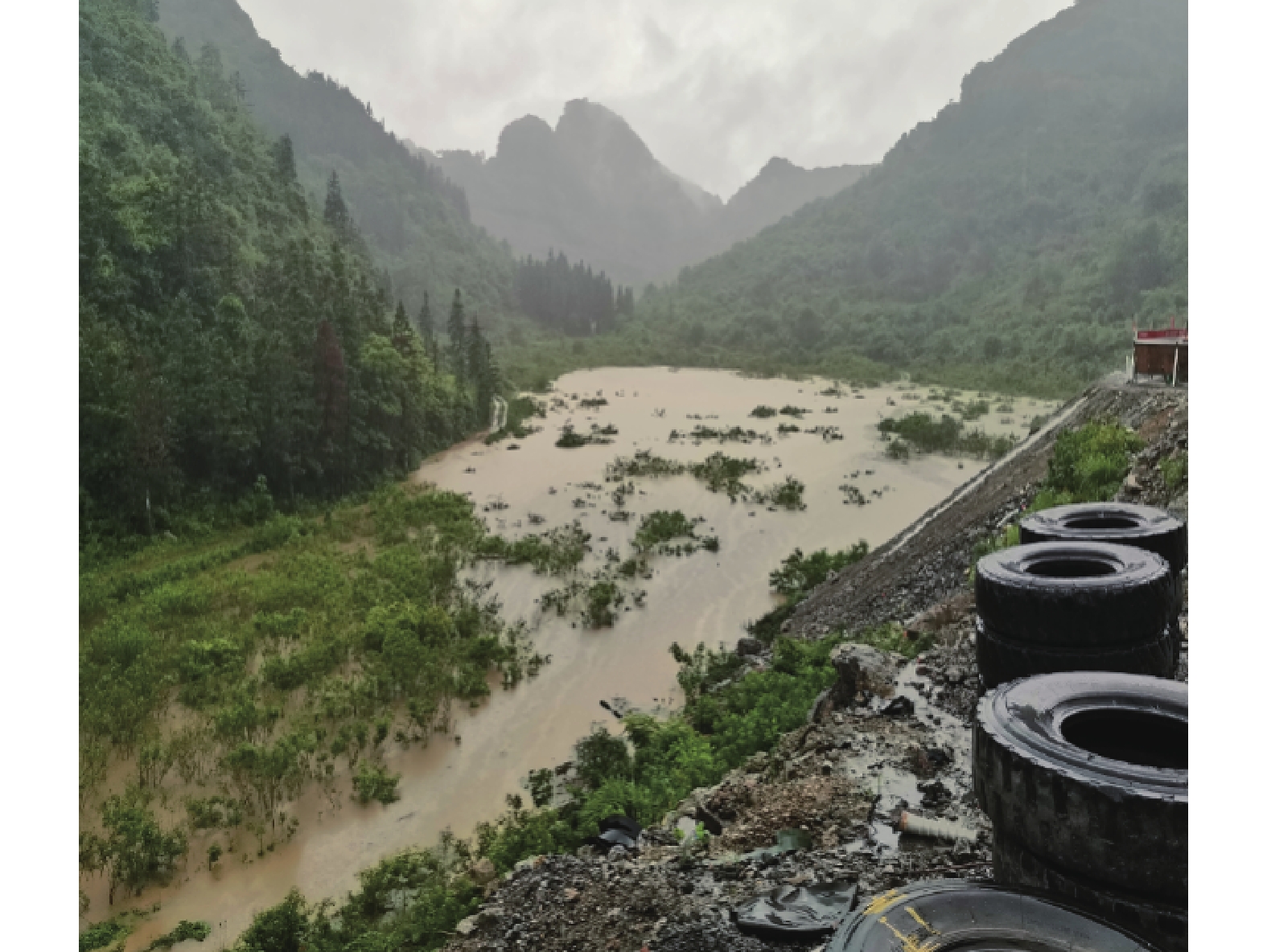
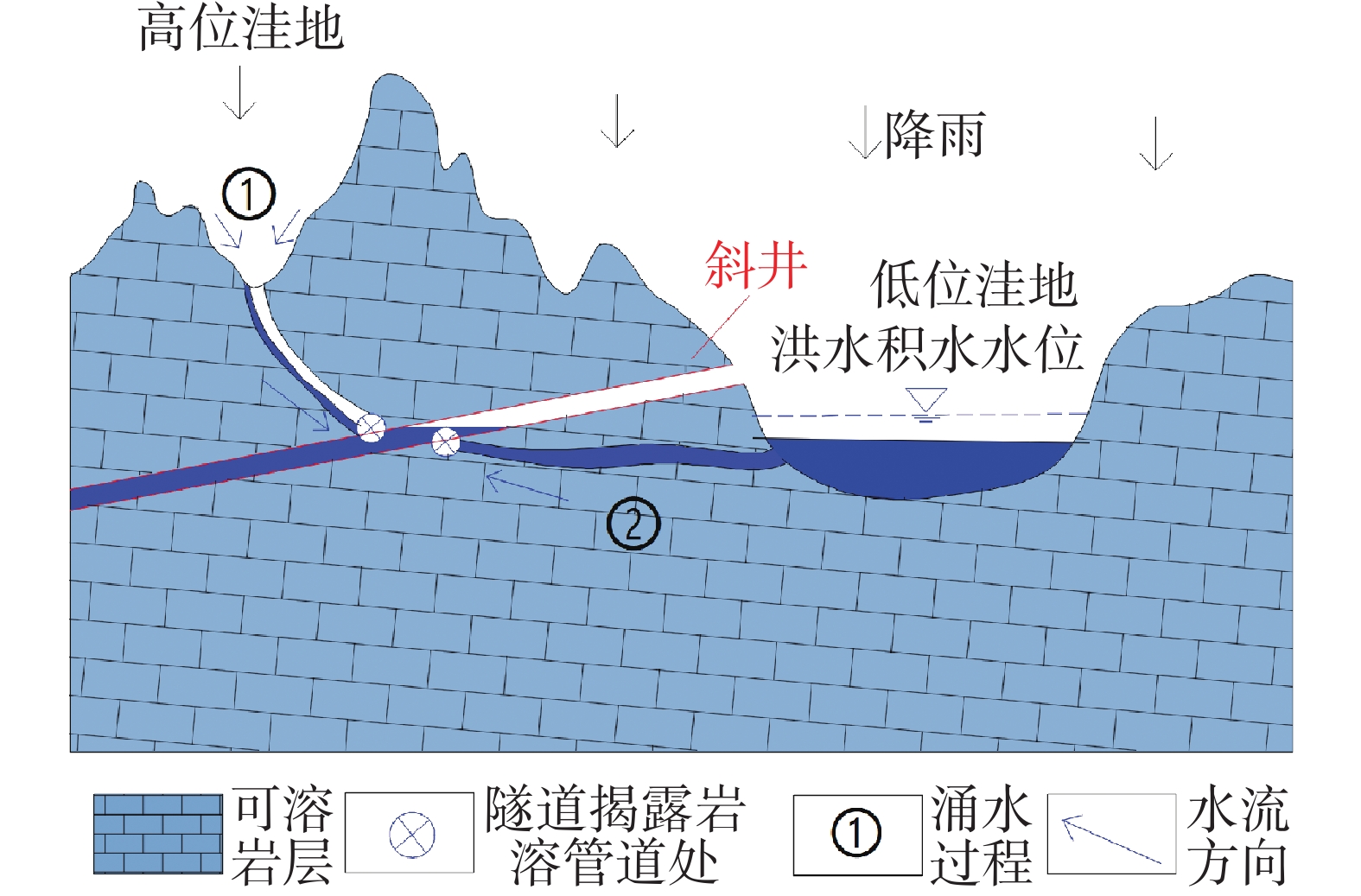
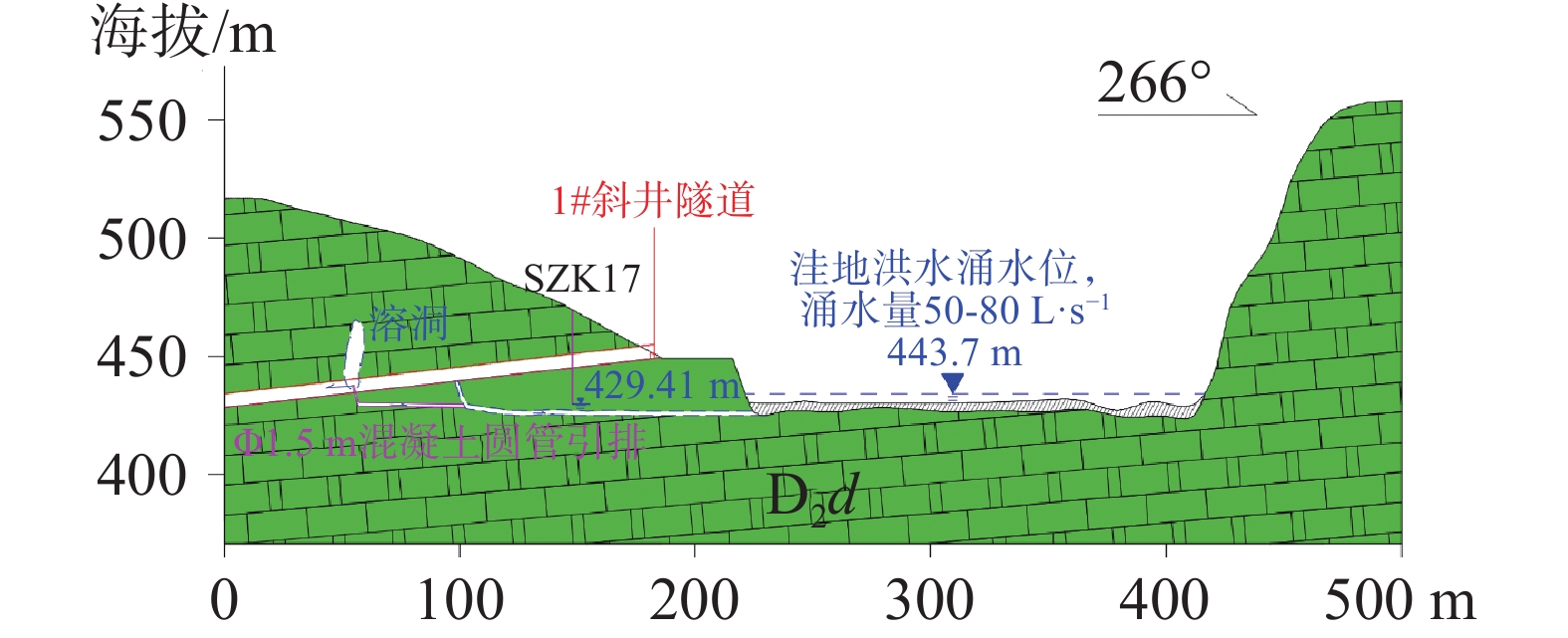
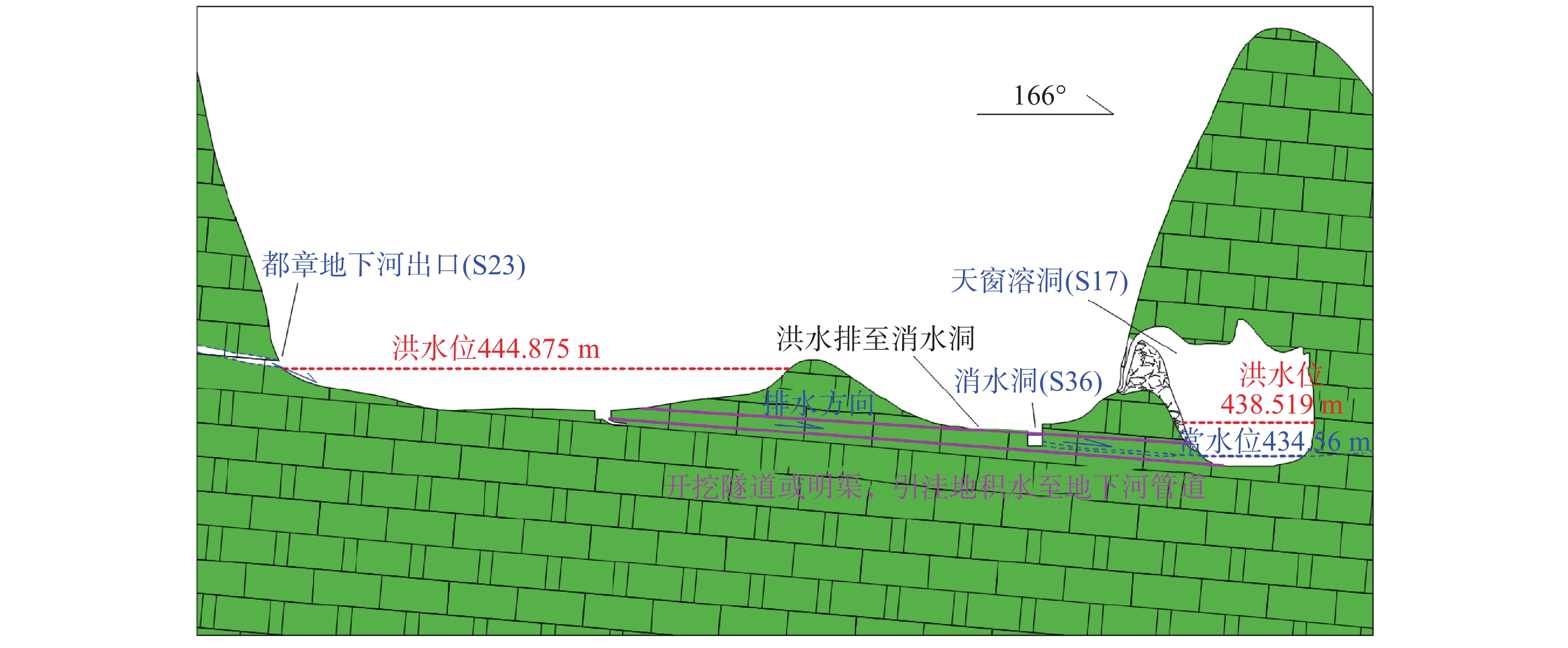
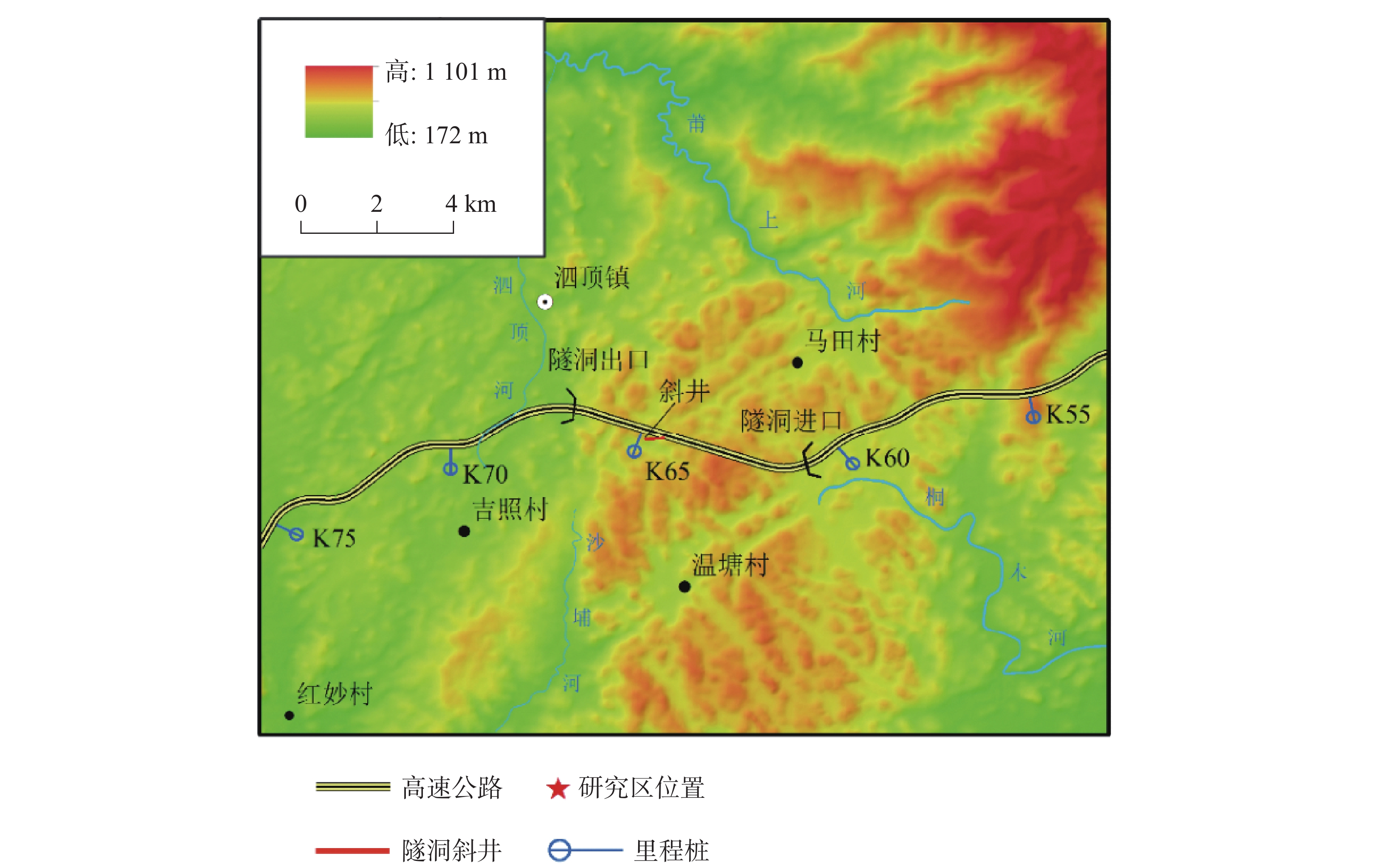
The problem of water inrush and mud gushing is a major hazard encountered during the construction of karst tunnels. During the excavation of the inclined shaft of the Siding tunnel on the Guilin–Liucheng expressway in Guangxi, karst caves were discovered at XK0+410 m and XK0+365 m, respectively. The karst pipelines exposed by the inclined shaft excavation caused groundwater to gush from the karst cave at XK0+365 m after rainfall, flowing back into the tunnel along the inclined shaft and disrupting construction. In May to June of 2020, the tunnel site experienced a rainstorm that significantly increased water inrush at XK0+365 m due to the karst cave, with a maximum flow rate of approximately 300 m³·h−1. Meanwhile, large-scale water accumulation occurred in the Xiaguling Depression, located south of the inclined shaft entrance, with water depths ranging from 1.50 to 4.67 m and a flood level of 444.874 m. The massive inflow of accumulated water into the tunnel made construction impossible, severely impeding project progress. This study takes the water inrush from the inclined shaft of the Siding tunnel on the Guilin–Liucheng expressway as the research object. Through karst hydrogeological surveys, high-density electrical resistivity prospecting, and connectivity experiments conducted in the tunnel site area, the study identified the water inrush channels and sources associated with the inclined shaft. It elucidated the genetic mechanism of water inrush, predicted the volume of water inflow, validated the accuracy of prediction in conjunction with the water inrush mechanism, and comprehensively compared three treatment measures. The results indicate the following: (1) During the construction of the Siding tunnel inclined shaft, a karst conduit was exposed,through which rainfall surged into the working area,resulting in a water inrush disaster.The primary sources of the water inrush are identified as:water from gullies on the hillslope,groundwater discharged via underground river conduits from the Duzhangtun depression from the north,and groundwater discharged from underground river tributary near Malong village from the northeast. All of these sources originate from atmospheric precipitation collected in karst negative terrains. (2) The formation process of the water inrush disaster at the Siding tunnel was as follows:during the construction of the inclined shaft,the upper conduit of the Duzhang underground river was exposed,resulting in immediate water inflow upon the occurrence of rainfall.Under heavy rain conditions,in addition to the drainage of rainwater from high-elevation depressions,the water level in the Xiaguling depression rose to 443.7 m, causing backflow into the tunnel's inclined shaft.The synergistic effect of these two factors led to a major water inrush.The water inrush mechanism at the inclined shaft of the Siding tunnel is classified as karst conduit-type water inrush, which can be divided into two processes: ① Rainwater drainage from high-elevation karst depressions. When the elevation of a karst depression is higher than that of the tunnel, after rainfall,water accumulates within the depression and flows along the karst conduit,discharging into the inclined shaft through the karst cave opening exposed during excavation. ② Backflow from low-elevation karst depressions. When the elevation of a karst depression is lower than that of the tunnel, during heavy rainfall,a large volume of rainwater accumulates instantaneously in the depression.Due to poor drainage, the water level rises continuously.When the water level exceeds the elevation of the karst conduit exposed by excavation,a hydraulic head difference drives the accumulated water to backflow into the inclined shaft via the karst conduit,resulting in a major inrush. (3) Based on the principle that groundwater in karst areas should be drained rather than blocked, and considering the sources of water inrush, channels, topography, and karst development characteristics of the inclined shaft of the Siding tunnel, a measure of intercepting and externally diverting water was adopted. This involved intercepting part of the floodwater in the Duzhangtun depression and using the natural drainage channel developed at the northwestern foot of the mountain in Duzhangtun to divert some of floodwater to Matang’ao village by raising the water level. Simultaneously, the accumulated water in the depression was directly diverted into the Tianchuang karst cave through tunnels or open ditches to achieve rapid drainage, reduce the flood level in the depression, and thereby decrease recharge sources and the water pressure in karst conduits. This approach effectively solves the water inrush problem in the inclined shaft and provides a basis for the treatment of water inrush in shallow-buried tunnels in similar karst areas. This study not only ensures the construction safety of the Siding tunnel, but also holds significant importance for ecological protection in the tunnel site area. -
Key words:
- karst inrush water /
- tunnel inclined shaft /
- formation mechanisms /
- treatment measures
-
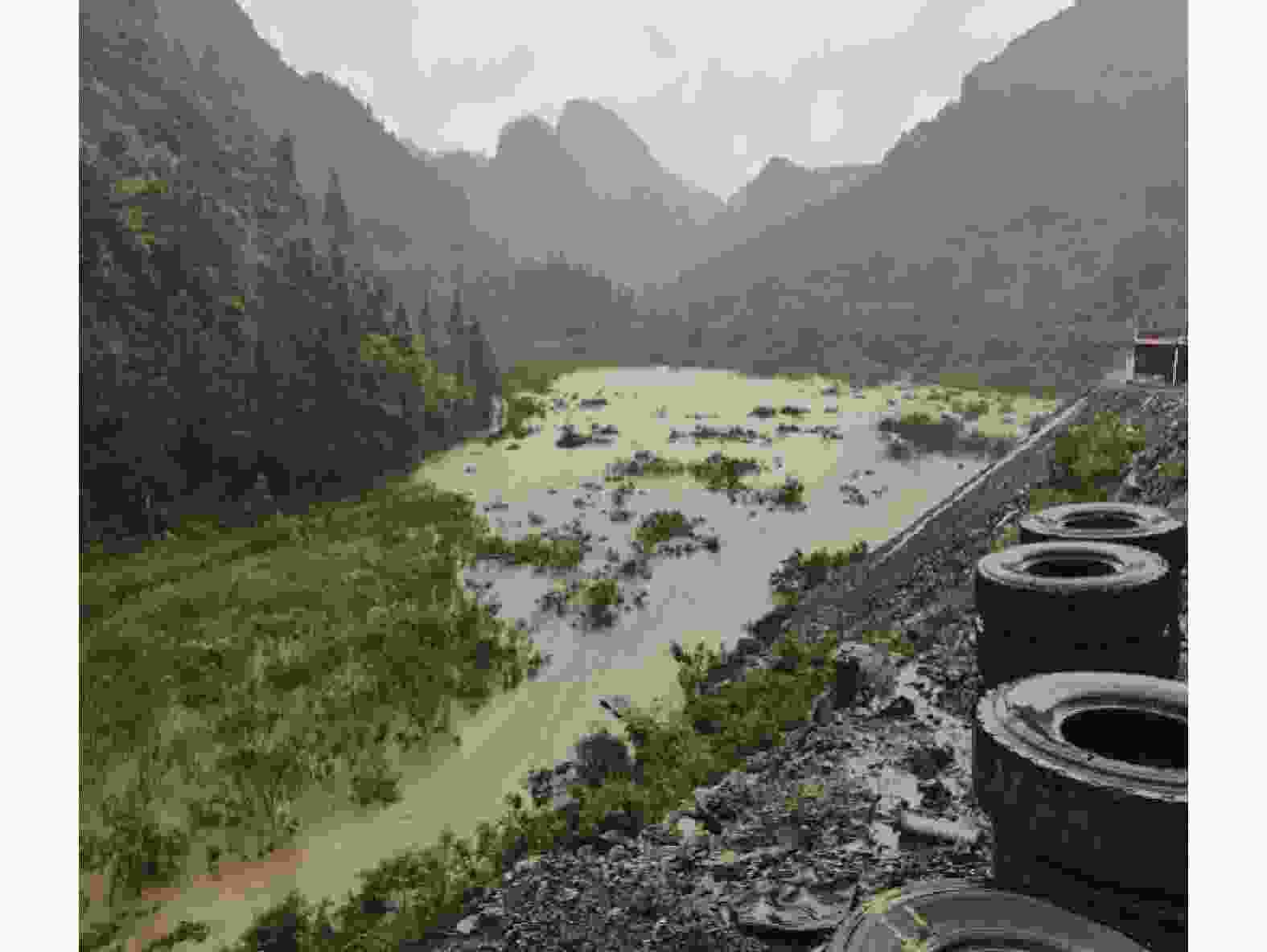
1 泗顶隧道斜井口洼地(下古另洼地)积水
1. Water accumulation in the depression at the pit of the Siding tunnel
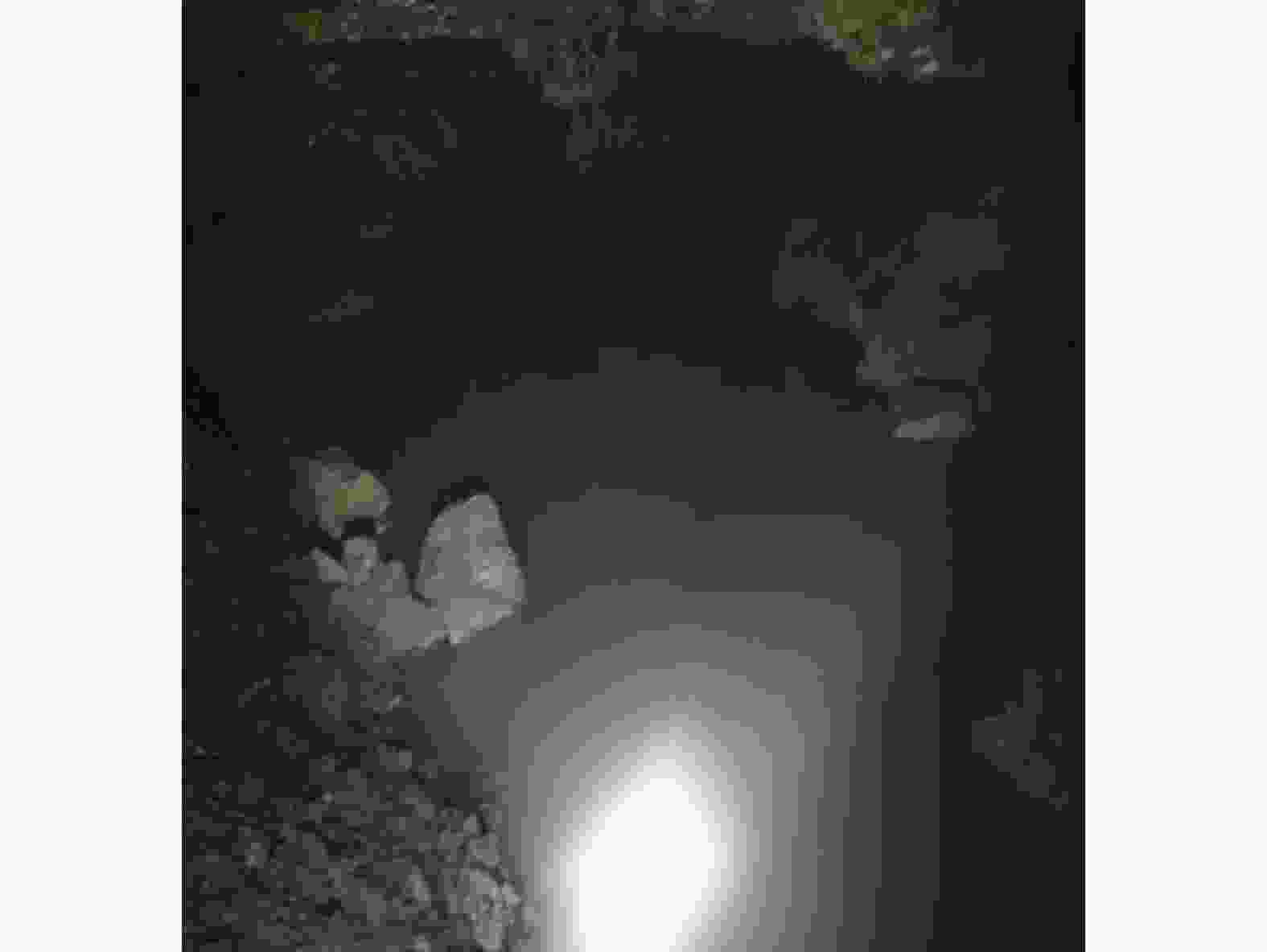
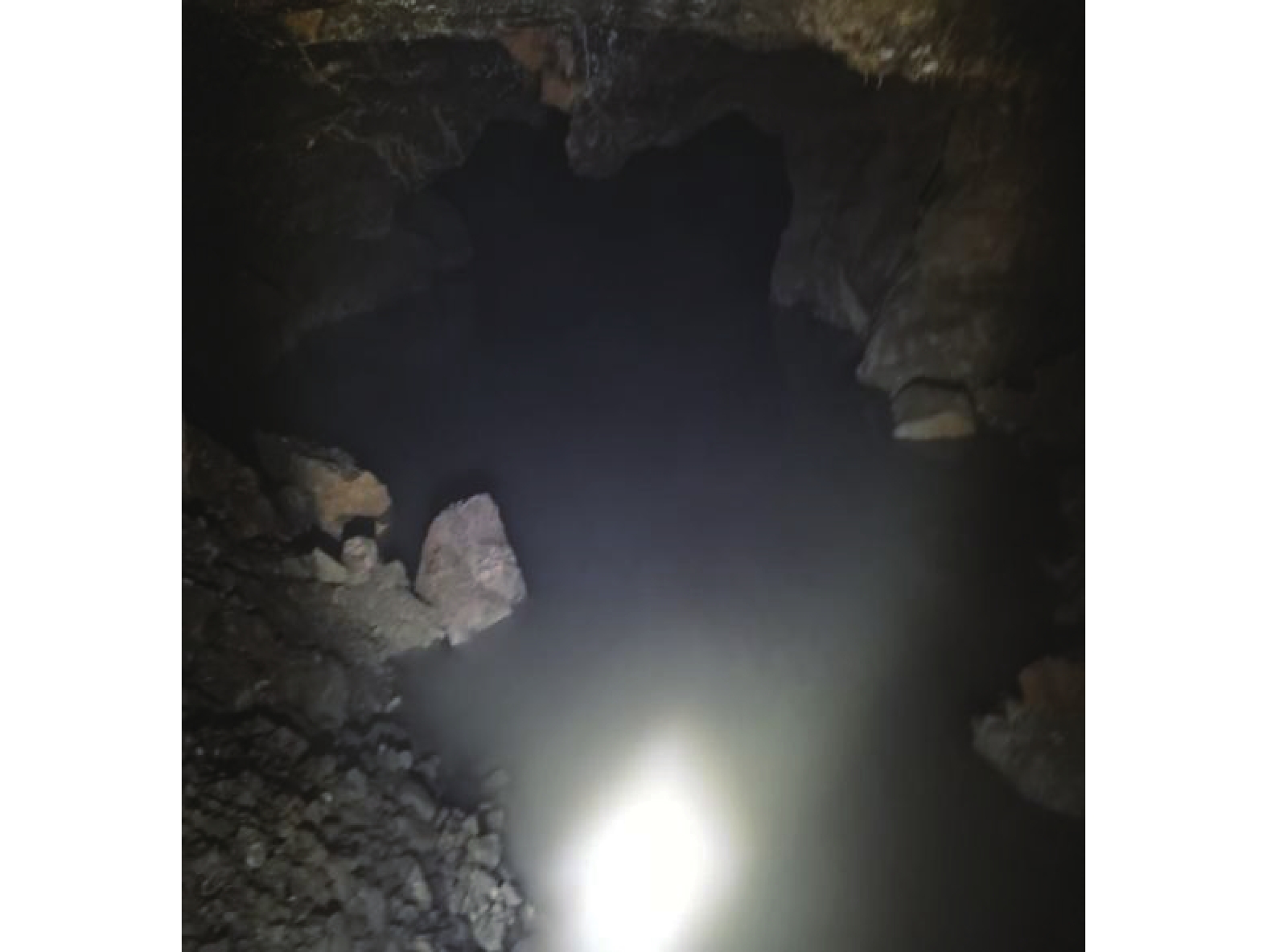
2 雨停后泗顶隧道斜井溶洞积水
2. Water accumulation in the karst cave at the inclined shaft of the Siding tunnel after rain events
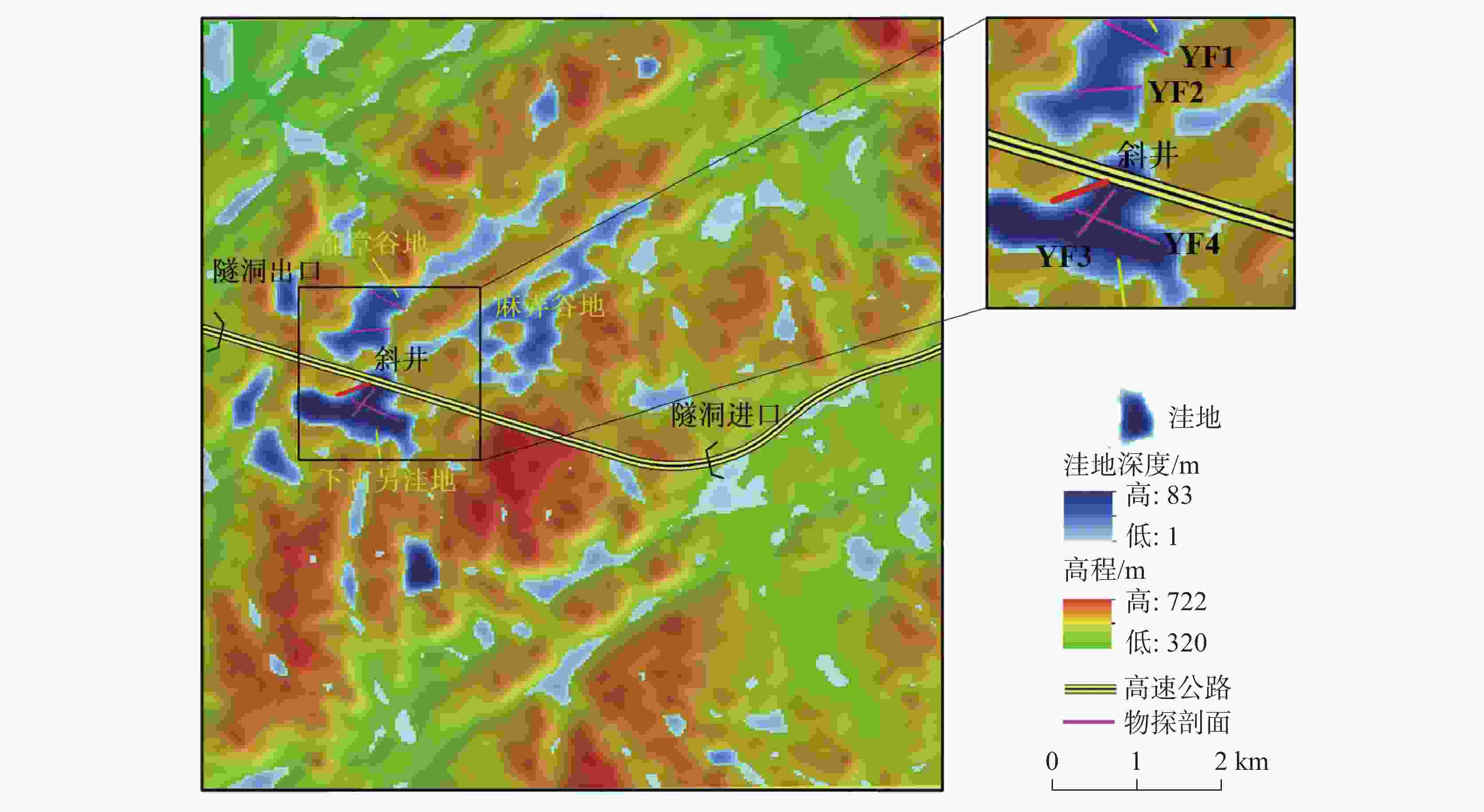
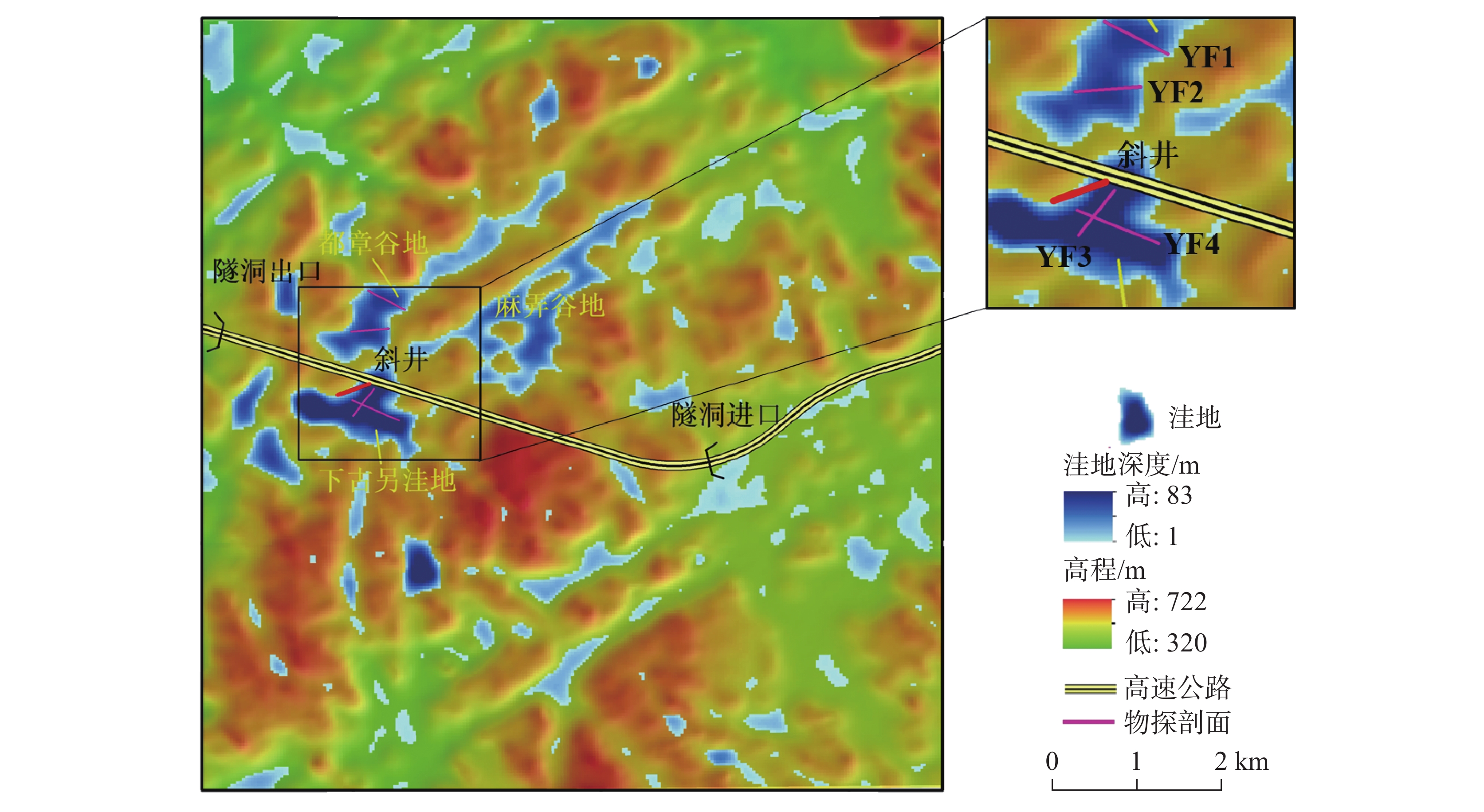
图 3 研究区岩溶洼地的遥感解译
Figure 3. Remote sensing interpretation of depressions in the study area
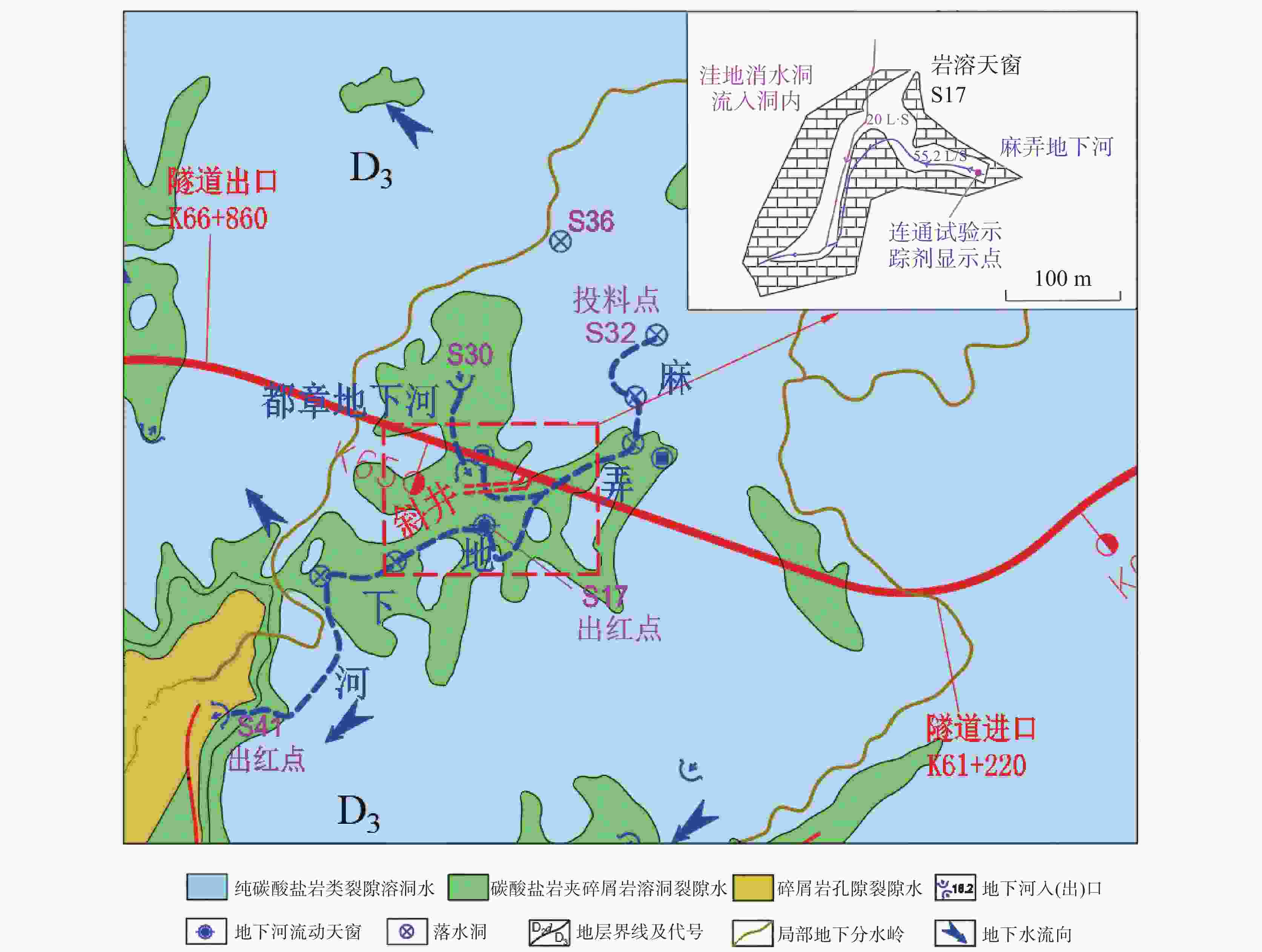
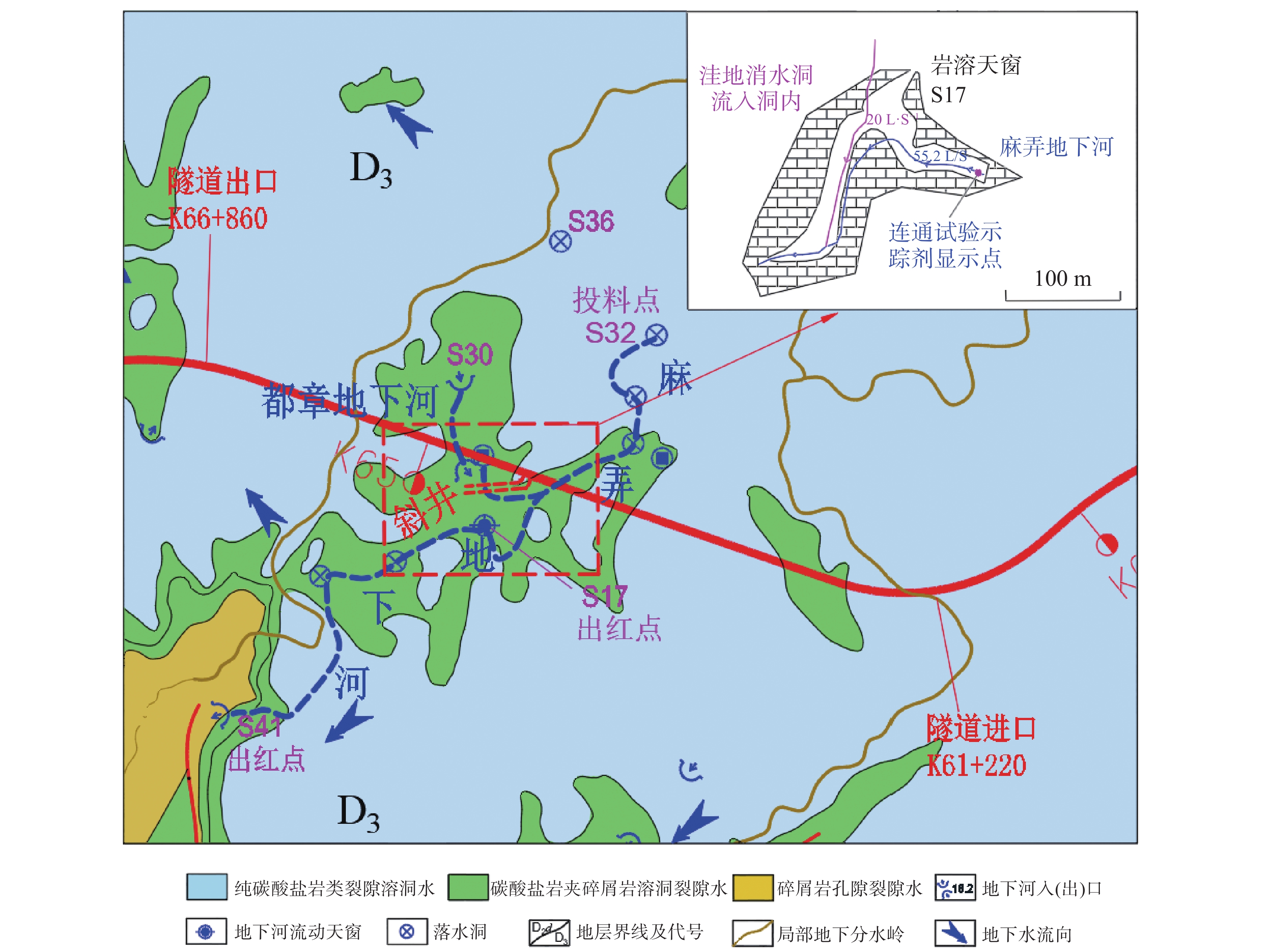
图 5 连通实验及地下河天窗平面示意图
Figure 5. Schematic plan of the connectivity experiment and underground river skylight
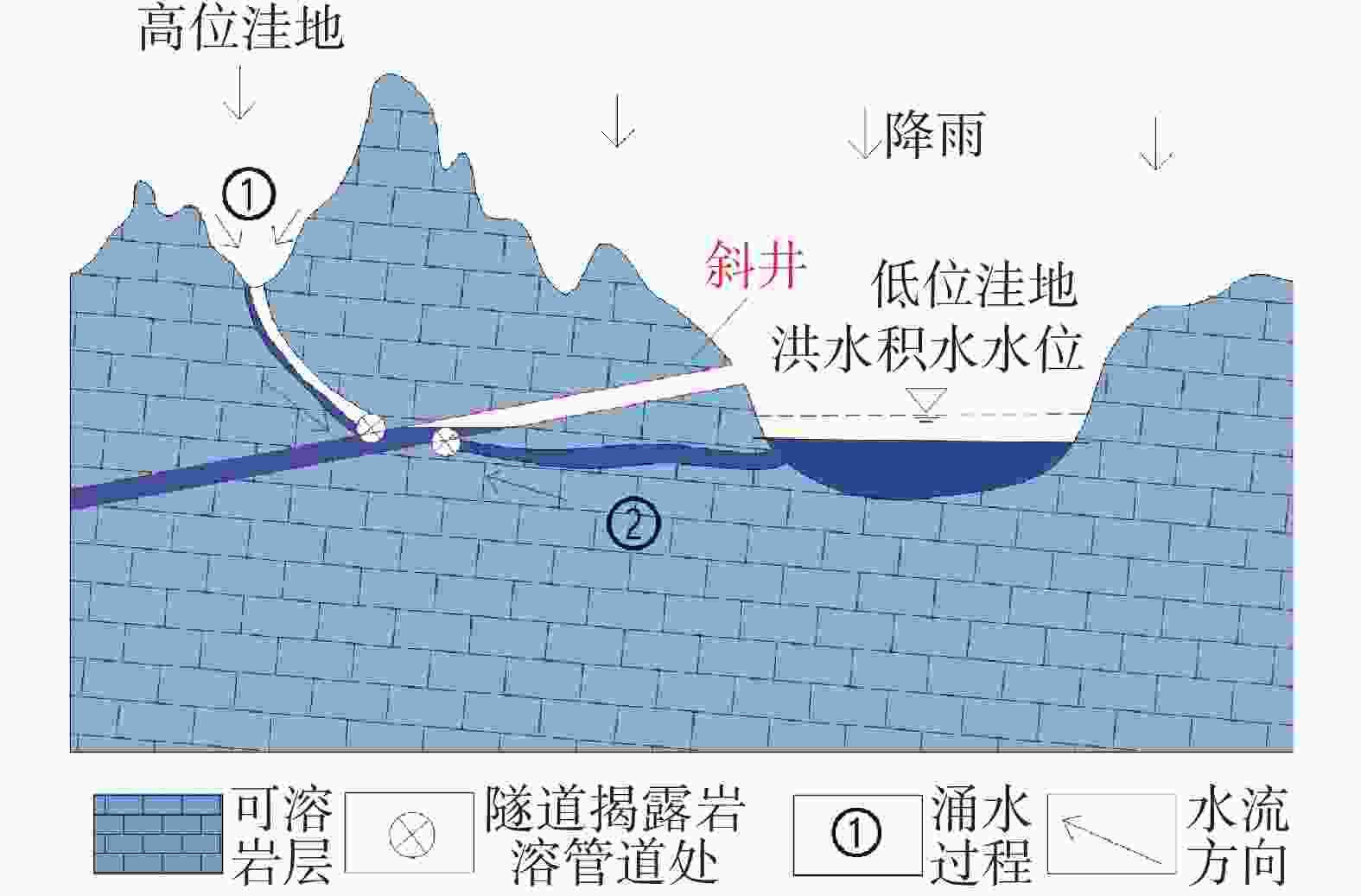
图 6 斜井充水管道型涌突水机制
Figure 6. Mechanism of water inrush from water-filled conduits in inclined shafts
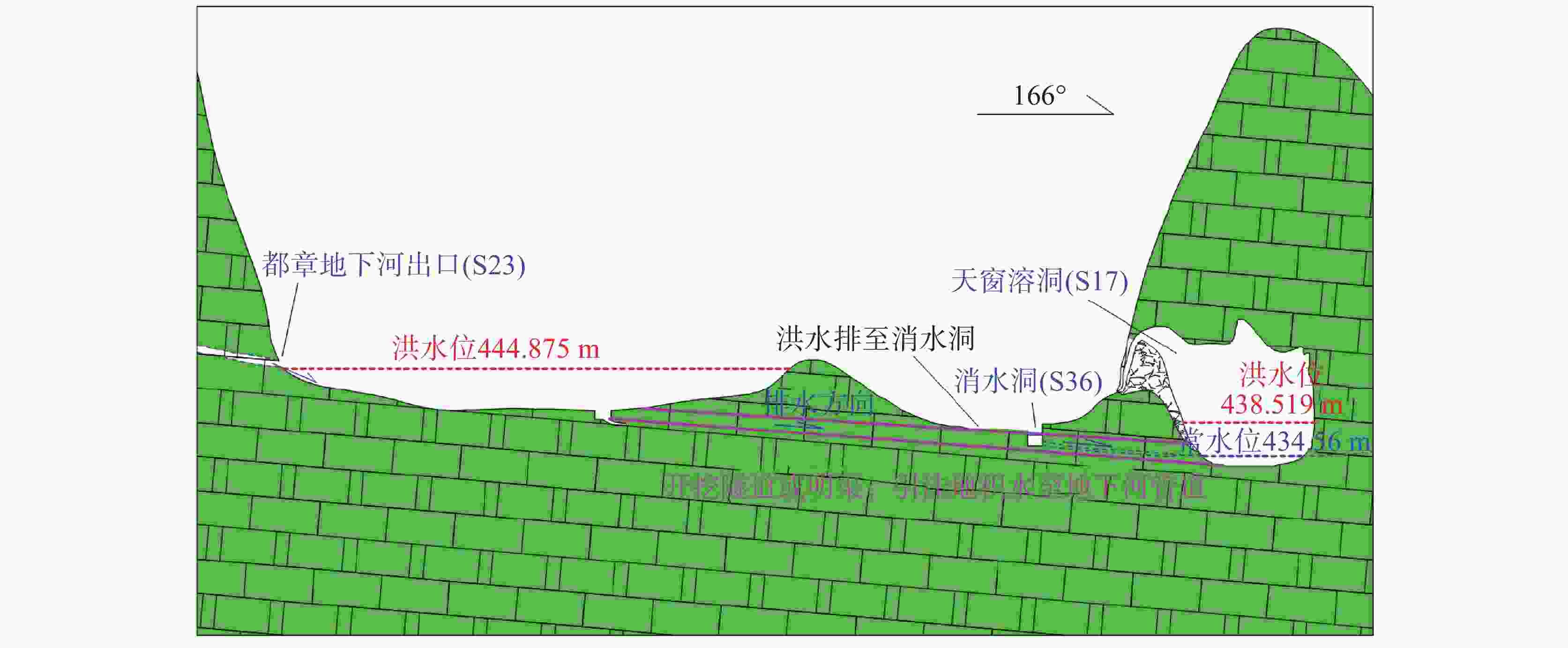
图 8 斜井涌水治理示意图
Figure 8. Schematic diagram of gushing water management in the inclined shaft
表 1 研究区岩溶暗河特征
Table 1. Characteristics of karst underground rivers in the study area
岩溶
暗河地层 水位埋
深/m汇水面
积/km2流量/(L·s−1) 径流特征 开发利用 与工程关系 枯季 雨季 都章地
下河D2 436.00 3.28 5.60 150 暗河接受大气降雨补给,从都章屯南西面平弄洼地(S30)底部排出,地下水排出地表后随即消入洼地消水洞,向洼地南东面径流,于山脚流入天窗(S17)汇入麻弄地下河 生活
用水出口位于斜井口下古另洼地(S23) 麻弄地
下河D3 434.56 / 3.26 300 暗河接受大气降雨补给,从麻弄屯北西面约620 m洼地中部(S32)进入地下,流经山脚流入天窗(S17),向南西面径流,于拉站弄地下河出口处(S41)排出地表 生活
用水流经斜井口下古另洼地南东面山脚天窗(S17)  下载: 导出CSV
表 2 隧道涌水量计算结果表
Table 2. Calculation results of tunnel water influx
降雨期 入渗系数α 年均降水量W/mm 集雨面积A/km2 涌水量/(m3·d−1) 枯水期 0.352 623.04 8.21 4933.47 平水期 0.528 1214.40 8.21 14424.12 丰水期 0.726 2640.00 8.21 43115.58
下载: 导出CSV
表 3 隧道涌水治理措施
Table 3. Treatment measures of tunnel water inrush
治理措施 适用场景 核心优势 主要局限 埋置管涵 岩溶管道明确、长期排水 定向引排,维护成本低 容量限制,倒灌风险 源头截流 洪水集中补给、分洪需求 削减总水量,长期效益 环境影响,工程复杂性 积水引流 洼地积水、应急排水 快速见效,灵活性高 施工风险,地形依赖
下载: 导出CSV
表 4 隧道涌水来源分析及预处理措施
Table 4. Analysis of sources of tunnel water inrush and pre-treatment measures
隧道段 涌水来源 涌水风险 预处理措施 K61+220~K61+830 地下暗河管道 雨后溶洞涌水 埋置管涵 K61+830~K62+370 低位洼地 洼地积水倒灌 截流外导 K62+370~K63+400 高位洼地 洼地雨水排泄 截流外导 K63+400~K64+320 高位洼地、低位洼地及地下暗河管道 洼地积水倒灌、洼地雨水排泄 截流外导 K64+320~K64+960 浅部地下河管道 雨后溶洞涌水 埋置管涵 K64+960~K66+860 密集高位洼地及地下暗河管道 洼地积水倒灌、洼地雨水排泄 截流外导
下载: 导出CSV
-
[1] 康小兵, 张强, 许模. 重庆走马岭岩溶隧道涌水量初步研究[J]. 工程地质学报, 2006(1): 68-71.Kang Xiaobing, Zhang Qiang, Xu Mo. A preliminary study of water intrusion in zoumaling karst tunnel, chongqing[J]. Journal of Engineering Geology, 2006(1): 68-71. [2] 李术才, 薛翊国, 张庆松, 李树忱, 李利平, 孙克国, 葛颜慧, 苏茂鑫, 钟世航, 李貅. 高风险岩溶地区隧道施工地质灾害综合预报预警关键技术研究[J]. 岩石力学与工程学报, 2008(7): 1297-1307.Li Shucai, Xue Yiguo, Zhang Qingsong, Li Shuchen, Li Liping, Su Keguo, Ge Yanhui, Su Maoxin, Zhong Shihang, Li Xiu. Research on key technology of comprehensive forecasting and early warning of geologic hazards in tunnel construction in high-risk karst areas[J]. Journal of Rock Mechanics and Engineering, 2008(7): 1297-1307. [3] 王遇国. 岩溶隧道突水灾害与防治研究[D]. 北京: 中国铁道科学研究院, 2010.Wang Yuguo. Study on scourge and prevention of karst tunnel water inrush[D]. Beijing: China Academy of Railway Sciences, 2010. [4] Lyu Yuxiang, Jiang Yongjun, Hu Wei, Cao Min, Mao Yang. A review of the effects of tunnel excavation on the hydrology, ecology, and environment in karst areas: Current status, challenges, and perspectives[J]. Journal of Hydrology, 2020, 586: 124891. [5] 吕玉香, 蒋勇军, 王正雄, 胡伟. 西南岩溶槽谷区隧道建设的水文生态环境效应研究进展[J]. 生态学报, 2020, 40(6): 1851-1864.Lyu Yuxiang, Jiang Yongjun, Wang Zhengxiong, Hu Wei. Review on the hydrology and the ecological and environmental effects of tunnel construction in the karst valley of Southwest China[J]. Acta Ecologica Sinica, 2020, 40(6): 1851-1864. [6] 江杰, 蒲鸥, 欧孝夺, 赵建刚, 谢规球. 岩溶区公路隧道围岩分级专家系统设计与应用[J]. 长江科学院院报, 2018, 35(7): 94-99.Jiang Jie, Pu Ou, Ou Xiaoduo, Zhao Jiangang, Xie Guiqiu. Expert system of surrounding rock classification for highway tunnel in karst region: Design and application[J]. Journal of Yangtze River Scientific Research Institute, 2018, 35(7): 94-99. [7] 甘子锋. 都巴高速公路隧道涌水突泥病害处治措施[J]. 西部交通科技, 2022(12): 150-151, 155.Gan Zifeng. Duba highway tunnel water surge mud disease treatment measures[J]. Western Transportation Technology, 2022(12): 150-151, 155. [8] 张丕界, 林振球, 熊安详. 斜井在长大隧道施工中的作用探讨[J]. 现代隧道技术, 2003, 40(4): 8-14.Zhang Pijie, Lin Zhenqiu, Xiong Anxiang. Discussion on the function of inclined shaft for long tunnel construction[J].Modern Tunnelling Technology, 2003,40(4): 8-14. [9] 蒋建平, 高广运, 李晓昭, 罗国煜. 隧道工程突水机制及对策[J]. 中国铁道科学, 2006, 27(5): 76-82.Jiang Jianping, Gao Guangyun, Li Xiaozhao, Luo Guoyi. Mechanism and countermeasures of water-bursting in railroad tunnel engineering[J]. China Railway Science, 2006, 27(5): 76-82. [10] 黄鸿健, 张民庆. 宜万铁路隧道工程岩溶及岩溶水分析与应对[J]. 现代隧道技术, 2009, 46(2): 22-34.Huang Hongjian, Zhang Minqing. Analysis and countermeasures against karst and karst-water in tunnels on Yichang-Wanzhou railway[J]. Modern Tunnelling Technology, 2009, 46(2): 22-34. [11] 王青松. 岩溶隧道突水机理研究[J]. 中国铁路, 2023(4): 1-8.Wang Qingsong. Research on the mechanism of sudden water flow in karst tunnels[J]. China Railway, 2023(4): 1-8. [12] 王运生, 黄润秋, 蒋良文, 许模, 李超. 园梁山隧道背斜段涌水机制探讨[J]. 地球科学进展, 2004(S1): 355-357.Wang Yunshen, Huang Runqiu, Jiang Liangwen, Xu Mo, Li Chao. Discussion on the mechanism of water gushing in the anticline section of Yuanliangshan Tunnel[J]. Advances In Earth Science, 2004(S1): 355-357. [13] 洪庆仁, 吴勇, 卓勇, 张凡, 邱钦钦. 综合超前地质预报在大秦岭隧道中的应用[J]. 人民长江, 2017, 48(7): 56-59.Hong Qingren, Wu Yong, Zhuo Yong, Zhang Fan, Qiu Qinqin. Application of integrated advance geological forecast in Daqinling Tunnel[J]. Yangtze River, 2017, 48(7): 56-59. [14] 陈国庆, 李天斌, 范占锋, 杨成祥. 基于不同渗流方程的岩溶隧道涌突水过程模拟[J]. 水文地质工程地质, 2011, 38(4): 8-13.Chen Guoqing, Li Tianbin, Fan Zhanfeng, Yang Chengxiang. A study of the process simulation of water burst in a karst tunnel based on different seepage equations[J]. Hydrogeology & Engineering Geology, 2011, 38(4): 8-13. [15] Li Ji, Hong Aihua, Yuan Daoxian, Jiang Yongjun, Deng Shujin, Cao Cong, Liu Jiao. A new distributed karst-tunnel hydrological model and tunnel hydrological effect simulations[J]. Journal of Hydrology, 2021, 593:125639. [16] Huang Xin, Li Shucai, Xu Zhenhao, Guo Ming, Chen Yucheng . Assessment of a concealed karst cave's influence on karst tunnel stability: A case study of the huaguoshan tunnel, China[J]. Sustainability, 2018,10(7): 2132. [17] 陈旭, 许模, 杜宇本, 赵帅军. 保山隧道暗河管道系统及其对隧道影响研究[J]. 人民长江, 2011, 42(5): 22-25.Chen Xu, Xu Mo, Du Yuben, Zhao Shuaijun. Research on underground river system in Baoshan tunnel and its influence on tunnel engineering[J]. Yangtze River, 2011, 42(5): 22-25. [18] 李利平, 李术才, 张庆松. 岩溶地区隧道裂隙水突出力学机制研究[J]. 岩土力学, 2010, 31(2): 523-528.Li Liping, Li Shucai, Zhang Qingsong. Study of mechanism of water inrush induced by hydraulic fracturing in karst tunnels[J]. Rock and Soil Mechanics, 2010, 31(2): 523-528. [19] Xu Zhenhao, Lin Peng, Xing Huilin, Pan Dongdong, Huang Xin. Hydro-mechanical coupling response behaviors in tunnel subjected to a water-filled karst cave[J]. Rock Mechanics and Rock Engineering,2021,54(8):3737-3756. [20] 史箫笛, 黄勋, 康小兵, 谢怀前. 高密度电法在覆盖型岩溶地区探测中的应用[J]. 人民长江, 2018, 49(S2): 117-120, 127.Shi Xiaodi, Huang Xun, Kang Xiaobing, Xie Huaiqian. Application of high density electrical method in exploration of covered karst areas[J]. Yangtze River, 2018, 49(S2): 117-120, 127. [21] 易连兴, 夏日元, 王喆, 卢海平, 赵良杰. 岩溶峰丛洼地区降水入渗系数: 以寨底岩溶地下河流域为例[J]. 中国岩溶, 2017, 36(4): 512-517.Yi Lianxing, Xia Riyuan, Wang Zhe, Lu Haiping, Zhao Liangjie. Infiltration coefficient of precipitation in karst peak-cluster depression area: A case study of Zhaidi karst underground river basin[J]. Carsologica Sinica, 2017, 36(4): 512-517. -

 点击查看大图
计量
- 文章访问数: 1251
- HTML浏览量: 133
- PDF下载量: 16
- 被引次数: 0
