


Study on cross-borehole resistivity CT method for detecting typical karst collapses in the Chongqing region
-
摘要: 重庆地区的岩溶塌陷具有隐蔽性、突发性和难以预见的特点,常规地球物理方法难以实现精准探测。跨孔电阻率CT具有独特的观测方式和较高的成像分辨率,适用于岩溶地区的精细化隐患排查。文章在梳理和分析重庆地区岩溶塌陷演化机理、形成过程的基础上,构建了相应的电阻率模型,涵盖了暂未形成土洞、初步形成土洞和土洞进一步扩大三个阶段,并通过数值模拟获得了岩溶塌陷各演化阶段的电阻率响应特征。结果表明:跨孔电阻率CT在划分基岩界面的基础上,能够准确识别低电阻率的岩溶管道和土洞等异常体,精准地刻画异常区的空间分布,误差不超过0.5 m。实际案例表明:跨孔电阻率CT剖面能够直观反映岩层界面及隐伏塌陷的位置和范围,探测效果良好。该研究拓展了以地面电阻率法为主的传统岩溶塌陷勘探思路,为重庆地区岩溶塌陷的预警与防治提供了理论依据。Abstract:
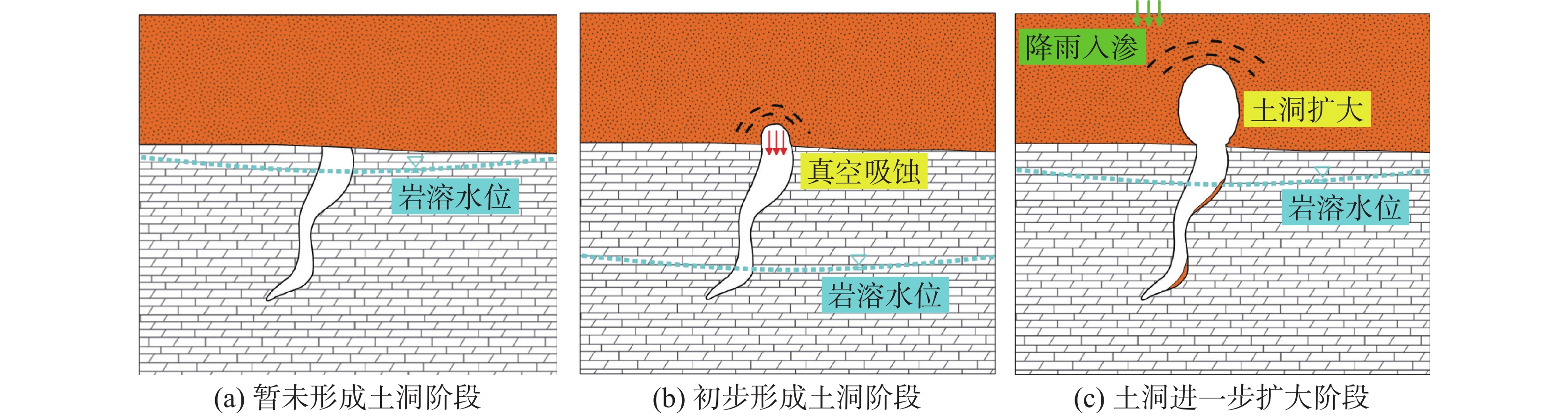
Karst ground collapses in the Chongqing region are characterized by concealment, sudden occurrence, and unpredictability, making them difficult to detect accurately using conventional geophysical methods. Cross-borehole resistivity computed tomography (CT), with its unique observation geometry and high imaging resolution, is well-suited for the detailed detection of hidden hazards in karst regions. The evolution of typical karst collapses in the Chongqing region can be summarized into three stages: soil cave incubation, formation, and expansion. During the incubation stage, the soil above the bedrock remains intact and stable, with water levels in karst conduits fluctuating periodically due to rainfall but without significantly affecting the stability of the overlying layer. In the formation stage, activities such as tunnel construction cause a rapid drop in groundwater levels, leading to a sharp increase in negative pressure within the karst conduits. This results in increased seepage pressure and gradual loosening of the overlying soil, forming localized cavities. During the expansion stage, repeated suffusion and erosion cause the soil cave to enlarge further, the roof depth to decrease, and eventually, surface collapse occurs. Based on a review of the formation mechanisms of karst collapses in Chongqing, this study developed geophysical resistivity models for the three stages mentioned above. Finite element forward modeling and smooth inversion calculations were employed to verify the effectiveness of cross-borehole resistivity CT in detecting karst collapses at different evolutionary stages. In the models, electrode spacing was set to one meter, and borehole spacing was set to 10 m. Simulation results demonstrate that cross-borehole resistivity CT technology can clearly delineate the spatial distribution characteristics of karst conduits and soil caves at each stage, with inversion errors less than 0.5 meters. In practical applications, cross-borehole resistivity CT successfully identify the morphology of hidden collapses and their associated karst conduits, effectively overcoming the limitations of traditional surface resistivity methods in terms of vertical resolution and detection accuracy, thereby providing an efficient solution for detecting karst collapses in complex geological settings. This study expands upon the traditional methodologies for detecting karst collapses, demonstrating the significant advantages of cross-borehole resistivity CT in improving the accuracy of identifying hidden karst conduits and soil cavities. Future research should focus on refining the technical parameters of this method to enable dynamic monitoring and more precise interpretation of concealed karst collapses. Such advancements will provide critical support for the scientific prevention and mitigation of karst disasters in Chongqing, thereby contributing to the sustainable and safe development of the Chengdu–Chongqing economic circle. -
Key words:
- resistivity CT /
- karst collapse /
- resistivity method /
- numerical simulation /
- electrical prospecting
-
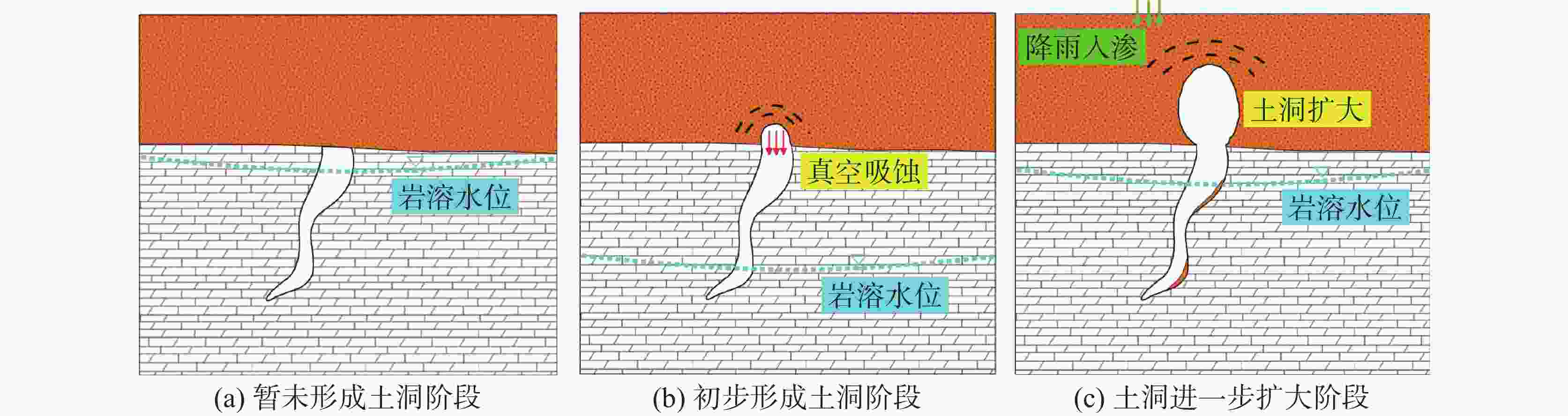
图 1 重庆地区典型岩溶塌陷的形成演化过程示意图
Figure 1. Schematic diagram of the formation and evolution of typical karst collapses in Chongqing
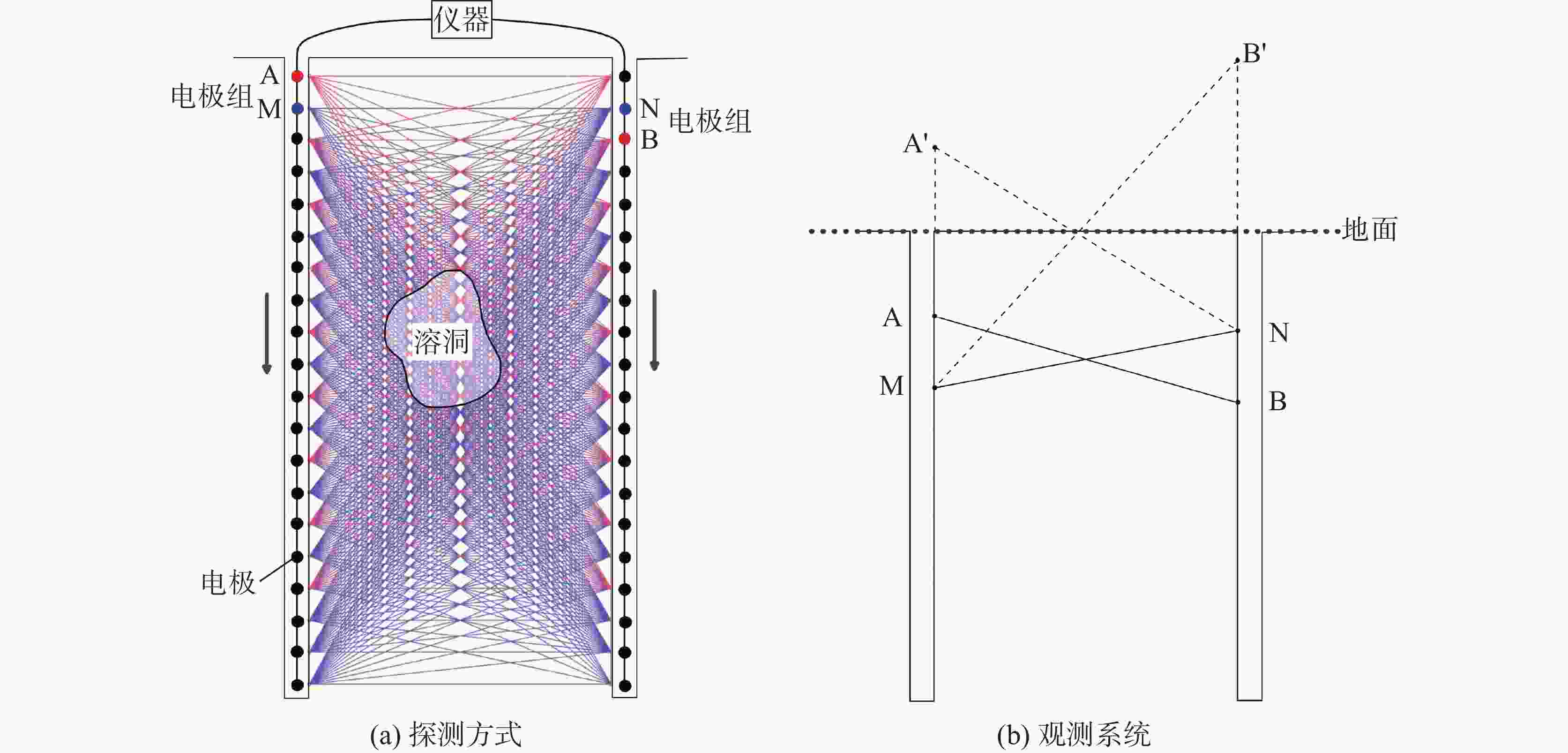
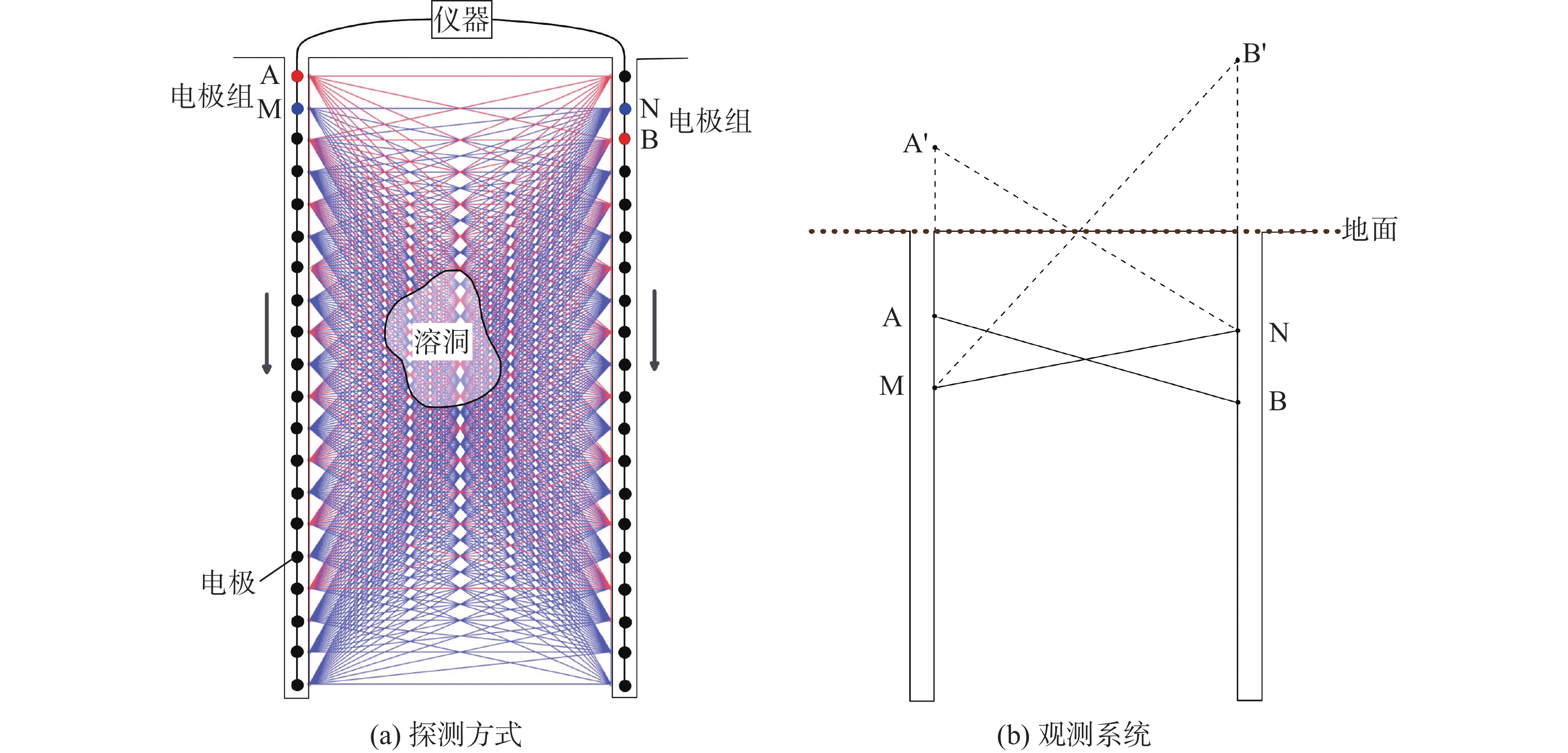
图 2 跨孔电阻率CT工作示意图
Figure 2. Schematic diagram of operating cross-borehole resistivity CT
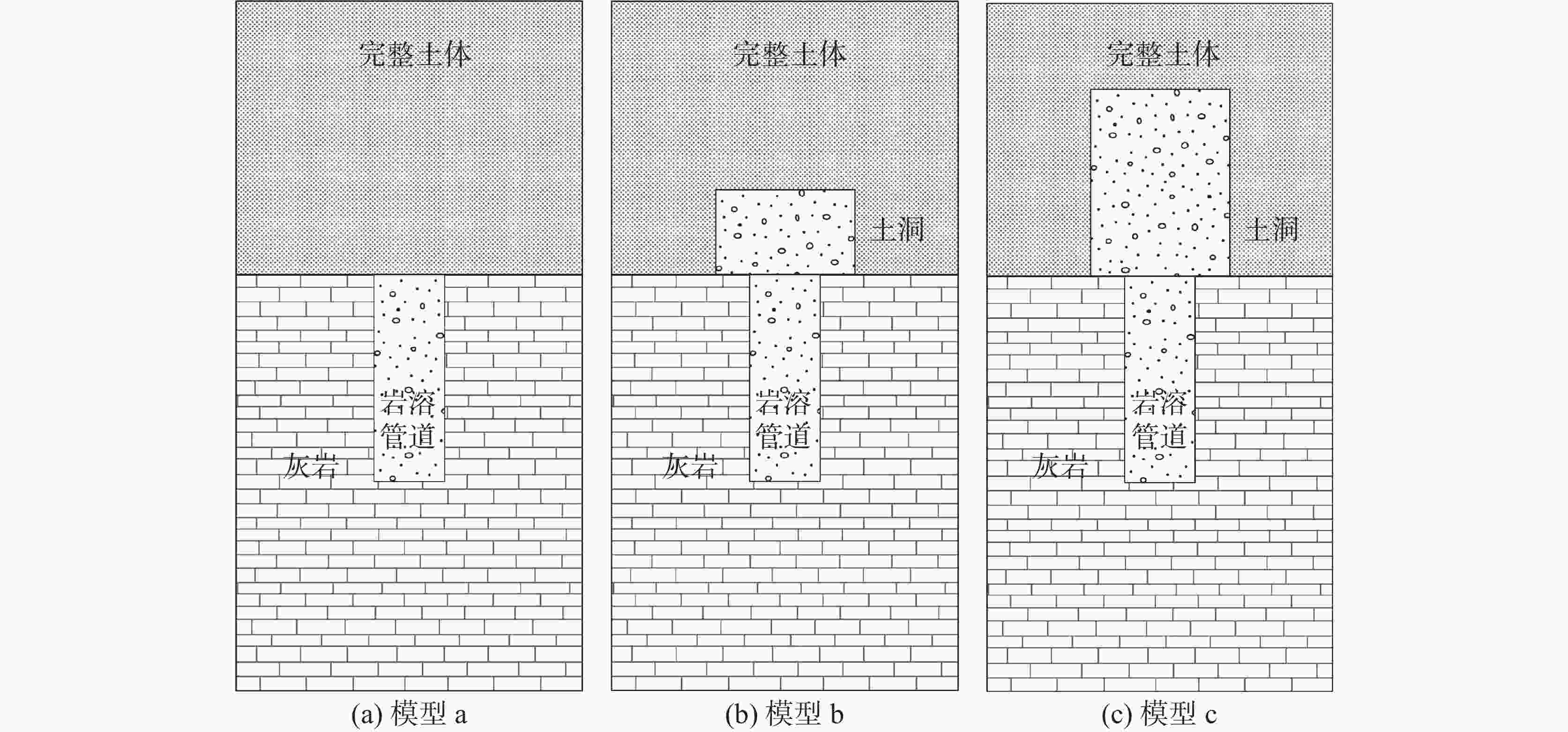
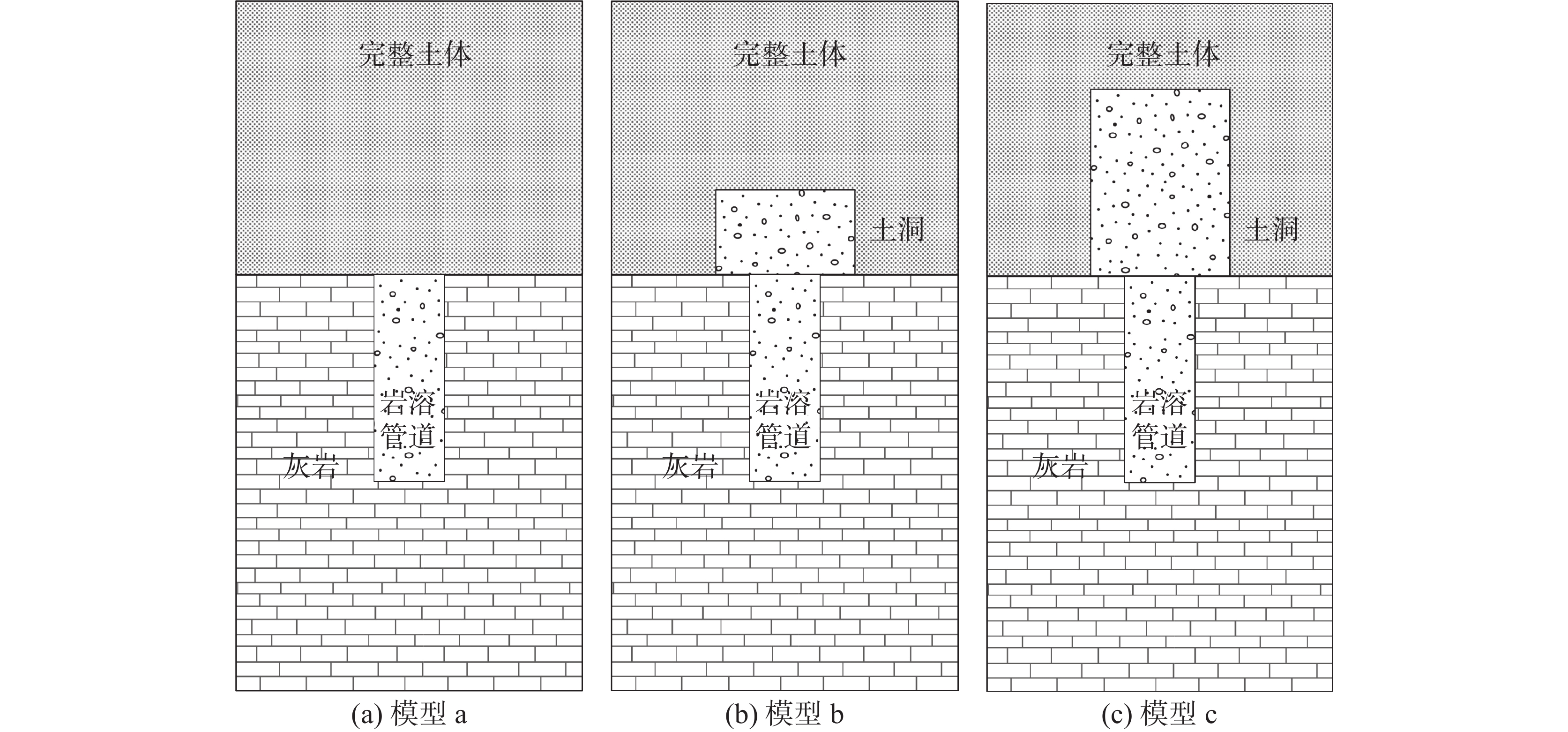
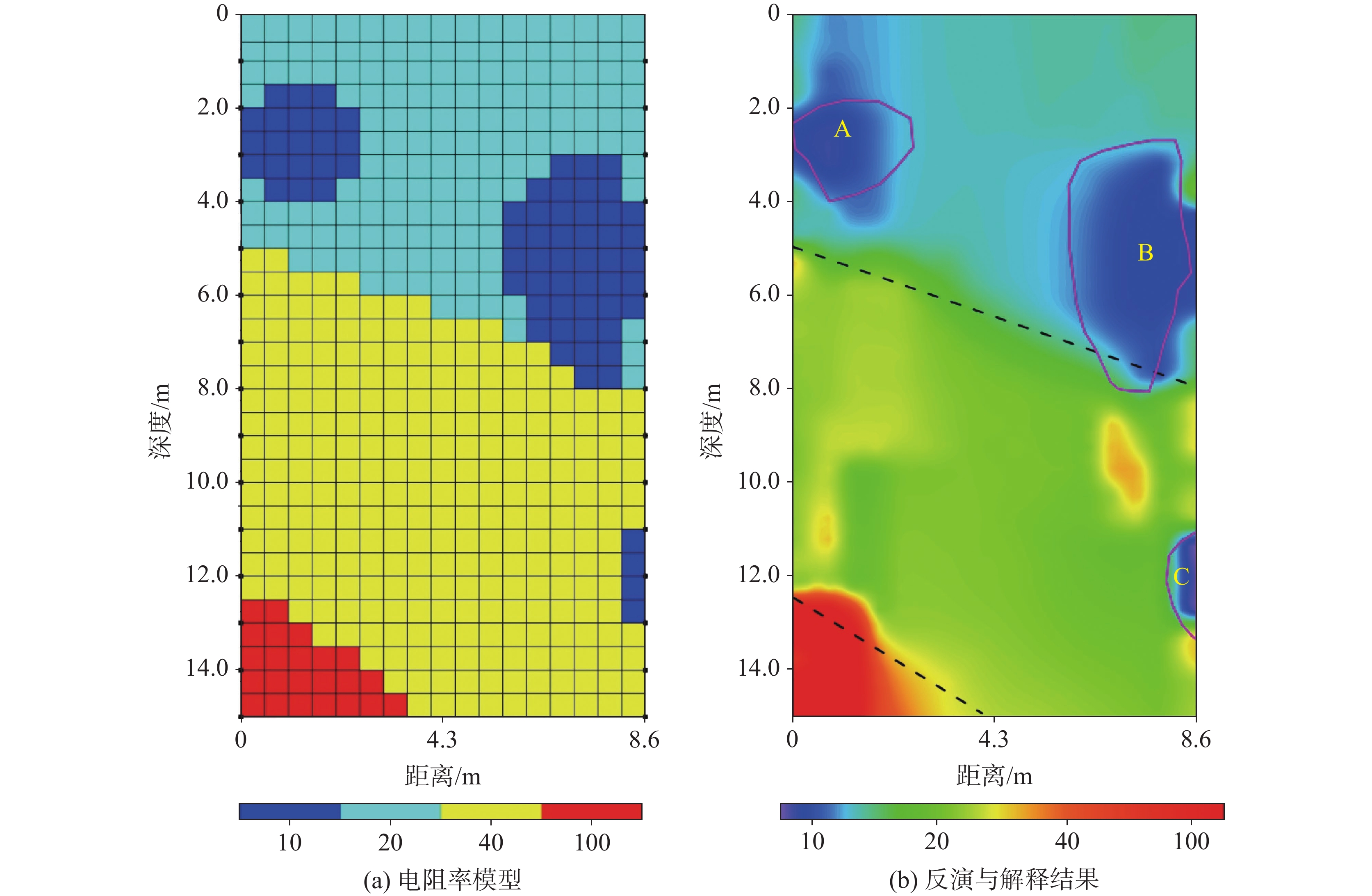
图 3 重庆地区典型岩溶塌陷演化的电阻率模型
Figure 3. Resistivity model of typical karst collapse evolution in Chongqing
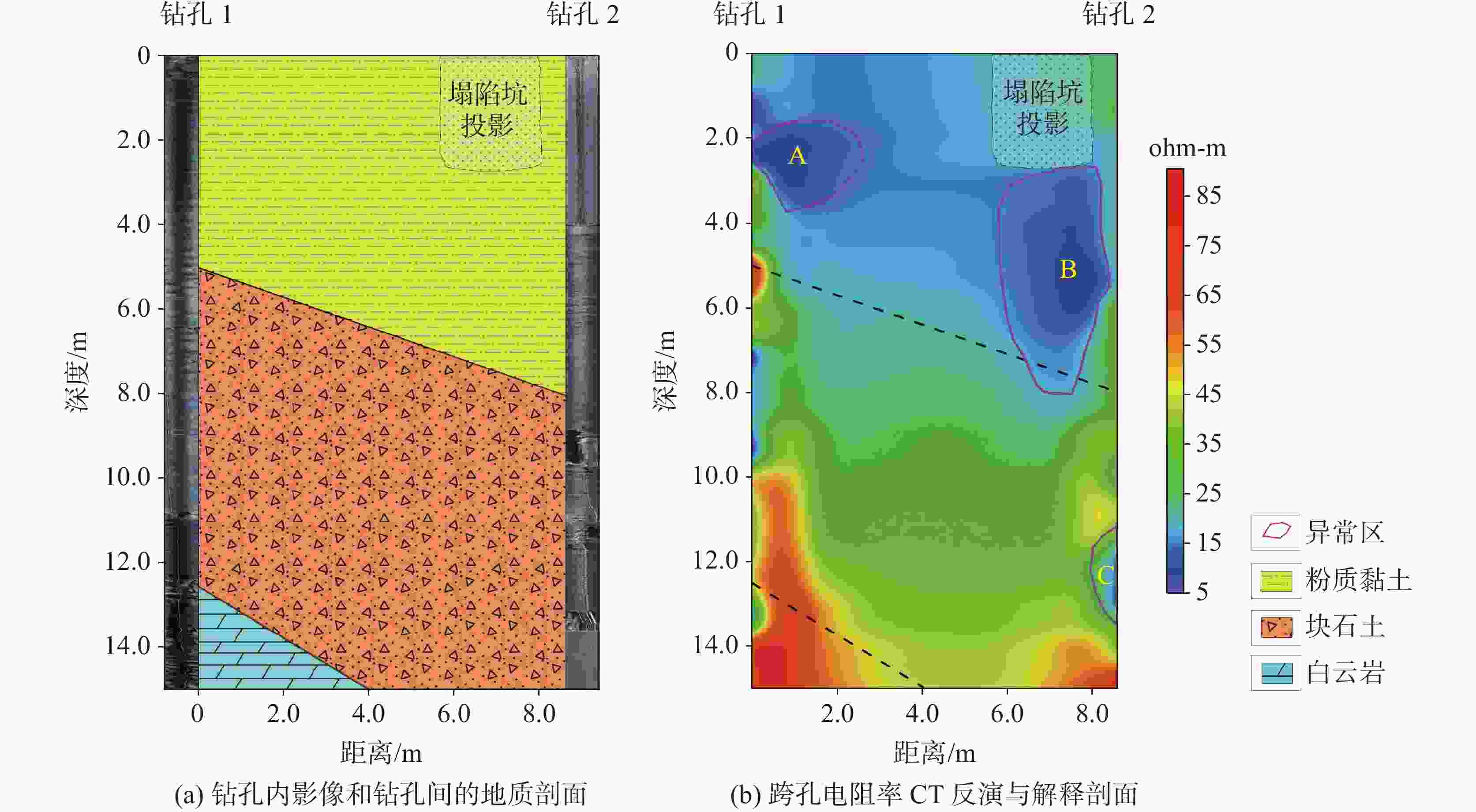
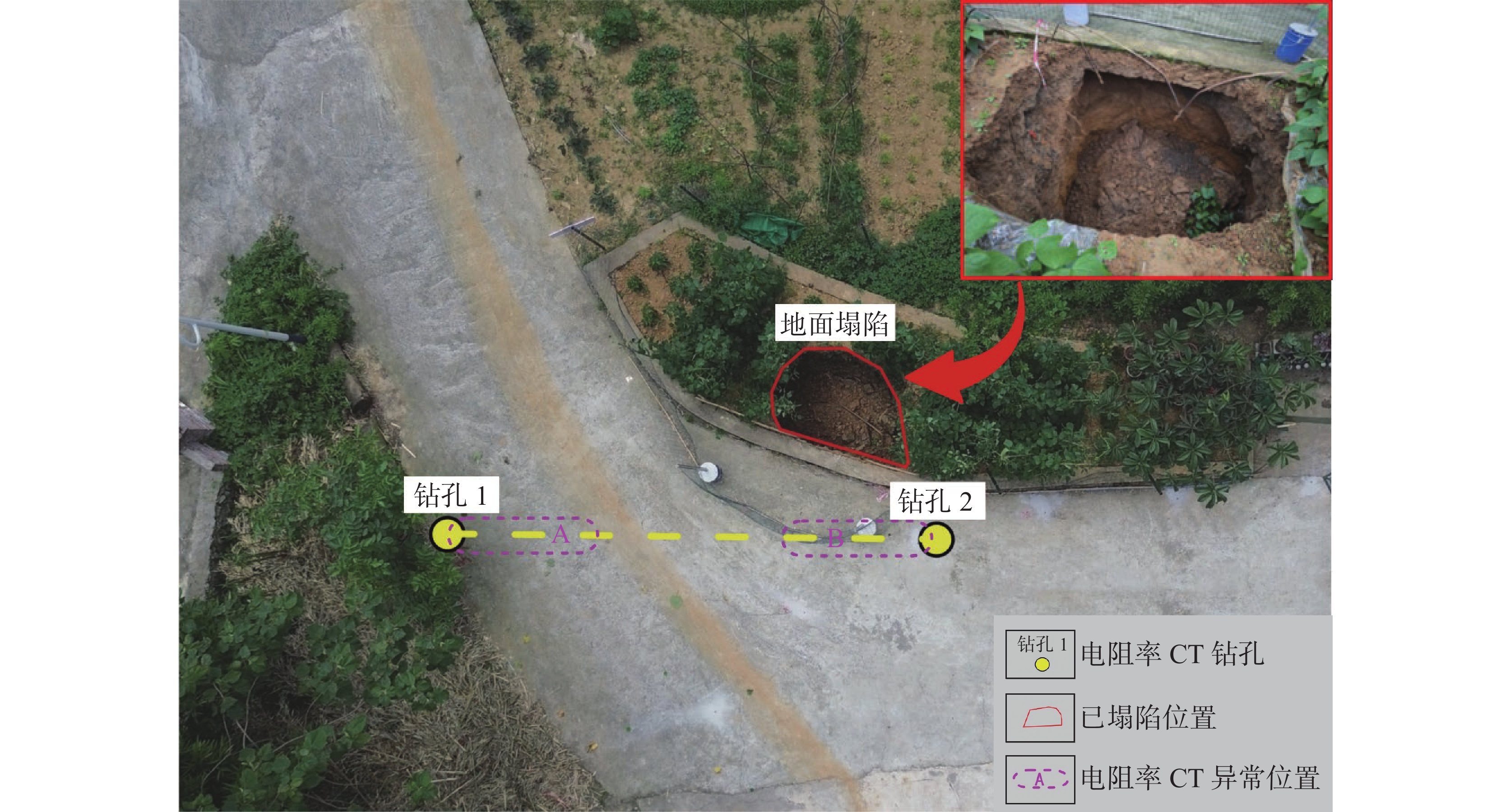
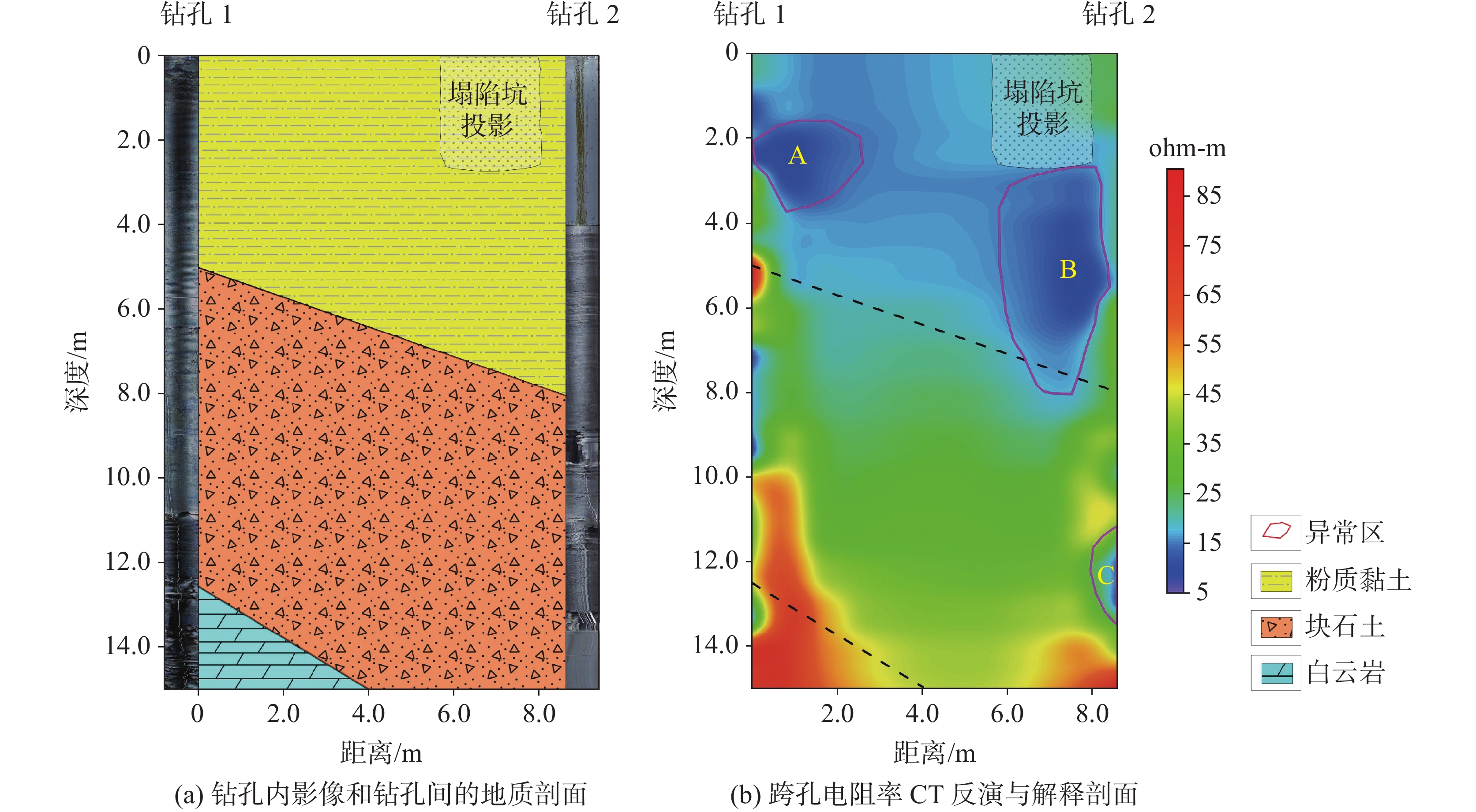
图 8 钻孔间地质剖面和电阻率CT剖面
Figure 8. Geological profile and profile of cross-borehole resistivity CT
表 1 模型参数
Table 1. Parameters of the models
名称 土洞尺寸/m×m 土洞中心位置/m 土洞顶板埋深/m 岩溶尺寸/m×m 岩溶中心位置/m 模型a / / / 2.0×6.0 (10,11) 模型b 4.0×2.5 (10,6.75) 5.5 模型c 4.0×5.5 (10,5.25) 2.5  下载: 导出CSV
表 2 数值模拟基本参数
Table 2. Basic parameters of numerical simulation
模型尺寸/m×m 电极距/m 网格大小/m 测量最大重复误差/% 最大互换测量误差/% 反演最大均方误差/% 迭代次数/次 圆滑系数 10×20 1.0 0.5 3 5 3 30 100
下载: 导出CSV
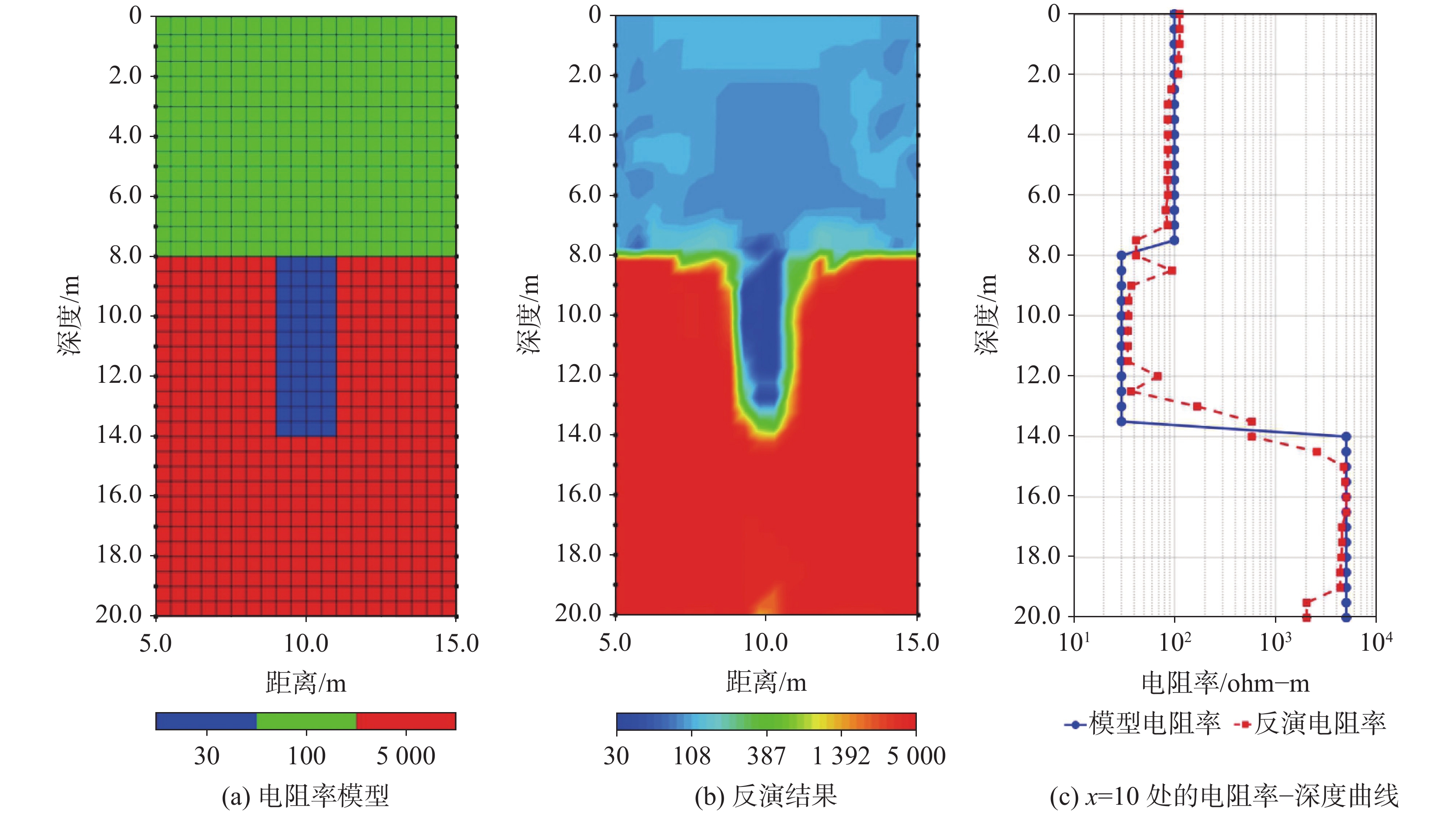
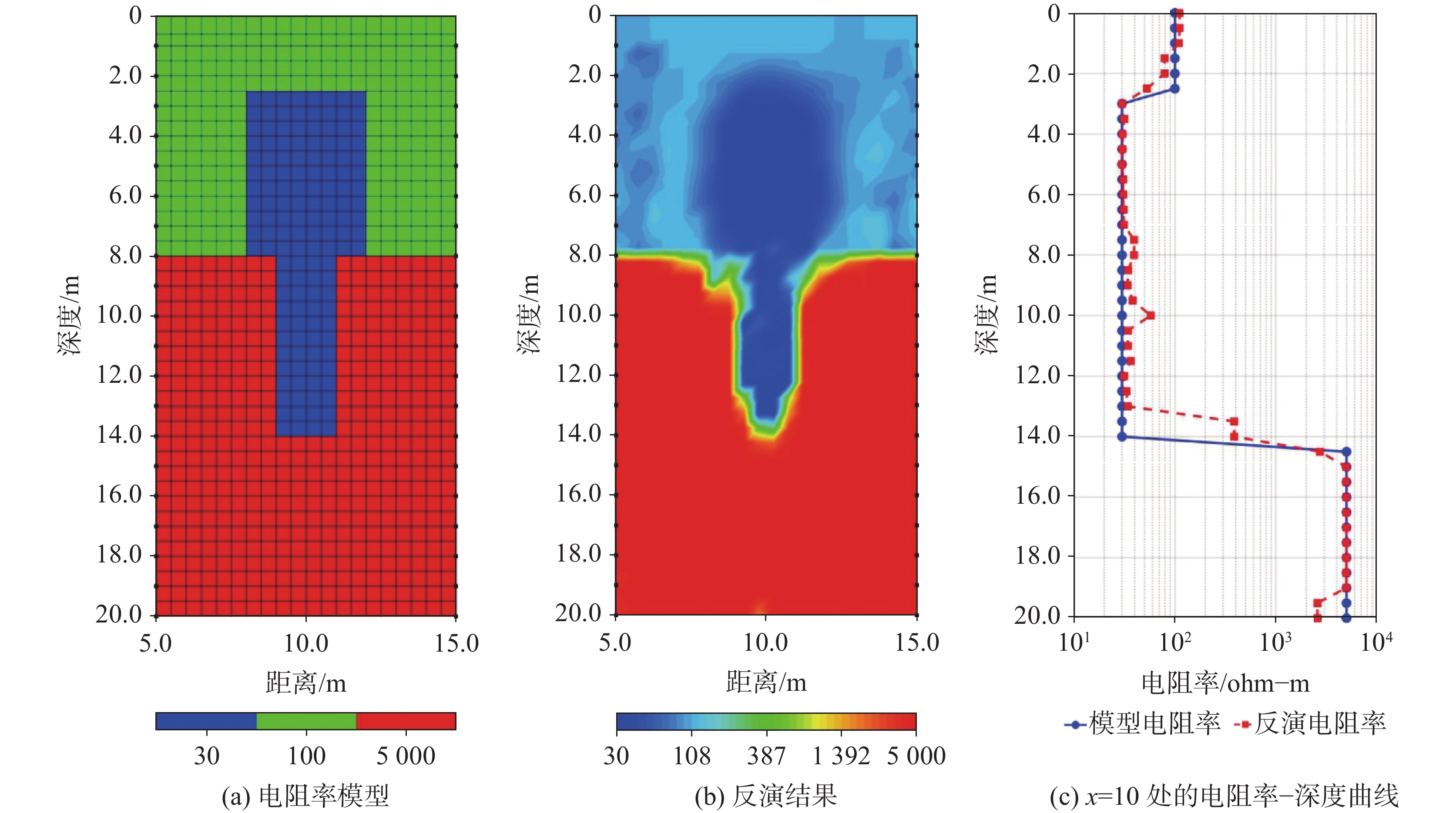
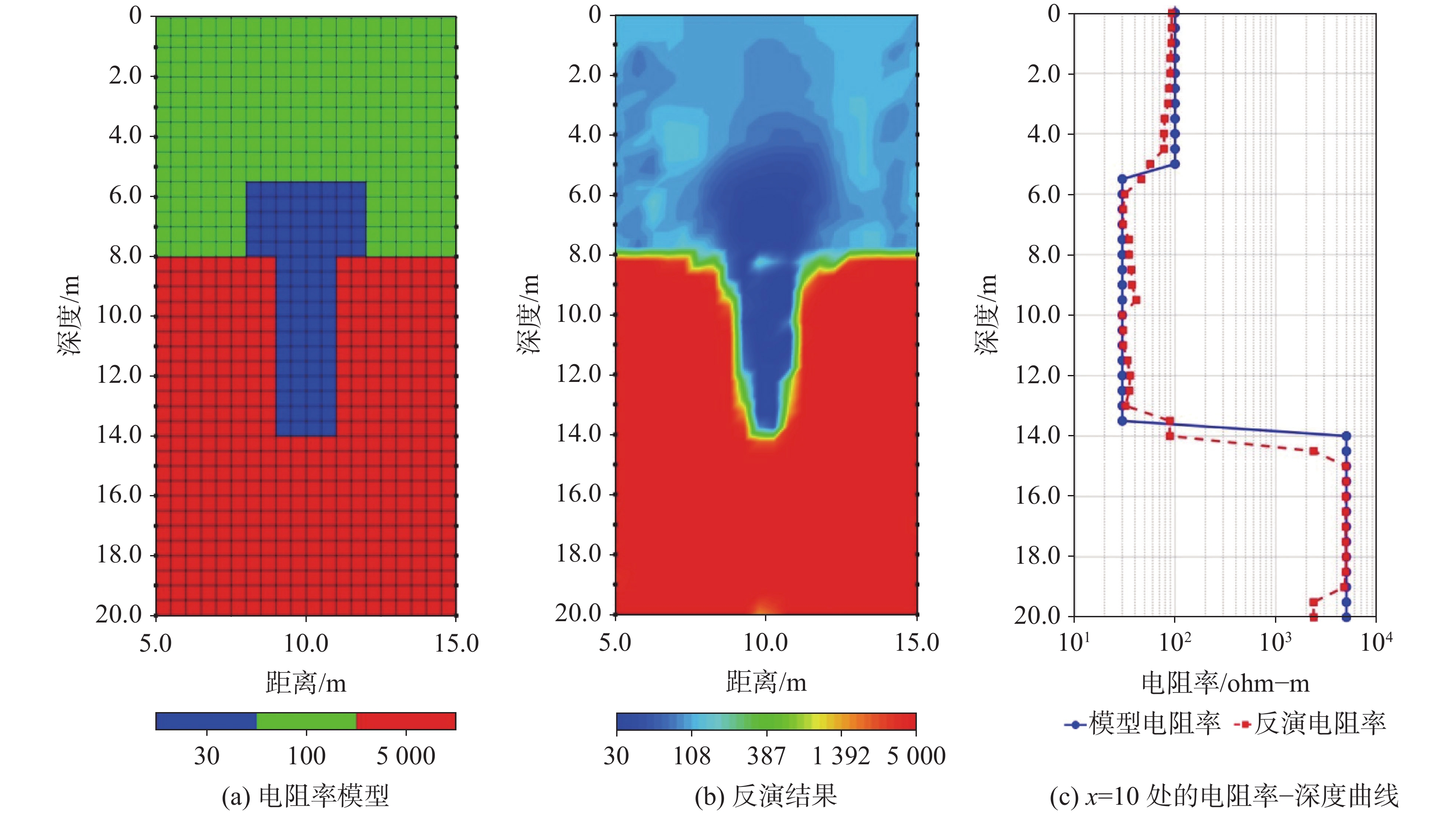
表 3 原始电阻率和反演电阻率数值对比表( Ω·m)
Table 3. Comparison of original and inverse resistivity values ( Ω·m)
正演/反演 岩溶塌陷阶段 模型 完整土体 土洞(土体松散区)、岩溶管道 灰岩 正演 / / 100 30 5000 反演 未形成土洞阶段 模型a 85.26~113.57(平均值:101.48) 30.28~69.25(平均值:41.99) 4799.82 ~5000 (平均值:4725.05 )初步形成土洞阶段 模型b 79.16~118.71(平均值:98.22) 30.45~72.84(平均值:44.84) 4712.90 ~5000 (平均值:4794.06 )土洞进一步扩大阶段 模型c 76.2~114.77(平均值:98.69) 30.05~56.08(平均值:38.56) 4636.55 ~5000 (平均值:4770.61 )
下载: 导出CSV
-
[1] 范长丽, 贾慧涛, 蔡向阳. 微动在城区岩溶勘探中的效果研究[J]. 工程地球物理学报, 2020, 17(5): 652-657.Fan Changli, Jia Huitao, Cai Xiangyang. Study on the effect of microtremor exploration in karst exploration in urban area[J]. Chinese Journal of Engineering Geophysics, 2020, 17(5): 652-657. [2] 李卫卫, 熊鑫, 蒙爱军. 跨孔地震CT探测基岩面附近岩溶研究[J]. 工程地球物理学报, 2022, 19(1): 6-15.Li Weiwei, Xiong Xin, Meng Aijun. Study on karst near bedrock surface by cross-hole seismic CT detection[J]. Chinese Journal of Engineering Geophysics, 2022, 19(1): 6-15. [3] 赵群, 曲寿利, 薛诗桂, 张明. 碳酸盐岩溶洞物理模型地震响应特征研究[J]. 石油物探, 2010, 49(4): 351-358.Zhao Qun, Qu Shouli, Xue Shigui, Zhang Ming. Study on seismic response characteristics of physical models of karst cavities in carbonate rocks[J]. Petroleum Geophysical Prospecting, 2010, 49(4): 351-358. [4] 李世聪, 刘亚军, 彭荣华, 郭鹏, 安进新, 黄磊. 瞬变电磁法对隐伏岩溶探测的影响因素研究[J]. 地球物理学进展, 2022, 37(1): 397-412.Li Shicong, Liu Yajun, Peng Ronghua, Guo Peng, An Jinxin, Huang Lei. Research on the influencing factors of transient electromagnetic method on the detection of hidden karst[J]. Progress in Geophysics, 2022, 37(1): 397-412. [5] 李俊杰, 朱红雷, 赵国军, 夏志强, 郭佳豪. 地质雷达电磁干扰分析及在隧洞岩溶探测中的应用[J]. 中国岩溶, 2018, 37(2): 286-293.Li Junjie, Zhu Honglei, Zhao Guojun, Xia Zhiqiang, Guo Jiahao. Electromagnetic interference analysis of ground penetrating radar and its Application in karst detection in tunnels[J]. Carsologica Sinica, 2018, 37(2): 286-293. [6] 王洁. 三维高密度电法在城市地下岩溶塌陷区探测中的应用[J]. 工程地球物理学报, 2021, 18(1): 107-112.Wang Jie. Application of three-dimensional high-density electrical method in urban underground karst collapse area detection[J]. Chinese Journal of Engineering Geophysics, 2021, 18(1): 107-112. [7] 张银松, 曹聪, 康世海, 刘家富. 重庆市中梁山地区隐伏塌陷特征及物探勘测的思路[J]. 中国岩溶, 2020, 39(6): 918-927.Zhang Yinsong, Cao Cong, Kang Shihai, Liu Jiafu. Characteristics of hidden karst collapse in the Zhongliangshan area of Chongqing and an approach of geophysical surveys[J]. Carsologica Sinica, 2020, 39(6): 918-927. [8] 何军, 刘磊, 黎清华, 刘道涵, 陈标典, 张傲, 赵永波. 隐伏岩溶区地下空间探测技术方法研究: 以武汉市为例[J]. 水文地质工程地质, 2020, 47(6): 47-56.He Jun, Liu Lei, Li Qinghua, Liu Daohan, Chen Biaodian, Zhang Ao, Zhao Yongbo. Techniques for detecting underground space in hidden karst regions: Taking Wuhan as an example[J]. Hydrogeology & Engineering Geology, 2020, 47(6): 47-56. [9] 王喜迁, 孙明国, 张皓, 江玉乐. 高密度电法在岩溶探测中的应用[J]. 煤田地质与勘探, 2011, 39(5): 72-75.Wang Xiqian, Sun Mingguo, Zhang Hao, Jiang Yule. Application of High-Density electrical technique in karst detection[J]. Coal Geology & Exploration, 2011, 39(5): 72-75. [10] Coscia I, Linde N, Greenhalgh S, Vogt T, Green A. Estimating traveltimes and groundwater flow patterns using 3D time-lapse crosshole ERT imaging of electrical resistivity fluctuations induced by infiltrating river water[J]. Geophysics, 2012, 77 (4): E239−E250. [11] Cho A H, Song S Y, Kim B, Son J S, Nam M J. Analysis of response characteristics in borehole electrical resistivity surveys and their applications[J]. Journal of the Korean Society of Mineral and Energy Resources Engineers, 2023, 60 (5): 377-394. [12] Phillips M, Buchli C, Weber S, Boaga J, Pavoni M, Bast A. Brief communication: Combining borehole temperature, borehole piezometer and cross-borehole electrical resistivity tomography measurements to investigate seasonal changes in ice-rich mountain permafrost[J]. The Cryosphere, 2023, 17: 753-760. [13] Liu R, Sun H, Wang Z, Fan Q, Liu S, Lin J, Yang Y. Investigation of subsurface karst in an opencast mine in southwestern China via surface and cross-borehole electrical resistivity tomography[J]. Exploration Geophysics, 2023, 54(6):685-695. [14] Deceuster J, Delgranche J, Kaufmann O. 2D cross-borehole resistivity tomographies below foundations as a tool to design proper remedial actions in covered karst[J]. Journal of Applied Geophysics, 2006, 60(1): 68-86. [15] 胡富彭, 欧元超, 付茂如. 不同充填介质下的溶洞跨孔电阻率CT探查数值模拟[J]. 中国岩溶, 2019, 38(5): 766-773.Hu Fupeng, Ou Yuanchao, Fu Maoru. Study on numerical simulation of karst cross-hole resistivity CT exploration with different filling media[J]. Carsologica Sinica, 2019, 38(5): 766-773. [16] 苏宝, 刘晓丽, 卫晓波, 高歌, 王云鹏. 井间超高密度电阻率法溶洞探测研究[J]. 物探与化探, 2021, 45(5): 1354-1358.Su Bao, Liu Xiaoli, Wei Xiaobo, Gao Ge, Wang Yunpeng. Karst cave prospecting using cross-hole ultra-high density resistivity method[J]. Geophysical and Geochemical Exploration, 2021, 45(5): 1354-1358. [17] 张文俊, 李术才, 苏茂鑫, 薛翊国, 邱道宏. 基于井间电阻率成像的城市地铁溶洞探测方法[J]. 山东大学学报(工学版), 2014, 44(3): 75-82.Zhang Wenjun, Li Shucai, Su Maoxin, Xue Yiguo, Qiu Daohong. Detection method of karst caves in city subway based on the cross-hole resistivity tomography[J]. Journal of Shandong University (Engineering Science), 2014, 44(3): 75-82. [18] 张巍, 周瑜琨, 刘立岩, 陈俊良. 跨孔电阻率法在城市输水管道渗漏监测中的应用[J]. 物探与化探, 2024, 48(3): 884-890.Zhang Wei, Zhou Yukun, Liu Liyan, Chen Junliang. Application of the cross-borehole resistivity method in the monitoring of leakage for urban water supply pipelines[J]. Geophysical and Geochemical Exploration, 2024, 48(3): 884-890. [19] 马新民, 毛德强, 闫利刚, 刘登峰, 李书鹏, 张家铭, Alex Furman, 王京. 基于跨孔电阻率CT的污染阻隔帷幕性能检测[J]. 环境工程, 2023, 41(8): 188-195, 201.Ma Xinmin, Mao Deqiang, Yan Ligang, Liu Dengfeng, Li Shupeng, Zhang Jiaming, Alex Furman, Wang Jing. Performance assessment of contamination barrier curtain based on cross-borehole electrical resistivity tomography (CT)[J]. Environmental Engineering, 2023, 41(8): 188-195, 201. [20] 李前银. 再论岩溶塌陷的形成机制[J]. 中国地质灾害与防治学报, 2009, 20(3): 52-55.Li Qianyin. Further study on the formation mechanism of karst collapse[J]. The Chinese Journal of Geological Hazard and Control, 2009, 20(3): 52-55. [21] 王滨, 贺可强, 高宗军. 岩溶塌陷发育的时空阶段性分析[J]. 水文地质工程地质, 2001, 28(5): 24-27.Wang Bin, He Keqiang, Gao Zongjun. Spatiotemporal phased analysis of karst collapse development[J]. Hydrogeology & Engineering Geology, 2001, 28(5): 24-27. [22] 张丽芬, 曾夏生, 姚运生, 廖武林. 我国岩溶塌陷研究综述[J]. 中国地质灾害与防治学报, 2007,18(3): 126-130.Zhang Lifen, Zeng Xiasheng, Yao Yunsheng, Liao Wulin. Review on karst collapse in China[J]. The Chinese Journal of Geological Hazard and Control, 2007,18(3): 126-130. [23] 谭开鸥, 李玉生. 重庆地区的岩溶塌陷及其形成机理[J]. 中国地质灾害与防治学报, 1995, 6(3): 23-27.Tan Kaiou, Li Yusheng. Karst collapse and its formation mechanism in Chongqing region[J]. The Chinese Journal of Geological Hazard and Control, 1995, 6(3): 23-27. [24] 张海坦, 李庆华, 邓书金. 歌乐山岩溶地面塌陷发育特征[J]. 中国岩溶, 2015, 34(1): 58-63.Zhang Haitan, Li Qinghua, Deng Shujin. Development characteristics of karst collapse in the Gele mountain area[J]. Carsologica Sinica, 2015, 34(1): 58-63. [25] 吴远斌, 殷仁朝, 雷明堂, 戴建玲, 贾龙, 潘宗源, 马骁, 周富彪. 重庆中梁山地区隧道工程影响下岩溶塌陷形成演化模式及防治对策[J]. 中国岩溶, 2021, 40(2): 246-252.Wu Yuanbin, Yin Renchao, Lei Mingtang, Dai Jianling, Jia Long, Pan Zongyuan, Ma Xiao, Zhou Fubiao. Triggering factors and prevention-control countermeasures of karst collapses caused by tunnel construction in the Zhongliangshan area, Chongqing[J]. Carsologica Sinica, 2021, 40(2): 246-252. [26] 刘征宇. 电阻率跨孔CT探测方法及其工程应用[D]. 济南: 山东大学, 2014.Liu Zhengyu. Research on the resistivity cross-hole CT methods and its application in the engineering field[D]. Jinan: Shandong University, 2014. [27] 李金铭. 地电场与电法勘探[M]. 北京: 地质出版社, 2005.Li Jinming. Geoelectric field and electrical prospecting[M]. Beijing: Geology Press, 2005. [28] 郑智杰, 陈贻祥, 甘伏平. 岩溶区岩土层地球物理性质浅析: 以吉利岩溶塌陷区为例[J]. 地球物理学进展, 2016, 31(2): 920-927.Zheng Zhijie, Chen Yixiang, Gan Fuping. Brief analysis of the geophysical properties of rock and soil in karst area: Taking Jili karst collapse area as an example[J]. Progress in Geophysics, 2016, 31(2): 920-927. -

 点击查看大图
计量
- 文章访问数: 1494
- HTML浏览量: 90
- PDF下载量: 345
- 被引次数: 0
