


Study on the impact and threshold effect of rural population decline on plant diversity in Southwest China
-
摘要: 大规模农村人口减少重构了生态环境,为生态系统恢复提供契机。植物多样性变化对农村人口减少的响应及其关键临界阈值尚不明晰。为此,基于维管植物物种丰富度数据,采用随机森林模型(Random Forest,RF)、相对贡献及阈值识别等方法,探究了西南地区植物多样性变化对农村人口减少的响应及其阈值,定量评估气候变化和人类压力对植物多样性的贡献。结果表明:2000—2020年,西南农村人口减少约1.37亿,人类压力下降5.23%,植物多样性增加44.32%。超过60%的农村人口减少地区植物多样性显著增加,植物多样性平均增加约0.73种·(100 km)−2,增加面积为26.66万km2。大幅度的农村人口减少有助于植物多样性增加,但存在明显的阈值效应。农村人口密度与植物多样性呈非线性关系:初期显著抑制,在336.68~956.73人·km−2区间抑制作用减弱,当密度超过956.73人·km−2时,呈现正向促进作用。农村人类压力对植物多样性变化的贡献率为38.64%,气候变化的贡献率为61.36%。该研究可为促进农村地区生物多样性保护和可持续发展提供参考。Abstract:
Although the global population continues to grow, the coming decades will witness the most rapid expansion of urban population in human history, primarily, driven by large-scale rural-to-urban migration. This migration alleviates human pressure significantly in rural areas, promotes the transformation of land use patterns and ecosystem restoration, and profoundly reshapes regional land spatial configurations. These changes directly or indirectly affect local ecological environments, thereby presenting both new opportunities and challenges for biodiversity. The southwestern region of China serves as a critical ecological security barrier for the country. It is not only a key area for global vegetation greening and plant diversity conservation, but also a typical region experiencing marked rural-urban migration and a pronounced decline in rural population. The ongoing and accelerating outflow of rural population in this region is profoundly reshaping local human-land relationships. Moreover, its distinctive karst landforms and ecological fragility make it highly sensitive to human disturbances. While large-scale rural population decline is reshaping the ecological environment, it also creates opportunities for ecosystem restoration. However, the response mechanisms of plant diversity to rural population decline and its threshold effects remain unclear, which hinders a deeper understanding of the coupling mechanisms in human-earth systems and constrains the scientific rigor and effectiveness of regional ecological conservation strategies. This study focuses on southwestern China as the research area. Based on vascular plant species richness data, the spatial pattern of plant diversity from 2000 to 2020 was reconstructed using a Random Forest model. The K-means algorithm was employed to identify urban-rural boundaries, revealing the spatiotemporal evolution characteristics of the rural population and examining the impact of rural population decline on plant diversity and its threshold effects. Using the human footprint index to characterize human pressure, the relationship between the release of human pressure induced by rural population decrease and the increase in biodiversity was analyzed. Through relative contribution rate decomposition, the driving contributions of climate change and human pressure were quantified. The study addresses the following key questions: (1) Spatiotemporal patterns of population decline in southwestern rural China; (2) Impacts of population decline on the spatial distribution of plant diversity and underlying mechanisms; (3) Threshold responses of plant diversity to changes in population density; (4) Relative contributions of climate change and human pressure to plant diversity changes. The results indicate that between 2000 and 2020, southwestern China experienced a rural population decrease of approximately 137 million, a 5.23% reduction in human pressure, and a significant 44.32% increase in plant diversity. Over 60% of the areas with rural population loss showed significant increases in plant diversity, with an average increase of approximately 0.73 species per 100 km2, across an area of 266,600 km2, Further analysis revealed a nonlinear relationship between rural population density and plant diversity: when population density fell below 336.68 persons·km−2, population decline exerted a suppressive effect on plant diversity; within the range of 336.68 to 956.73 persons·km−2, this suppressive effect gradually weakened; and when density exceeded 956.73 persons·km−2, population decline transitioned to a positive facilitative effect. Decomposition of driving factors showed that changes in rural human pressure contributed 38.64% to plant diversity changes, while climatic factors accounted for 61.36%, indicating that climate change remains the dominant factor influencing regional plant diversity. This study quantifies and reveals for the first time the nonlinear relationship and key thresholds between rural population decline and plant diversity in southwest China. It systematically elucidates the response mechanisms of plant diversity to population decline and human pressure, and clarifies the relative contributions of human activities and climate change. By analyzing the response patterns of plant diversity to rural population outmigration and identifying critical thresholds of population density effects, this research provides a scientific basis for understanding the mechanisms by which rural-urban migration influences biodiversity. The findings offer important insights for biodiversity conservation and regional sustainable development in southwest China. -
Key words:
- rural population decline /
- human pressure /
- plant diversity /
- threshold effect /
- southwest China
-
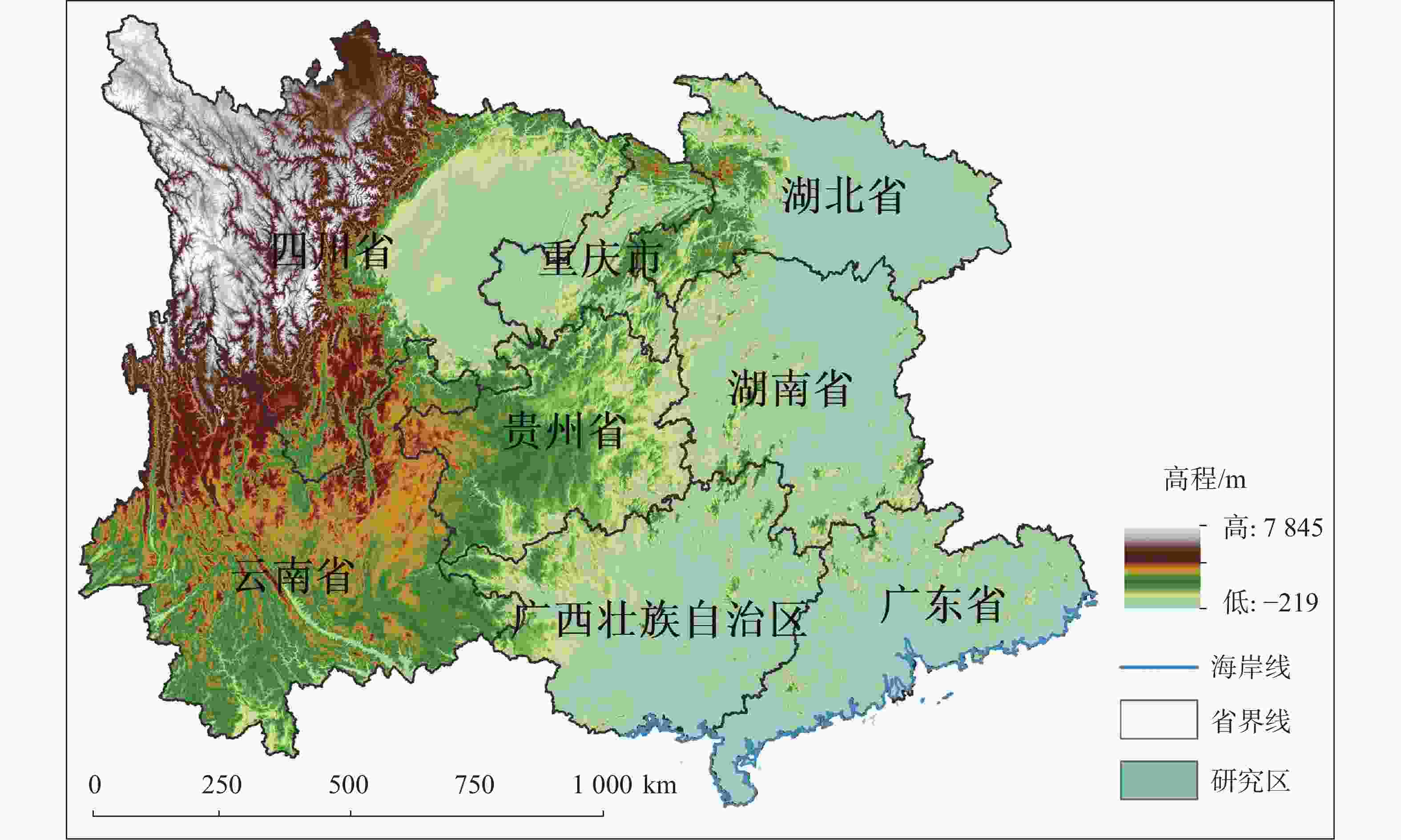
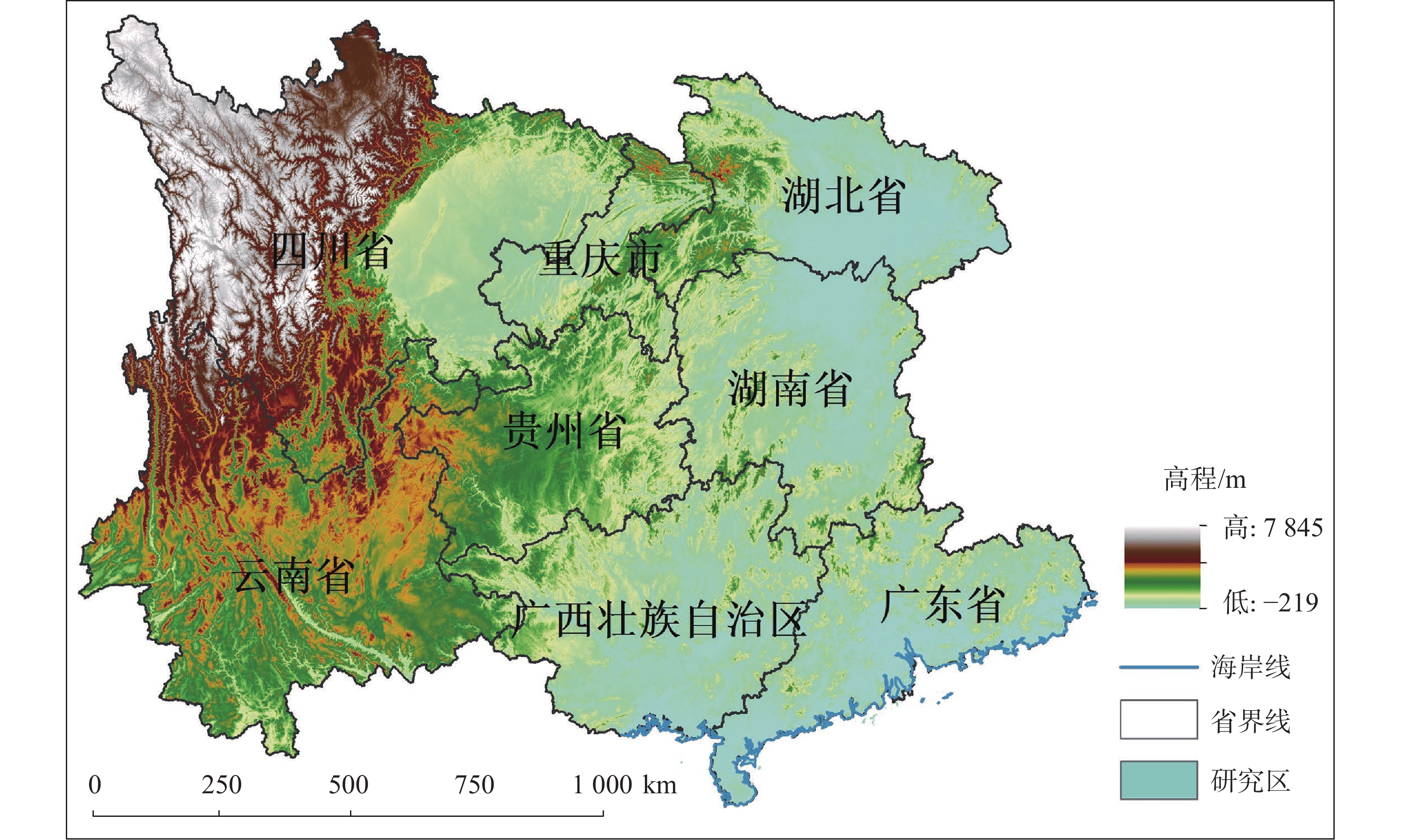
图 1 中国西南地区高程
注:基于自然资源部标准地图服务网站GS(2016)1549号的标准地图制作,地图边界无修改。
Figure 1. Elevation in southwest China
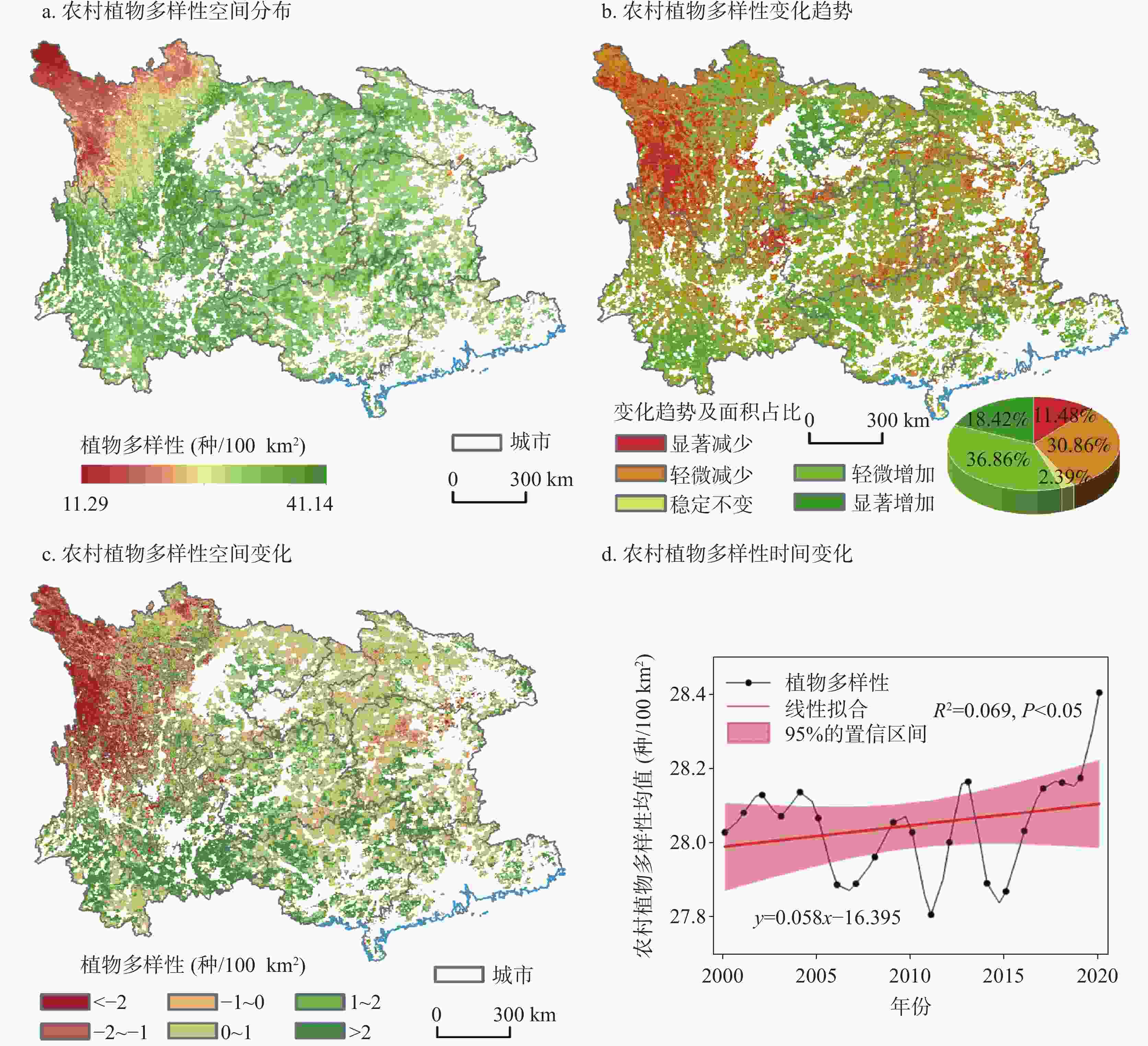
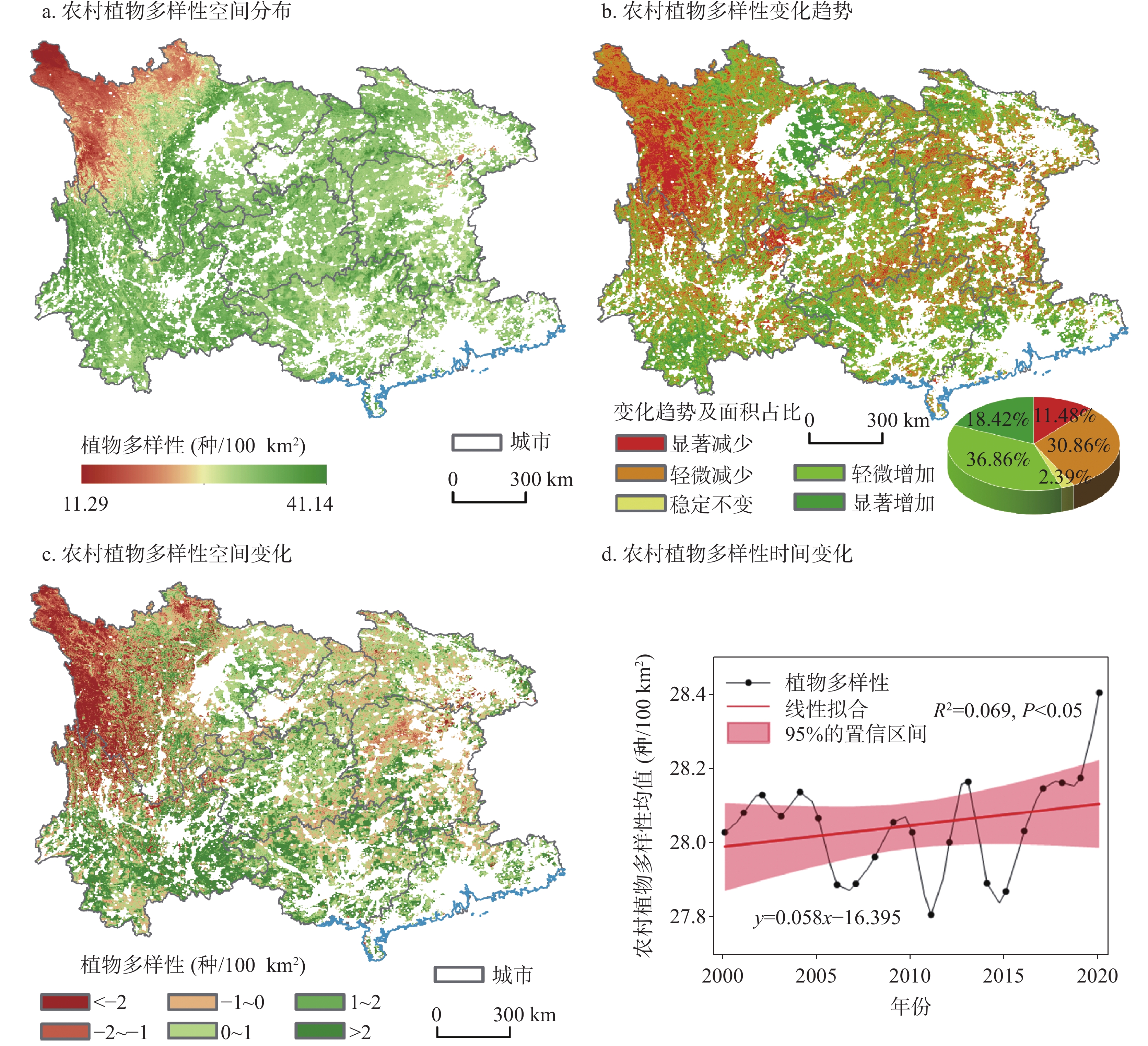
图 2 2000—2020年中国西南农村地区植物多样性的时空变化
Figure 2. Spatial and temporal changes of plant diversity in rural areas of southwest China from 2000 to 2020
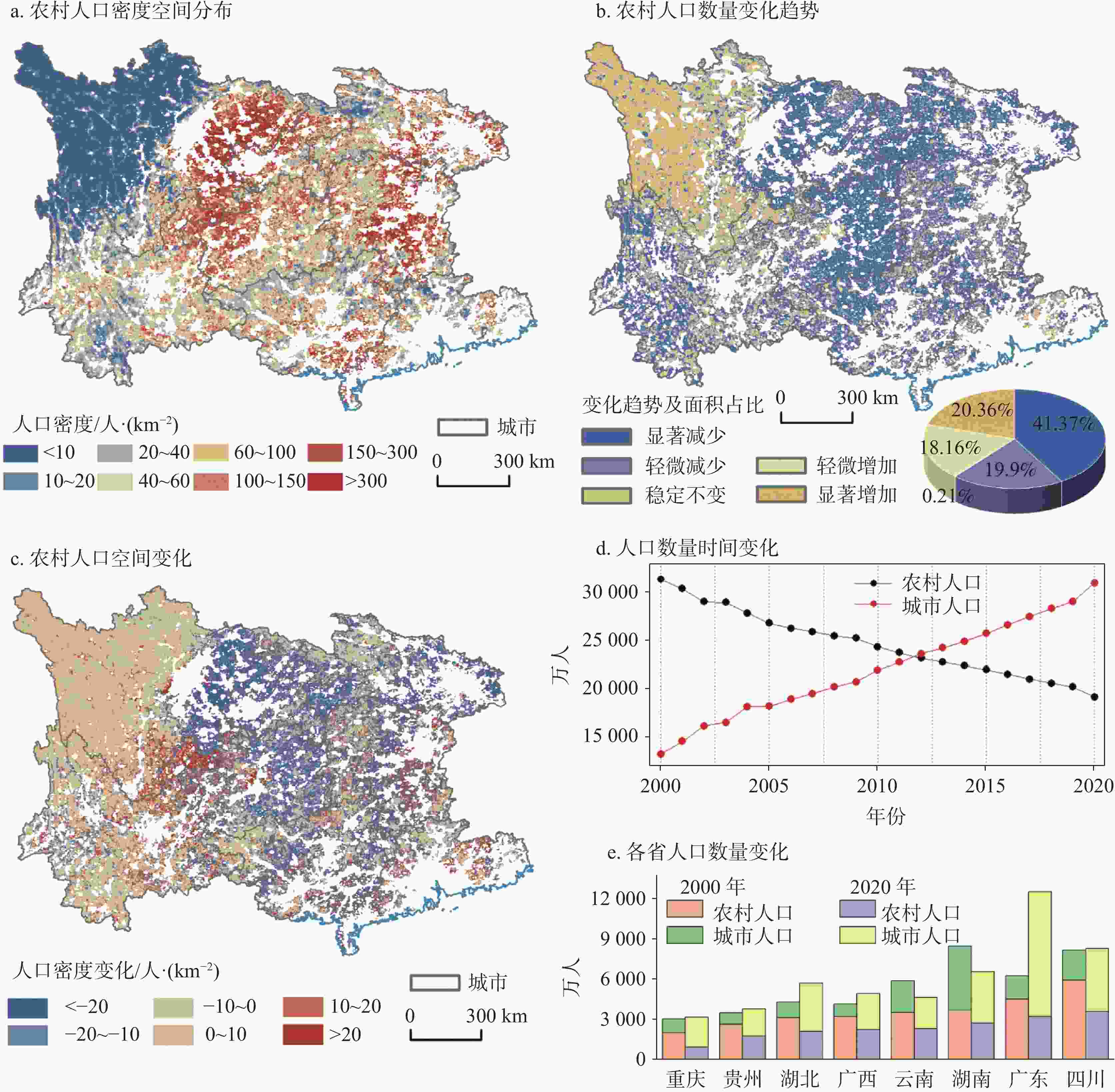
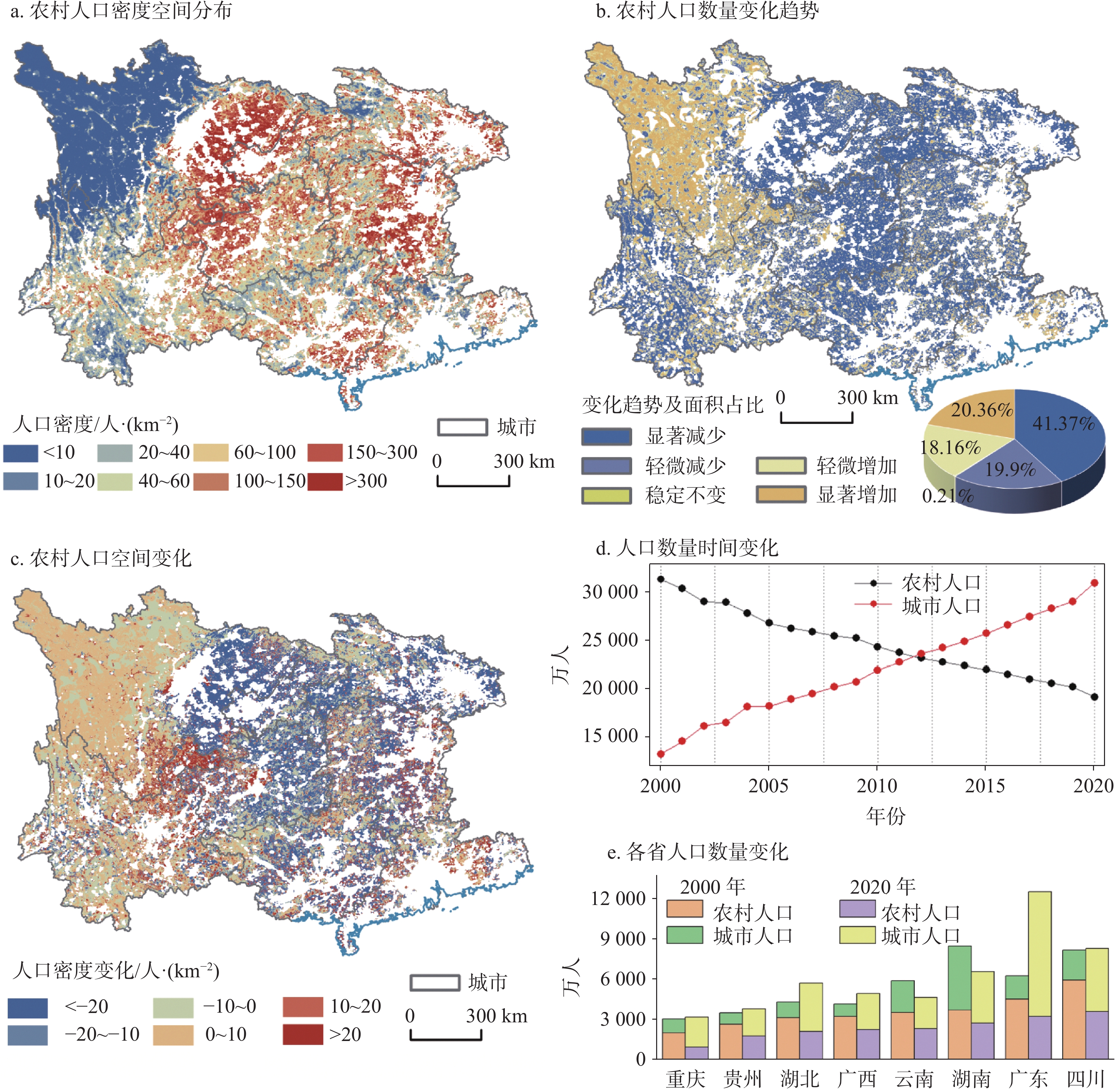
图 4 2000—2020年西南农村人口的时空变化
Figure 4. Spatial and temporal changes of rural population in southwest China from 2000 to 2020
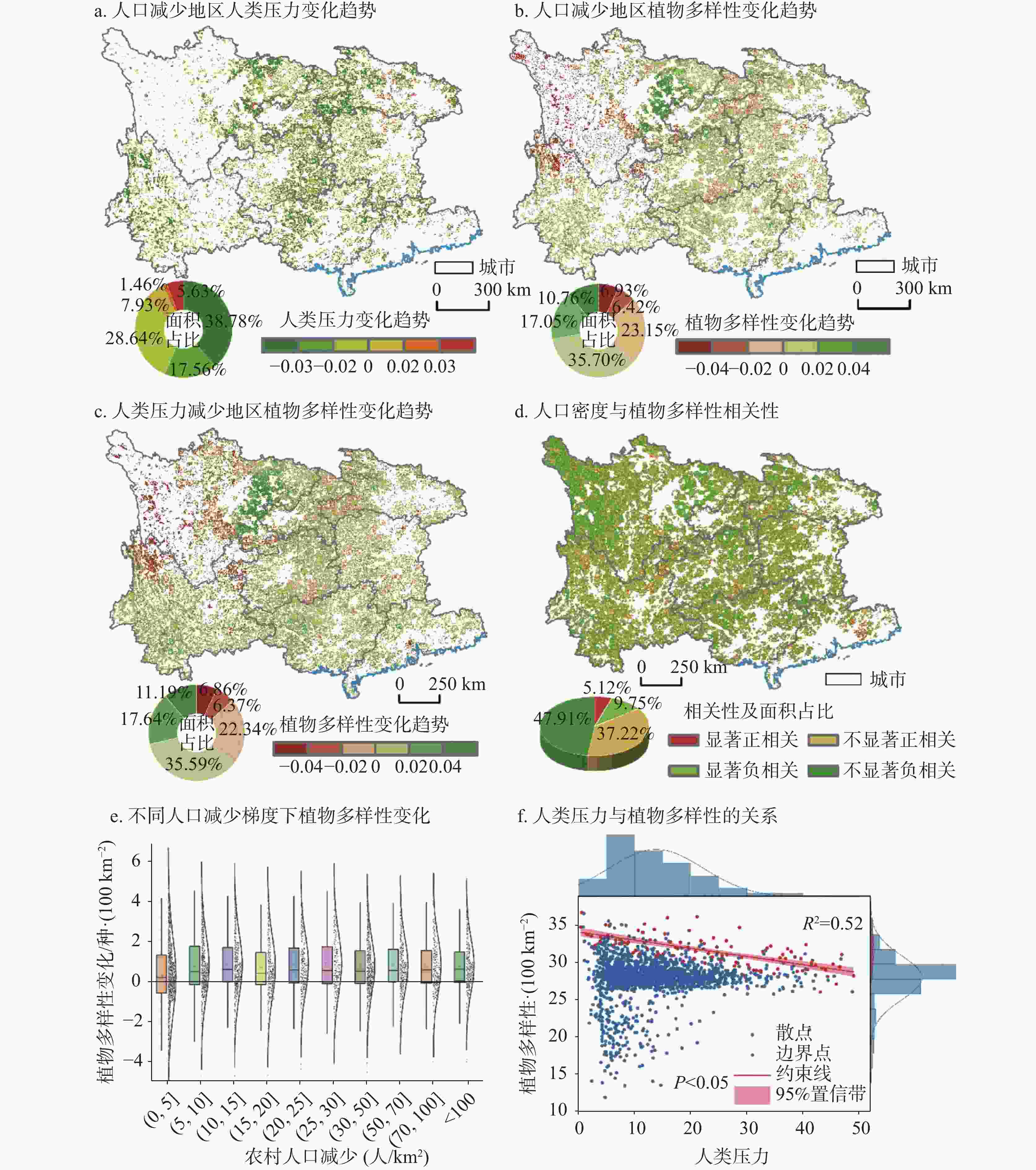
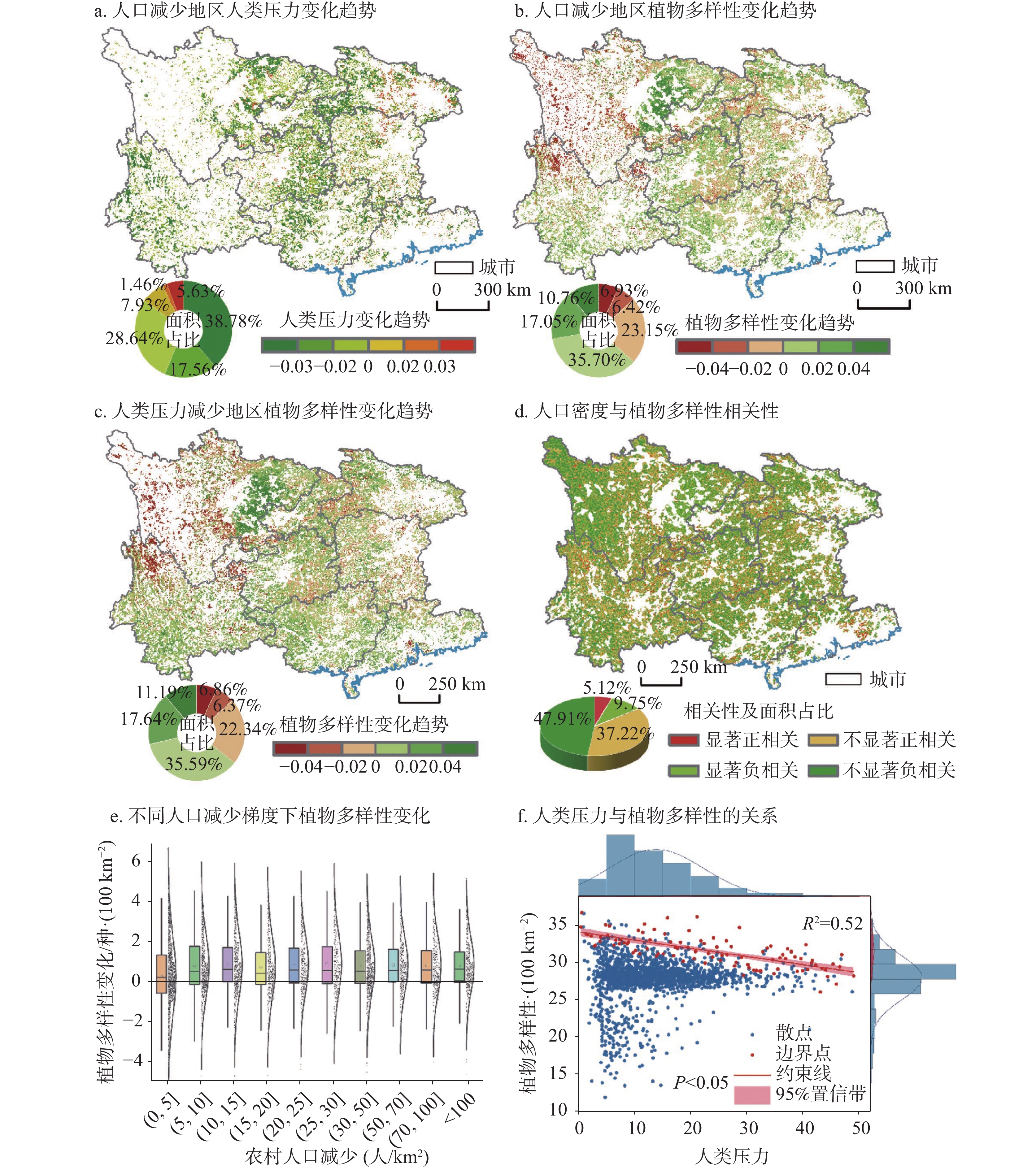
图 5 植物多样性对农村人口减少的响应
Figure 5. Responses of plant diversity to rural population decline
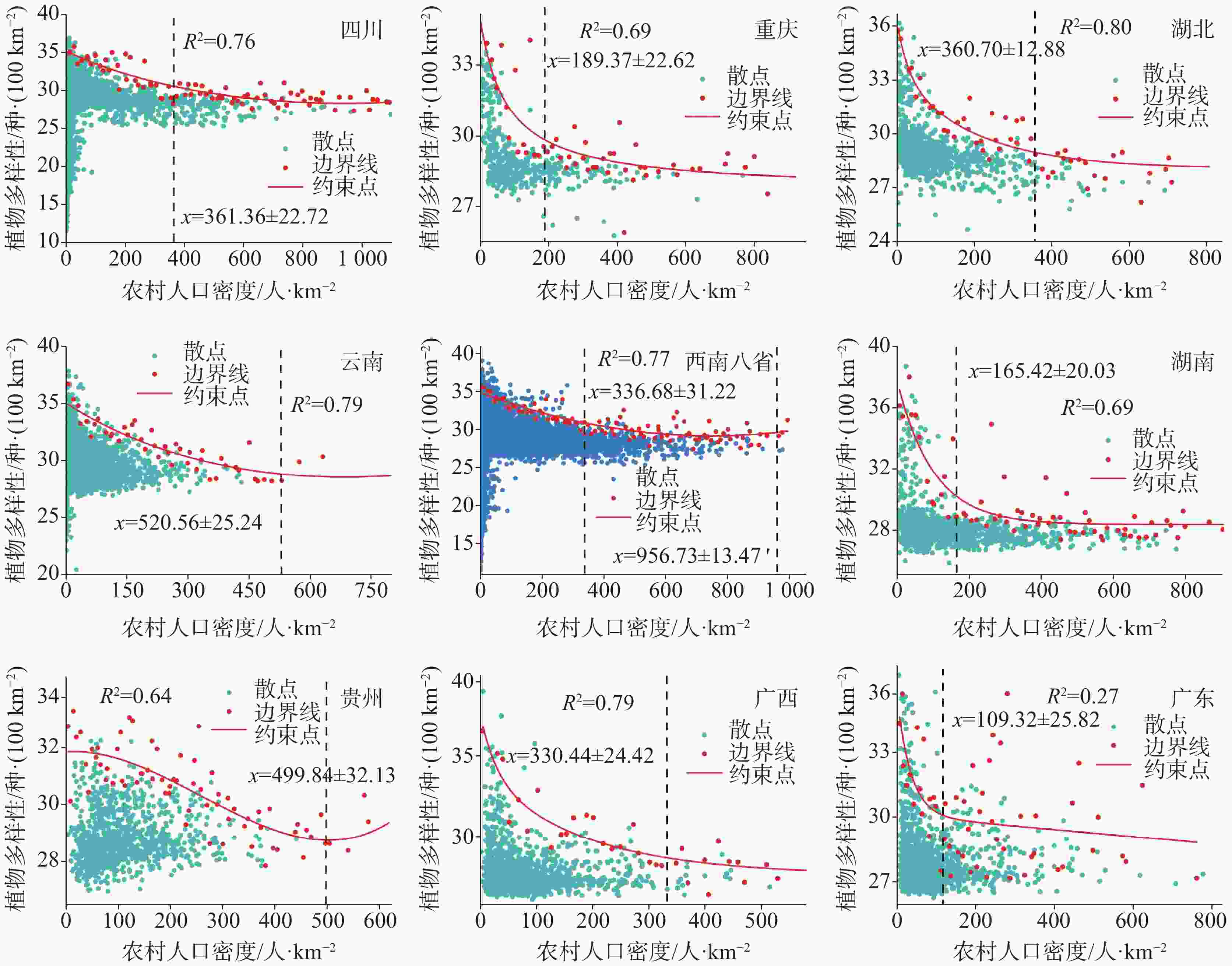
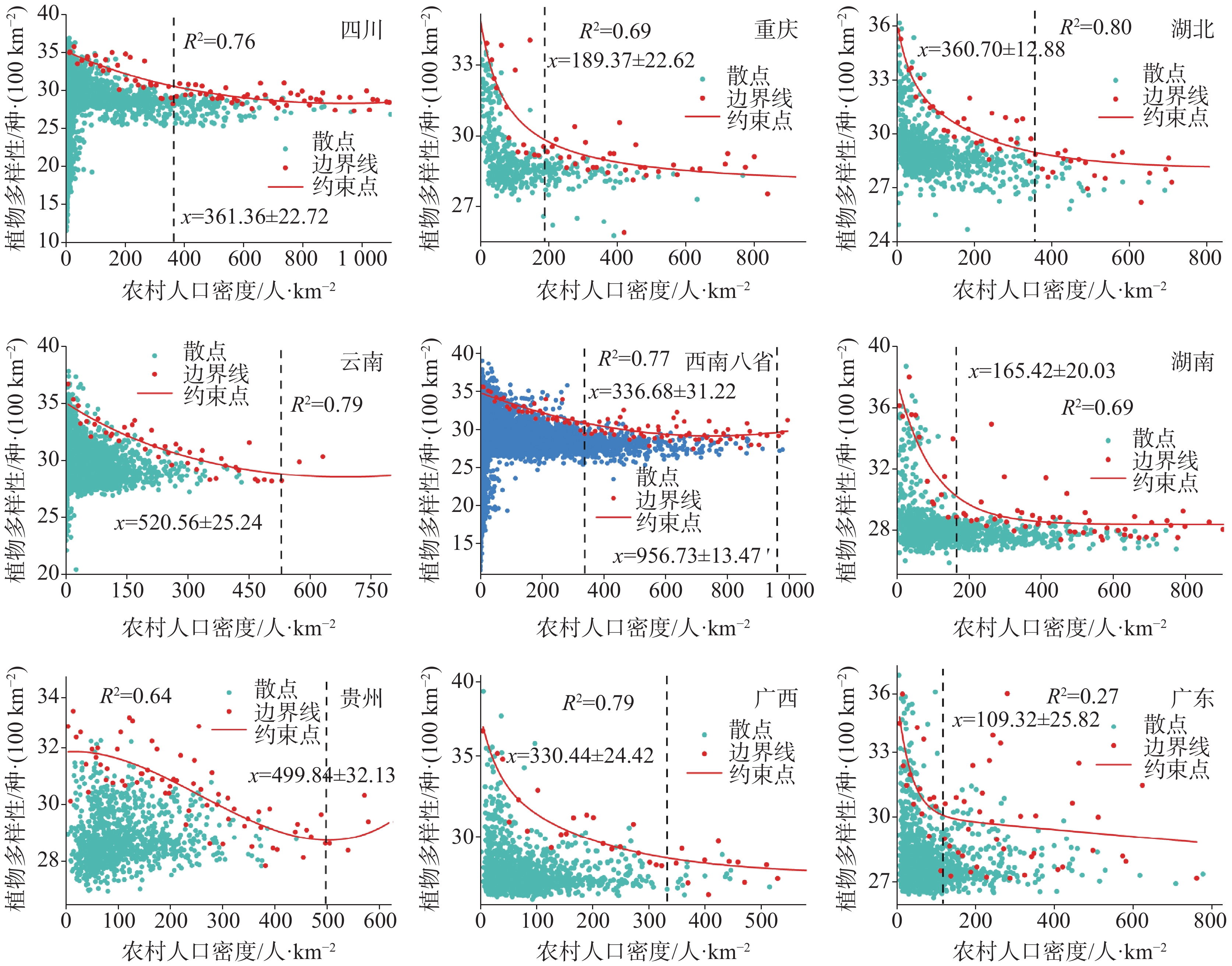
图 6 西南地区农村人口变化与植物多样性的约束关系
Figure 6. Constrained relationship between rural population change and plant diversity in southwest China
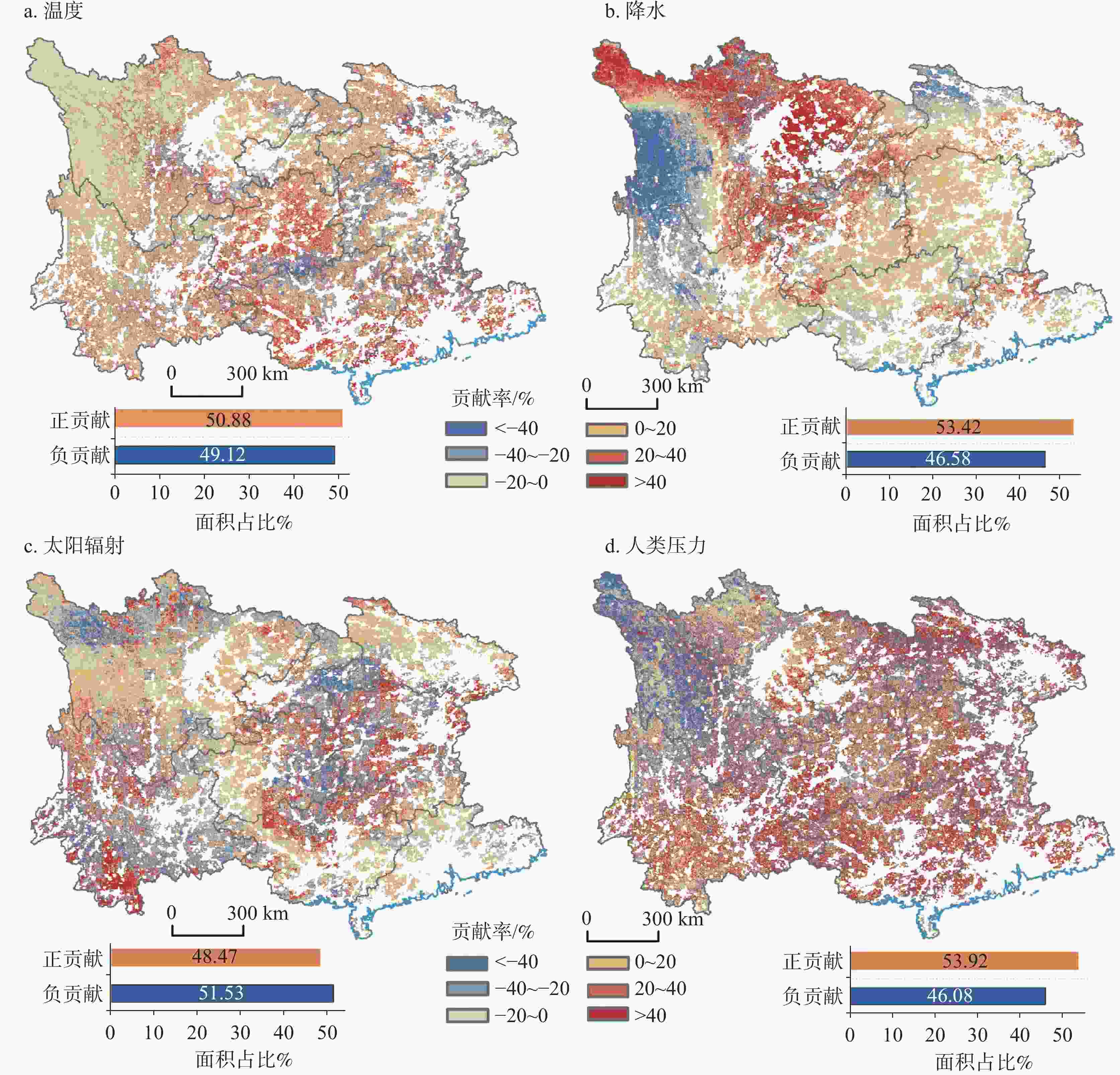
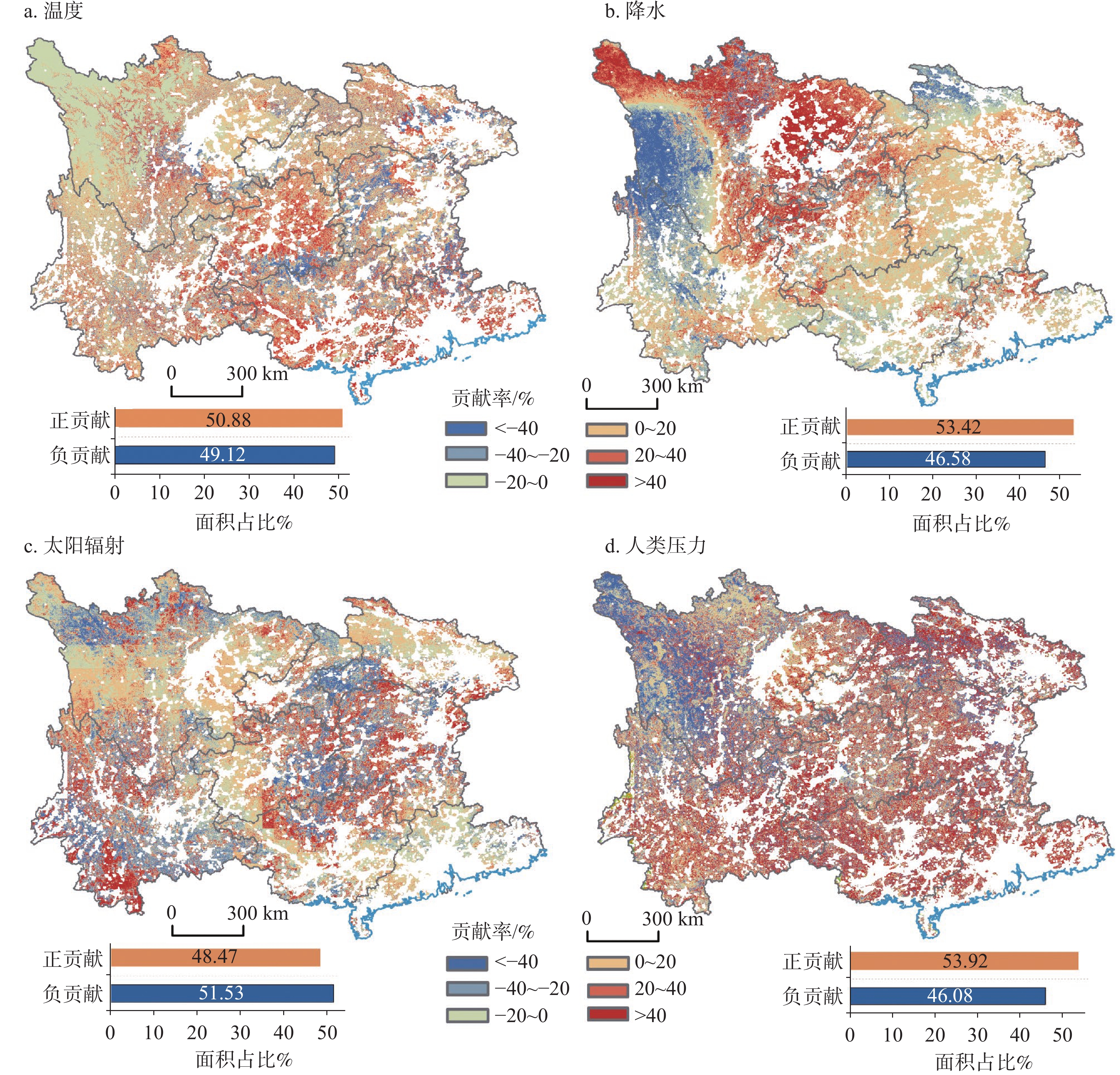
图 7 2000—2020年西南农村地区人类压力及气候变化对植物多样性贡献率的空间分布
Figure 7. Spatial distribution of the contribution rates of human pressure and climate change to plant diversity in rural areas of southwest China from 2000 to 2020
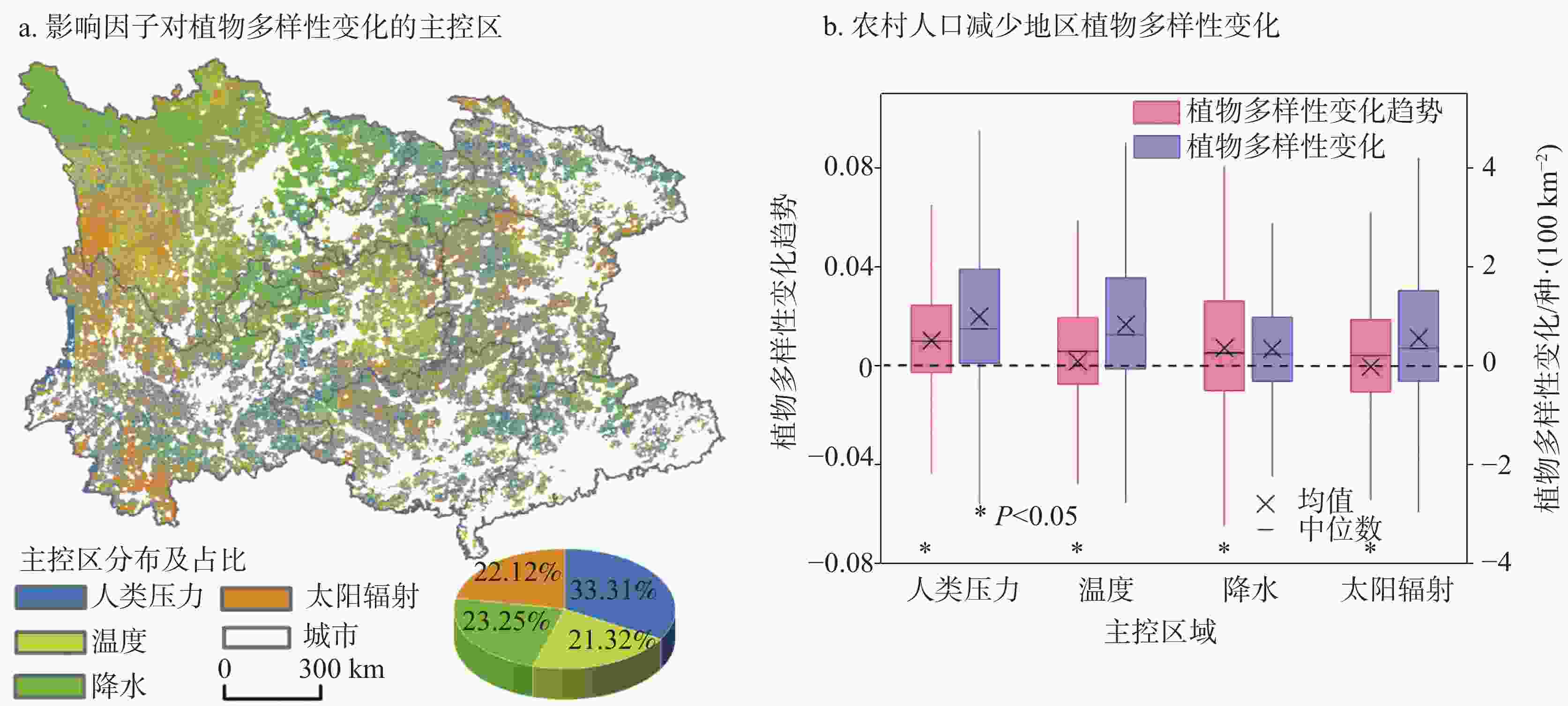
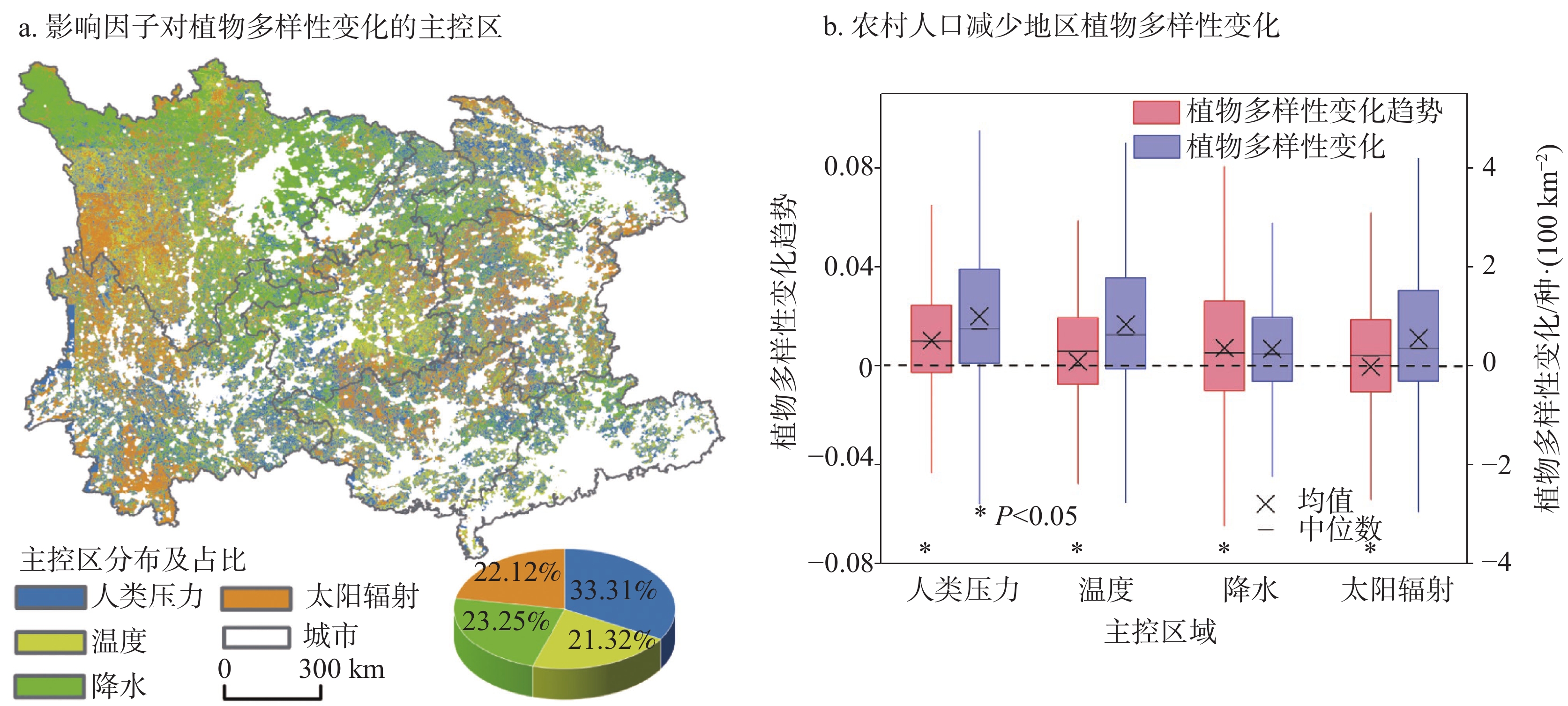
图 8 2000—2020年不同影响因子主控区内植物多样性变化
Figure 8. Changes in plant diversity within areas dominated by different influencing factors from 2000 to 2020
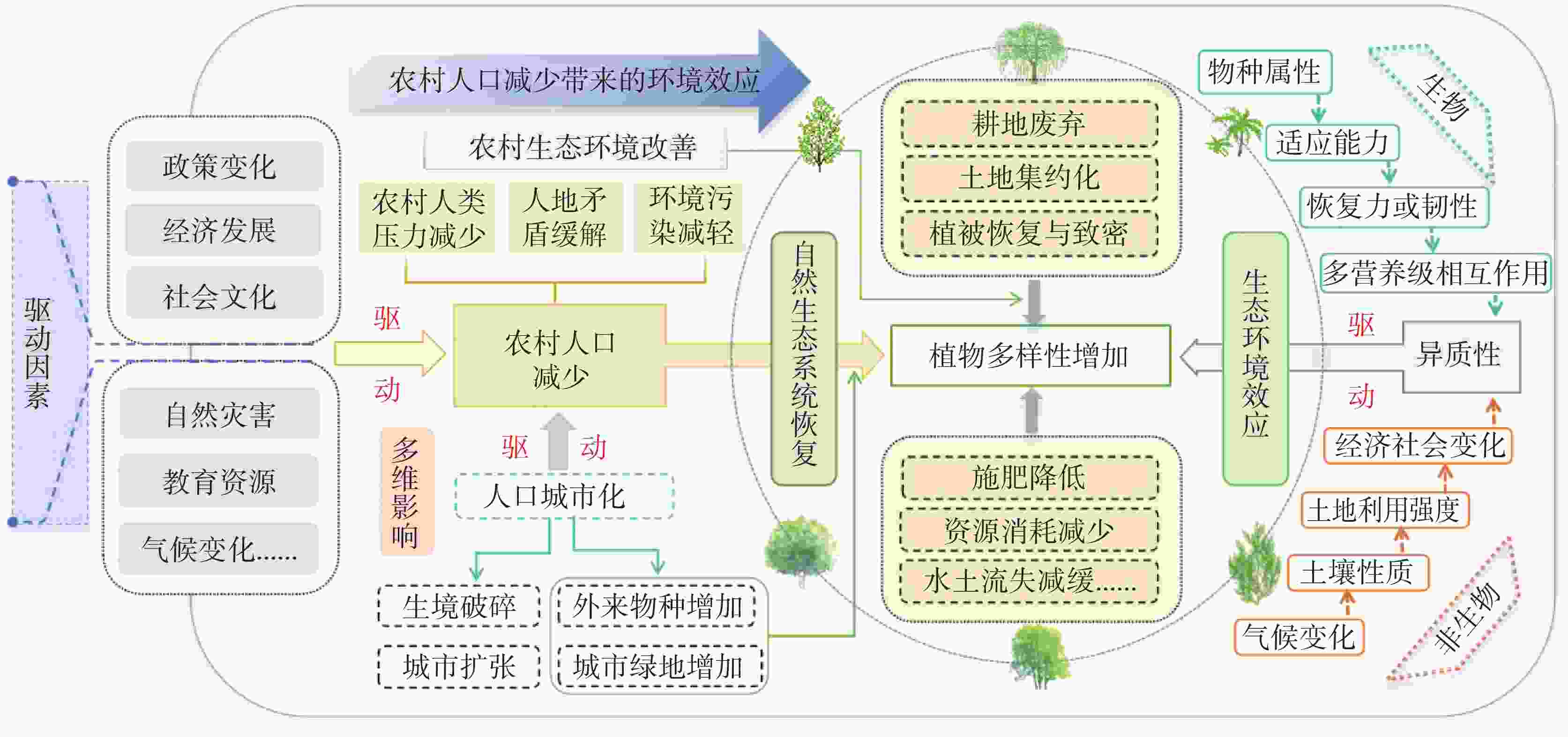
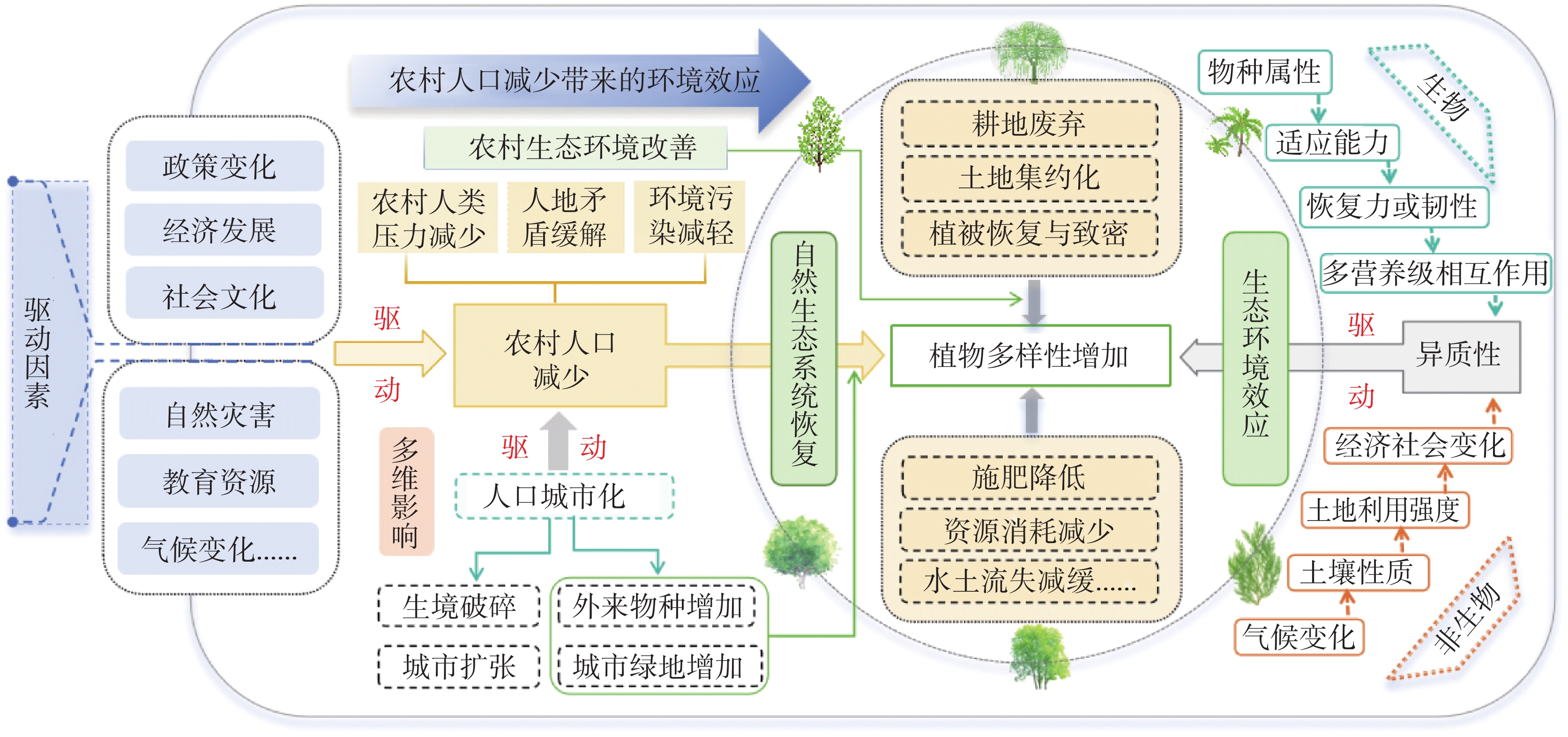
图 9 农村人口减少对植物多样性的影响机理
Figure 9. Mechanism of the impact of rural population decline on plant diversity
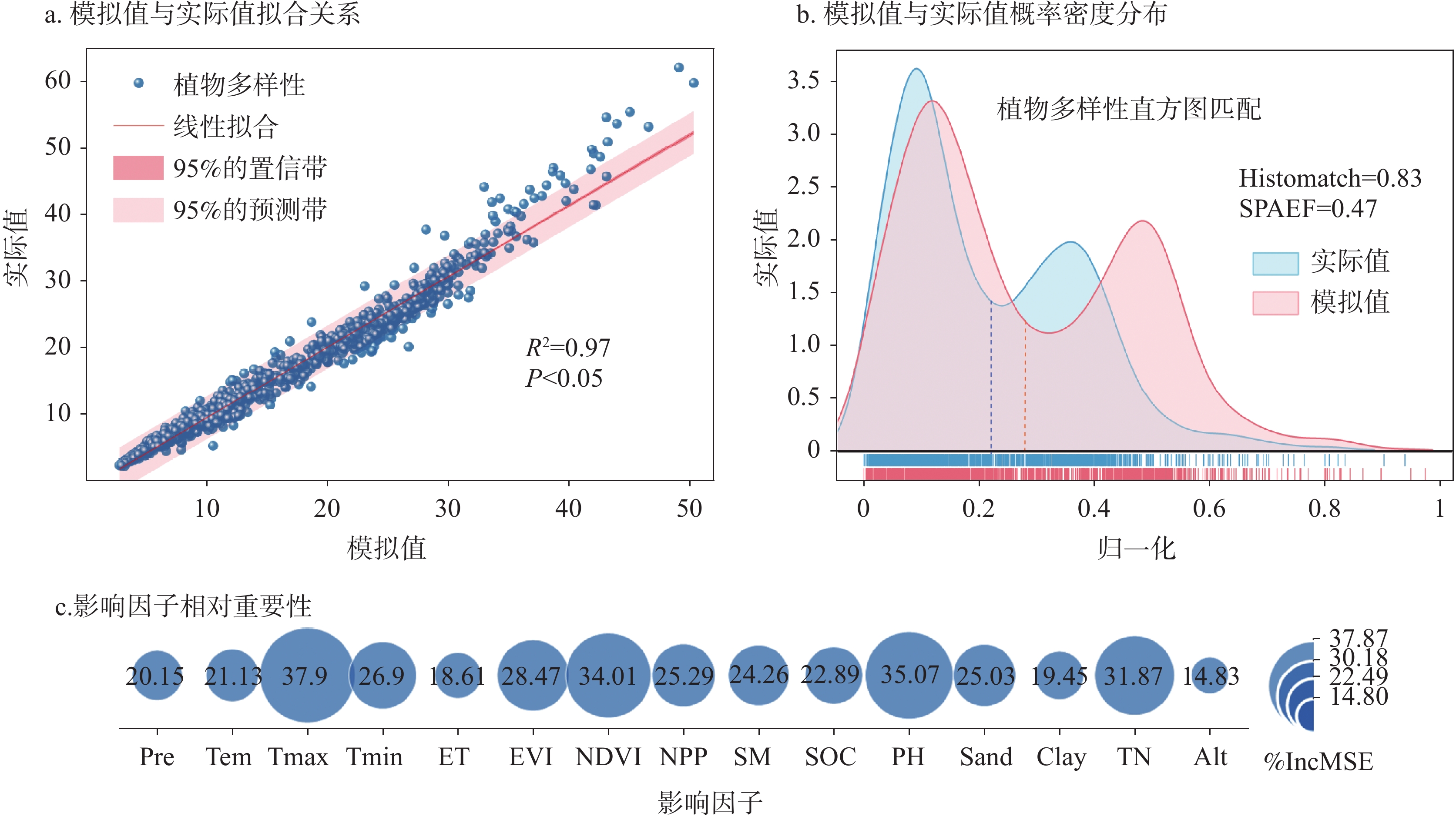
表 1 随机森林模型中的环境因子
Table 1. Environmental factors in the random forest model
类别 数据(缩写) 单位 空间分辨率 数据说明及处理 数据来源 气
候
环
境年平均温度 (Tem) ℃ 1 km 1982—2020年期间,年平均气温 国家地球系统科学数据中心 ( https://www.geodata.cn/ )年总降水量 (Pre) mm 1982—2020年,年累计降水量 年最高温度 (Tmax) ℃ 1901—2023年,以月计算年数据 国家青藏高原科学数据中心 ( https://data.tpdc.ac.cn/ )年最低温度 (Tmin) ℃ 蒸散发 (ET) mm 0.0083333 °2000—2019年,以月计算年数据,2020年通过空间插值生成 哈佛大学数据库 (Harvard Dataverse | APIs and Data at Harvard University) 植
被
特
征增强植被指数 (EVI) − 250 m 2000—2022年,月数据(MOD13Q1) (MODIS Data | Terra (nasa.gov)) 归一化植被指数 (NDVI) − 0.0083333 °2000—2022年,月数据(MOD13A3) 植被净初级生产力 (NPP) g· C·m−2 2000—2022年,年数据(MOD17A3) 土
壤
性
质土壤全氮 (TN) g·kg−1 0.1~1 km 2010—2018年,包含七个土壤层深度,基于三个土壤深度层的平均值计算
(0~5 cm,5~15 cm,15~30 cm)国家青藏高原科学数据中心 ( https://data.tpdc.ac.cn/ )土壤砂粒 (Sand) 土壤黏粒 (Clay) 土壤pH (pH) − 土壤水分 (SM) m3·m−3 1~10 km 2000—2020年,时间步长为每
日/月土壤有机碳 (SOC) t· C·ha−1 0.0083333 °1987—2019年,表层(0~30 cm)年值,2020年通过空间插值生成 国家地球系统科学数据中心( https://www.geodata.cn/ )地形特征 海拔 (Alt) m 1 km 全球陆地基础高程(GLOBE)数据集 美国国家海洋和大气管理局( https://ngdc.noaa.gov/ ) 下载: 导出CSV
表 2 2000—2020年不同农村人口减少梯度下植物多样性的变化
Table 2. Changes of plant diversity under different rural depopulation gradients from 2000 to 2020
组 农村人口减少/人· km−2 农村人口减少面积/104 km2 植物多样性变化/种·(100 km−2) EVI变化/% 1 <5 16.717 0.339 9.573 2 [5-10) 9.461 0.754 8.211 3 [10-30) 20.150 0.849 7.868 4 [30-50) 8.989 0.856 8.837 5 ≥50 13.993 0.857 13.456
下载: 导出CSV
-
[1] Bruno Daniel, Sorando Ricardo, Álvarez-farizo Begoña, Castellano Clara, Céspedes Vanessa, Gallardo Belinda, Jiménez Juan J, López M Victoria, López-flores Rocío, Moret-fernández David, Navarro Enrique, Picazo Félix, Sevilla-callejo Miguel, Tormo Jaume, Vidal-macua Juan José, Nicolau José Manuel, Comín Francisco A. Depopulation impacts on ecosystem services in Mediterranean rural areas[J]. Ecosystem Services, 2021, 52: 11. [2] 李月, 冯霞, 吴路华. 1973-2030年普定县土地利用动态模拟及生态系统服务价值响应[J]. 中国岩溶, 2025, 44(3): 555-571.Li Yue, Feng Xia, Wu Luhua. Dynamic simulation of land use and its response to the ecosystem servicevalue in Puding county from 1973 to 2030[J]. Carsologica Sinica, 2025, 44(3): 555-571. [3] Li Wei, Li Xiubin, Tan Minghong, Wang Xiuhong. Influences of population pressure change on vegetation greenness in China's mountainous areas[J]. Ecology and Evolution, 2017, 7(21): 9041-9053. doi: 10.1002/ece3.3424 [4] Zhang Xuxiang, Brandt Martin, Tong Xiaowei, Ciais Philippe, Yue Yuemin, Xiao Xiangming, Zhang Wenmin, Wang Kelin, Fensolt Rasmus. A large but transient carbon sink from urbanization and rural depopulation in China[J]. Nature Sustainability, 2022, 5(4): 321-328. doi: 10.1038/s41893-021-00843-y [5] Zhang Shihao, Xiong Kangning, Min Xiaoying, Zhang Song. Demographic shrinkage promotes ecosystem services supply capacity in the karst desertification control[J]. Science of The Total Environment, 2024, 917: 170427. doi: 10.1016/j.scitotenv.2024.170427 [6] Chang Jianyuan, Yue Yuemin, Tong Xiaowei, Brandt Martin, Zhang Chunhua, Zhang Xuemei, Qi Xiangkun, Wang Kelin. Rural outmigration generates a carbon sink in South China karst[J]. Progress in Physical Geography: Earth and Environment, 2023, 47(5): 655-667. doi: 10.1177/03091333231154177 [7] Liu Zhen. Empirical examinations of whether rural population decline improves the rural eco-environmental quality in a Chinese context[J]. Remote Sensing, 2022, 14(20): 5217. doi: 10.3390/rs14205217 [8] Cafaro Philip, Hansson Pernilla, Götmark Frank. Overpopulation is a major cause of biodiversity loss and smaller human populations are necessary to preserve what is left[J]. Biological Conservation, 2022, 272: 109646. doi: 10.1016/j.biocon.2022.109646 [9] Mokany Karel, Ferrier Simon, Harwood Thomas D, Fulton Elizabeth A, Ware Chris, Di Marco Moreno, Grantham Hedley S, Venter Oscar, Hoskins Andrew J, Watson James E M. Reconciling global priorities for conserving biodiversity habitat[J]. Proceedings of the National Academy of Sciences of the United States of America (PNAS), 2020, 117(18): 9906-9911. [10] Su Guohuan, Logez Maxime, Xu Jun, Tao Shengli, Villéger Sébastien, Brosse Sébastien. Human impacts on global freshwater fish biodiversity[J]. Science, 2021, 371(6531): 835-838. doi: 10.1126/science.abd3369 [11] Moi Dieison A, Lansac-tôha Fernando M, Romero Gustavo Q, Sobral-souza Thadeu, Cardinale Bradley J, Kratina Pavel, Perkins Daniel M, Teixeira De Mello Franco, Jeppesen Erik, Heino Jani, Lansac-tôha Fábio A, Velho Luiz F M, Mormul Roger P. Human pressure drives biodiversity−multifunctionality relationships in large Neotropical wetlands[J]. Nature Ecology & Evolution, 2022, 6(9): 1279-1289. [12] Guo Wenyong, Serra-Diaz Josep M, Schrodt Franziska,Svenning Jens Christian. High exposure of global tree diversity to human pressure[J]. Proceedings of the National Academy of Sciences of the United States of America (PNAS), 2022, 119(25): e2026733119. [13] Zhang Yang, Li Xiubin, Song Wei, Zhang Xiaolin. Land abandonment under rural restructuring in China explained from a cost-benefit perspective[J]. Journal of Rural Studies, 2016, 47: 524-532. doi: 10.1016/j.jrurstud.2016.06.019 [14] Daskalova Gergana N, Kamp Johannes. Abandoning land transforms biodiversity[J]. Science, 2023, 380(6645): 581-583. doi: 10.1126/science.adf1099 [15] Jones Kendall R, Venter Oscar, Fuller Richard A, Allan James R, Maxwell Sean L, Negret Pablo Jose, Watson James E M. One-third of global protected land is under intense human pressure[J]. Science, 2018, 360(6390): 788-791. doi: 10.1126/science.aap9565 [16] 肖霜霜, 陈武荣, 傅伟, 张建兵. 土地利用方式对喀斯特土壤微生物资源限制的影响[J]. 中国岩溶, 2024, 43(5): 1065-1075.Xiao Shuangshuang, Chen Wurong, Fu We, Zhang Jianbing. Effects ofland use patterns on the limitation of soil microbial resourcesin the karst areas of Southwest China[J]. Carsologica Sinica, 2024, 43(5): 1065-1075. [17] 傅靖轩. 西南地区维管植物优先保护及保护空缺分析[D]. 太原: 山西大学, 2016.Fu Jingxuan. Analysis of priority protection and conservation vacancy of vascular plants in Southwest China[D]. Taiyuan: Shanxi University, 2016. [18] Lin Ziyan, Wu Tong, Rao Enming, Xiao Yi, Ouyang Zhiyun. Using gross ecosystem product to harmonize biodiversityconser-vation and economic development in Southwestern China[J]. People and Nature, 2024, 6(5): 1838-1848. [19] 龙明康, 白晓永, 李姿霖, 薛盈盈, 陈飞, 李朝君, 冉晨 , 张思蕊, 杜朝超, 宋丰姣, 肖碧琴, 熊练. 中国西南喀斯特石漠化治理对生物多样性的影响[J]. 地理学报, 2024, 79(1): 97-113.Long Mingkang, Bai Xiaoyong, Li Zilin, Xue Yingying, Chen Fei, Li Chaojun, Ran Chen, Zhang Sirui, Du Chaochao, Song Fengjiao, Xiao Biqin, Xiong Lian. Impacts of karst rocky desertification control on biodiversity in Southwest China[J]. Acta Geographica Sinica, 2024, 79(1): 97-113. [20] Chang Aoxiang, Wu Ting, Li Bowen, Jiao Dezhi, Wang Yushu, He Dan, Jiang Zihan, Fan Zhenyu. Distribution pattern of species richness of endemic genera in mountainous areas of southwest China and its influencing factors[J]. Sustainability, 2024, 16(9): 3750. doi: 10.3390/su16093750 [21] Wang Xiaoyi, Yang Cheng, Qiao Huijie, Liu Junhua. More than two-fifths of the protected land in a global biodiversity hotspot in southwest China is under intense human pressure[J]. Science of the Total Environment, 2024, 906: 167283. doi: 10.1016/j.scitotenv.2023.167283 [22] 王希尧, 魏登峰, 匡鸿海. 西南地区植被对陆地水储量的响应[J]. 应用生态学报, 2023, 34(10): 2723-2729.Wang Xiyao, Wei Dengfeng, Kuang Honghai. Response of vegetation to terrestrial water storage in Southwest China[J]. Chinese Journal of Applied Ecology, 2023, 34(10): 2723-2729. [23] 马炳鑫, 和彩霞, 靖娟利, 王永锋, 刘兵, 何宏昌. 1982—2019年中国西南地区植被变化归因研究[J]. 地理学报, 2023, 78(3): 714-728.Ma Bingxin, He Caixia, Jing Juanli, Wang Yongfeng, Liu Bing, He Hongchang. Attribution of vegetation dynamics in Southwest China from 1982 to 2019[J]. Acta Geographica Sinica, 2023, 78(3): 714-728. [24] Ellis Erle C, Antill Erica C, Kreft Holger. All is not loss: Plant biodiversity in the Anthropocene[J]. PLoS ONE, 2012, 7(1): e30535. doi: 10.1371/journal.pone.0030535 [25] Mu Haowei, Li Xuecao, Wen Yanan, Huang Jianxi, Du Peijun, Su Wei, Miao Shuangxi, Geng Mengqing. A global record of annual terrestrial Human Footprint dataset from 2000 to 2018[J]. Scientific Data, 2022, 9(1): 176. doi: 10.1038/s41597-022-01284-8 [26] Venter Oscar, Sanderson Eric W, Magrach Ainhoa, Allan James R, Beher Jutta, Jones Kendall R, Possingham Hugh P, Laurance William F, Wood Peter, Fekete Balázs M, Levy Marc A, Watson James E M. Sixteen years of change in the global terrestrial human footprint and implications for biodiversity conser-vation[J]. Nature Communications, 2016, 7(1): 12558. doi: 10.1038/ncomms12558 [27] Yang Yuli, Ma Mingguo, Tan Chao, Li Wangping. Spatial recognition of the urban-rural fringe of Beijing using DMSP/OLS nighttime light data[J]. Remote Sensing, 2017, 9(11): 1141. doi: 10.3390/rs9111141 [28] Feng Zhao, Peng Jian, Wu Jiansheng. Using DMSP/OLS nighttime light data and K-means method to identify urban-rural fringe of megacities[J]. Habitat International, 2020, 103: 102227. doi: 10.1016/j.habitatint.2020.102227 [29] Li Xuecao, Gong Peng, Zhou Yuyu, Wang Jie, Bai Yuqi, Chen Bin, Hu Tengyun, Xiao Yixiong, Xu Bing, Yang Jun, Liu Xiaoping, Cai Wenjia, Huang Huabing, Wu Tinghai, Wang Xi, Lin Peng, Li Xun, Chen Jin, He Chunyang, Li Xia, Yu Le, Clinton Nicholas, Zhu Zhiliang. Mapping global urban boundaries from the global artificial impervious area (GAIA) data[J]. Environmental Research Letters, 2020, 15(9): 094044. doi: 10.1088/1748-9326/ab9be3 [30] He Chunyang, Liu Zhifeng, Tian Jie, Ma Qun. Urban expansion dynamics and natural habitat loss in China: A multiscale landscape perspective[J]. Global Change Biology, 2014, 20(9): 2886-2902. doi: 10.1111/gcb.12553 [31] 孟小军, 邢昭. 基于InSAR技术与随机森林算法的清江流域长阳西段滑坡危险性评价[J]. 中国岩溶, 2025, 44(3): 609-620.Meng Xiaojun, Xing Zhao. Landslide susceptibilityassessment in the western Changyang section of the Qingjiang River Basin based on InSAR technology and random forest algorithm method[J]. Carsologica Sinica, 2025, 44(3): 609-620. [32] Koch Julian, Demirel Mehmet C, Stisen Simon. The SPAtial EFficiency metric (SPAEF): Multiple-component evaluation of spatial patterns for optimization of hydrological models[J]. Geoscientific Model Development, 2018, 11: 1873-1886. doi: 10.5194/gmd-11-1873-2018 [33] Bennett Elena M, Peterson Garry D, Gordon Line J. Understanding relationships among multiple ecosystem services[J]. Ecology Letters, 2009, 12(12): 1394-1404. doi: 10.1111/j.1461-0248.2009.01387.x [34] He Juan, Li Yao, Shi Xueyi. Integrating the impacts of vegetation coverage on ecosystem services to determine ecological restoration targets for adaptive management on the Loess Plateau, China[J]. Land Degradation & Development, 2023, 34(18): 5697-5712. [35] Wang Cong, Tang Chongjun, Fu Bojie, Lü Yihe, Xiao Shengsheng, Zhang Jie. Determining critical thresholds of ecological restoration based on ecosystem service index: A case study in the Pingjiang catchment in southern China[J]. Journal of Environmental Management, 2022, 303: 114220. doi: 10.1016/j.jenvman.2021.114220 [36] 郭远智, 周扬, 刘彦随. 中国农村人口外流的时空演化及其驱动机制[J]. 地理科学, 2020, 40(1): 50-59.Guo Yuanzhi, Zhou Yang, Liu Yansui. Spatial-temporal evolution of rural population outflow and its mechanism in China[J]. Scientia Geographica Sinica, 2020, 40(1): 50-59. [37] Cao Shengpeng, Zhang Lifeng, He Yi, Zhang Yali, Chen Yi, Yao Sheng, Yang Wang, Sun Qiang. Effects and contributions of meteorological drought on agricultural drought under different climatic zones and vegetation types in Northwest China[J]. Science of the Total Environment, 2022, 821: 20. [38] Huete Alfredo, Didan Kamel, Miura Tomoaki, Rodriguez Eric P, Gao Xiang, Ferreira Laerte G. Overview of the radiometric and biophysical performance of the MODIS vegetation indices[J]. Remote Sensing of Environment, 2002, 83(1-2): 195-213. doi: 10.1016/S0034-4257(02)00096-2 [39] Li Delong, Cao Wenfang, Dou Yuehan, Wu Shuyao, Liu Junguo, Li Shuangcheng. Non-linear effects of natural and anthropogenic drivers on ecosystem services: Integrating thresholds into conservation planning[J]. Journal of Environmental Management, 2022, 321: 116047. doi: 10.1016/j.jenvman.2022.116047 [40] Zhao Xiaoqing, Xu Yifei, Pu Junwei, Tao Junyi, Chen Yanjun, Huang Pei, Shi Xinyu, Ran Yuju, Gu Zexian. Achieving the supply-demand balance of ecosystem services through zoning regulation based on land use thresholds[J]. Land Use Policy, 2024, 139: 107056. doi: 10.1016/j.landusepol.2024.107056 [41] 盛叶子, 曾蒙秀, 林德根, 彭海军, 朱丽东, 李凤全, 余奕泓, 王能静. 2000-2014年人类活动对贵州省植被净初级生产力的影响[J]. 中国岩溶, 2020, 39(1): 62-70.Sheng Yezi, Zeng Mengxiu, Lin Degen, Peng Haijun, Zhu Lidong, Li Fengquan, Yu Yihong, Wang Nengjing. Impacts of human activities on net primary productivity of vegetation in Guizhou Province from 2000 to 2014[J]. Carsologica Sinica, 2020, 39(1): 62-70. [42] Hu Xiaoli, Lima M F. The association between maintenance and biodiversity in urban green spaces: A review[J]. Landscape and Urban Planning, 2024, 251: 105153. doi: 10.1016/j.landurbplan.2024.105153 [43] Uchida Kei, Matanle Peter, Yang Li, Fujita Taku, Hiraiwa Masayoshi K. Biodiversity change under human depopulation in Japan[J]. Nature Sustainability, 2025, 8(8): 883-893. [44] 何娴娴, 杨智谋, 赵宇鸾, 张蒙. 基于典型村落的山−坝系统土地利用演化时空分异特征[J]. 中国岩溶, 2024, 43(2): 326-335.He Xianxian, Yang Zhimou, Zhao Yuluan, Zhang Meng. Spatial-temporal pattern ofland use evolution in mountain-basinsystems based on three typical villages[J]. Carsologica Sinica, 2024, 43(2): 326-335. [45] Jung Martin, Rowhani Parisa, Scharlemann Jörn P W. Impacts of past abrupt land change on local biodiversity globally[J]. Nature Communications, 2019, 10(1): 5474. doi: 10.1038/s41467-019-13452-3 [46] Simkin Rohan D, Seto Karen C, Mcdonald Robert I, Jetz Walter. Biodiversity impacts and conservation implications of urban land expansion projected to 2050[J]. Proceedings of the National Academy of Sciences of the United States of America (PNAS), 2022, 119(12): e2117297119. [47] 曾海聪, 李晨亮, 张君瑶, 张健, 郑安迪, 吴子敬, 王嘉楠. 城市绿地生物多样性影响因素研究概述[J]. 中国城市林业, 2023, 21(5): 171-178.Zeng Haicong, Li Chenliang, Zhang Junyao, Zhang Jian, Zheng Andi, Wu Zijing, Wang Jianan. Research on influencing factors to biodiversity in urban green spaces[J]. Journal of Chinese Urban Forestry, 2023, 21(5): 171-178. -

 点击查看大图
计量
- 文章访问数: 1092
- HTML浏览量: 145
- PDF下载量: 173
- 被引次数: 0
