


Depth distribution of 238U、232Th、226Ra、40K from a soil wedge on limestone slope in Guzhou karst peak-cluster depression of Huanjiang and its origin analysis
-
摘要: 为了探讨喀斯特峰丛洼地坡地石灰土的成土物质来源和土楔形成机制,于广西环江古周洼地锥丘坡地分层采集了石灰岩坡地土楔土样和石灰岩围岩样品,测定了土样的粒度、容重、pH和土岩样品的238U、232Th、226Ra和40K活度。结果表明:土楔剖面石灰土质地均一,粒度组成以粉(31.81%)、黏粒(58.82%)为主,容重0.94~1.01g·cm−3,pH 7.47~8.01。剖面的238U、232Th和226Ra活度平均值分别为111.91 Bq·kg−1、100.17 Bq·kg−1和74.03 Bq·kg−1;40K活度随深度增加略有增加,平均值341.55 Bq·kg−1。围岩的238U活度低于检出限0.71Bq·kg−1,232Th、226Ra和40K分别为2.77 Bq·kg−1、3.69 Bq·kg−1和18.43 Bq·kg−1。土体和围岩的232Th∶226Ra∶40K活度比值分别为1∶0.74∶3.41和1∶1.34∶6.65,差别较大。围岩与土体的238U活度差差别更大。土楔石灰土剖面的粒度,容重几乎无变化,不同深度土层的238U与 232Th、226Ra比值较一致,土体与围岩直接接触无过渡层,这些证据证实土楔是土壤蠕滑充填岩隙形成。而围岩与土体232Th∶226Ra∶40K活度比值的不一致及238U活度的明显差异,表明土楔土体的主要成土物质可能不是石灰岩围岩原位就地风化产物。Abstract:
The longstanding debate regarding the origin of pedogenic materials in karst regions—whether derived from in situ weathering of carbonate bedrock or allochthonous inputs—motivated this investigation into soil wedge formation within the karst peak-cluster depression of Huanjiang Guzhou depression, Guangxi, China. To resolve this controversy, we analyzed distributions of natural radionuclides (238U、232Th、226Ra和40K), grain size, bulk density, and pH in a limestone slope soil wedge to trace material sources and elucidate formation mechanisms. Stratified soil samples (0−10, 10−20, 20−40 cm, and 2 m depth) and adjacent limestone bedrock were collected from a 3-m-deep soil wedge (24°55′0.20″N, 107°57′4.35″E), with bulk density measured in situ via the ring-knife method. Grain size distribution was determined using laser diffraction (Mastersizer 2 000) following H2O2 and HCl pretreatment, while radioisotope activities were quantified through low-background γ-spectrometry (HPGe detector, LOAX model) at characteristic energy peaks: 92.8 keV (238U), 583 keV (232Th), 609 keV (226Ra), and 1460 keV (40K). The pH is measured by a pH meter.Results revealed remarkably homogeneous soil physicochemical properties: silt (average 31.81%) and clay (58.82%) dominated the texture, while bulk density (0.94−1.01 g·cm−3) and pH (7.47−8.01) exhibited minimal variation across depths, though the surface layer (0−10 cm) showed slightly lower clay content (27.59%) and higher bulk density (1.01 g·cm−3). Radionuclide activities within the soil wedge demonstrated significant stability: 238U, 232Th, and 226Ra averaged 111.91, 100.17, and 74.03 Bq·kg−1 respectively with negligible depth variation, while 40K activity exhibited a slight increase with depth (average 341.55 Bq·kg−1). Crucially, isotopic ratios remained consistent vertically, with 238U∶ 232Th∶ 226Ra∶ 40K ≈ 1∶0.89∶0.66∶2.86 (0−40 cm) and 1∶0.91∶0.65∶3.76 (2 m), indicating profound vertical homogeneity. In stark contrast, the underlying bedrock exhibited extremely low radionuclide activities: 238U was undetectable (<0.71 Bq·kg−1), while 232Th、26Ra and 40K registered only 2.77, 3.69, and 18.43 Bq·kg−1 respectively, yielding a distinct 232Th∶226Ra∶40K ratio of 1∶1.34∶6.65. The soil-bedrock contrast was unequivocal: 238U activity in the soil (95.72−120.10 Bq·kg−1) exceeded the bedrock level by more than 135 times, and the fundamental difference in 232Th∶ 226Ra∶40K ratios (1∶0.74∶3.41 in soil vs. 1∶1.34∶6.65 in bedrock) provided definitive evidence. This stark geochemical disparity, particularly the absence of 238U and the divergent isotopic signatures in the bedrock, categorically refutes traditional models of residual accumulation via in situ weathering of the underlying pure carbonate limestone, as U/Th series nuclides primarily reside in silicate minerals which are negligible in such bedrock. Instead, the uniform soil texture, stable isotopic ratios across depths, and most critically, the abrupt soil-bedrock contact devoid of any transitional layers, collectively provide robust evidence supporting a formation mechanism driven by gravitational soil creep infilling pre-existing rock fissures. The elevated 238U activity and consistent Th/Ra ratios within the soil wedge point towards external material sources, likely comprising weathered residues from interbedded clastic layers within the mid-upper slopes and/or contributions from aeolian dust, analogous to the Saharan dust inputs documented in Mediterranean Terra Rossa formations. This mechanism stands in clear global context: unlike granitic weathering crusts characterized by gradual transitions through distinct weathering horizons (e.g., soil → strongly weathered layer → weakly weathered layer → fresh bedrock), limestone soil wedges exhibit sharp, unconformable interfaces-a definitive hallmark of allochthonous infilling. While this aligns with the formation paradigm of Mediterranean Terra Rossa, it fundamentally contrasts with models proposing in situ karst weathering. Integrated evidence thus conclusively confirms that soil wedges in karst peak-cluster depressions form primarily through the gravitational infilling of rock fissures by externally sourced materials, not through the in-situ weathering of the immediate limestone substrate. Radionuclide activity ratios, particularly the highly diagnostic 238U /232Th contrast, serve as powerful tracers for discerning pedogenic sources in such complex terrains. These findings necessitate a redefinition of karst soil evolution paradigms, significantly underscoring the critical role of aeolian and slope-wash transported alluvial inputs in shaping subtropical karst ecosystems. -
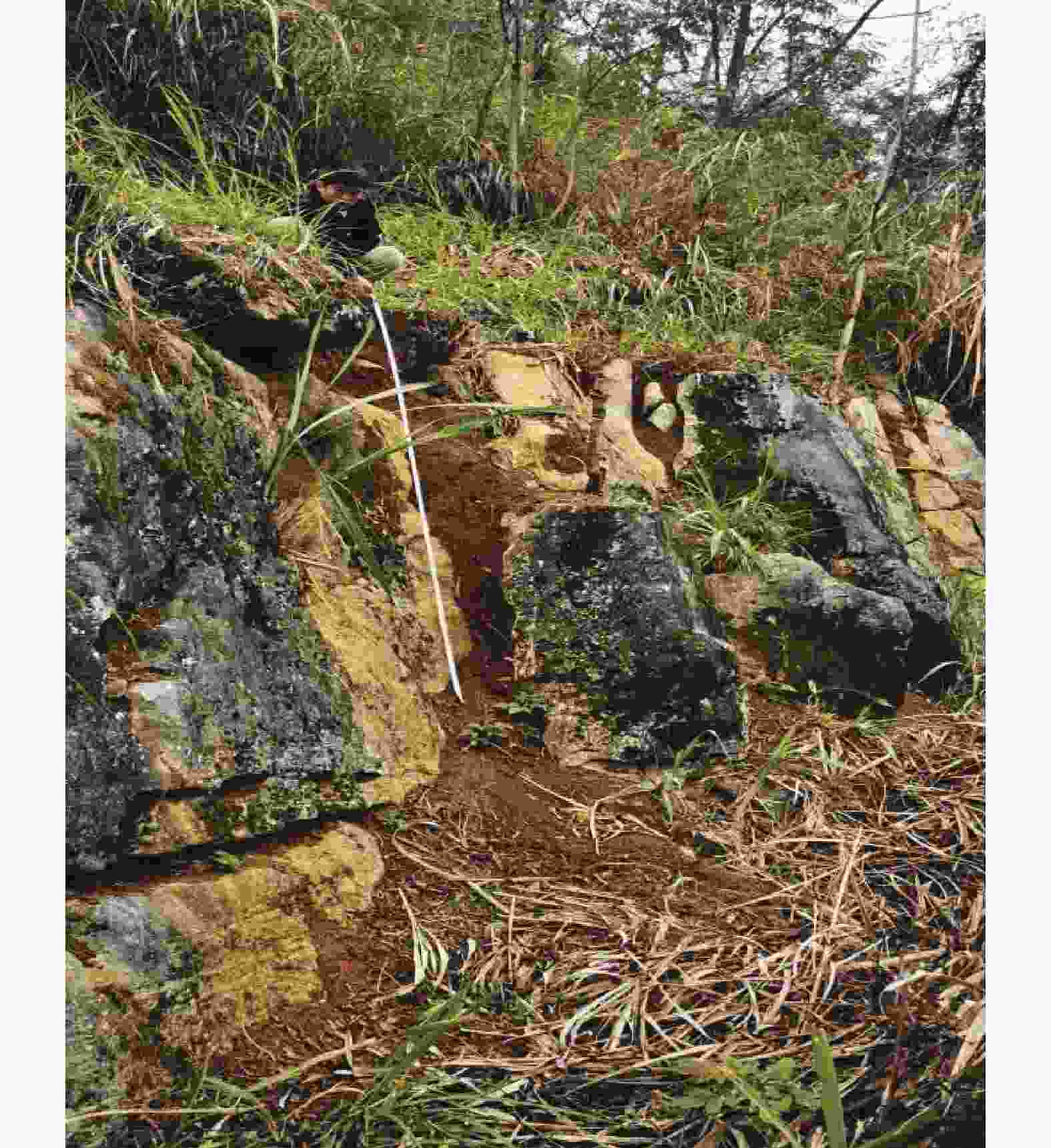
图 1 广西环江古周洼地石灰岩坡地土楔石灰土取样剖面
Figure 1. Sampling profile of the limestone slope soil wedge in Huanjiang Guzhou depression, Guangxi
表 1 古周石灰岩坡地土楔石灰土剖面的粒度、容重和pH深度变化
Table 1. Variations in grain size, bulk density, and pH with depth in the limestone slope soil wedge profile, Guzhou
深度/cm 容重/
g·cm−3238U/Bq·kg−1 232Th/Bq·kg−1 226Ra/Bq·kg−1 40K/Bq·kg−1 粒度/%
<2 µm粒度/%
2~20 µmpH 0~10 1.01 112.88±6.33 100.38±2.81 71.57±1.73 304.88±11.32 27.59 41.15 7.47 10~20 0.98 118.92±6.53 107.90±2.70 84.99±1.98 358.85±11.39 30.11 66.14 7.47 20~40 120.10±6.34 105.19±2.68 77.26±1.80 342.48±11.09 34.74 63.28 7.85 200 0.94 95.72±6.00 87.19±2.55 62.28±1.79 359.98±11.81 34.80 64.71 8.01 石灰岩 低于检出限0.71 2.77±0.55 3.69±0.50 18.43±3.05  下载: 导出CSV
-
[1] 李景阳, 王朝富, 樊廷章. 试论碳酸盐岩风化壳与喀斯特成土作用[J]. 中国岩溶, 1991, 10(1): 29-38.Li Jingyang, Wang Chaofu, Fan Tingzhang. Weathering crust of carbonate rocks and process of karst earth formation[J]. Carsologica Sinica, 1991, 10(1): 29-38. [2] 李景阳, 朱立军, 王朝富, 樊延章, 陈筠. 碳酸盐岩风化壳及喀斯特成土作用研究[J]. 贵州地质, 1996, 13(2): 139-145.Li Jingyang, Zhu Lijun, Wang Chaofu, Fan Tingzhang, Chen Jun. Weathering crust of carbonate rocks and process of karst soil formation[J]. Guizhou Geology, 1996, 13(2): 139-145. [3] 王世杰, 季宏兵, 欧阳自远, 周德全, 郑乐平, 黎廷宇. 碳酸盐岩风化成土作用的初步研究[J]. 中国科学(D辑: 地球科学), 1999, 29(5): 441-449.Wang Shijie, Ji Hongbing, Ouyang Ziyuan, Zhou Dequan, Zheng Leping, Li Tingyu. A preliminary study on weathering and pedogenesis of carbonate rocks[J]. Science in China Series D: Earth Sciences, 1999, 29(5): 441-449. [4] 孙承兴, 王世杰, 周德全, 刘秀明, 季宏兵. 碳酸盐岩酸不溶物作为贵州岩溶区红色风化壳主要物质来源的证据[J]. 矿物学报, 2002, 22(3): 235-242. doi: 10.3321/j.issn:1000-4734.2002.03.009Sun Chengxing, Wang Shijie, Zhou Dequan, Liu Xiuming, Ji Hongbing. Insoluble residues of carbonate rocks as source material for red weathering crusts in karst regions of Guizhou pro-vince, China[J]. Acta Mineralogica Sinica, 2002, 22(3): 235-242. doi: 10.3321/j.issn:1000-4734.2002.03.009 [5] 徐则民, 黄润秋, 唐正光, 费维水. 中国南方碳酸盐岩上覆红土形成机制研究进展[J]. 地球与环境, 2005, 33(4): 29-36.Xu Zemin, Huang Runqiu, Tang Zhengguang, Fei Weishui. A review of advances and outstanding issues in research on the forming mechanism of laterite in south China[J]. Earth and Environment, 2005, 33(4): 29-36. [6] 杨瑞东, 朱立军, 魏怀瑞, 王伟, 鲍淼, 张晓东, 刘玲. 贵阳地区碳酸盐岩岩系成土方式及其特征[J]. 地球与环境, 2007, 35(3): 193-201. doi: 10.3969/j.issn.1672-9250.2007.03.001Yang Ruidong, Zhu Lijun, Wei Huairui, Wang Wei, Bao Miao, Zhang Xiaodong, Liu Ling. Pedogenic mechanism of carbonate laterite and its characteristics in Guiyang, Guizhou province, China[J]. Earth and Environment, 2007, 35(3): 193-201. doi: 10.3969/j.issn.1672-9250.2007.03.001 [7] 刘秀明, 王世杰, 冯志刚, 孙承兴. 石灰土物质来源的判别: 以黔北、黔中几个剖面为例[J]. 土壤, 2004, 36(1): 30-36. doi: 10.3321/j.issn:0253-9829.2004.01.007Liu Xiuming, Wang Shijie, Feng Zhigang, Sun Chengxing. Identification of origin of limestone soil: case study of profiles in central and north Guizhou[J]. Soil, 2004, 36(1): 30-36. doi: 10.3321/j.issn:0253-9829.2004.01.007 [8] 卢耀如, 中国喀斯特地貌的演化模式[J]. 地理研究, 1986, 5(4): 25-35.Lu Yaoru. Models of karst geomorphological evolutions in China[J]. Geographical Research, 1986, 5(4): 25-35. [9] 符必昌, 黄英. 试论碳酸盐岩上覆红土的形成模式及演化趋势[J]. 地质科学, 2003, 38(1): 128-136. doi: 10.3321/j.issn:0563-5020.2003.01.013Fu Bichang, Huang Ying. An approach to forming and evolution of laterite overlying carbonate rocks[J]. Chinese Journal of Geology, 2003, 38(1): 128-136. doi: 10.3321/j.issn:0563-5020.2003.01.013 [10] 刘文景, 刘丛强, 赵志琦, 李龙波, 涂成龙, 刘涛泽. 喀斯特地区风化与成土过程特征: 黄壤和石灰土剖面Sr同位素地球化学研究[J]. 地球环境学报, 2011, 2(2): 331-336.Liu Wenjing, Liu Congqiang, Zhao Zhiqi, Li Longbo, Tu Chenglong, Liu Taoze. The weathering and soil formation process in karstic area, southwest China: A study on Strontium isotope geochemistry of yellow and limestone soil profiles[J]. Journal of Earth Environment, 2011, 2(2): 331-336. [11] Mee A C, Bestland E A, Spooner N A. Age and origin of Terra Rossa soils in the Coonawarra area of South Australia[J]. Geomorphology, 2004, 58(1-4): 1-25. doi: 10.1016/S0169-555X(03)00183-1 [12] Muhs D R, Budahn J R. Geochemical evidence for African dust and volcanic ash inputs to terra rossa soils on carbonate reef terraces, northern Jamaica, West Indies[J]. Quaternary International, 2009, 196(1-2): 13-35. doi: 10.1016/j.quaint.2007.10.026 [13] Feng J L. Behaviour of rare earth elements and yttrium in ferromanganese concretions, gibbsite spots, and the surrounding terra rossa over dolomite during chemical weathering[J]. Chemical Geology, 2010, 271(3-4): 112-132. doi: 10.1016/j.chemgeo.2010.01.003 [14] 何守阳. 碳酸盐岩风化成土过程的铀系地球化学研究[D]. 北京: 中国科学院大学, 2010.He Shouyang. Uranium-series geochemistry during weathering and pedogenesis of carbonate rocks[D]. Beijing: University of Chinese Academy of Sciences, 2010. [15] 冯志刚, 马强, 王世杰, 李石朋, 梁连东. 碳酸盐岩风化剖面U和Th的富集特征及淋溶实验的指示[J]. 地质通报, 2013, 32(4): 639-651. doi: 10.3969/j.issn.1671-2552.2013.04.012Feng Zhigang, Ma Qiang, Wang Shijie, Li Shipeng, Liang Liandong. The enrichment characteristics of Uranium and Thorium in weathering profiles of carbonate rocks and the implications of their leaching experiments[J]. Geological Bulletin of China, 2013, 32(4): 639-651. doi: 10.3969/j.issn.1671-2552.2013.04.012 [16] 林发利, 何守阳. 碳酸盐岩风化过程的铀、钍地球化学行为[J]. 高校地质学报, 2022, 28(4): 493-505.Lin Fali, He Shouyang. Geochemical behaviors of Uranium and Thorium during weathering of carbonate rocks[J]. Geological Journal of China Universities, 2022, 28(4): 493-505. [17] 史忠林, 张信宝, 张润川. 2021年“3·15”沙尘暴沙尘来源核素示踪研究[J]. 中国沙漠, 2022, 42(2): 1-5.Shi Zhonglin, Zhang Xinbao, Zhang Runchuan. Use of radionuclides to trace sand and dust sources of the March 15, 2021 dust storm event[J]. Journal of Desert Research, 2022, 42(2): 1-5. [18] 唐益群, 张晓晖, 周洁, 佘恬钰, 杨坪, 王建秀. 喀斯特石漠化地区土壤地下漏失的机理研究: 以贵州普定县陈旗小流域为例[J]. 中国岩溶, 2010, 29(2): 121-127. doi: 10.3969/j.issn.1001-4810.2010.02.003Tang Yiqun, Zhang Xiaohui, Zhou Jie, She Tianyu, Yang Ping, Wang Jianxiu. The mechanism of underground leakage of soil in karst rocky desertification areas: A case in Chenqi small watershed, Puding, Guizhou Province[J]. Carsologica Sinica, 2010, 29(2): 121-127. doi: 10.3969/j.issn.1001-4810.2010.02.003 [19] Ballagh T M, Runge E C A. Clay-rich horizons over limestone - illuvial or residual?[J]. Soil Science Society of America Journal, 1970, 34(3): 534-536. doi: 10.2136/sssaj1970.03615995003400030047x [20] Borg L E, Banner J L. Neodymium and strontium isotopic constraints on soil sources in Barbados, West Indies[J]. Geochimica Et Cosmochimica Acta, 1996, 60(21): 4193-4206. doi: 10.1016/S0016-7037(96)00252-9 [21] 张信宝, 王世杰, 贺秀斌, 汪阳春, 何永彬. 碳酸盐岩风化壳中的土壤蠕滑与岩溶坡地的土壤地下漏失[J]. 地球与环境, 2007, 35(3): 202-206. doi: 10.3969/j.issn.1672-9250.2007.03.002Zhang Xinbao, Wang Shijie, He Xiubin, Wang Yangchun, He Yongbin. Soil creeping in weathering crusts of carbonate rocks and underground soil losses on karst slopes[J]. Earth and Environment, 2007, 35(3): 202-206. doi: 10.3969/j.issn.1672-9250.2007.03.002 [22] 程凭, 程勤波, 陈喜, 刘金涛, 张志才, 高满. 基于频域电磁法反演喀斯特表层土-岩结构研究[J]. 中国岩溶, 2022, 41(5): 675-683. doi: 10.11932/karst20220501Cheng Ping, Cheng Qinbo, Chen Xi, Liu Jintao, Zhang Zhicai, Gao Man. Exploration of superficial soil-rock structure for karst area based on frequency domain electromagnetic method[J]. Carsologica Sinica, 2022, 41(5): 675-683. doi: 10.11932/karst20220501 [23] 高强山, 彭韬, 付磊, 王世杰, 曹乐, 程倩云. 探地雷达技术对表层岩溶带典型剖面组构刻画与界面识别[J]. 中国岩溶, 2019, 38(5): 759-765. doi: 10.11932/karst20190512Gao Qiangshan, Peng Tao, Fu Lei, Wang Shijie, Cao Le, Cheng Qianyun. Structure description and interface recognition on epikarst typical profiles using GPR technology[J]. Carsologica Sinica, 2019, 38(5): 759-765. doi: 10.11932/karst20190512 -

 点击查看大图
图(2) / 表(1)
计量
- 文章访问数: 1638
- HTML浏览量: 126
- PDF下载量: 228
- 被引次数: 0
