


Hydrochemical characteristics and water quality assessment of Yepuqu alpine karst basin
-
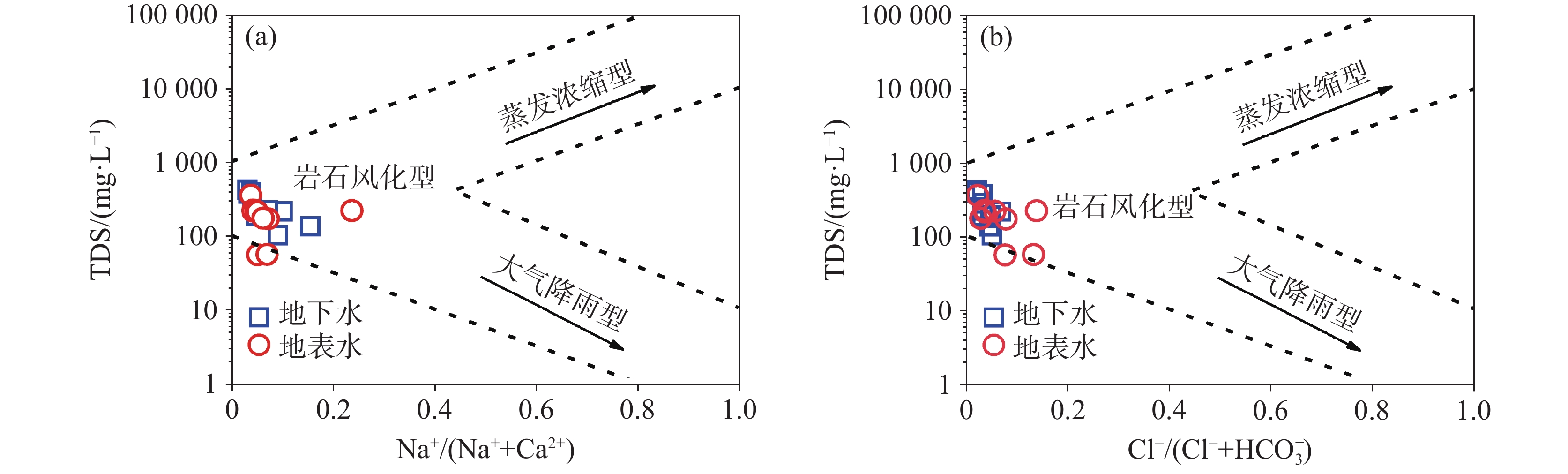
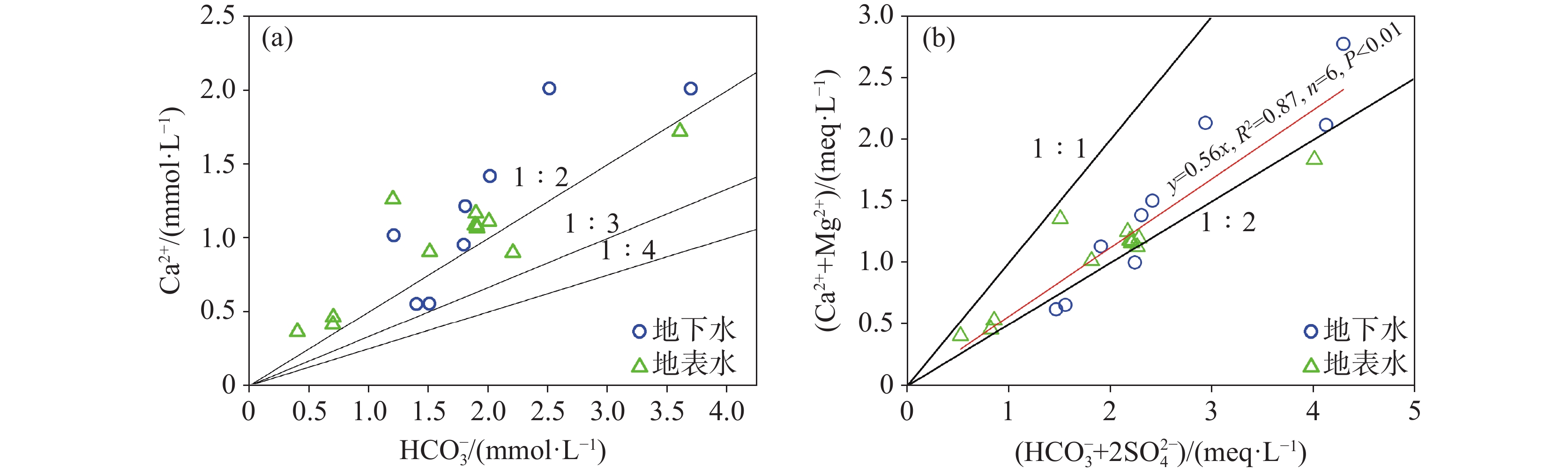
摘要: 高寒岩溶水作为亚洲水塔的重要组成部分,其水质是青藏高原可持续发展最重要的环境问题之一。文章选取拉萨河流域北侧叶普曲岩溶流域为研究对象,开展流域地表水、地下水水化学特征及水质评价研究,运用水化学分析、主成分分析、单因子评价和综合污染指数评价进行研究,结果表明叶普曲岩溶流域水体中Ca2+、HCO$_3^{-}$的毫克当量百分数均大于对应阴阳离子的50%,岩溶地下水和地表水水化学类型为HCO3-Ca和HCO3·SO4-Ca型;离子平衡图分析表明地表水以方解石溶解、方解石与白云石共同溶解作用的占比为83%、17%;地下水以方解石溶解、方解石和白云石共同溶解的占比为67%、33%。岩石风化溶解作用是控制是水化学组成的主要机制,此外还伴有阳离子交换作用。叶普曲岩溶流域水质分析表明单因子评价分析的21组水样中Ⅲ类水占86%,Ⅳ和Ⅴ类水占14%,综合污染指数评价结果表明研究区为优质水。TN是单因子评价中的关键指标参数,水体中超标指标参数氮主要来自化肥输入。主成分分析表明研究区水质主要受3个主因子控制:人类活动、天然地层背景值以及二者的复合影响。Abstract: As a vital component of the "Asian Water Tower", the water quality of alpine karst water is one of the most critical environmental challenges for sustainable development on the Qinghai-Xizang Plateau. The Lhasa river basin, a core water source area in Xizang, plays a pivotal role in both the health of local residents and the ecological security of Asia's water systems. However, current research on karst water predominantly focuses on low-altitude regions, leaving significant gaps in understanding high-altitude karst systems. This study focuses on the Yepuqu karst basin, a tributary of the Lhasa river in northern Xizang, to investigate the hydrochemical characteristics and water quality of both surface water and groundwater. The research aims to reveal the hydrochemical composition and water quality features of a typical alpine karst basin, as well as the key controlling factors influencing the water quality.The systematic collection of surface water and groundwater in the Yepuqu karst basin was analyzed using methods such as hydrochemical analysis, principal component analysis, single-factor index, and comprehensive pollution index. The results indicated that the milliequivalent percentages of Ca2+ and ${\rm{HCO}}_3^{-}$ in the water bodies both exceeded 50% of their corresponding cations and anions, with the hydrochemical types of karst groundwater and surface water classified as HCO3-Ca and HCO3·SO4-Ca types, respectively. Ion balance diagram analysis showed that surface water was dominated by 83% calcite dissolution and 17% a combination of calcite and dolomite dissolution, while groundwater exhibited 67% calcite dissolution and 33% combined calcite-dolomite dissolution. The weathering and dissolution of rocks were the primary mechanisms controlling water mineralization, with both surface water and groundwater dominated by calcite dissolution, followed by combined dissolution of calcite and dolomite. Additionally, cation exchange reactions were also involved. The water quality analysis of the Yepuqu karst basin indicated that 86% of the 21 water samples evaluated by single-factor assessment belong to Class III, while 14% were Class IV and V. The comprehensive pollution index assessment further showed that the study area was of high-quality water. The results of two assessments showed certain discrepancies, primarily due to their differing assessment principles. Decision-makers can adopt a dual-track evaluation system combining "single-factor qualitative assessment + comprehensive pollution index quantitative assessment" to define different water quality conditions, thereby implementing more effective water resource management measures. This approach holds significant practical value for the comprehensive governance of water resources. Among them, Total Nitrogen (TN) was a key parameter in single-factor assessment, and the excessive nitrogen in water bodies primarily originates from fertilizer inputs. To address the issue of excessive TN levels in agricultural areas, an integrated prevention and control strategy of "source reduction,process interception,and smart monitoring" is recommended. This includes implementing crop rotation to reduce nitrogen fertilizer demand, applying soil testing-based formula fertilization with furrow-covering techniques to enhance nitrogen utilization efficiency, replacing chemical fertilizers with organic alternatives, and transforming drainage ditches into ecological filter beds to intercept nitrogen in runoff. Additionally, deploying soil moisture sensors for variable-rate fertilization can improve nitrogen agronomic efficiency. These measures collectively contribute to effective nitrogen management and water quality protection. The principal component analysis revealed that the primary factors influencing groundwater quality in the study area, ranked in order of significance, were anthropogenic activities, natural geological background values, and the composite effects of natural geological background and anthropogenic activities. For surface water quality, the key influencing factors followed the order of natural formation background values, anthropogenic activities, and the composite effects of natural geological background and anthropogenic activities. The results indicated that water quality in the study area was primarily influenced by three key factors: anthropogenic activities, natural formation background values, and the composite effects of natural geological background and anthropogenic activities. This study investigated the hydrochemical characteristics and water quality assessment of the Yepuqu alpine karst basin, which held significant theoretical and practical value for establishing a plateau water source protection system and safeguarding the ecological security of the "Asian Water Tower".
-
Key words:
- Yepuqu /
- alpine karst basin /
- karst water /
- hydrochemical characteristics /
- water quality assessment
-
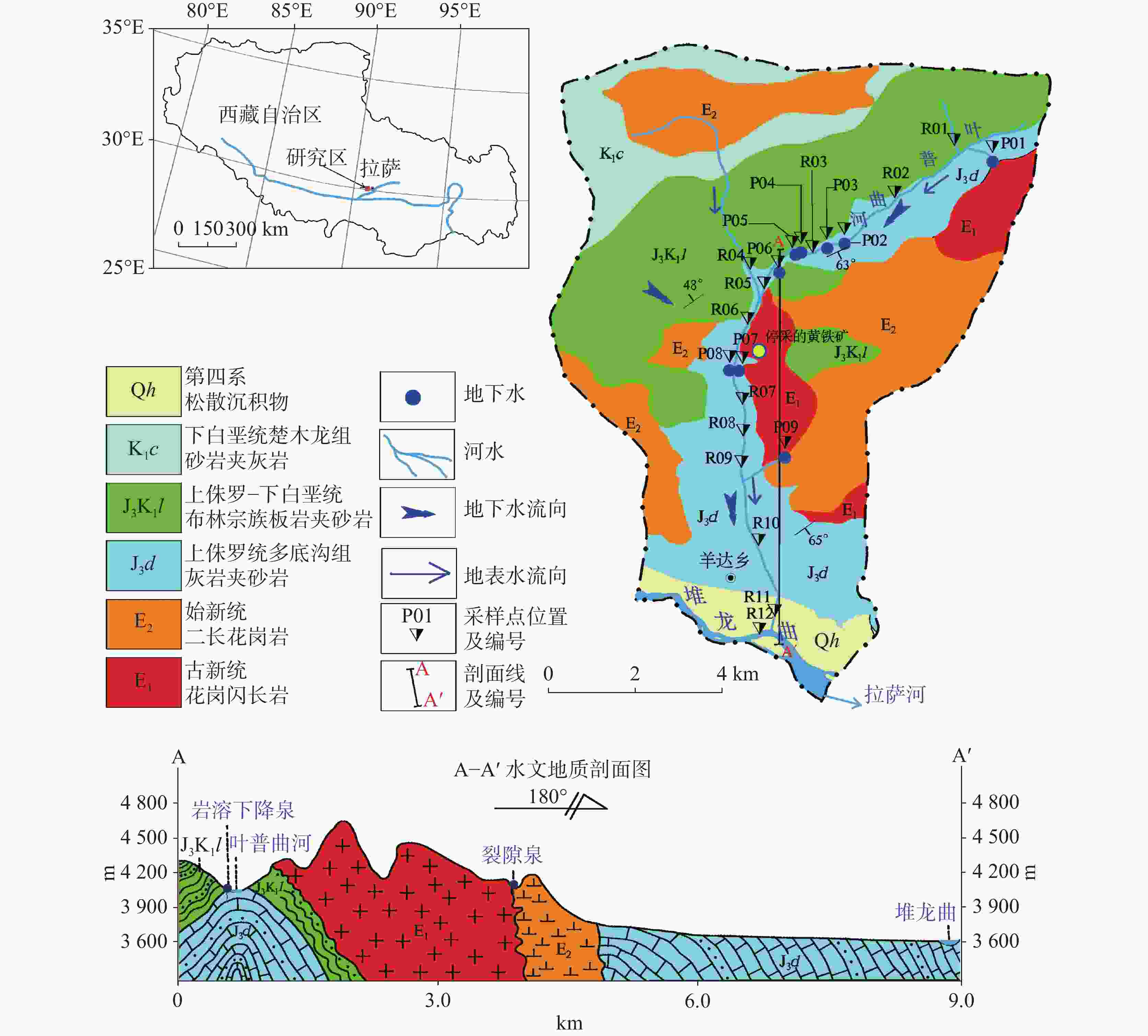
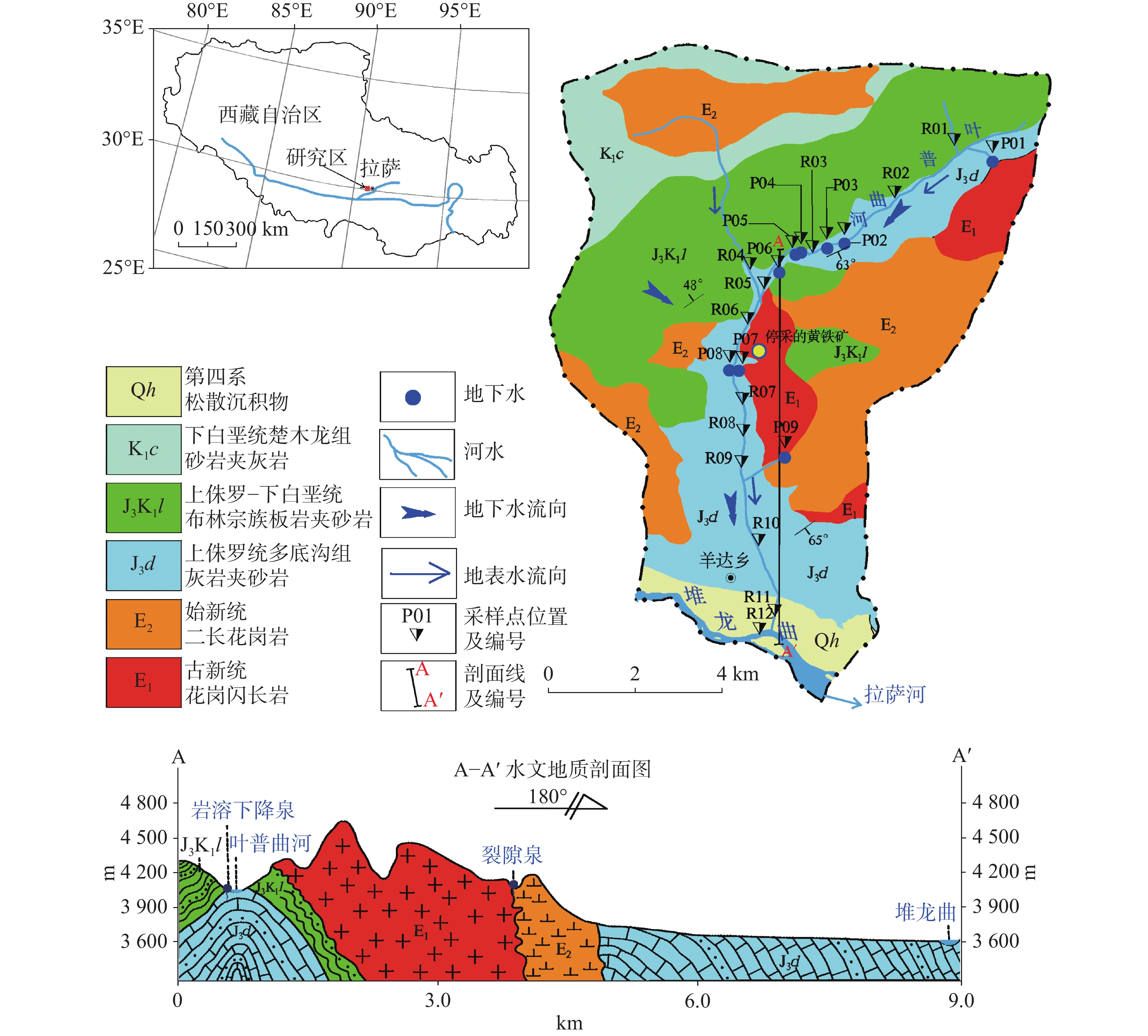
图 1 研究区水文地质示意图及取样点分布
Figure 1. Hydrogeological sketch and sampling sites of the study area
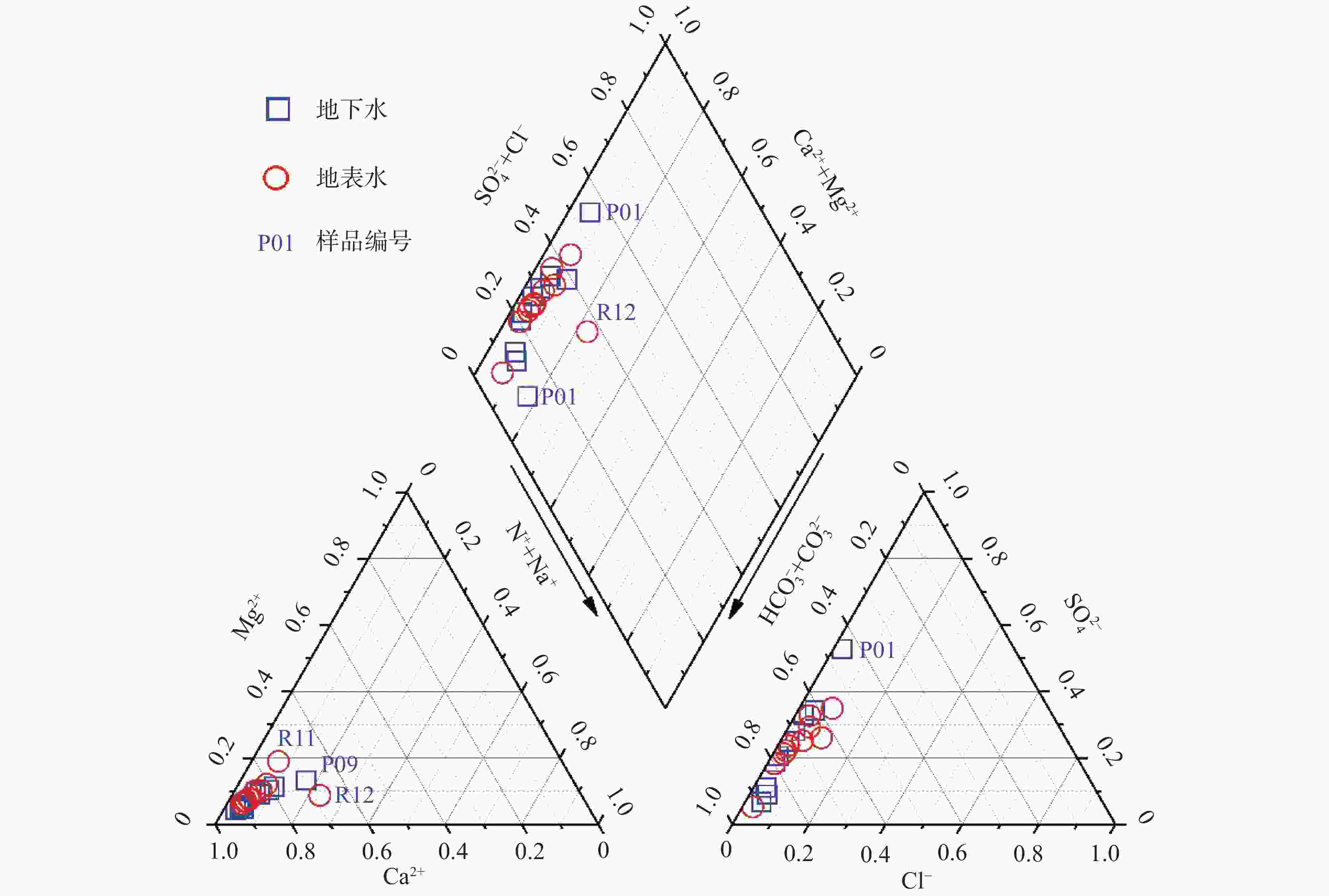
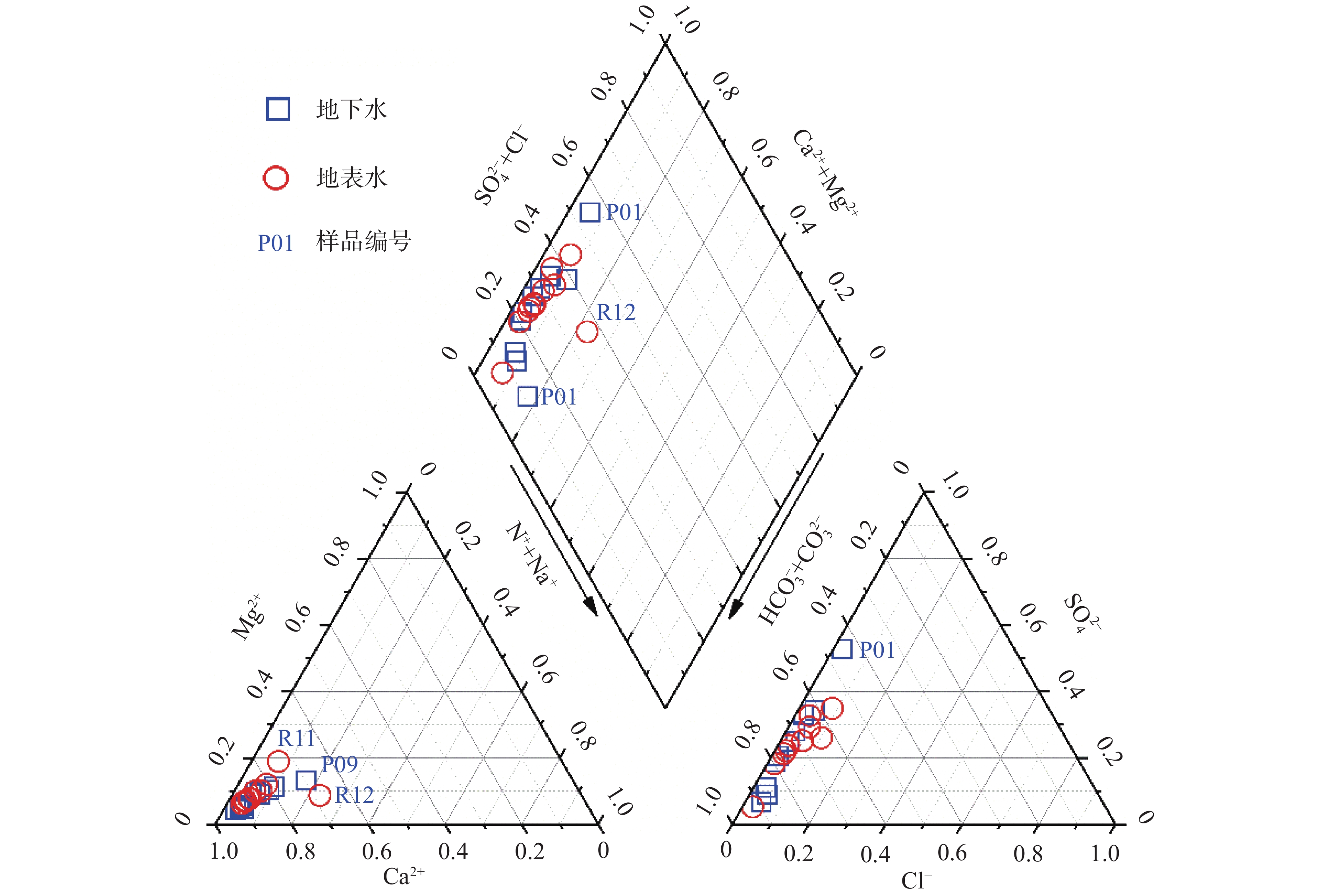
图 2 研究区水化学Piper 三线图
Figure 2. Piper trilinear diagram of hydrochemistry in the study area
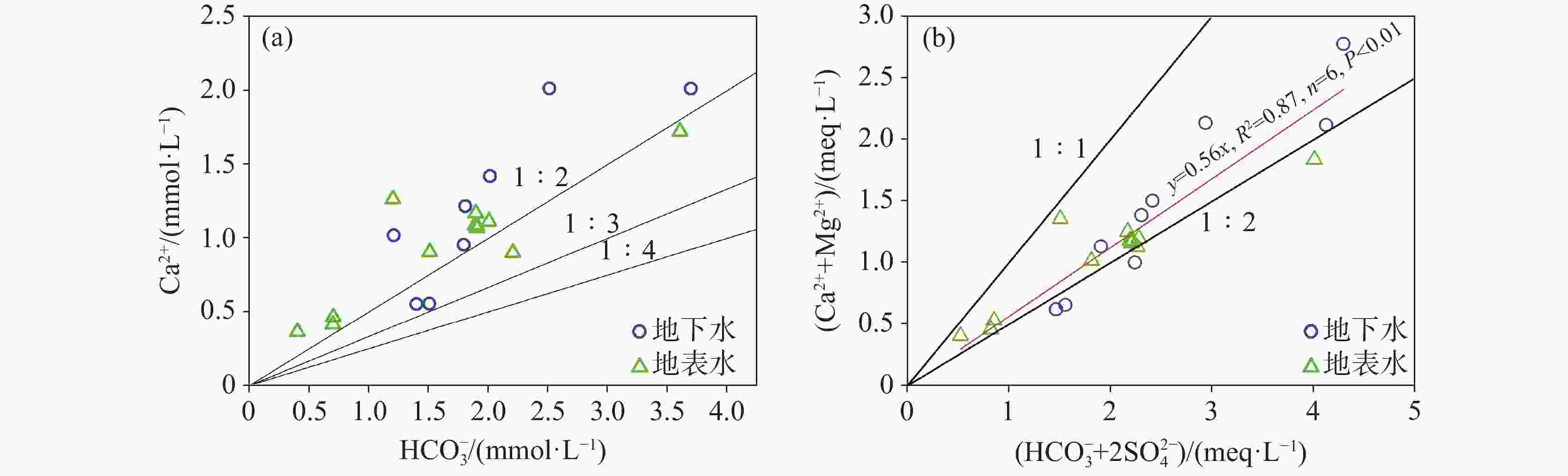
图 4 研究区碳酸盐岩溶解离子关系
Figure 4. Relationship of carbonate rock dissolution irons in the study area
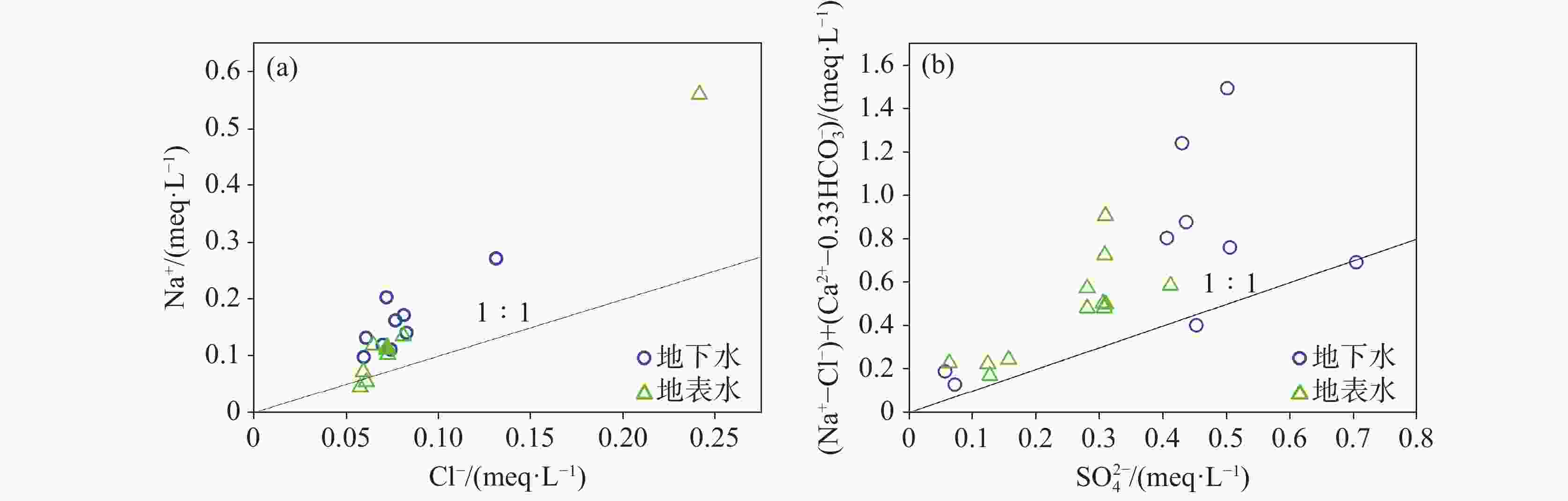
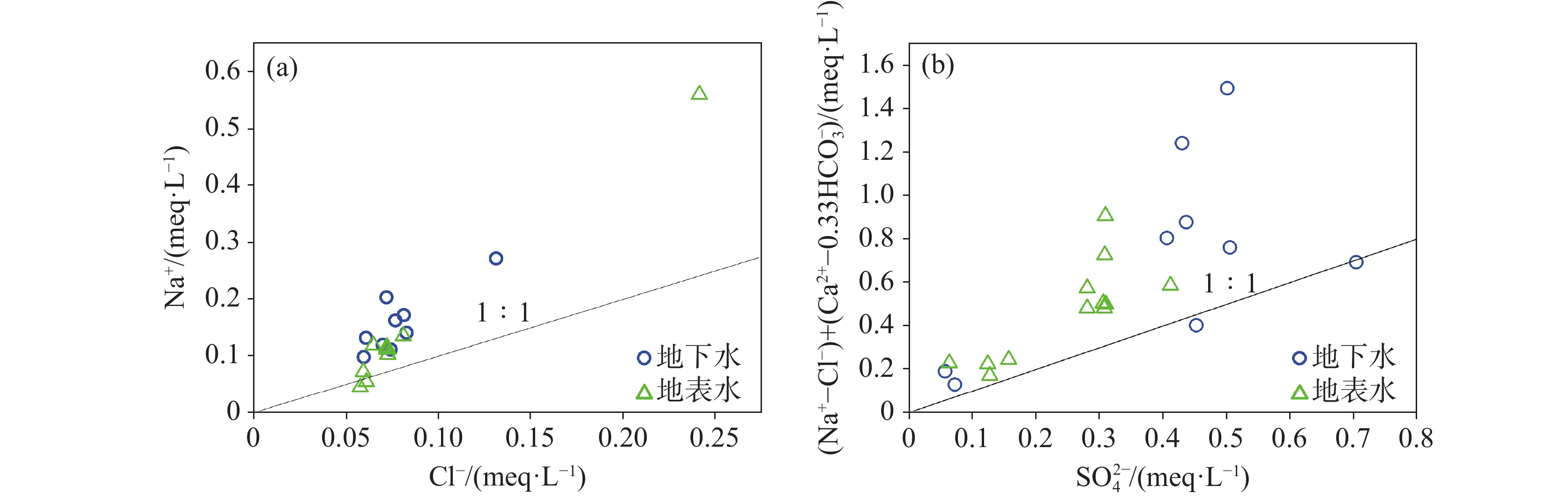
图 5 研究区非碳酸盐岩盐溶解离子关系
Figure 5. Relationship of non-carbonate rock salt dissolution ions in the study area
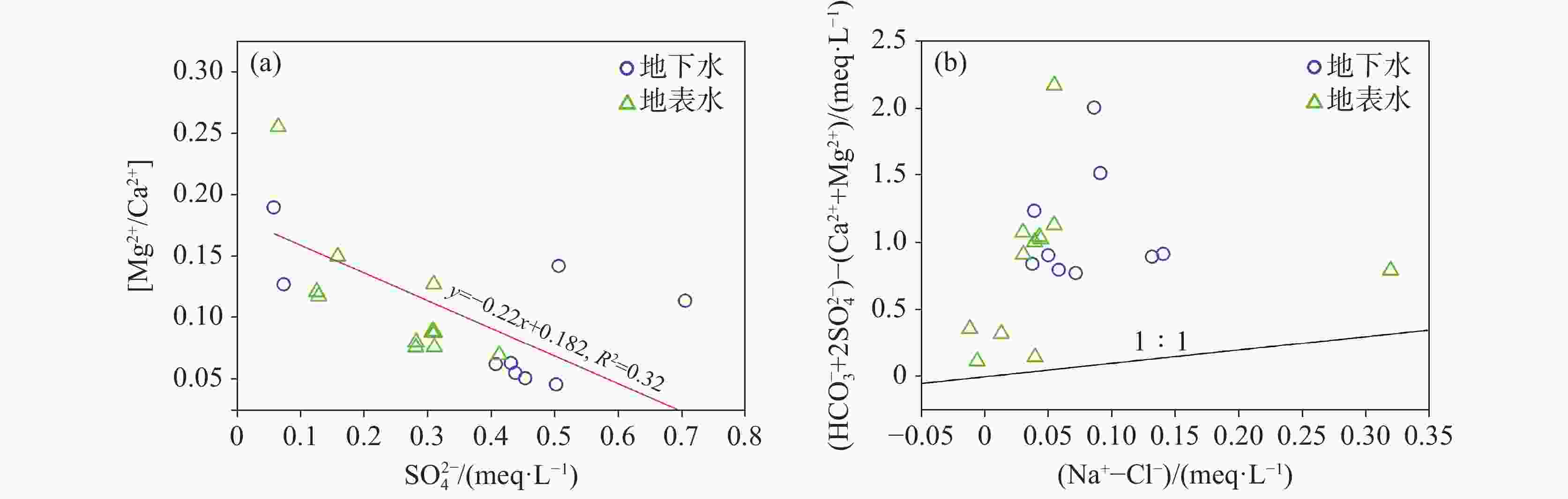
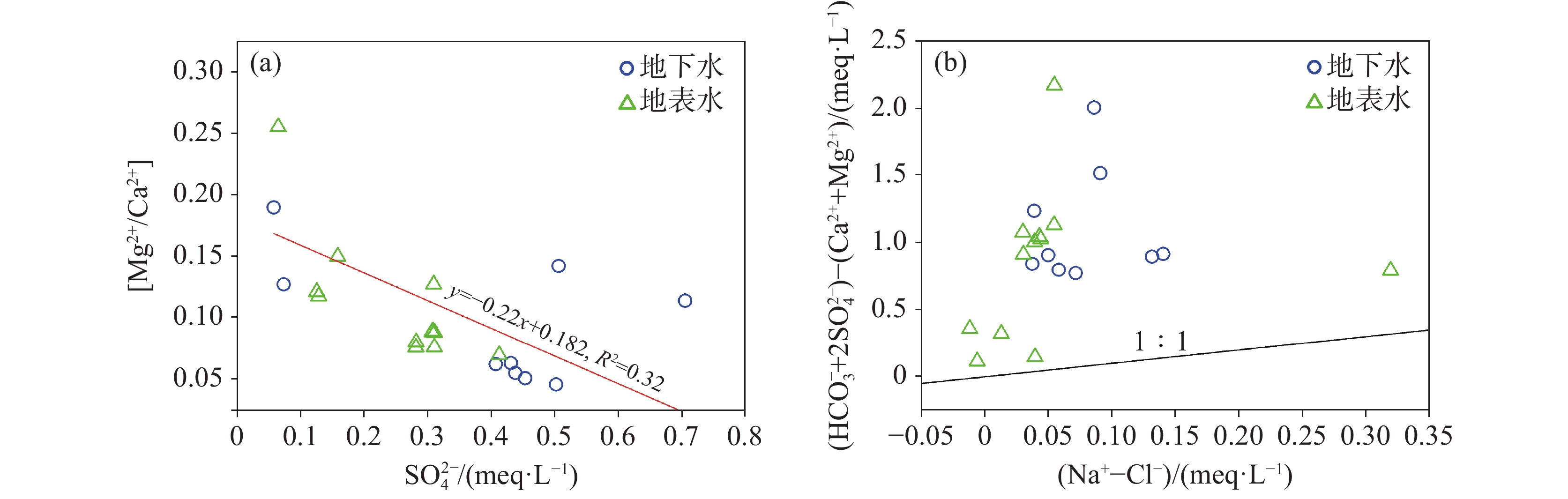
图 6 研究区[Mg2+/Ca2+]与${\rm{SO}}_4^{2-}$及阳离子交换关系
Figure 6. Relationship between [Mg2+/Ca2+] and ${\rm{SO}}_4^{2-}$ and cation exchange in the study area
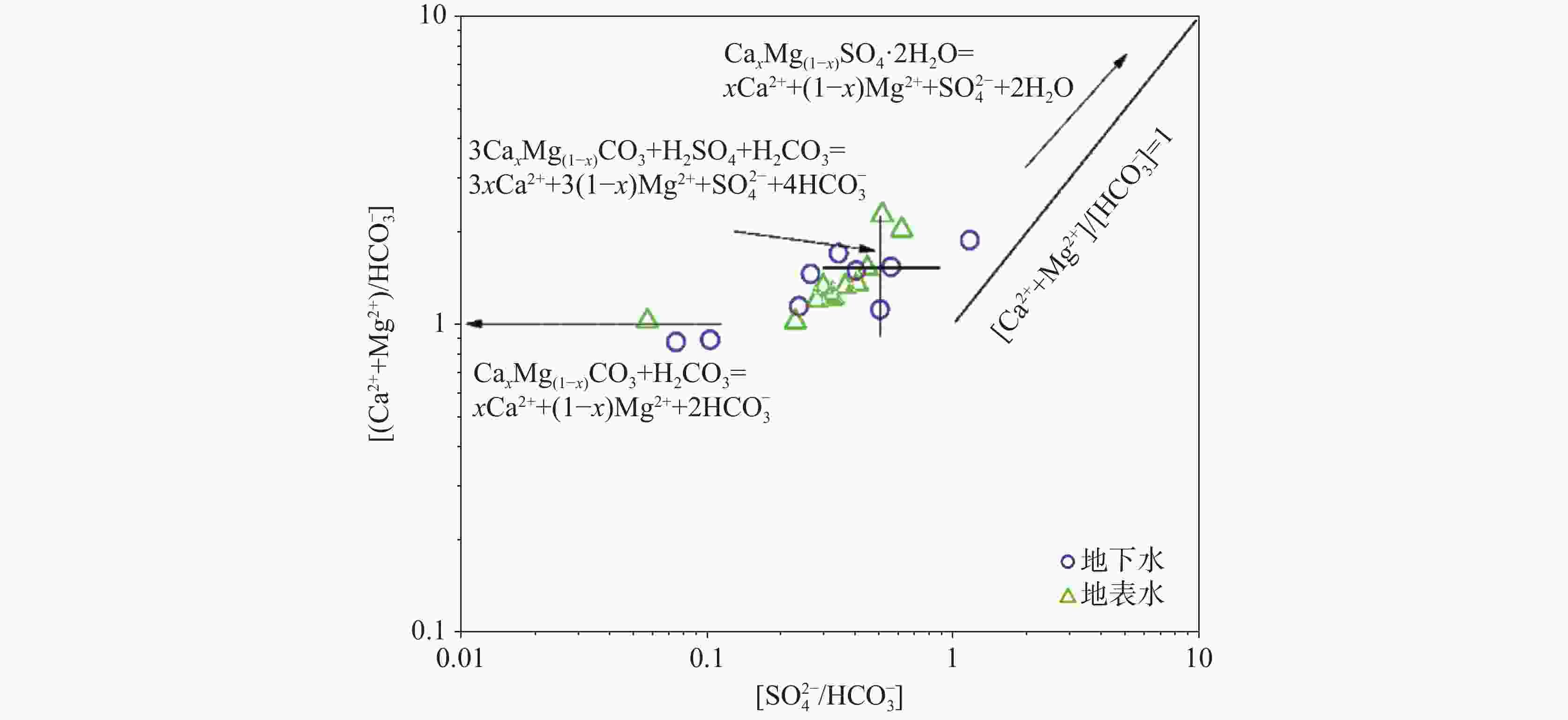
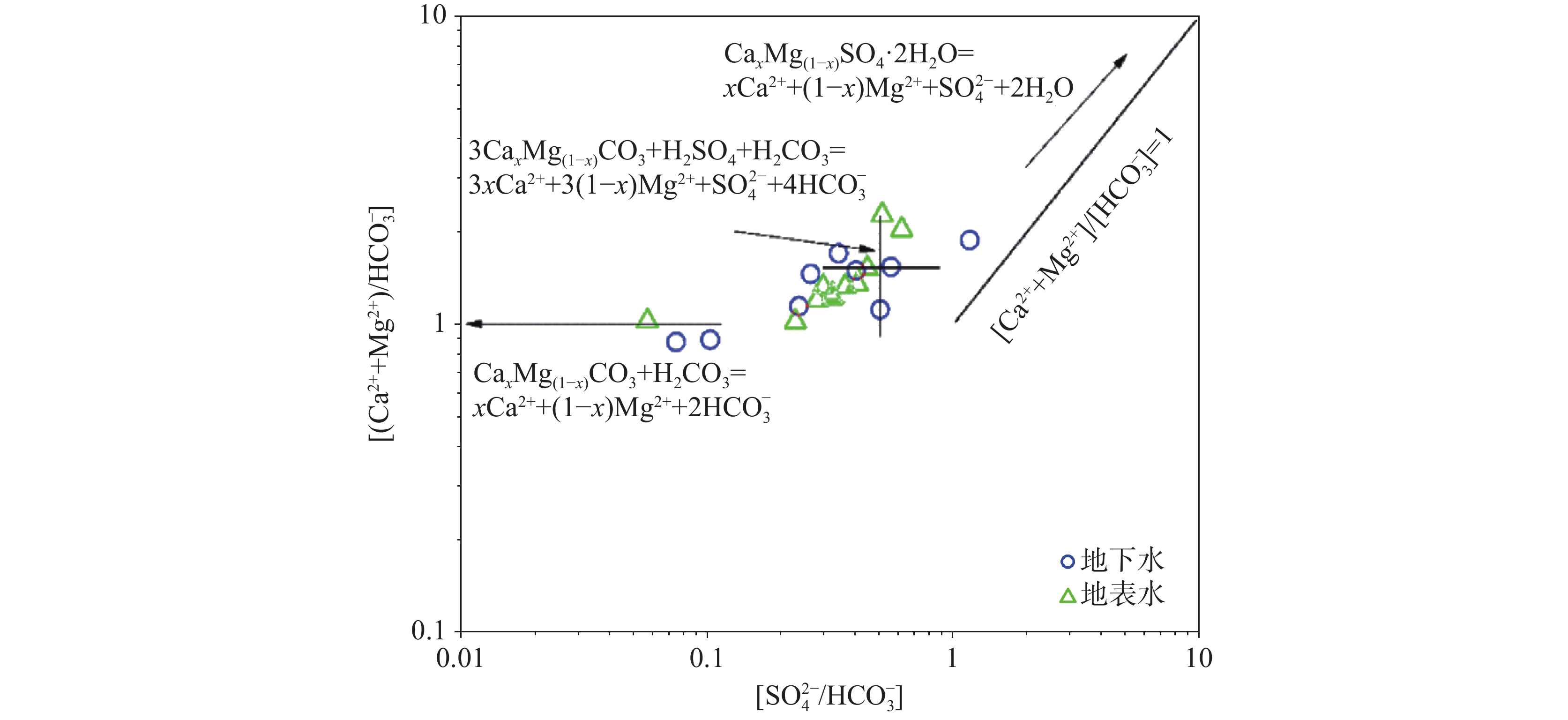
图 7 不同水体中[(Ca2++Mg2+)/${\rm{HCO}}_3^{-}$]和 [${\rm{SO}}_4^{2-}$/${\rm{HCO}}_3^{-}$]关系
Figure 7. Relationship between [(Ca2++Mg2+)/${\rm{HCO}}_3^{-}$] and [${\rm{SO}}_4^{2-}$/${\rm{HCO}}_3^{-}$] in different water bodies
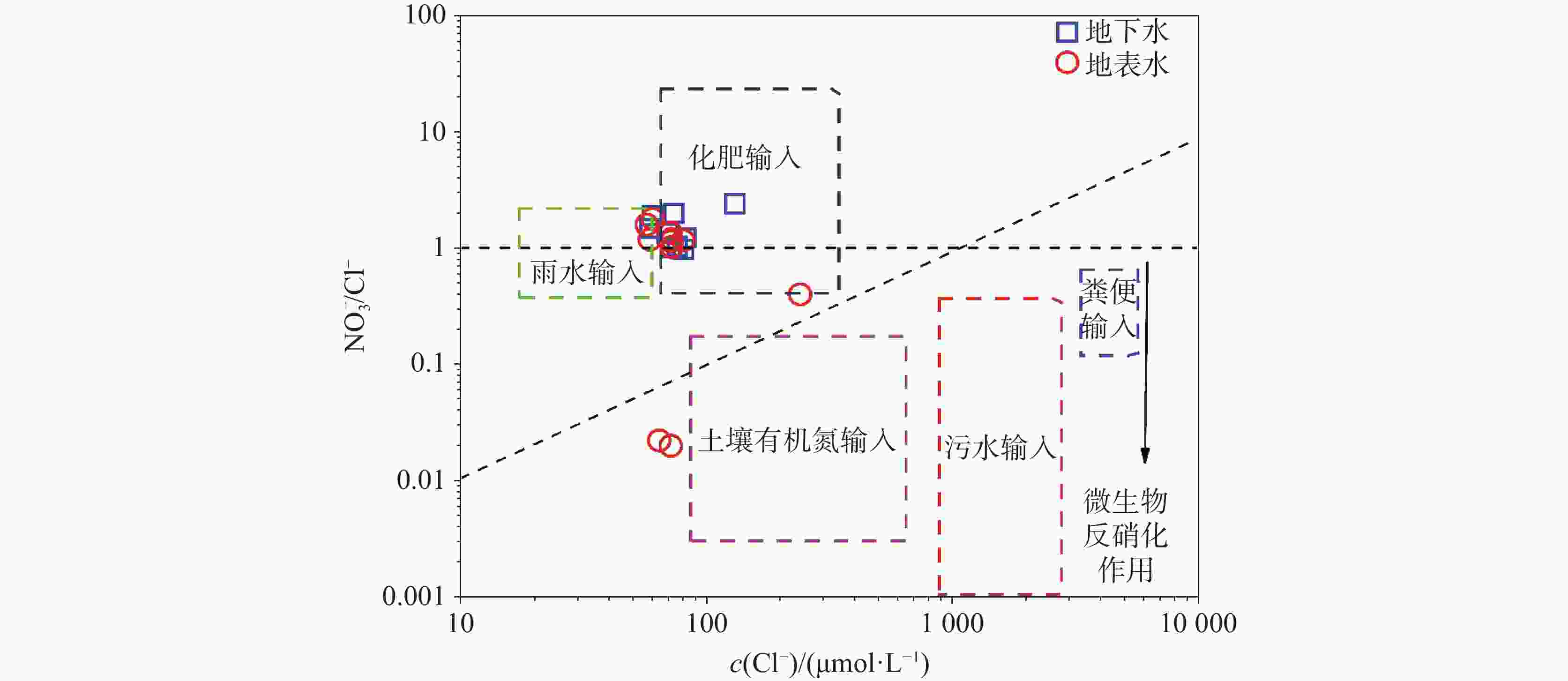
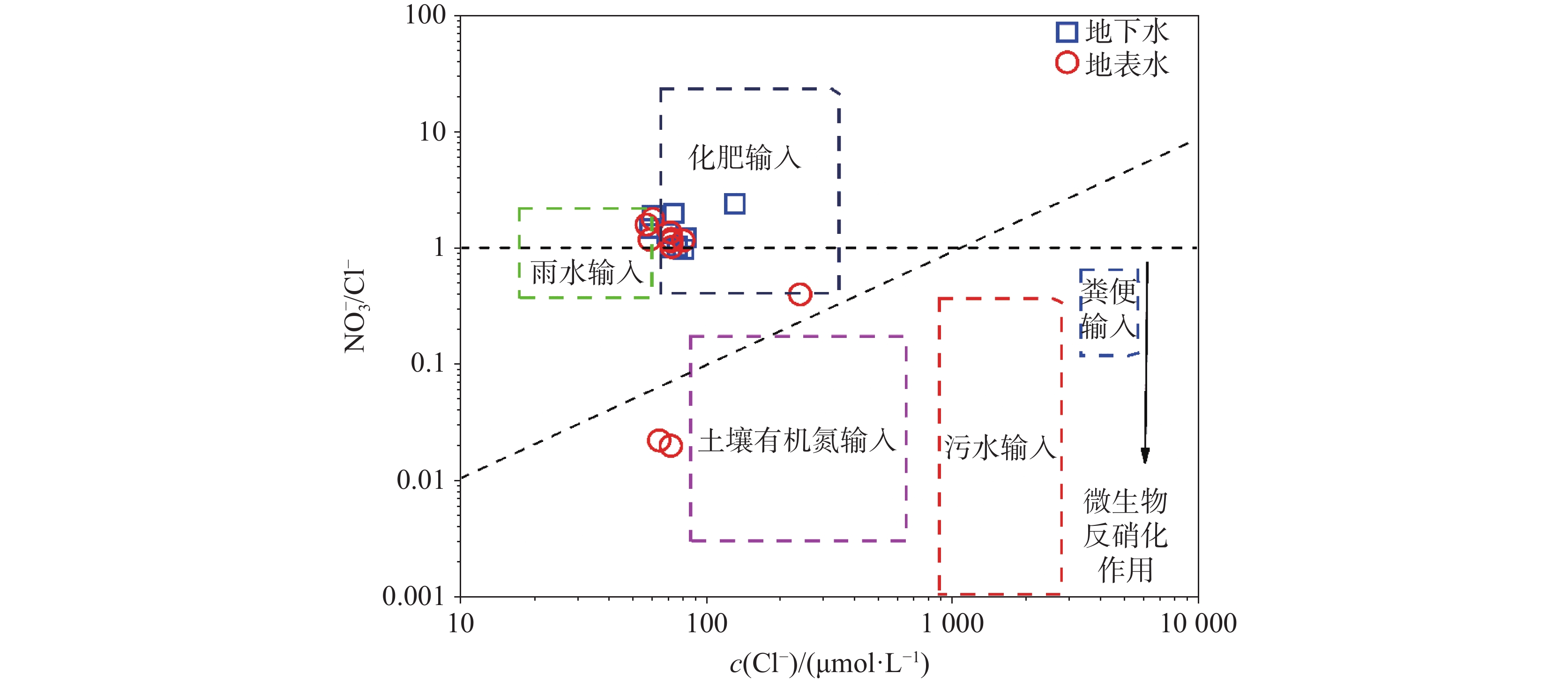
图 9 研究区地下水-地表水中Cl−与${\rm{NO}}_3^{-}$/ Cl−间关系
Figure 9. Relationship between Cl− and ${\rm{NO}}_3^{-}$/Cl− in groundwater and surface water of the study area
表 1 地表水和地下水水质标准 (单位:mg·L−1)
Table 1. Water quality standards for surface water and groundwater (unit: mg·L−1)
类型 参数 Ⅰ Ⅱ Ⅲ Ⅳ Ⅴ 地表水 TN ≤0.2 ≤0.5 ≤1 ≤1.5 ≤2 NH3-N ≤0.15 ≤0.5 ≤1 ≤1.5 ≤2 TP ≤0.02 ≤0.1 ≤0.2 ≤0.3 ≤0.4 DO ≤7.5 ≤6 ≤5 ≤3 ≤2 CODMn ≤15 ≤15 ≤20 ≤30 ≤40 As ≤0.05 ≤0.05 ≤0.05 ≤0.1 ≤0.1 Pb ≤0.01 ≤0.01 ≤0.05 ≤0.05 ≤0.1 Zn ≤0.05 ≤1 ≤1 ≤2 ≤2 Cd ≤0.001 ≤0.005 ≤0.005 ≤0.005 ≤0.01 地下水 TN / / / / / NH3-N ≤0.02 ≤0.1 ≤0.5 ≤1.5 >1.5 TP / / / / / DO / / / / / CODMn ≤1 ≤2 ≤3 ≤10 >10 As ≤0.001 ≤0.001 ≤0.01 ≤0.05 >0.05 Pb ≤0.005 ≤0.005 ≤0.01 ≤0.1 >0.1 Zn ≤0.05 ≤0.5 ≤1 ≤5 >5 Cd ≤ 0.0001 ≤0.001 ≤0.005 ≤0.01 >0.01 注:“/”为未给出水质标准限值。  下载: 导出CSV
表 2 综合污染指数评价
Table 2. Comprehensive pollution index assessment
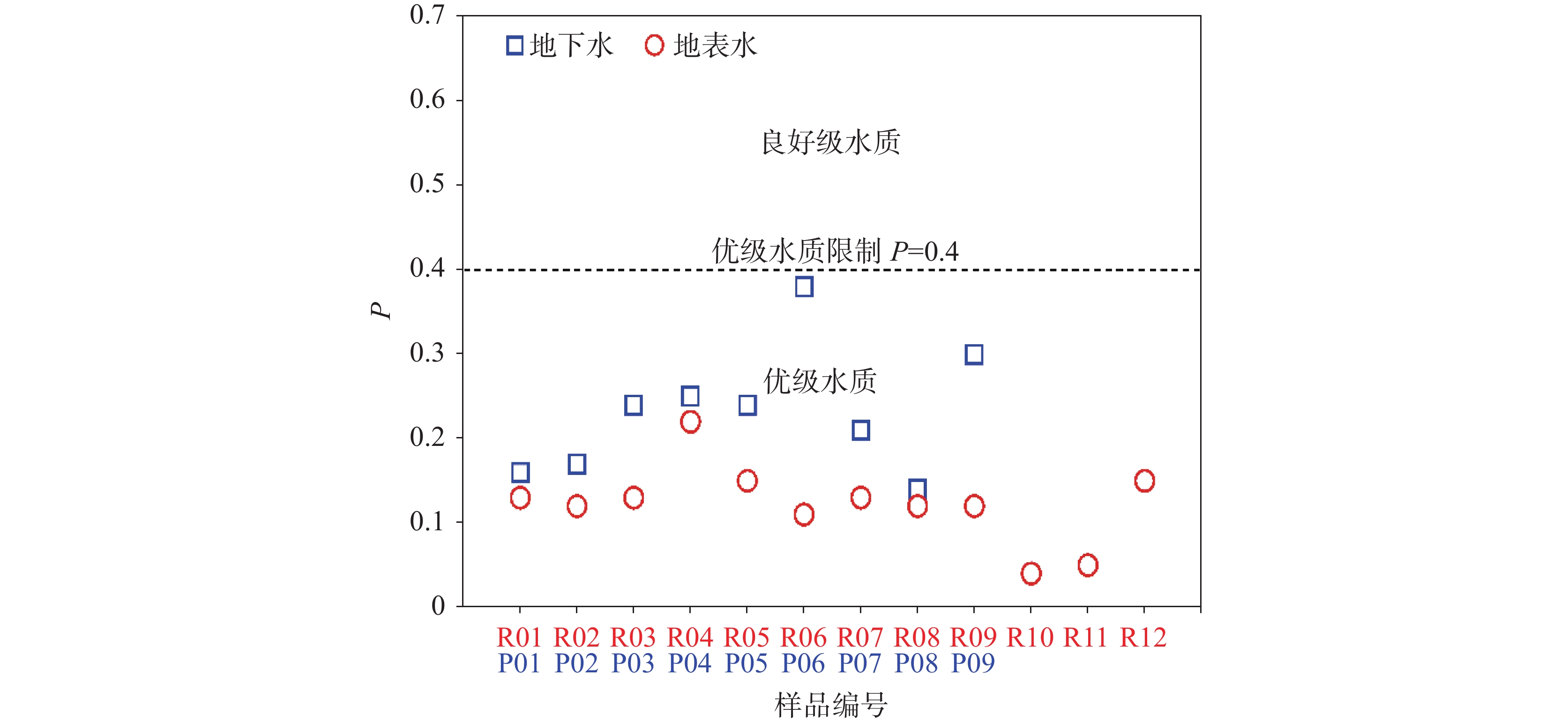
P 水质级别 污染程度 水质特征阐述 ≤0.4 Ⅰ 优 多数项目未检出,个别检出也在标准内 0.4~0.70 Ⅱ 良好 仅个别项目检出超标 0.71~1.00 Ⅲ 轻度污染 2项检出超标 1.01~2.00 Ⅳ 中度污染 相当部分检出超标 >2.00 Ⅴ 重度污染 相当部分检出超标数倍或几十倍
下载: 导出CSV
表 3 研究区水化学特征统计
Table 3. Statistics of hydrochemical characteristics in the study area
类型 样品编号 pH T ρ(TDS) ρ(K+) ρ(Na+) ρ(Ca2+) ρ(Mg2+) ρ(Cl−) ρ(${\rm{SO}}_4^{2-}$) ρ(HCO$_3^{-}$) ρ(NO$_3^{-}$) 地下水 P01 7.99 2.1 197.81 0.35 3.04 40.8 2.79 2.12 67.64 73.4 4.00 P02 7.40 6.7 384.12 0.47 3.24 80.4 3.06 2.89 41.26 152.9 3.51 P03 8.31 5.9 193.25 0.36 2.26 38.2 1.17 2.08 43.44 109.2 3.05 P04 8.25 7.2 286.22 0.36 2.75 56.8 2.13 2.44 38.98 122.5 3.25 P05 7.98 7.1 439.36 0.39 3.96 106.3 2.93 2.84 48.12 231.5 2.76 P06 8.19 6.5 401.51 0.38 3.74 80.4 2.67 2.68 41.92 225.1 2.76 P07 8.26 12.4 222.76 1.17 6.25 48.7 4.16 4.59 48.50 109.9 10.98 P08 7.92 12.5 105.42 0.47 2.56 22.1 1.69 2.59 6.89 85.0 5.10 P09 8.30 10.4 139.41 2.77 4.68 22.2 2.53 2.51 5.40 91.6 2.50 地表水 R01 7.97 11.6 176.97 0.52 1.66 18.5 1.67 2.07 15.05 42.6 2.43 R02 8.08 7.8 57.62 0.28 1.04 16.5 1.17 2.01 12.18 42.4 3.17 R03 8.03 6.2 367.33 0.43 3.12 68.8 2.89 2.83 39.50 219.5 3.27 R04 8.23 4.5 58.55 0.27 1.26 14.5 1.06 2.13 11.88 24.4 3.78 R05 8.06 4.8 230.31 0.35 2.36 46.7 2.14 2.53 26.90 115.3 3.02 R06 7.82 5.1 229.27 0.35 2.36 44.5 2.15 2.54 26.92 122.1 2.58 R07 7.96 5.1 224.48 0.40 2.56 50.5 2.32 2.51 29.68 73.0 3.40 R08 8.05 6.1 223.22 0.42 2.57 43.6 2.32 2.54 29.32 115.0 2.92 R09 7.96 7.9 220.16 0.46 2.64 42.7 2.29 2.52 29.50 116.0 2.87 R10 8.06 8.7 219.29 0.49 2.67 43.3 2.30 2.52 29.70 115.8 0.05 R11 8.25 3.2 179.83 2.05 2.74 36.0 5.52 2.26 6.05 134.3 0.05 R12 8.14 6.8 228.67 1.83 12.90 36.2 2.77 8.44 29.57 91.9 3.36 地下水(n=9) 最大值 8.31 12.5 439.36 2.77 6.25 106.3 4.16 4.59 67.64 231.5 10.98 最小值 7.40 2.1 105.42 0.35 2.26 22.1 1.17 2.08 5.40 73.4 2.50 平均值 8.06 7.9 263.32 0.75 3.61 55.1 2.57 2.75 38.02 133.4 4.21 标准差 0.27 3.2 113.69 0.76 1.17 27.1 0.81 0.70 18.79 55.1 2.51 变异系数 0.03 0.4 0.43 1.01 0.32 0.5 0.31 0.26 0.49 0.4 0.60 地表水(n=12) 最大值 8.25 11.6 367.33 2.05 12.90 68.8 5.52 8.44 39.50 219.5 3.78 最小值 7.82 3.2 57.62 0.27 1.04 14.5 1.06 2.01 6.05 24.4 0.05 平均值 8.05 6.5 201.31 0.65 3.16 38.5 2.38 2.91 23.85 101.0 2.58 标准差 0.11 2.2 78.37 0.58 3.00 15.0 1.08 1.68 9.58 50.0 1.18 变异系数 0.01 0.3 0.39 0.89 0.95 0.4 0.46 0.58 0.40 0.5 0.46 注:除pH 和变异系数无量纲外,T的单位为 ℃,其余水化学指标的最大值、 最小值、 平均值和标准差的单位均为mg·L−1。
下载: 导出CSV
表 4 研究区水质参数特征统计
Table 4. Statistics of water quality parameters in the study area
类型 样品编号 ρ(TN)/ NH3-N/ TP/ DO/ CODMn/ As/ Pb/ Zn/ Cd/ mg·L−1 mg·L−1 μg·L−1 mg·L−1 mg·L−1 μg·L−1 μg·L−1 μg·L−1 μg·L−1 地下水 P01 0.96 0.04 20.00 8.53 0.33 0.31 0.15 0.80 0.06 P02 0.85 0.03 20.00 6.84 0.55 1.64 0.09 3.87 0.06 P03 0.71 0.02 20.00 7.95 0.81 8.62 0.44 1.14 0.07 P04 0.79 0.02 22.20 7.12 0.51 8.26 0.24 0.80 0.06 P05 0.69 0.02 20.00 6.46 0.44 9.56 0.07 1.74 0.06 P06 2.48 0.03 27.12 7.65 0.44 7.61 5.36 6.27 0.06 P07 1.22 0.02 26.91 6.81 0.55 0.55 0.85 2.18 0.06 P08 0.70 0.03 21.82 7.57 0.51 1.29 0.17 0.80 0.06 P09 0.58 0.02 20.00 6.90 0.84 0.67 0.53 3.43 0.06 地表水 R01 0.59 0.03 20.00 6.59 0.95 5.31 0.97 1.95 0.11 R02 0.74 0.02 20.00 7.43 0.37 0.62 0.28 0.80 0.06 R03 0.75 0.02 20.00 8.04 0.44 2.13 0.12 2.94 0.06 R04 1.51 0.02 20.00 8.48 0.62 0.45 0.15 0.80 0.06 R05 0.70 0.02 20.00 8.45 2.09 1.45 0.28 1.00 0.06 R06 0.62 0.02 20.00 8.47 0.73 1.39 0.19 0.80 0.06 R07 0.78 0.02 20.00 8.58 0.81 1.34 0.18 0.80 0.06 R08 0.68 0.02 20.00 8.38 0.66 1.35 0.19 0.80 0.06 R09 0.67 0.02 20.00 8.02 0.59 1.42 0.21 0.80 0.06 R10 0.03 0.02 20.00 7.93 0.75 1.56 0.74 3.02 0.06 R11 0.02 0.02 20.00 8.85 0.70 2.21 2.49 13.7 0.06 R12 0.78 0.02 20.00 8.77 0.84 23.41 0.71 2.57 0.06
下载: 导出CSV
表 7 旋转成分矩阵
Table 7. Rotating component matrix
地下水 地表水 指标参数 因子1 因子2 因子3 指标参数 因子1 因子2 因子3 ρ(NH3-N)/(mg·L−1) 0.978 −0.172 0.221 ρ(TN)/(mg·L−1) −0.213 0.812 0.008 ρ(CODMn)/(mg·L−1) −0.161 0.620 0.151 ρ(NH3-N)/(mg·L−1) −0.019 0.841 0.474 ρ(As)/(mg·L−1) 0.054 0.288 0.696 ρ(TP) /(mg·L−1) −0.119 0.880 0.236 ρ(Pb)/(mg·L−1) 0.265 0.924 0.219 ρ(DO)/(mg·L−1) 0.090 −0.215 −0.085 ρ(Zn)/(mg·L−1) 0.128 0.759 −0.132 ρ(CODMn)(mg·L−1) −0.049 0.128 −0.306 ρ(Cd)/(mg·L−1) 0.278 0.797 0.392 ρ(As)/(mg·L−1) 0.033 −0.025 0.925 ρ(Pb)/(mg·L−1) 0.953 0.064 −0.076 ρ(Zn)/(mg·L−1) 0.944 −0.163 0.010 ρ(Cd)/(mg·L−1)> 0.907 0.093 −0.236 特征值 3.508 2.178 1.590 特征值 3.08 2.749 1.534 累计方差/% 38.983 63.187 80.849 累计方差/% 32.761 63.003 81.945
下载: 导出CSV
-
[1] 曹宏斌, 李爱民, 赵赫, 李庭刚, 张笛, 朱利中. 我国工业水污染防治措施实施情况评估[J]. 中国工程科学, 2022, 24(5): 137-144.Cao Hongbin, Li Aiming, Zhao He, Li Tinggang, Zhang Di, Zhu Lizhong. Evaluation on the implementation of industrial water pollution control in China [J]. Strategic Study of CAE, 022, 24(5): 137-144. [2] Liao H, Jiang Z, Zhou H, Qin X, Huang Q. Isotope-based study on nitrate sources in a karst wetland water, Southwest China[J]. Water, 2022, 14(10): 1533. doi: 10.3390/w14101533 [3] Liu Y, Shan F, Yue H, Wang X. Characteristics of drought propagation and effects of water resources on vegetation in the karst area of Southwest China[J]. Science of The Total Environment, 2023, 891: 164663. doi: 10.1016/j.scitotenv.2023.164663 [4] 王楠, 胥芹, 孙小艳, 武显仓, 李常锁, 高帅. 趵突泉泉域岩溶水化学特征及成因研究[J]. 中国岩溶, 2024, 43(2): 279-290. doi: 10.11932/karst20240203Wang Nan, Xu Qin, Sun Xiaoyan, Wu Xiancang, Li Changsuo, Gao Shuai. Hydrochemical characteristics and formation mechanism of karst water in Baotu Spring watershed[J]. Carsologica Sinica, 2024, 43(2): 279-290. doi: 10.11932/karst20240203 [5] 夏日元, 卢海平, 曹建文, 赵良杰, 王喆, 栾崧. 南方岩溶区地下水资源特征与水资源保障对策[J]. 中国地质, 2022, 49(4): 1139-1153. doi: 10.12029/gc20220408Xia Riyuan, Lu Haiping, Cao Jianwen, Zhao Liangjie, Wang Zhe, Luan Son. Characteristics of groundwater resources of karst areas in the Southern China and water resources guarantee countermeasures[J]. Geology in China, 2022, 49(4): 1139-1153. doi: 10.12029/gc20220408 [6] 任坤, 曾洁, 彭聪, 潘晓东, 于正良, 吴华英. 玉龙雪山—丽江水体水化学和同位素特征及其变化规律与成因[J]. 地理学报, 2024, 79(11): 2864-2879. doi: 10.11821/dlxb202411011Ren Kun, Zeng Jie, Peng Cong, Pan Xiaodong, Yu Zhengliang, Wu Huaying. Hydrochemical and isotopic characteristics, changes and controlling factors of waters in the Yulong Snow Mountain-Lijiang area, China[J]. Acta Georaphical Sinica, 2024, 79(11): 2864-2879. doi: 10.11821/dlxb202411011 [7] 于令芹, 林广奇, 刘媛媛, 齐欢, 孟庆斋, 马河宽, 江露露, 刘春伟. 济南市区泉水与东、西郊岩溶水水力联系研究[J]. 中国岩溶, 2023, 42(5): 917-930, 955. doi: 10.11932/karst20230505Yu Lingqin, Lin Guangqi, Liu Yuanyuan, Qi Huan, Meng Qingzhai, Ma Hekuan, Jiang Lulu, Liu Chunwei. Study on the hydraulic connection between downtown and eastern and western suburbs in Jinan[J]. Carsologica Sinica, 2023, 42(5): 917-930, 955. doi: 10.11932/karst20230505 [8] 赵春红, 申豪勇, 卢海平, 王志恒, 梁永平, 唐春雷. 晋祠泉域岩溶地下水防污性能评价与水质保护区划分[J]. 中国岩溶, 2024, 43(4): 822-830. doi: 10.11932/karst2024y034Zhao Chunhong, Shen Haoyong, Lu Haiping, Wang Zhiheng, Liang Yongping, Tang Chunlei. Vulnerability assessment of karst groundwater in the Jinci spring area and the zoning of protected areas for water quality[J]. Carsologica Sinica, 2024, 43(4): 822-830. doi: 10.11932/karst2024y034 [9] 张浔浔, 文浪, 杨斌, 赵阳刚, 邢莉圆, 段阳海, 蒲春. 青藏高原拉萨河—尼洋河流域三类水体氢氧稳定同位素特征分析[J]. 现代地质, 2025, 39(2): 410-419.Zhang Xunxun, Wen Lang, Yang Bin, Xing Liyuan, Duan Yanghai, Pu Chun. Characteristics analysis of three types of water hydroxide stabilization of hydroxide stabilization of the Lhasa River and Nyang River basin in Qinghai-Tibet Plateau[J]. Geoscience, 2025, 39(2): 410-419. [10] 谷黄河, 刘宇清, 王晓燕, 代斌, 张瀚文, 付晓雷, 余钟波. 基于VIC_glacier模型的拉萨河水文模拟及冰川径流研究[J]. 水文, 2024, 44(1): 90-95, 103.Gu Huanghe, Liu Yuqing, Wang Xiaoyan, Dai Bin, Zhang Hanwen, Fu Xiaolei, Yu Zhongbo. Hydrology simulation and glacier runoff study in Lasa River basin based on VIC_glacier model[J]. Journal of China Hydrology, 2024, 44(1): 90-95, 103. [11] 刘坤, 袁新, 谭军, 苏景, 向浩渝, 陆必生, 孙飞达, 魏巍. 拉萨河流域典型草原植物多样性及土壤养分异质性研究[J/OL]. 中国地质, 2024-07-19. https://link.cnki.net/urlid/11.1167.P.20240717.1703.002.Liu Kun, Yuan Xin, Tan Jun, Su Jing, Xiang Haoyu, Lu Bisheng, Sun Feida, Wei Wei. Typical grassland plant diversity and soil nutrient heterogeneity in the Lhasa River basin, Xizang (Tibet)[J/OL]. Geology in China, 2024-07-19. https://link.cnki.net/urlid/11.1167.P.20240717.1703.002. [12] 李婧婷, 田震, 蔡庆华. 雅鲁藏布江大型底栖无脊椎动物多样性分异的流域驱动因子分析: 以尼洋河与拉萨河为例[J]. 湿地科学, 2023, 21(6): 918-926.Li Jingting, Tian Zheng, Cai Qinghua. Watershed driving factors and differentiation of benthic macroinvertebrate diversity in the Yarlung Tsangpo River: A case study of the Niyang River and the Lhasa River[J]. Wetland Science, 2023, 21(6): 918-926. [13] 周建伟, 罗君, 马雪洋. 拉萨河流域土地利用与生态系统服务价值时空演变及驱动因素[J]. 干旱区研究, 2024, 41(6): 1021-1031.Zhou Jianwei, Luo Jun, Ma Xueyang. Spatio-temporal evolution and driving factors of land use and ecosystem service value in the Lhasa River Basin, China[J]. Arid Zone Research, 2024, 41(6): 1021-1031. [14] 杜书栋, 关亚楠, 李欣, 赵玉强, 刘善军, 闫崇军, 白军红. 基于熵权法改进的综合污染指数的水质评价: 以白云湖为例[J]. 环境科学学报, 2022, 42(1): 205-212.Du Shudong, Guan Yanan, Li Xin, Zhao Yuqiang, Liu Shanjun, Yan Chongjun, Bai Junhong. Water quality evaluationwith improved comprehensive pollution index based on entropy weight method: A case study of Baiyun Lake[J]. Acta Scientiae Circumstantiae, 2022, 42(1): 205-212. [15] 谢慧钰, 胡梅, 嵇晓燕, 曹炳伟, 贾世琪, 徐建, 金小伟. 2011—2019年鄱阳湖水质演化特征及主要污染因子解析[J]. 环境科学, 2022, 43(12): 5585-5597.Xie Huiyu, Hu Mei, Ji Xiaoyan, Cao Bingwei, Jia Shiqi, Xu Jian, Jin Xiaowei. Water quality evolution characteristics and pollution factor analysis in Poyang Lake from 2011 to 2019.[J]. Environmental Science, 2022, 43(12): 5585-5597. [16] Rao N S, Dinakar A, Sun L. Estimation of groundwater pollution levels and specific ionic sources in the groundwater, using a comprehensive approach of geochemical ratios, pollution index of groundwater, unmix model and land use/land cover: A case study[J]. Journal of Contaminant Hydrology, 2022, 248: 103990. doi: 10.1016/j.jconhyd.2022.103990 [17] 周智强, 黄奇波, 汪玉松, 罗飞, 梁建宏, 熊江俣. 典型岩溶矿区地表水和地下水补给来源及水化学演化机制[J]. 环境科学, 2024, 45(9): 5264-5276.Zhou Zhiqiang, Huang Qibo, Wang Yusong, Luo Fei, Liang Jianhong, Xiong Jiangyu. Recharge sources and hydrochemical evolution mechanism of surface water and groundwater in typical karst mining area[J]. Environmental Science, 2024, 45(9): 5264-5276. [18] Mu W, Wu X, Wu C, Hao Q, Deng R, Qian C. Hydrochemical and environmental isotope characteristics of groundwater in the Hongjiannao Lake Basin, Northwestern China[J]. Environmental earth sciences, 2021, 80: 1-21. doi: 10.1007/s12665-020-09327-2 [19] Huang Q B, Qin X Q, Liu P Y, Zhang L K, Su C T. Impact of sulfuric and nitric acids on carbonate dissolution, and the associated deficit of CO2 uptake in the upper−middle reaches of the Wujiang River, China[J]. Journal of contaminant hydrology, 2017, 203: 18-27. doi: 10.1016/j.jconhyd.2017.05.006 [20] 刘海, 康博, 管政亭, 宋阳, 柴义伦. 淮南煤矿区地表水和地下水水化学特征及控制因素[J]. 环境科学, 2023, 44(11): 6038-6049.Liu Hai, Kang Bo, Guan Zhengting, Song Yang, Chai Yilun. Hydrochemical characteristics and control factors of surface water and groundwater in Huainan coal mine area[J]. Environmental Science, 2023, 44(11): 6038-6049. [21] 刘凤, 李梅, 张荣飞, 崔益斌. 拉萨河流域重金属污染及健康风险评价[J]. 环境化学, 2012, 31(5): 580-585.Liu Feng, Li Mei, Zhang Rongfei, Cui Yibin. Pollution analysis and health risk assessment of heavy metals in Lhasa River[J]. Envieonmental Chemistry, 2012, 31(5): 580-585. [22] 黄奇波, 覃小群, 刘朋雨, 蓝芙宁, 张连凯, 苏春田. 乌江中上游段河水主要离子化学特征及控制因素[J]. 环境科学, 2016, 37(5): 1779-1787.Huang Qibo, Qin Xiaoqun, Liu Pengyu, Lan Funing, Zhang Liangkai, Su Chuntian. Major ionic features and their controlling factors in the upper-middle reaches of Wujiang River[J]. Environmental Science, 2016, 37(5): 1779-1787. [23] Gibbs R J. Mechanisms controlling world water chemistry[J]. Science, 1970, 170(3962): 1088-1090. doi: 10.1126/science.170.3962.1088 [24] Ranjan R K, Ramanathan A, Parthasarathy P, Kumar A. Hydrochemical characteristics of groundwater in the plains of Phalgu River in Gaya, Bihar, India[J]. Arabian Journal of Geosciences, 2013, 6: 3257-3267. doi: 10.1007/s12517-012-0599-1 [25] 廖驾, 朱振华, 彭毅, 韦珊珊, 罗朝晖, 刘壮, 徐强强, 谢亘. 湘西北地区岩溶地下水水化学与氘氧同位素特征分析[J]. 中国岩溶, 2023, 42(3): 425-435. doi: 10.11932/karst2023y003Liao Jia, Zhu Zhenhua, Peng Yi, Wei Shanshan, Luo Chaohui, Liu Zhuang, Xu Qiangqiang, Xie Gen. Analysis on D/18O and hydrochemical characteristics of karst groundwater in northwestern Hunan Province[J]. Carsologica Sinica, 2023, 42(3): 425-435. doi: 10.11932/karst2023y003 [26] Ming-Hui H, Stallard R, Edmond J. Major ion chemistry of some large Chinese rivers[J]. Nature, 1982, 298(5874): 550-553. doi: 10.1038/298550a0 [27] Qu B, Zhang Y, Kang S, Sillanpaa M. Water quality in the Tibetan Plateau: Major ions and trace elements in rivers of the "Water Tower of Asia"[J]. Science of the Total Environment, 2019, 649: 571-581. doi: 10.1016/j.scitotenv.2018.08.316 [28] Barzegar R, Asghari Moghaddam A, Najib M, Kazemian N, Adamowski J. Characterization of hydrogeologic properties of the Tabriz plain multilayer aquifer system, NW Iran[J]. Arabian Journal of Geosciences, 2016, 9: 147. doi: 10.1007/s12517-015-2098-7 [29] Xing L, Guo H, Zhan Y. Groundwater hydrochemical characteristics and processes along flow paths in the North China Plain[J]. Journal of Asian Earth Sciences, 2013, 70: 250-264. [30] Stimson J, Frape S, Drimmie R, Rudolph D. Isotopic and geochemical evidence of regional-scale anisotropy and interconnectivity of an alluvial fan system, Cochabamba Valley, Bolivia[J]. Applied Geochemistry, 2001, 16(9-10): 1097-1114. doi: 10.1016/S0883-2927(01)00019-1 [31] Hidalgo M C, Cruz-Sanjulián J. Groundwater composition, hydrochemical evolution and mass transfer in a regional detrital aquifer (Baza basin, southern Spain)[J]. Applied Geochemistry, 2001, 16(7-8): 745-758. doi: 10.1016/S0883-2927(00)00078-0 [32] Cerling T E, Solomon D K, Quade J A Y, Bowman J R. On the isotopic composition of carbon in soil carbon dioxide[J]. Geochimica et Cosmochimica Acta, 1991, 55(11): 3403-3405. doi: 10.1016/0016-7037(91)90498-T [33] Marghade D, Malpe D, Zade A. Geochemical characterization of groundwater from northeastern part of Nagpur urban, Central India[J]. Environmental Earth Sciences, 2011, 62: 1419-1430. doi: 10.1007/s12665-010-0627-y [34] Li P, Wu J, Qian H, Zhang Y, Yang N, Jing L, Yu P. Hydrogeochemical characterization of groundwater in and around a wastewater irrigated forest in the southeastern edge of the Tengger Desert, Northwest China[J]. Exposure and Health, 2016, 8:331-348. doi: 10.1007/s12403-016-0193-y [35] Kumari S, Udayabhanu G, Prasad B. Studies on environmental impact of acid mine drainage generation and its treatment: an appraisal[J]. Indian journal of environmental protection, 2010, 30(11): 953-967. [36] Ren K, Pan X D, Liang J P, Peng C, Zeng J. Sources and fate of nitrate in groundwater in a typical karst basin: Insights from carbon, nitrogen, and oxygen isotopes[J]. Huan Jing Ke Xue, 2021, 42(5): 2268-2275. [37] 谢浩, 申豪勇, 张海岛, 林永生, 李军, 梁慧雅, 王志恒, 朱天龙, 邹胜章. 清江流域不同类型岩溶地下水化学分布特征及成因机制[J]. 环境科学, 2025, 46, 3: 1417-1426.Xie Hao, Shen Haoyong, Zhang Haidao, Lin Yongsheng, Li Jun, Liang Huiya, Wang Zhiheng, Zhu Tianlong, Zou Shengzhang. Distributions and driving factors of hydrochemical compositions in different types of karst groundwater in Qingjiang River Basin[J]. Environmental Science, 2025, 46, 3: 1417-1426. [38] Li J, Zou S, Wang J, Zhou C, Wu Y, Zhang H, Zhao Y, Yang G. Spatiotemporal variability and control factors of ${\rm{NO}}_3^{-}$in a polluted karst water system of an agricultural wetland in south China[J]. Chemosphere, 2023, 313: 137435. doi: 10.1016/j.chemosphere.2022.137435 [39] 秦欢欢, 黄丽想, 陈益平, 高柏, 孙占学. 拉萨河水体砷和镉的分布特征与健康风险评价[J]. 生态与农村环境学报, 2023, 39(1): 107-114.Qin Huanhuan, Huang Lixiang, Chen Yiping, Gao Bai, Sun Zhanxue. Distribution characteristics and health risk assessment of arsenic and cadmm water of Lhasa River Basin[J]. Joumal of Ecology and Rural Environment, 2023, 39(1): 107-114. [40] 柳青青, 杨忠芳, 周国华, 夏学齐, 侯青叶, 余涛, 翟大兴. 中国东部主要入海河流As元素分布、来源及影响因素分析[J]. 现代地质, 2012, 26(1): 114-124. doi: 10.3969/j.issn.1000-8527.2012.01.012Liu Qingqing, Yang Zhongfang, Zhou Guohua, Xia Xueqi, Hou Qingye, Yu Tao, Zhai Daxing. Distribution, sources and impact factors of arsenic in the major rivers of Eastern China[J]. Geoscience, 2012, 26(1): 114-124. doi: 10.3969/j.issn.1000-8527.2012.01.012 -

 点击查看大图
计量
- 文章访问数: 1874
- HTML浏览量: 234
- PDF下载量: 631
- 被引次数: 0
