


Study on the development model of deep carbonate paleokarst reservoirs in the Tarim Basin
-
摘要: 以塔里木盆地典型碳酸盐岩油气田古岩溶储层为代表,从岩芯、钻录井、测井和地震等多种技术手段及丰富的地质资料对古岩溶储层进行识别,建立了典型碳酸盐岩油气田古岩溶储层发育模式。本文以现代岩溶理论为指导,结合岩溶地质背景条件、岩溶层组类型、古岩溶缝洞发育规模、古岩溶发育形态组合、古地下水的径流形态特征、钻井揭示岩溶特征、录井揭示岩溶特征、测井揭示岩溶特征等综合分析,将潜山区古岩溶缝洞发育特征在垂向上划分为表层岩溶带、垂向渗滤溶蚀带、径流溶蚀带、潜流溶蚀带四个带,并对不同垂向分带岩溶发育特征进行横向对比。在古岩溶缝洞识别与古岩溶垂向分带研究基础上,对潜山型古岩溶、浅覆盖型古岩溶、滨岸岛屿型古岩溶、断控型古岩溶等典型碳酸盐岩油气田古岩溶储层发育规律及地质模式进行研究,探讨了古岩溶形成机制,建立了典型碳酸盐岩油气田古岩溶储层发育地质模式,为古岩溶型油气藏勘探开发提供科技支撑。Abstract:
As a critical hydrocarbon-bearing basin in China, the Tarim Basin contains exceptionally abundant oil and gas resources within its Paleozoic marine carbonate formations, particularly in the deep subsurface where it exhibits significant exploration potential. However, the complex development patterns of paleokarst reservoirs in carbonate rocks, along with their extreme heterogeneity, pose severe challenges for hydrocarbon exploration and development. This study focuses on the paleokarst reservoirs of representative carbonate oil and gas fields in the Tarim Basin. By integrating multidisciplinary and multitechnique approaches-including core analysis, drilling and logging data, well logging data, high-resolution seismic data, and comprehensive regional geological background materials-this study conducts an in-depth and systematic identification and analysis of paleokarst reservoirs. The findings reveal that the paleokarst development in the Tarim Basin has undergone multiple superimposed transformations. The combined effects of uplift, erosion, and burial have resulted in highly complex heterogeneity characterized by the types, scales, and distribution of reservoir spaces. Paleokarst reservoir spaces primarily include dissolution pores, caves, and fractures; these diverse secondary pore types collectively constitute the main reservoir spaces in carbonate rock formations. Based on the dominant reservoir space categories, the reservoirs can be further subdivided into fracture-dominated, pore-dominated, fracture-pore-dominated, and cave-dominated reservoir types. Paleokarst development is controlled by factors such as tectonic evolution, paleogeomorphology, paleohydrodynamic conditions, and lithology. To identify paleokarst fractures and caves, this study employs a multi-source data fusion approach. Core data provide the most direct and detailed evidence, clearly revealing the macroscopic morphology of dissolution pores, dissolution stylolites, and caves, along with their internal filling characteristics. The filling materials are diverse, including mechanical infillings such as mudstone, breccia, and black organic matter, as well as chemical precipitates like calcite, silica, fluorite, and pyrite, reflecting a multi-stage geological filling process. Drilling, logging, and well logging data indicate the presence of large-scale caves or fractures underground through anomalies such as lost circulation of drilling fluid, increased drilling speed, kick events, and borehole enlargement. In terms of well logging curves, abrupt changes in conventional parameters-gamma values, resistivity, and acoustic transit time-along with dark black features observed in imaging logs, can effectively indicate the presence of underground paleokarst fractures and caves. Seismic data, as a macroscopic detection method, reveals the spatial distribution and geometric morphology of large-scale fracture-cavity bodies through seismic wave characteristics such as frequency reduction, amplitude attenuation, chaotic reflections, weak reflections, bead-like reflections, and low velocity. Morphologically, ancient karst fracture-cavity bodies often exhibit various seismic facies patterns, including "multiple bead-like", "single bead-like", and "continuous sheet-like" forms. Additionally, ancient surface rivers, large karst skylights, sinkholes, entrances and exits of ancient underground rivers, and other karst landform features can be clearly identified on seismic profiles. In summary, guided by modern karst theory and based on the specific karst geological conditions of the Tarim Basin, this study conducted a comprehensive analysis of the types of karst strata groups, the developmental scale of paleokarst fractures and caves, the morphological combinations of paleokarst, the flow characteristics of ancient groundwater, as well as karst features revealed by multi-source data such as drilling, logging, and well testing. It innovatively divided the developmental characteristics of paleokarst fractures and caves in the piedmont area into four vertical zones: the shallow karst zone, the vertical percolation dissolution zone, the runoff dissolution zone, and the subflow dissolution zone. Additionally, lateral comparisons of the karst developmental characteristics across these vertical zones were performed. The shallow karst zone is closely linked to surface water systems, where groundwater primarily undergoes dissolution through horizontal runoff and vertical percolation, making it prone to mechanical filling. The vertical percolation dissolution zone is dominated by vertical percolation with weak lateral connectivity and is primarily characterized by mechanical filling. The runoff dissolution zone is dominated by horizontal runoff, featuring large-scale underground river systems, strong karst action, and mechanical filling, often accompanied by mechanical collapse deposits. The subflow dissolution zone is characterized by deep, slow flow dominated by chemical filling, with frequent occurrences of carbonate minerals such as calcite and dolomite. Building on this foundation, the study comprehensively investigated and summarized the developmental patterns and geological models of paleokarst reservoirs in typical carbonate rock oil and gas fields, including piedmont-type paleokarst, shallow cover-type paleokarst, shore-island-type paleokarst, and fault-controlled paleokarst. By exploring these models, the study elucidated the formation mechanisms of different types of paleokarst and their impacts on reservoir properties, thereby establishing a geological model for the development of paleokarst reservoirs in typical carbonate rock oil and gas fields. This provides important theoretical support and practical guidance for the exploration and development of paleokarst-type oil and gas reservoirs in the Tarim Basin and analogous geological settings worldwide. -
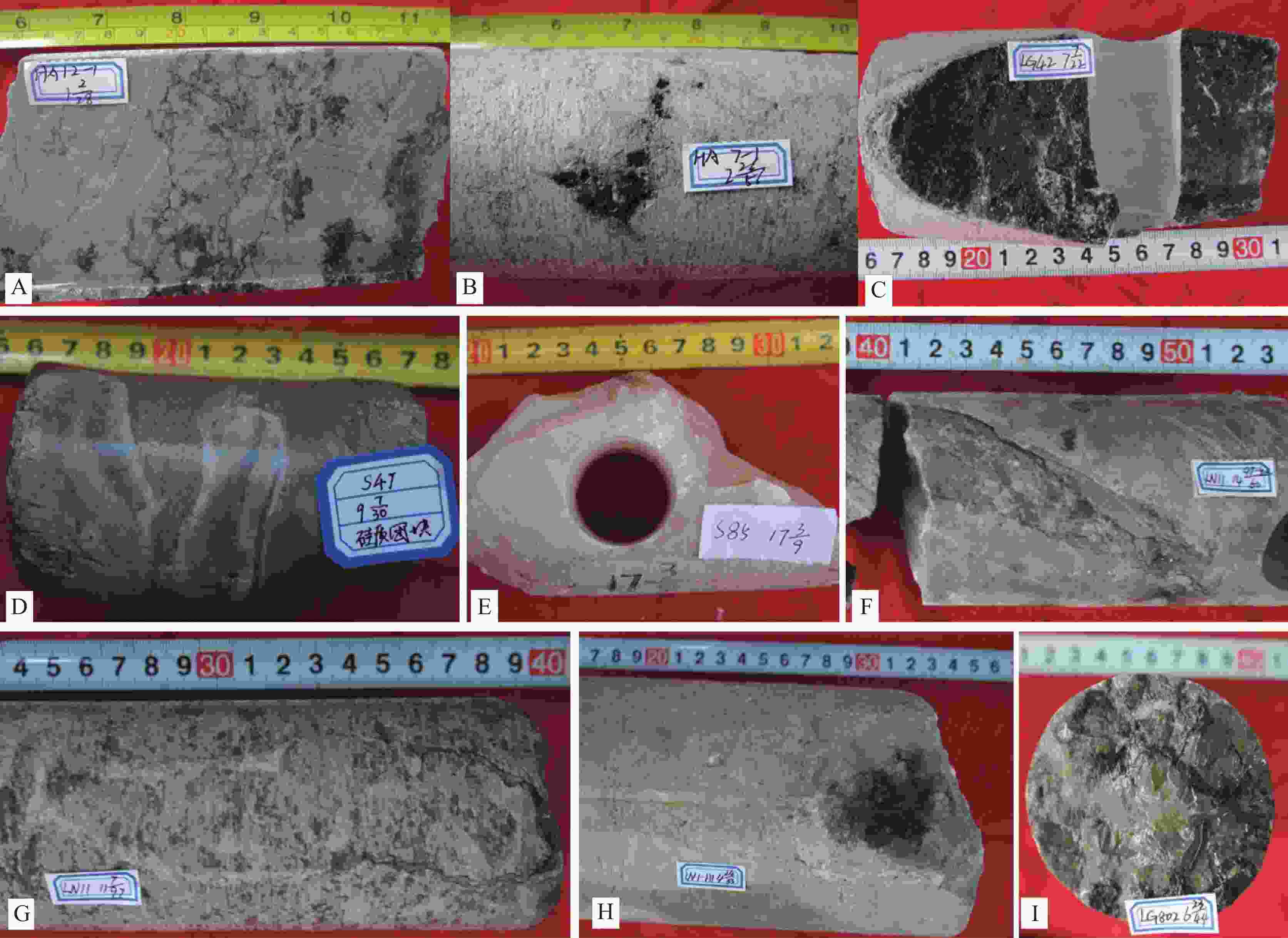
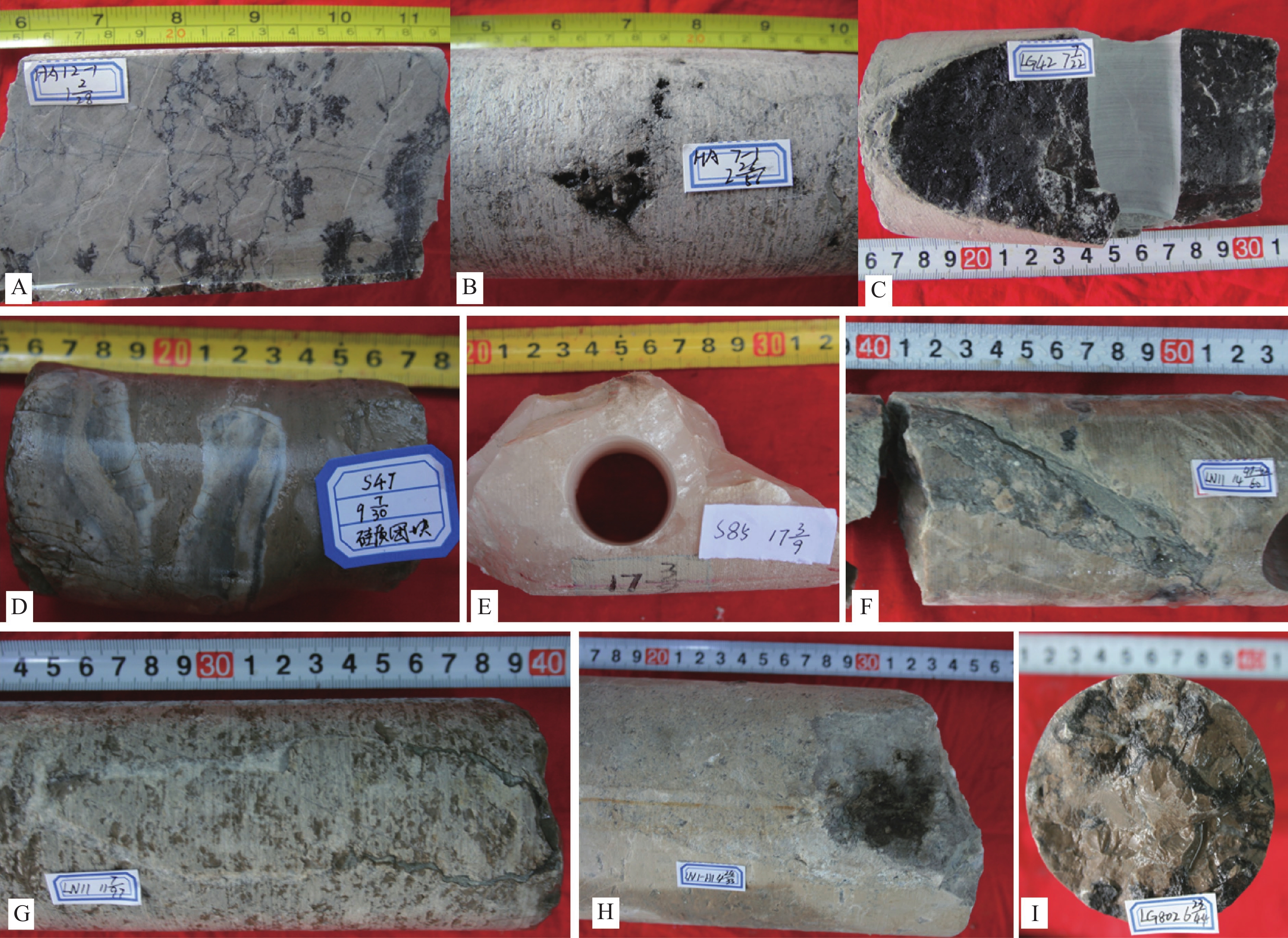
图 1 岩芯古岩溶识别标识
A. H12-1 发育压溶缝,黑色有机质充填 B. H7-1 发育溶蚀孔,方解石半充填,后期油气充注 C. L42 发育高角度缝,方解石沿缝壁一期充填,后期充填黑色有机质 D. S47 发育硅质团块 E. S85 发育溶洞,伟晶方解石充填 F. L11 发育溶洞,灰绿色钙泥质、岩溶角砾与黄铁矿晶体混合充填 G. L11 发育高角度缝,灰绿色钙泥质全充填 H. L1 发育溶洞,灰绿色钙泥质及黄铁矿充填 I. 发育高角度缝,灰黑色有机质及钙泥质一期充填,方解石二期充填
Figure 1. Identification markers for paleokarst in core samples
A. H12-1, pressure-solution fractures, filled with black organic matter; B. H7-1, dissolution pores, partially filled with calcite, and later filled with oil and gas; C. L42, high-angle fissures, with calcite filling along the fissure wall in the first stage and black organic matter filling in the later stage; D. S47, siliceous clumps; E. S85, karst caves, filled with pegmatite calcite; F. L11, karst caves, filled with a mixture of gray green calcareous mud, karst breccia, and pyrite crystals; G. L11, high-angle fissures, fully filled with gray green calcium mud material; H. L1, karst caves filled with gray green calcareous mud and pyrite; I. high-angle fissures, filled with gray black organic matter and calcium mud in the first stage, and with calcite in the second stage
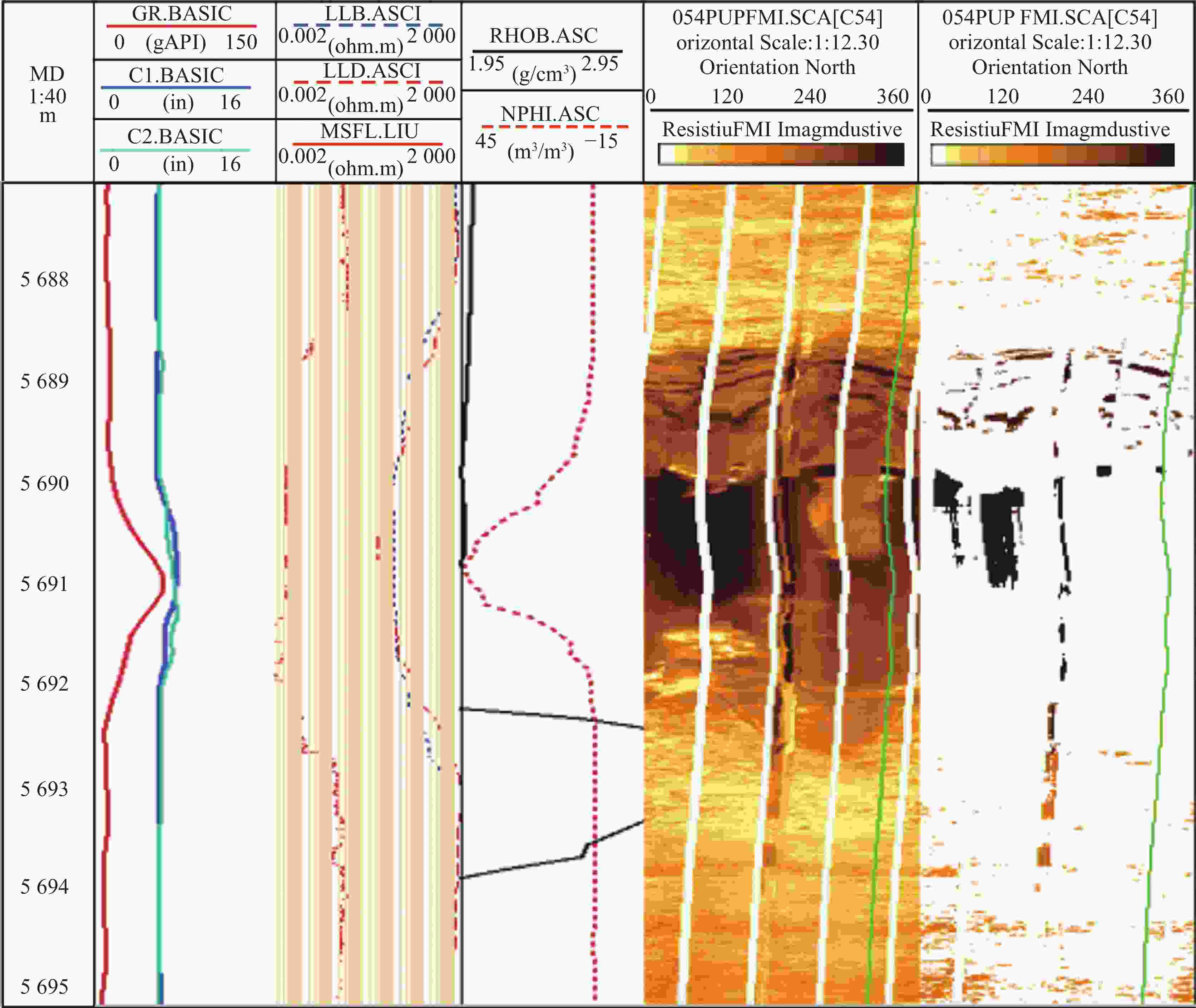
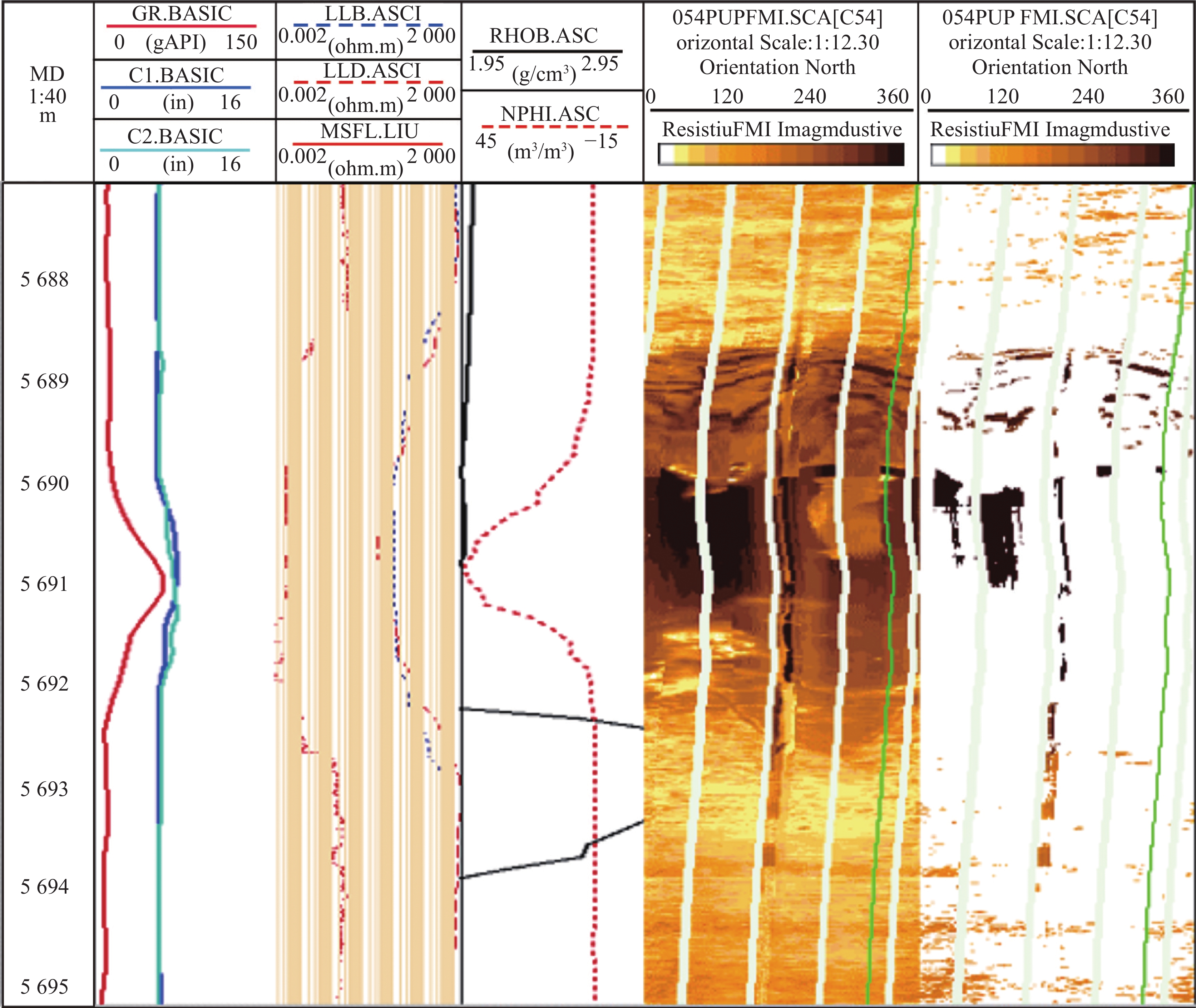
图 2 T701井
5689.98 ~5692.50 m深度发育2.52 m的溶洞Figure 2. Cave with a depth of 2.52 m developed at the depth interval of
5689.98 to5692.50 m in Well T701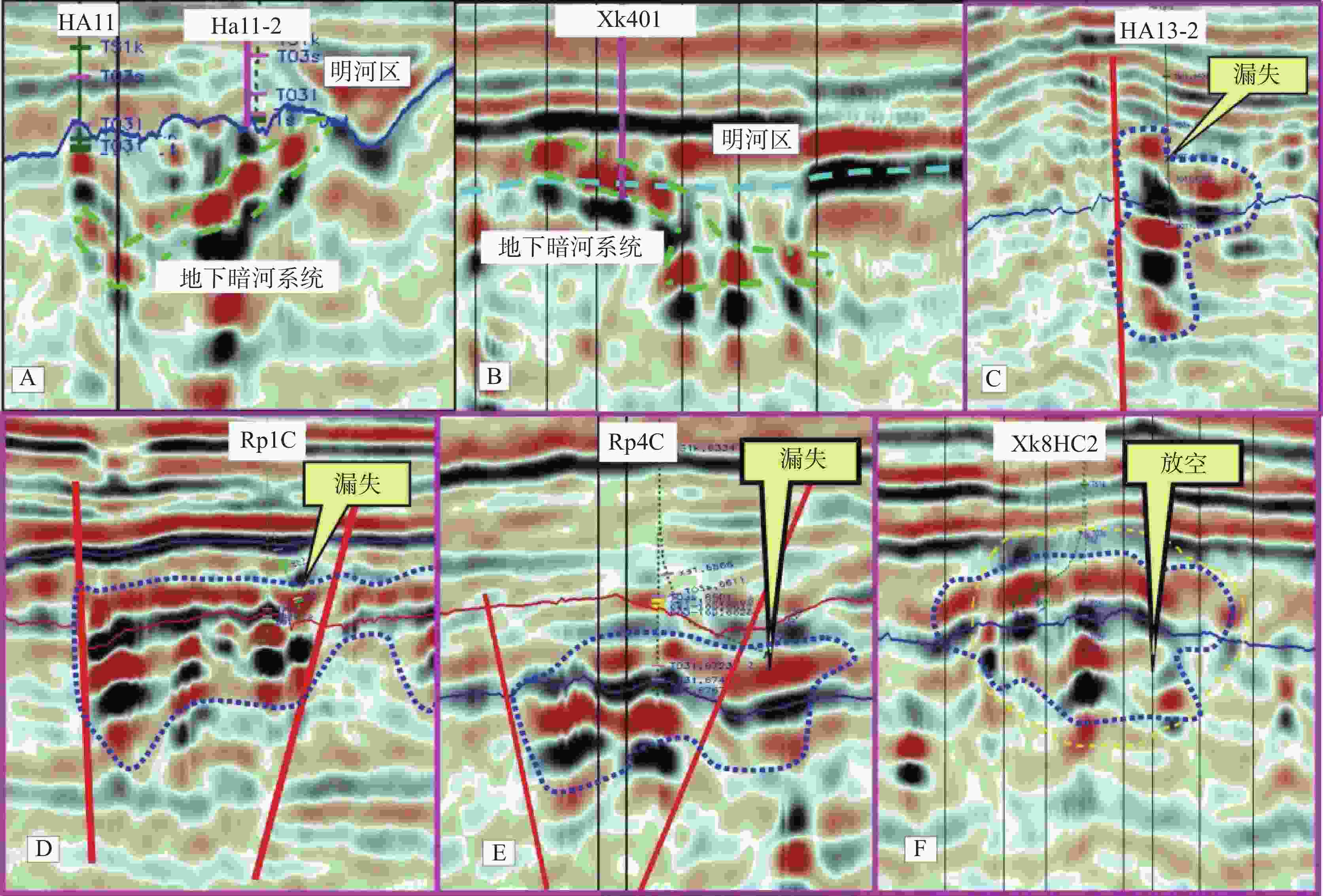
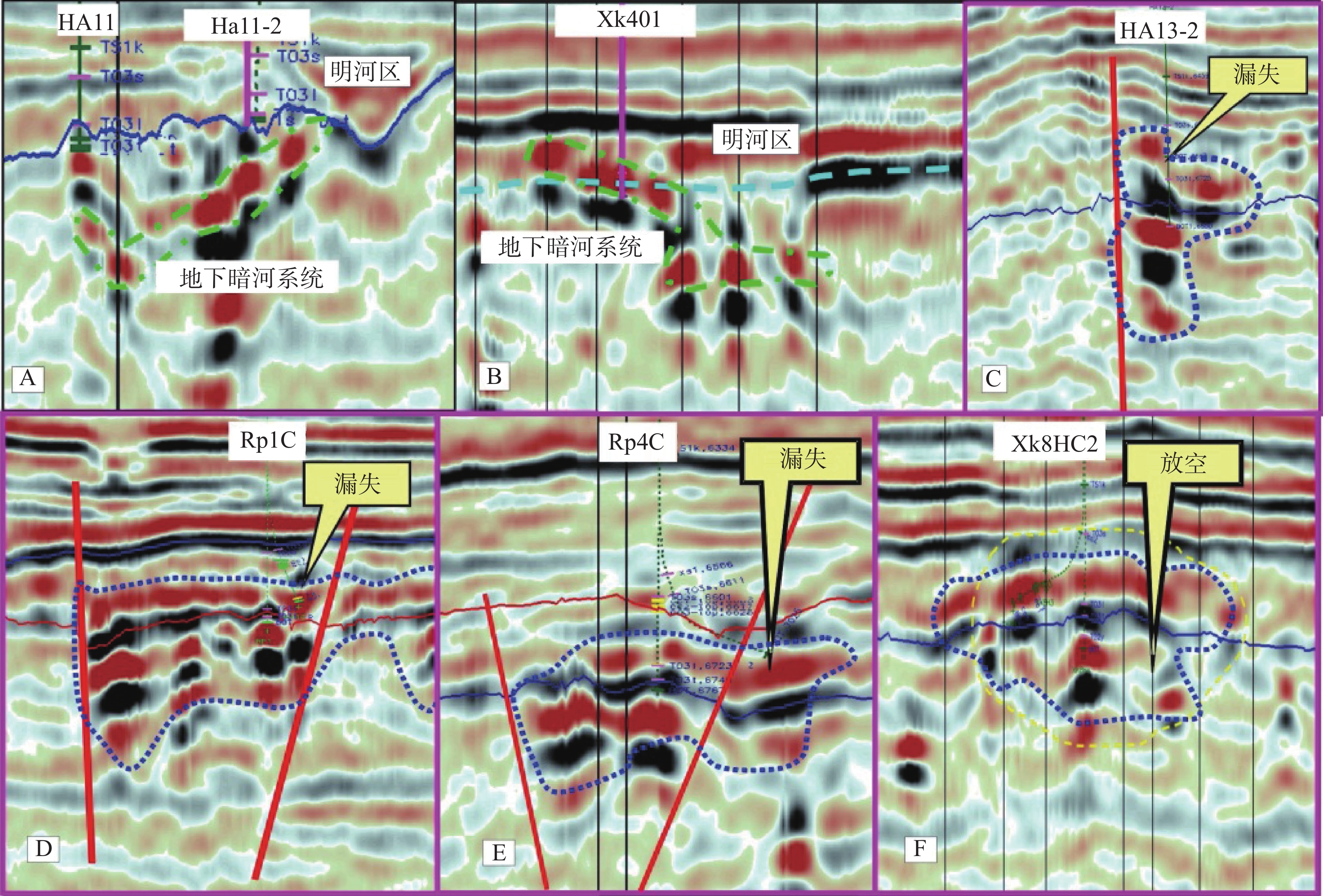
图 3 深层-超深层大型缝洞储集空间地震响应特征
A. 发育流入型地下暗河系统 B. 发育流出型地下暗河系统 C. 发育孤立溶洞型地下缝洞系统 D-F. 发育大型古岩溶缝洞储集体
Figure 3. Seismic response characteristics of deep to ultra-deep large-scale fissure cave reservoirs
A. inflow-type underground river system B. outflow-type underground river system C. isolated karst cave-type underground fissure-cavity system D-F. large paleokarst fissure cave reservoirs
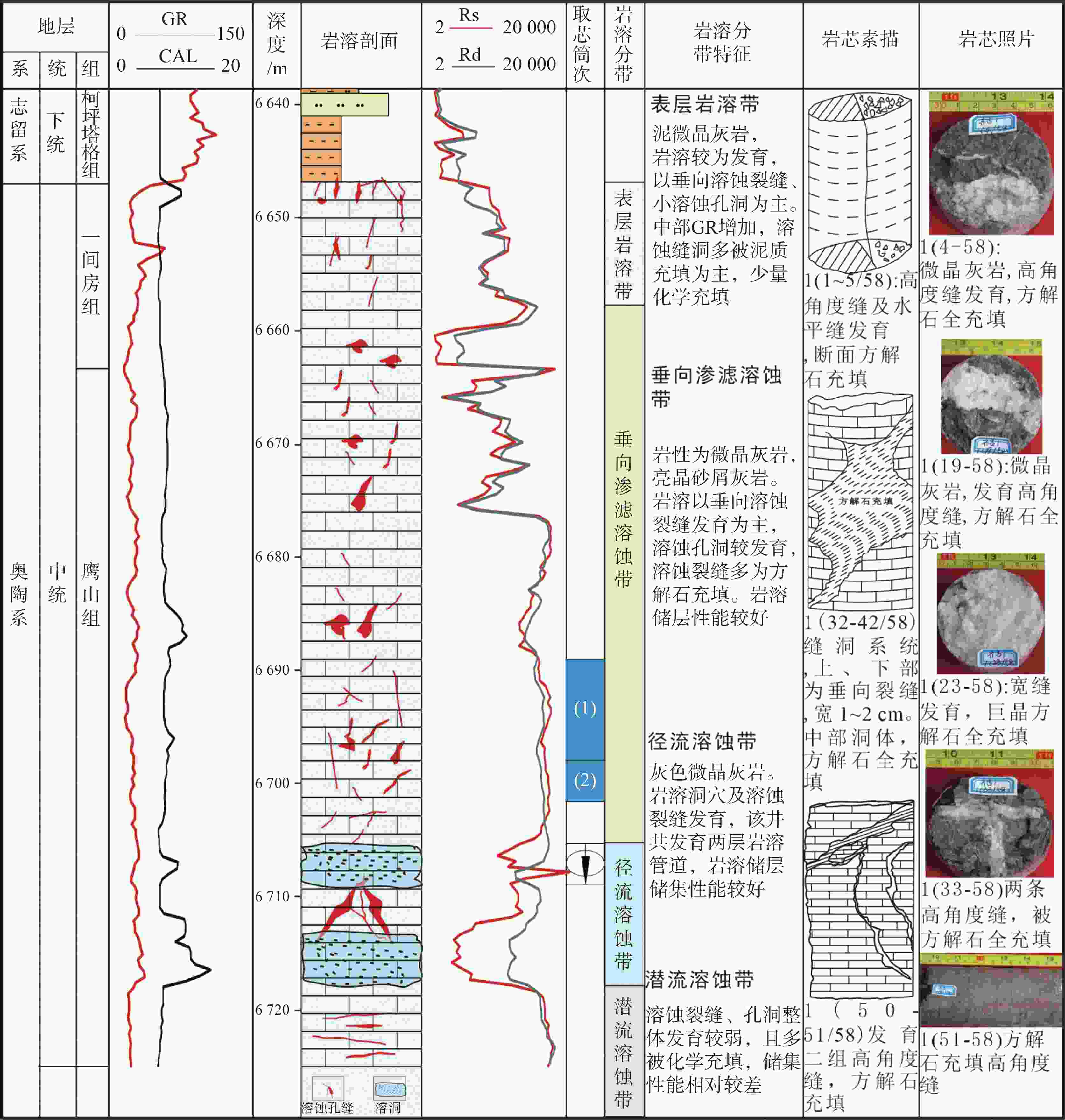
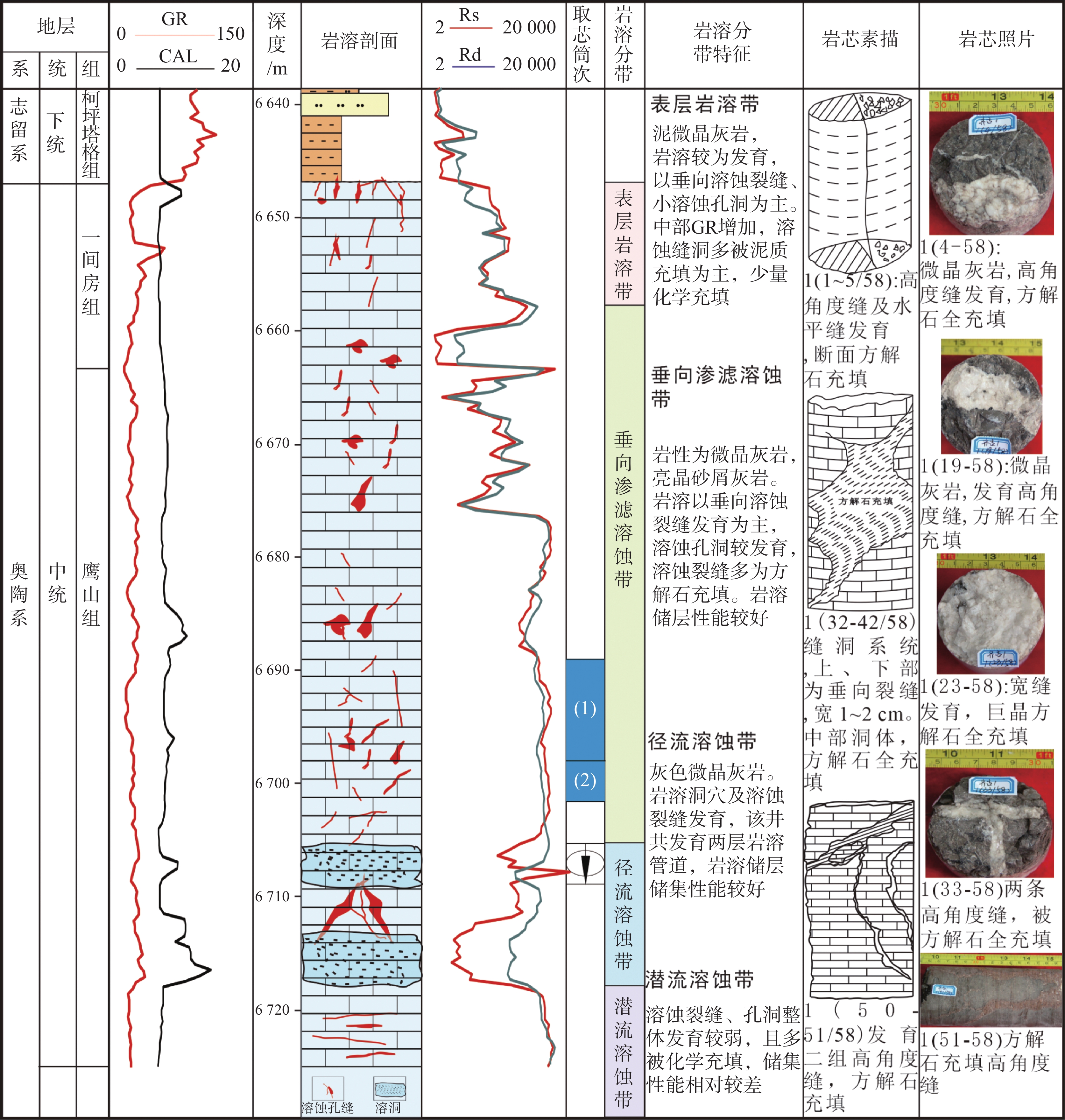
图 4 丘峰洼地LGA井奥陶系古岩溶垂向结构剖面图
Figure 4. Vertical structural profile of the Ordovician paleokarst in Well LGA in the hill-peak depression
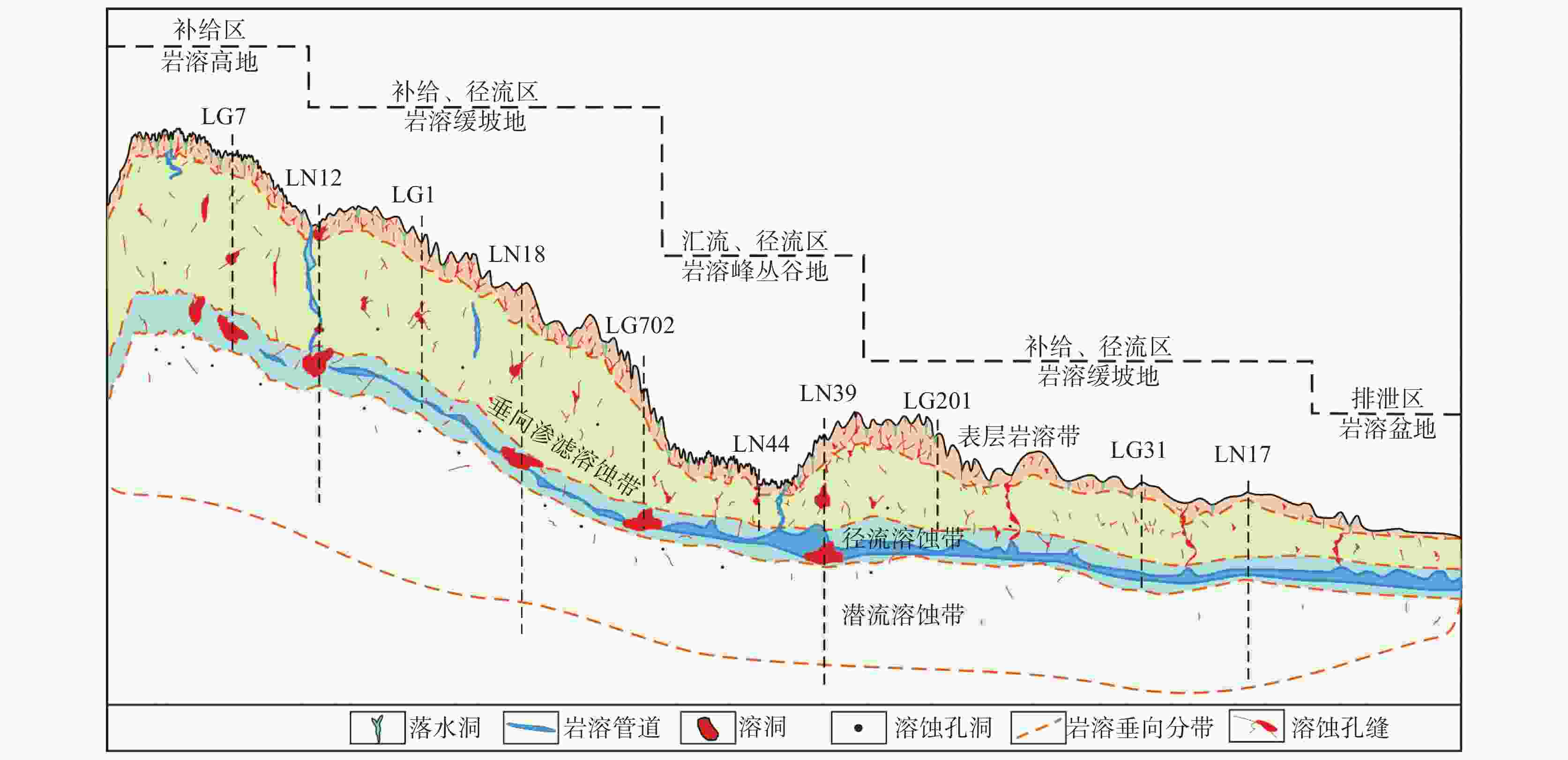
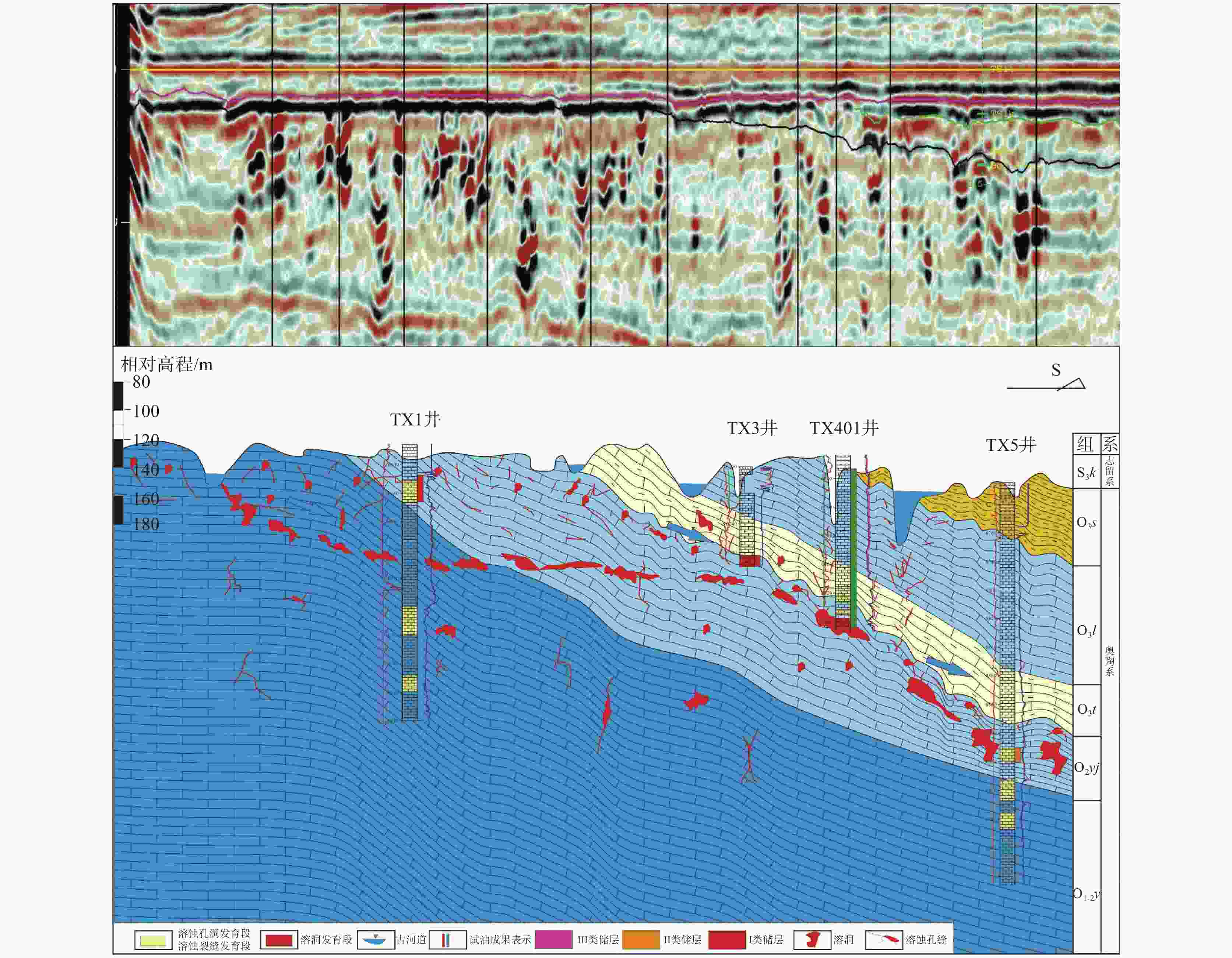
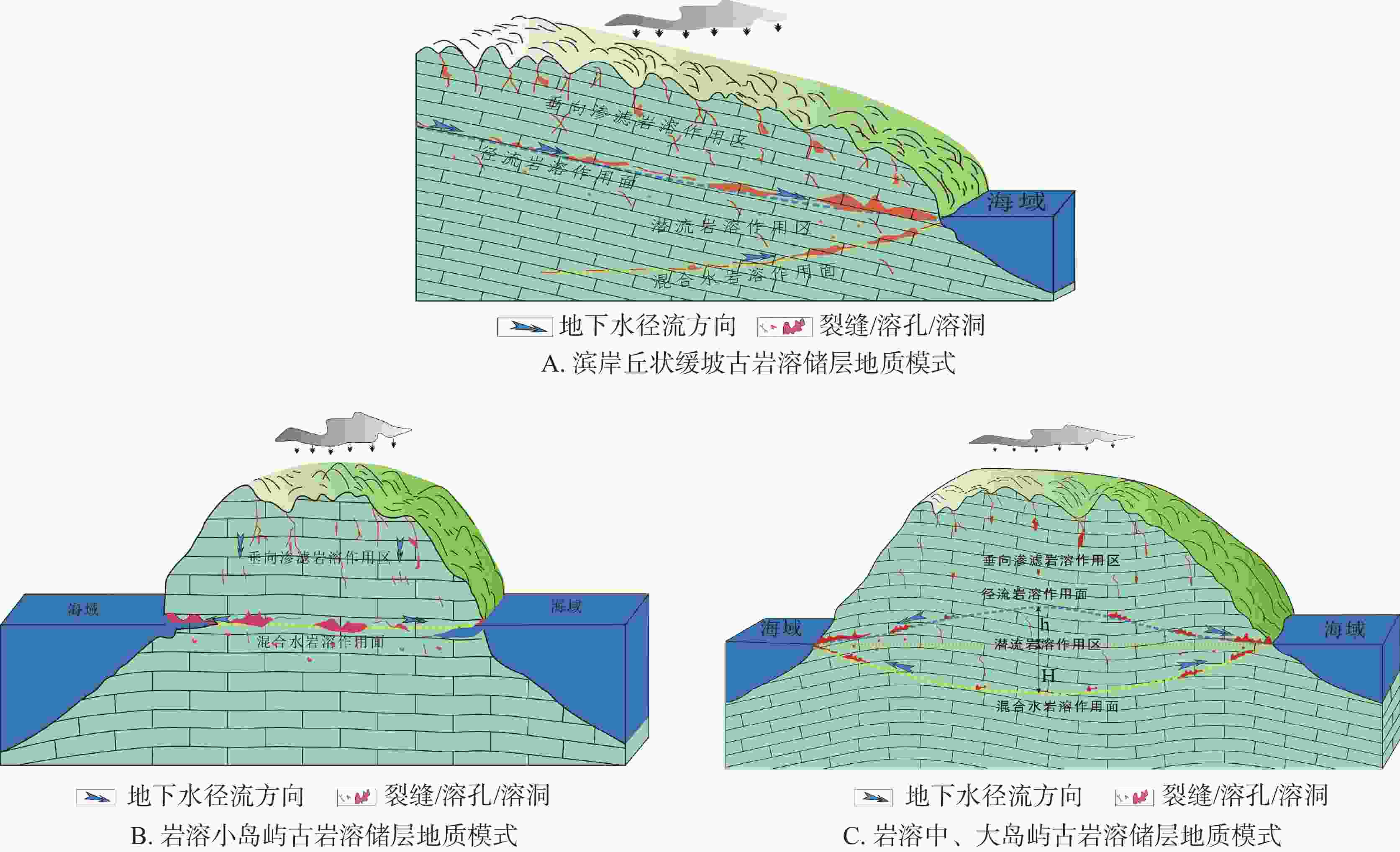
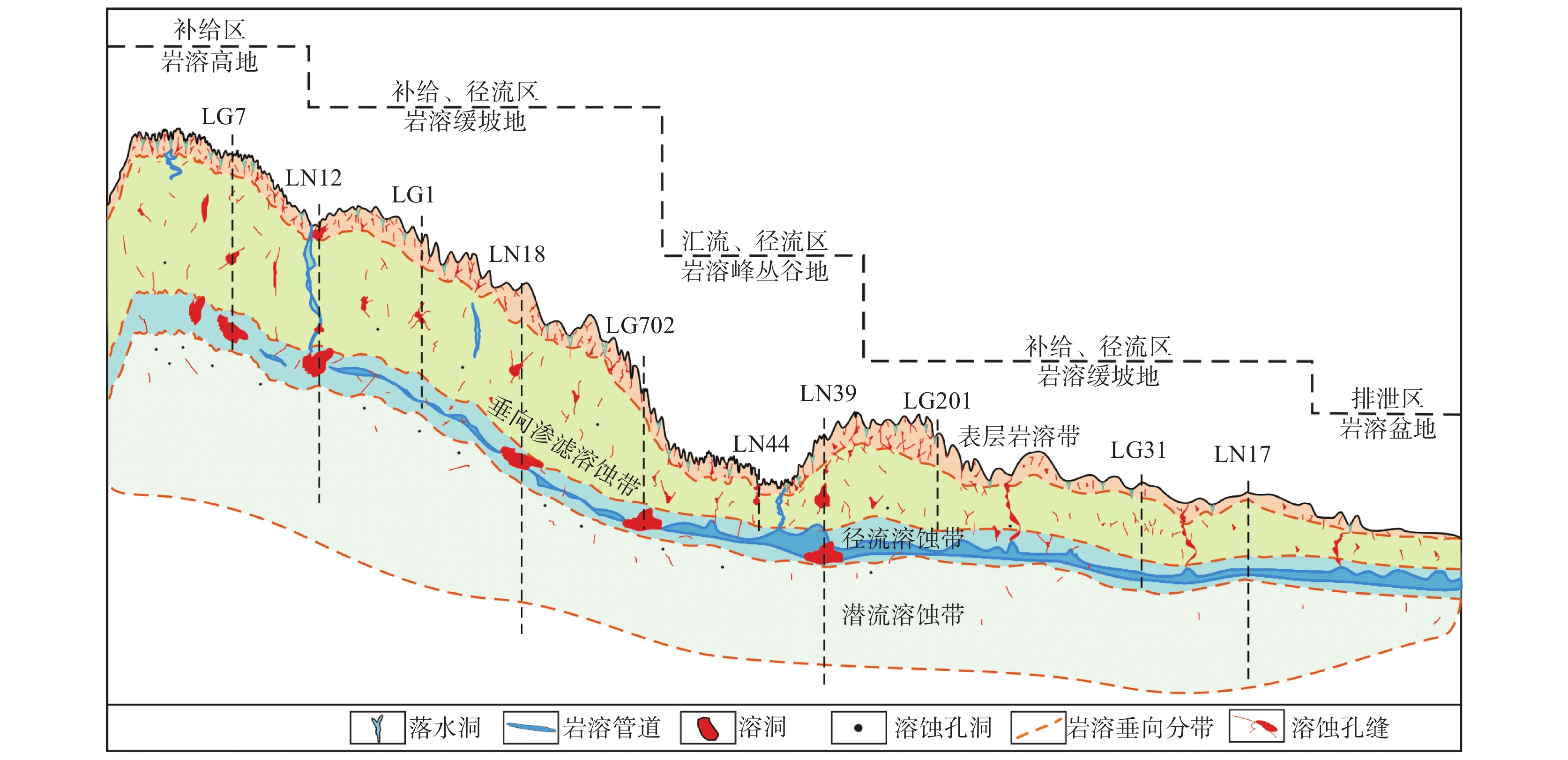
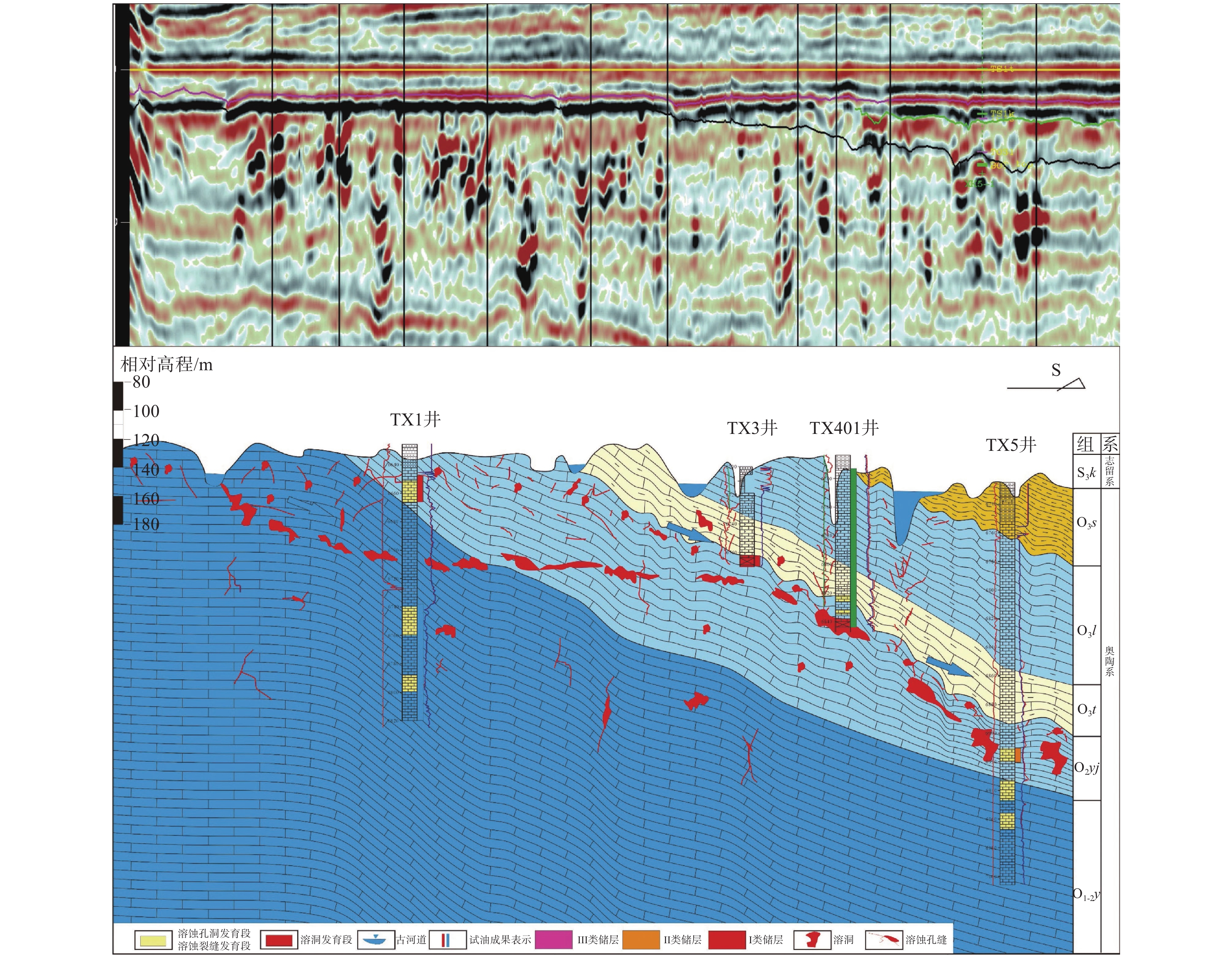
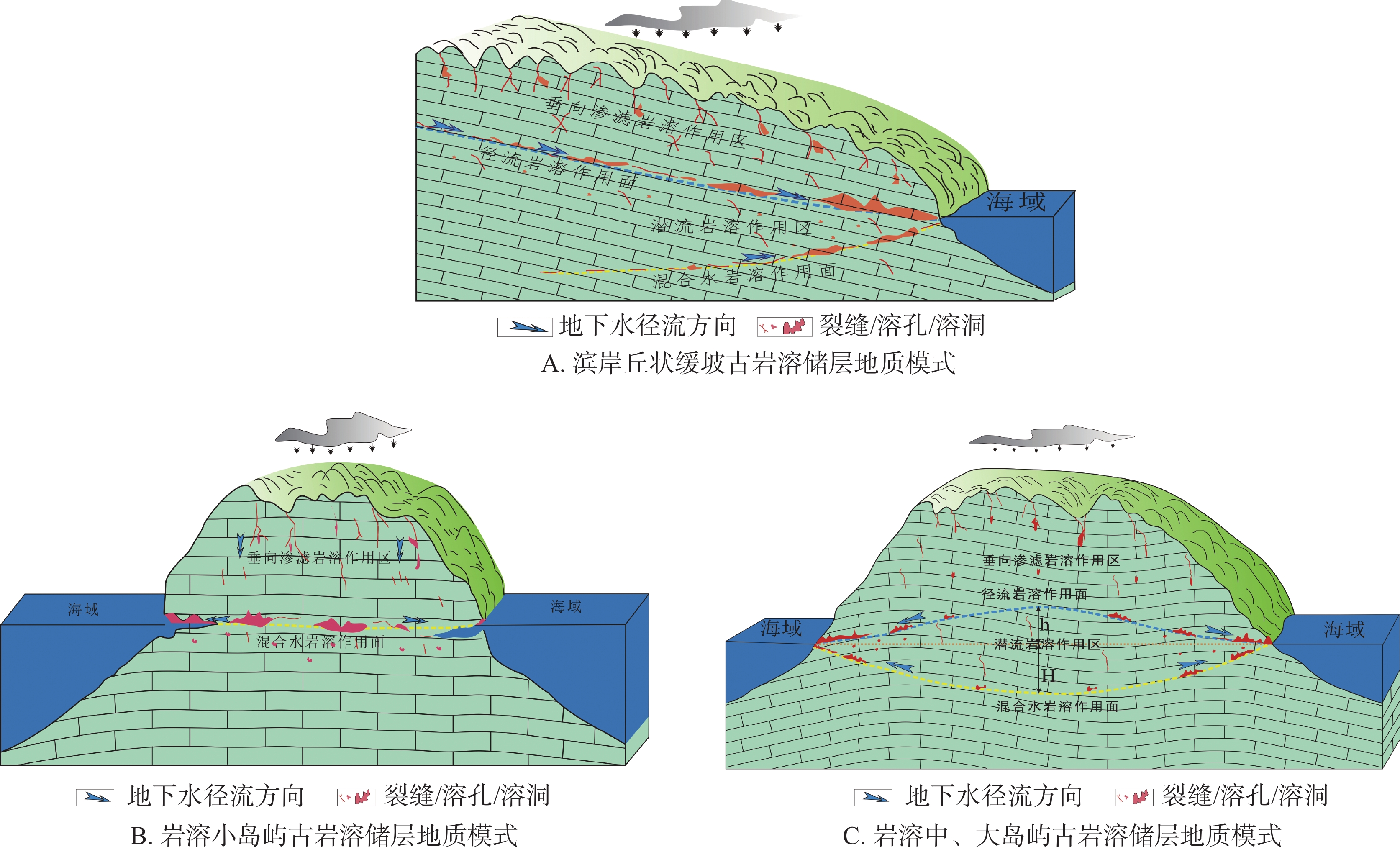
图 7 滨岸岛屿型古岩溶储层地质模式
Figure 7. Geological model of shore-island-type paleokarst reservoir
-
[1] 赵文智, 沈安江, 胡素云, 张宝民, 潘文庆, 周进高, 汪泽成. 中国碳酸盐岩储集层大型化发育的地质条件与分布特征[J]. 油气勘探与开发, 2012, 39(1): 1-12. doi: 10.1016/S1876-3804(12)60010-XZHAO Wenzhi, SHEN Anjiang, HU Suyun, ZHANG Bomin, PAN Wenqing, ZHOU Jingao, WANG Zecheng. Geological conditions and distributional features of large-scale carbonate reservoirs onshore China[J]. Petroleum Exploration and Development, 2012, 39(1): 1-12. doi: 10.1016/S1876-3804(12)60010-X [2] 夏日元, 唐建生, 邹胜章, 梁彬, 金新峰, 姚昕. 碳酸盐岩油气田古岩溶研究及其在油气勘探开发中的应用[J]. 地球学报, 2006, 27(5): 503-509.XIA Riyuan, TANG Jiansheng, ZOU Shengzhang, LIANG Bin, JIN Xinfeng, YAO Xin. Palaeo-karst Research of the Carbonate Oil-gas Field and Its Application to Oil-Gas Exploration and Development[J]. Acta Geoscientica Sinica, 2006, 27(5): 503-509. [3] 夏日元, 邹胜章, 梁彬, 等. 塔里木盆地奥陶系碳酸盐岩缝洞系统模式及成因研究[M]. 地质出版社, 2011.XIA Riyuan, ZOU Shengzhang, LIANG Bin, et al. Study on the Patterns and Forming Mechanism of Fracture-cavity Systems in Ordovician Carbonate, Tarim Basin [M]. Geological Publishing House, 2011. [4] 王振宇, 李凌, 谭秀成, 代宗仰, 马青. 塔里木盆地奥陶系碳酸盐岩古岩溶类型识别[J]. 西南石油大学学报(自然科学版), 2008, 30(5): 11-16.WANG Zhenyu, LI Ling, TAN Xiucheng, DAI Zongyang, MA Qing. Types and recognizable indicators of ordovician carbonate rock okarstification in tarim basin[J]. Journal of Southwest Petroleum University(Science & Technology Edition), 2008, 30(5): 11-16. [5] 王招明, 张丽娟, 孙崇浩. 塔里木盆地奥陶系碳酸盐岩岩溶分类、期次及勘探思路[J]. 古地理学报, 2015, 17(5): 635-644.WANG Zhaoming, ZHANG Lijuan, SUN Chonghao. Classification, period and exploration for carbonate karst in the Ordovician, Tarim Basin[J]. Journal of Palaeogeography: Chinese Edition, 2015, 17(5): 635-644. [6] 赵宗举. 海相碳酸盐岩储集层类型、成藏模式及勘探思路[J]. 石油勘探与开发, 2008, 35(6): 692-703.ZHAO Zongju. Types, accumulation models and exploration concepts of marine carbonate reservoirs[J]. Petroleum Exploration and Development, 2008, 35(6): 692-703. [7] 顾乔元. 塔里木盆地轮南地区奥陶系潜山含油气性研究[D]. 成都: 成都理工大学, 2002.GU Qiaoyuan. Research on Oil-Gas Content Characteristics of Ordovician Buried-hill in Lunnan Area in Tarim Basin [D]. Chengdu: Chengdu University of Technology, 2002. [8] 韩剑发, 王招明, 潘文庆, 赵孟军, 顾乔元, 秦胜飞. 轮南古隆起控油理论及其潜山准层状油气藏勘探[J]. 石油勘探与开发, 2006, 33(4): 448-453.HAN Jianfa, WANG Zhaoming, PAN Wenqing, ZHAO Mengjun, GU Qiaoyuan, QIN Shengfei. Petroleum controlling theory of Lunnan paleohigh and its buried hill pool exploration technology, Tarim Basin[J]. Petroleum Exploration and Development, 2006, 33(4): 448-453. [9] 康玉柱. 塔里木盆地古潜山油气田[J]. 石油实验地质, 2003, 25(5): 458-463.KANG Yuzhu. Oil And Gas Fields In Burial Hills Of Tarim Basin[J]. Petroleum Geology & Experiment, 2003, 25(5): 458-463. [10] 杨海军, 邬光辉, 韩剑发, 王晓峰, 吉云刚. 塔里木盆地中央隆起带奥陶系碳酸盐岩台缘带油气富集特征[J]. 石油学报, 2007(4): 26-30.YANG Haijun, WU Guanghui, HAN Jianfa, WANG Xiaofeng, JI Yungang. Characteristics of hydrocarbon enrichment along the Ordovician carbonate platform margin in the central uplift of Tarim Basin[J]. Acta Petrolei Sinica, 2007(4): 26-30. [11] 邬光辉, 李建军, 杨栓荣, 高辉, 彭轼, 曹淑玲. 塔里木盆地中部地区奥陶纪碳酸盐岩裂缝与断裂的分形特征[J]. 地质科学, 2002, 37(S1): 51-56.WU Guanghui, LI Jianjun, YANG Shunrong, GAO Hui, PENG Shi, CAO Shuling. Fractal Characteristics Of Fissures And Fractures Of Ordovician Carbonate Rocks In The Central Tarim Area[J]. Chinese Journal of Geology(Scientia Geologica Sinica), 2002, 37(S1): 51-56. [12] 邬光辉, 陈志勇, 曲泰来, 王春和, 李浩武, 朱海燕. 塔里木盆地走滑带碳酸盐岩断裂相特征及其与油气关系[J]. 地质学报, 2012, 86(2): 219-227.WU Guanghui, CHEN Zhiyong, QU Tailai, WANG Chunhe, LI Haowu, ZHU Haiyan. Characteristics of the Strik-Slip Fault Facies in Ordovician Carbonate in the Tarim Basin, and Its Relations to Hydrocarbon[J]. Acta Geologica Sinica, 2012, 86(2): 219-227. [13] 王鹏, 刘兴晓. 轮南古潜山岩溶缝洞系统定量描述[J]. 新疆石油地质, 2003, 24(6): 546-548.WANG Peng, LIU Xingxiao. Quantitative Description of Carbonate Reservoir in Lunnan Buried Hill, Tarim Basin[J]. Xinjiang Petroleum Geology, 2003, 24(6): 546-548. [14] 朱光有, 张水昌, 张斌, 苏劲, 杨德彬. 中国中西部地区海相碳酸盐岩油气藏类型与成藏模式[J]. 石油学报, 2010, 31(6): 871-878.ZHU Guangyou, ZHANG Shuichang, ZHANG Bin, SU Jin, YANG Debin. Reservoir types of marine carbonates and their accumulation model in western and central China[J]. Acta Petrolei Sinica, 2010, 31(6): 871-878. [15] 朱光有, 杨海军, 朱永峰, 顾礼敬, 卢玉红, 苏劲, 张宝收, 范秋海. 塔里木盆地哈拉哈塘地区碳酸盐岩油气地质特征与富集成藏研究[J]. 岩石学报, 2011, 27(3): 827-844.ZHU Guangyou, YANG Haijun, ZHU Yongfeng, GU Lijing, LU Yuhong, SU Jin, ZHANG Baoshou, FAN Qiuhai. Study on petroleum geological characteristics and accumulation of carbonate reservoirs in Hanilcatam area, Tarim basin[J]. Acta Petrologica Sinica, 2011, 27(3): 827-844. [16] 赵文智, 沈安江, 潘文庆, 张宝民, 乔占峰, 郑剑峰. 碳酸盐岩岩溶储层类型研究及对勘探的指导意义: 以塔里木盆地岩溶储层为例[J]. 岩石学报, 2013, 29(9): 3213-3222.ZHAO Wenzhi, SHEN Anjiang, PAN Wenqing, ZHANG Bomin, QIAO Zhanfeng, ZHENG Jianfeng. A research on carbonate karst reservoirs classification and its implication on hydrocarbon exploration: Cases studies from Tarim Basin[J]. Acta Petrologica Sinica, 2013, 29(9): 3213-3222. [17] 沈安江, 赵文智, 胡安平, 佘敏, 陈娅娜, 王小芳. 海相碳酸盐岩储集层发育主控因素[J]. 石油勘探与开发, 2015, 42(5): 545-554.SHEN Anjiang, ZHAO Wenzhi, HU Anping, SHE Min, CHEN Yana, WANG Xiaofang. Major factors controlling the development of marine carbonate reservoirs[J]. Petroleum Exploration and Development, 2015, 42(5): 545-554. [18] 沈安江, 陈娅娜, 蒙绍兴, 郑剑锋, 乔占峰, 倪新锋, 张建勇, 吴兴宁. 中国海相碳酸盐岩储层研究进展及油气勘探意义[J]. 海相油气地质, 2019, 24(4): 1-14.SHEN Anjiang, CHEN Yana, MENG Shaoxing, ZHENG Jianfeng, QIAO Zhanfeng, NI Xinfeng, ZHANG Jianyong, WU Xingning. The research progress of marine carbonate reservoirs in China and its significance for oil and gas exploration[J]. Marine Origin Petroleum Geology, 2019, 24(4): 1-14. [19] 陈利新, 潘文庆, 梁彬, 罗日升, 张庆玉, 高翔. 轮南奥陶系潜山表层岩溶储层的分布特征[J]. 中国岩溶, 2011, 30(3): 327-333.CHEN Lixin, PAN Wenqing, LIANG Bin, LUO Risheng, GAO Xiang. The distribution characteristics of the epikarst reservoir in Lunnan ordovician buried hill[J]. Carsologica Sinica, 2011, 30(3): 327-333. [20] 李世银, 罗春树, 邓兴梁, 李保华, 常少英, 王轩, 裴广平. 轮古西奥陶系潜山洞穴型岩溶储层发育特征与充填规律[J]. 海相油气地质, 2012, 17(2): 70-74.LI Shiyin, LUO Chunshu, DENG Xingliang, LI Baohua, CHANGshaoying, WANG Xuan, PEI Guangping. Development Characteristics and Filling Rule of Ordovician Buried-hill Karst Caved Reservoirs in the West Part of Lungu Oilfield, Tarim Basin[J]. Marine Origin Petroleum Geology, 2012, 17(2): 70-74. [21] 刘伟方, 郑多明, 王洪求, 董瑞霞, 张喜梅, 苗青. 塔里木盆地奥陶系碳酸盐岩潜山古水系研究方法及意义[J]. 海相油气地质, 2013, 18(4): 75-81.LIU Weifang, ZHENG Daming, WANG Hongqiu, DONG Ruixia, ZHANG Ximei, MIAO Qing. Research Methods and the Significance of Palaeodrainage Patterns in Ordovician Buried-hill Carbonate Reservoirs, Tarim Basin[J]. Marine Origin Petroleum Geology, 2013, 18(4): 75-81. [22] 邓兴梁, 佟彦明, 张正红, 杨品, 潘杨勇, 赵春段. 塔中西部奥陶系碳酸盐岩潜山精细古地貌研究[J]. 石油天然气学报, 2014, 36(8): 30-33.DENG Xingliang, TONG Yanming, ZHANG Zhenghong, YANG Pin, PAN Yangyong, ZHAO Chunduan. Fine Study on Ordovician Carbonate Buried-hill Palaegeomorphology in the West of Tazhong Area[J]. Journal of Oil and Gas Technology, 2014, 36(8): 30-33. [23] 张庆玉, 梁彬, 秦凤蕊, 陈利新, 淡永, 李景瑞. 哈拉哈塘凹陷奥陶系岩溶古地貌及岩溶缝洞体发育模式[J]. 新疆石油地质, 2016, 37(6): 660-666.ZHANG Qingyu, LIANG Bin, QIN Fengrui, CHEN Lixin, DAN Yong, LI Jingrui. Karst paleogeomorphology and development model of karst fracture-cave bodies of Ordovician in Halahatang Sag[J]. Xinjiang Petroleum Geology, 2016, 37(6): 660-666. [24] 张丽娟, 马青, 范秋海, 朱永峰, 高春海, 蔡泉, 张硕, 刘晨曦. 塔里木盆地哈6区块奥陶系碳酸盐岩古岩溶储层特征识别及地质建模[J]. 中国石油勘探, 2012, 17(2): 1-7.ZHANG Lijuan, MA Qing, FAN Qiuhai, ZHU Qiuhai, GAO Chunhai, CAI Quan, ZHANG Shuo, LIU Chenxi. Paleokarst reservoir recognition and geology modeling of Ordovician carbonate of block Ha 6 in Tarim Basin[J]. China Petroleum Exploration, 2012, 17(2): 1-7. [25] 潘文庆, 侯贵廷, 齐英敏, 张鹏, 陈永权, 鞠玮. 碳酸盐岩构造裂缝发育模式探讨[J]. 地学前缘, 2013, 20(5): 188-195.PAN Wenqing, HOU Guiting, QI Yingmin, ZHANG Peng, CHEN Yongquan, JU Wei. Discussion on the development models of structural fractures in the carbonate rocks[J]. Earth Science Frontiers, 2013, 20(5): 188-195. [26] 张庆玉, 梁彬, 曹建文, 淡永, 郝彦珍, 李景瑞. 塔里木盆地轮古西地区奥陶系古潜山岩溶作用机理与发育模式[J]. 石油实验地质, 2015, 37(1): 1-7.ZHANG Qingyu, LIANG Bin, CAO Jianwen, DAN Yong, HAO Yanzheng, LI Jingrui. Mechanism and development model of karsts in Ordovician buried hills in western Lungu area, Tarim Basin[J]. Petroleum Geology & Experiment, 2015, 37(1): 1-7. [27] 曹建文. 轮南古潜山东部地区古岩溶分布规律及成因机理研究[D]. 武汉: 中国地质大学, 2019.CAO Jianwen. Distribution Law and Genesis Mechanism of Paleokarst in the Eastern Part of Lunnan Paleoburied Mountain [D]. Wuhan: China University of Geosciences, 2019. [28] 张庆玉. 塔里木盆地哈拉哈塘地区奥陶系碳酸盐岩古岩溶发育机理[D]. 武汉: 中国地质大学, 2018.ZHANG Qingyu. Development Mechanism of Ordovician Carbonate Paleokarst in the Halahatang Area of the Tarim Basin [D]. Wuhan: China University of Geosciences, 2018. [29] 张庆玉, 李景瑞, 梁彬, 淡永, 曹建文. 塔里木盆地塔中地区奥陶系古岩溶包裹体特征及古环境意义[J]. 中国岩溶, 2020, 39(6): 894-899.ZHANG Qingyu, LI Jingrui, LIANG Bin, DAN Yong, CAO Jianwen. Characteristics and paleoenvironmental significance of Ordovician karst inclusions in the Tazhong area, Tarim basin[J]. Carsologica Sinica, 2020, 39(6): 894-899. [30] 张庆玉, 梁彬, 秦凤蕊, 曹建文, 淡永, 李景瑞. 塔里木盆地奥陶系古潜山碳酸盐岩岩溶储层评价与预测: 以轮古7井区以东为例[J]. 中国岩溶, 2017, 36(1): 32-41.ZHANG Qingyu, LIANG Bin, QIN Fengrui, CAO Jianwen, DAN Yong, LI Jingrui. Evaluation and prediction of carbonate karst reservoirs in the Ordovician buried hills beneath the Tarim basin: An example east of the Lungu7 well block[J]. Carsologica Sinica, 2017, 36(1): 32-41. [31] 张庆玉, 梁彬, 淡永, 李景瑞, 曹建文. 塔中北斜坡奥陶系鹰山组岩溶储层特征及古岩溶发育模式[J]. 中国岩溶, 2016, 35(1): 106-113.ZHANG Qingyu, LIANG Bin, DAN Yong, LI Jingrui, CAO Jianwen. Research of karst reservoirs characteristics and paleokarst development pattern of the Ordovician Yingshan formation north-slope of Tazhong, Tarim basin area[J]. Carsologica Sinica, 2016, 35(1): 106-113. [32] 段铁军, 徐宏节, 伍泓, 汤慧珉. 塔里木盆地与断裂作用有关的圈闭类型特征[J]. 石油实验地质, 1998(3): 15-20, 14.DUAN Tiejun, XU Hongjie, WU Hong, TANG Huimin. Characteristics Of Faulting Related Trap Types In The Tarim Basin[J]. Petroleum Geology & Experiment, 1998(3): 15-20, 14. [33] 邓韦克, 刘翔, 李翼杉. 川中震旦系灯影组储集层形成及演化研究[J]. 天然气勘探与开发, 2015, 38(3): 12-16, 26, Ⅱ.DENG Weike, LIU Xiang, LI Yishan. Reservoir Formation And Evolution Of Sinsian Dengying Formation, Central Sichuan Basin[J]. Natural Gas Exploration and Development, 2015, 38(3): 12-16, 26,Ⅱ. [34] 金之钧, 朱东亚, 孟庆强, 胡文瑄. 塔里木盆地热液流体活动及其对油气运移的影响[J]. 岩石学报, 2013, 29(3): 1048-1058.JIN Zhijun, ZHU Dongya, MENG Qingqiang, HU Wenxuan. Hydrothermal activites and influences on migration of oil and gas in Tarim Basin[J]. Acta Petrologica Sinica, 2013, 29(3): 1048-1058. [35] 贾承造, 庞雄奇. 深层油气地质理论研究进展与主要发展方向[J]. 石油学报, 2015, 36(12): 1457-1469.JIA Chengzao, PANG Xiongqi. Research processes and main development directions of deep hydrocarbon geological theories[J]. Acta Petrolei Sinica, 2015, 36(12): 1457-1469. -

 下载:
下载:
 点击查看大图
计量
- 文章访问数: 593
- HTML浏览量: 218
- PDF下载量: 50
- 被引次数: 0
