


Hydrochemical characteristics and genesis analysis of hot springs in the Changtan area, Chongqing
-
摘要: 渝东北地区高隆起背斜两翼发育的地下热水系统具有独特的水化学特征与成因机制。为揭示其水化学特征及其与典型地下热水的成因差异,选取方斗山背斜西北翼长滩地区天然温泉及钻孔温泉为研究对象,通过水文地球化学测试、水化学图解、地热温标和地下热水循环深度计算,结合区域水文地质条件探讨其形成机理。结果表明:(1)研究区温泉水化学类型为Cl-Na型,主要离子含量呈现出Na+(40.27 g·L−1)与Cl−(60.72 g·L−1)显著富集特征;(2)基于SiO2地热温标计算显示热储温度为54~78 ℃,结合地温梯度推算地下水循环深度达
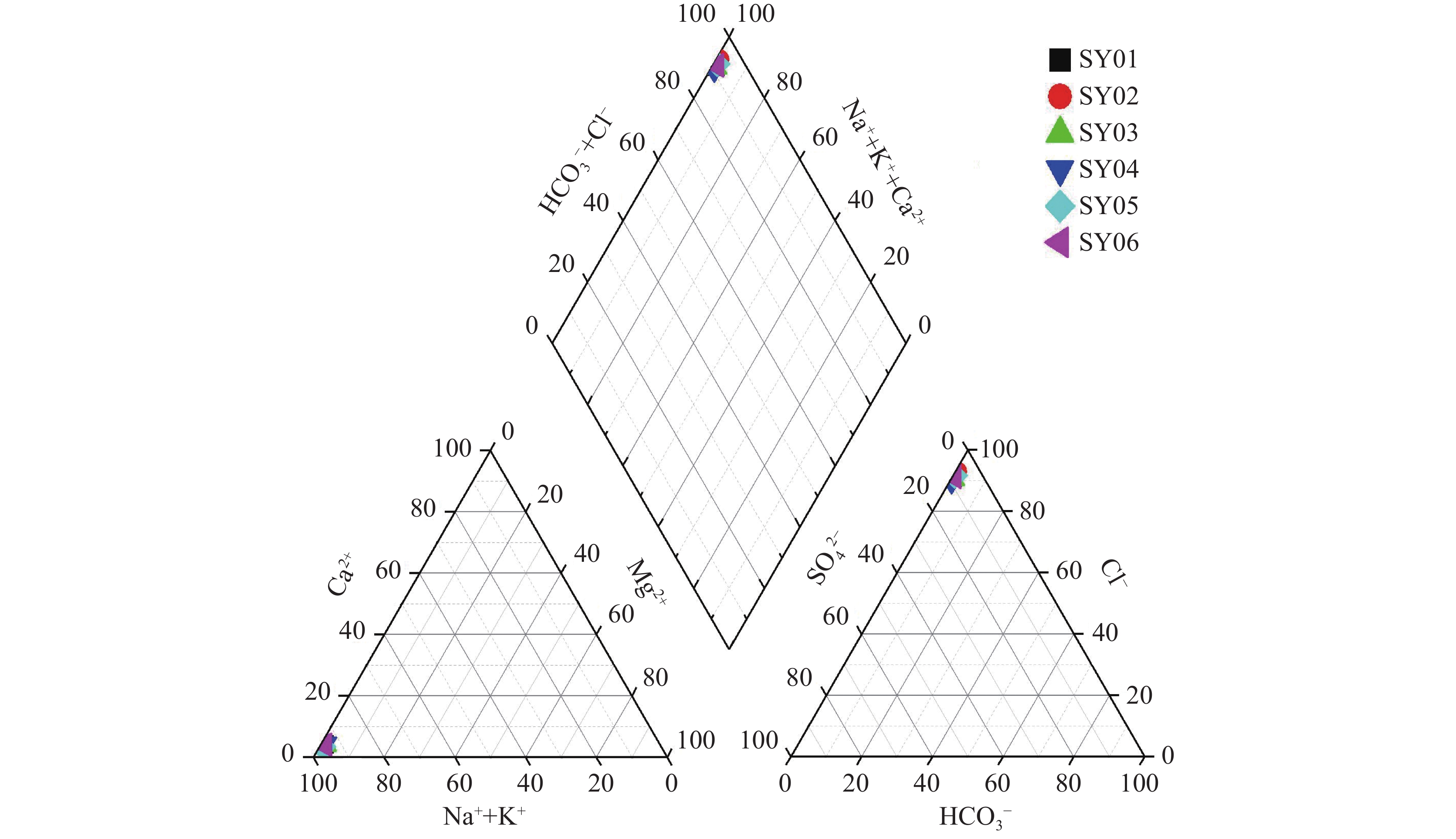
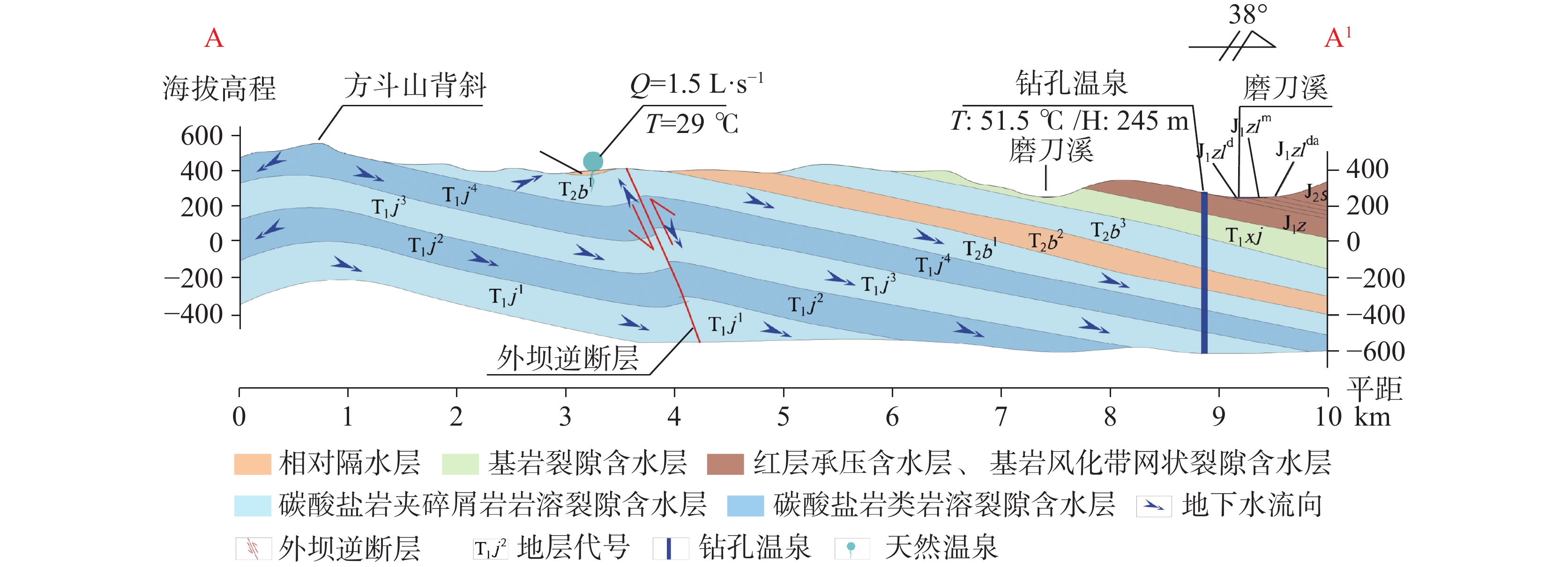
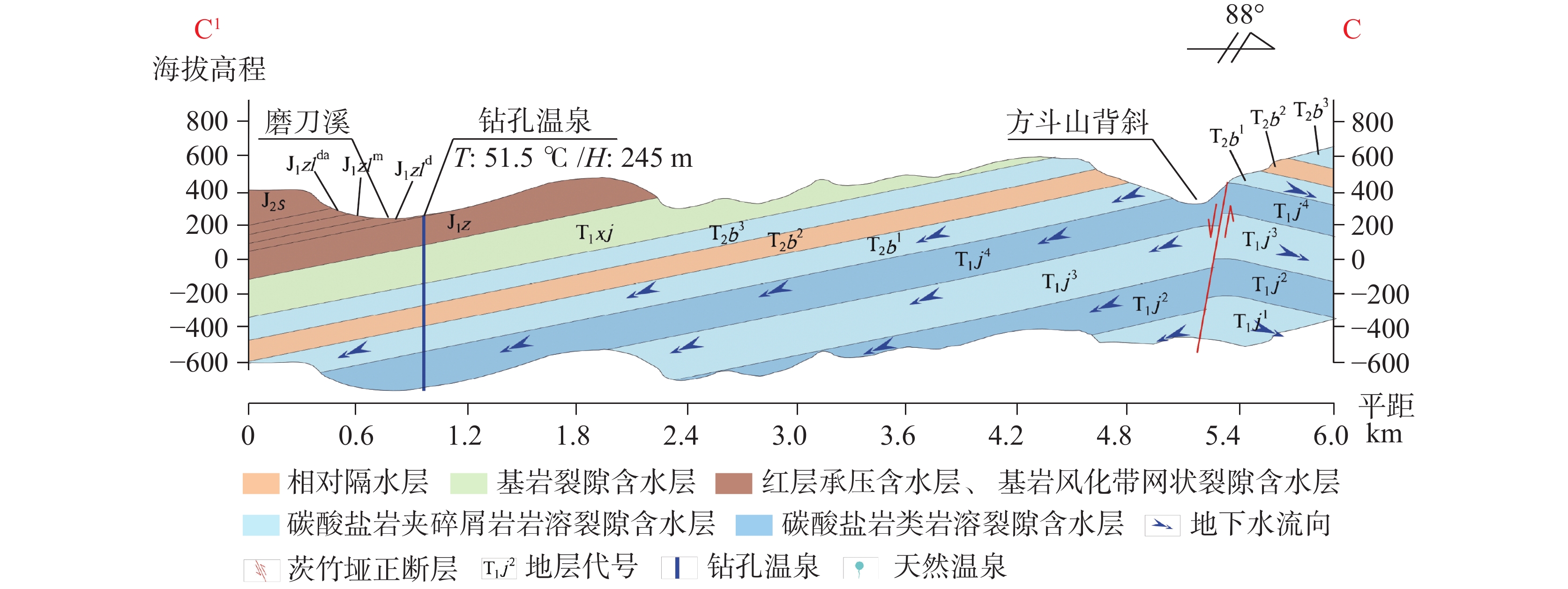
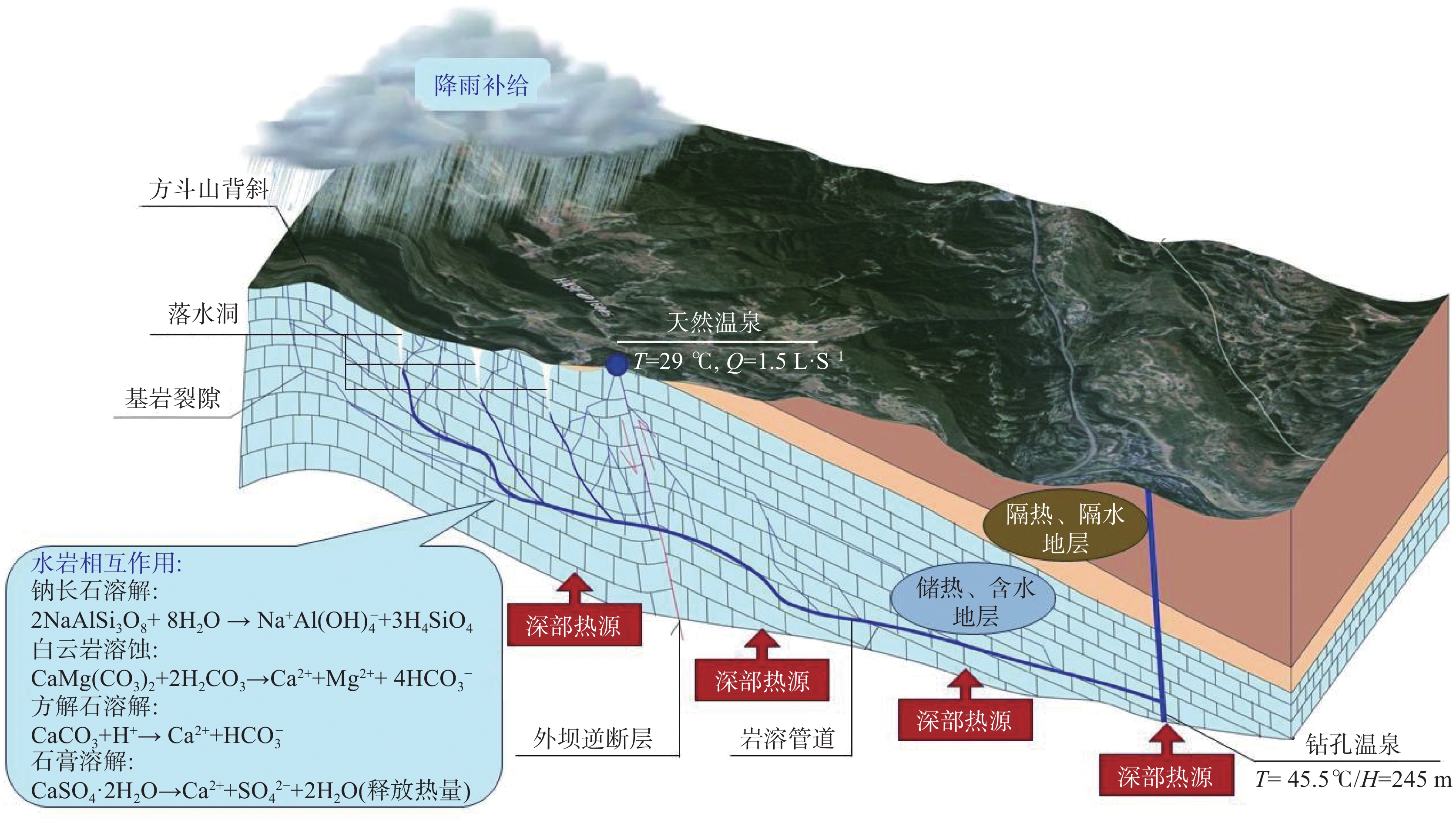
2000 m;(3)地下水系统接受方斗山背斜核部灰岩出露区大气降水入渗补给,热源机制以围岩传导热为主。Abstract:This study takes the natural and artificially drilled hot springs as the research objects located in the northwest wing of the Fangdoushan anticline in Changtan Town, Wanzhou District, Chongqing City. It systematically examines their hydrochemical characteristics, heat storage conditions, and genetic mechanisms, revealing the unique formation process of the low-temperature Cl-Na type hot springs in the high-uplift anticline region. The hot springs in the study area are located within the carbonate rock layers of the Lower Triassic Jialingjiang Formation (T1j), and are controlled by the combined effect of the Fangdoushan anticline structure and local hydrogeological conditions. Through hydrogeochemical analysis, geothermal temperature scale calculations, and hydrogeological conceptual model analysis, the following key conclusions are drawn: 1. Chemical characteristics and genesis of water (1) The chemical composition of the hot spring water is classified as Cl-Na type (according to the Piper three-line graph). The pH is weakly alkaline (7.26 to 7.87). The mineralization degree is significantly higher than the regional background level, TDS up to 11.25 g·L−1. The proportions of Cl− and Na+ are 36.72% and 55.37%, respectively.(2) The high mineralization degree stems from the concentrated halogen dissolution and filtration in the tidal flat-lagoon facies strata of the Triassic Jialingjiang Formation (T1j), as well as the water-rock interactions during the deep circulation processes (such as dolomite dissolution and sodium growth petrification). Additionaly, sulfate reduction reactions involving microorganisms (e.g., H2S generation) and long-range migration (>10 km) further enhance ion enrichment.(3) The content of Sr2+ among the trace elements is notably high (37.06 mg·L−1), and its source is closely related to the water-rock interactions involving carbonate rocks and gelatinate layers in the Triassic Jialingjiang Formation (T1j). 2. Heat storage conditions and circulation mechanism (1) The calculation of geothermal temperature scales (quartz, chalcedony, and quartzite) shows that the heat storage temperature ranges from 54 ℃ to 78 ℃, with an average of 65.4 ℃, classifying it as a low-temperature geothermal system. Based on the ground temperature gradient, the circulation depth is estimated to be approximately 2,000 meters.(2) The heat storage layer is composed of interbedded limestone and dolomite from the Triassic Jialingjiang Formation (T1j), which overlies the mudstone of the second section of the Badong Formation (T2b2), the clastic rocks of the Triassic Xujiahe Formation (T3xj), and the sand-mudstone of the Jurassic system. Together, these formations create a water-proof and heat-insulating cover layer, thereby forming a closed heat storage structure. 3. Groundwater recharge sources and heat sources (1) Recharge sources: Atmospheric precipitation in the exposed area of the Triassic Jialingjiang Formation (T1j) at the core of the Fangdoushan anticline infiltrates in through karst fissures and sinkholes, generating deep runoff.(2) Runoff path: Groundwater migrates deeper along the fault-fracture system at the wing of the anticline, absorbs heat from the surrounding rock, and undergoes dissolution and filtration, with a retention time of several hundred years.(3) Heat source: There is no additional heat source, such as magmatic activity. The heat originates from the normal geothermal gradient (2.5 to 3.0 ℃·100 m−1), and the formation of the heat reservoir is driven by the warming of the stratum. 4. Three-dimensional genesis conceptual model (1) After the infiltrating as atmospheric precipitation, the water migrates deeper along the fracture network at the core of the anticline. It undergoes long-path circulation (approximately 2,000 meters) and slow warming, accompanied by intense water-rock interaction with salt-bearing carbonate rocks. (2) Deep faults, such as the outer dam reverse fault, act as secondary hydrothermal channels that locally supplement solutes and heat; however, the main heat source remains the natural warming of the crust. (3) Hydrogeological sections reveal that the combination of an aquifer and impermeable layer under the control of anticline structures, is the key to the occurrence and migration of thermal fluids. The mudstone of the Triassic Badong Formation (T2b) effectively blocks vertical heat loss and maintains the stability of thermal reservoirs. -
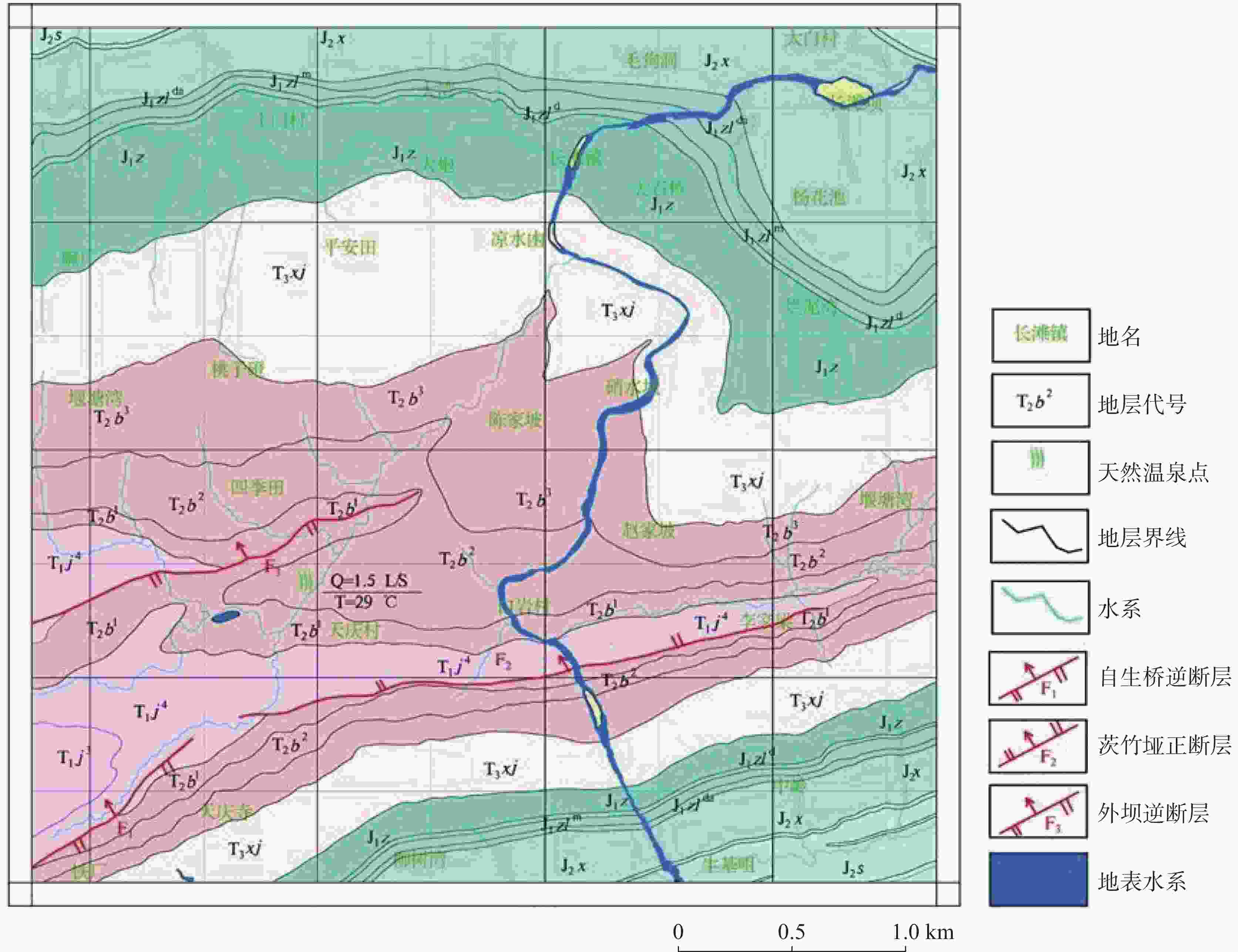
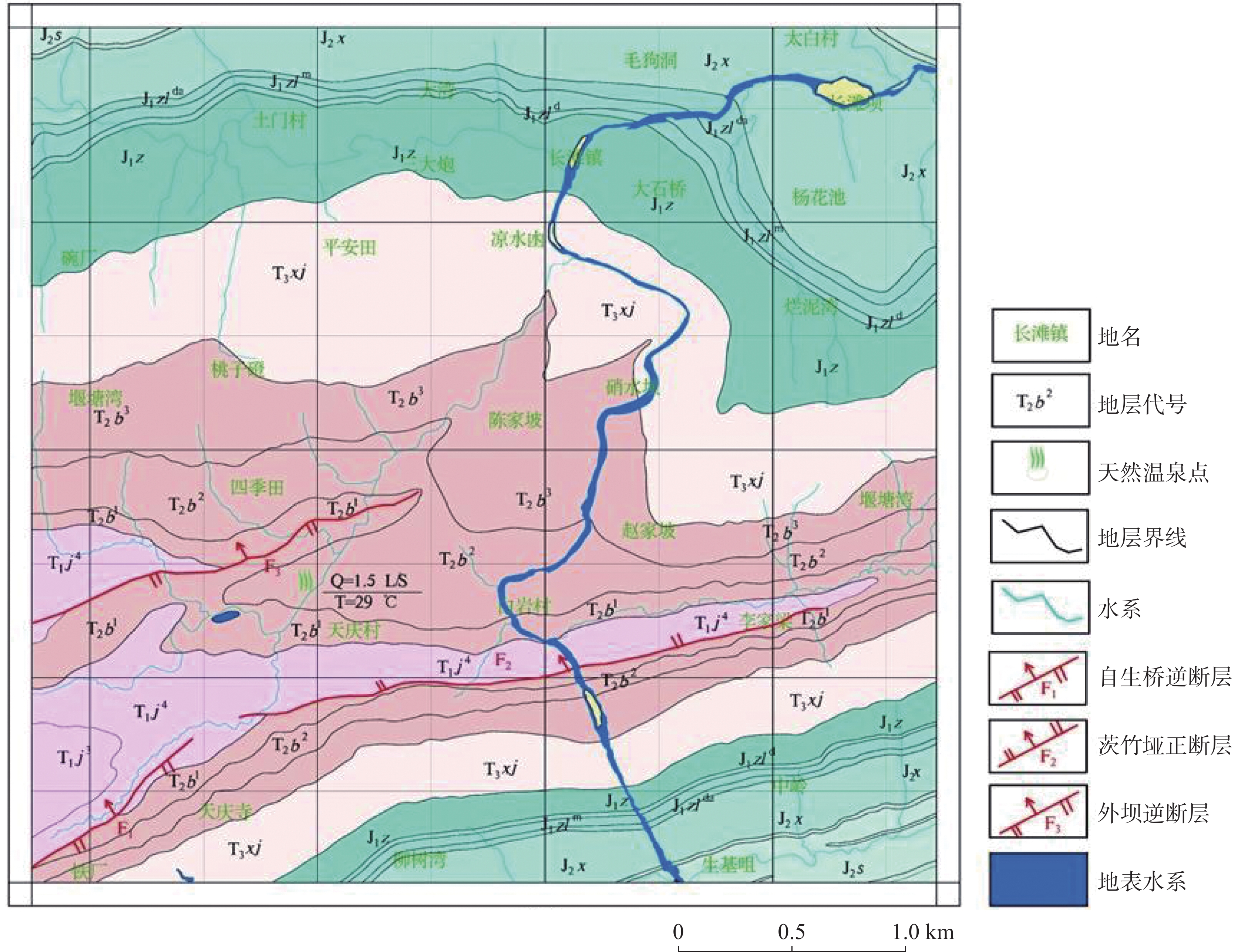
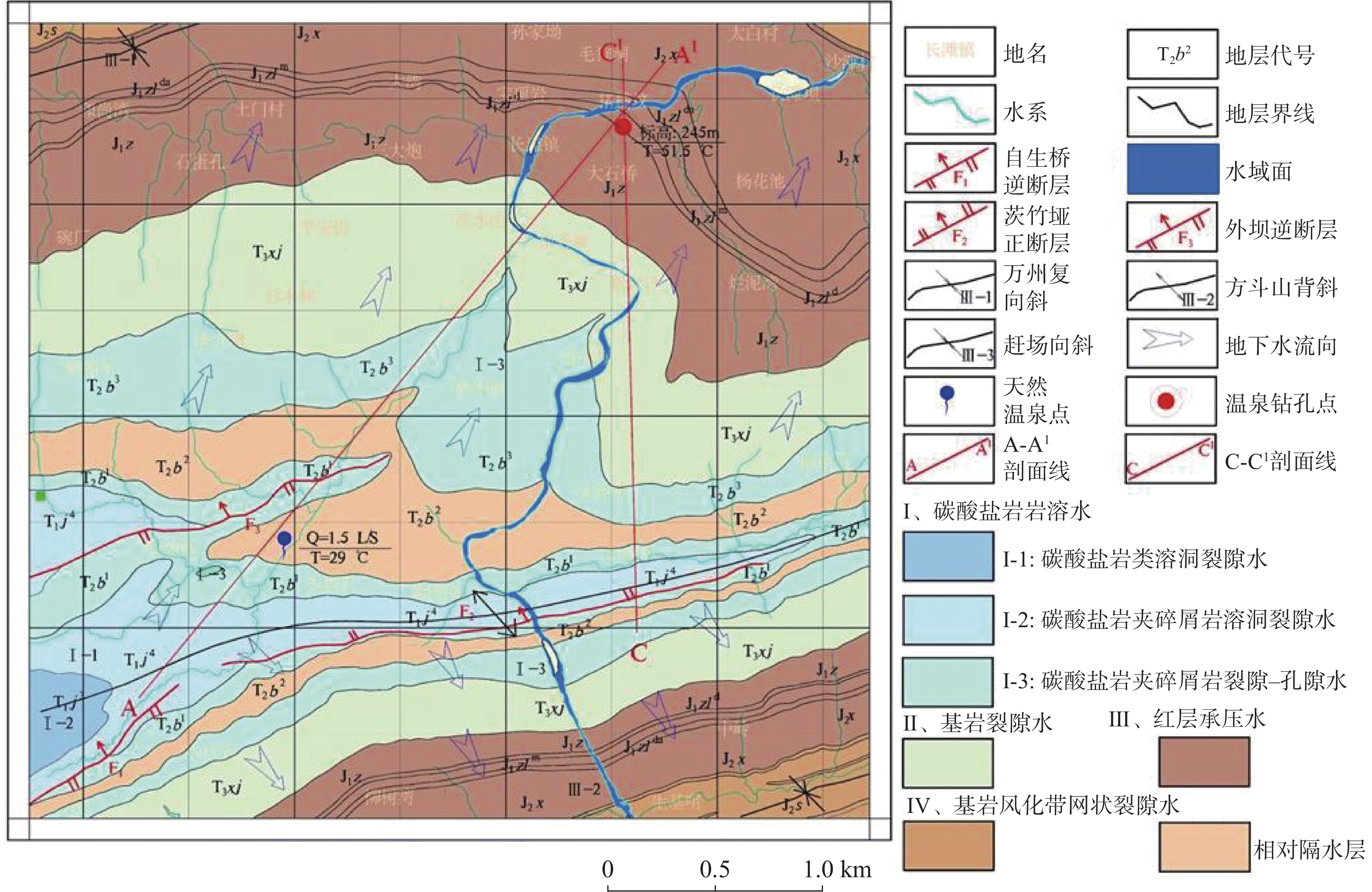
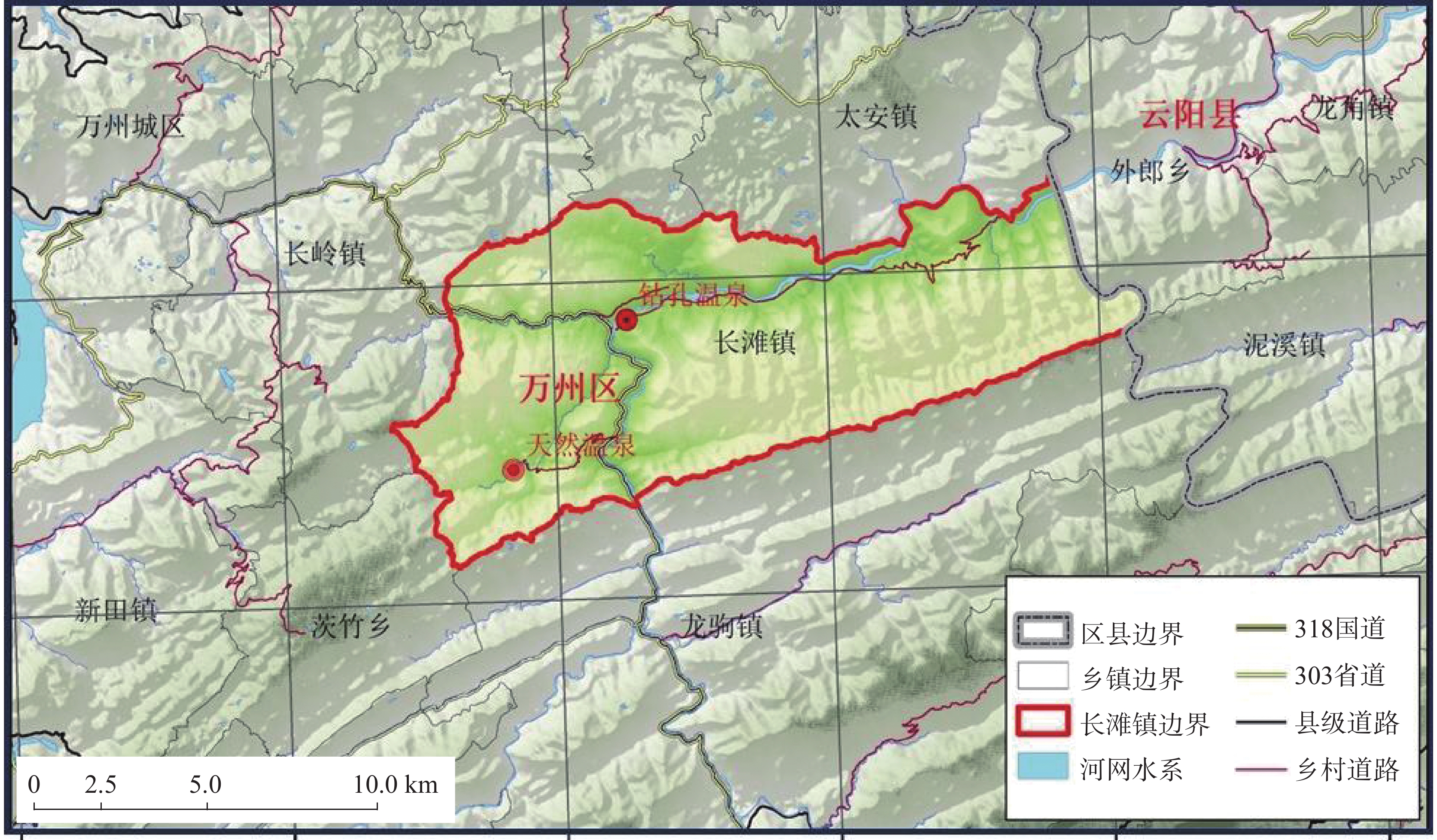
图 2 研究区地质及构造纲要简图
Figure 2. Simplified geological and structural outline of the study area
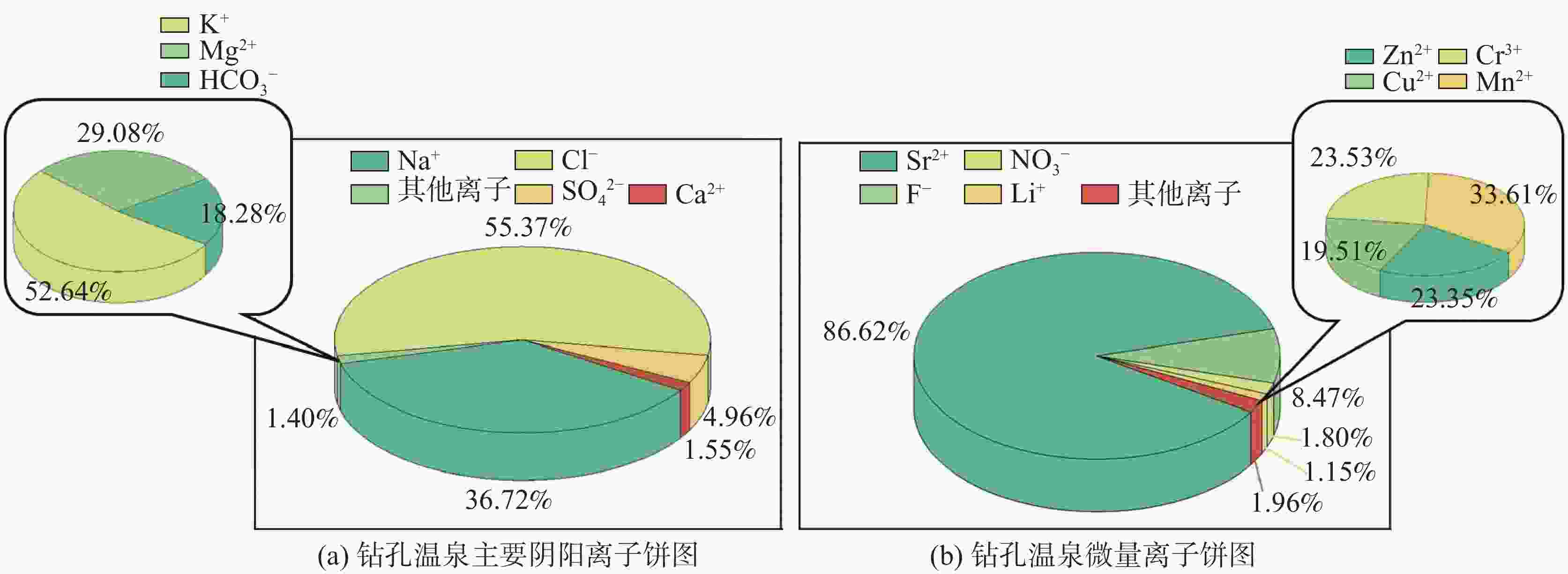
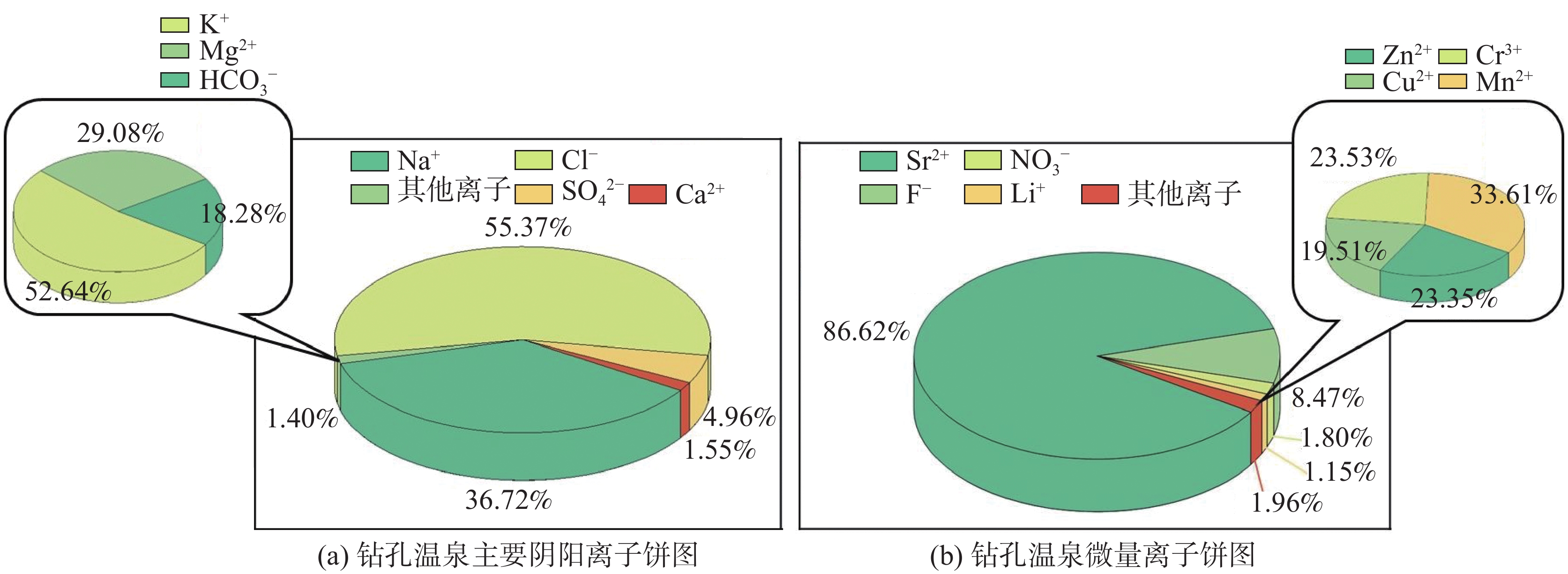
图 5 钻孔温泉主要离子组成(a)、微量离子组成(b)组成饼图
Figure 5. Pie chart of compositions of main ions (a) and trace ions (b) in artificially drilled hot springs
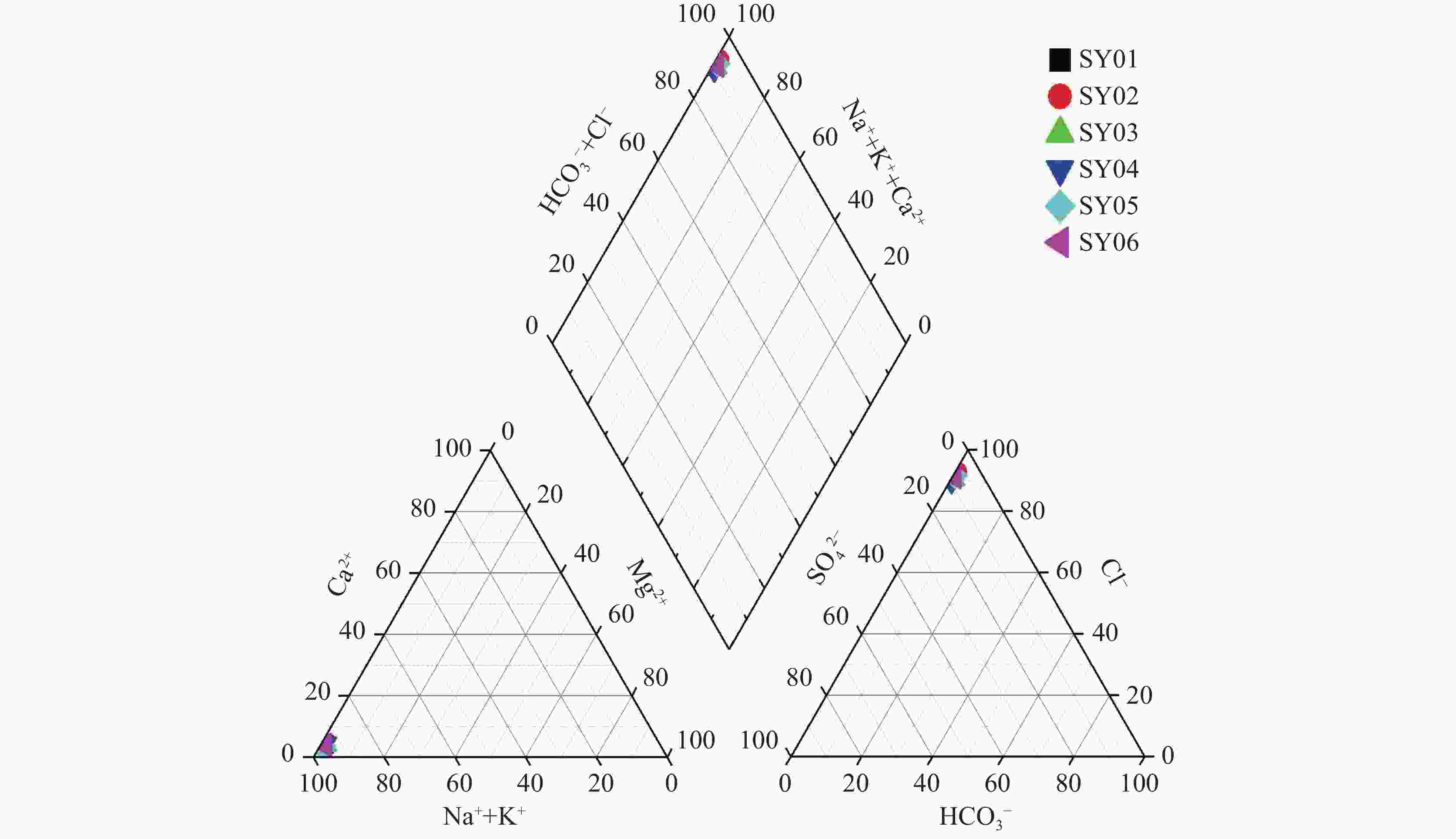
图 6 钻孔温泉地下水元素组成Piper三线图
Figure 6. Piper diagram of elements in artificially drilled hot springs
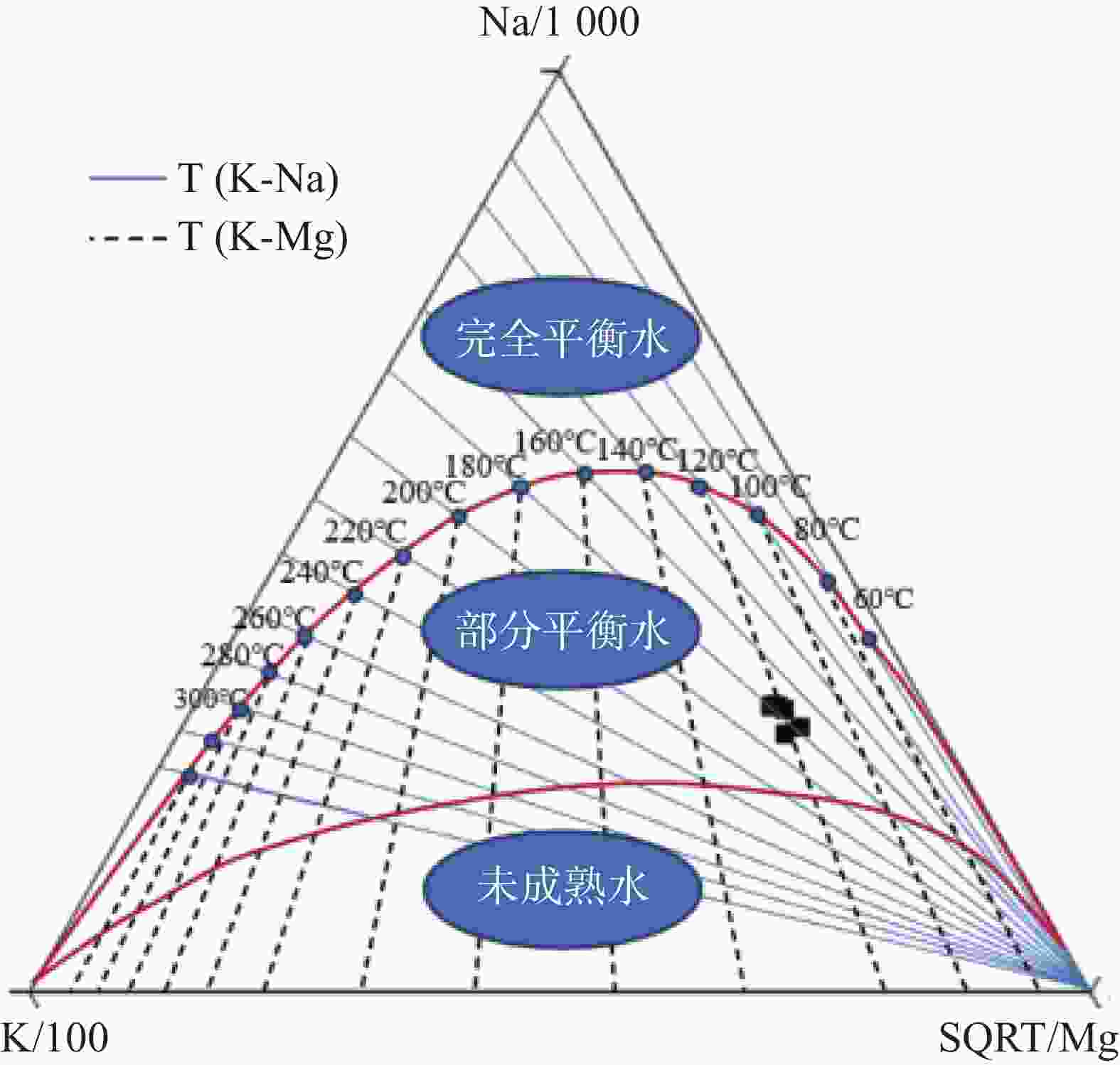
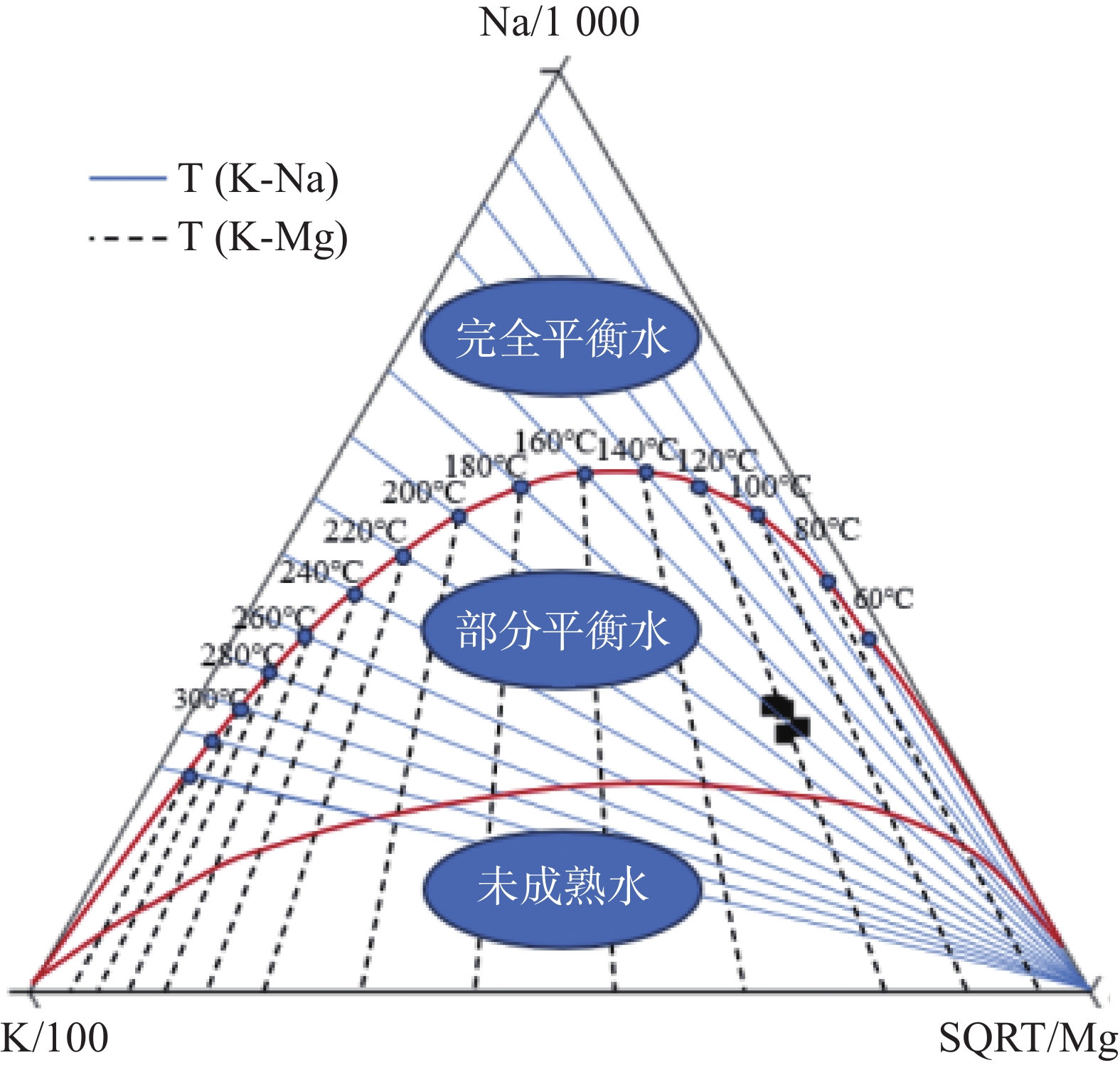
图 7 钻孔温泉的Giggenbach Na-K-Mg三角图
Figure 7. Giggenbach Na-K-Mg triangle of artifically drilled hot springs
表 1 研究区地下水类型及其赋存环境一览表
Table 1. Summary of groundwater types and their host environments
地下水类型 地下水亚类 赋存地层 赋存环境 碳酸盐岩溶水 碳酸盐岩类溶洞裂隙水 T2j3 赋存于方斗山背斜核部及北西翼近核部,表层岩溶作用导致
地形上形成溶蚀沟谷、溶洞、垄脊状沟谷等地貌类型碳酸盐岩夹碎屑岩溶洞裂隙水 T2j4 碳酸盐岩夹碎屑岩裂隙-孔隙水 T2b1、T2b3 基岩裂隙水 碎屑岩层间裂隙水 T3xj 赋存状况受制于砂岩含水层厚度、裂隙发育程度及地貌条件 红层承压水 红层承压水 J1z、J1zl、J2x 赋存于泥岩之间的砂岩含水层中,独立的补径排系统 网状裂隙水 基岩风化带网状裂隙水 J2s 赋存于侏罗系红层浅部风化带网状裂隙中,其富水性极弱  下载: 导出CSV
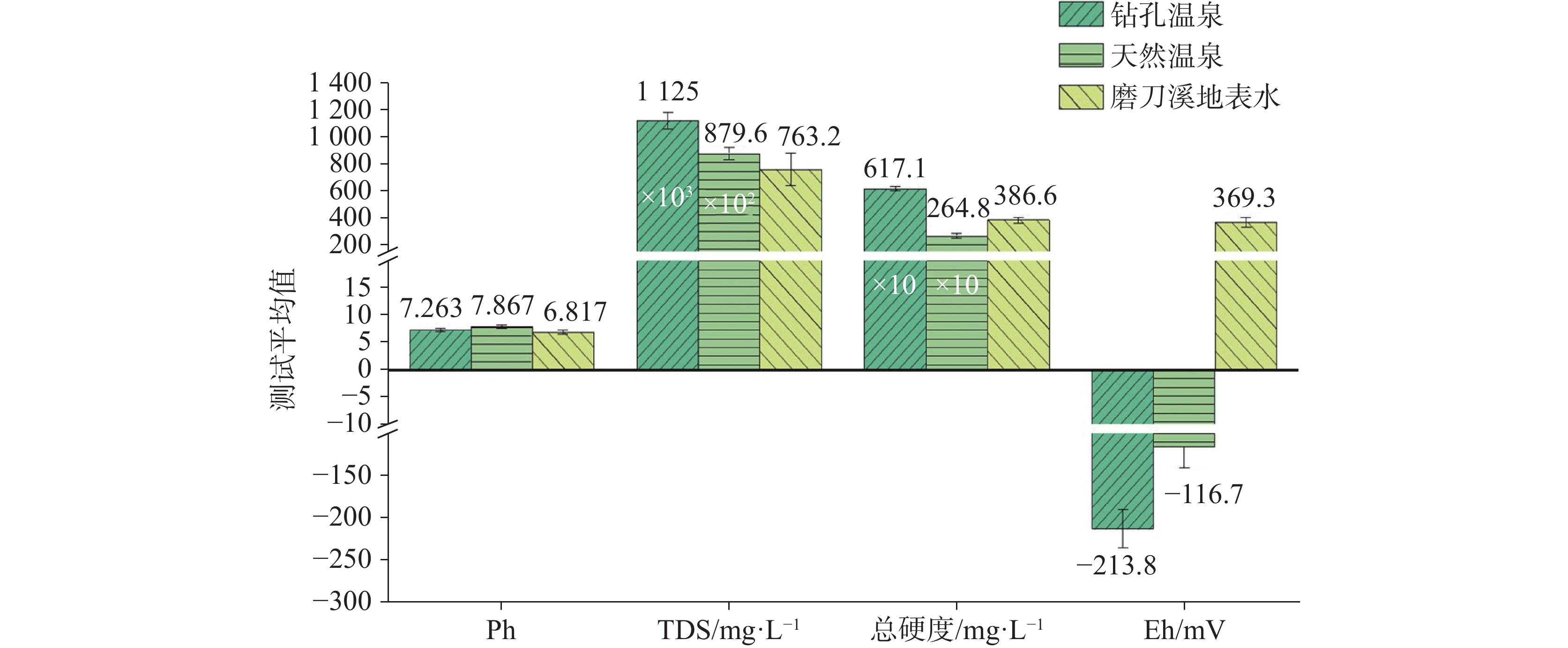
表 2 水化学综合指标数据表
Table 2. Comprehensive index data of water chemistry
水样采集点 pH 标准差 TDS/mg∙L−1 标准差 总硬度/mg∙L−1 标准差 Eh/mV 标准差 钻孔温泉 7.26 0.30 112.50×10³ 6197 617.1×10 16.92 −214 22.79 天然温泉 7.87 0.32 879.62×10² 4591 264.8×10 19.38 −117 24.83 磨刀溪地表水 6.82 0.38 763.20 123.31 386.60 21.47 369 36.50
下载: 导出CSV
表 3 钻孔温泉物质含量表
Table 3. Ion contents of artificially drilled hot springs
物质类别 物质种类 SY01 SY02 SY03 SY04 SY05 SY06 均值 主要阴阳离子 Na+/ g∙L−1 38.01 43.04 38.02 36.60 47.20 38.75 40.27 Ca2+/ g∙L−1 1.69 1.67 1.73 1.72 1.69 1.67 1.69 Cl−/ g∙L−1 56.83 67.48 56.32 56.32 66.13 61.24 60.72 ${\rm{SO}}_4^{2-}$/ g∙L−1 5.44 4.73 5.46 5.91 5.62 5.49 5.44 K+/ mg∙L−1 109.86 1119.73 919.95 932.03 1058.00 1015.26 1015.26 Mg2+/ mg∙L−1 476.61 451.34 439.57 435.29 549.12 501.27 475.53 ${\rm{HCO}}_3^{-}$/mg∙L−1 286.91 377.51 285.93 237.00 326.15 280.43 298.99 微量离子 F−/ mg∙L−1 3.44 3.48 3.80 3.92 3.60 3.50 3.62 ${\rm{NO}}_3^{-}$/ mg∙L−1 2.82 1.19 0.12 0.14 0.21 0.15 0.77 Li+/ mg∙L−1 0.46 0.41 0.54 0.51 0.49 0.55 0.49 Sr2+/ mg∙L−1 41.69 22.60 42.25 43.67 41.52 30.65 37.06 Zn2+/ mg∙L−1 0.15 0.15 0.36 0.19 0.22 0.11 0.20 Cu2+/ mg∙L−1 0.23 0.28 0.26 0.21 0.16 Cr3+/ mg∙L−1 0.59 0.04 0.39 0.14 0.02 0.20 Mn2+/ mg∙L−1 0.34 0.32 0.31 0.43 0.28 0.01 0.28 硫化物 H2S/ mg∙L−1 153.86 117.86 133.47 121.64 140.26 123.15 131.71
下载: 导出CSV
表 4 钻孔温泉热储温度计算表
Table 4. Calculation of thermal storage temperature for artifically drilled hot springs
取样批次 SiO2浓度/ g∙L−1 T1/℃ T2/℃ T3/℃ Ta/℃ SY01 31.48 50.31 81.62 51.85 61.26 SY02 34.81 54.80 85.26 55.81 65.29 SY03 40.80 62.14 91.17 61.82 71.71 SY04 32.55 51.79 82.82 53.18 62.60 SY05 46.63 68.57 96.30 66.69 77.19 SY06 26.63 43.12 75.71 44.93 54.59 均值 35.48 55.12 85.48 55.71 65.44
下载: 导出CSV
表 5 钻孔温泉地下热水循环深度计算表
Table 5. Calculation of depth of underground hot water circulation in artificially drilled hot springs
取样批次 g/m·℃−1 T/℃ t0/℃ h0/m h/m SY01 40 61.26 17 25 1795.39 SY02 40 65.29 17 25 1956.60 SY03 40 71.71 17 25 2213.43 SY04 40 62.60 17 25 1848.89 SY05 40 77.19 17 25 2432.45 SY06 40 54.59 17 25 1528.41
下载: 导出CSV
-
[1] Taran Y A, Peiffer L. Hydrology, hydrochemistry and geothermal potential of El Chichón volcano hydro thermal system, Mexico[J]. Geothermics, 2009, 38(4): 370-378. doi: 10.1016/j.geothermics.2009.09.002 [2] Wen Y H, Wang N A, Hu Z. Hydrochemistry of geothermal water in Tianshui and adjacent area, Gansu province, China[J]. Environmental Earth Sciences, 2012, 67(5): 1281-1290. doi: 10.1007/s12665-012-1571-9 [3] Jean J S, Liao L, Kar S. Hydrochemistry of hot springs in geothermal fields of central, northern and northeastern Taiwan: implication on occurrence and enrichment of arsenic[J]. Environmental Earth Sciences, 2016, 75(19): 1316. doi: 10.1007/s12665-016-6128-x [4] Toth J. Gravityinduced crossformational flow of formation flu-ids, Red Earth Region, Alberta, Canada: analysis, patterns and evolution[J]. Water Resources Rese-arch, 1978, 14(5): 805-843. doi: 10.1029/WR014i005p00805 [5] Swanson S K, Bahr J M, Schwar M T, Potter K W. Two way cluster analysis of geochemical data to constrain spring source waters[J]. Chemical Geology, 2001, 179(1): 73-91. [6] Evans M J, Derry L A. Hydrothermal flux of metamorphic carbon dioxide from the central Nepal Himalaya[C]. AGU Fall Meeting Abstracts, 2005: H51C-0384. [7] 曾敏. 重庆温泉分布及类型研究[J]. 地下水, 2013, 35(5): 4-7.ZENG Min. Study on hot spring distribution and types in Chongqing[J]. Groundwater, 2013, 35(5): 4-7. [8] 张宇, 杨平恒, 王建力, 谢世友, 罗顺清, 樊新庆. 重庆温泉研究进展[J]. 中国岩溶, 2015, 34(5): 468-478.ZHANG Yu, YANG Pingheng, WANG Jianli, XIE Shiyou, LUO Shunqing, FAN Xinqing. Reviewed research on the hot springs in Chongqing[J]. Carsologica Sinica, 2015, 34(5): 468-478. [9] 吕玉香, 胡伟, 杜春兰, 杨照国. 重庆市地热水资源勘查研究进展述略[J]. 地下空间与工程学报, 2010, 6(S2): 1544-1547.LYU Yuxiang, HU Wei, DU Chunlan, YANG Zhaoguo. Review on the progress of geothermal water exploration research in Chongqing[J]. Chinese Journal of Underground Space and Engineering, 2010, 6(S2): 1544-1547. [10] 杨华云, 徐静. 重庆都市圈地热资源评价及开发利用方向[J]. 中国水运, 2006, 6(8): 217-218.YANG Huayun, XU Jing. Chongqing metropolis circle geothermal resource appraisal and development use direction[J]. China Water Transport, 2006, 6(8): 217-218. [11] 罗云菊, 刘东燕, 刘新荣. 重庆打造“温泉之都”的可行性分析[J]. 重庆大学学报(自然科学版), 2007, 1(30): 147-151.LUO Yunju, LIU Dongyan, LIU Xinrong. Feasibility analysis of exploittation City of Hot Spring in Chongqing[J]. Journal of Chongqing University (Natrual Science Edition), 2007, 1(30): 147-151. [12] 中华人民共和国民政部. 中华人民共和国政区大典•重庆市卷[M]. 北京: 中国社会出版社, 2015: 90-92. [13] 国家统计局农村社会经济调查司. 中国县域统计年鉴2021(乡镇卷)[M]. 北京: 中国统计出版社, 2022: 438. [14] 重庆市地质调查研究院. 重庆市区域地质志[M]. 北京: 地质出版社, 2021: 465-478. [15] 涂明江, 赵良杰, 李强, 陈刚, 王若帆, 王元坤. 黔西南地区地热储层结构特征: 以望谟平洞地热储层为例[J]. 中国岩溶, 2024, 43(1): 84-91.TU Mingjiang, ZHAO Liangjie, LI Qiang, CHEN Gang, WANG Ruofan, WANG Yuankun. Structural characteristics of geothermal reservoirs in southwest Guizhou: Taking Pingdong geothermal reservoir in Wangmo county as an example[J]. Carsologica Sinica, 2024, 43(1): 84-91. [16] Gil-Marquez J M, Barbera J A, Andreo B, Mudarra M. Hydrological and geochemical processes constraining groundwater salinity in wetland areas related to evaporitic karst systems. A case study from Southern Spain[J]. Journal of Hydrology, 2017, 544: 538-554. [17] Elderfield H. The Oceanic chemistry of the rareearth elements[J]. Philosophical Transactions of the Royal Society A: Mathematical, Physical and Engineering Sciences, 1988, 325(1583): 105-126. [18] 苏春田, 黄晨晖, 邹胜章, 谢代兴, 赵光帅, 唐建生, 罗飞, 杨杨. 新田县地下水锶富集环境及来源分析[J]. 中国岩溶, 2017, 36(5): 678-683.SU Chuntian, HUANG Chenhui, ZOU Shengzhang, XIE Daixing, ZHAO Guangshuai, TANG Jiansheng, LUO Fei, YANG Yang. Enrichment environment and sources of strontium of groundwater in Xintian county, Hunan Province[J]. Carsologica Sinica, 2017, 36(5): 678-683. [19] 周训, 曹琴, 李双鹏, 王黎栋, 黄熙, 张永帅, 尹菲. 重庆巫溪县宁厂盐泉的形成[J]. 第四系研究, 2014, 34(5): 1036-1043.ZHOU Xun, CAO Qin, LI Shuangpeng, WANG Lidong, HUANG Xi, ZHANG Yongshuai, YIN Fei. Formation of the Ningchang salt spring in Wuxi county of Chongqing[J]. Quarter-nary Sciences, 2014, 34(5): 1036-1043. [20] 张华, 何绕生, 康晓波, 杨颖彬, 李芹, 高瑜, 周俊蓉, 柴金龙. 滇西盈江盆地地下热水循环系统特征及资源潜力[J]. 中国岩溶, 2024, 43(6): 1317-1326.ZHANG Hua, HE Raosheng, KANG Xiaobo, YANG Yingbin, LI Qin, GAO Yu, ZHOU Junrong, CHAI Jinlong. Characteristics of the underground hot water circulation system western Yunnan Yingjiang basin and resources development potential[J]. Carsologica Sinica, 2024, 43(6): 1317-1326. [21] 金文正. 云南省洱源县断裂特征及其对地热的控制作用[J]. 中国岩溶, 2024, 43(1): 57-71.JIN Wenzheng. Characteristics of faults and their controlling effect on geothermal energy in Eryuan county, Yunnan Province[J]. Carsologica Sinica, 2024, 43(1): 57-71. [22] 肖琼. 重庆三叠系碳酸盐岩热储成因与水−岩作用过程研究[D]. 重庆: 西南大学, 2012.XIAO Qiong. Water-Rock interaction and genesis of thermal groundwater in carbonate reservoir in Chongqing[D]. Chongqing: Southwest University, 2012. [23] Giggenbach W F. Geothermal solute equi-libria, derivation of Na-K-Mg-Ca geoindicators[J]. Geochimica Et Cosmochimica Acta, 1988, 52(12): 2749-2765. doi: 10.1016/0016-7037(88)90143-3 [24] 郭娟. 四川盆地东北部盐泉、咸泉和卤水水文地球化学特征及演化[D]. 北京: 中国地质大学(北京), 2019.GUO Juan. Hydrogeochemical characteristics and evolution of the saline/salty springs and subsurface brines in the northeastern Sichuan Basin[D]. Beijing: China University of Geosciences (Beijing), 2019. [25] 周训, 姜长龙, 韩佳君, 唐丽伟, 曹琴, 李婷. 沉积盆地深层地下卤水资源量评价之若干探讨[J]. 地球学报, 2013, 34(5): 610-616. doi: 10.3975/cagsb.2013.05.12ZHOU Xun, JIANG Changlong, HAN Jiajun, TANG Liwei, CAO Qin, LI Ting. Some problems related to the evaluation of subsurface brine resources in deep-seated aquifers in sedimentary basins[J]. Acta Geoscientica Sinica, 2013, 34(5): 610-616. doi: 10.3975/cagsb.2013.05.12 [26] 韩佳君, 周训, 姜长龙, 胡良君, 方斌, 孙琦. 柴达木盆地西部地下卤水水化学特征及其起源演化[J]. 现代地质, 2013, 27(6): 1454-1464. doi: 10.3969/j.issn.1000-8527.2013.06.025HAN Jiajun, ZHOU Xun, JIANG Changlong, HU Liangjun, FANG Bin, SUN Qi. Hydrochemical characteristics, origin and evolution of the subsurface brines in western Qaidam Basin[J]. Geoscience, 2013, 27(6): 1454-1464. doi: 10.3969/j.issn.1000-8527.2013.06.025 [27] 马瑞. 碳酸盐岩热储隐伏型中低温热水的成因与水−岩相互作用研究: 以山西太原为例[D]. 北京: 中国地质大学(北京), 2007.MA Rui. Water-rock interaction and genesis of low-medium temperature thermal groundwater in carbonate reservoir: A case study at Taiyuan, Shanxi[D]. Beijing: China University of Geosciences (Beijing), 2007 [28] 马腾, 王焰新, 马瑞, 闫春淼, 单慧媚, 陈柳竹. 太原盆地区碳酸盐岩中–低温地热系统演化[J]. 地球科学(中国地质大学学报), 2012, 37(5): 229-238.MA Teng, WANG Yanxin, MA Rui, YAN Chunmiao, SHAN Huimei, CHEN Liuzhu. Evolution of middle-low temperature carbonate geothermal system in Taiyuan, Northern China[J]. Earth Science (Journal of China University of Geosciences), 2012, 37(5): 229-238. -

 点击查看大图
计量
- 文章访问数: 819
- HTML浏览量: 280
- PDF下载量: 293
- 被引次数: 0
