


Grading of germanium contents and establishment of standard for germanium-enrichment in cultivated soils in Guizhou Province
-
摘要: 目前对富锗土壤的研究与开发逐渐增多,全国尚没有统一的富锗土壤国家标准或行业标准,在一定程度上阻碍了富锗产业的发展,因此土壤富锗地方标准的制定具有重要的现实意义。文章依据对贵州全省耕地
454 453 个土壤样品分析测试结果,参考目前关于土壤锗含量分级的3种分级方法,对土壤锗含量进行分级。并根据不同的影响因素进行统计计算,得出土壤锗含量的分级临界值。经过计算所有样品5个等级的分级临界值分别为2.00×10⁻⁶、1.70 ×10⁻⁶、1.35×10⁻⁶、1.07×10⁻⁶。建议将1.70×10⁻⁶作为全省耕地土壤富锗标准参考值,并根据土壤的不同pH条件、不同成土母岩或土地利用类型进行综合分级。Abstract: Germanium is a rare and dispersed element in nature. Positioned between metals and non-metals on the periodic table, germanium possesses properties of both groups. In soils, germanium mainly originates from rock weathering and mineral formation. Monitoring and statistical data show that the background content of germanium in soil in China is 1.7 mg·kg−1, while the latest research suggests that the background or benchmark value for germanium in cultivated soils in China ranges from 1.3 mg·kg−1 to 1.4 mg·kg−1. At present, studies on grading germanium contents in soils mostly adopt the cumulative frequency analysis method. This approach tests whether the data follow a normal distribution or log-normal distribution. Once the data conform to one of these distributions, a critical percentile value is established to determine the grading standard, which is typically divided into five levels. This germanium content in soils is then classified according to these levels. In recent years, Chinese government’s emphasis on functional agriculture has led to a surge in research and exploitation of germanium-enriched soil and crops. However, no unified national or industry standards currently exist; only Heilongjiang Province has issued the local standard for evaluating germanium-enriched soil. Therefore, the timely establishment of such standard is of great significance for the industrialization of germanium-enriched products and for the sustainable and healthy development of the relevant market.The geochemical survey and evaluation of cultivated land quality in Guizhou Province is a high-precision study encompassing all cultivated land in the province at a scale of 1:50,000. The sampling areas mainly include cultivated lands, such as paddy fields, dry land, irrigated land, and a small proportion of tea gardens, orchards, etc. A total of 454,453 surface soil samples from cultivated lands were collected. Based on the analysis and testing results of these samples, this study adopted three grading methods to classify soil germanium contents and calculated the critical values for grading soil germanium contents according to different influencing factors. The threshold values for five grades of all samples were calculated as 2.00 mg·kg−1, 1.70 mg·kg−1, 1.35 mg·kg−1 and 1.07 mg·kg−1, respectively. These values were divided into five levels to represent the abundance or deficiency of germanium contents in soils. The critical value of the first level is generally used as the standard for germanium enrichment. Considering the current germanium contents in cultivated soils of Guizhou Province, the proportion of germanium-enriched soils, and the development needs of the germanium enrichment industry, it is advisable to use the second-level critical value of 1.70 mg·kg−1-corrected by the arithmetic mean method across all samples-as the reference standard for germanium enrichment in cultivated soils in the province. Additionally, reference values for germanium enrichment in soils can also be established based on variations in soil pH ranges, parent rocks, or land use types. This study uses 1.70 mg·kg−1 as the reference value. The number of samples meeting the standard for germanium enrichment in soils is 126,395, accounting for 27.8%. The cultivated area characterized by soils enriched with germanium in the province is about 16.08 million mu, representing 22.3% of the total surveyed area. The sample scope of this study covers agricultural soils throughout Guizhou Province, ensuring broad representativeness and diversity. Analysis and testing were carried out in accordance with the established standard, employing quality control measures such as inclusion of the substances meeting the national first-class standard, monitoring samples, repeated checks, and spot checks for anomalies. Therefore, the results are authentic, scientific, and valuable for reference. In addition, the contents of organic matter, aluminum/iron oxides, clay minerals, and redox potential in soils have a certain impact on the available contents of germanium in soils. Future research should focus on a more detailed classification of standards for germanium enrichment in soils.-
Key words:
- soil /
- germanium content /
- germanium-enrichment /
- cultivated land /
- grading /
- standard /
- Guizhou Province
-
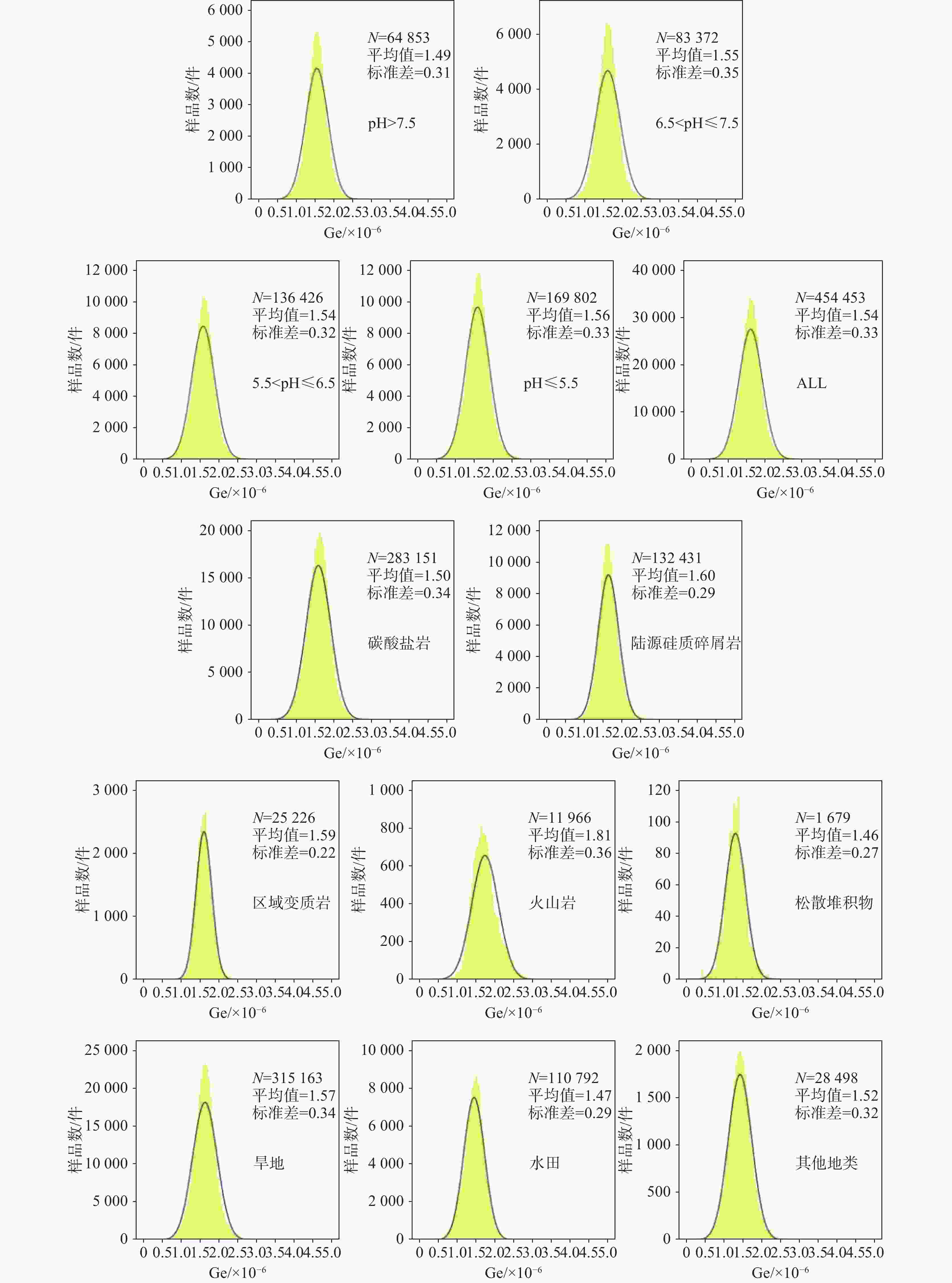
图 1 贵州省耕地土壤锗含量频率分布图
Figure 1. Frequency of germanium contents in cultivated soils in Guizhou Province
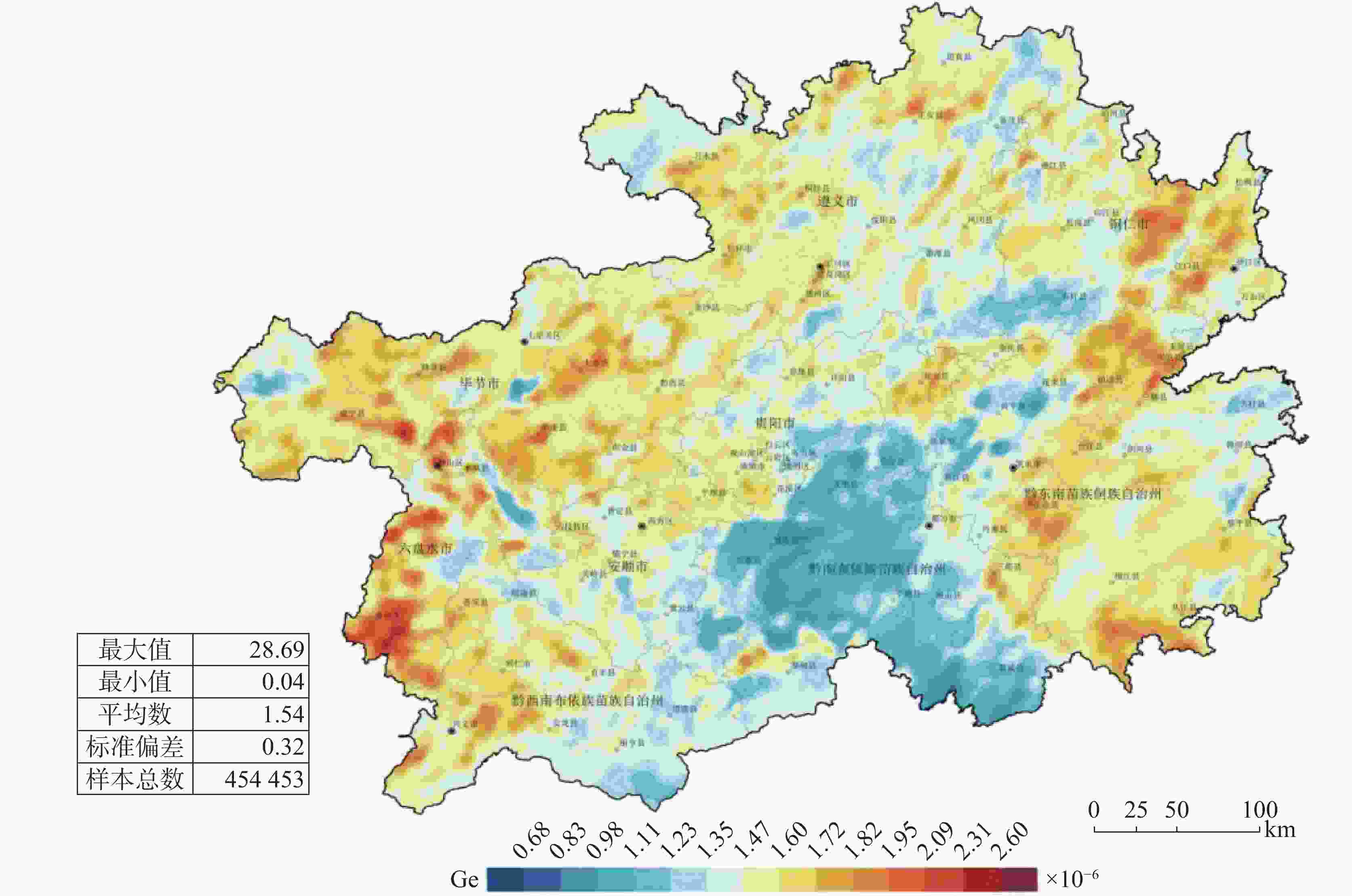
图 2 贵州省耕地土壤锗含量分布图
Figure 2. Distribution of germanium contents in cultivated soils in Guizhou Province
表 1 全国部分地区土壤富锗情况
Table 1. Germanium-enrichment in soils in some regions of China
研究区域 锗平均值/×10−6 富锗标准/×10−6 参考依据 云南省广南县[6] 1.648 ≥1.4 DZ/T 0295-2016 南京市溧水区[7] 1.4 ≥1.5 DZ/T 0295-2016 广西北部湾地区[8] 1.43 ≥1.4 DZ/T 0295-2016 重庆市南川区[9] 1.54 ≥1.4 参照相关文献 江西省万年县[10] 2.1 ≥2.0 综合当地土壤锗元素数据和已有研究成果划定 新疆若羌县[11] 1.16 ≥1.3 参照西北地区其它区域土壤中锗元素含量 西藏拉萨河沿岸[12] 1.3 ≥1.3 参照相关文献 贵州黔东南州[13] 1.54 ≥1.6 累积频率统计 黑龙江地方标准[4] ≥1.5 累积频率统计  下载: 导出CSV
表 2 贵州不同成土母岩区耕地土壤锗含量值统计
Table 2. Statistics of germanium contents in cultivated soils in the areas with different parent rocks of Guizhou Province
成土母岩
大类成土母岩(质) 样本数量/件 Ge元素含量/×10−6 最大值 中位值 算术平均值 最小值 碳酸盐岩 灰岩 171210 28.69 1.54 1.52 0.04 白云岩 111941 15.60 1.44 1.44 0.10 陆源硅质碎屑岩 泥(页)岩 80635 7.88 1.62 1.63 0.19 紫红色砂岩 26232 6.35 1.55 1.57 0.14 砂岩 23155 6.97 1.46 1.49 0.12 黑色页岩 2409 2.73 1.48 1.47 0.06 火山岩 玄武岩 11966 5.64 1.78 1.81 0.05 区域
变质岩板岩 9802 3.00 1.58 1.60 0.74 变余凝灰岩 9789 2.99 1.57 1.57 0.60 变质砂岩 5635 5.06 1.60 1.59 0.44 松散堆积物 泥、砂、砾 1679 2.83 1.45 1.46 0.54
下载: 导出CSV
表 3 不同pH区间锗含量分级计算结果(×10−6)
Table 3. Grading of germanium contents in different pH ranges
计算依据 分级 pH>7.5
(64853 件)6.5<pH≤7.5
(83372 件)5.5<pH≤6.5
(136426 件)pH≤5.5
(169802 件)DZ T
0295-2016一级
(≥80%)≥1.69 ≥1.76 ≥1.76 ≥1.80 二级
(60%~80%)1.54~1.69 1.61~1.76 1.61~1.76 1.63~1.80 三级
(40%~60%)1.42~1.54 1.48~1.61 1.48~1.61 1.49~1.63 四级
(20%~40%)1.27~1.42 1.32~1.48 1.30~1.48 1.31~1.49 五级
(≤20%)≤1.27 ≤1.32 ≤1.30 ≤1.31 DB23/T
2411-2019一级
(≥95%)≥1.95 ≥2.02 ≥2.03 ≥2.09 二级
(65%~95%)1.57~1.95 1.64~2.02 1.64~2.03 1.66~2.09 三级
(25%~65%)1.31~1.57 1.37~1.64 1.35~1.64 1.36~1.66 四级
(5%~25%)1.03~1.31 1.08~1.37 1.02~1.37 1.00~1.36 五级
(≤5%)≤1.03 ≤1.08 ≤1.02 ≤1.00 算数平均值
加减标准离差一级
(≥$ {\bar{X}} $+2S)≥2.11 ≥2.23 ≥2.18 ≥2.22 二级
($ {\bar{X}} $+S~$ {\bar{X}} $+2S)1.80~2.11 1.89~2.23 1.86~2.18 1.89~2.22 三级
($ {\bar{X}} $-S~$ {\bar{X}} $+S)1.18~1.80 1.21~1.89 1.22~1.86 1.23~1.89 四级
($ {\bar{X}} $-2S~$ {\bar{X}} $-S)0.87~1.18 0.87~1.21 0.90~1.22 0.90~1.23 五级
(≤$ {\bar{X}} $-2S)≤0.87 ≤0.87 ≤0.90 ≤0.90 算术平均法
修正后参考值一级 ≥1.92 ≥2.00 ≥2.00 ≥2.04 二级 1.64~1.92 1.71~2.00 1.70~2.00 1.73~2.04 三级 1.30~1.64 1.35~1.71 1.35~1.70 1.36~1.73 四级 1.06~1.30 1.09~1.35 1.07~1.35 1.07~1.36 五级 ≤1.06 ≤1.09 ≤1.07 ≤1.07
下载: 导出CSV
表 4 不同成土母岩区锗含量分级计算结果(×10−6)
Table 4. Grading of germanium contents in the areas with different parent rocks
计算依据 分级 碳酸盐岩
(283151 件)陆源硅质
碎屑岩
(132431 件)区域变质岩
(25226 件)火山岩
(11966 件)松散堆积物
(1679 件)DZ T
0295-2016一级
(≥80%)≥1.74 ≥1.80 ≥1.75 ≥2.08 ≥1.66 二级
(60%~80%)1.57~1.74 1.64~1.80 1.63~1.75 1.86~2.08 1.51~1.66 三级
(40%~60%)1.43~1.57 1.52~1.64 1.53~1.63 1.71~1.86 1.40~1.51 四级
(20%~40%)1.24~1.43 1.38~1.52 1.42~1.53 1.54~1.71 1.25~1.40 五级
(≤20%)≤1.24 ≤1.38 ≤1.42 ≤1.54 ≤1.25 DB23/T
2411-2019一级
(≥95%)≥2.00 ≥2.07 ≥1.96 ≥2.48 ≥1.92 二级
(65%~95%)1.61~2.00 1.67~2.07 1.66~1.96 1.90~2.48 1.54~1.92 三级
(25%~65%)1.30~1.61 1.42~1.67 1.45~1.66 1.58~1.90 1.29~1.54 四级
(5%~25%)0.96~1.30 1.18~1.42 1.28~1.45 1.33~1.58 1.03~1.29 五级
(≤5%)≤0.96 ≤1.18 ≤1.28 ≤1.33 ≤1.03 算数平均值
加减标准离差一级
(≥$ {\bar{X}} $+2S)≥2.20 ≥2.18 ≥2.03 ≥2.54 ≥2.02 二级
($ {\bar{X}} $+S~$ {\bar{X}} $+2S)1.85~2.20 1.89~2.18 1.81~2.03 2.18~2.54 1.74~2.02 三级
($ {\bar{X}} $-S~$ {\bar{X}} $+S)1.15~1.85 1.31~1.89 1.37~1.81 1.46~2.18 1.18~1.74 四级
($ {\bar{X}} $-2S~$ {\bar{X}} $-S)0.80~1.15 1.02~1.31 1.15~1.37 1.10~1.46 0.90~1.18 五级
(≤$ {\bar{X}} $-2S)≤0.80 ≤1.02 ≤1.15 ≤1.10 ≤0.90 算术平均法
修正后参考值一级 ≥1.98 ≥2.02 ≥1.91 ≥2.37 ≥1.87 二级 1.67~1.98 1.73~2.02 1.70~1.91 1.98~2.37 1.60~1.87 三级 1.29~1.67 1.42~1.73 1.45~1.70 1.58~1.98 1.29~1.60 四级 1.00~1.29 1.19~1.42 1.28~1.45 1.32~1.58 1.06~1.29 五级 ≤1.00 ≤1.19 ≤1.28 ≤1.32 ≤1.06
下载: 导出CSV
表 5 不同土地利用类型锗含量分级计算结果 (×10−6)
Table 5. Grading of germanium contents for different land use types
计算依据 分级 旱地
(315163 件)水田
(110792 件)其它地类
(28498 件)全部样品
(454453 件)DZ T
0295-2016一级
(≥80%)≥1.79 ≥1.69 ≥1.76 ≥1.77 二级
(60%~80%)1.63~1.79 1.54~1.69 1.59~1.76 1.61~1.77 三级
(40%~60%)1.50~1.63 1.41~1.54 1.45~1.59 1.47~1.61 四级
(20%~40%)1.33~1.50 1.24~1.41 1.27~1.45 1.30~1.47 五级
(≤20%)≤1.33 ≤1.24 ≤1.27 ≤1.30 DB23/T
2411-2019一级
(≥95%)≥2.08 ≥1.91 ≥2.04 ≥2.04 二级
(65%~95%)1.66~2.08 1.58~1.91 1.63~2.04 1.64~2.04 三级
(25%~65%)1.38~1.66 1.29~1.58 1.33~1.63 1.35~1.64 四级
(5%~25%)1.05~1.38 0.97~1.29 1.01~1.33 1.02~1.35 五级
(≤5%)≤1.05 ≤0.97 ≤1.01 ≤1.02 算数平均值
加减标准离差一级
(≥$ {\bar{X}} $+2S)≥2.25 ≥2.05 ≥2.16 ≥2.18 二级
($ {\bar{X}} $+S~$ {\bar{X}} $+2S)1.91~2.25 1.76~2.05 1.84~2.16 1.86~2.18 三级
($ {\bar{X}} $-S~$ {\bar{X}} $+S)1.23~1.91 1.18~1.76 1.20~1.84 1.22~1.86 四级
($ {\bar{X}} $-2S~$ {\bar{X}} $-S)0.89~1.23 0.89~1.18 0.88~1.20 0.90~1.22 五级
(≤$ {\bar{X}} $-2S)≤0.89 ≤0.89 ≤0.88 ≤0.90 算术平均法
修正后参考值一级 ≥2.04 ≥1.88 ≥1.99 ≥2.00 二级 1.73~2.04 1.63~1.88 1.69~1.99 1.70~2.00 三级 1.37~1.73 1.29~1.63 1.33~1.69 1.35~1.70 四级 1.09~1.37 1.03~1.29 1.05~1.33 1.07~1.35 五级 ≤1.09 ≤1.03 ≤1.05 ≤1.07
下载: 导出CSV
-
[1] 叶铁林, 徐宝财. 化学元素的奇妙世界[M]. 北京: 化学工业出版社, 2016. [2] 中国环境监测总站. 中国土壤元素背景值[M]. 北京: 中国环境科学出版社, 1990: 1-89. [3] 杨峥, 彭敏, 赵传冬, 杨柯, 刘飞, 李括, 周亚龙, 唐世琪, 马宏宏, 张青, 成杭新. 中国土壤54项指标的地球化学背景与基准研究[J]. 地学前缘, 2024,31(4):380-402.YANG Zheng, PENG Min, ZHAO Chuandong, YANG Ke, LIU Fei, LI Kuo, ZHOU Yalong, TANG Shigi, MA Honghong, ZHANG Qing, CHENG Hangxin. The study of geochemical background and baseline for 54 chemical indicators in Chinese soil[J]. Earth Science Frontiers, 2024,31(4):380-402. [4] DB23/T 2411-2019. 富锗土壤评价技术要求[S].2019. [5] DZ T 0295-2016. 土地质量地球化学评价规范[S].2016. [6] 洪涛, 孔祥胜. 云南省广南县富锗土壤地球化学特征及成因分析[J]. 矿产与地质, 2021, 35(2): 290-295.HONG Tao, KONG Xiangsheng. Geochemical feature and genesis analysis of germanium rich soiin Guangnan County of Yunnan[J]. Mineral Resources and Geology, 2021, 35(2): 290-295. [7] 周墨, 梁晓红, 张明, 文帮勇, 唐志敏, 湛龙. 南京市溧水区表层土壤锗地球化学特征及影响因素[J]. 现代地质, 2023, 37(1): 217-226.ZHOU Mo, LIANG Xiaohong, ZHANG Ming, WEN Bangyong, TANG Zhimin, ZHAN Long. Geochemical characteristics and influencing factors of germaniumin surface soil of Lishui District, Nanjing City[J]. Ceoscience, 2023, 37(1): 217-226. [8] 段轶仁, 杨忠芳, 杨琼, 郑国东, 卓小雄, 陈彪. 广西北部湾地区土壤锗分布特征、影响因素及其生态环境评价[J]. 中国地质, 2020, 47(6): 1826-1837.DUAN Yiren, YANG Zhongfang, YANG Qiong, ZHENG Guodong, ZHUO Xiaoxiong, CHEN Biao. The distribution of soil germanium and itsinfluencing factors in Beibu Gulf of Guangxi[J]. Geology in China, 2020, 47(6): 1826-1837. [9] 余飞, 张永文, 王宇, 罗凯, 陈达兵, 谢建. 重庆典型农业区富锗土壤分布特征及影响因素[J]. 地质与资源, 2021, 30(5): 610-615.YU Fei, ZHANG Yongwen, WANG Yu, LUO Kai, CHEN Dabing, XlE Jian. Distribution characteristics and influencing factors of germanium-rich soil in typical agricultural area of Chongoing municipality[J]. Geology and Resources, 2021, 30(5): 610-615. [10] 张根秀, 揭江明, 刘冰权, 卢先锋, 周强强, 张涛亮. 赣东北万年地区富锗土壤与农作物地球化学特征及其意义[J]. 江西科学, 2022, 40(3): 514-519.ZHANG Genxiu, JlE Jiangmin, LlU Bingquan, LU Xianfeng, ZHOU Qiangqiang, ZHANG Taoliang. Geochemical characteristics and significance of germaniumrich soil and crops in Wannian Area, Northeast Jiangxi Province[J]. Jiangxi Science, 2022, 40(3): 514-519. [11] 曾妍妍, 周金龙, 郑勇, 王松涛, 范薇. 新疆若羌县绿洲区富锗土壤地球化学特征及成因分析[J]. 土壤通报, 2017, 48(5): 1082-1085.ZENG Yanyan, ZHOU Jinlong, ZHENG Yong, WANG Songtao, FAN Wei. Geochemical features of germanium-rich soilsand its causes in oasis region of Ruogiang County, Xinjiang[J]. Chinese Joumal of Soil Science, 2017, 48(5): 1082-1085. [12] 袁宏, 赵利, 王茂丽, 徐开锋, 尊珠桑姆, 王海勇. 西藏拉萨至曲水拉萨河沿岸农用地土壤硒锗空间分布与评价[J]. 土壤, 2020, 52(2): 427-432.YUAN Hong, ZHAO Li, WANG Maoli, XU Kaifeng, ZUNZHU Sangmu, WANG Haiyong. Spatial distribution and evaluation of selenium and germanium in farmland soils from lhasa to qushui along the Lhasa River in Tibet[J]. Soils, 2020, 52(2): 427-432. [13] 张庆华, 苏之良, 罗勇军, 张涛, 但仕生. 黔东南州富锗土壤地球化学特征及成因分析[J]. 上海国土资源, 2021, 2: 20-24,29.ZHANG Qinghua, SU Zhiliang, LUO Yongjun, ZHANG Tao, DAN Shisheng. Geochemical features and origin of germanium-rich soil in Qiandongnan prefecture[J]. Shanghai Land and Resources, 2021, 2: 20-24,29. [14] 陈秋帆, 卢琦, 王妍, 刘云根. 西南石漠化区林下土壤养分特征及差异性[J]. 中国岩溶, 2023, 42(2): 290-299.CHEN Qiufan, LU Qi, WANG Yan, LIU Yungen. Nutrient characteristics and differences of forest soil in rockydesertification areas of Southwest China[J]. Carsologica Sinica, 2023, 42(2): 290-299. [15] 张春来, 陆来谋, 杨慧, 黄芬. 岩溶区土壤有机质空间变异性分析[J]. 中国岩溶, 2022, 41(2): 228-236.ZHANG Chunlai, LU Laimou, YANG Hui, HUANG Fen. Spatial variation analysis of soil organic matter in karst area[J]. Carsologica Sinica, 2022, 41(2): 228-236. [16] 汪丹, 闫加力, 王梦园, 夏伟, 周伟, 张阳阳. 恩施州中草药硒、锶、锗、锌元素含量特征及其影响因素研究[J]. 资源环境与工程, 2022, 36(5): 651-657.WANG Dan, YAN jiali, WANG Mengyuan, XIA Wei, ZHOU Wei, ZHANG Yangyang. Study on content characteristics and cine influencing factors of selenium' strntium' germanium and zinc in Chinese herbal medicine in Enshi prefecture[J]. Resources Fnvironment and Engineering, 2022, 36(5): 651-657. [17] 余飞, 罗恺, 王佳彬, 李瑜, 周皎, 王锐, 余亚伟, 张云逸. 重庆岩溶地质高背景区土壤-农作物系统重金属累积特征及影响因素[J]. 中国岩溶, 2023, 42(1): 71-79.YU Fei, LUO Kai, WANG Jiabin, LI Yu, ZHOU Jiao, WANG Rui, YU Yawei, ZHANG Yuny. Characteristies and influencing factors of heavy metal accumulation in soil-crop system in the karst area with high geological background of Chongqing[J]. Carsologica Sinica, 2023, 42(1): 71-79. -

 点击查看大图
计量
- 文章访问数: 1006
- HTML浏览量: 747
- PDF下载量: 10
- 被引次数: 0
