


Effects of soil conditioner dosage on soil physicochemical properties and maize growth in subtropical karst area
-
摘要: 亚热带岩溶区石灰土存在质地黏重、保水保肥能力低等问题,影响作物生长。文章旨在通过土壤改良剂与化肥的优化配施,提升石灰土的肥力和玉米的健康水平。为验证岩溶区土壤改良和平衡施肥的有效性,研制针对岩溶区石灰土的土壤改良剂,设置T0(仅施化肥)和T1-T5(化肥与不同浓度土壤改良剂配施)六组盆栽试验处理。通过分析土壤理化性质和玉米叶片养分表现,运用DRIS(Diagnosis and Recommendation Integrated System)法评估玉米营养状况。研究结果表明:T1-T5处理中,土壤氮、磷等大量元素随改良剂配施比例增加而上升,而Ca、Cu、Mn、Cl、P和Mo等微量元素则呈下降趋势。T1-T5处理的玉米叶片各养分含量普遍高于T0处理。DRIS法诊断显示,岩溶区玉米需肥顺序为Fe>Cu>S>K>Ca>Mg>N>P>Zn>B>Mn。综合分析表明,T4处理(5.38 g/盆土壤改良剂+43 g/盆化肥)是提升土壤质量和玉米健康水平的最优组合。化肥与HH土壤改良剂的优化配施能有效改善岩溶区石灰土的理化性质,提升玉米的营养吸收和生长表现,其中T4处理效果最佳,可作为岩溶区土壤改良和玉米种植的推荐方案。Abstract:
Soil resources in subtropical karst regions constitute a critical yet fragile component of agricultural arable land, playing a pivotal role in ensuring local food security and ecological stability. The unique geological setting dominated by carbonate rocks in these areas profoundly shapes the properties of the derived calcareous soils. A prominent challenge of such soils is their inherently heavy and sticky texture, stemming from high clay content and poor aggregation, which severely impedes water infiltration and root penetration. Concurrently, the region's high rainfall and porous bedrock accelerate nutrient leaching, exacerbating the soils' low water and fertilizer retention capacity,which leads to the frequent nutrient deficiencies, the obstruction of crop growth, and the decrease of agricultural productivity. Over time, these limitations have not only constrained yields of maize-a staple crop in many karst regions-but also exacerbated soil degradation and ecosystem vulnerability, highlighting the urgent need for effective soil improvement strategies. Against this backdrop, research on soil improvement technologies tailored to subtropical karst zones is essential for enhancing maize health, optimizing nutrient use efficiency, and providing actionable technical references for calcareous soil amelioration and balanced fertilization. To address this need, our study focused on developing a novel soil conditioner, specifically formulated to mitigate the constraints of karst calcareous soils. The conditioner was designed to improve soil structure, enhance nutrient retention, and promote nutrient availability, with the overarching goal of creating a more favorable growth environment for maize.To systematically evaluate the efficacy of the conditioner, we conducted controlled pot experiments involving combined applications of chemical fertilizers and varying concentrations of the conditioner. The experimental design included six treatments: T0 (control, no conditioner + 43 g per basin fertilizer) and T1-T5 (43 g per basin fertilizer combined with 1.35, 2.70, 4.05, 5.38, and 6.73 g per basin of the conditioner, respectively), with each treatment replicated three times to ensure result reliability. Over a 106-day growth period, we monitored soil physicochemical properties (pH, organic matter content, cation exchange capacity, and concentrations of macronutrients—N, P, K, S—and micronutrients—Ca, Mg, Fe, Cu, Zn, Mn, B, Mo, Cl) and maize biological traits (plant height, stem diameter, leaf area index, and aboveground biomass).A central component of our analytical framework was the integration of the Diagnosis and Recommendation Integrated System (DRIS), a robust method for assessing crop nutritional status by comparing nutrient ratios against optimal reference values. For mature maize leaves, we quantified 11 essential nutrients (N, P, K, S, Ca, Mg, Fe, Cu, Zn, Mn, B) and calculated DRIS indices to evaluate nutrient balance, identified limiting factors, and determined the Nutrient Imbalance Index (NII)—a composite metric reflecting overall nutritional status. The results revealed several key findings:(1) Regarding soil properties: in treatments T1-T5, concentrations of macronutrients such as N and P increased significantly with higher application rates of the conditioner (P<0.05), attributed to the conditioner's ability to inhibit nutrient leaching and promote mineralization. In contrast, concentrations of micronutrients including Ca, Cu, Mn, Cl, and Mo decreased with increasing conditioner dosage.(2) Concerning nutrient content in maize leaves: all T1-T5 treatments exhibited higher leaf nutrient concentrations compared to T0. (3) DRIS-based nutrient diagnosis indicated that the overall fertilizer requirement order for maize in karst regions was Fe>Cu>S>K>Ca>Mg>N>P>Zn>B>Mn,which has underscored the critical role of micronutrients such as Fe and Cu—often overlooked in conventional fertilization regimes—in limiting maize growth in these soils.Integrating soil nutrient data, leaf nutrient concentrations, DRIS indices, and NII values, the T4 treatment (5.38 g/basin HH conditioner + 43 g/basin fertilizer) was identified as the optimal combination. This treatment not only improved soil structure but also resulted in the lowest NII (1.23), indicating the most balanced nutritional status, and the highest maize biomass (38% higher than T0). In conclusion, the combined application of soil conditioner at optimal rates with chemical fertilizers effectively alleviates the constraints of karst calcareous soils, enhances nutrient availability, and promotes maize health. The DRIS-based approach provides a scientific basis for formulating tailored fertilization strategies in karst regions, contributing to sustainable agricultural development and soil conservation in these ecologically sensitive areas. -
Key words:
- karst area soils /
- fertilizers /
- soil amendments /
- soil amelioration /
- maize traits
-
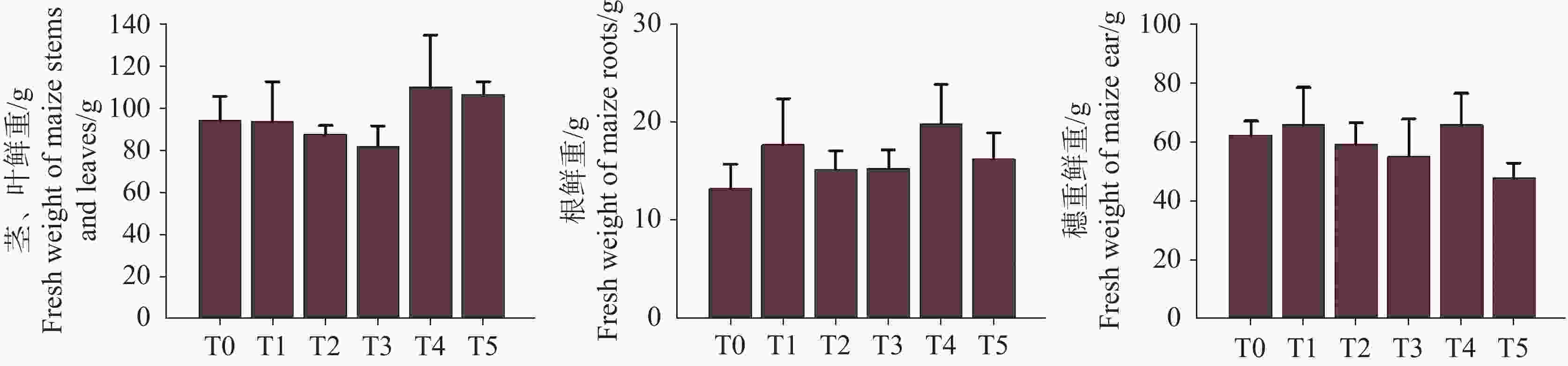
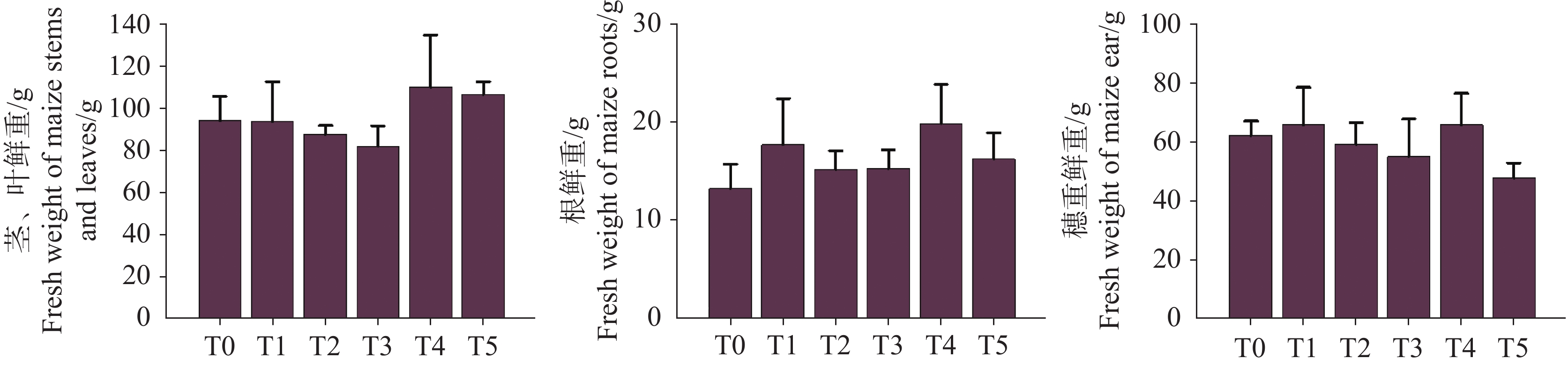
图 2 不同处理下茎、叶、根和穗的鲜重
Figure 2. Fresh weight of maize stems, leaves, roots and ears under different treatments
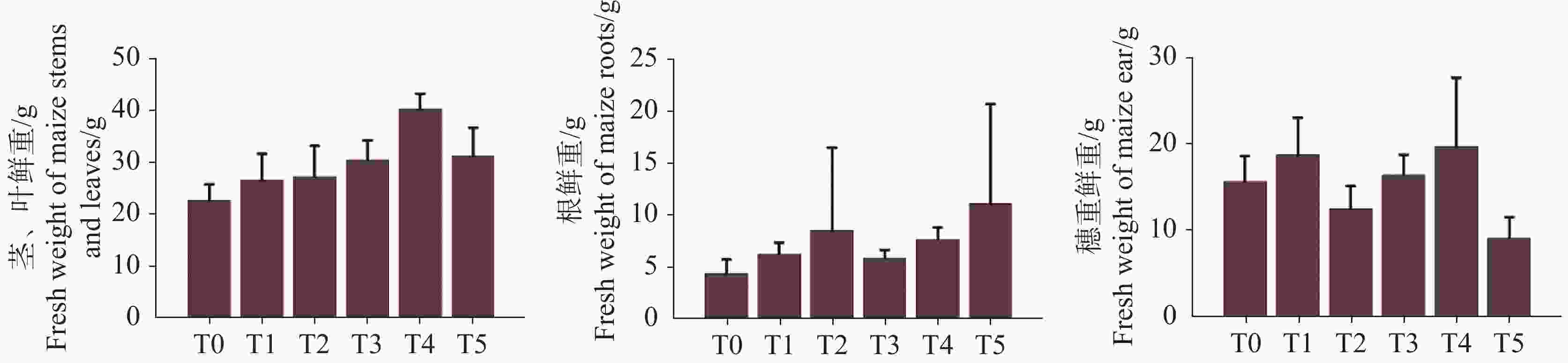
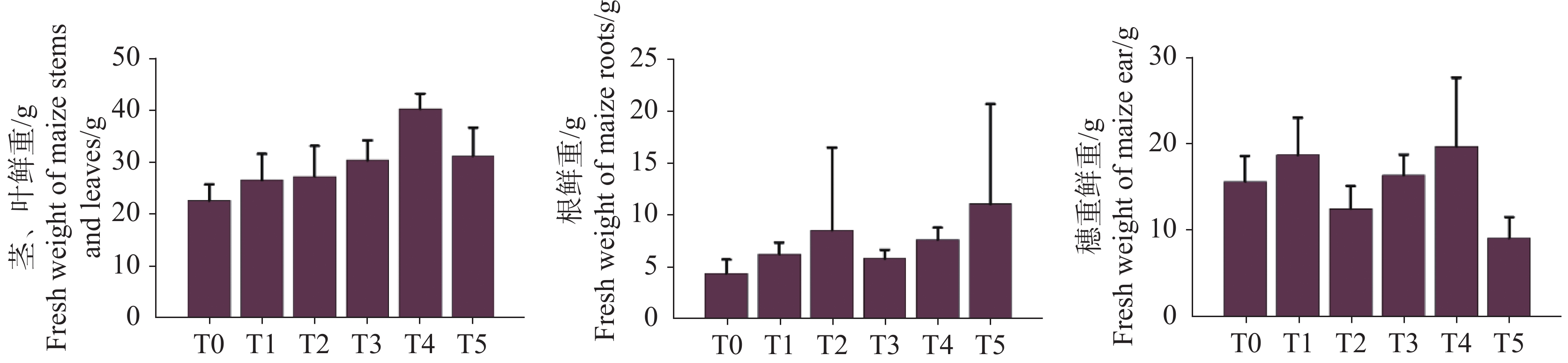
图 3 不同处理下茎、叶、根和穗的干重
Figure 3. Dry weights of maize stems, leaves, roots and ears under different treatments
表 1 供试土壤的基本性质
Table 1. Basic properties of the tested soil
指标 单位 数值 pH − 5.73 阳离子交换量 Cation exchange capacity cmol·kg−1 22.78 容重 Soil capacity g·cm−3 1.28 土壤有机碳 Soil organic carbon g·kg−1 19.82 全氮 Total nitrogen g·kg−1 2.10 全磷 Total phosphorus g·kg−1 1.43 全钾 Total potassium g·kg−1 11.79 全硫 Total sulfur mg·kg−1 343.00 全钙 Total calcium g·kg−1 1.79 全镁 Total magnesium mg·kg−1 6.54 速效氮 Quick-acting nitrogen mg·kg−1 239.00 有效磷 Effective phosphorus mg·kg−1 7.16 速效钾 Quick-acting potassium mg·kg−1 326.08 有效硫 Effective sulfur mg·kg−1 81.12 交换性钙 Calcium oxide cmol·kg−1 7.35  下载: 导出CSV
表 2 盆栽试验设计
Table 2. Pot experiment design
处理 玉米盆栽试验设计 1 T0 只施化肥43 g/盆 2 T1 2.15 g/盆土壤改良剂+化肥(43 g/盆) 3 T2 3.23 g/盆土壤改良剂+化肥(43 g/盆) 4 T3 4.3 g/盆土壤改良剂+化肥(43 g/盆) 5 T4 5.38 g/盆土壤改良剂+化肥(43 g/盆) 6 T5 6.45 g/盆土壤改良剂+化肥(43 g/盆)
下载: 导出CSV
表 3 不同处理下土壤中的元素含量
Table 3. Contents of elements in soil under different treatments
处理 N/ P/ K/ S/ Ca/ Mg/ g·kg−1 g·kg−1 g·kg−1 g·kg−1 g·kg−1 mg·kg−1 T0 2.00±0.00c 1.70±0.06c 11.45±0.26a 0.35±0.05a 2.36±0.24a 6.09±0.10a T1 2.03±0.06bc 1.85±0.09bc 11.34±0.12a 0.32±0.02a 1.94±0.21b 6.19±0.07a T2 2.10±0.00ab 1.90±0.11ab 11.24±12ab 0.35±0.02a 1.76±0.07b 6.05±0.03a T3 2.10±0.00ab 1.89±0.07ab 11.40±0.08a 0.36±0.02a 1.80±0.10b 6.23±0.05a T4 2.07±0.06abc 1.81±0.15abc 10.99±0.20b 0.37±0.07a 1.76±0.13b 6.07±0.17a T5 2.13±0.06a 1.78±0.10c 11.26±0.07ab 0.38±0.05a 2.02±0.22b 6.18±0.04a
下载: 导出CSV
处理 Fe/ Cu/ Mn/ Zn/ Cl/ B/ Mo/ g·kg−1 mg·kg−1 g·kg−1 g·kg−1 mg·kg−1 g·kg−1 mg·kg−1 T0 60.56±0.24a 46.02±0.69a 1.85±0.05a 0.31±0.00a 29.62±3.42a 0.14±0.00a 1.84±0.81a T1 60.74±1.20a 46.31±1.31a 1.84±0.11a 0.31±0.00a 20.48±3.06b 0.15±0.02a 1.49±0.03a T2 60.68±0.69a 45.41±1.20ab 1.78±0.05a 0.31±0.00ab 14.35±1.67c 0.13±0.00a 1.79±0.12a T3 62.09±0.79a 44.59±0.17ab 1.91±0.14a 0.31±0.00ab 13.26±1.81c 0.14±0.01a 2.00±0.03a T4 60.17±1.70a 43.77±1.28b 1.78±0.08a 0.30±0.01b 12.64±2.85c 0.13±0.01a 1.97±0.15a T5 61.33±0.69a 45.89±0.76a 1.83±0.03a 0.31±0.00ab 13.67±2.84c 0.13±0.01a 1.59±0.13a 注:a,b,c代表差异性显著水平。
Note: a,b and c represent the significant levels of difference.
下载: 导出CSV
表 4 不同处理成熟期玉米叶片营养元素相关系数
Table 4. Correlation coefficients of nutrient elements in maize leaves at maturity stage under different treatments
营养元素 N P S Fe Cu K −0.064 0.512* Ca 0.248 −0.074 0.550* Mg −0.024 0.554* −0.202 Cu −0.153 −0.337 −0.441 0.988** Zn 0.659** 0.753** 0.055 −0.451 −0.473* Mn 0.079 −0.435 −0.218 0.726** 0.714** 注:*,P<0.05;**,P<0.01。
Note: * means P<0.05; ** means P<0.01.
下载: 导出CSV
表 5 玉米叶片DRIS诊断参数统计
Table 5. Statistics of DRIS diagnostic parameters for maize leaves
营养形式 化肥组 化肥+土壤改良剂组 平均值 标准差 变异系数 方差 平均值 标准差 变异系数 方差 N 29.47 1.67 0.06 2.77 27.43 1.49 0.05 2.21 P 3.10 0.20 0.06 0.04 2.70 0.32 0.12 0.10 K 22.41 1.62 0.07 2.63 23.06 2.81 0.12 7.90 S 2.26 0.30 0.13 0.09 2.54 0.25 0.10 0.06 Ca 5.12 0.17 0.03 0.03 4.84 0.57 0.12 0.33 Mg 1.04 0.03 0.03 0.00 1.00 0.13 0.13 0.02 Fe 8.31 2.22 0.27 4.91 14.78 12.99 0.88 168.81 Cu 0.09 0.03 0.32 0.00 0.19 0.16 0.88 0.03 Zn 21.87 1.14 0.05 1.29 17.10 2.05 0.12 4.20 Mn 0.48 0.07 0.14 0.00 0.46 0.11 0.23 0.01 B 7.62 2.17 0.28 4.72 8.69 2.57 0.30 6.58 N/P 9.52 0.64 0.07 0.41 10.27 0.98 0.10 0.97 N/K 1.33 0.16 0.12 0.03 1.20 0.14 0.11 0.02 N/S 13.20 1.35 0.10 1.82 10.86 0.98 0.09 0.97 N/Ca 5.75 0.19 0.03 0.03 5.75 0.75 0.13 0.56 N/Mg 28.46 1.87 0.07 3.49 27.90 3.88 0.14 15.05 N/Fe 3.85 1.19 0.31 1.43 18.11 30.74 1.70 945.01 N/Cu 365.77 147.44 0.40 21738.00 599.81 768.94 1.28 591263.55 N/Zn 1.35 0.04 0.03 0.00 1.62 0.16 0.10 0.03 N/Mn 62.24 5.40 0.09 29.19 63.91 17.78 0.28 316.30 N/B 4.20 1.17 0.28 1.37 3.53 1.39 0.40 1.94 P/K 0.14 0.02 0.12 0.00 0.12 0.01 0.09 0.00 P/S 1.39 0.11 0.08 0.01 1.07 0.16 0.15 0.03 P/Ca 0.61 0.03 0.04 0.00 0.57 0.12 0.21 0.01 P/Mg 3.00 0.29 0.10 0.08 2.72 0.29 0.11 0.08 P/Fe 0.41 0.15 0.37 0.02 1.89 3.18 1.68 10.13 P/Cu 39.43 18.21 0.46 331.53 63.22 85.45 1.35 7301.77 P/Zn 0.14 0.01 0.04 0.00 0.16 0.01 0.09 0.00 P/Mn 6.59 0.87 0.13 0.76 6.45 2.75 0.43 7.54 P/B 0.44 0.12 0.28 0.01 0.34 0.14 0.39 0.02 K/S 10.18 2.11 0.21 4.45 9.11 1.18 0.13 1.38 K/Ca 4.39 0.47 0.11 0.22 4.84 0.96 0.20 0.93 K/Mg 21.63 1.47 0.07 2.15 23.30 2.99 0.13 8.91 K/Fe 2.92 0.84 0.29 0.70 17.76 31.39 1.77 985.22 K/Cu 275.83 101.84 0.37 10371.80 567.72 780.11 1.37 608564.50 K/Zn 1.03 0.13 0.13 0.02 1.36 0.14 0.10 0.02 K/Mn 48.20 10.46 0.22 109.39 54.80 22.52 0.41 507.15 K/B 3.10 0.56 0.18 0.31 3.02 1.57 0.52 2.47 S/Ca 0.44 0.05 0.10 0.00 0.53 0.04 0.08 0.00 S/Mg 2.19 0.36 0.16 0.13 2.59 0.42 0.16 0.17 S/Fe 0.30 0.13 0.43 0.02 1.90 3.42 1.80 11.71 S/Cu 29.23 15.15 0.52 229.62 60.08 80.18 1.33 6428.54 S/Zn 0.10 0.01 0.09 0.00 0.15 0.02 0.12 0.00 S/Mn 4.76 0.59 0.12 0.35 5.95 1.76 0.30 3.08 S/B 0.33 0.11 0.33 0.01 0.34 0.18 0.53 0.03 Ca/Mg 4.95 0.28 0.06 0.08 4.94 0.88 0.18 0.77 Ca/Fe 0.67 0.22 0.32 0.05 3.44 6.22 1.81 38.69 Ca/Cu 63.98 26.65 0.42 710.04 108.98 143.44 1.32 20575.12 Ca/Zn 0.23 0.00 0.02 0.00 0.29 0.05 0.16 0.00 Ca/Mn 10.86 1.26 0.12 1.58 11.20 2.90 0.26 8.38 Ca/B 0.73 0.19 0.26 0.04 0.64 0.32 0.51 0.10 Mg/Fe 0.13 0.04 0.27 0.00 0.68 1.15 1.68 1.32 Mg/Cu 12.70 4.56 0.36 20.83 22.75 30.39 1.34 923.32 Mg/Zn 0.05 0.00 0.08 0.00 0.06 0.01 0.16 0.00 Mg/Mn 2.16 0.47 0.22 0.22 2.36 0.91 0.39 0.83 Mg/B 0.14 0.01 0.11 0.00 0.13 0.05 0.41 0.00 Fe/Cu 92.59 8.04 0.09 64.68 68.93 23.52 0.34 553.01 Fe/Zn 0.38 0.11 0.28 0.01 0.92 0.83 0.90 0.68 Fe/Mn 17.52 4.63 0.26 21.44 29.06 21.39 0.74 457.52 Fe/B 1.16 0.43 0.37 0.19 1.78 1.64 0.92 2.68 Cu/Zn 0.00 0.00 0.33 0.00 0.01 0.01 0.90 0.00 Cu/Mn 0.19 0.06 0.33 0.00 0.37 0.26 0.71 0.07 Cu/B 0.01 0.01 0.40 0.00 0.02 0.02 0.90 0.00 Zn/Mn 46.28 4.76 0.10 22.68 40.59 15.61 0.38 243.73 Zn/B 3.11 0.86 0.28 0.74 2.21 1.01 0.46 1.02 Mn/B 0.07 0.02 0.34 0.00 0.06 0.03 0.46 0.00 注:营养元素锌和硼的含量单位为mg·kg−1,其他元素的含量单位为g·kg−1。
Note: The unit of content of nutrient elements Zn and B is mg·kg−1, and the unit of content of other elements is g·kg−1.
下载: 导出CSV
表 6 不同处理成熟期玉米叶片DRIS诊断指数
Table 6. Diagnostic index of DRIS for maize leaves at maturity stage under different treatments
处理 N P K S Ca Mg Fe Cu Zn Mn B T0 − 1456.88 −445.38 − 1543.35 − 1268.25 − 1832.35 − 1445.84 − 5752.26 − 1209.27 − 2733.96 −469.39 −133.29 T1 − 7655.01 − 8017.82 − 6816.63 − 20634.43 − 9736.35 − 9723.33 − 27420.71 − 40293.15 − 6021.72 −717.41 − 1314.98 T2 − 2391.77 − 2909.71 − 3469.12 − 2779.49 − 2579.17 − 2875.82 − 12498.47 − 4197.34 1739.08 −54.02 − 1186.82 T3 − 7980.72 − 8705.58 − 12319.01 − 9589.84 − 9739.14 − 8198.87 − 42102.06 − 8416.23 1010.03 764.55 864.58 T4 1583.59 1545.82 2341.47 2041.75 1901.30 1813.28 − 12030.93 − 1046.45 − 5871.12 − 4680.98 − 7593.61 T5 − 1325.10 −385.38 −275.31 293.03 285.00 −246.64 325.76 256.39 27.48 −547.13 − 2311.55 T1-T5平均 − 3553.80 − 3694.53 − 4107.72 − 6133.80 − 3973.67 − 3846.28 − 18745.28 − 10739.36 − 1823.25 − 1047.00 − 2308.48 总平均 − 3204.32 − 3153.01 − 3680.33 − 5322.87 − 3616.79 − 3446.20 − 16579.78 − 9151.01 − 1975.04 −950.73 − 1945.95
下载: 导出CSV
表 7 不同处理成熟期玉米叶片需肥顺序及NII指数
Table 7. Leaf NII index and fertilizer requirement sequence of maize leaves at maturity stage under different treatments
处理 所需顺序 NII T0 Fe>Zn>Ca>K>N>Mg>S>Cu>Mn>P>B 1139.37 T1 Cu>Fe>S>Ca>Mg>P>N>K>Zn>B>Mn 10070.15 T2 Fe>Cu>K>P>Mg>S>Ca>N>B>Mn>Zn 2334.59 T3 Fe>K>Ca>S>P>Cu>Mg>N>Mn>B>Zn 6960.60 T4 Fe>B>Zn>Mn>Cu>P>N>Mg>Ca>S>K 2853.14 T5 B>N>Mn>P>K>Mg>Zn>Cu>Ca>S>Fe 373.38 T1-T5平均 Fe>Cu>S>K>Ca>Mg>P>N>B>Zn>Mn 4518.37 总平均 Fe>Cu>S>K>Ca>Mg>N>P>Zn>B>Mn 3955.20
下载: 导出CSV
表 8 不同处理成熟期玉米叶片养分含量范围等级
Table 8. Nutrient content range grade of maize leaves at maturity stage under different treatments
营养级 N P K S Ca Mg Fe Cu Zn Mn B 过剩 31.4 3.55 30.56 3.2 6.37 1.34 49.42 0.62 22.56 0.74 15.53 偏高 29.42 3.12 26.81 2.87 5.61 1.17 32.1 0.4 19.83 0.6 12.11 平衡 27.43 2.7 23.06 2.54 4.84 1 14.78 0.19 17.1 0.46 8.69 偏低 25.45 2.28 19.32 2.22 4.07 0.83 <14.78 <0.19 14.37 0.32 5.27 缺乏 23.47 1.85 15.57 1.89 3.31 0.66 <14.78 <0.19 11.63 0.17 1.85 注:营养元素Zn、B含量单位为mg·kg−1,其他元素含量单位为g·kg−1。
Note: The unit of content of nutrient elements Zn and B is mg·kg−1, and the unit of content of other elements is mg·kg−1.
下载: 导出CSV
-
[1] 曹建华, 袁道先, 潘根兴. 岩溶生态系统中的土壤[J]. 地球科学进展, 2003,18(1): 37-44.Cao Jianhua, Yuan Daoxian, Pan Genxing. Soils in karst ecosystems[J]. Adwance in Earth Sciences, 2003,18(1): 37-44. [2] Durrh H, Michel M, Durrh S H. Lithologic composition of the Earth's continental surfaces derived from a new digital map emphasizing riverine material transfer[J]. Global Biogeochemical Cycles, 2005, 19(4): GB4S10. [3] 宋贤威, 高扬, 温学发, 郭大立, 于贵瑞, 何念鹏, 张进忠. 中国喀斯特关键带岩石风化碳汇评估及其生态服务功能[J]. 地理学报, 2016, 71(11): 1926-1938.Song Xianwei, Gao Yang, Wen Xuefa, Guo Dali, Yu Guirui, He Nianpeng, Zhang Jinzhong. Assessment of rock weathering carbon sinks and their ecological service functions in the key belt of karst in China[J]. Acta Geographica Sinica, 2016, 71(11): 1926-1938. [4] 袁道先. 现代岩溶学[M]. 北京: 科学出版社, 2016: 3-255.Yuan Daoxian. Modern Karstology[M]. Beijing: Science Press, 2016: 3-255. [5] 罗维均, 王世杰, 刘秀明. 喀斯特洞穴系统碳循环的烟囱效应研究现状及展望[J]. 地球科学进展, 2014, 29(12): 1333-1340.Luo Weijun, Wang Shijie, Liu Xiuming. Current status and outlook of research on the chimney effect of carbon cycling in karst cave systems[J]. Progress in Earth Science, 2014, 29(12): 1333-1340. [6] 袁道先. 西南岩溶石山地区重大环境地质问题及对策研究[M]. 北京: 科学出版社, 2014.Yuan Daoxian. Research on major environmental geological problems and countermeasures in southwest karst rocky mountain area [M]. Beijing: Science Press, 2014. [7] 曹建华, 袁道先, 杨慧, 黄芬, 朱同彬, 梁建宏, 周孟霞, 罗劬侃, 吴夏. 岩溶生态系统中的植物[J]. 中国岩溶, 2022, 41(3): 365-377.Cao Jianhua, Yuan Daoxian, Yang Hui, Huang Fen, Zhu Tongbin, Liang Jianhong, Zhou Mengxia, Luo Qukan, Wu Xia. Karst ecosystem and its plants[J]. Carsologica Sinica, 2022, 41(3): 365-377. [8] Koch A, A M B, R L. Global soil week: Put soil security on the global agenda[J]. Nature, 2012, 492(7428): 186-186. [9] 朱德根, 杨慧, 赵虎, 史绍亮, 吴秀芹, Mitja Prelovšek, Nataša Ravbar. 广西岩溶区石漠化演变及其对土地利用变化的响应[J]. 中国岩溶,2025,44(5): 1088-1100.Zhu Degen, Yang Hui, Zhao Hu, Shi Shaoliang, Wu Xiuqin, Mitja Prelovšek, Nataša Ravbar. Evolution of rocky desertification and its response to land use changes in the karst areas of Guangxi[J]. Carsologica Sinica,2025,44(5):1084-1100. [10] 谢银财, 杨慧, 李军, 缪雄谊, 杨霖, 吴树诚. 岩溶区石灰土演化过程中钙影响土壤氮矿化的机制研究[J]. 中国岩溶, 2024, 43(5): 1057-1064.Xie Yincai, Yang Hui, Li Jun, Miao Xiongyi, Yang Lin, Wu Shucheng. Influence mechanism of calcium on soil organic nitrogen mineralization during calcareous soil evolvement in karst areas[J]. Carsologica Sinica, 2024, 43(5): 1057-1064. [11] 李阳兵, 王世杰, 王济. 岩溶生态系统的土壤特性及其今后研究方向[J]. 中国岩溶, 2006,25(4): 285-289.Li Yangbing, Wang Shijie, Wang Ji. Soil characteristics of karst ecosystems and their future research directions[J]. Carsologica Sinica, 2006,25(4): 285-289. [12] 蒋忠诚, 章程, 罗为群, 肖琼, 吴泽燕. 我国岩溶地区碳汇研究进展与展望[J]. 中国岩溶, 2022, 41(3): 345-355.Jiang Zhongcheng, Zhang Cheng, Luo Weiqun, Xiao Qiong, Wu Zeyan. Research progress and prospect of carbon sink in karst region of China[J]. Carsologica Sinica, 2022, 41(3): 345-355. [13] 彭韬, 邢学刚, 蔡先立, 王世杰, 张信宝, 孟凡德, 张林. 保水剂与活性炭改良白云岩石漠化坡地土壤促进植物生长的盆栽试验研究[J]. 中国岩溶, 2016, 35(5): 525-532.Peng Tao, Xing Xuegang, Cai Xianli, Wang Shijie, Zhang Xinbao, Meng Fande, Zhang Lin. Pot experiment research on the effects of water retaining agent and activated carbon as soil amendments for plant growing on dolomitic rocky desertification slopes[J]. Carsologica Sinica, 2016, 35(5): 525-532. [14] BEAUFILS R E. Diagnosis and recommendation integrated system(DRIS)[M]. Maritzburg. University of Natal Pieter, 1973, 2973. [15] 周龙, 汤利, 陈俊, 曾志伟, 杨德荣. 褚橙龙陵基地柑橘叶片DRIS图解法和指数法综合营养诊断分析[J]. 南方农业学报, 2020, 51(10): 2498-2506.Zhou Long, Tang Li, Chen Jun, Zeng Zhiwei, Yang Derong. Comprehensive nutritional diagnosis and analysis of Bingtang orange leaf based on DRIS graphic method and index method in Chucheng orange Longling base[J]. Journal of Southern Agriculture, 2020, 51(10): 2498-2506. [16] 唐健, 覃祚玉, 邓小军, 潘波, 农必昌, 宋贤冲. 广西孟江油茶叶片营养DRIS诊断[J]. 福建林业科技, 2015, 42(1): 11-15.Tang Jian, Qin Zuoyu, Deng Xiaojun, Pan Bo, Nong Bichang, Song Xianchong. Nutritional DRIS diagnosis of oil tea leaves in Mengjiang, Guangxi[J]. Fujian Forestry Science and Technology, 2015, 42(1): 11-15. [17] 胡国珠, 高伟, 许怡欣, 龚春, 宁博轩, 徐林初, 杨馥宁. 江西成林油茶叶片春梢末期营养诊断[J]. 南京林业大学学报(自然科学版), 2018, 42(4): 193-197.Hu Guozhu, Gao Wei, Xu Yixin, Gong Chun, Ning Boxuan, Xu Linchu, Yang Funing. Nutritional diagnosis of oil tea leaves at the end of spring in Jiangxi Chenglin[J]. Journal of Nanjing Fores-try University (Natural Sciences Edition), 2018, 42(4): 193-197. [18] 丁柏泉. 有机肥与中微量元素水溶肥联合施用对作物产量的影响研究[J]. 乡村科技, 2024, 15(14): 87-90.Ding Baiquan. Research on the effect of joint application of organic fertilizer and water-soluble fertilizer of trace elements on crop yield[J]. Rural Science and Technology, 2024, 15(14): 87-90. [19] 徐祖亮. 普定县后寨河流域土壤铁、锰氧化物特征分异及其发生学指示意义[D]. 贵阳: 贵州师范大学, 2023.Xu Zuliang. Characteristic differentiation of soil iron and manganese oxides in Houzhai River watershed of Puding County and its indicative significance of occurrence[D]. Guiyang: Guizhou Normal University, 2023. [20] OLIVEIRA M G , FREIRE A C , CELIO C F D.Nutritional eevaluation by the DRIS method of corn plants fertilized with sewage sludge biochar[J]. Communications in Soil Science and Plant Analysis, 2022, 53(17): 2187-2195. [21] 杜林梅. 沿海防护林树种潺槁树、木麻黄苗期施肥效应研究[D]. 福州: 福建农林大学, 2011.Du Linmei. Study on the effect of seedling fertilization on coastal protection forest species of Hagiella gurgoides and Mucuna pruriens[D]. Fuzhou: Fujian Agriculture and Forestry University, 2011. [22] Singh K, Hundal S H, Singh D. Monitoring Nutrient Status for Maize in Northwestern India through Diagnostic and Recommendation Integrated System Approach[J]. Communications in Soil Science and Plant Analysis, 2012, 43(22): 2915-2923. doi: 10.1080/00103624.2012.728267 [23] 何苇竹. 我国柑橘叶片矿质养分含量标准的建立及营养诊断[D]. 武汉: 华中农业大学, 2020.He Weizhu. Establishment of mineral nutrient content standards and nutritional diagnosis of citrus leaves in China[D]. Wuhan: Huazhong Agricultural University, 2020. [24] Aliyu T K, Kamara Y A, Huising J. Implication of blanket NPK application on nutrient balance of maize based on soil and tissue diagnosis approaches in the savannas of northern Nigeria [J]. Environmental Research Communications, 2023, 5(6):065007. [25] Aliyu T K, Jeroen H, Kamara Y A. Understanding nutrient imbalances in maize (Zea mays L.)using the diagnosis and recommendation integrated system (DRIS) approach in the Maize belt of Nigeria[J]. Scientific Reports, 2021, 11(1): 16018-16018. doi: 10.1038/s41598-021-95172-7 -

 点击查看大图
计量
- 文章访问数: 1026
- HTML浏览量: 63
- PDF下载量: 159
- 被引次数: 0
