


Resource endowment and conservation value of the karst area in Southwestern Guangxi
-
摘要: 自然保护地是生态建设的核心载体,在维护国家生态安全中居于首要地位。文章以自然保护地体系建设相关要求为依据,从国家代表性、生态重要性、文化独特性等方面深入研究地处中越边境的桂西南地区的资源禀赋和保护核心价值,分析了区域保护现状和存在的问题。结果表明:桂西南地区的典型峰丛洼地、峰林平原地貌面积占区域面积的56.28%,拥有亚洲第一的德天跨国瀑布、天坑数量排名世界第二的那坡天坑群等众多独特的瀑布、天坑、地下河、石林、洞穴岩溶景观;保存有中国乃至世界少有的面积较大、具有高度完整性和原真性的北热带石山季节性雨林,为望天树(Parashorea chinensis)、东黑冠长臂猿(Nomascus nasutus)、白头叶猴(Trachypithecus poliocephalus)等10种旗舰物种提供良好的栖息地;属于印缅生物多样性热点地区,是全球最濒危灵长类动物聚集区和中国三大植物特有现象中心之一,已记录有野生脊椎动物695种(其中国家重点保护野生动物Ⅰ级18种、Ⅱ级69种)、野生维管植物254科
1349 属4262 种(其中国家重点保护野生植物Ⅰ级16种、Ⅱ级56种);拥有世界文化遗产“左江花山岩画文化景观”,是22个少数民族的聚居区和红色革命老区,为中华民族共同体的重要组成部分。研究区同时也存在自然保护地面积占比偏小、生态保护与经济发展矛盾尖锐、文化保护与传承的创新能力不足等问题,亟需深化自然保护地整合优化方案,构建一体化监测与生态修复技术体系,推动文旅科普融合及跨境合作,实现跨生态系统保护与经济社会协调发展,以筑牢边境生态安全屏障,助力边疆高质量发展。Abstract:Natural reserves serve as the core carrier of ecological conservation and play a pivotal role in safeguarding national ecological security. The southwest of Guangxi Zhuang Autonomous Region, bordering Vietnam, experiences a tropical and southern subtropical monsoon climate and features extensively distributed typical tropical and subtropical karst landforms, including peak-cluster depressions, peak-forest plains, sinkhole groups, caves, and canyons. Notably, this region preserves large-areas of northern tropical limestone mountain seasonal rainforests, which are rare both in China and globally. Boasting high integrity and good authenticity, this forest ecosystem provides favorable habitats for flagship species such as plants of the Cycas and Taxus genera, as well as Parashorea chinensis, Excentrodendron hsienmu, Nomascus nasutus, Trachypithecus francoisi, and Trachypithecus poliocephalus. This region harbors exceptionally rich biodiversity. A total of 695 wild vertebrate species have been documented, including 36 species endemic to China, 18 listed as Class Ⅰ national key protected wild animals, and 69 as Class Ⅱ. Additionally, there are 4,262 wild vascular plant species belonging to 1,349 genera of 254 families. Among these plants, 1,171 are endemic to China, 16 are Class Ⅰ national key protected wild plants, and 56 are Class Ⅱ. As part of the Indo-Burma Biodiversity Hotspot, this region serves as a global concentration site for the most endangered primates, is one of the three major centers of plant endemism in China, and is a priority area for biodiversity conservation in the mountainous regions of Southwestern Guangxi. Inhabited by ethnic minorities, it is home to a World Cultural Heritage site-the Zuojiang Huashan Rock Art Cultural Landscape, and also boasts abundant revolutionary tangible and intangible heritage, such as the Baise Uprising Memorial Hall and the Zuoyoujiang Revolutionary Base Area, thereby serving as an important part of the community for the Chinese nation. Furthermore, it functions as a vital node for consolidating the ecological security barrier along the China-Vietnam border and for building a community with a shared future for all life on Earth. Based on the relevant requirements for establishing and developing the system of natural reserves, this study conducts assesses and concludes that the karst region in Southwestern Guangxi holds exceptional conservation value in terms of national representativeness, ecological significance, and cultural uniqueness. This study particularly emphasizes the integrated and systematic protection of the karst ecosystem in this region, recommending that the Forestry Bureau of the Autonomous Region take the lead in establishing an extensive cooperation mechanism among governments, universities, research institutes, and enterprises. Furthermore, it suggests integrating the natural reserves in the karst region within Southwestern Guangxi to establish the Natural Reserve Alliance of Southwestern Guangxi. This study addresses the challenges facing the karst region in Southwestern Guangxi, including inadequate coverage of natural reserves, significant contradictions between ecological protection and economic development, and insufficient innovation capacity for cultural preservation and inheritance. It proposes targeted measures such as further advancing the integration and optimization of natural reserves, establishing an integrated monitoring system, implementing ecological restoration projects, promoting the integration of culture and tourism with science popularization and education, strengthening cross-border ecological cooperation, and achieving comprehensive ecosystem protection. These initiatives aim to promote the coordinated development of ecological protection and economic growth, continuously strengthen the protection of the region's core values, consolidate the ecological security barrier along the China-Vietnam border, achieve greater progress in the high-quality development of border and ethnic minority areas, and make more contributions to safeguarding national security. -
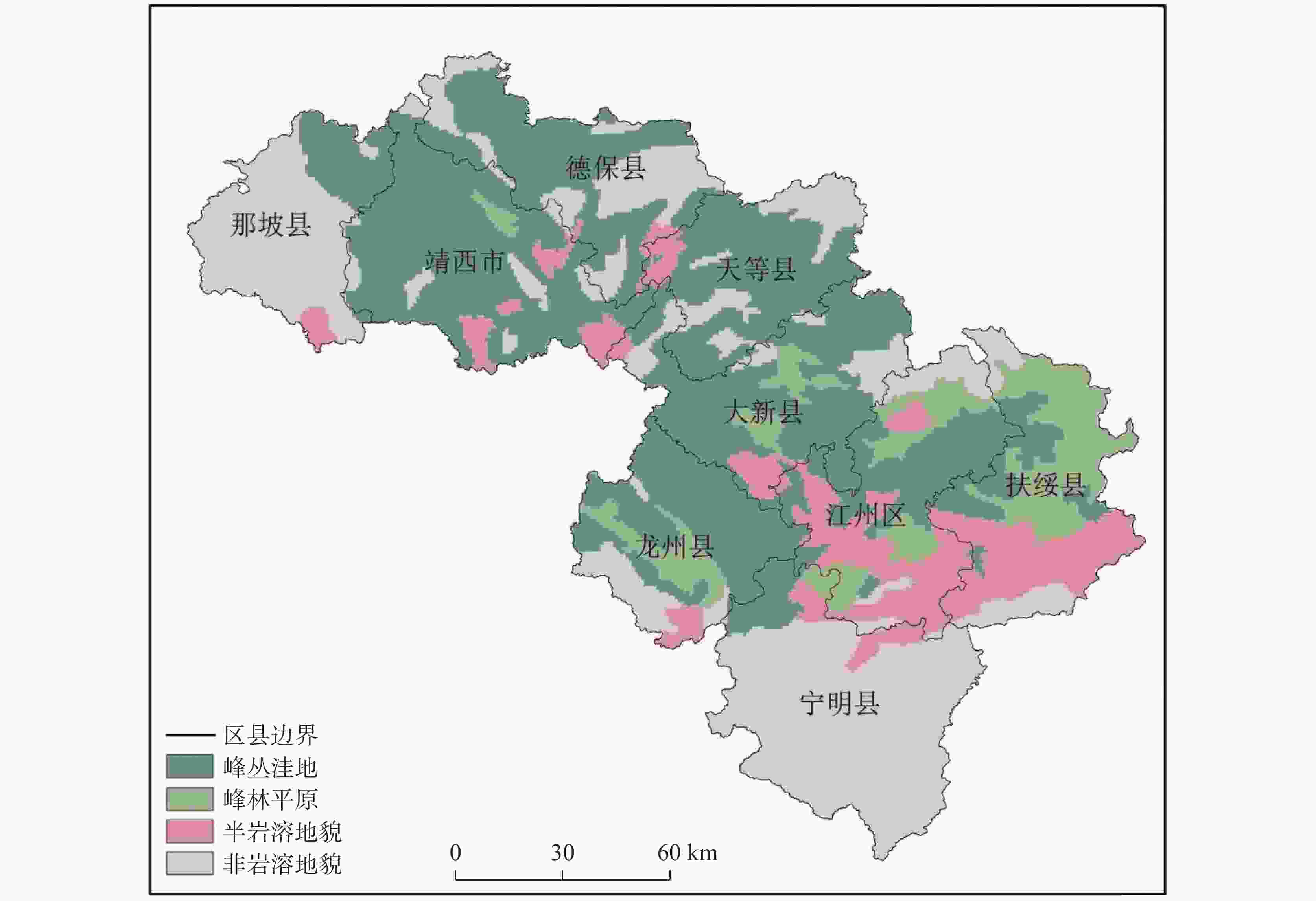
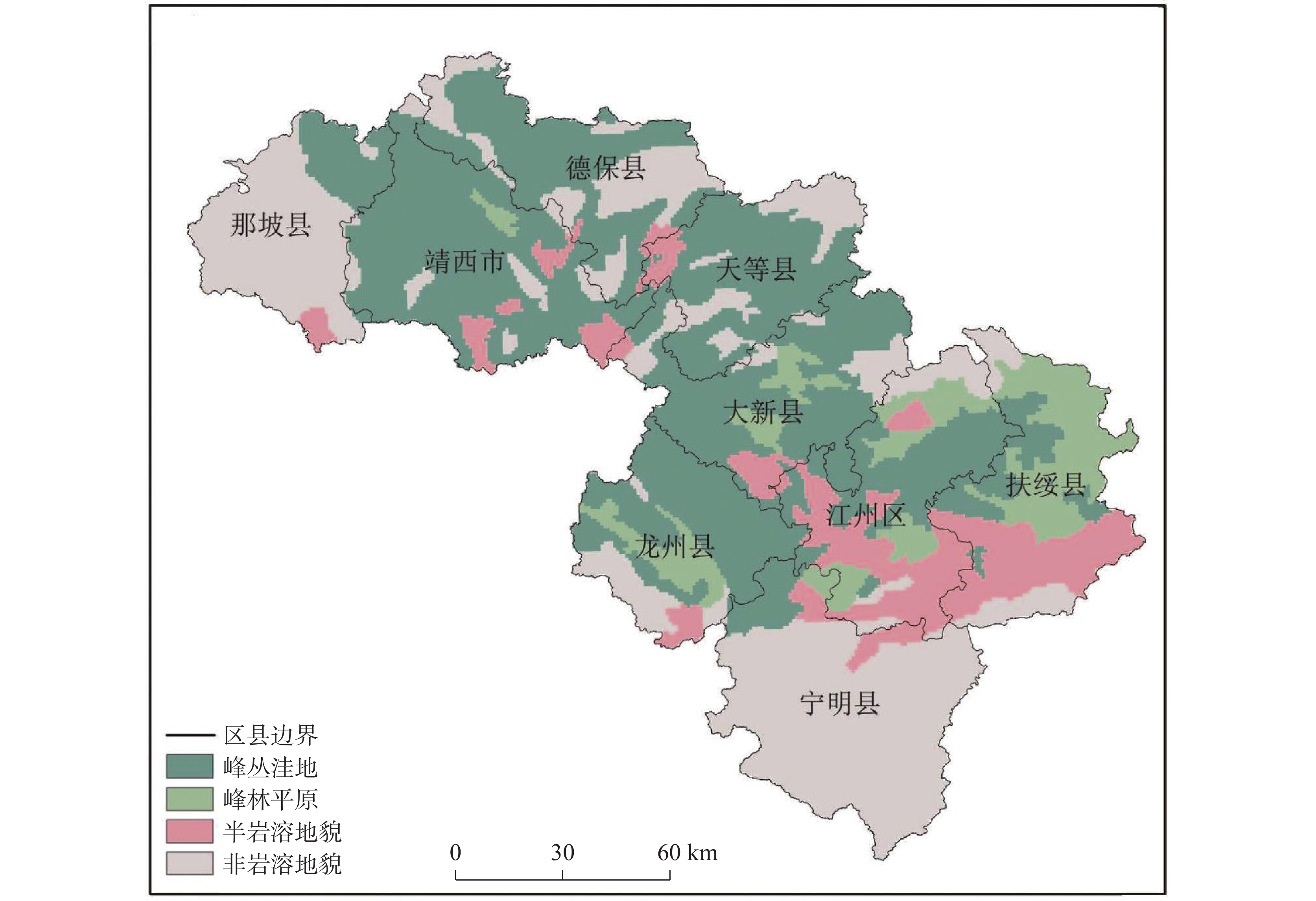
图 1 桂西南岩溶区地貌类型分布图
Figure 1. Distribution of geomorphic types in the karst region of Southwestern Guangxi
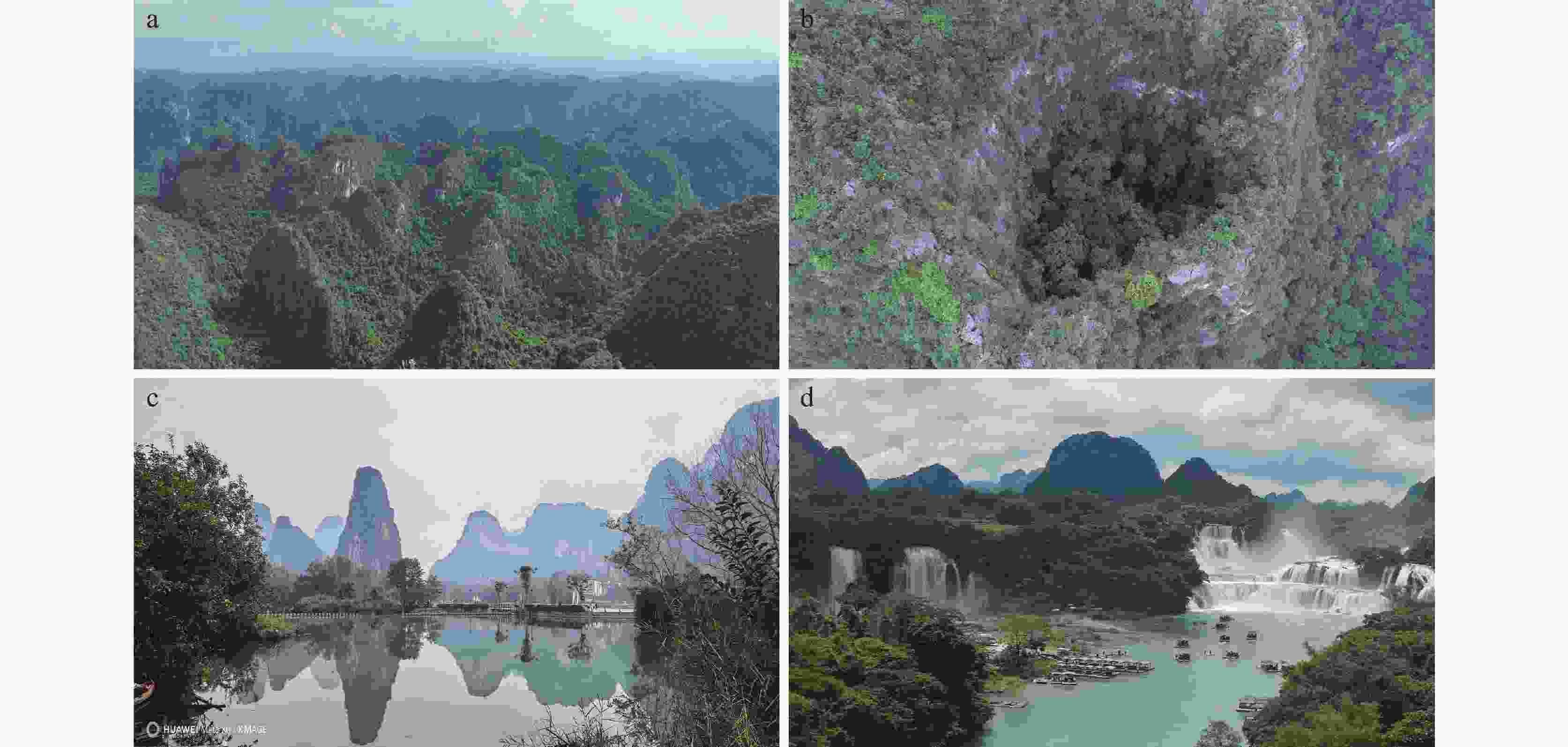
图 2 桂西南典型岩溶景观[a.峰丛洼地(刘晟源供图), b.天坑(刘晟源供图), c.峰林平原, d.德天瀑布]
Figure 2. Typical karst landscapes in Southwestern Guangxi[a.Peak-cluster depressions(provided by Liu Shengyuan), b.Sinkholes(provided by Liu Shengyuan), c.Peak-forest plains, d.Detian Falls]
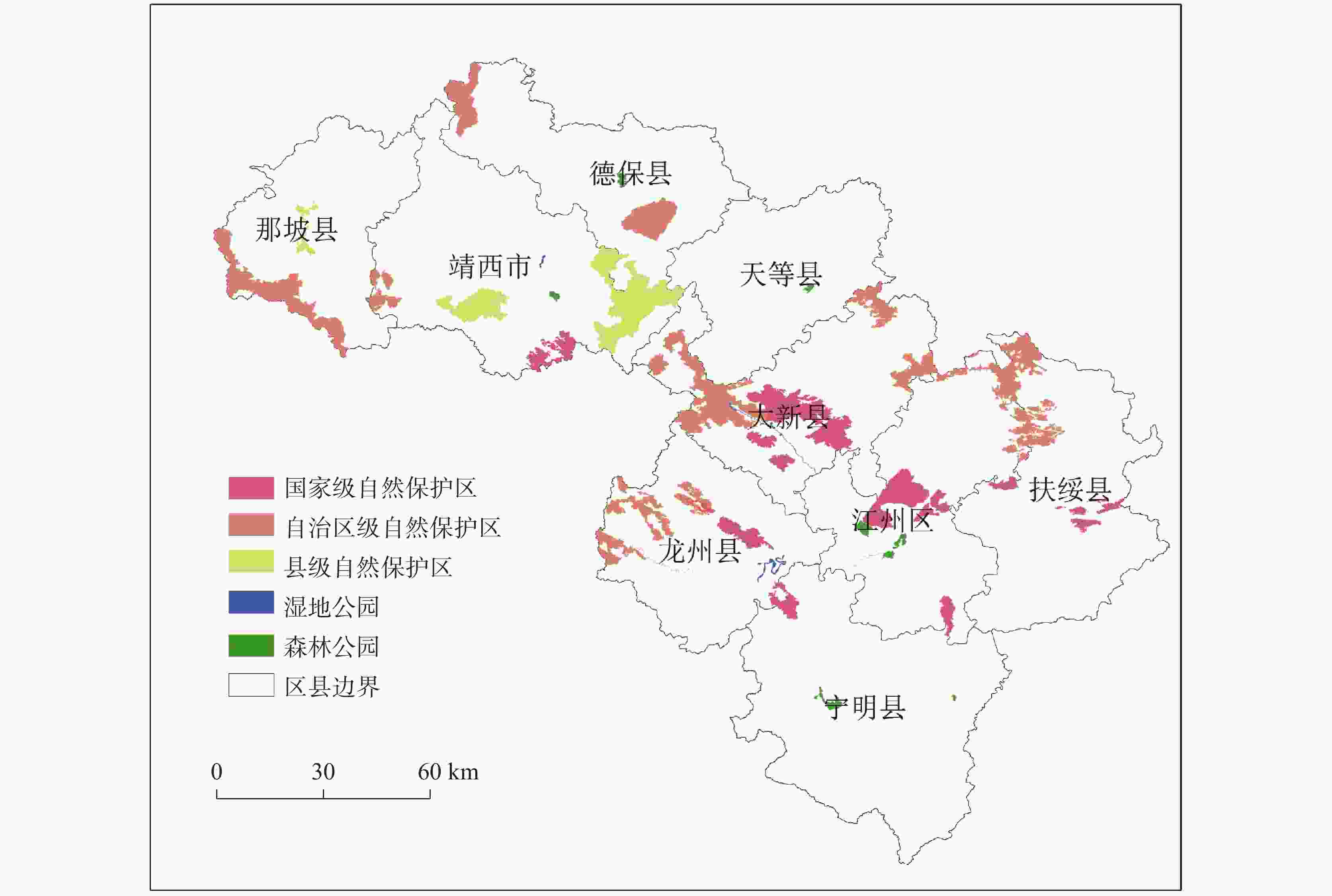
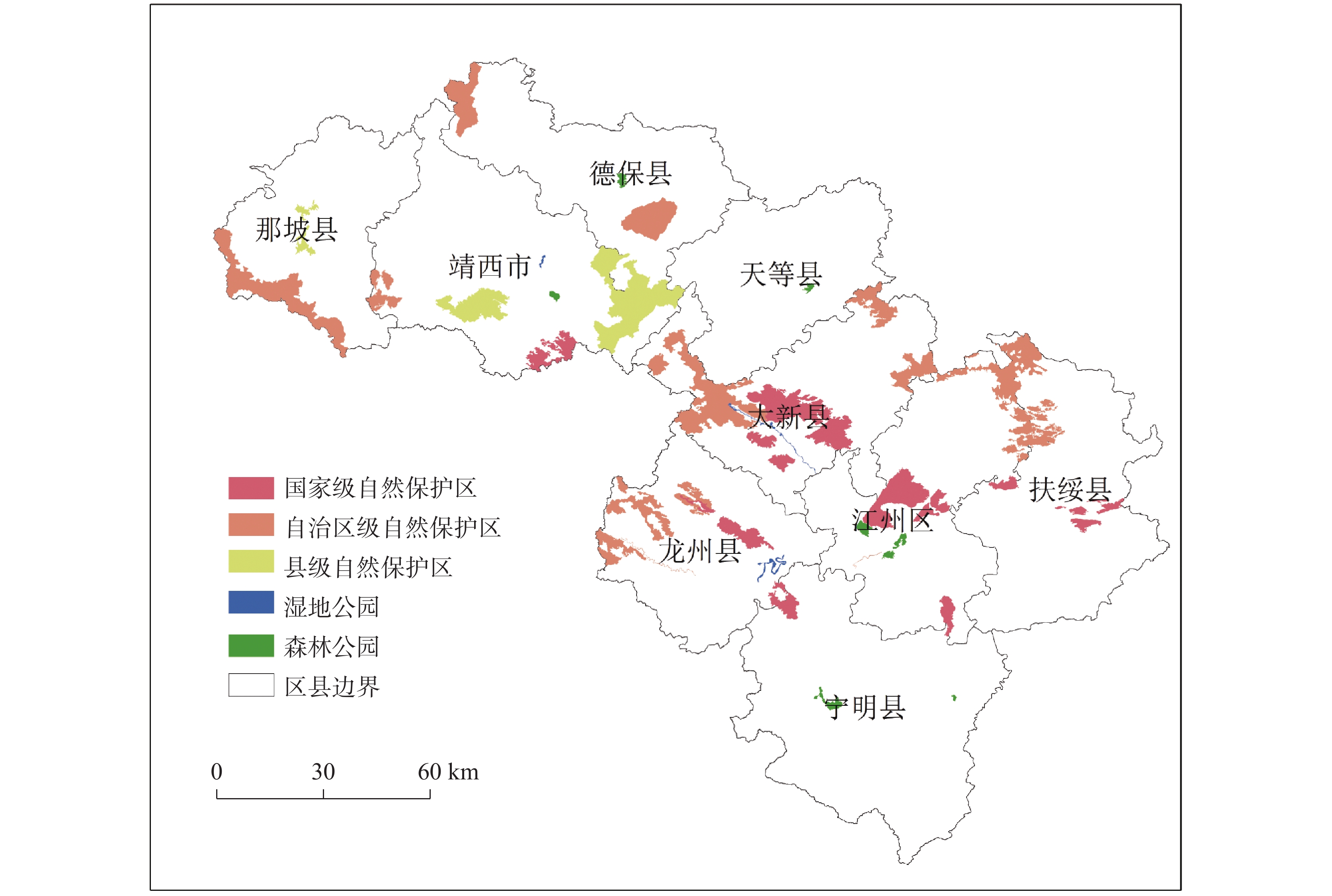
图 3 桂西南岩溶区不同类型自然保护地空间分布图
Figure 3. Spatial distribution of different types of nature reserves in the karst area of Southwestern Guangxi
表 1 桂西南岩溶区岩溶景观特征
Table 1. Characteristics of karst landform landscapes in the karst region of Southwest Guangxi
岩溶自然
景观类型发育特征 典型景观区 峰丛洼地 面积 11601.97 km2,占广西峰丛洼地面积的23.37%,是全球岩溶峰丛洼地集中分布区之一[2];峰丛高程400~1200 m,洼地高程140~740 m,洼地深度220~460 m,具有分布面积大且高、中、低多种峰丛洼地类型特点[2]大新黑水河峰丛、德保红叶峰丛、左江峰丛(龙州段和扶绥段)、崇左桃花岛峰丛、天等都康峰丛 峰林平原 峰林平原面积为 2337.34 km2[5],与享誉世界的桂林峰林平原面积相当,约占中国峰林平原面积的18.20%,以崇左市分布最为集中靖西鹅泉峰林、大新–扶绥峰林平原、龙州–江州峰林平原 石林、石柱峰 石林岩体相对高度介于5~15 m,以屏风状、柱状、塔状等多形态为主;石柱峰主要为方柱形,岩体相对高度为50~120 m,柱身宽介于15~30 m[2] 崇左石林、大新宝贤石林、大新雷平石林,其中:面积约为1 km2的崇左石林是广西连片分布面积最大的石林;大新石柱峰、靖西石柱峰 洞穴 发育洞穴多、洞穴密度大,典型洞穴33处,石笋、石幔、钙华池等地质景观丰富,形态各异,洞厅特别发育,如靖西卧龙大厅容积大于 1000000 m3德保吉星岩、靖西卧龙大厅、靖西屏山穿洞、龙州龙元洞和紫霞洞、那坡海子洞和罩子洞、大新龙宫洞和黑岩 天坑 已发现天坑数量26个,占全国天坑数量的11.66%;天坑发育成群,并与地下河相伴发育,特别是那坡天坑群的天坑数量(包括19个天坑和14个塌陷漏斗)世界排名第二,坑内原始植被群落保存完好,宛如坛子形态最典型,属于世界级天坑群 那坡天坑群、靖西龙潭天坑、大新硕龙那岭天坑群、大新五山天坑群、龙州左江天坑群 岩溶瀑布 岩溶瀑布的集中发育区,有垂直型、悬空型、倾斜型等多种类型[2],具有独特景观和美学价值,如大新德天瀑布为垂直型和倾斜型混合的多级瀑布,高49 m,多年平均流量达黄果树瀑布的3倍,是亚洲第一、世界第四大跨国瀑布;通灵大峡谷瀑布高达165 m,是中国落差最大的瀑布[2] 德天跨国瀑布、靖西通灵大峡谷瀑布 河流与湿地 以河流、岩溶泉为景观主线,包括左江、黑水河、鹅泉及其地貌景观等构成,具有自然景观功能和生态调节功能 黑水河景观带、左江景观带、靖西龙潭鹅泉风景区、大新黑水河湿地 地下河 具有流程长、流域面积大、集中排泄、管道复杂、流域景观多样等特点,如作登地下河总长102.9 km,为中国排名第五长巨型地下河,从天窗溢流和地下河出口集中排泄,流域内溶斗、落水洞、天窗等岩溶形态十分发育 德保作登地下河、定业地下河、龙临–头咘地下河、岜白地下河、下雷巴赞地下河  下载: 导出CSV
表 2 桂西南岩溶区国家I级重点保护野生动物名录
Table 2. List of national Level I key protected wild animals in the karst region of Southwestern Guangxi
序号 物种 序号 物种 1 白头叶猴 Trachypithecus poliocephalus 10 鼋 Pelochelys cantorii 2 东黑冠长臂猿 Nomascus nasutus 11 云豹 Neofelis nebulosa 3 黑叶猴 Trachypithecus francoisi 12 大灵猫 Viverra zibetha 4 蜂猴 Nycticebus bengalensis 13 小灵猫 Viverricula indica 5 大斑灵猫 Viverra megaspila 14 林麝 Moschus berezovskii 6 熊狸 Arctictis binturong 15 秃鹫 Aegypius monachus 7 中国穿山甲 Manis pentadactyla 16 白肩雕 Aquila heliaca 8 冠斑犀鸟 Anthracoceros albirostris 17 金猫 Catopuma temminckii 9 缅甸陆龟 Indotestudo elongata 18 豺 Cuon alpinus
下载: 导出CSV
表 3 桂西南岩溶区国家I级重点保护野生植物名录
Table 3. List of national Level I key protected wild plants in the karst region of Southwestern Guangxi
序号 物种 序号 物种 1 广西火桐 Firmiana kwangsiensis 9 同色兜兰 Paphiopedilum concolor 2 望天树 Parashorea chinensis 10 长瓣兜兰 Paphiopedilum dianthum 3 广西青梅 Vatica guangxiensis 11 巧花兜兰 Paphiopedilum helenae 4 德保苏铁 Cycas debaoensis 12 带叶兜兰 Paphiopedilum hirsutissimum 5 锈毛苏铁 Cycas ferruginea 13 麻栗坡兜兰 Paphiopedilum malipoense 6 叉叶苏铁 Cycas micholitzii 14 硬叶兜兰 Paphiopedilum micranthum 7 石山苏铁 Cycas sexseminifera 15 飘带兜兰 Paphiopedilum parishii 8 南方红豆杉 Taxus wallichiana 16 紫毛兜兰 Paphiopedilum villosum
下载: 导出CSV
表 4 桂西南岩溶区自然保护地概况
Table 4. Overview of nature reserves in the karst region of Southwestern Guangxi
序号 保护地名称 地理位置 主要保护对象或者区域特色 1 广西弄岗国家级自然保护区 龙州县、宁明县 北热带石灰岩季雨林生态系统、白头叶猴、黑叶猴、弄岗穗鹛、望天树、苏铁属植物、山茶科金花茶组植物等珍稀濒危野生动植物及其生境 2 广西崇左白头叶猴国家级自然保护区 江州区和扶绥县 白头叶猴、黑叶猴等野生动物及其栖息地、苏铁等珍稀植物及其原生地、典型的岩溶地貌和脆弱的石灰岩生态系统 3 广西恩城国家级自然保护区 大新县 黑叶猴、林麝、蟒蛇、冠斑犀鸟、石山苏铁及其生境,北热带岩溶森林生态系统 4 广西邦亮长臂猿国家级自然保护区 靖西市 东部黑冠长臂猿及北热带岩溶山地季雨林生态系统 5 广西西大明山自治区级自然保护区 崇左市、南宁市 冠斑犀鸟、北回归线上多样的山地森林生态系统和重要水源涵养林,是全球同纬度地区重要的天然参照系 6 广西下雷自治区级自然保护区 大新、天等、龙州 北热带岩溶森林生态系统,黑叶猴、熊猴、蚬木、石山苏铁和兰科等珍稀濒危动植物及其生境 7 广西青龙山自治区级自然保
护区龙州县 北热带石灰岩山地季雨林生态系统和黑叶猴、蚬木、苏铁等珍稀濒危动植物及其生境 8 广西左江佛耳丽蚌自治区级自然保护区 江州区和龙州县 佛耳丽蚌、多瘤丽蚌、背瘤丽蚌和我国唯一的淡水软骨鱼类——赤魟及其栖息地 9 广西老虎跳自治区级自然保
护区那坡县 北热带岩溶森林生态系统及望天树、兰科植物等野生动
植物10 广西底定自治区级自然保护区 靖西市与那坡县 桫椤群落及其生境、南亚热带季雨林和石灰岩季雨林生态系统 11 广西黄连山–兴旺自治区级自然保护区 德保县 北热带山地森林生态系统,德保苏铁、黑叶猴等珍稀濒危物种及其栖息地,以及重要的水源涵养林 12 广西大王岭自治区级自然保
护区右江区 北亚热带山地森林生态系统及以德保苏铁为主要保护对象 13 广西德孚县级自然保护区 那坡县 以常绿落叶阔叶混交林、水源涵养林及珍稀野生动植物为保护对象;属于北热带生物气候带 14 广西古龙山县级自然保护区 靖西市和德保县 该保护区主要保护对象是水源涵养林 15 广西地州水源林县级自然保
护区靖西 主要保护对象为石山水源林(北热带岩溶森林生态系统) 16 广西大新黑水河国家湿地公园 大新县 岩溶地貌永久性河流湿地的典型代表,涵盖永久性河流型湿地、洪泛平原湿地、灌丛沼泽等类型 17 广西龙州左江国家湿地公园 龙州县 具有典型的“森林–河流–库塘–稻田”复合生态系统特点,动植物种类十分丰富 18 广西靖西龙潭国家湿地公园 靖西市 中越边境生物交流通道上,生物地理区位重要;由大龙潭、小龙潭、龙潭河及连接大、小龙潭的地下河组成,是典型岩溶湿地 19 广西龙峡山国家级森林公园 江州区 以木棉为代表的石灰岩次生季雨林、石山灌木林和人工台湾相
思林20 广西丽川自治区级森林公园 天等县 拥有茂密的石山森林和风景秀丽的丽川河段,是难得的城市森林和山地景观 21 广西派阳山自治区级森林公园 宁明县 拥有茂林、云海、瀑布、溪流、湖泊等众多自然风景资源,有金花茶、桫椤、蟒蛇、广西瘰螈等丰富的动植物资源 22 广西狮子头自治区级森林公园 宁明县 拥有天池、瀑布、峡谷、仙人洞等自然景观 23 广西德保红叶自治区级森林
公园德保县 以红枫为主题的城市森林景观 24 广西五岭自治区级森林公园 靖西市 桫椤及常绿针叶林、常绿落叶阔叶林
下载: 导出CSV
表 5 桂西南岩溶区各市县森林分布情况
Table 5. Forest distribution status in cities/counties of the karst region of Southwestern Guangxi
市县 国土面积/
hm2林地面积/
hm2公益林面积/
hm2天然商品林/
hm2林地占国土
比例/%公益林+天然商品林
占国土比例/%德保县 257653.9 202804.0 66776.6 65930.4 78.7 51.5 那坡县 222786.4 166916.7 55489.0 39110.6 74.9 42.5 靖西市 332762.7 233660.0 170799.1 17494.3 70.2 56.6 江州区 291809.1 143586.7 71274.0 15043.3 49.2 29.6 扶绥县 284112.7 138051.5 39310.6 14430.6 48.6 18.9 宁明县 370477.6 255683.4 36999.4 21076.4 69.0 15.7 龙州县 231226.6 143864.9 73514.2 45070.8 62.2 51.3 大新县 274859.4 178968.7 134116.0 16880.2 65.1 54.9 天等县 216542.2 144655.6 61734.9 43300.9 66.8 48.5 合计 2482230.6 1608191.5 710013.8 278337.5 64.8 39.8
下载: 导出CSV
-
[1] 《广西西南喀斯特生物多样性》编委会. 广西西南喀斯特生物多样性[M]. 北京: 中国大百科全书出版社, 2011.Editorial Committee of Biodiversity in the Karst Area of Southwest Guangxi. Biodiversity in the karst area of Southwest Guangxi[M]. Beijing: Encyclopedia of China Publishing House, 2011. [2] 韦跃龙, 李成展, 陈伟海, 罗劬侃, 朱德浩, 潘天望. 广西岩溶景观特征及其形成演化分析[J]. 广西科学, 2018, 25(5): 465-504. doi: 10.13656/j.cnki.gxkx.20181115.001Wei Yuelong, Li Chengzhan, Chen Weihai, Luo Qukan, Zhu Dehao, Pan Tianwang. Characteristics and formation and evolution analysis of the karst landscape of Guangxi[J]. Guangxi Sciences, 2018, 25(5): 465-504. doi: 10.13656/j.cnki.gxkx.20181115.001 [3] 陈彪, 吕璞良, 何显锦, 刘芳. 左江流域崇左段沉积物重金属分布特征及生态风险[J]. 矿产与地质, 2020, 34(3): 571-578. doi: 10.19856/j.cnki.issn.1001-5663.2020.03.023Chen Biao, Lyu Puliang, He Xianjin, Liu Fang. Spatial distribution characteristics and ecological risk of heavy metals in stream sediment of the Zuojiang River[J]. Mineral Resources and Geology, 2020, 34(3): 571-578. doi: 10.19856/j.cnki.issn.1001-5663.2020.03.023 [4] 黄丽芳, 覃星铭, 胡宝清, 黄思敏, 韦雯雯, 张礼黎, 陈思锜, 赖茹芸, 陈汉唐. 桂西南石漠化综合治理效益评价及其耦合协调关系[J]. 中国岩溶, 2024, 43(1): 126-136, 208.Huang Lifang, Qin Xingming, Hu Baoqing, Huang Simin, Wei Wenwen, Zhang Lili, Chen Siqi, Lai Ruyun, Chen Hantang. Benefit evaluation of comprehensive control of rocky desertification in Southwest Guangxi and the coupling and coordination relationship[J]. Carsologica Sinica, 2024, 43(1): 126-136, 208. [5] 广西壮族自治区地方志编纂委员会编 (朱德浩主编). 广西通志·岩溶志 [M]. 南宁: 广西人民出版社, 2000.Compiled by the Local Chronicles Compilation Committee of Guangxi Zhuang Autonomous Region (edited by Zhu Dehao). Local records of Guangxi: Karst local chronicles [M]. Nanning: Guangxi People's Publishing House, 2000. [6] 王栋华, 田义超, 张强, 张亚丽, 林俊良, 陶进, 黄亮亮. 2000—2021年桂西南峰丛洼地流域植被净初级生产力演变特征及其归因[J]. 中国岩溶, 2024, 43(2): 336-348. doi: 10.11932/karst20240204Wang Donghua, Tian Yichao, Zhang Qiang, Zhang Yali, Lin Junliang, Tao Jin, Huang Liangliang. Evolution and attribution of net primary productivity of vegetation in the peak-cluster depression basin of Southwest Guangxi from 2000 to 2021[J]. Carsologica Sinica, 2024, 43(2): 336-348. doi: 10.11932/karst20240204 [7] 何佶泳, 田义超, 张强, 王栋华, 张亚丽, 周慧娟. 基于DEM的喀斯特峰丛洼地地貌信息提取及形态特征分析[J]. 中国岩溶, 2024, 43(3): 595-605.He Jiyong, Tian Yichao, Zhang Qiang, Wang Donghua, Zhang Yali, Zhou Huijuan. Geomorphic information extraction and morphological characteristics analysis of karst peak-cluster depressions based on DEM[J]. Carsologica Sinica, 2024, 43(3): 595-605. [8] 陈安泽. 中国喀斯特石林景观研究[M]. 北京: 科学出版社, 2011.Chen Anze. Research on karst stone forest landscape in China [M]. Beijing: Science Press, 2011. [9] 李先琨, 苏宗明, 吕仕洪, 欧祖兰, 向悟生, 区智, 陆树华. 广西岩溶植被自然分布规律及对岩溶生态恢复重建的意义[J]. 山地学报, 2003, 21(2): 129-139. doi: 10.3969/j.issn.1008-2786.2003.02.001Li Xiankun, Su Zongming, Lyu Shihong, Ou Zulan, Xiang Wusheng, Ou Zhi, Lu Shuhua. The spatial pattern of natural vegetation in the karst regions of Guangxi and the ecological signality for ecosystem rehabilitation and reconstruction[J]. Journal of Mountain Science, 2003, 21(2): 129-139. doi: 10.3969/j.issn.1008-2786.2003.02.001 [10] 苏宗明, 李先琨, 丁 涛, 宁世江, 陈伟烈, 莫新礼. 广西植被(第一卷)[M]. 北京: 中国林业出版社, 2014.Su Zongming, Li Xiankun, Ding Tao, Ning Shijiang, Chen Weilie, Mo Xinli . The vegetation of Guangxi[M]. Beijing: China Forestry Publishing House, 2014. [11] Myers N, Mittermeier R A, Mittermeier C G, Cristina G Mittermeiert, da Fonsecat G A B, Kents J . Biodiversity hotspots for conservation priorities [J]. Nature, 2000, 403(6772): 853-858. [12] 李雄, 李满, 吴望辉, 覃永华, 罗开文, 王双玲. 广西被子植物新资料[J]. 广西植物, 2023, 43(3): 557-568.Li Xiong, Li Man, Wu Wanghui, Qin Yonghua, Luo Kaiwen, Wang Shuangling. New records of angiosperms in Guangxi[J]. Guihaia, 2023, 43(3): 557-568. [13] 蒋忠诚, 章程, 罗为群, 肖琼, 吴泽燕. 我国岩溶地区碳汇研究进展与展望[J]. 中国岩溶, 2022, 41(3): 345-355. doi: 10.11932/karst20220302Jiang Zhongcheng, Zhang Cheng, Luo Weiqun, Xiao Qiong, Wu Zeyan. Research progress and prospect of carbon sink in karst region of China[J]. Carsologica Sinica, 2022, 41(3): 345-355. doi: 10.11932/karst20220302 [14] Yuemin Yue, Lu Wang, Xinbao Zhang, Kelin Wang.Towards achieving carbon neutrality: The role of vegetation restoration in karst regions of Southwest China[J]. Journal of Earth Science, 2024, 35(3): 1044-1048. [15] Yan Zhen, Haodong Zheng, Qiong Xiao , Changjiang Wang . Estimation method for karst carbon sinks on the basis of a concentration prediction model[J]. Journal of Environmental Management, 2025, 373: 123845. [16] 彭杨靖, 黄治昊, 林乐乐, 王锐锋, 崔国发. 国家公园陆地自然生态系统完整性与原真性评价方法探索: 以钱江源国家公园体制试点为例[J]. 生物多样性, 2021, 29(10): 1295-1307.Peng Yangjin, Huang Zhihao, Lin Lele, Wang Ruifeng, Cui Guofa. Exploring evaluation methods for integrity and authenticity of terrestrial natural ecosystems in national parks: The case of Qianjiangyuan National Park system pilot[J]. Biodiversity Science, 2021, 29(10): 1295-1307. [17] 王晓军. 全球化背景下桂西南地区少数民族文化传承的几点思考[J]. 桂林师范高等专科学校学报(综合版), 2005, 19(3): 122-126. doi: 10.3969/j.issn.1001-7070.2005.03.032Wang Xiaojun. Considerations under the globalization background about national minority cultural[J]. Journal of Guilin Normal University (Comprehensive Edition), 2005, 19(3): 122-126. doi: 10.3969/j.issn.1001-7070.2005.03.032 [18] 向建华, 韦茂斌. 民族交往交流交融视域下左江花山岩画的文化阐释与遗产传承[J]. 广西民族师范学院学报, 2024, 41(5): 13-18,39. doi: 10.19488/j.cnki.45-1378/g4.20241203.001Xiang Jianhua, Wei Maobin. Cultural interpretation and heritage inheritance of Huashan rock paintings near Zuojiang River from the perspective of ethnic communication, exchange and integration[J]. Journal of Guangxi Normal University for Nationalities, 2024, 41(5): 13-18,39. doi: 10.19488/j.cnki.45-1378/g4.20241203.001 [19] 庾新顺. 邓小平在广西的历史贡献: 纪念邓小平诞辰110周年[J]. 传承, 2014(7): 4-9.Yu Xinshun. Deng Xiaoping's historical contributions in Guangxi: Commemorating the 110th Anniversary of Deng Xiaoping's birth[J]. Inheritance & Innovation, 2014(7): 4-9. [20] 韦延兰, 李文莉, 黄晨晖, 周立新, 杨象鹏. 越南岩溶地质概况[J]. 中国岩溶, 2024, 43(2): 392-405. doi: 10.11932/karst20240206Wei Yanlan, Li Wenli, Huang Chenghui, Zhou Lixin, Yang Xiangpeng. Overview on karst geology of Vietnam[J]. Carsologica Sinica, 2024, 43(2): 392-405. doi: 10.11932/karst20240206 [21] 蔡明君, 龙娟, 郭东强, 吴滢, 梁萍. “一带一路”背景下中国–东盟森林生态建设合作概况与对策[J]. 林草政策研究, 2024, 4(2): 77-81. doi: 10.12344/lczcyj.2024.05.06.0001Cai Mingjun, Long Juan, Guo Dongqiang, Wu Ying, Liang Ping. China-ASEAN eorest ecological cooperation under Belt and Road Initiative: Challenges and solutions[J]. Journal of Forestry and Grassland Policy, 2024, 4(2): 77-81. doi: 10.12344/lczcyj.2024.05.06.0001 [22] 李春燕, 田义超, 彭倩蓉, 陆大秦. 桂西南地区水源涵养物质量及其价值评估[J]. 中国水土保持, 2023(5): 49-52.Li Chunyan, Tian Yichao, Peng Qianrong, Lu Daqin. Quality and value assessment of water conservation materials in Southwest Guangxi[J]. Soil and Water Conservation in China, 2023(5): 49-52. [23] Zhang Ze, Hu Baoqing, Qiu Honghai. Comprehensive assessment of ecological risk in southwest Guangxi-Beibu bay based on DPSIR model and OWA-GIS[J]. Ecological Indicators, 2021, 132: 108334. doi: 10.1016/j.ecolind.2021.108334 [24] 黄建兴, 刘金龙. 深化集体林权制度改革的实践与理论探索[J]. 南宁师范大学学报(哲学社会科学版), 2024, 45(6): 1-22.Huang Jianxing,Liu Jinlong.Practice and theoretical exploration of deepening the reform of collective forest tenure system[J]. Journal of Nanning Normal University(Philosophy and Social Sciences Edition), 2024, 45(6): 1-22. -

 点击查看大图
计量
- 文章访问数: 927
- HTML浏览量: 108
- PDF下载量: 169
- 被引次数: 0
