


Application of integrated geophysical exploration methods for target area selection in the geothermal field of Xianxian county
-
摘要: 为查明献县东南区块深部地热资源分布及控热构造,支撑基岩裂隙型热储开发,采用大地电磁测深法(MT)与微动探测法相结合的综合物探技术,结合钻探验证。研究区位于渤海湾盆地沧县隆起–献县凸起北部,
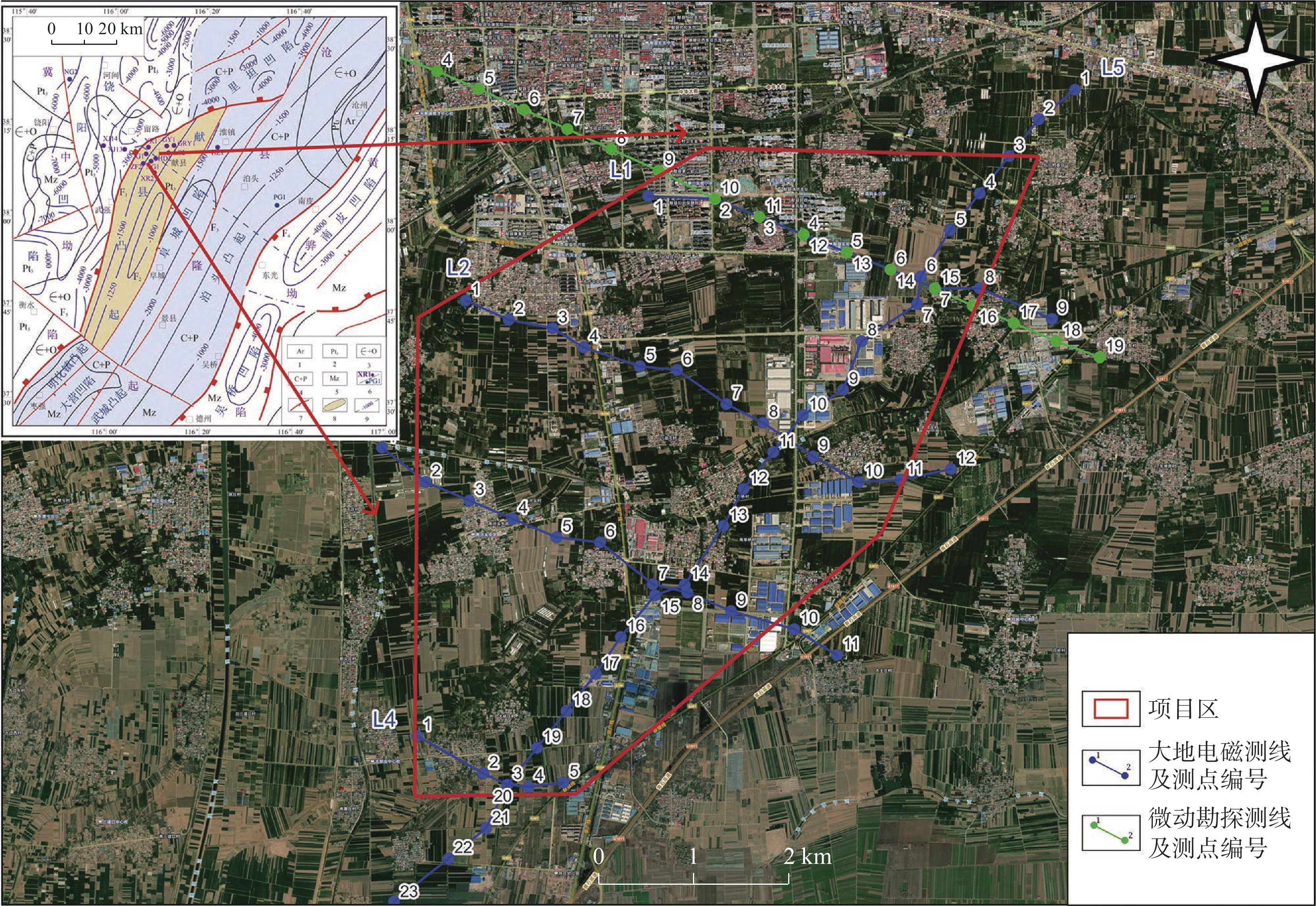
4000 m以浅地层包括新生界、中生界、古生界及中上元古界。野外布设大地电磁法测深剖面5条(28.67 km,60个测点),采用V8电法仪记录正交电磁场分量,通过一维(Bostick)、二维(RRI、Occam)等反演获取电性结构;微动探测剖面1条(8.54 km,19个测点),利用EPS-D10宽频地震仪提取瑞雷波频散曲线反演地下横波速度,两种方法相互约束以降低物探多解性。结果表明:①识别出6条次级断裂及破碎带,主要位于西北部,为地热流体运移通道;②明确新生界第四系底界埋深415~471 m、新近系底界980~1420 m,蓟县系雾迷山组顶界980~1430 m,且呈现“西北深、东南浅”的分布特征;③新生界地温梯度3.5~4.0 ℃·(100 m)−1,基岩地温梯度1~1.5 ℃·(100 m)−1,蓟县系雾迷山组热储中部温度70~80 ℃,呈西北高东南低特征;④圈定适宜地热开采区,中上元古界蓟县系岩溶裂隙热储全区分布,热储厚度500~600 m,涌水量57~140.19 m3·h−1,单位涌水量0.266~8.67 m3·(h·m)−1。献县东南探采1井(井深2508 m,水温70 ℃,水量100 m3·h−1)验证,物探解译与实钻数据相吻合。研究证实,大地电磁测深法与微动探测法的联合应用可有效刻画地热地质结构,成果可为献县地热资源科学开发及区域“双碳”目标实现提供技术支撑。Abstract:Xianxian county is recognized as "the largest geothermal enrichment area in North China," boasting abundant medium- and low-temperature geothermal resources. To address the limited understanding of deep geothermal resource distribution and the development of heat-controlling structures in the southeastern block of Xianxian county, and to support the large-scale development of bedrock fracture-type thermal reservoirs, this study employed an integrated geophysical exploration approach combining the magnetotelluric (MT) method and microtremor surveys. It involved the exploration and interpretation of stratigraphic, fault, and thermal reservoir characteristics in the study area, with the reliability of the results verified using drilling data. The study area is located in the northern part of the Xianxian uplift in the Cangxian uplift, within the Bohai Bay Basin. Within a depth of 4,000 m, the stratigraphic sequence from top to bottom includes the Cenozoic, Mesozoic, Paleozoic, and Middle-Upper Proterozoic Erathems. For fieldwork, five MT profiles were deployed, totaling 28.67 km in length with 60 survey points. A V8 electrical instrument recorded orthogonal electromagnetic field components, and electrical structures were derived through multi-method inversion techniques, including 1D Bostick, 2D RRI, and 2D Occam. For microtremor surveys, one profile was established, measuring 8.54 km with 19 survey points. An EPS-D10 broadband seismograph was used to extract Rayleigh wave dispersion curves, which were then inverted to determine the underground shear wave velocity structure. The two methods constrained each other to reduce geophysical non-uniqueness. The results show: (1) Six secondary faults and fractured zones were identified, mainly distributed in the northwest of the study area. Well-developed fractures around fault zones provide channels for geothermal fluid migration, making them key targets for drilling. (2) Burial depths of the top and bottom boundaries of major strata were clarified: the bottom boundary of the Quaternary system (Cenozoic) ranges from 415 to 471 m; the bottom boundary of the Neogene system ranges from 980 to 1420 m; and the top boundary of the Wumishan formation (Jixian system, middle-upper Proterozoic) ranges from 980 to 1,430 m. The strata exhibit a pattern of deeper burial in the northwest and shallower burial in the southeast. (3) Geothermal gradient characteristics were revealed: the highest heating rates occur in the Cenozoic and Mesozoic strata, with the Cenozoic geothermal gradient ranging from 3.5 to 4.0 ℃·(100m)−1; upon entering the middle-upper Proterozoic basement, the heating rate decreases with bedrock geothermal gradients ranging from 1.0 to1.5 ℃·(100m)−1. The temperature in the middle of the Wumishan formation thermal reservoir is 70 to 80 ℃, gradually decreasing from northwest to southeast. (4) Suitable and relatively suitable geothermal mining areas were delineated. Karst-fracture thermal reservoirs of the Jixian system (middle-upper Proterozoic) are distributed throughout the area, with thermal reservoir thickness of 500 to 600 m, water inflow rates of 57 to 140.19 m3·h−1, and specific water inflow rates of 0.27 to 8.67 m3·(h·m)−1. Verification through Exploration-Production Well 1 in southeastern Xianxian county (well depth: 2,508 m; water temperature: 70 ℃; water inflow: 100 m3·h−1) shows high consistency between geophysically interpreted stratigraphic sequences and burial depths and actual drilling data. This study confirms that the combined application of MT and microtremor methods effectively characterizes geothermal geological structures, providing technical support for the scientific development of Xianxian country's geothermal resources and the achievement of regional "dual carbon" goals. -
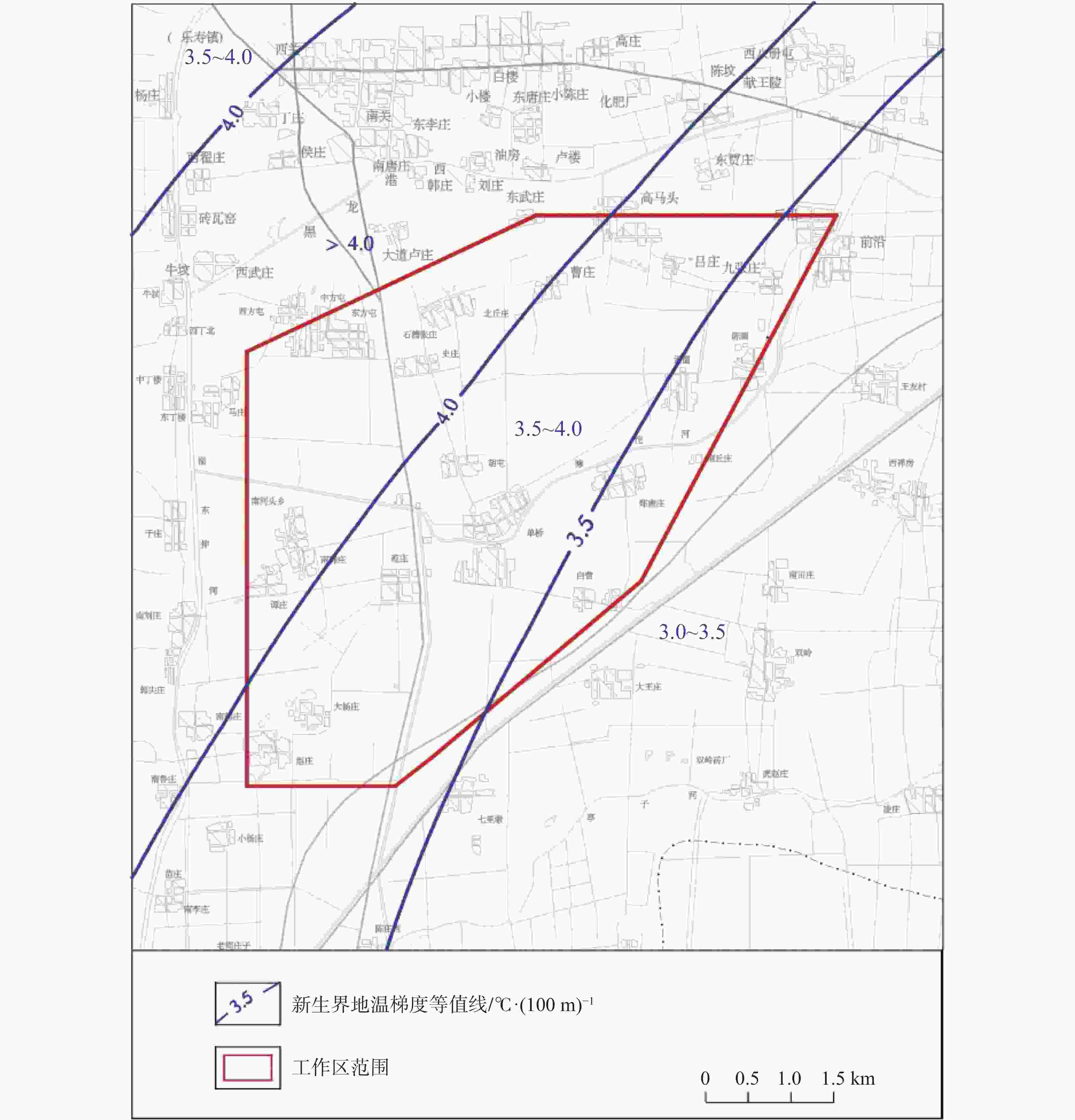
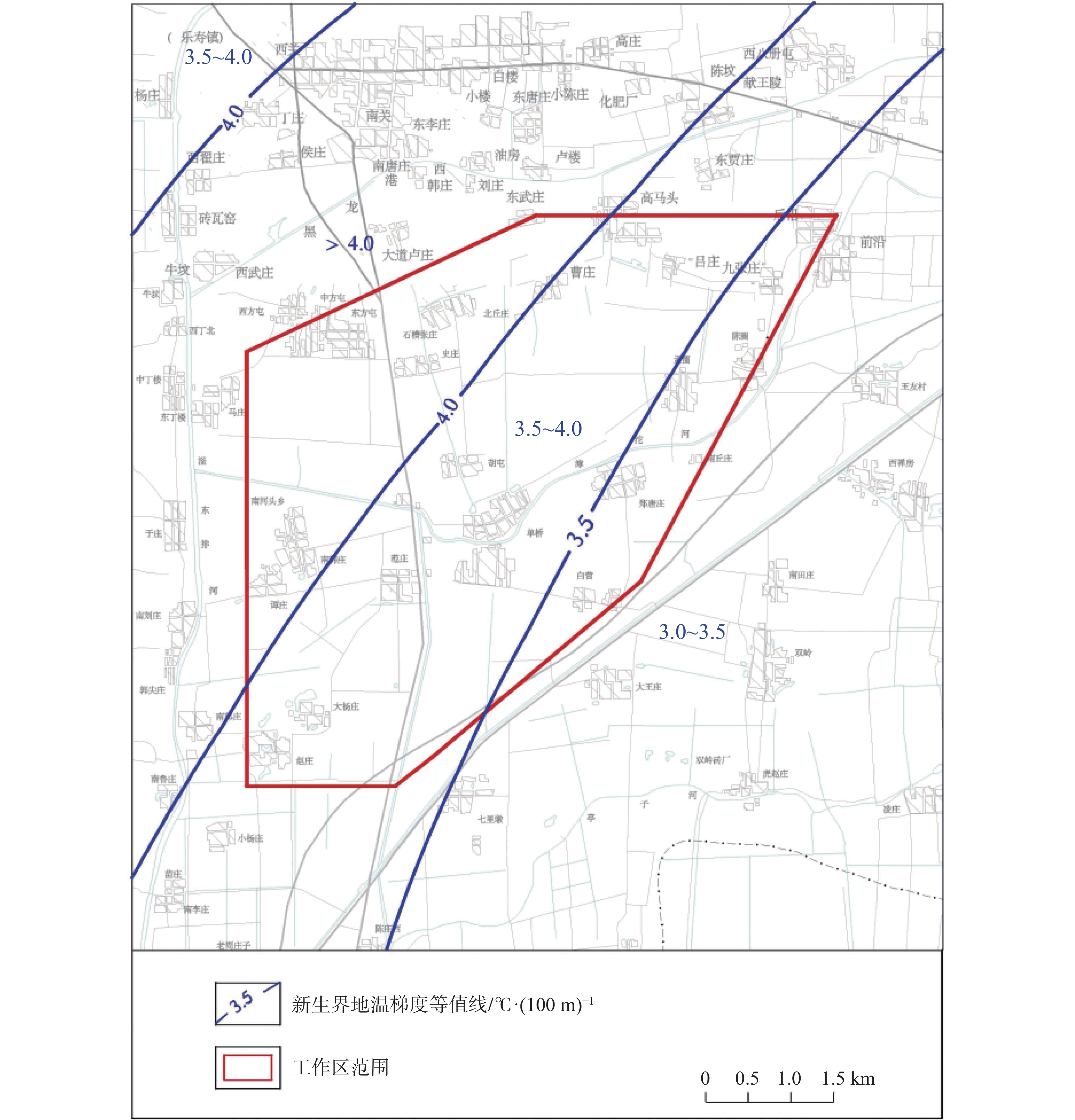
图 2 研究区新生界地温梯度等值线图
Figure 2. Geothermal gradient contour map of the Cenozoic Erathem in the study area
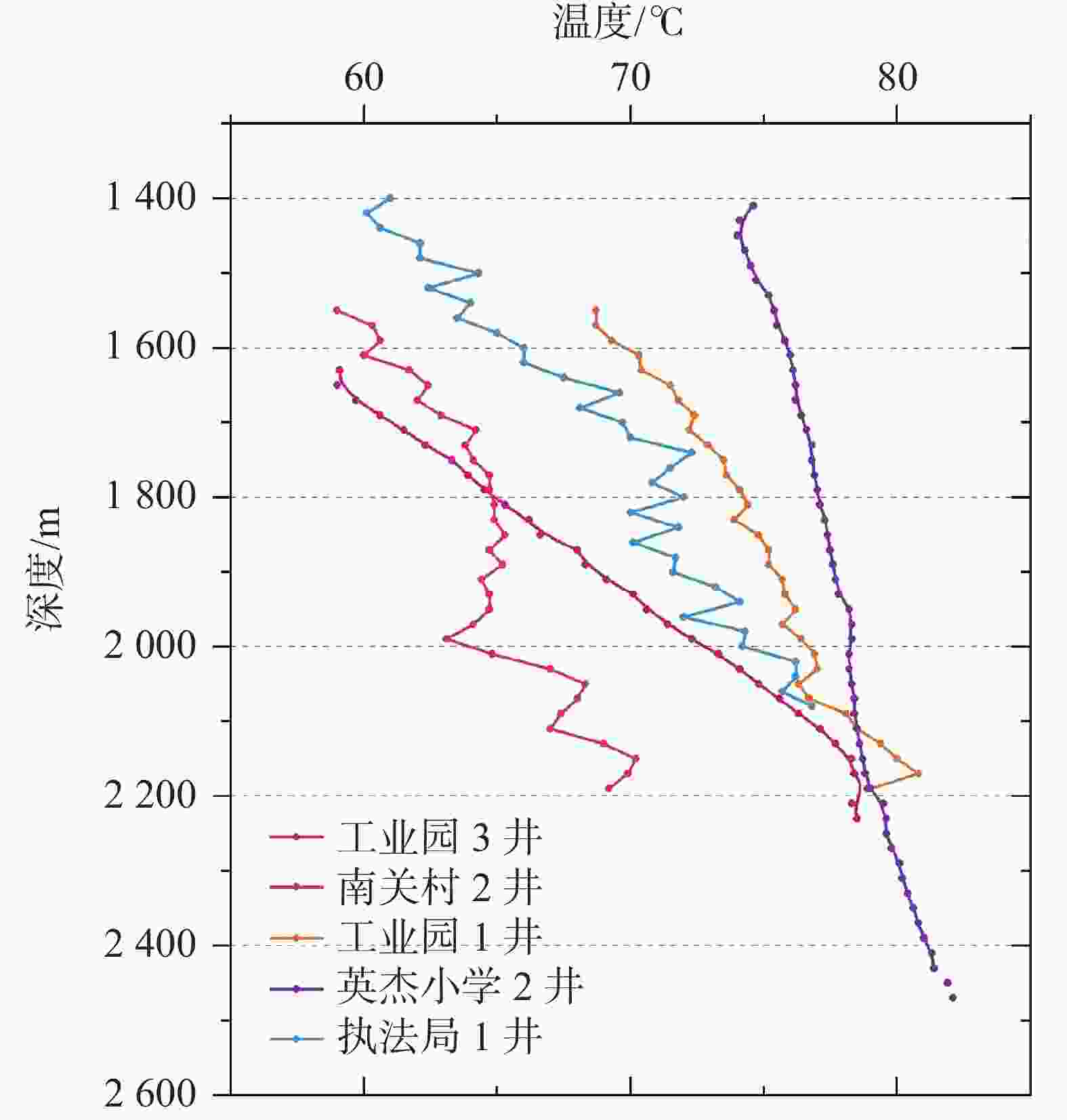
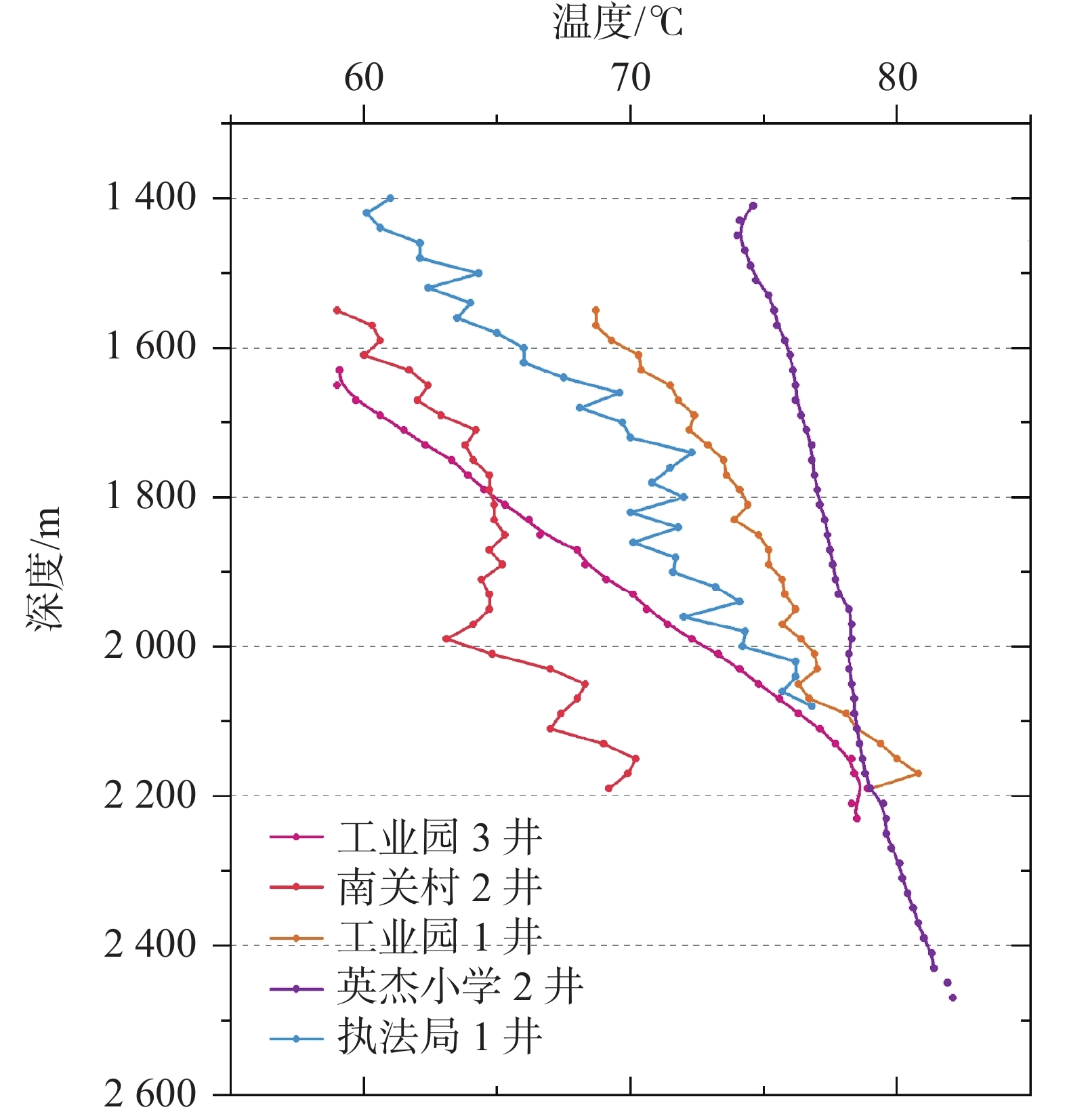
图 3 献县区域地热井井温曲线图
Figure 3. Well temperature curves of geothermal wells in the Xianxian area
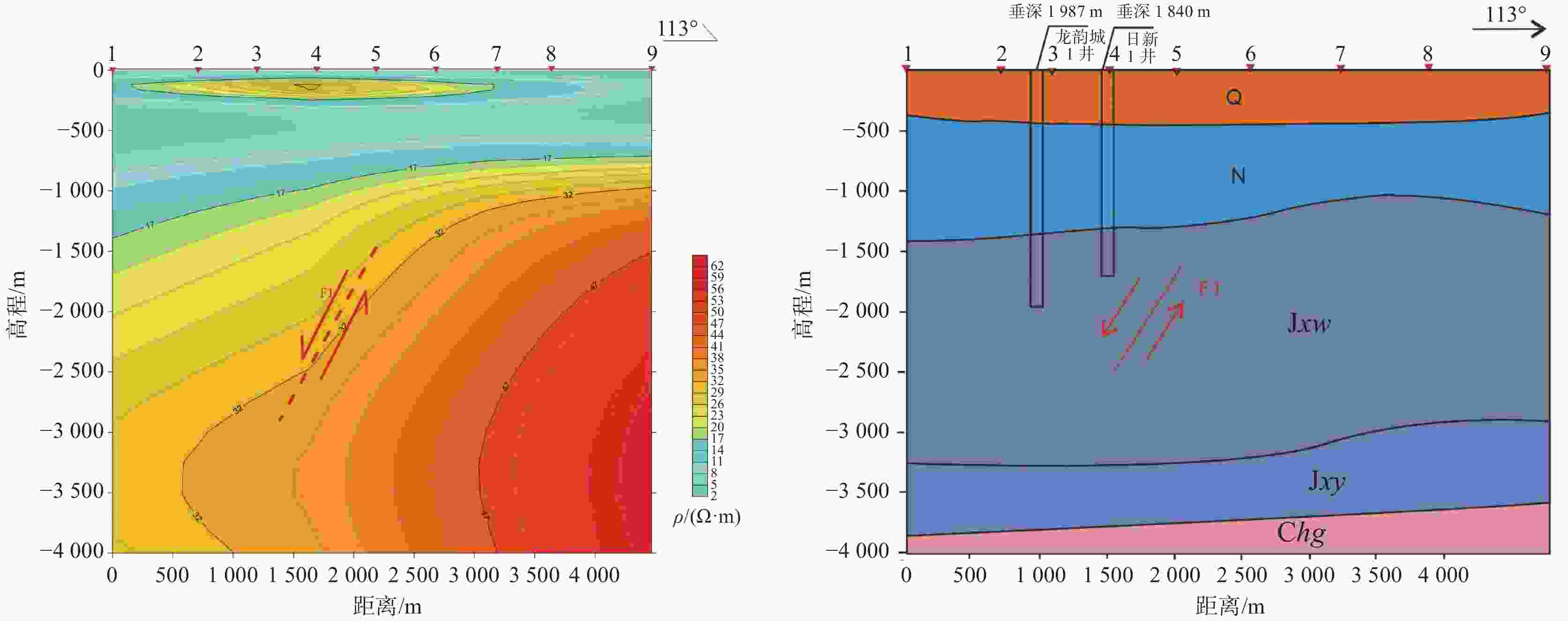
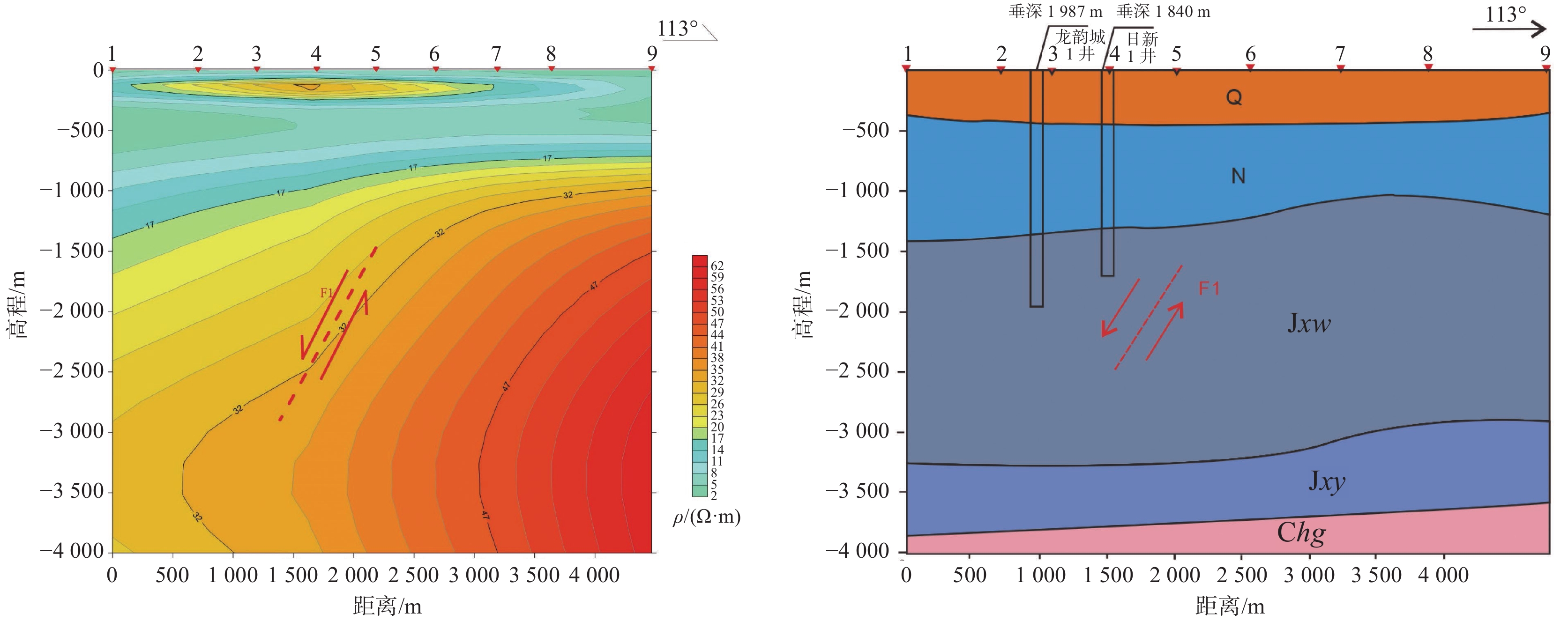
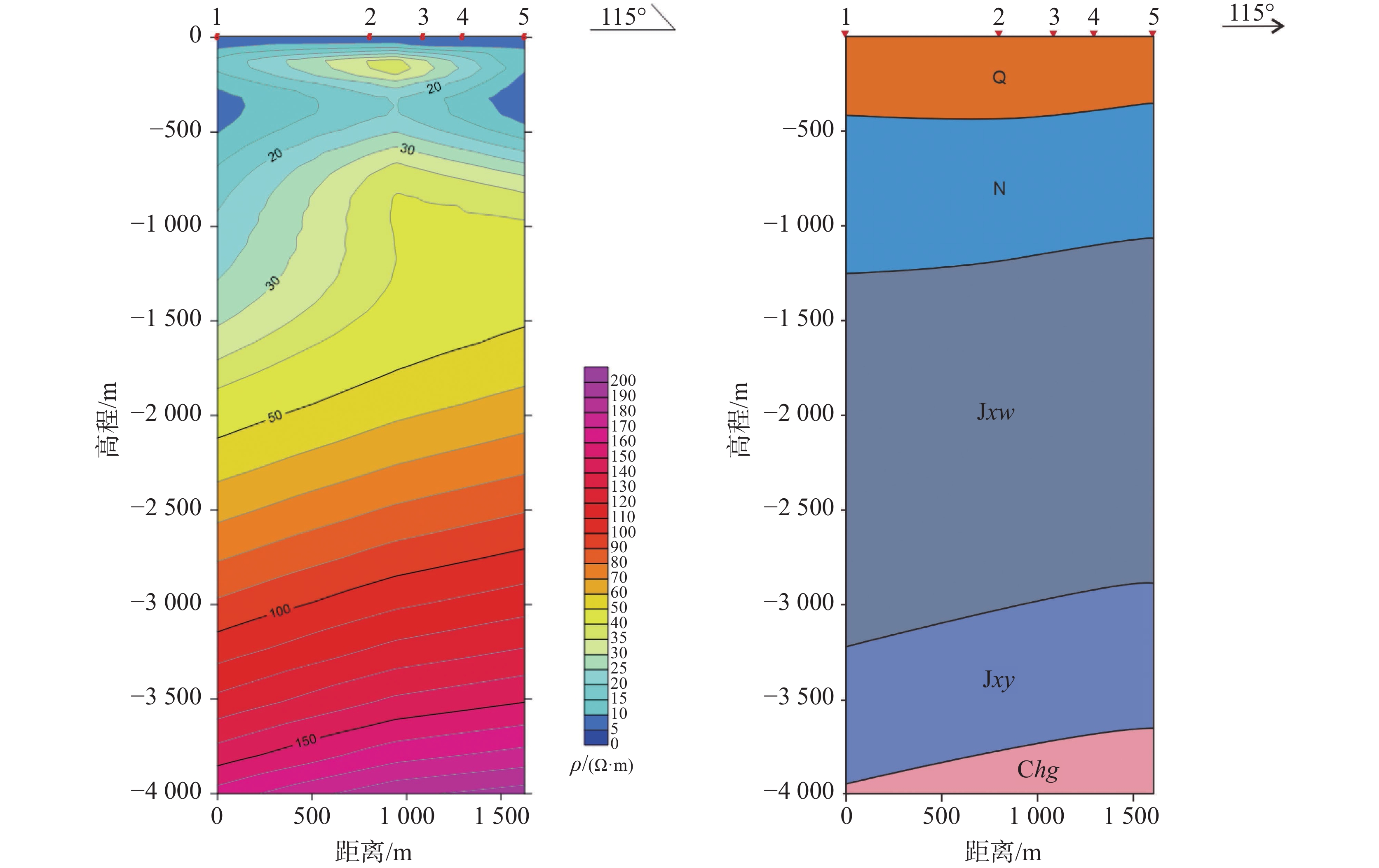
图 4 大地电磁测深法L1测线综合解释剖面图(左:视电阻率等值线图,右:地层埋深剖面解释图)
Figure 4. Comprehensive interpretation profile of MT Survey Line L1 (Left: Contour map of apparent resistivity; Right: Interpretation map of stratigraphic burial depth profile)
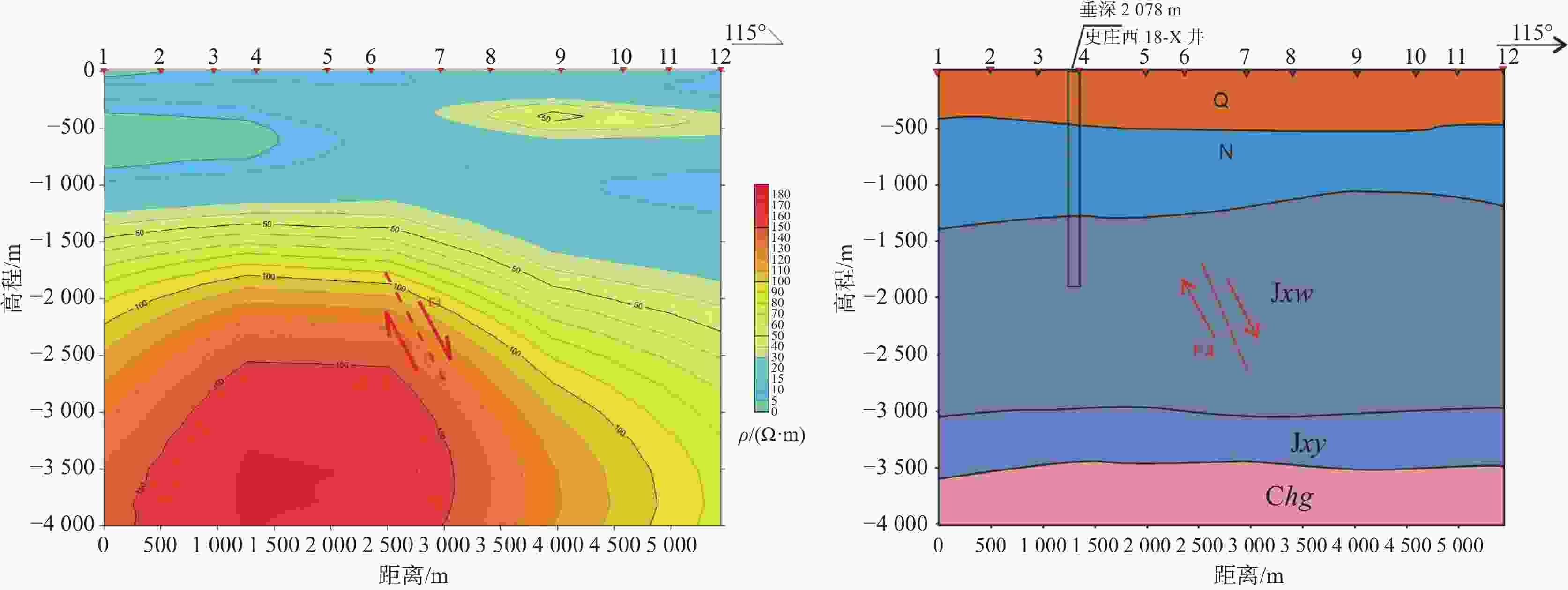
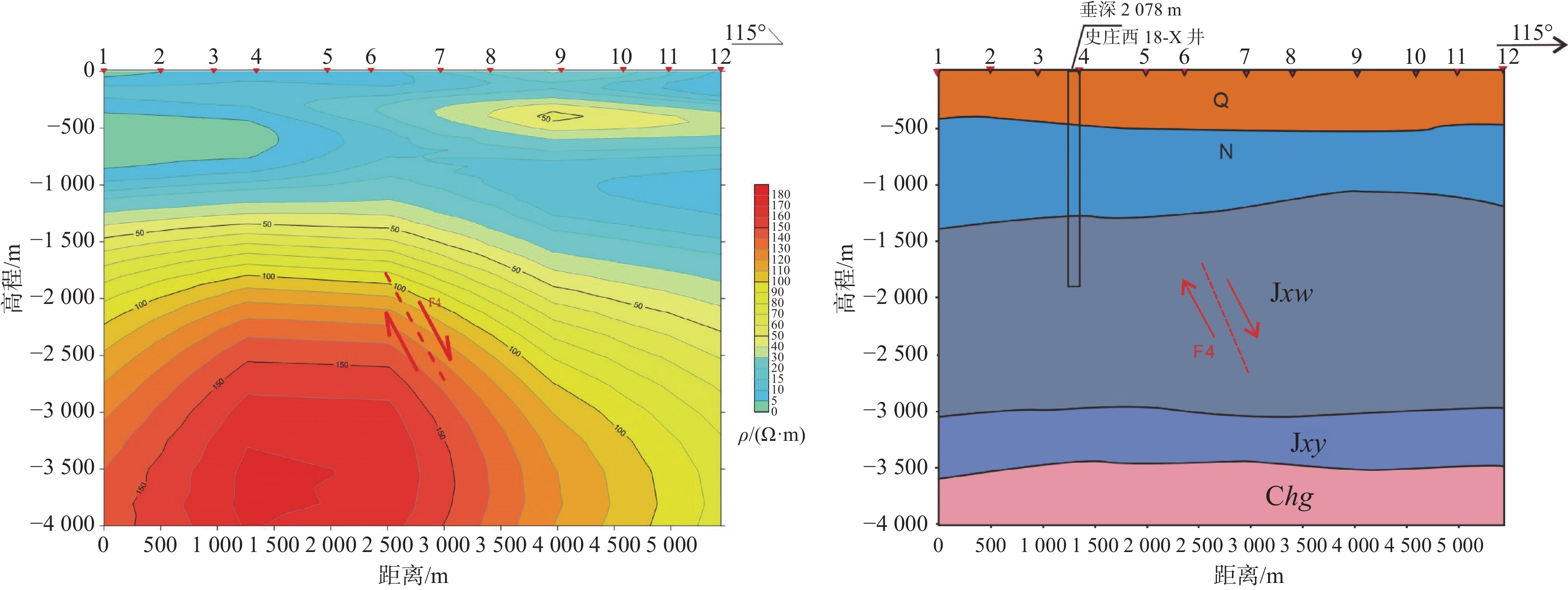
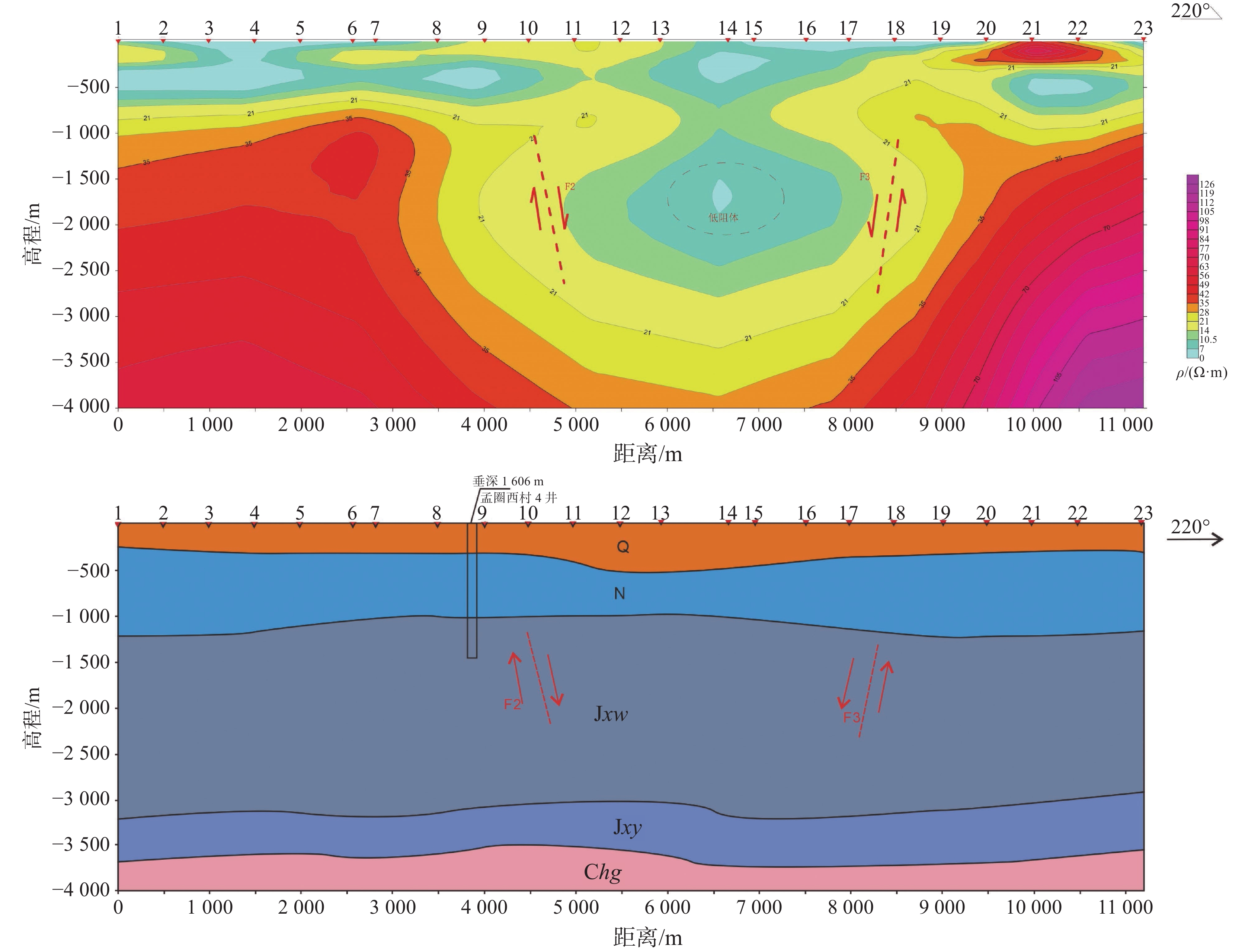
图 5 大地电磁测深法L2测线综合解释剖面图(左:视电阻率等值线图,右:地层埋深剖面解释图)
Figure 5. Comprehensive interpretation profile of MT Survey Line L2 (Left:Contour map of apparent resistivity; Right: Interpretation map of stratigraphic burial depth profile)
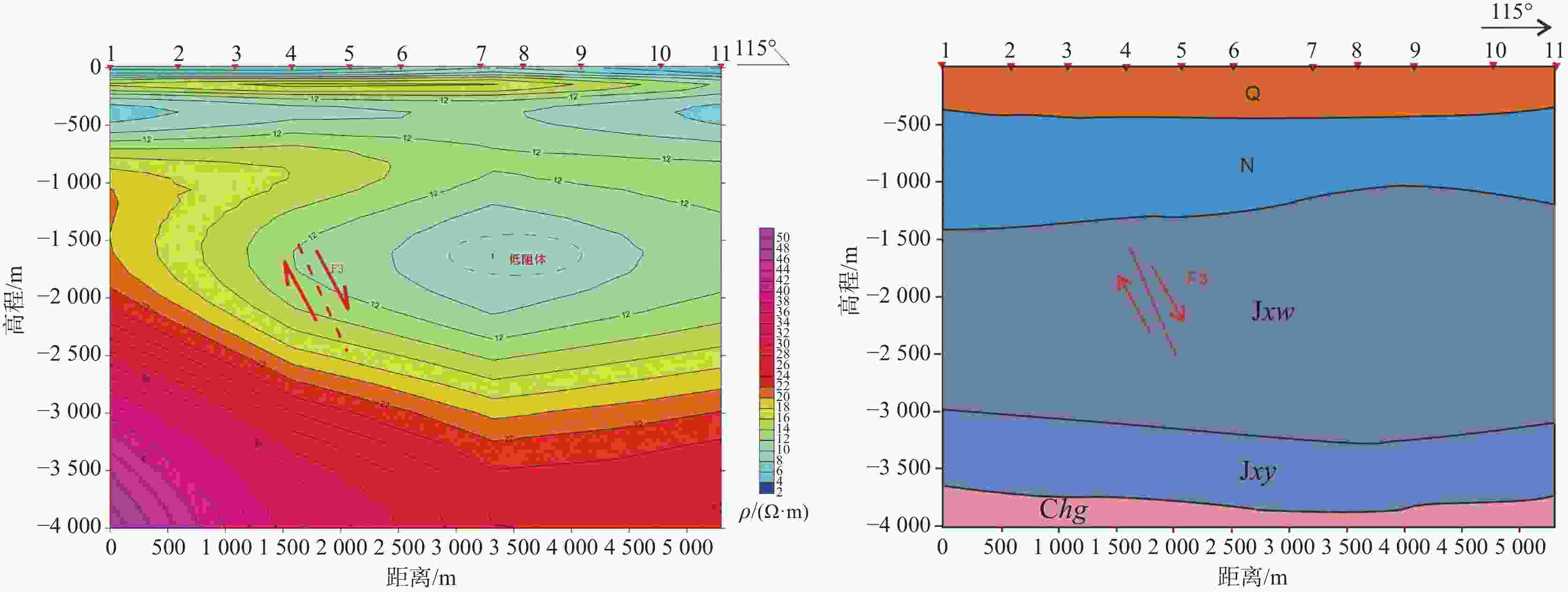
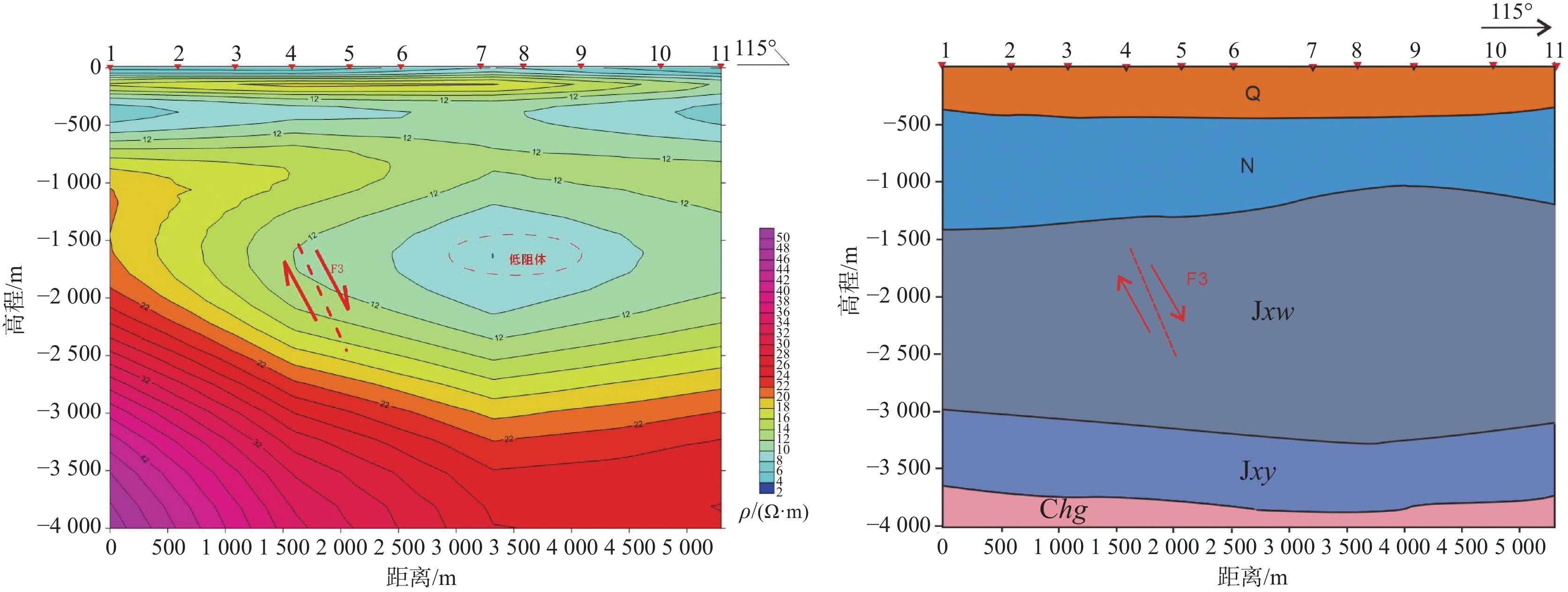
图 6 大地电磁测深法L3测线综合解释剖面图(左:视电阻率等值线图,右:地层埋深剖面解释图)
Figure 6. Comprehensive interpretation profile of MT Survey Line L3 (Left:Contour map of apparent resistivity; Right: Interpretation map of stratigraphic burial depth profile)
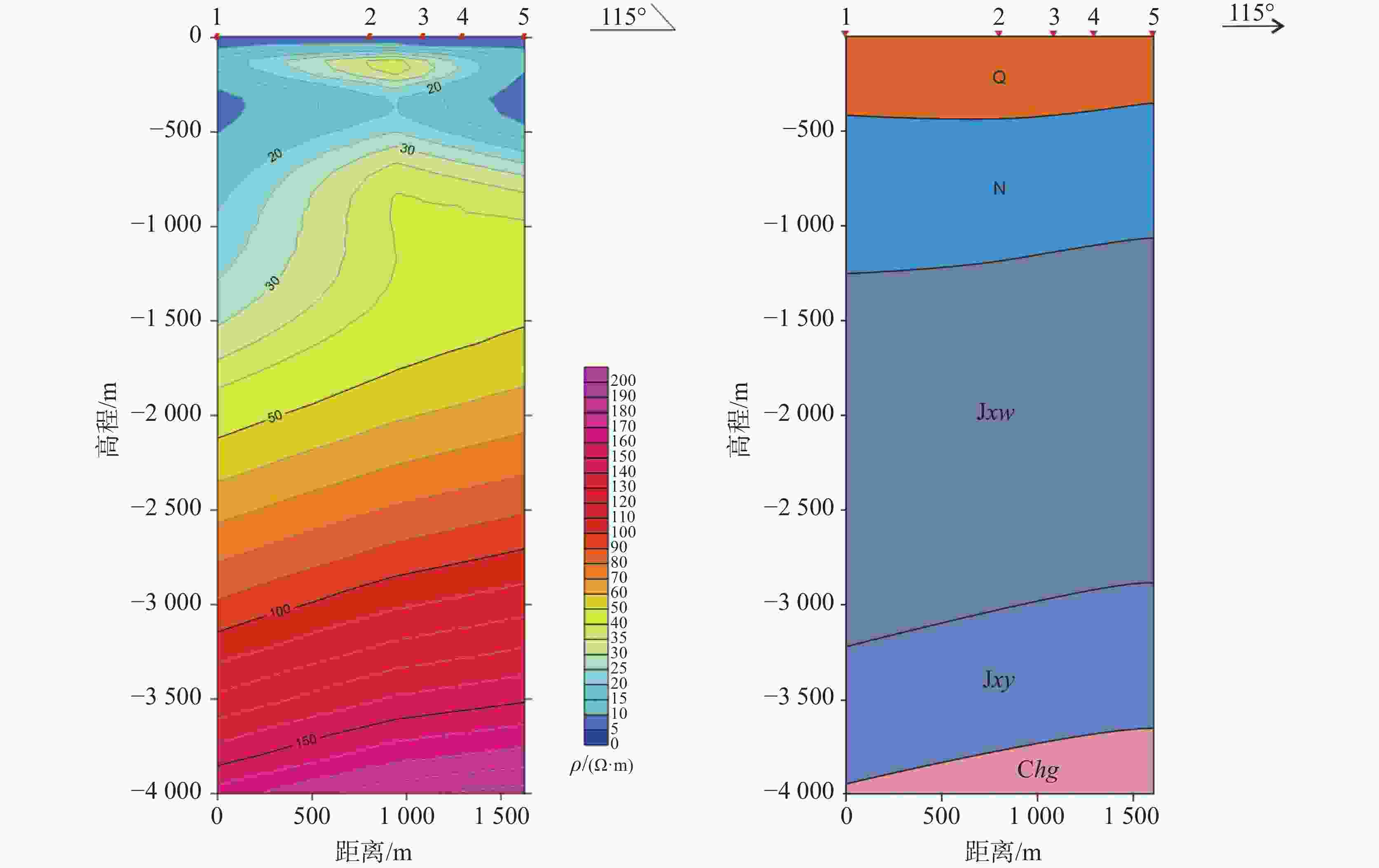
图 7 大地电磁测深法L4测线综合解释剖面图(左:视电阻率等值线图,右:地层埋深剖面解释图)
Figure 7. Comprehensive interpretation profile of MT Survey Line L4 (Left:Contour map of apparent resistivity; Right: Interpretation map of stratigraphic burial depth profile)
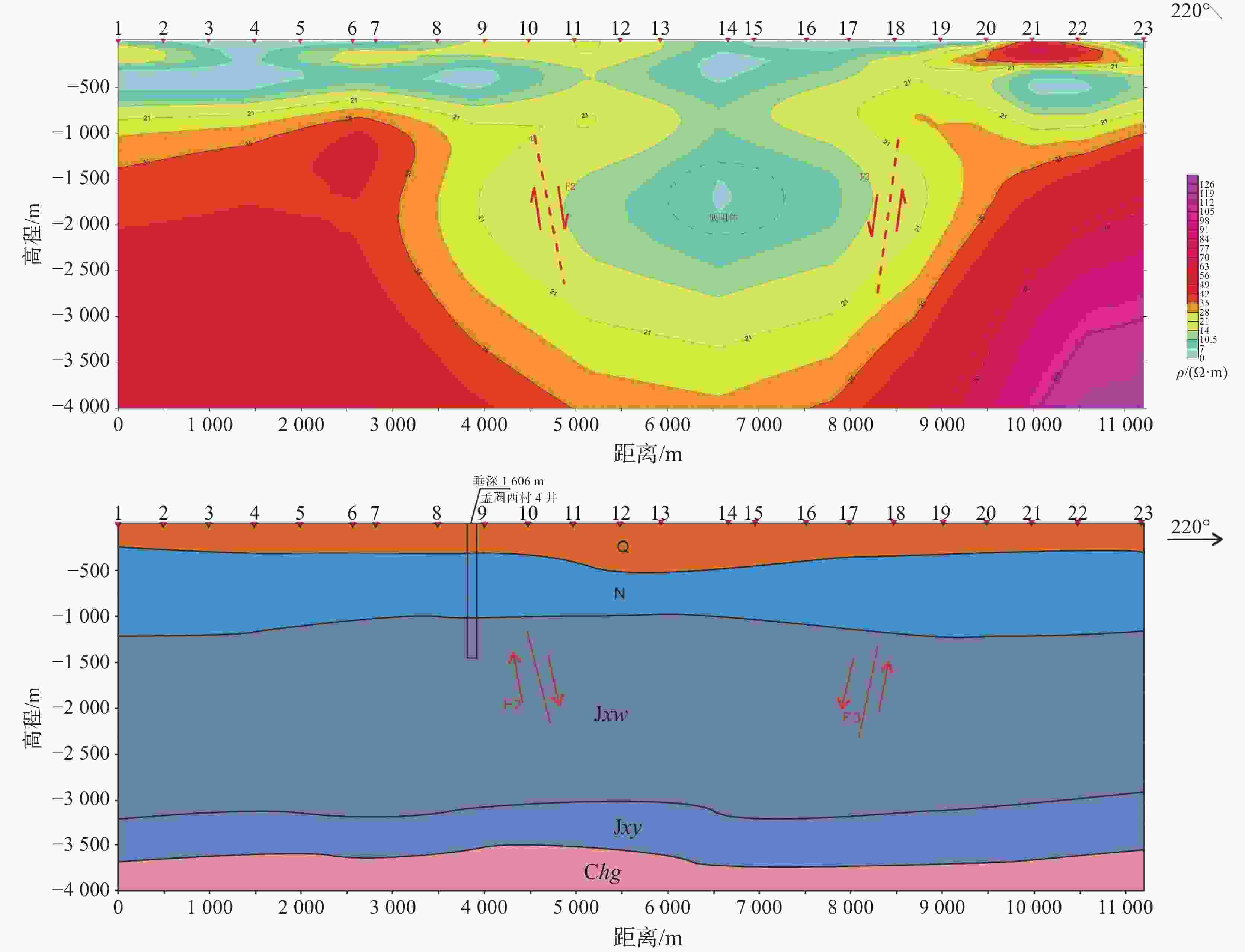
图 8 大地电磁测深法L5测线综合解释剖面(上:视电阻率等值线图,下:地层埋深剖面解释图)
Figure 8. Comprehensive interpretation profile of MT Survey Line L5 (Top:Contour map of apparent resistivity; Bottom: Interpretation map of stratigraphic burial depth profile)
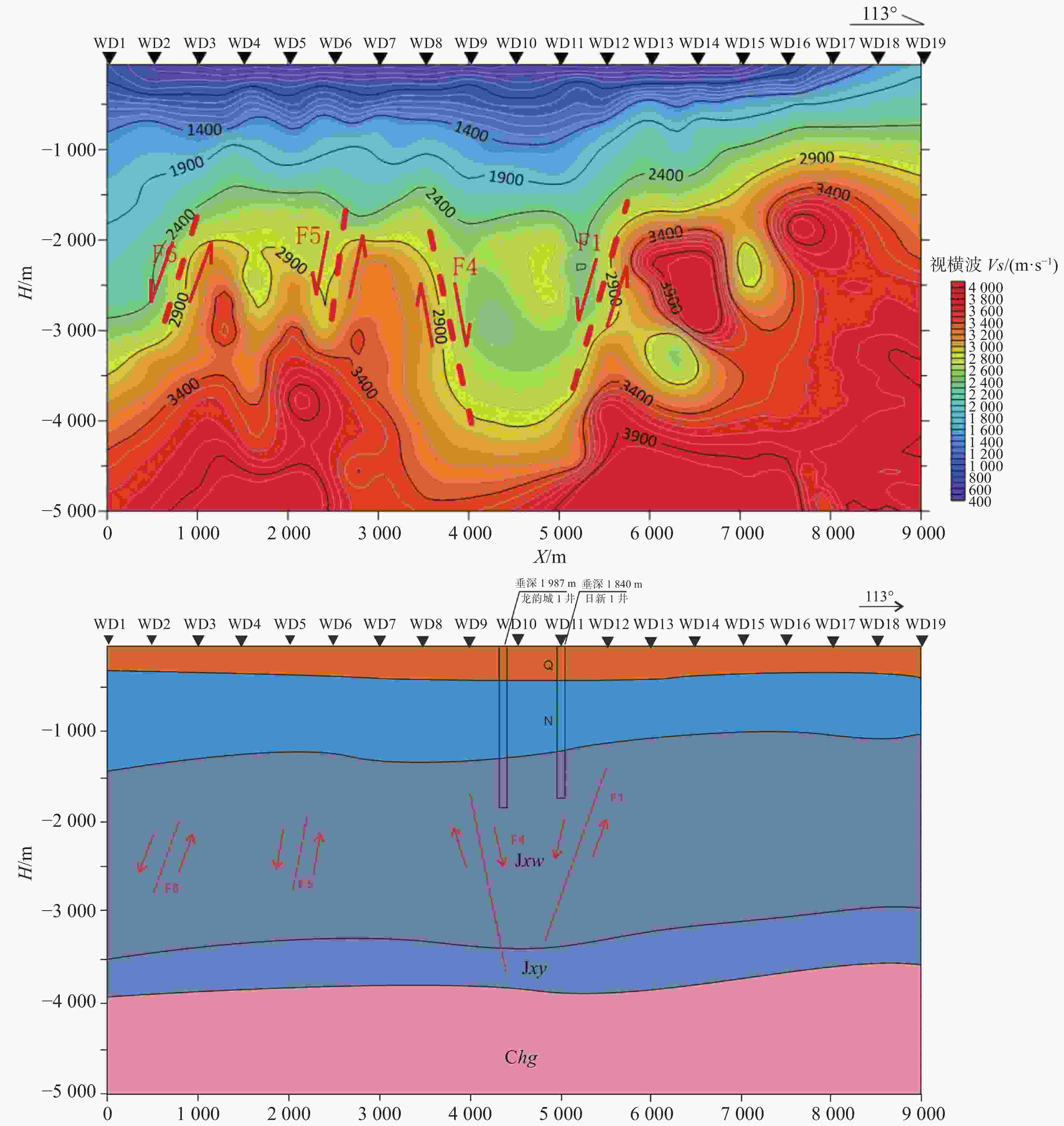
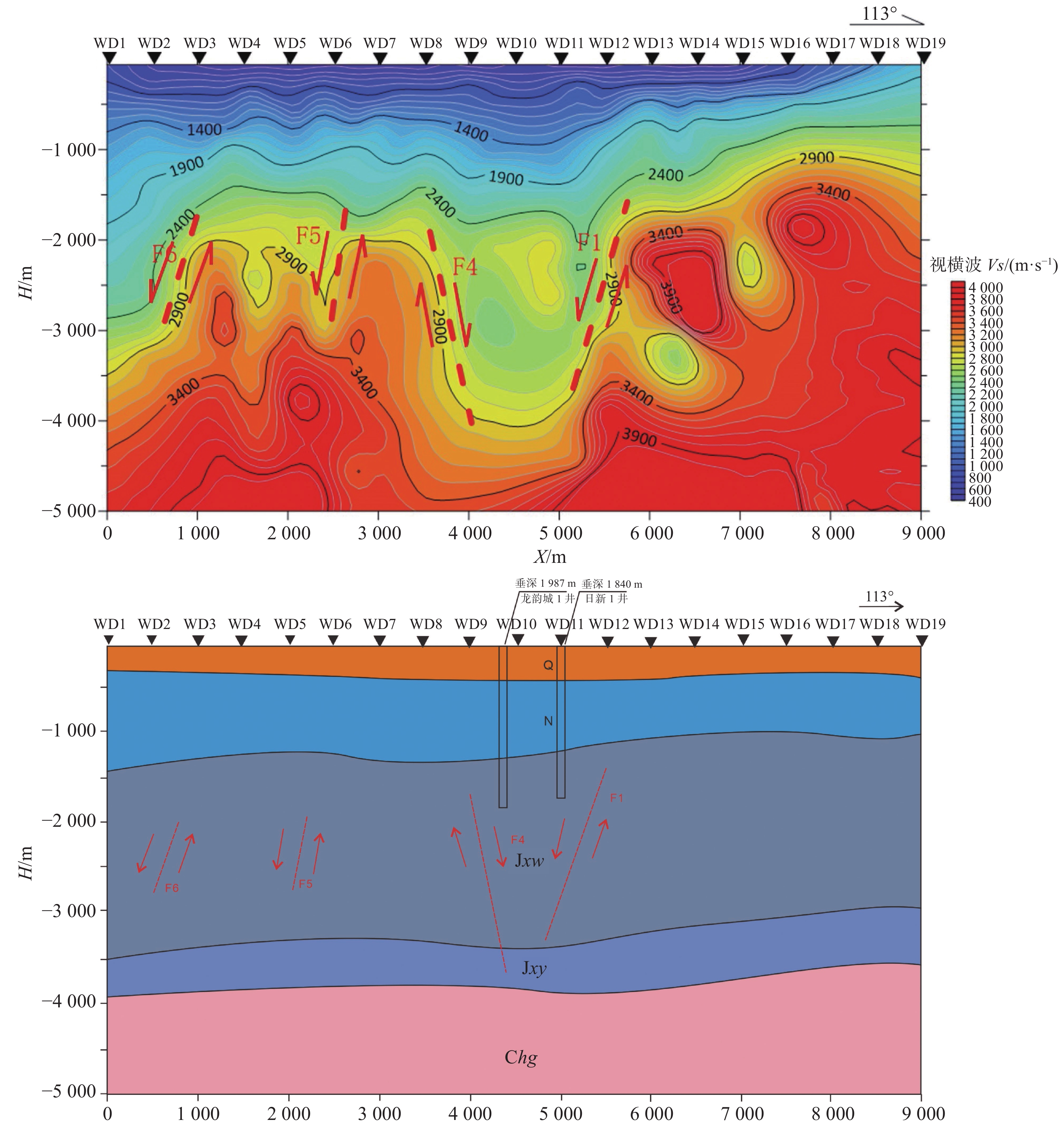
图 9 微动测线视横波等值线图及地球物理—地质推断图(上:视横波等值线图,下:地层埋深剖面解释图)
Figure 9. Contour map of apparent shear wave and map of geophysical-geological inference map of microtremor survey line (Top: Contour map of apparent shear wave; Bottom: Interpretation map of stratigraphic burial depth profile)
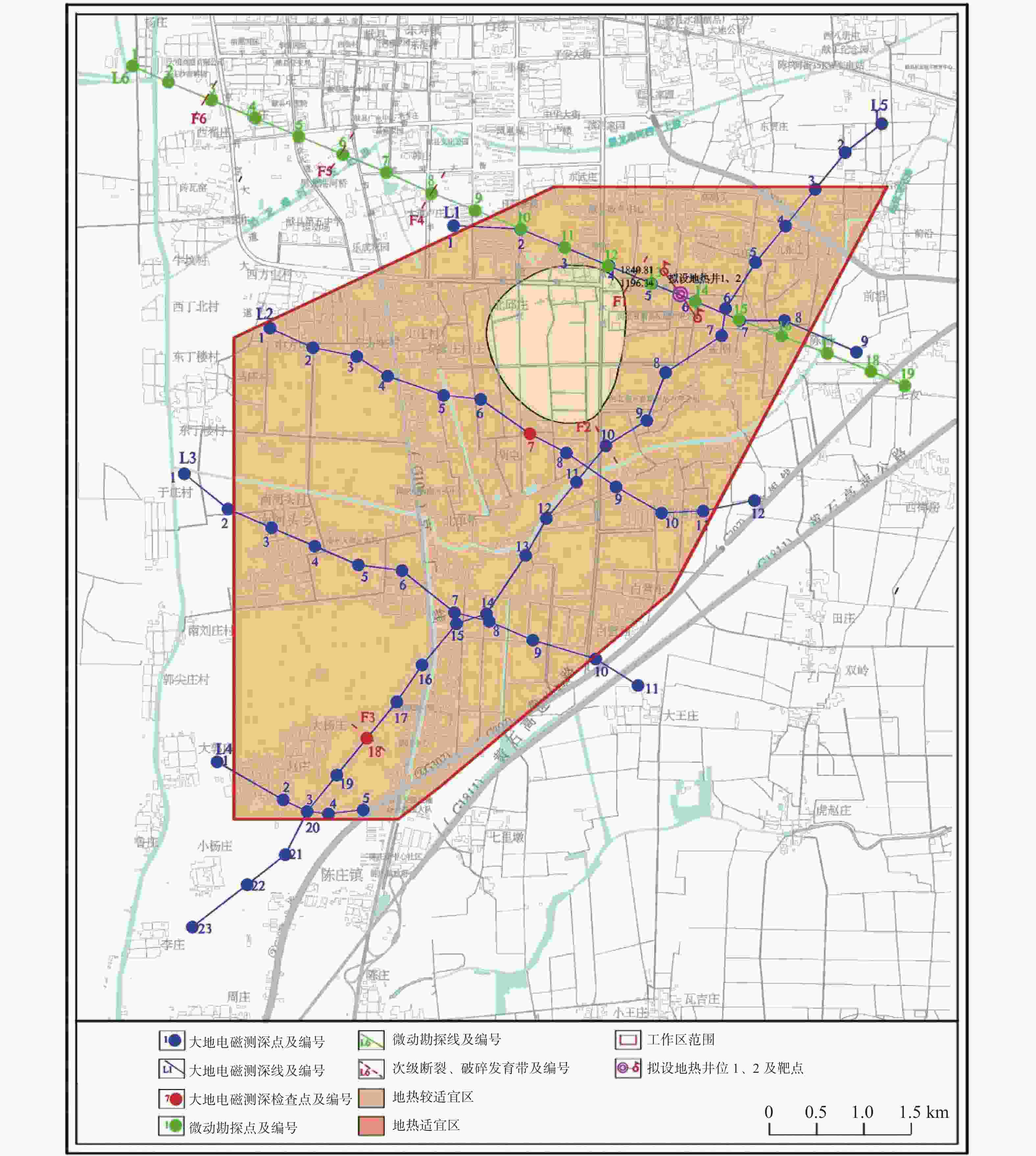
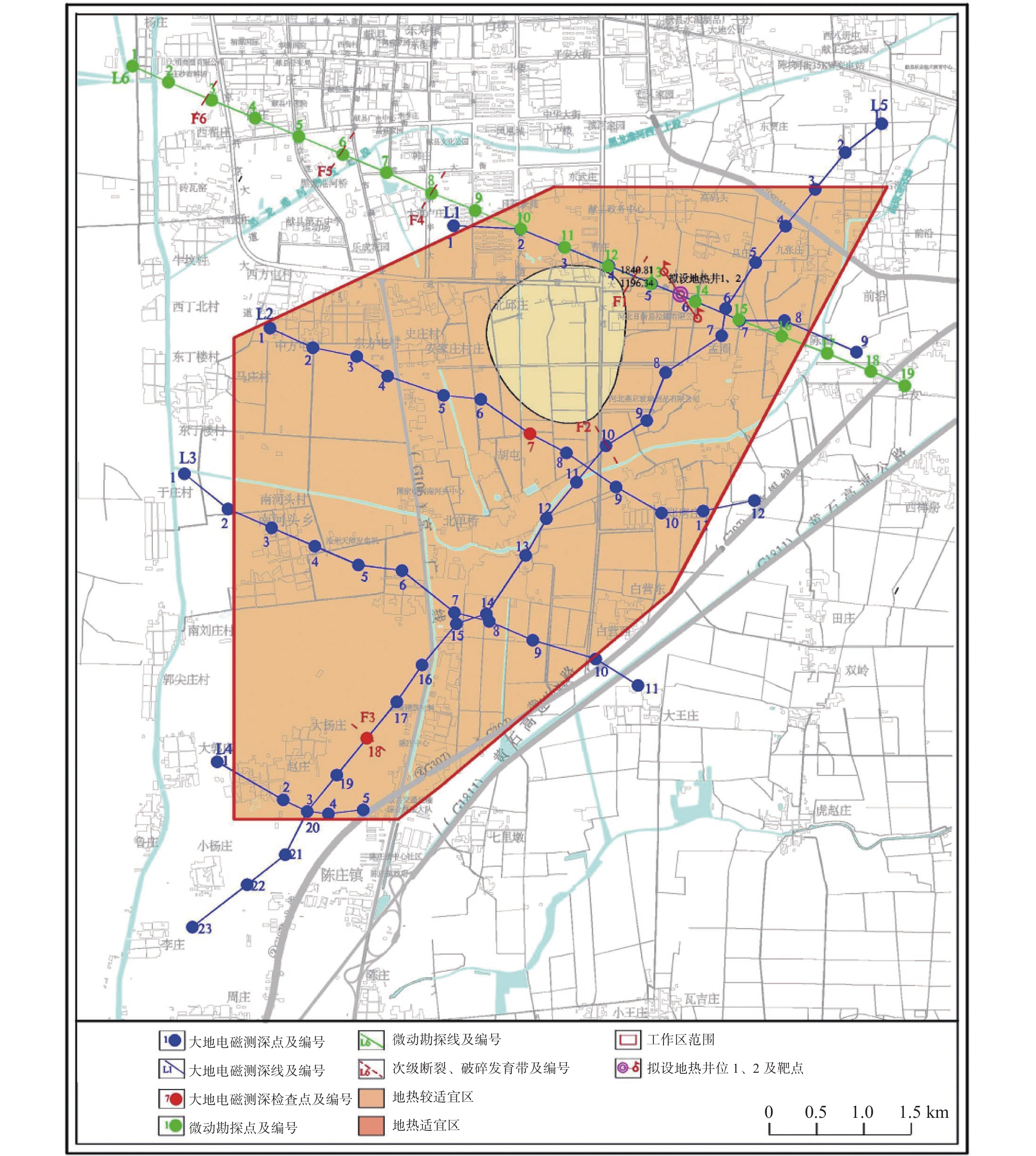
图 10 研究区次级断裂平面位置图
Figure 10. Planar location map of secondary faults in the study area
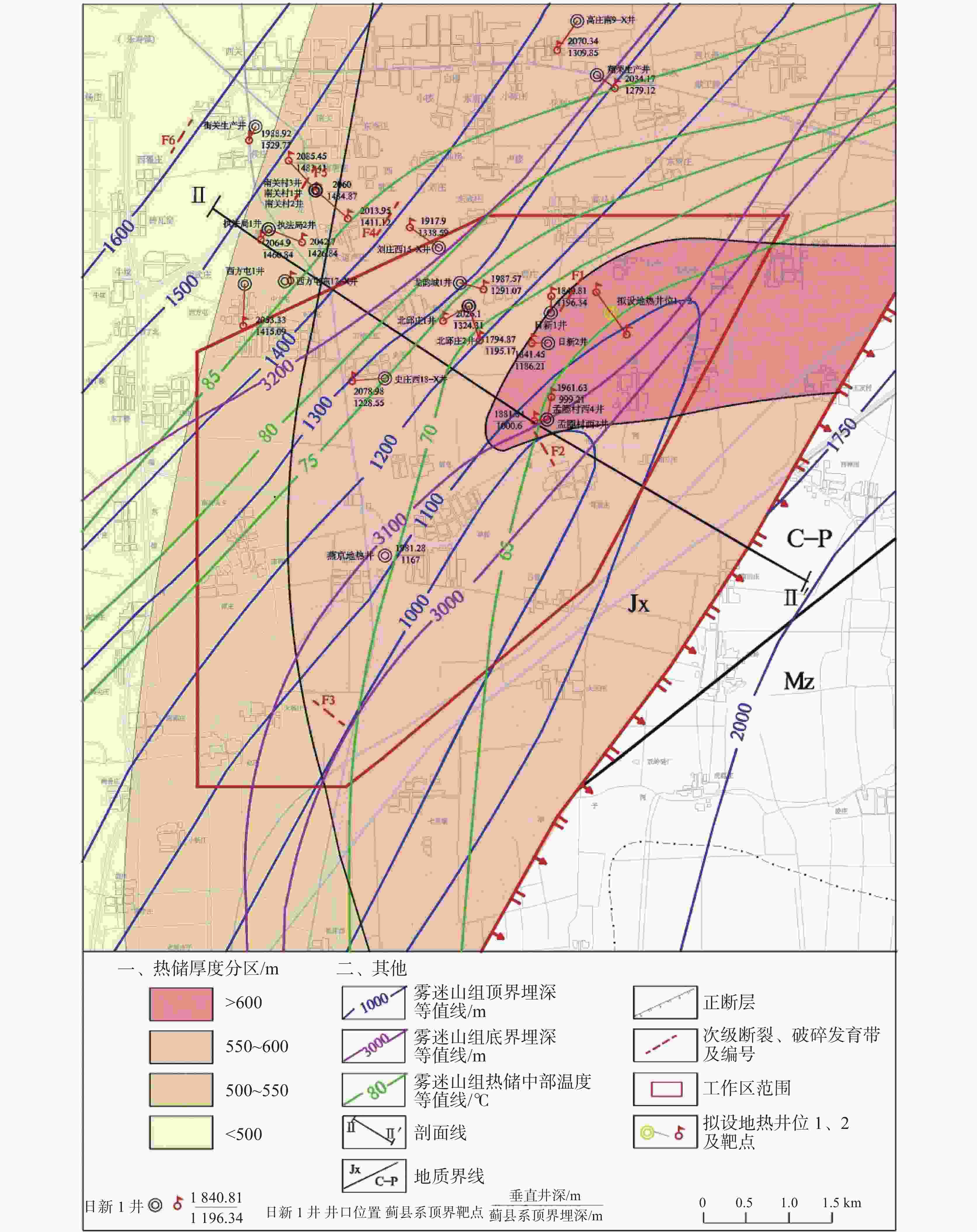
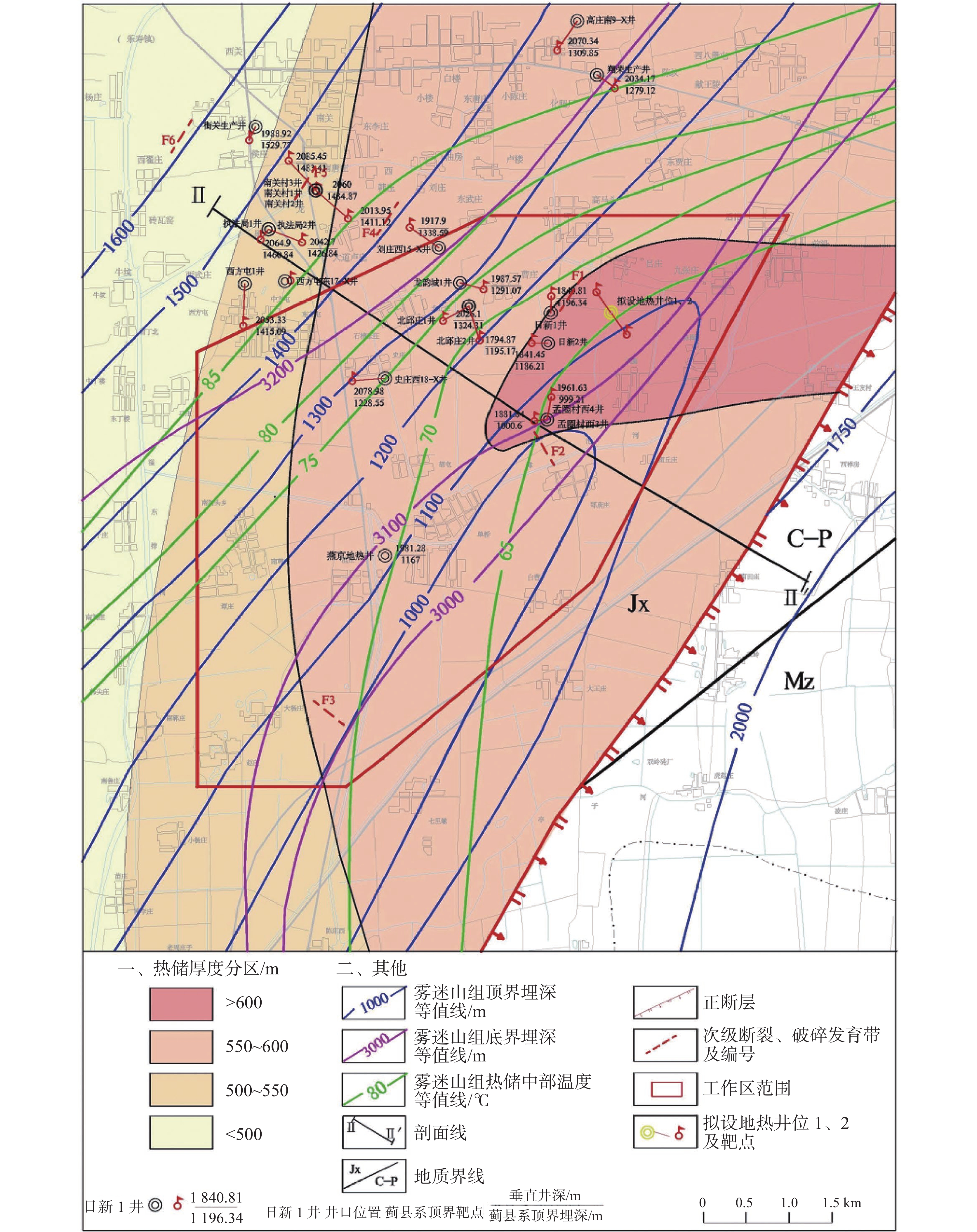
图 11 研究区蓟县系雾迷山组地层埋深等值线图
Figure 11. Contour map of formation burial depth of the Wumishan formation in the Jixian system in the study area
表 1 献县已有地热井利用层段及热储中部温度表
Table 1. Utilized intervals and middle part temperatures of geothermal reservoirs in Xianxian country
井名 利用层段/m 热储中部温度/℃ 北邱庄1井 1461.54 2026.10 78.6 北邱庄2井 1198.85 1794.87 75.3 龙韵城1井 1291.66 1987.57 82.0 日新1井 1196.34 1840.81 75.6 日新2井 1186.21 1841.45 79.5 孟圈村西3井 1006.27 1600.81 74.6 孟圈村西4井 1003.69 1606.92 71.2 西方屯D17-X 1261.30 2079.00 93.7  下载: 导出CSV
表 2 研究区不同岩性电阻率参数一览表
Table 2. List of resistivity parameters for different typesof lithology in the study area
地层 岩性 电阻率变化范围/(Ω·m) 第四系 亚砂土、亚黏土 <40 新近系 泥岩、砂岩 4~30 蓟县系 白云岩 20~150 长城系 白云岩 >40
下载: 导出CSV
表 3 测点预测地层深度与地热井实钻地层深度对比表
Table 3. Comparison between predicted formation depths at survey points and actual drilled formation depth of geothermal wells
地层 L1测线点号或井名位置内地层深度/m 3点 LYC1井 4点 RX1井 第四系 440 440.00 450 449.98 新近系 1291 1291.07 1196 1196.34 蓟县系雾迷山组 3185 1987.57 ▽3165 1840.81 ▽蓟县系杨庄组 3710 / 3690 / 长城系高于庄组 4000 / 4000 /
下载: 导出CSV
表 4 测点预测地层深度与地热井实钻地层深度对比表
Table 4. Comparison between predicted formation depths at survey points and actual drilled formation depths of geothermal wells
地层 L2测线点号或井名位置内地层深度/m 4点 SZX18-X井 第四系 455 454.97 新近系 1288 1228.55 蓟县系雾迷山组 2990 2078.98 ▽蓟县系杨庄组 3490 / 长城系高于庄组 4000 /
下载: 导出CSV
表 5 测点预测地层深度与地热井实钻地层深度对比表
Table 5. Comparison between predicted formation depths at survey points and actual drilled formation depth of geothermal wells
地层 L5测线点号或井名位置内地层深度/m 9点 MQC4井 第四系 460 399.99 新近系 1001 999.21 蓟县系雾迷山组 3110 1601.00 ▽蓟县系杨庄组 3580 / 长城系高于庄组 4000 / 注:▽地层未钻穿
下载: 导出CSV
表 6 献县东南区块探井实钻分层表
Table 6. Stratification of actual drilled exploration wells in the southeast block of Xianxian country
地层 底界埋深/m 岩性 第四系平原组 405 上部浅黄色黏土层,棕黄色砂砾岩,灰黄色、棕黄色、泥岩、细砂岩,下部棕黄色、棕红色泥岩、砂质泥岩不等厚互层,底部为棕红色砂岩 新近系明化镇组 1000 以紫红色、棕红色泥岩、砂质泥岩、泥质粉砂岩与灰色、灰绿色、灰白色砂砾岩、细砂岩呈不等厚互层 蓟县系洪水庄组 1 830 为浅海相泥质沉积,主要由黑、黑绿色页岩组成,下部夹薄层白云岩,上部夹薄层砂岩 蓟县系雾迷山组 3103 岩性主要为黄灰色、浅灰色、灰白色白云岩、薄层泥质白云岩,局部见燧石条带。白云岩质较纯
下载: 导出CSV
-
[1] 段和肖. 献县地热田深部热结构及地热成因研究[D]. 邯郸: 河北工程大学, 2023.Duan Hexiao. Deep thermal structure and geothermal origin of Xianxian geothermal field[D]. Handan: Hebei University of Engineering, 2023. [2] 段和肖, 刘彦广, 王贵玲, 边凯, 牛小军, 牛飞, 胡静. 沧县隆起中部大地热流及岩石圈热结构特征: 以献县地热田为例[J]. 地球科学, 2023, 48(3): 988-1001.Duan Hexiao, Liu Yanguang, Wang Guiling, Bian Kai, Niu Xiaojun, Niu Fei, Hu Jing. Characteristics of the terrestrial heat flow and lithospheric thermal structure in central Cangxian uplift: A case study of Xianxian geothermal field[J]. Earth Science, 2023, 48(3): 988-1001. [3] 宋洪伟, 夏凡, 尚铭森. MT法在河北献县地区地热勘查中的应用[J]. 地质与资源, 2018, 27(3): 284-287.Song Hongwei, Xia Fan, Shang Mingsen. Application of MT method in geothermal prospecting in Xianxian area, Hebei Province[J]. Geology and Resources, 2018, 27(3): 284-287. [4] 汪新伟, 高楠安, 王婷灏, 刘慧盈, 毛小平, 黄旭. 河北献县地热田地热异常的分布特征及成因机制[J]. 地质学报, 2022, 96(7): 2611-2625.Wang Xinwei, Gao Nanan, Wang Tinghao, Liu Huiying, Mao Xiaoping, Huang Xu. Distribution characteristics and genetic mechanism of the geothermal abnormality in the Xianxian geothermal field, Hebei Province[J]. Acta Geologica Sinica, 2022, 96(7): 2611-2625. [5] 余俊虎. 基于低阻矿体模型的三维大地电磁反演研究[J]. 中国科技信息, 2020(6): 80-81,14.Yu Junhu. Study on 3D Magnetotelluric inversion based on low-resistance ore body model[J]. China Science and Technology Information, 2020(6): 80-81,14. [6] 莫亦可. EH-4电磁成像系统在高速铁路隧道工程勘察中的应用[J]. 重庆科技学院学报(自然科学版), 2011, 13(6): 154-156,196.Mo Yike. Application of EH-4 electromagnetic imaging system in survey of high-speed railway tunnel engineering[J]. Journal of Chongqing University of Science and Technology (Natural Science Edition), 2011, 13(6): 154-156,196. [7] 苑守成, 彭朝晖, 张家奇, 肖金平. 沧县隆起中南段煤系地层分布区地球物理特征[J]. 物探与化探, 2007,31(3): 198-201, 210.Yuan Shoucheng, Peng Zhaohui, Zhang Jiaqi, Xiao Jinping. Geophysical characteristics of coal-bearing strata distribution area in the middle-southern section of Cangxian uplift[J]. Geophysical and Geochemical Exploration, 2007,31(3): 198-201, 210. [8] 董湘龙. 物探技术在高放废物处置库场址特性评价中的应用研究[D]. 成都: 成都理工大学, 2013.Dong Xianglong. Study on the application of geophysical exploration technology in site characteristic evaluation of high-level radioactive waste repository [D]. Chengdu: Chengdu University of Technology, 2013. [9] 田必林. 可控源音频大地电磁法在黑龙江省宁安市地热资源勘查中的应用[D]. 长春: 吉林大学, 2012.Tian Bilin. Application of controlled-source audio-frequency magnetotelluric method in geothermal resource exploration in Ning'an city, Heilongjiang province[D]. Changchun: Jilin University, 2012. [10] 贾慧涛, 廖圣柱, 盛勇, 徐子桥. 微动勘探技术在城市地质工作中的应用[J]. 安徽地质, 2020, 30(1): 35-38, 80.Jia Huitao, Liao Shengzhu, Sheng Yong, Xu Ziqiao. Application of microtremor exploration technology in urban geological work[J]. Anhui Geology, 2020, 30(1): 35-38, 80. [11] 王成龙, 杨雪娟. 微动探测技术在城市道路隐伏岩溶勘察中的应用[J]. 当代化工研究, 2023(18): 101-103.Wang Chenglong, Yang Xuejuan. Application of microtre-mor detection technology in the survey of concealed karst in urban roads[J]. Contemporary Chemical Research, 2023(18): 101-103. [12] Bostick F. A simple almost exact method of magnetotelluric analysis[M]. E Ward S (ed.) in, Workshop on electrical methods in geothermal exploration: United States Geological Survey Contract, 1977. [13] Chave A D, Jones A G, Mackie R, Rodi W. The magnetotelluric method (Theory and Practice)[M]// 3B. Description of the magnetospheric/ionospheric sources, 2012. DOI:10.1017CBO9781139020138, 96-121. [14] 曹振国. 微动观测方法在煤矿陷落柱探测中的应用[J]. 山东煤炭科技, 2010(1): 89-90.Cao Zhenguo. Application of microtremor observation method in the detection of coal mine collapse columns[J]. Shandong Coal Science and Technology, 2010(1): 89-90. [15] 韩术合, 裴秋明, 许健, 宋志勇, 莫海斌. 综合物探方法在内蒙古敖汉旗林家地地热资源勘查中的应用试验[J]. 物探与化探, 2024, 48(4): 962-970.Han Shuhe, Pei Qiuming, Xu Jian, Song Zhiyong, Mo Haibin. Application of comprehensive geophysical prospecting in the exploration of geothermal resources in the Linjiadi area, Aohan Banner, Inner Mongolia[J]. Geophysical and Geochemical Exploration, 2024, 48(4): 962-970. [16] 马健, 王晓光, 刘明明, 吴振, 郭恒, 张龙. 综合地球物理方法在中深层地热资源勘查中的应用综述[J]. 矿产勘查, 2024, 15(4): 623-633.Ma Jian, Wang Xiaoguang, Liu Mingming, Wu Zhen, Guo Heng, Zhang Long. Application summary of comprehensive geophysical methods in exploration of geothermal resources in middle and deep layers[J]. Mineral Exploration, 2024, 15(4): 623-633. [17] 饶松, 罗洋, 黄顺德, 张英, 王社教, 王一波, 胡圣标. 冀中坳陷岩溶热储地下水对流活动的聚热效应[J]. 地球物理学报, 2024, 67(8): 3075-3088.Rao Song, Luo Yang, Huang Shunde, Zhang Ying, Wang Shejiao, Wang Yibo, Hu Shengbiao. Heat accumulation effect of groundwater convective activity in karst geothermal reservoir in Jizhong Depression, Bohai Bay Basin[J]. Chinese Journal of Geophysics, 2024, 67(8): 3075-3088. [18] 张晗, 卢玮, 黄烜, 白晨, 申云飞. 综合地球物理方法在范县地热勘查中对比试验研究[J]. 地质装备, 2021, 22(4): 15-23.Zhang Han, Lu Wei, Huang Xuan, Bai Chen, Shen Yunfei. Comparative experimental study on comprehensive geophysical methods in geothermal exploration of Fan county[J]. Geological Equipment, 2021, 22(4): 15-23. [19] 张继伟. 可控源音频大地电磁法与微动探测资料拟二维联合反演研究[D]. 北京: 中国地质大学(北京), 2021.Zhang Jiwei. Quasi two-dimensional joint inversion of CSAMT and microtremor survey data[D]. Beijing: China University of Geosciences (Beijing), 2021. [20] 章惠, 隋少强, 钱烙然, 汪新伟. 多种非震方法在山东齐河地热勘查中的应用[J]. 物探与化探, 2020, 44(4): 727-733.Zhang Hui, Sui Shaoqiang, Qian Luoran, Wang Xinwei. The application of multiple non-seismic methods to geothermal exploration in Qihe, Shandong Province[J]. Geophysical and Geochemical Exploration, 2020, 44(4): 727-733. [21] 刘远. 地微动探测与大地电磁测深联合使用的研究[D]. 北京: 中国地质大学(北京), 2008.Liu Yuan. Study of microtremor and mengnetotelluric associated survey[D]. Beijing: China University of Geosciences (Beijing), 2008. [22] 徐光辉, 余钦范, 袁学诚. 深部地热勘查方法在北京地区应用的探讨[J]. 物探与化探, 2007, (1): 9-13.Xu Guanghui, Yu Qinfan, Yuan Xuecheng. A tentative discussion on the application of the deep geothermal exploration method in Beijing area[J]. Geophysical and Geochemical Exploration, 2007 (1): 9-13. [23] 毛翔, 汪新伟, 郭世炎, 鲍志东. 高阳地热田及邻区地热资源形成机制[J]. 中国岩溶, 2021, 40(2): 273-280.Mao Xiang, Wang Xinwei, Guo Shiyan, Bao Zhidong. Genetic mechanism of geothermal resources in the Gaoyang geothermal field and adjacent areas[J]. Carsologica Sinica, 2021, 40(2): 273-280. [24] 张秋霞, 刘东林, 岳冬冬, 杨骊, 冯昭龙, 李胜涛. 天津市深部地热资源水文地球化学特征及循环模式[J]. 中国岩溶, 2025, 44(3): 445-461.Zhang Qiuxia, Liu Donglin, Yue Dongdong, Yang Li, Feng Zhaolong, Li Shengtao. Hydrogeochemical characteristics and circulation model of deep geothermal resources in Tianjin[J]. Carsologica Sinica, 2025, 44(3): 445-461. [25] 张振国. 华北盆地岩溶地热资源评价[J]. 中国岩溶, 1988,7(4): 50-54.Zhang Zhenguo. An assessment of karst geothermal resources of the North China basin[J]. Carsologica Sinica, 1988,7(4): 50-54. -

 点击查看大图
计量
- 文章访问数: 1773
- HTML浏览量: 273
- PDF下载量: 313
- 被引次数: 0
