


Research on groundwater seepage parameters in deep mine exploration based on 3D sonar detection technology
-
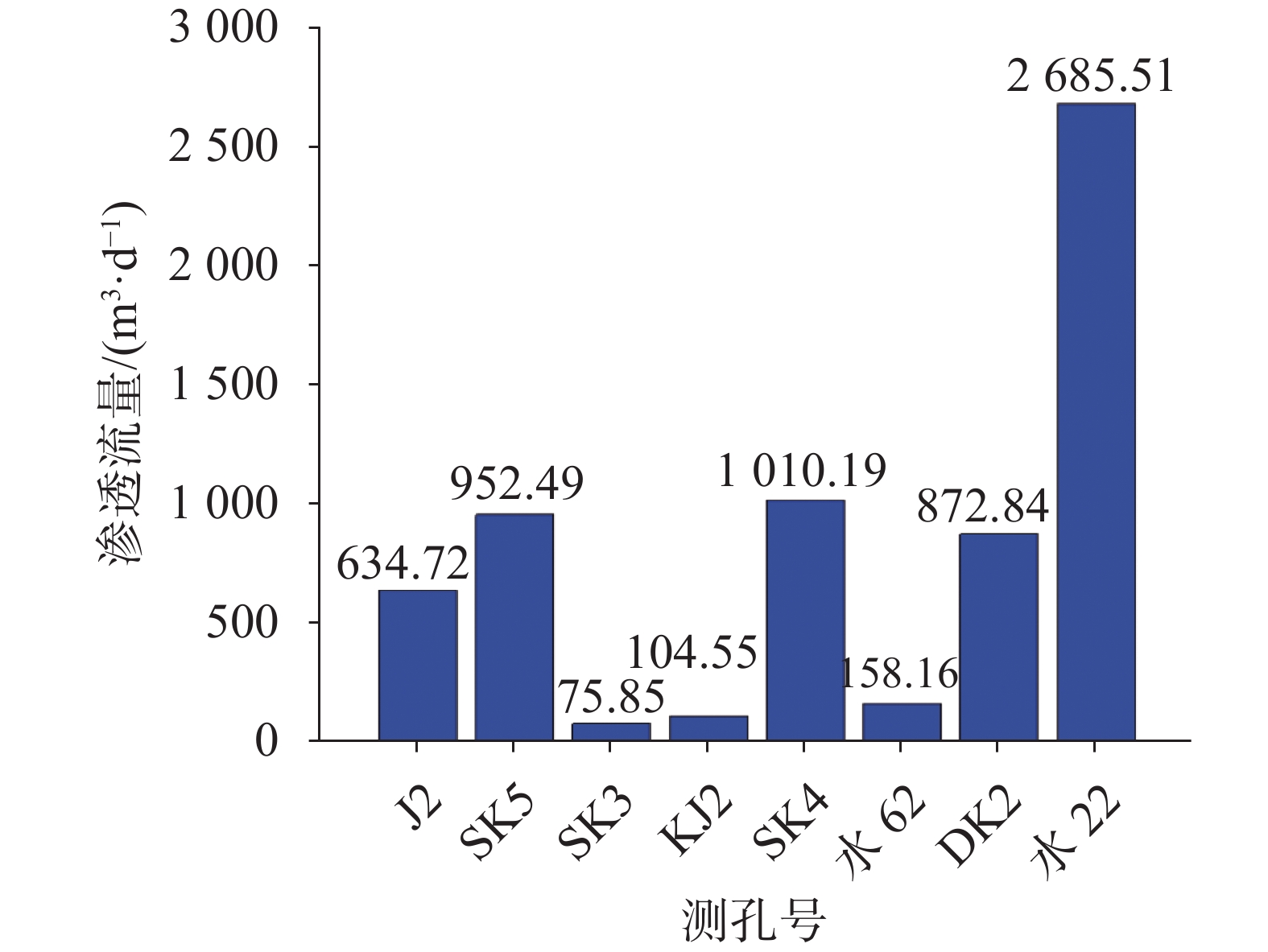
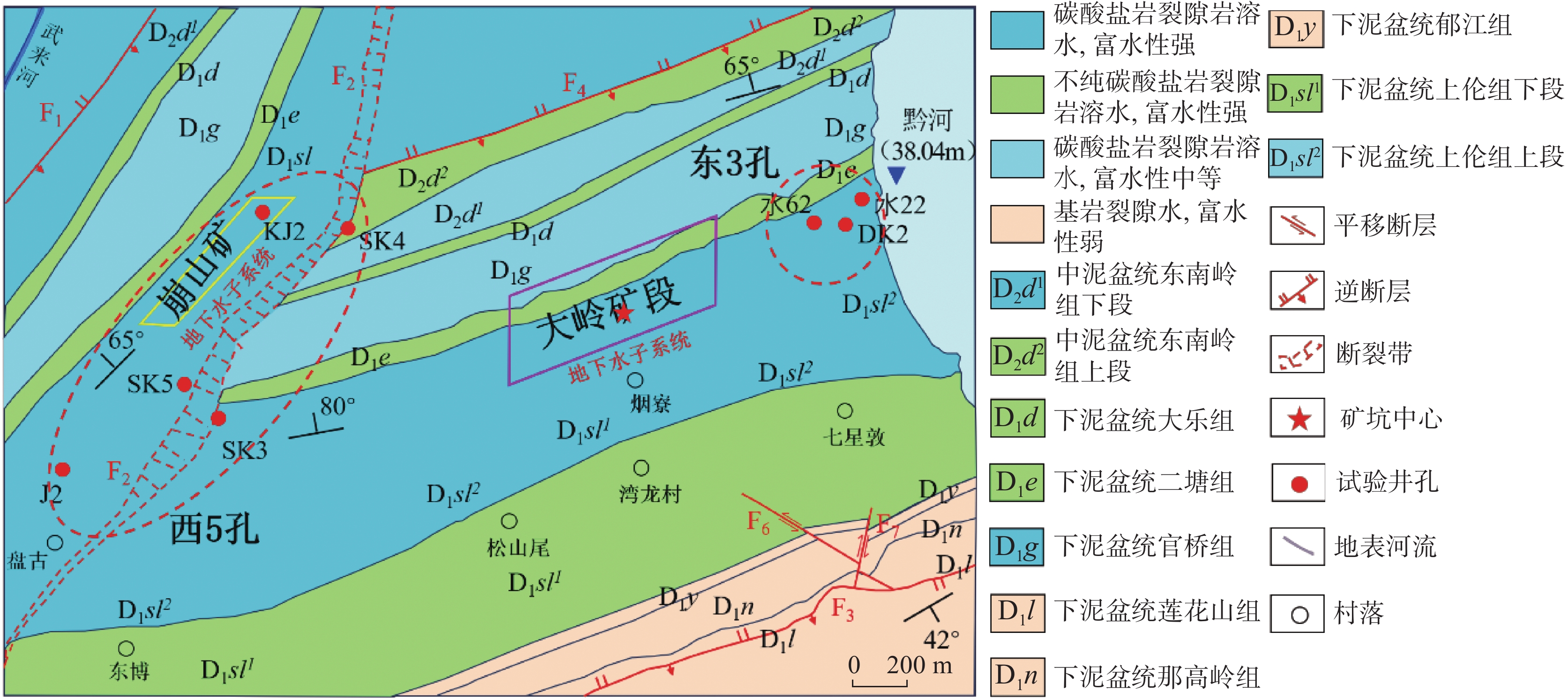
摘要: 水文地质参数的准确获取是制约深部开采矿山水害防控的关键因素之一。以广西盘龙铅锌矿区为研究对象,采用三维声呐渗流探测技术,获取矿区东西两侧测孔内的地下水渗流速度、渗流方向、渗流量、渗透系数等水文地质参数,分析水文地质参数的孔内空间分布特征及矿区地下水的主要来源。结果表明:声呐渗流探测技术能够准确探明深埋岩溶含水层沿深度方向上的渗流速度、渗流方向、渗透系数、渗透流量等参数的变化特征,并准确预测矿区东侧水22测孔在−25 ~−78 m及−85 m高程以下,矿区西侧SK4测孔在−90 m高程以下存在地下水径流通道;矿区已探明的总渗透流量为
6494.31 m3·d−1,仅占矿区日常排水量的1/3,其中矿区东侧和西侧的地下水渗透流量分别占总渗透流量的58%和42%;声呐渗流探测技术受限于测孔位置的布设,采用关键测孔(揭示主要径流通道的钻孔)开展探测工作有助于提高矿区涌水量预测的精准度。Abstract:In regions characterized by extensive development of karst landform, the extraction of deep mineral resources faces significant challenges in preventing and controlling water hazards. Hydrogeological parameters, which are essential for understanding groundwater flowing patterns and assessing water hazard risks, critically influence the effectiveness of prevention measures in mining areas. Inaccurate determination of these parameters can easily lead to disasters such as water inrushes and sudden water surges during mining operations. These events not only jeopardize the safety of underground personnel but also pose risks to equipment, disrupt mining progress, result in substantial economic losses, and cause ecological damage. Currently, traditional methods for obtaining hydrogeological parameters on-site primarily include pumping tests, water injection tests, and water pressure tests. These techniques, which involve direct interaction with groundwater systems, can accurately determine key parameters of aquifers and have long been considered essential in the field of hydrogeological research. However, they are often associated with labor-intensive on-site testing and high costs in practical applications. Furthermore, the process-from experimental design and on-site implementation to stable data collection and final analysis-can take several months or even years. This extended timeline significantly lags behind the demands of mining area development and construction, making it challenging to address the urgent need for dynamic water hazard prevention and control. Geophysical methods have become widely adopted in the industry for obtaining hydrogeological parameters due to their distinct advantages. Unlike traditional experimental approaches, geophysical techniques do not require large-scale destruction of geological formations, substantially reduce operational costs, and enable preliminary exploration of extensive areas within a short timeframe, thereby enhancing efficiency. However, as detection depth increases, signals from deep strata are affected by various factors, including complex geological structures, the degree of rock weathering, and the chemical composition of groundwater. Consequently, the signal attenuation and distortion during propagation lead to a significant decline in detection accuracy. This challenge is especially pronounced for deep karst aquifers, where intricate cave and fissure systems complicate the interpretation of geophysical signals, making it difficult to accurately characterize true hydrogeological parameters. Such complexity poses potential risks for water hazard prevention and control in deep mining areas. In response to these technological challenges, 3D sonar seepage detection technology has emerged as an innovative method for obtaining hydrogeological parameters of deep karst aquifers. This technology effectively mitigates the issue of reduced detection accuracy with increasing depth. Whether addressing shallow weathered fissure aquifers or deep karst conduit systems extending hundreds or even thousands of meters, it enables high-precision parameter determination. Additionally, its high-resolution imaging capability visually represents the three-dimensional flow dynamics of water within the borehole, providing a powerful tool for a deeper understanding of groundwater seepage behavior. Based on this background, this study focuses on the deep mining area of the Panlong Lead-Zinc Mine in Guangxi. Located in the western region of Guangxi, an area characterized by intense karst development, the mine features an active subsurface karst system that poses significant water hazard threats during deep mining operations. This study employs 3D sonar seepage detection technology, strategically deploying monitoring boreholes on both the eastern and western sides of the mining area to achieve a comprehensive and detailed characterization of groundwater seepage within the boreholes. Through prolonged and high-frequency data acquisition, a substantial volume of accurate seepage parameters-including seepage velocity, direction, flow rate, and permeability coefficient-was obtained. Building on this data foundation, the spatial distribution patterns of these parameters were analyzed in depth to investigate differences in groundwater seepage across various depths and regions. This analysis aims to reveal the water-conducting characteristics and karst development features of the aquifers on the eastern and western flanks of the mining area, thereby providing robust data support and a theoretical basis for the scientific formulation of water hazard prevention and control strategies for deep mining operations in the region. The research results indicate that sonar seepage detection technology can accurately evaluate the variation of parameters such as seepage velocity, seepage direction, permeability coefficient, and seepage flow rate with depth in deeply buried karst aquifers. It can also accurately predict the presence of groundwater runoff channels in the eastern part of the mining area at elevations between -25 m and -78 m, as well as below -85 m at Sampling Hole 22. Additionally, it can identify groundwater runoff channels in the western part of the mining area at elevations below -90 m at Sampling Hole SK4. The total proven seepage flow in the mining area is 6,494.31 m3·d−1, which represents only one-third of the daily drainage in the region. Groundwater seepage flow on the eastern and western sides of the mining area accounts for 58% and 42% of the total seepage flow, respectively. The accuracy of sonar seepage detection technology is limited by the arrangement of sampling holes. Utilizing key sampling holes-holes revealing the main runoff channels-for detection significantly enhances the accuracy of predicting water inflow in mining areas.-
Key words:
- sonar seepage detection /
- deep mining /
- the Panlong lead-zinc mine /
- karst /
- permeability coefficient
-
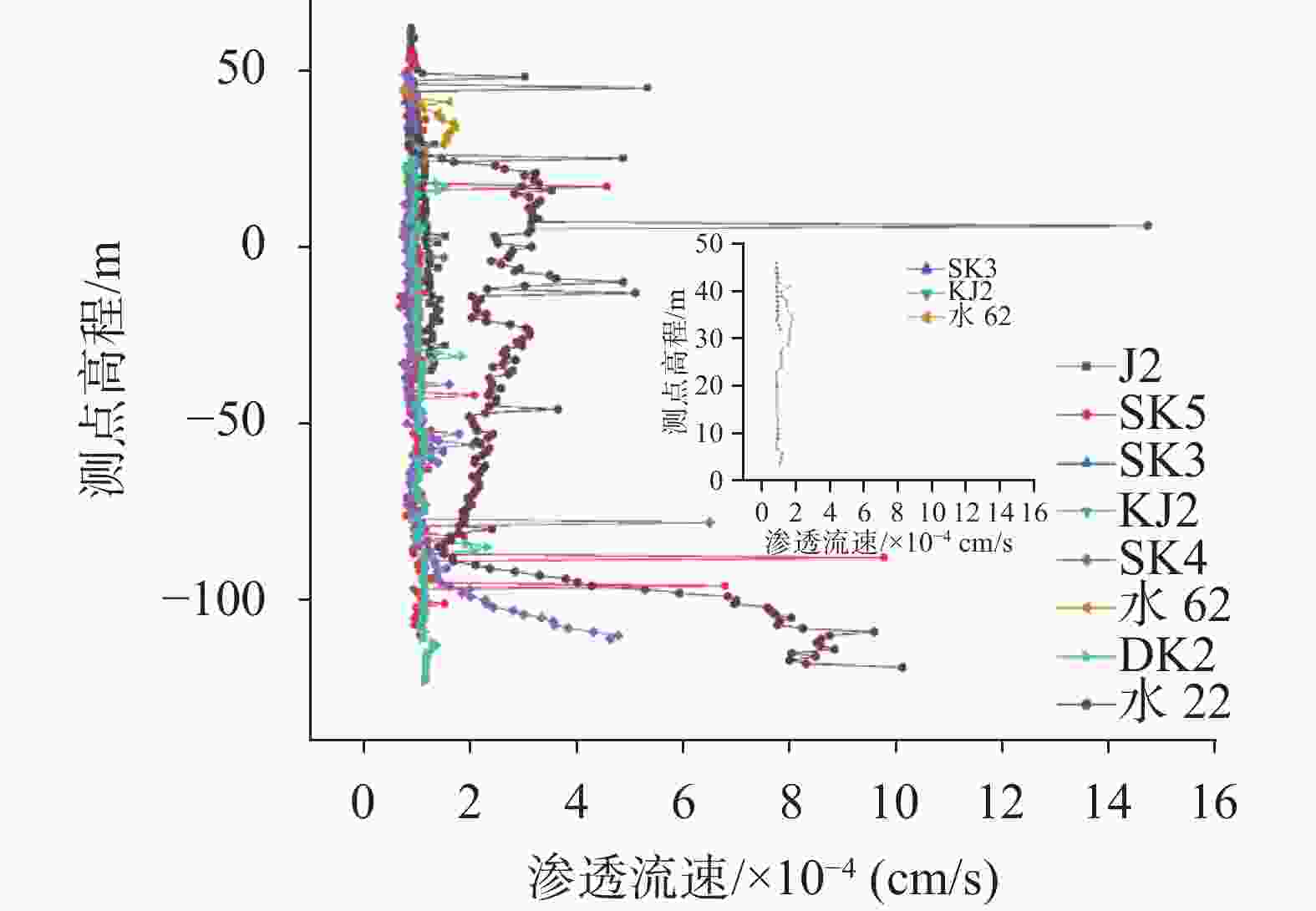
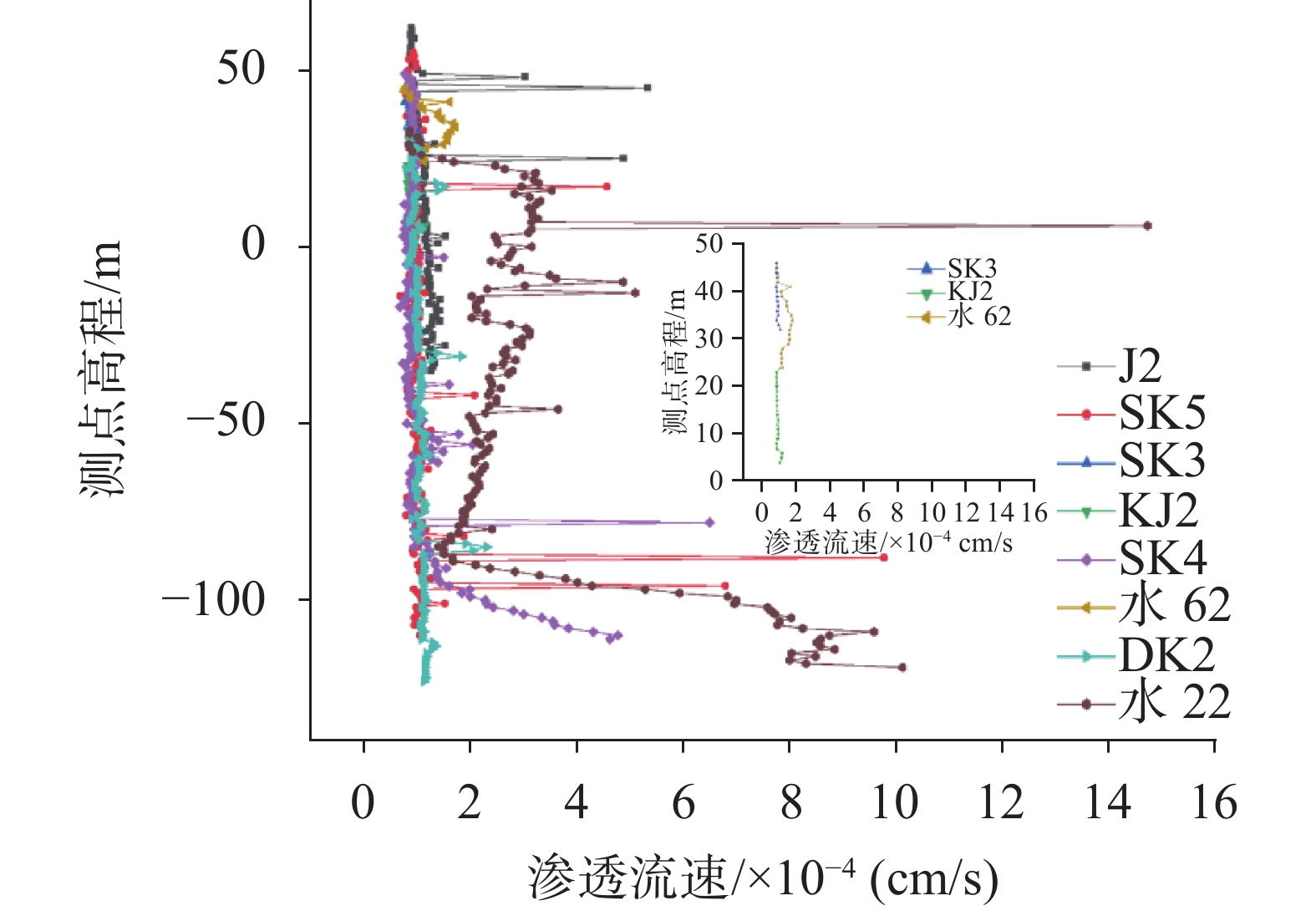
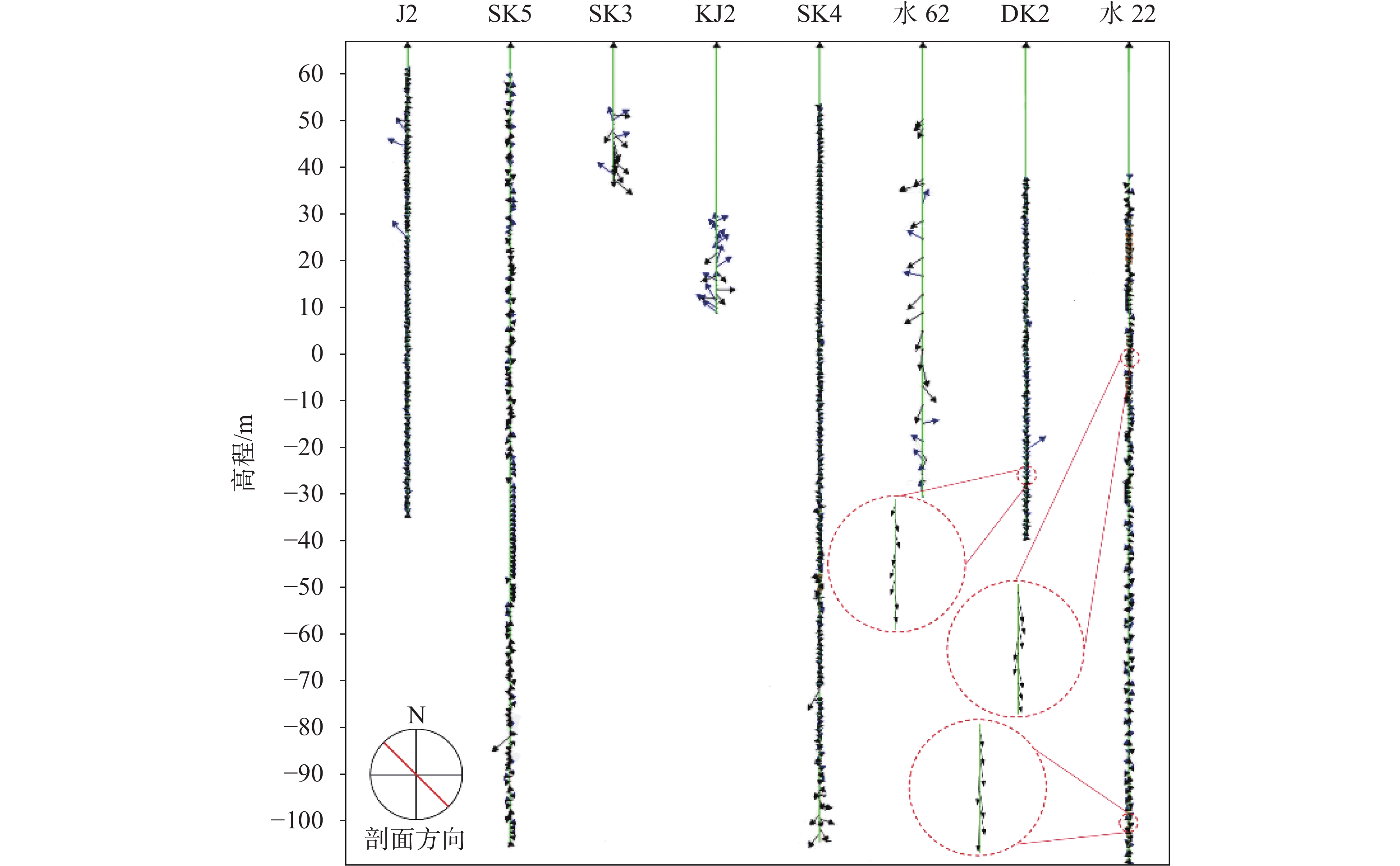
图 5 各测孔渗流速度沿高程分布曲线
Figure 5. Distribution curve of seepage velocity along the elevation
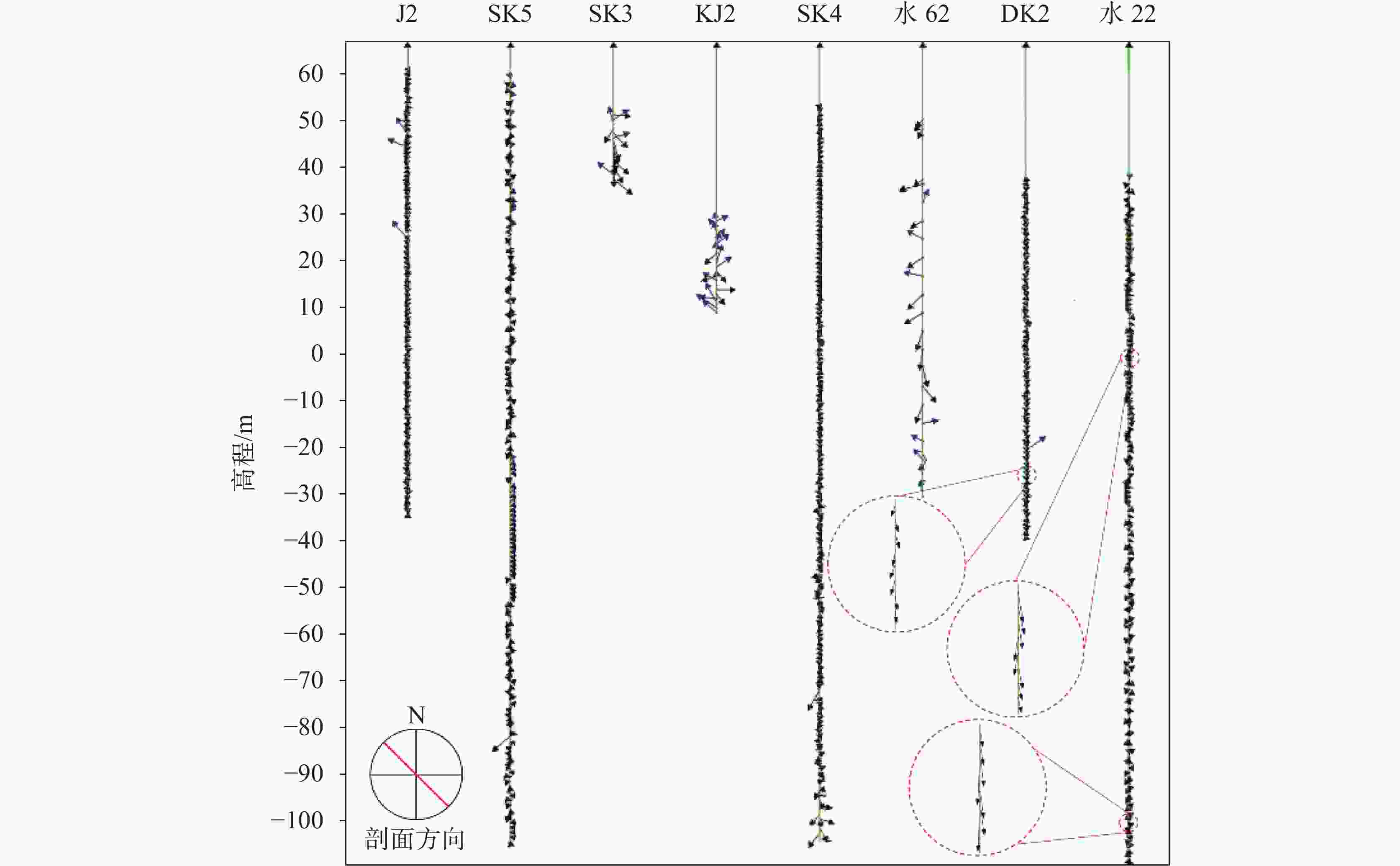
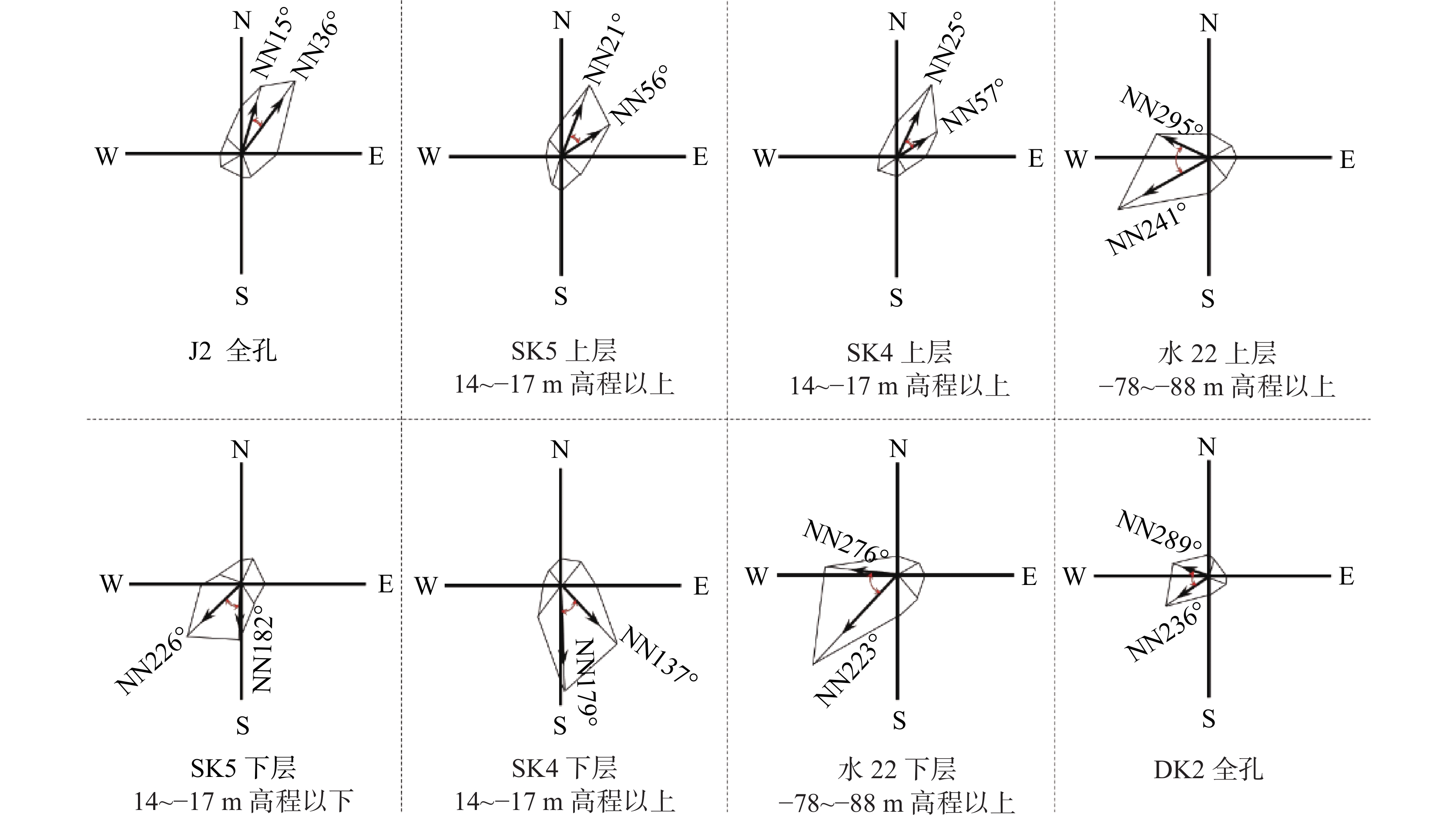
图 6 测孔剖面渗流速度矢量方向分布图
Figure 6. Direction distribution of seepage velocity vector in the section of measuring holes
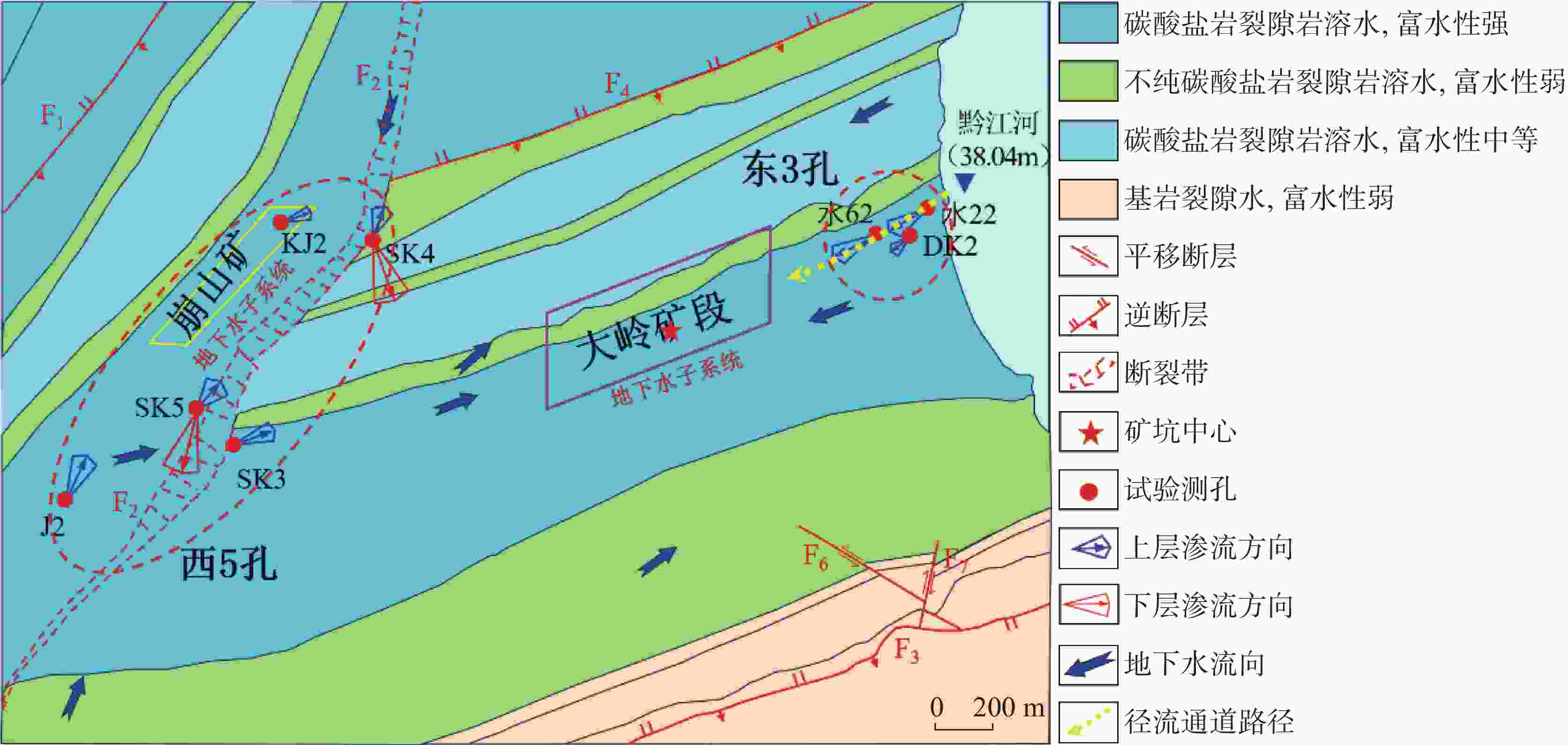
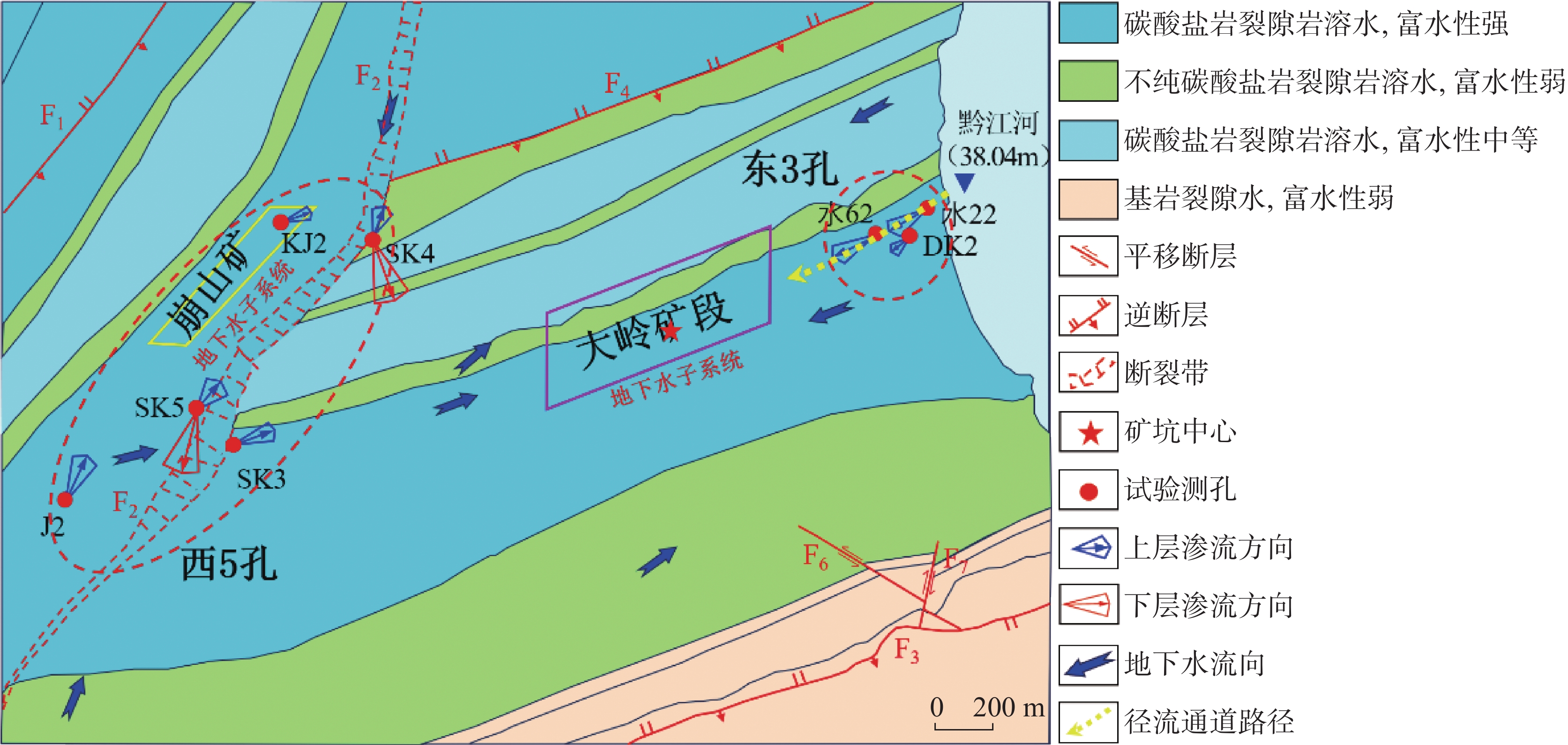
图 8 地下水渗流方向及径流通道路径示意图
Figure 8. Diagram of groundwater seepage direction and runoff pathway
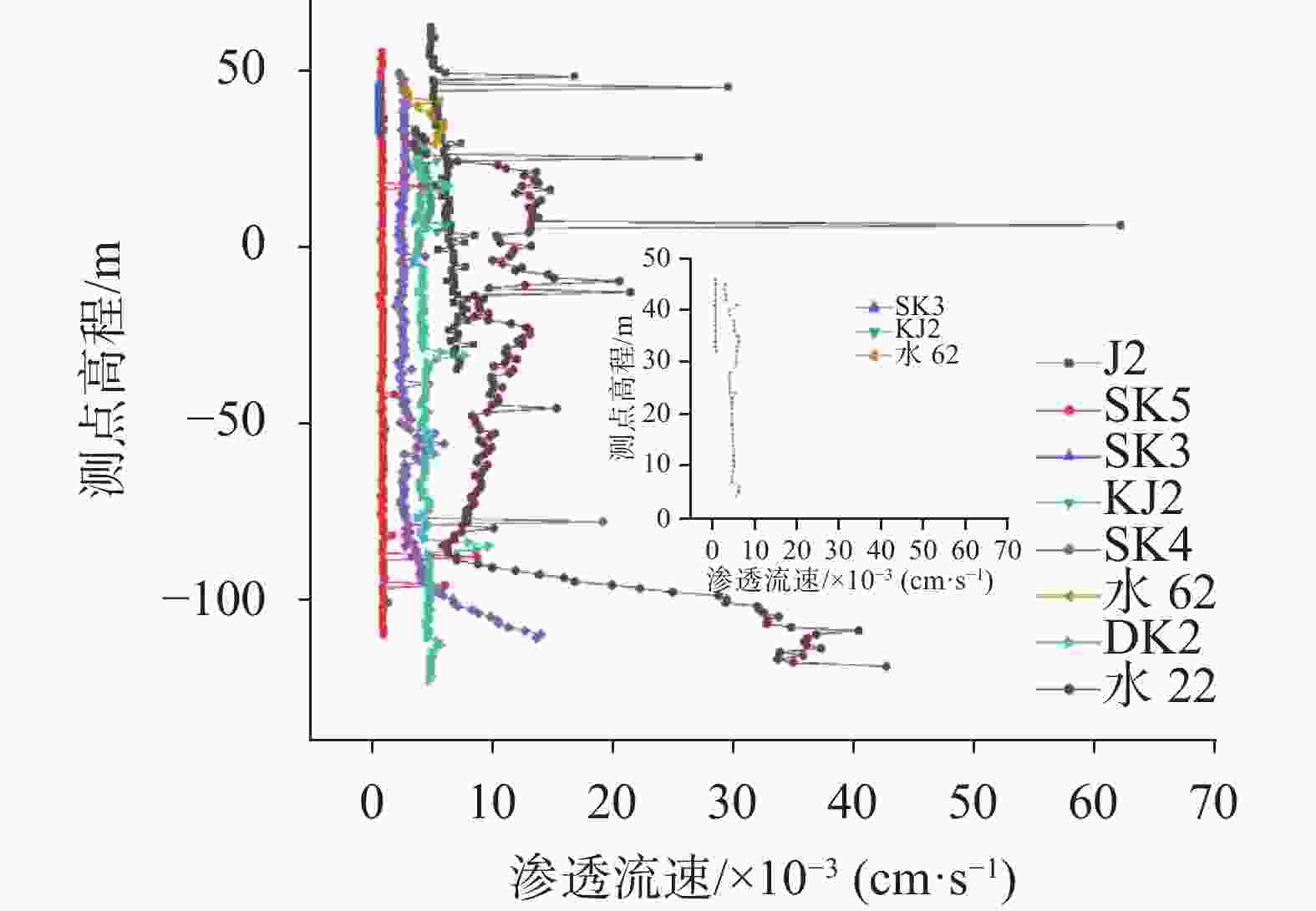
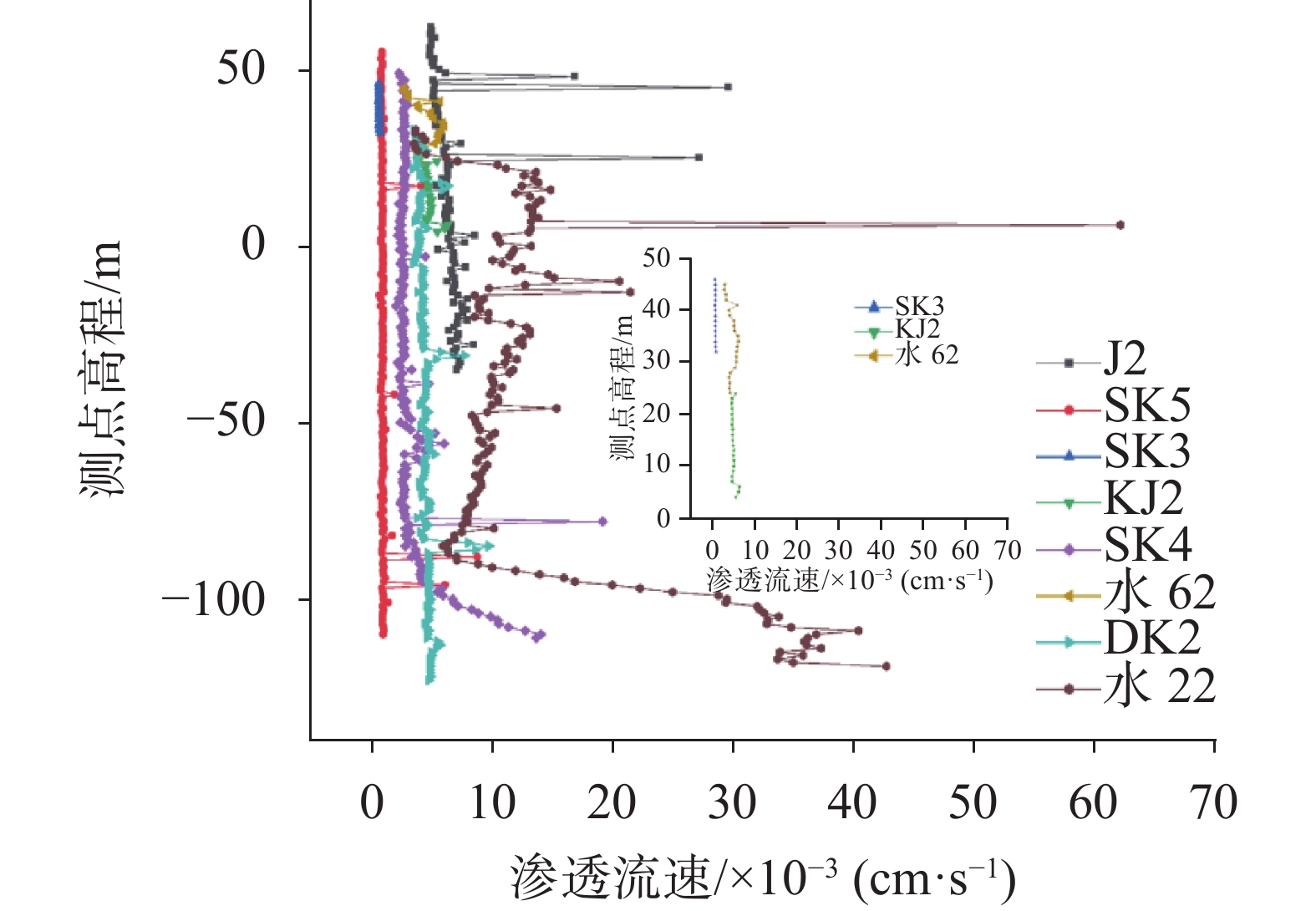
图 9 测孔渗透系数沿高程分布曲线
Figure 9. Distribution curve of permeability coefficient of sampling holes along the elevation
表 1 测孔水位
Table 1. Water levels of sampling holes
编号 井口高
程/m测量时水位
埋深/m水位高
程/m黔江水位 / / 38.04 J2 62.33 0.65 61.68 SK5 60.72 5.7 55.02 SK3 69.67 46.5 23.17 KJ2 58.5 20 38.5 SK4 59.65 12 47.65 水62 73.96 44.5 29.46 DK2 65.1 31.7 33.4 水22 67.12 31.5 35.62 矿坑(降落漏斗中心点) 61.09 154.22 −93.13  下载: 导出CSV
表 2 渗流速度探测值(部分)
Table 2. Detection value of seepage velocity (partly)
高程/m J2 SK5 SK3 KJ2 SK4 水62 DK2 水22 62 8.82E-05 / / / / / / / 52 9.00E-05 9.64E-05 / / / / / / 42 9.13E-05 8.55E-05 8.77E-05 / 9.68E-05 8.54E-05 / / 32 1.01E-04 9.18E-05 1.02E-04 / 9.22E-05 1.58E-04 8.33E-05 8.50E-05 22 1.13E-04 9.24E-05 / 7.93E-05 8.98E-05 / 8.04E-05 2.64E-04 12 1.15E-04 8.44E-05 / 8.67E-05 7.50E-05 / 9.37E-05 3.23E-04 2 1.14E-04 8.56E-05 / / 8.59E-05 / 9.37E-05 2.49E-04 −8 1.20E-04 8.46E-05 / / 9.02E-05 / 9.85E-05 3.48E-04 −18 1.42E-04 1.04E-04 / / 8.86E-05 / 1.00E-04 2.12E-04 −28 1.52E-04 9.70E-05 / / 8.29E-05 / 9.91E-05 2.96E-04 −38 / 8.99E-05 / / 7.95E-05 / 1.05E-04 2.38E-04 −48 / 9.29E-05 / / 1.00E-04 / 1.04E-04 1.97E-04 −58 / 1.06E-04 / / 1.48E-04 / 1.15E-04 2.29E-04 −68 / 9.27E-05 / / 8.90E-05 / 9.32E-05 2.16E-04 −78 / 1.09E-04 / / 6.48E-04 / 1.04E-04 1.88E-04 −88 / 9.75E-04 / / 1.11E-04 / 1.10E-04 1.66E-04 −98 / 1.01E-04 / / 1.83E-04 / 1.10E-04 5.92E-04 −108 / 1.07E-04 / / 3.83E-04 / 1.07E-04 8.23E-04 −118 / / / / / / 1.13E-04 8.29E-04
下载: 导出CSV
表 3 水力梯度计算表
Table 3. Hydraulic gradient calculation
矢量方向 水位差/m 水平距离/m 水力梯度 $J$ 水22 水62 6.16 217 0.02839 DK2 水62 3.94 166 0.02374 SK5 SK4 7.37 565 0.03396 SK5 SK3 31.85 217 0.14677 J2 SK5 6.66 369 0.01805
下载: 导出CSV
-
[1] 周志芳, 庄超, 戴云峰, 窦智. 单孔振荡式微水试验确定裂隙岩体各向异性渗透参数[J]. 岩石力学与工程学报, 2015, 34(2): 271-278.Zhou Zhifang, Zhuang Chao, Dai Yunfeng, Dou Zhi. Determining anisotropic hydraulic conductivity in fractured rocks based on single-borehole slug tests[J]. Chinese Journal of Rock Mechanics and Engineering, 2015, 34(2): 271-278. [2] 江杰, 魏丽, 钟有信, 胡盛斌, 杨杉楠. 基坑降水对声呐渗流检测精度的影响分析[J]. 水文地质工程地质, 2020, 47(5): 73-80.Jiang Jie, Wei Li, Zhong Youxin, Hu Shengbin, Yang Shannan. Influence of foundation pit dewatering on sonar seepage detection accuracy[J]. Hydrogeology & Engineering Geology, 2020, 47(5): 73-80. [3] 张伟杰, 李术才, 魏久传, 张庆松, 张霄, 车宗原, 王刚. 岩溶泉域煤矿奥灰顶部相对隔水性及水文地质特征研究[J]. 岩石力学与工程学报, 2014, 33(2): 349-357.Zhang Weijie, Li Shucai, Wei Jiuchuan, Zhang Qingsong, Zhang Xiao, Che Zongyuan, Wang Gang. Relative impermeability and hydrogeological characteristics of Ordovician limestone of coal mine in karst spring basin[J]. Chinese Journal of Rock Mechanics and Engineering, 2014, 33(2): 349-357. [4] 李涛, 李文平, 高颖, 乔伟. 杨庄矿6煤底板深部岩溶裂隙水体特征研究[J]. 采矿与安全工程学报, 2010, 27(1): 94-99.Li Tao, Li Wenping, Gao Ying, Qiao Wei. Characteristics of karst-fissure water bodies deeply seated in the floor of No. 6 coal seam in Yangzhuang coal mine[J]. Journal of Mining & Safety Engineering, 2010, 27(1): 94-99. [5] Rogers A, Manes C, Tsuzaki T. Measuring the geometry of a developing scour hole in clear-water conditions using underwater sonar scanning[J]. International Journal of Sediment Research, 2020, 35: 105-114. [6] 赵冬冬, 刘雪松, 周凡, 胡映天, 陈耀武. 兼顾远场和近场性能的便携式三维声呐设计[J]. 浙江大学学报(工学版), 2019, 53(2): 364-372.Zhao Dongdong, Liu Xuesong, Zhou Fan, Hu Yingtian, Chen Yaowu. Design of portable three-dimensional sonar for both far-field and near-field[J]. Journal of Zhejiang University (Engineering Science), 2019, 53(2): 364-372. [7] 田金章, 查志成, 王秘学, 蒋流杰. 视声一体化渗漏探测技术在面板坝渗漏检测中的应用[J]. 水电能源科学, 2019, 37(1): 88-90.Tian Jinzhang, Zha Zhicheng, Wang Mixue, Jiang Liujie. Application of video and sonar integrated leakage detection technology in concrete faced dam leakage detection[J]. Water Resources and Power, 2019, 37(1): 88-90. [8] 田金章, 向友国, 谭界雄. 综合检测技术在面板堆石坝渗漏检测中的应用[J]. 人民长江, 2018, 49(18): 103-107.Tian Jinzhang, Xiang Youguo, Tan Jiexiong. Application of integrated leakage detection technology in detection of concrete face rockfill dam[J]. Yangtze River, 2018, 49(18): 103-107. [9] 杨启贵, 高大水, 周晓明. 某高面板坝及其岩溶坝基渗漏综合检测技术[J]. 人民长江, 2016, 47(17): 64-67.Yang Qigui, Gao Dashui, Zhou Xiaoming. Comprehensive detective techniques for leakage of a high CFRD and its karst foundation[J]. Yangtze River, 2016, 47(17): 64-67. [10] 王鹏, 钟有信, 杜广林, 王亮. 地铁深基坑连续墙渗漏风险的量化控制[J]. 城市轨道交通研究, 2019, 22(6): 90-93.Wang Peng, Zhong Youxin, Du Guanglin, Wang Liang. Quantitative control of diaphragm wall leakage risk in metro deep foundation pit[J]. Urban Mass Transit, 2019, 22(6): 90-93. [11] 庞振勇, 崔王洪. 基于渗流场变化的基坑止水帷幕缺陷判别研究与实践[J]. 都市快轨交通, 2016, 29(6): 99-105, 119. doi: 10.3969/j.issn.1672-6073.2016.06.020Pang Zhenyong, Cui Wanghong. Research and practice on identifying defects of waterproof curtain for excavation engineering based on changes of seepage field[J]. Urban Rapid Rail Transit, 2016, 29(6): 99-105, 119. doi: 10.3969/j.issn.1672-6073.2016.06.020 [12] 王永涛, 朱珺, 李东明, 胡亚斌. 市政排水管道检测中的声呐成像系统设计[J]. 电子技术应用, 2017, 43(1): 111-113, 117.Wang Yongtao, Zhu Jun, Li Dongming, Hu Yabin. Design of the sonar imaging system in the detection of municipal drainage pipeline[J]. Application of Electronic Technique, 2017, 43(1): 111-113, 117. [13] 胡盛斌, 杜国平, 徐国元, 钟有信, 杜广林. 基于声呐渗流技术的地铁联络通道涌水探测应用研究[J]. 中国安全生产科学技术, 2019, 15(2): 51-56. doi: 10.11731/j.issn.1673-193x.2019.02.008Hu Shengbin, Du Guoping, Xu Guoyuan, Zhong Youxin, Du Guanglin. Application research on water inflow detection of metroconnecting passage based on sonar seepage technology[J]. Journal of Safety Science and Technology, 2019, 15(2): 51-56. doi: 10.11731/j.issn.1673-193x.2019.02.008 [14] Zhang Lei, Zhang Guangsheng, Pham Thi Nhan. Accurate exploration of karst geology based on the land sonar method[J]. International Journal of Geomate, 2019, 17(60): 244-250. [15] Lei Hongquan, Li Diquan, Jiang Haidong. Enhancement of sonar detection in karst caves through advanced target location and image fusion algorithms[J]. International Information and Engineering Technology Association. 2023, 40(4): 1593-1600. [16] Gregory C Willden, Donald R Poole, Ben A Abbott. Ronald T Green. Mapping borehole-accessed karst solutional features and culvert conduits using Rremote sensor technology[J]. Ieee Sensors Applications Symposium (Sas), 2011, 29-33. [17] 邓忠, 廖培涛, 秦平亮, 唐勇臣, 康志强. 大藤峡水库对广西盘龙铅锌矿矿坑涌水量影响预测[J]. 中国岩溶, 2021, 40(2): 198-204. doi: 10.11932/karst20210202Deng Zhong, Liao Peitao, Qin Pingliang, Tang Yongchen, Kang Zhiqiang. Influence of the Datengxia reservoir on water inrusch amount of the Panlong lead-zinc mine in Guangxi[J]. Carsologica Sinica, 2021, 40(2): 198-204. doi: 10.11932/karst20210202 [18] 梁国宝, 胡明安, 杨振. 广西朋—盘龙铅锌矿地球化学特征及矿床成因[J]. 桂林理工大学学报, 2015, 35(3): 437-444. doi: 10.3969/j.issn.1674-9057.2015.03.003Liang Guobao, Hu Mingan, Yang Zhen. Geochemical characteristics and genesis in Pengcun-Panlong Pb-Zn deposit of Guangxi[J]. Journal of Guilin University of Technology, 2015, 35(3): 437-444. doi: 10.3969/j.issn.1674-9057.2015.03.003 [19] 覃佳肖, 黄泽霖, 蒋亚萍, 陈余道, 夏源, 郑杲, 闫佳宁. 广西盘龙铅锌矿区F2断层透水性及控水作用分析[J]. 安全与环境工程, 2022, 29(6): 54-61.Qin Jiaxiao, Huang Zelin, Jiang Yaping, Chen Yudao, Xia Yuan, Zheng Gao, Yan Jianing. Permeability and water control of F2 fault in Panlong lead-zinc mine area, Guangxi[J]. Safety and Environmental Engineering, 2022, 29(6): 54-61. [20] 苏程, 俞伟斌, 倪广翼, 黄智才, 陶春辉, 章孝灿. 深水多波束测深侧扫声呐显控系统研究[J]. 浙江大学学报(工学版), 2013, 47(6): 934-943, 968.Su Cheng, Yu Weibin, Ni Guangyi, Huang Zhicai, Tao Chunhui, Zhang Xiaocan. Display and control system for deep water multi-beam bathymetric side-scan sonar[J]. Journal of Zhejiang University (Engineering Science), 2013, 47(6): 934-943, 968. [21] 徐启鹏, 倪汉杰, 王玥. 地下连续墙接缝渗漏检测及防治技术[J]. 隧道建设(中英文), 2019, 39(S2): 372-378.Xu Qipeng, Ni Hanjie, Wang Yue. Detection and prevention technology of diaphragm wall joints seepage[J]. Tunnel Construction, 2019, 39(S2): 372-378. [22] 朱敏, 郭晓刚, 董志超. 三维声纳渗流探测技术在深基坑工程中的应用: 以湖北宜昌庙嘴长江大桥锚碇基坑工程为例[J]. 人民长江, 2015, 46(17): 43-45, 56.Zhu Min, Guo Xiaogang, Dong Zhichao. Application of 3D sonar seepage detecting technology in deep foundation pit projects: A case of anchorage base of Miaozui Yangtze River Bridge at Yichang, Hubei[J]. Yangtze River, 2015, 46(17): 43-45, 56. [23] 周游, 王益楠, 史剑. 基于声呐渗流检测的地下连续墙渗漏处置措施研究[J]. 现代隧道技术, 2020, 57(S1): 1288-1292.Zhou You, Wang Yinan, Shi Jian. Study on the disposal measures of retaining structure leakage based on sonar seepage detection[J]. Modern Tunnelling Technology, 2020, 57(S1): 1288-1292. [24] 胡盛斌, 杜国平, 徐国元, 周天忠, 钟有信, 石重庆. 基于能量测量的声呐渗流矢量法及其应用[J]. 岩土力学, 2020, 41(6): 2143-2154.Hu Shengbin, Du Guoping, Xu Guoyuan, Zhou Tianzhong, Zhong Youxin, Shi Chongqing. Sonar seepage vector method based on energy measurement and its application[J]. Rock and Soil Mechanics, 2020, 41(6): 2143-2154. [25] 刘豪, 龚星, 李昱成, 田凌宁, 吕建兵. 凹陷式开采石灰岩矿区地下水渗流数值模拟[J]. 科学技术与工程, 2023, 23(17): 7271-7281. doi: 10.12404/j.issn.1671-1815.2023.23.17.07271Liu Hao, Gong Xing, Li Yucheng, Tian Lingning, Lü Jianbing. Numerical simulation of groundwater seepage in the open-pit limestone mining area[J]. Science Technology and Engineering, 2023, 23(17): 7271-7281. doi: 10.12404/j.issn.1671-1815.2023.23.17.07271 -

 点击查看大图
计量
- 文章访问数: 1441
- HTML浏览量: 274
- PDF下载量: 384
- 被引次数: 0
